An Appreciation of Ecological Sanitation (or Turds for Nerds) - EMF 2026
Watch on YouTubeVideo summary
The speaker, Val, a long-time houseboat resident, introduces ecological sanitation as a sustainable alternative to traditional sewage systems that rely on flushing toilets and massive water usage. Having experienced various problematic systems ranging from vacuum units to expensive masserators, Val advocates for a closed-loop aerobic system that maintains equilibrium rather than accumulating foul odors and waste on the deck. This approach fundamentally shifts the paradigm from viewing human waste as a hazardous slurry requiring dilution with vast amounts of water to treating it as a valuable resource rich in nutrients. By separating urine from solids at the source, the system prevents the creation of smelly, waterlogged environments that have historically plagued urban areas, effectively turning what was once a dangerous public health issue into a manageable and productive process.
The historical context provided explains how modern sewage infrastructure evolved from a misunderstanding of disease transmission based on the miasma theory rather than germ theory. Early societies utilized night soil men to transport fertilizer directly from homes to fields, but the invention of the flushing toilet and the S-bend trap led to the belief that water was necessary to flush away germs and smells. This resulted in the construction of massive sewer networks like those in London, which diluted human waste with millions of gallons of water before discharging it into rivers, causing significant pollution and even contributing to tragic accidents like the sinking of the Princess Alice. The speaker highlights that this centralized model is inefficient, expensive, and environmentally damaging, often failing to purify water adequately while wasting a precious resource that could be used for agriculture instead.
Val details his specific aerobic composting toilet setup, which utilizes a Swedish Jura form 270 hot composter to break down waste rapidly without generating methane or ammonia. The core of this system is maintaining the correct carbon-to-nitrogen ratio by adding wood shavings and cardboard to balance the nitrogen-rich feces, urine, coffee grounds, and food scraps. Inside the composter, aerobic microbes such as *Actinobacter* and fungi thrive in a moist environment, generating heat that accelerates decomposition and reduces the volume of waste significantly within days. The process transforms roughly 160 liters of mixed inputs into only about 30 liters of finished soil over an 18-month period, which is then used to fertilize the speaker's garden on the boat, demonstrating a complete and odor-free cycle that eliminates the need for water transport.
In conclusion, the video argues for decentralizing sewage management by moving away from large-scale centralized plants toward local, community-based solutions like those pioneered in Sweden. These smaller systems allow for better control over inputs, preventing the dumping of hazardous chemicals and plastics that clog municipal pipes and poison waterways. The speaker suggests reviving modernized versions of the night soil model where sealed containers are collected locally, reducing the ecological footprint and financial burden of pumping water through cities. By embracing ecological sanitation, communities can reclaim nutrients, protect local water bodies from toxic sludge, and create a more resilient and self-sufficient approach to human waste management that respects both environmental limits and economic realities.
Read the full video transcript
So I'm Val and uh I've lived on a
houseboat off and on well mostly on for
about 30 years and as such
uh I have had to deal with a lot of
different sewage systems including
temp's water throwing the sewage into an
outlet pipe just near my boat on the on
the temp's river. Um, but some of the
sewage systems that I've had to or to
contend with are things like Elsand,
which is probably about the worst,
vacuum systems, things in a bucket, uh,
um, masserators and the loathed, very
expensive, but didn't work very well.
Maybe it was just the people running it
vacuum system. So when I was going to
move the boat to a new marina, I thought
it was time to try something new and
hence ecological sanitation. Uh which is
a closed loop system.
No,
which sorry. So it means that um
there's closed loop means that it's
going to stay in a static state. So
hopefully the whole thing will go into
an equilibrium state and you won't wind
up with huge amounts of feces on your
deck of your boat uh which is stacking
up and smelling and everybody hates you.
Uh,
and the system that I'm talking about
today that I've made is an aerobic
system,
but you don't have to have an app an
aerobic system to be in an ecoand thing,
but it makes it a lot easier. And this
will be the reason why
I haven't got focus.
which is there's two types of microbes.
There's the anorobic type of microbe
which is the one that is basically the
smelly one. And if you look at the
equation there you may notice that what
the it's giving off is uh
methane which is pretty stinky, rotten
egg gas and ammonia. all of which are
not something that the neighbors are
going to appreciate. Uh
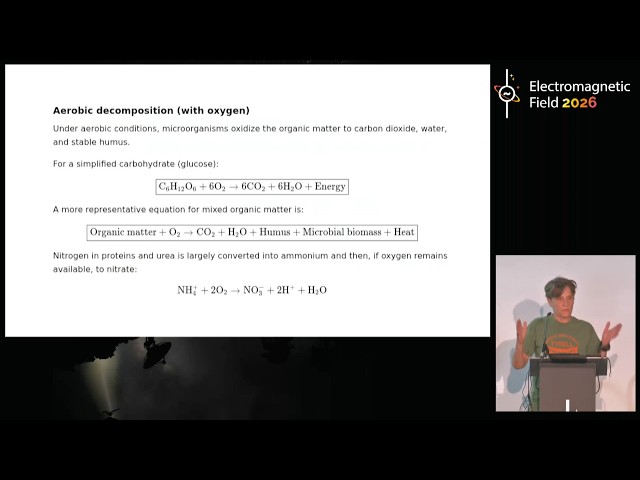
whereas if you use
aerobic sanitation,
this is where
the inputs are in a solid state. So
you're not using a flushing toilet,
you're using a composting toilet. Uh, in
fact, the toilet that we use has a
separation of urine from the solids to
make sure that it's not sitting in a
huge pile of water or water waterlike
substances because that is what's
creating the smell. And you can see here
that the equations for this reaction
is a lot less smelly because the only
outputs are CO2 and H2O plus the normal
organic uh stuff that's left behind
after the microbes have eaten all the
yummy feces and greens and other things
you might throw in there. And uh if you
get the process right, it works out very
well. in fact surprisingly well I found
uh and I was pretty surprised almost
like magic. So
what should I stay?
So I'm just going to go through a little
quick history of how we got to if the
aerobic system is so much better than
the anorobic system. How did we ever get
stuck with throwing huge amounts of
water into our sewage system and taking
what used to be an extremely valuable
commodity which was which was all the
fertilizer because all the nutrients are
going into humans and then we take all
of that we throw huge amounts of water
in it turn it into a horrible uh sewage
and then spend a lot more money trying
to get rid of the water out of it. And
so here is a very quick little history.
Hopefully, it'll be quick. So, we used
to have the night soil men, and the
night soil men were, even though they
were shunned by most of society, they
were actually very wealthy people
because the fertilizer trade was very
well paid. And you can see from this
calling card uh that this this wasn't,
you know, a cheap business. This is not
the sort of shuffling sort of ogre that
they usually show as being the night
soil men.
So, this is a little picture of the
people that the previous man who owned
that business might have employed. Uh,
and they've got the little sanitation
bucket there and uh
and off they go. Now one of the problems
that happened was
even before we got the flushing toilet
all the rest of that sort of thing
though the anorobic the aerobic system
even working quite well when there was
quite sparsely populated uh areas as
soon as you got into a city situation
you started getting a lot of people who
were digging trenches and holes and
though that might work well when you've
got a little bit of land around you in a
little crop in London for instance it
does not work very well. And so we've
even at 1660, we've got a little thing
from Peep saying that uh that a great
heap of turds had flooded his basement
from his next door neighbor. And uh and
also there was a lot of dangerous gases
and things that were put off uh by these
cess bits which they then tried to
contain by uh burying them and that sort
of thing which actually just sort of
made the whole anorobic thing worse.
that at this point
the germ theory and aerobic and anorobic
microbes had not been discovered and the
prevailing philosophy of how disease was
spread was by myasma and this is from
the Napoleonic war showing that cholera
is ripping through all the uh troops not
because they've just got a latrine full
of
germs and they're not disposing of it
particularly well, it's because of the
foul air. And so when they decide to
start
making a sewage system,
they decide that uh
that water is the way to go because
so here we've got uh
a little timeline of adding extra water
which is uh the invention of the
flushing toilet And in fact, in 1775,
when Cummings invented the Sbend, it
made it even worse because they were
trying to stop the methane from coming
back up the pipe from the septic tank.
So, they needed huge amounts of water to
get it over the Sbend to put it into the
septic tank in the first place and made
it
a lot lot worse.
Excuse me.
So
once the flushing toilet had become very
popular, this had ruined the whole
fertilizing business because it was now
filled with water. It was very very
heavy to transport. Uh the farmers
didn't want it because it was so water
logged. They had water. What they wanted
was fertilizer, not gallons and gallons
of smelly sludge. And again they thought
that this was where disease was coming
from from the smell.
[cough]
So they decided based on the myasma
theory to build a lovely sewer. And this
is Basiljet building the sewer for
London. And uh he has
buried all the
all the sewage things which used to run
open in the street. So that got rid of
the smell and presumably they thought
that's got rid of all the germs
and
and uh they but they didn't start
building it until after the great stink.
And this is a picture of the great stink
when parliament was evacuated because it
smelt too bad. And that's when they
decided that they would commission
Basiljette. And here's a picture of him
building the sewer
to uh build this great big sewer with an
outlet of 75 million gallons where at uh
Cross Ness, which is where there was
which is just a little bit further east
than
than uh the edge of London at the time
down by Wulitch.
And this was where they where the
outflow of the all the 2.5 million
people's sewage went with great globs of
water. And what happened here was
this is an accident that happened just
after the sewer had been completed which
is the sinking of the Princess Alice uh
hit by a collier
right at the point where that 75 million
gallons was being put out into the
temps.
And there was a huge huge brewhaha about
this because out of the 750 people on
board, 650 of them died. And uh
and there was an inquest where the
official uh cause of death was drowning,
but the Times and a lot of other
newspapers reported that it was actually
because it was a sthing mess of bubbling
stuff that looked like soda water. And
the reason for that was that the micros
were still busy working there. They
thought that the water would purify and
take away all the sewage. But in fact it
was all the heavy sludge that stuck to
the bottom. The temps is quite uh got a
lot of undulations in terms of the river
bottom. And so there was huge pools of
toxic
anorobic sludge sticking under there.
and all the methane and
ammonia and whatnot was bubbling up. So
a lot of people said it wasn't drowning
it was asphixxiation but that was not
the official official thing. Meanwhile,
in France, Louis Pastor had invented,
well, not invented, discovered aerobic
and anorobic uh
microbes. And here's a response from 10
years after it got more or less adopted
that germs were real. And that's what we
decided would be the best thing to do is
kill them all.
And that's what a lot of people made a
lot of money doing. And so it goes that
we got to the point where
uh we've got the modern sewage system
and if you look at each uh step along
the way, it's trying to get the water
out of the sewage. Uh
and even though at the end of this
process,
they do recover some of the sludge and
turn it into fertilizer. the cost of all
these tanks. And in fact, they even go
so far as to
reach the thing to try and get the
aerobic microbes to do the work because
because they heat it up and they can eat
things that and they're much faster and
whatnot. So huge amounts of money is
spent on one putting all the drinking
water for us into our private homes for
us to into and then pumping it at
great expense all the way around a city
for instance and then spending even more
money trying to get all the water out
again. And uh and we don't even do that
very well because here's a report from
the rivers trust showing how many rivers
are seen as not being not being fit for
the creatures that used to live there.
And as you can see, it's a bit of a
mess. And I think the rivers trust are
reasonable about saying what's
polluting, what's not. Anyway, here's a
little quick rundown of uh the history
of toilets. Uh, and you'll see that we
start off not using any water. We go off
at that point when the toilet becomes
very fashionable and everybody wants one
into using huge amounts of water,
especially for the wonderful invention
of the Sben to stop the methane. And
then back down to the very one at the
end here, which is what I'm going to
talk about next, which is ecological
sanitation using no water at all.
Well, that's not quite true, but we'll
get to that.
So, here's uh the ecological sanitation
system that I put together, and it
starts off with a a a toilet that's uh
from Sweden, who tend to be the leaders
in all of this type of technology, which
is separating out the feces from the
urine. So there's two chambers that that
you'll see there. Urine goes one way and
the
solids go into this uh composting system
which is called a hot composter which in
our case is again from Sweden called a
Jura form 270. It's called 270 because
it uh takes 270 L which is just about
right for the two of us who live on the
house boat.
And uh yep, it stays in the tumblers. It
gets turned around and then it goes out
and put onto my little garden that I
have on the boat. Now to get this, the
very important thing about running a
system like this, especially in a very
small space, is it can't smell. It can't
get bigger and expand out to take over
the whole of the boat. uh and it has to
be quite quick in the way that it breaks
down stuff and I have to be able to get
rid of the final output. Now one of the
things that makes all of this pro
possible is to create a good recipe for
a microbe. So this is took me a little
while to come up with but with help. So
this is the four things at the bottom
are the ones that I can't change. So, in
other words, we've got the feces, we've
got the toilet paper, we've got our
fruit and vegetable scraps, and we drink
a lot of coffee. Uh,
the cardboard and wood shavings at the
top are the are the carbon that we need
to balance it to get that ratio of 30
to1, which is what the aerobic microbes
like. So, I'm trying to get them a very
tasty dish that they are just going to
eat like crazy and breed like crazy. And
uh
so the magic ingredient in this is to
find a nice source of carbon.
And this is what we use, which is a mix
of uh wood shavings that is designed for
a rabbit and some cardboard, which is
mostly Amazon boxes.
And uh so that's the thing that we
there's the variable that you top up to
get the carbon ratio right. Here's
[clears throat]
here's a picture from inside
that that uh hot composter
where
you I've got a I've also got a moisture
uh dial as well. You can see there it's
not. This is more or less at the
beginning of the summer.
The white stuff you can see there is the
aerobic microbes which are two types at
this point. uh which I'm probably not
going to be able to come out uh but one
is called actctiminus
I don't know and basillus subtilus and
um these are the first phase of
the composting process which is called
the meophilic
which is you can see goes up to about
40° so it's from 25 to 40°
And
oh, and the other white stuff which I
love is uh the m it's a fungal mcelium
because mycelium I think is wonderful.
And here it is just a few days later
where it uh where it's climbing up into
the uh
towards the thermopilic ones which is a
good thing in because uh it these ones
can get very very hot. In fact, they are
supposed to be able to get up to about
70° in this particular composter that
I've got. Whether or not it actually
makes it, I don't know. But the last
just before I came here, I did a reading
on it and it showed me that I was up to
52 degrees and it had been rising
steadily. So, I'm pretty pleased about
that. And the other thing that is
amazing about this, and it really is
like magic, we can throw
16 lers of mixed sort of uh feces,
scraps, coffee, and and the uh wooden
cardboard. And the cardboard and wood
shavings remain, but the the all the
what they call the fast volatiles
disappear in days and the whole thing
shrinks down in amazing way. So once it
gets going, it is really quite an
astonishing process. Well, to me anyway.
I didn't really think it would do that.
And I've got a little graph.
Well, I first I'm going to show this
which is just so that instead I don't
want to encourage people to play with
their poo unless they know what they're
doing. Uh
so here's a little graph showing you
what you need to achieve to make sure
that that your stuff is going to be
safe. Now you can see along the bottom
axis this is uh this is time and the
other one the y- axis is the temperature
it needs to be the big sewage processing
plants
they because they're running anorobic
microbial practice they get the uh
methane actually get that off from the
in a bioreactor and use it to heat up
the whole of the sewage because they
don't actually the anorobic microbes
don't get anywhere near this heat.
Whereas if you use the aerobic ones,
they'll do it themselves if you've got
enough of it. The little system I've got
is only just on the cusp of being big
enough to actually hit that sort of
temperature. But then again, I am not
trying to sell this to anybody. I am
going I am not uh selling the produce
from this. And so this sort of range
which I've ringed here is quite good
enough for what I'm doing with it. In
fact, I don't grow food in it at all.
Here's here's a little graph I did of
how it what the uh rate at which it
goes. So you'll see
these little jaggy lines that each week
we take all the uh I'll call them fast
volatile we each week we put all the
stuff into the composter and you'll see
that that little edgy sawtooth is how
quickly it gets rid of it and the things
that are actually climbing up are what
they call the slow volatiles and those
are the the the uh things that you can
see uh in orange here which are the wood
chips and the cardboard and that type of
stuff and the and the other ingredient
is water because it wants to be moist.
So the blue one is is the moisture
content.
When I first did this I got it up to
about
I misread what the composting
people said the bakers of the compost.
So I looked at that straight line going
up there and it got to about 3 months
and I thought, "Oh no,
it's just going to go straight up and
and it's not going to last anywhere near
as long as I thought before it fills
up." What I didn't realize is that once
it gets a critical mass and it starts
and I got this recipe right that it
would suddenly sort of start digesting
the stuff at a phenomenal rate. So here
it the mark in the middle is where I'm
the composter has two chambers. One is
the active chamber and the other one is
the one that they say is curing. So 270
so just under 120 L is where I'm going
to switch over
and start filling up the other one. And
the one on the right is it's going up
and down because I still want the
microbes to be digesting the rest of the
cardboard. So, I'm still adding little
bits of water as needs be. I've got a
little moisture meter to make sure that
it's the right consistency because the
microbes don't like it if it's not it's
not nice and moist for them and they'll
just die and do nothing. Here's a
picture of the composter in question.
And this is should should last the two
of us for about for about I think
probably about 18 months, maybe even as
long as a two years. We haven't run it
that long, so I can't say for sure, but
certainly on that graph that I showed
previously, it has hit those marks. So,
I have been measuring it. Here's some of
the uh what I've got here also is some
of the bamboo and
sunflowers which are very very heavy
feeders. So that the compost that is
created, which out of all of that years
or worth of stuff that's put into the
composting bin probably will turn out to
be only about 30 odd lers of actually
finished soil, which is all that I buy
for my little garden that I've got on
the deck of the boat anyway. So it works
out quite nicely. And
here's a little picture of my garden out
on the back of the boat.
And uh
so that that is pretty much it. But
there are I'm not quite finished. There
are a few other I just like to mention
that there are quite a few few uh
initiatives by the WHO and the UN about
trying to find alternatives to using
water as a mechanism for transport and
for you know these massive great sewage
plants. And one of the things that
Sweden has done is to make uh not
individual ones but ones for like a
block of apartments or you know like a
thousand people. So you now get a little
local thing and that's a good thing
because what you can then say is that
you know what the inputs are from that
uh and you can run a much smaller
system. you don't have to have the huge
amounts of water that you're using to
unblock the pipes and travel along and
all the rest of that which costs a lot
of money. And the other thing is with
the sewage systems
are so anonymous that if you look at the
sort of things that people throw down
the sewage, it's amazing. There's not
just, you [snorts] know, rubbish like
people's shoes and socks. Uh,
apparently, uh, flame retardant is a
very big thing that people like to get
rid of down there. And maybe that's a
good thing if there's such a lot of
methane around. I don't know. Uh, and
all sorts of chemicals and things which
makes it very hard for a sewage company
to be able to
sort of manage all the different things
that they may or may not have to deal
with. So,
so having a a local system means at
least you can tell this is a residential
block. if there is anybody putting paint
or chemicals down there that they can be
called out and you can keep much better
control over it. Means the systems can
be smaller and more focused and uh and I
think that it would be good if we did
try and look at decentralizing the
system and getting rid of a lot of the
water out of uh the sewage. And here's
last little side which is just some
references. Uh there's a number of
people that are going back to the night
soil thing which called you know the
circular res revolution where they will
come around on a little bike and bring
you a sealed container
a little bin so you can go and collect
it. You can call them up. It's not even
that expensive depending on where you
live. I think it's about 20 quid a week
they're charging for the people who
hackne marshes to go and collect up from
the little canal boats and things like
that. So worth thinking about. Anyway,
thanks very much. Hope you liked it.
[applause]