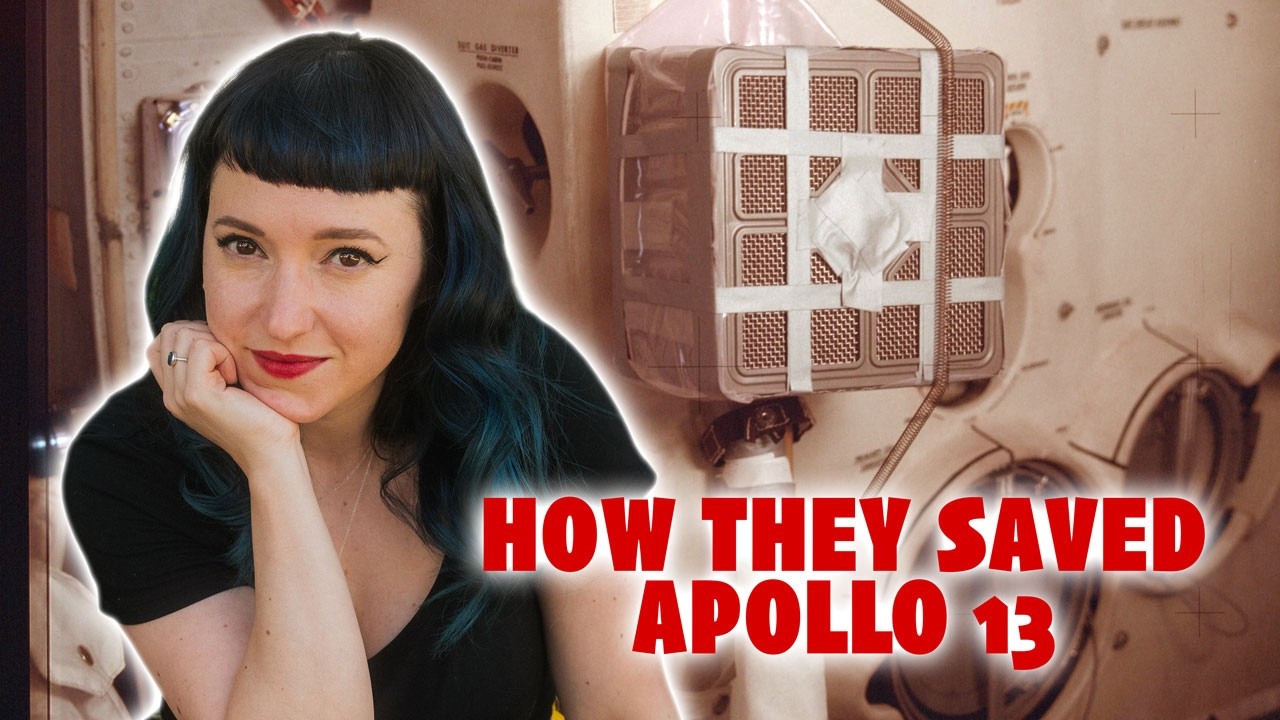
Video summary
The narrative of Apollo 13 begins not as a triumphant moon landing but as an aborted rescue mission born from a catastrophic engineering failure rooted in flawed design choices made years prior to launch. The disaster originated with Oxygen Tank No. 2, which suffered from overheating that cracked its Teflon insulation due to voltage mismatches and damaged fittings; this vulnerability was triggered on the third day of flight when crew member Jack Swigert activated a heater system while stirring cryotanks, causing an electrical arc that ruptured the tank with force equivalent to seven pounds of TNT. The explosion sheared off part of the spacecraft's side panel, disabled two fuel cells leaving only one operational, and caused erratic tumbling that disrupted communications and drained reaction control system fuel, forcing Mission Control to realize immediately that their primary lifeboat was lost and survival now depended entirely on repurposing the Lunar Module "Aquarius," a vehicle designed for just two days of lunar surface operations rather than an emergency return trip.
To survive the long journey home against critical shortages of power, heat, and carbon dioxide scrubbers, Mission Control orchestrated a complex series of improvisations that turned engineering constraints into life-saving solutions. The crew had to isolate leaking oxygen lines by sacrificing one fuel cell entirely, manage extreme cold in the Command Module without adequate water reserves due to freezing lines, and construct an improvised adapter using square lithium hydroxide canisters taped inside plastic bags to fit the round ports of the Lunar Module's air scrubbing system—a classic "square peg in a round hole" fix. Navigation became even more perilous as debris clouds from the explosion blocked star sightings, requiring astronauts to perform delicate sun checks and manually control attitude using limited thruster fuel while executing precise midcourse correction burns that looped their trajectory around the Moon back toward Earth without jettisoning the damaged Service Module prematurely.
The final phase of the mission involved a grueling re-entry sequence where the crew endured extended communication blackouts caused by atmospheric ionization at speeds nearing 25,000 mph while managing freezing conditions and depleting batteries that had been charged via reverse current flow from the Lunar Module. As they approached splashdown in the Pacific Ocean near Hawaii, parachutes deployed to ensure a soft landing just as Fred Haise slept through the final moments of descent, leading to their recovery aboard USS Iwo Jima where President Nixon welcomed them home alongside their families. This historic event ultimately reinforced that despite Hollywood dramatizations suggesting constant chaos and improvisation, the successful rescue was largely the result of rigorous training, precise manual flight adjustments, and a ground team's ability to anticipate needs through extensive preparation rather than mere luck or surprise.
Read the full video transcript
Okay, Houston, we've had a problem.
>> Houston, we've had a problem. We've had
a main bus.
>> Apollo 13 is a familiar story. The third
lunar landing aborted after an in-flight
emergency turned a nominal flight into a
rescue mission. The story has been told
in documentaries with astronauts and
flight controllers and an amazing movie
starring Tom Hanks. So, what do I have
in my office that those Hollywood level
productions don't have? Freedom from the
need to satisfy shareholders and recruit
money spent. We're going into the
mission through the voice recordings.
Hi, I'm Amy, an author, historian, and
someone who's been researching Apollo
Air Space Flight for most of my life.
Apollo 13 is one of my favorite movies
and for me, a gold standard of science
depicted on film, but it's still
Hollywoodized. Years ago, I talked to
Jerry Griffin about this. Jerry was the
flight director and leader of the gold
team on this mission and also a
technical consultant on the movie. He
told me that when he first met with Ron
Howard, I think he said that Dave Scott,
Jim Levelvel, and Glenn Lenny were there
as well. They met in the old mission
control room and walked Ron Howard
through the flight. Jerry said he left
that meeting feeling like there wasn't
enough there for a movie. From his
perspective, they were trained for
emergencies and they just leaned on
their training. Everyone did their jobs
very well. In rereading the transcript
and reports to write this, I kind of see
where he was coming from. It's
interesting because, as we'll see when
we get into the details, the emergency
was so much worse when you really unpack
it and understand it, but it was also
less chaotic. Jerry told me that Ron
Howard added background actors walking
in the halls to create a sense of
tension and urgency that wasn't really
present in Mission Control. The truth
is, Houston wasn't blindsided or caught
off guard by anything once they were in
emergency mode. It's really interesting
to see through the source material just
how they worked the problem. This might
not be the version Hollywood told to
satisfy audiences, but I think you'll
still be satisfied at the end of this.
All right, let's go to the moon.
[music]
Fair warning, I'm about to hit you with
a lot of names, but we've got to meet
our cast of characters, both human and
machine. The original crew for Apollo 13
was Commander Jim Levelvel, lunar module
pilot Fred Hayes, and command module
pilot Ken Mattingley. To ground you in
more familiar faces, that's Tom Hanks,
Bill Paxton, and Gary Cise. They started
training for their mission on August 1st
of 1969, just one week after Apollo 11
splashed down. They had been the backup
crew for Apollo 11, which as per the
flight assignment rotation, put them in
line to fly on Apollo 14. But Apollo 13
commander Al Shepard, recently back to
flight status after successful
experimental surgery to correct Menè's
disease, needed more time to train, so
the crew swapped missions. Jim Level's
crew was announced publicly on August
6th. At the time, he was the most
experienced astronaut in NASA's roster,
having flown on Geminy 7, commanded
Gemini 12, and had already gone to the
moon on Apollo 8. Full video about that
mission is right up here for you to
check out after this one. Both Fred
Hayes and Ken Mattingly were rookies,
but not without relevant experience.
Every astronaut was assigned to work
closely with some part of Apollo's
hardware, and in Fred's case, he had
been heavily involved in development and
testing of the lunar module with its
manufacturer, Grumman. The backup crew
was Commander John Young, another Geminy
veteran who'd flown to the moon on
Apollo 10, and two more rookies, lunar
module pilot Charlie Duke, and command
module pilot Jack Swagert, who's
probably in your head right now looking
like Kevin Bacon. Jack came to NASA from
North American Aviation, North American
Rockwell, after a merger in 1967, which
was the company that built the command
service module. The same way Fred was
assigned to the lunar module, Jack had
been integral in developing
troubleshooting and emergency procedures
for the command module. He was
considered one of the foremost experts
on the spacecraft. The command service
module for Apollo 13 christened Odyssey
was internally known as spacecraft CSM
109. And its story starts long before it
was assigned a crew or a mission all the
way back on February 26th, 1966. And I
promise this isn't just superolous
detail. We do have to go back this far.
This is the date that North American
awarded the Beach Aircraft Corporation a
contract to build the service module's
cryogenic gas storage tanks to hold
super cold liquid oxygen and hydrogen.
The service module was what made Apollo
missions possible. This largest piece of
the stack held most of the consumables
used on a mission and its engine, the
service propulsion system or SPS was the
one the crews needed for critical events
like slowing down into lunar orbit and
adjusting their trajectory. The service
module was where those cryogenic oxygen
and hydrogen tanks lived as part of the
fuel cell system. And the fuel cells
were how Apollo missions had power. Each
fuel cell, and there were three, had 31
separate but connected cells. The
electrochemical reaction of combining
the reactants of cryogenic hydrogen and
oxygen produced electricity as well as
heat and portable water as byproducts.
These two gases are what kept the crew
alive and in contact with the ground.
Each fuel cell produced between 400 and
1,420 watts at 31 to 27 volts direct
current. For perspective, with three
fuel cells at max output, the system
could produce 4,260 watts or 4.26 kW per
hour times 24, that's 102.4 kwatt hours
in a day, which is nearly four times
what my house uses. And they typically
weren't running at full power. In short,
they had plenty of power on an Apollo
mission. And I know this is deeply
technical, but this is the key part of
Apollo 13's story. The fuel cells were
tied to two buses that distributed the
power. Fuel cell one was connected to
main DC bus A. Fuel cell 2 was connected
to DC main buses A and B. And fuel cell
3 was connected to main DC bus B. Solid
state inverters converted that direct
current power into alternating current
power that was then distributed through
the spacecraft's electrical system in
the command module via an external
umbilical. The service module also
supplied some power to the lunar module
during the coast to the moon. The oxygen
and hydrogen tanks in the fuel cells
weren't connected to each other. Neither
were the fuel cells connected to one
another. The astronauts were also able
to manually isolate individual fuel
cells and control the direction of power
flow if something malfunctioned. These
were all built-in safety measures to
prevent one failure in the system from
crippling an entire mission. The oxygen
tanks themselves were insulated spheres
with an inner and outer shell and a dome
over top to enclose the lines that
carried fluids and wires for electrical
power and signals. Inside each tank,
there were two cylindrical units. One
was a heating coil with small fans to
stir the cryogenic oxygen and prevent
stratification and the other was a
quantity probe. The tank whose story we
want to tell is oxygen tank
100024x-ta00009
and it also starts in 1966. Initial
testing at Beach found minor flaws. The
tank was disassembled, the heater and
fans replaced, and then the whole thing
reassembled, and testing resumed. There
were still a few problems, but they
weren't critical. And the tank was
shipped to North American on May 3rd of
1967. It was paired with oxygen
tank-a00008
to create oxygen shelf 0632A
G3277.
I know some of you out there love the
detail of serial numbers. On June 4th,
1968, that shelf was installed in
service module 106 and assigned to
Apollo 10. Then an overall design flaw
was found and every oxygen tank needed
to be updated, which meant removing the
shelf installed in Apollo 10 service
module. The removal on October 21st,
1968 was a finicky process of
disconnecting all the wires, unscrewing
bolts, and lifting the shelf out of the
spacecraft with a huge crane. But one
bolt was still in place. When
technicians lifted the shelf, it caught
on the bolt, the fixture broke, and the
shelf fell about 2 in. The stray bolt
was removed, and the shelf lifted away
on the second attempt. No one thought
much of the incident. Engineers
calculated the forces associated with a
2-in drop were so low, it was unlikely
anything was seriously damaged, so the
tanks were updated, and in January of
1969, the shelf was reinstalled in
service module 109. A month later, that
spacecraft was assigned to Apollo 13.
Apollo 13 Saturn 5 rolled out to the
launch pad on December 15th. The next
day, the launch was pushed back from its
early mid-March target date to April
11th to give the crew a little more time
to prepare for their landing at
Frammoro. Pre-launch tests with the
Saturn 5 on the pad revealed an ongoing
problem with that one oxygen tank.
Technicians could fill and pressurize it
just fine, but it didn't empty like it
was supposed to. And it happened more
than once, so it wasn't an isolated
incident. The only way technicians could
empty the tank was to use the heater and
fans to boil off the oxygen. A fill test
on March 30th, 12 days before launch,
saw the same problem. Both oxygen tanks
could be filled just fine, but tank 2
needed its heater and fan turned on to
empty. But it wasn't a dealbreaker, and
nothing looked a miss with the boiloff
procedure. Every time they boiled off
the oxygen, the temperature gauge didn't
register above 80° F or 26.6°
centigrade, which was acceptable. Never
mind that the gauge didn't have numbers
beyond 80 degrees. More to the point,
the tanks didn't need to be emptied in
flight. They needed to hold liquid
oxygen, which tank 2 could do just fine.
A few days after this troubling test,
there was another anomaly. This one in
backup lunar module pilot Charlie Duke's
body. He'd picked up German measles from
one of his kids' friends. He wasn't
seriously ill, but he'd been in close
contact with a prime crew, whose blood
test revealed that only Jim and Fred had
the disease and were immune. Ken's
results were inconclusive. It was
possible he'd start to exhibit symptoms
in flight, and NASA couldn't risk him
being out of action at a critical
moment. The decision was finally made,
though not without pleading from Jim
Levelville to ground Ken Mattingley and
swap him out with Jack Swagger just 8
days before launch. The new crew had
days to get into sync of working
together. It was never about getting
Jack up to speed. It was making sure
they could react as a team. And so, the
stage is set for the third lunar landing
mission. A minor technical issue and a
last minute crew change, but this is
exactly why NASA has such rigorous
training and testing and backup crews.
[music]
On the morning of launch, Apollo 13
isn't the biggest story. The third lunar
landing doesn't feel exciting,
especially in light of the news that
Paul McCartney is going for a solo
career and the Beatles future is looking
grim. Still, some 100,000 people show up
to watch Apollo 13 leave the Earth.
>> 8 7 6 ignition 4 3 2 1
>> zero liftoff.
>> The clock is running.
All engines,
>> clear the tower.
>> Clear the
>> clearing the tower is a huge moment. The
Saturn 5's first stage, the S1C, is
powered by five massive F1 engines for a
total of 7.5 million pounds of thrust.
But the whole stack is insanely heavy.
6.2 million pounds or 2.8 million kg.
For the first 10 seconds of launch, four
engines can't lift the stack. So, if one
engine fails, it'll crash back down.
Once the Saturn 5 clears the tower, the
rocket can lose one engine and keep
flying to orbit.
>> Complete pitching.
Okay, we're going here. Good.
>> 13 Houston trajectory is good. Thrust is
good.
>> The second stage, the S2, also has five
engines and is annoyingly susceptible to
a phenomenon known as the pogo effect,
which for once in NASA's life isn't an
acronym. It's a reference to a pogo
stick. The force of the thrusting
engines, the pumps managing the fluids,
and the resonance of the propellant
ducts combined to create longitudinal
vibrations, and the rocket bounces like
a giant pogo stick. The center engine
number five is shaking so much that it
shuts down early.
>> Roger. We confirm in 13 standby for S4B
to COI capability.
>> S4B to CO. Roger.
>> COI is contingency to orbit. This is an
abort mode for if the second stage
fails, but the spacecraft is otherwise
fine. They can use their third stage,
the S4B, to go into Earth orbit, but
that's as far as it'll be able to take
them. They'd have to go through a backup
Earth orbital Apollo flight, which no
one wants to do.
>> Uh, negative. Not right now, flight. All
the other engines are go.
>> Flight confirmed.
>> Houston, we don't have a story on why
the inboard out was early, but the uh
other engines are go and you're go.
>> Should be no problem. All right.
>> Apollo 13 gets lucky here. By the time
engine 5 fails, they're above enough
atmosphere that there's less drag on the
rocket. They can burn the remaining
engines longer to compensate without
threatening their lunar mission.
>> Roger station.
>> S4B looks good. Flight.
>> Okay,
>> we should have the
predicted cut off.
>> Once in orbit, there's a bit of a rest
period to make sure everything's running
as it should. The crew also gets the
first of many computer updates known as
pre-advisory data or pads. These are
instructions the crew inputs into the
computer through the display known as
the disc key that tells the computer how
to manage the upcoming event. This pad
is data for their trans lunar injection
or TLIB burn done with the S4B stage on
the opposite side of the planet from
their target. This puts them into a
massively elliptical orbit the apogee of
which will intersect the moon in 3 days
time. and you are you are go for TLI.
>> Now on their trans lunar coast, the next
big event is transposition and docking,
which is the formal term for getting
their lunar module out of storage. The
lunar module or just LEM is stored
underneath the main spacecraft during
launch. So they have to get it. They
separate from the S4B, then turn around
and carefully dock with the LEM, pulling
it out of its protective casing. And
that's the Apollo stack complete, ready
for a lunar landing. I'm a little bit
>> hard to use.
>> Roger. Understand. Hard dock. Good deal.
>> The S4B, meanwhile, has an interesting
mission of its own on Apollo 13. It's
remotely put on a course to the moon
where it will impact and trigger the
seismometer left by Apollo 12 on
November of 1969. Crashing something
with a known mass and a known velocity
is an excellent way to get data about
the moon's inner structure. For the
first 3 days, the flight is routine, or
as routine as you can be, going to the
moon. There's a lot of housekeeping and
checking on systems. The astronaut's
primary companion is Capcom, short for
capsule communicator. Capcom shifts with
the whole team in mission control. He's
the only one who has a comms link with
the crew to keep tower to a minimum. And
he's always an astronaut. The astronauts
know the systems. In some cases, they've
flown, so know the sensations, and they
are the experts at interpreting the data
from engineers and controllers into
astronaut speak. They also do a lot of
daily news updates, usually over
breakfast.
>> Guys, we forgot. We'd like to hear what
the news is.
>> Okay. There's not a whole lot to it. Uh
let's see. We'll start with the uh let's
start with sports. What the heck? The uh
Astros survived 8 to7. Okay. Let's see.
The Beatles have announced they will no
longer perform as a group. The quartet
is reported to have made in excess of a
half billion dollars during their short
musical career. However, rumors that
they will use this money to start their
own space program uh are false.
>> Okay, we can borrow some.
>> Okay. Many uh air traffic controllers
are still out, but reports indicate that
they are slowly returning to work and uh
you'll be happy to know that the
controllers here in the Mocher are still
on the job.
>> Thank goodness for that.
>> Okay, today's favorite pastime across
the U. Uh oh. Have you guys completed
your income tax? How do I apply for the
detention?
>> Yeah. No. Uh, I got a Hey, that's that
ain't a funny kind of things got to
happen real fast down there. And I I do
need an extension.
>> Huh?
>> I didn't get mine filed. I was serious.
Would you
>> You're breaking up the room time in
>> I may be spending time in I may be
spending time in another quarantine
besides the one that they they're
planning for me. We'll see what we can
do, Jack. We'll get with recovery and
see if we can get the uh the agent out
there in the Pacific when you come back.
>> One of the bigger items on a coast of
the moon are midcourse correction burns.
These are done to fine-tune the
spacecraft's trajectory. When it started
its trip, Apollo 13 was in a free return
trajectory, a path that would see them
swing around the moon and head home if
they didn't slow themselves into orbit.
This is a safety measure, a way to make
sure they have a ride home if their SPS
engine doesn't work. But a midcourse
burn at 30 hours and 40 minutes changes
that. They go from a free return
trajectory to a path that better aligns
them for their landing at Frammorro.
After entering lunar orbit spacecraft's
in real good shape as far as we're
concerned, Jim, we're boards down here.
>> Their trajectory is so good after this
midcourse burn that they're able to
cancel another one planned for day
three, opening their schedule for the
main event, a televised tour of the
lunar module Aquarius. It might be
interesting. Just after we went to sleep
last night, we had a master alarm and uh
it really scared us and we rolled over
the cockpit like a wet noodle.
>> Sorry it wasn't something more
significant. Uh uh I've also got a a
procedure for you on that H2 tank. Uh
simple thing after you get done stirring
up the cryos.
>> There's just one anomaly that pops up on
that third day. Oxygen tank 2 is reading
offscale high.
>> Ready to copy. And on the O2 we have
81%.
However, we show the O2 tank 2 reading
offscale high. Now, we're quite sure
it's a uh it's a sensor failure. We'd
like you to verify it with your onboard
reading.
>> Okay, stand by. Uh Joe, we confirm uh
our gauge reading is uh the number 202
high now, but just tell me that uh it
was okay when you first went this
morning. Uh we we verify that at uh 4645
we had 82%
and uh apparently uh uh when he stirred
the uh the cryos uh the sensor broke.
>> Okay.
>> The sensor in question is the quantity
gauge. One of the two elements built
inside the tank. It's made of two nested
aluminum tubes that act as a capacitor.
When a static charge is set up between
the tubes, the density of the oxygen in
that space affects their ability to
store an electric charge, properly
called capacitance. It's a good way of
measuring the amount of oxygen in the
tank. But it's somehow stopped providing
useful data. The solution is to stir the
tanks. The hope is that the fans will
jiggle the inner pieces and resolve the
contact issue. This isn't an irregular
procedure. The tanks are regularly
stirred. But cycling the fans doesn't
fix the telemetry from tank 2's quantity
gauge. It's a nuisance, but they're fine
on consumables and it's not a critical
failure. They can work around the
problem by keeping the contents in the
tanks well mixed. And since tank one
sensor is working just fine and they
know the rate of oxygen usage, they can
reasonably infer tank 2's oxygen levels.
>> Go ahead.
>> Uh, roger 13. uh because of the uh O2
tank 2 quantity sensor uh dropout u uh
ECOM wants to keep a little closer track
of the uh of the cryo quantities and
he's going to be asking you to stir all
the cryotanks at slightly more frequent
intervals than um than have been
planned. And the first time is now and
we'll be calling you probably every 5 or
6 hours except during sleep periods and
uh and high activity periods. We'd like
you to do it now. Over.
>> Okay, we'll start a cry soon now.
>> Thank you.
>> It's such a non-issue that Gene Crance,
current flight director on shift and
mission control, whom you're imagining
is Ed Harris, notes it as no sweat in
the flight director's mission log. They
just need to keep an eye on it. That job
falls to ECOM, the electrical,
environmental, and consumables manager.
On Jean's white team, that's Sai
Liberot, dramatized by Clint Howard.
>> Okay, sounds good. We'll get the TV
started right away. Roger. The Capcom on
Jean's white team is Jack Lusma. And I'm
sorry, we do have two Jacks in play. I
know it's confusing. Jack Lusma doesn't
tell the crew that none of the major US
networks broadcast their TV
transmission. It's 8:30 p.m. in Houston
prime time, and a tour of the LM isn't
as exciting as baseball, the Dick Cavit
Show, or a rerun of I Love Lucy.
>> Okay, 13. We got on TV.
>> Your TV operator is now resting on the
center couch looking at Fred Hayes,
whose head is now just about at the
beginning of the tunnel. and Fred will
now transport himself into the tunnel
and into the uh spaceship aquarius. Uh
there's a little bit of an orientation
change that uh been through it once in a
water tank.
It's still pretty unusual. Right under
uh Jim now he's actually standing on a
what looks to be a can here. Housed
inside this can is the the mass engine
where hopefully you can see my hand
resting on top of right now. Fred's now
looking through our optical device. Uh
it's an instrument in which to uh align
our platform. Look outside picture. You
might be able to get we might be able to
use a TV camera to uh look through our
optical instrument to the outside of the
command module. Okay. It's uh looking
through the AOT and uh we're looking
back uh toward the uh over the side
hatch at the M side of the service
module. Okay, Jack. I'm looking out the
uh right window now and you can see the
the objective. And now Fred's engaged in
his favorite pastime I found out on this
flight so far.
>> He's not in the food locker, is he?
>> That's his second favorite pastime. He's
he's rigging his hammock for sleep on
the lunar surface now to try it out to
see what it's going to be like.
>> Roger. Uh sleeping and then eating.
>> Okay. Well, we show you now a little
added benefit. And uh we've got the
drove on Fred's uh couch in the command
module right now. And underneath his uh
couch, we've got the uh probe stowed.
Quite a big coloring device. Uh we might
uh give you a quick uh a quick shot of
our entertainment on board the
spacecraft, which is keeping us company
for some time.
And it's rather odd to see a floating
like this in uh in Odyssey while it's
playing uh the scenes of 2001.
>> Okay, Jim. Uh it's been a real good TV
show. Uh we think we ought to conclude
it from here now. Uh what do you think?
>> Roger. Sounds good. And this is the crew
of Apollo 13. Wishing everybody there a
nice evening and uh we're just about
ready to close out our inspection of
Aquarius and get back for a pleasant
evening at Odyssey. Good night.
>> After the broadcast, it's back to
housekeeping. Houston has the crew
adjust their attitude to photograph the
comet Bennett. They check the high gain
antenna configuration. They finish
charging battery B, one of the three
batteries in the command module they
need for their return to Earth. The
service module that powers the mission
doesn't come home. Only the command
module is equipped with a heat shield to
protect the crew during their fall
through the atmosphere. So, the command
module has three batteries on board to
provide the re-entering spacecraft with
power for the last couple hours of a
mission. These batteries can be used in
flight if the crew needs more power than
the fuel cells alone can generate, but
it's a short-term power boost, and it's
crucial they be recharged immediately
after to make sure they're full for that
final mission phase. They also check the
reading on the docking index at this
point. The docking index number tells
them the relative position of the
command and lunar modules while docked,
which is important for when they
configure the lunar modules attitude
reference before Jim and Fred take it
down to the lunar surface. This one's a
little tricky to get your head around.
In transposition and docking, when they
collected the limb from its stowed
position, both spacecraft were moving
freely in space, but their docking
mechanism is symmetrical. So, it doesn't
matter if they're twisted relative to
one another. They can dock but be offset
around their X-axis, which runs from
engine bell to engine bell. Because
they'll use the command module's
inertial platform orientation to set up
the limbs. They need to know this angle
to translate the data accurately. In
this bout of housekeeping, Sai also has
them stir their cryotanks.
>> 13, we've got one more item for you when
you get a chance. We'd like you to uh
stir up your cryotanks.
>> Okay, stand by. Hitting the switch to
stir oxygen tank 2 sends power through
tefloncoated wires inside the tank to
the fans. Remember how during the
pre-launch test, technicians had to heat
the tank to boil out the oxygen. The
test wherein it didn't look like the
temperature gauge is going above 80° F
or 26.6 C, but also the numbers on the
gauge didn't go any higher. Technicians
had no reason not to trust the gauge
because thermostatic switches were in
place to cut the power to prevent the
temperature in the tank from going above
that critical 80°. But they didn't, and
that was because they were rated for the
wrong voltage. The spacecraft worked on
28 volts DC, but at some point during
Apollo's development and construction,
the ground systems at the pad were
changed to work on 65 volts DC. The
change had gone out to all the
contractors to make sure their systems
could tolerate this higher voltage. But
the change somehow didn't get to the
company that made the thermostatic
switches for Beach, who made the tanks
for North American, who made the CSM for
NASA. So, we're looking at a
subcontractor supplier here. The
thermostatic switches designed to
interrupt power to the heaters to
protect the tanks couldn't function at
this higher voltage. So, instead of
cutting power, they welded themselves
shut. This left the heaters running,
raising the internal temperature to more
than 900 degrees Fahrenheit or a little
over 500 centrade, hot enough to leave
the electrical insulation cracked and
brittle, damaging the Teflon coating.
But why did they need to use the heaters
in the first place? Well, that goes back
to when the tank was dropped during its
removal for refurbishment, October 21st,
1968. The jolt from that 2-in fall might
have damaged the fitting used to fill
and drain the tank, leaving it able to
fill but not drain. That set up the
scenario where the tanks reached unsafe
high temperatures during not one but two
separate tests. Now Apollo 13 is about
204,839
mi or 329,656
km from Earth with badly damaged Teflon
insulation around wires feeding power
into a tank of compressed pure oxygen.
It's a bomb. When Jack flips a switch
and the power flows, the insulation
finally fails. The exposed wires come
close enough to spark. The teflon
ignites and the resulting fire very
quickly ruptures the tank with the force
of about seven pounds of TNT, enough to
shear an entire side panel of the
spacecraft clear off. The force is
enough to knock out two of the three
fuel cells, causing a dip in voltage.
The remaining fuel cell, number two, is
still working and getting oxygen from
tank one, but the pipe leading to that
tank has also been damaged and it's
leaking. Of course, neither the crew on
board nor the team in Houston know any
of this. This was all determined after
the postfight investigation, but I want
you to know what happened right now.
When Jack flips the switch, he's in the
lefth hand seat in the command module
Odyssey. Jim is in the lower equipment
bay and Fred is in the limb. The crew
hears a dull but definite bang, just the
noise moving through the spacecraft
structure. Fred feels a slight shudder
and Jim, who's floating freely, doesn't
feel anything at all. The dip in voltage
triggers the caution and warning system
and that gives the crew a master alarm.
In that same instant in Houston, Inko,
the instrument and communications
officer, sees on his console that the
spacecraft suddenly switches to widebeam
communications, then hears a strange
crackle over the radio, almost like it
veered off course, which is exactly what
happens. The force of the oxygen tank
rupturing knocks the stack off kilter
and it starts wildly rotating,
triggering the clusters of reaction
control or RCS thrusters to fire in a
losing battle to restore the
spacecraft's attitude.
Okay, Houston, we got a problem here.
>> Hatch is closed.
>> Five guidance.
>> Go guidance.
>> This is Houston. Say again, please.
>> We've had a hardware restart. I don't
know what it was.
>> Houston, we've had a problem. We've had
a main bus undervolt.
>> You see an AC bus undervolt? Third
guidance or uh ECOM?
>> Okay. Flight. We've got some
instrumentation flags. Let me let me add
them up. Roger.
>> Fred floats up into the command module
and Houston immediately jumps into
troubleshooting. The loss of power. The
main bus B undervolt suggests it could
be an instrumentation issue. Everyone's
leaning towards this being a false alarm
generated from the faulty sensor
readings because in the immediate
aftermath of the warning, the power
supply seems to be stabilizing. And
caution and warnings alarm aren't
uncommon. It's already been tripped on
this flight from pressure transducers in
the suit loop and an issue measuring the
quality of the drinking water. Caution
and warning alarms aren't always
critical, but the readings from the
cryogenic system are worrying and so is
the bang the crew heard. In the inter
room here, we're starting to go ahead
and button up the tunnel again.
>> Fred starts buttoning up the tunnel
connecting the command module and the
LEM. Thinking that if the issue is with
the lunar spacecraft, they need to
isolate themselves in the vehicle that
can get them home. A minute and a half
after the explosion, Jim adds an
abnormality of the high pressure helium
gas system that delivers propellant to
the RCS thrusters. The indicators, which
are called talkbacks, are barber pulled.
Gray means normal, striped black and
white means trouble. There are magnetic
solenoid valves in the propellant lines
that are fairly sensitive. They can
close from a jolt like when the CM
separates from the S4B, but they haven't
done any maneuvers that would jolt them
for a while, which is the first
indication that the bang they heard
wasn't just a noise.
>> Okay, AC2 is showing zip. I'm going to
try to reconfigure on that. Jon, you
were seeing any AC problems. Looked like
a lot of instrumentation problems there.
Go ahead.
>> That's firm.
>> Well, let's get some you got any better
ideas? Main bus a undervolt now too.
Sean
>> main A undervolt.
>> He's got uh fuel cells one and three are
offline. We've got main A volts. We have
no main B volts. Have him attempt to re
uh reconnect the fuel cells. Fuel cell
one to main A. Fuel cell uh three to
main B.
>> Okay. Fuel cell.
>> Just try that.
>> Okay. Now, is there do we have
instrumentation problems?
>> Okay. Uh is that all we come up with for
him? Uh we got any other
recommendations? Yeah, we wanted to get
fuel cell one configured to main A, fuel
cell three to main B. Did you pass that
up?
>> Let's attempt that flight.
>> And call this seems to BAC type problems
and maybe tied into that tie gain thing
you got.
>> We went went to wide beam with flight at
55504.
The best we can tell.
>> I copy flight. Let me let me miserate on
that.
>> Is there any kind of leads we can give
them or we looking at instrumentation or
we got a real problem or what? Fred can
see that their AC current supply is cut
and tries to bring it back by changing
the distribution grid configuration, but
AC2 is powered by main bus B, which is
reading nothing. Main A is low, which
triggers an alarm. Houston sees the same
thing, and at this point, 6 minutes
since the explosion, the situation is
entirely unclear to both the crew and in
mission control. The immediate
troubleshooting suggestion is to reset
the connections between the fuel cells
and the power system and put the fuel
cells back to their usual configuration.
Then Houston wants them to check the
helium valve on a bank of RCS thrusters
that doesn't seem to be firing properly.
But there's a bigger indication of
trouble. Their reactants, the cryogenic
hydrogen and oxygen that react in the
fuel cells are no longer flowing to fuel
cells one and three.
>> You got Can we review our status here,
Sai, and see what we've got from a
standpoint of status? What do you think
we got in a spacecraft that's good?
>> 8 minutes since the explosion and it's
starting to become clear that this isn't
an instrumentation problem or something
to do with the high gain antenna. Fred
connects battery A, one of the re-entry
batteries into the power grid to boost
their failing voltage and keep their
systems running.
>> Okay, Houston, are you still
stand?
>> That's affirmative. We're reading you.
We're trying to come up with some good
ideas here for you.
>> 13 Houston, we'd like you to verify a
couple readings for us. We'd like the
hardware.
>> Nitrogen pressure on fuel cell one.
>> We need the oxygen pressure on fuel
celling.
>> Nitrogen gas maintains pressure in the
fuel cells and it's calibrated closely
with the oxygen. So checking the
nitrogen pressure can be a roundabout
way of gauging the oxygen level. But
none of the data they're seeing in
Houston makes any sense. And Sai
Libergot is especially baffled that his
displays are telling him that two fuel
cells have completely stopped working.
Compounding the problem is incomplete
data. The spacecraft stack's erratic
movements is making it so the antenna
that's sending the data back via the
radio down link is drifting away from a
clear line of sight with receiving
stations on Earth and that's
interrupting the signal on board. The
crew doesn't have every single piece of
information on hand because of the
physical limitations in the spacecraft.
Even though the command module is
wallto-wall displays and switches, they
don't have a light or a gauge for every
system. What they don't have on board
Houston can usually see, but right now
there's gaps in their combined
knowledge. The onboard backup is the
systems test meter, which is just a
voltmeter showing a value from 0 to 5.
They can take a measurement, scale it,
digitize it, and send it to Earth for
interpretation. And the erratic movement
is raising a new worry for Gene Crants.
RCS fuel is a consumable like anything
else. They have a finite amount, and
it's pretty strictly rationed to make
sure they can manage their attitude
throughout the flight. They need RCS
fuel and they're using way more than
they should be right now. Meanwhile,
Telmu, who's the LEM electrical,
environmental, and EVA mobility officer,
basically the ECOM equivalent for the
lunar module, notices that the LEM's
heater's current is also behaving
erratically. But it's one more piece of
information than Gene can deal with for
the moment.
>> I tell you,
>> go tell me the LEM heater currents
become essentially static.
>> Raj, let's solve one problem at a time.
come back to me later on in
>> the LEM's heater seems minor, but it's
actually indicating the breadth of the
problem because everything right now is
tied to the SM's power, including the
LEM. It's drawing power from the fuel
cells to run heaters that keep vital
systems from freezing on the transenter
coast. Usually, when that power transfer
is cut, when the spacecraft separate,
the LEM switches to its own internal
power. But telemetry says that hasn't
happened. So, the stirrus module's fuel
cells are also affecting the lunar
module's heater. At this point, 12
minutes after the explosion, Fred
finally manages to get a reading on the
nitrogen tanks. There are two of them,
and they should be at 53 PSI and 62.5
PSI, but they're reading 0 and 0.6,
respectively. So, as far as they can
tell, either the oxygen pressure is
nothing, or there's another sensor
problem, which would just add another
layer of confusion to the unbelievable
data marred by patchy communications.
Sigh directs Jack Luzman on Capcom to
tell the crew to leave fuel cell 2 alone
and disconnect fuel cells one and three.
He's hoping that taking the load off
these cells will let them recover, but
they can't keep them offline for long.
The system relies on the heat of the
fuel cells working to keep them working.
Then Jim calls down that the sensor that
was reading off scale high a few hours
ago is now reading zero. So it still
looks like this could be a faulty signal
owing to the loss of AC bus 2 that
powers the tank 2's systems. O2 quantity
number two is zero.
>> That's AC. Okay.
>> Yeah, that's that's AC. And I was
looking out the hatch that we are
venting something.
>> Crew thinks they're venting. So
>> we are we are venting something out into
the uh into space.
>> Roger. We copy your venting.
>> Copy this.
>> Okay, let's everybody think of the kind
of things we'd be venting. GNC, you got
anything that looks abnormal in your
system? Negative.
>> How about you, Ecom? You see anything
that uh with the instrumentation you've
got, it could be vending.
>> Nearly 15 minutes after the explosion
and Jim sees the gas out the window and
realizes what's happened or at least why
their oxygen levels have plummeted. It's
not instrumentation and it doesn't
resolve everything, but the picture
starts to get clearer. Now they have to
figure out, are they leaking or venting?
In either case, Jean Cray is eyeing the
lunar module.
>> Okay, now let's everybody keep cool. We
got the limb still attached. The limb
spacecraft's good. So, if we need uh to
get back home, we got a limb to do a
good portion of it with. Okay. Let's
make sure that we don't do anything
that's going to blow our CSM electrical
power with the batteries or that will
cause us to lose the main or the fuel
cell number two. Okay? We want to keep
the O2 and that kind of stuff working.
We'd like to have RCS, but we got the
command module system. So, we're in good
shape. If we need to get home, let's
solve the problem, but let's not make it
any worse by guessing. The venting also
explains why they're having such a hard
time with their attitude. The oxygen is
acting like a thruster, shoving them off
course, and the RCS is trying to cancel
out that motion. It's a tugof-war that's
putting Apollo 13 at risk of getting
lost in space.
>> 13 Houston, we see you getting close to
gimbal lock there.
>> Gimbal lock is a constant threat on
Apollo, though it's rarely this
immediate. And to understand it, we need
to look at the guidance computer. At the
heart of the Apollo guidance computer is
the inertial measurement unit or IMU.
This is a unit about the size of a
soccer ball containing three nested
gimbals. A gimbal is just a pivoting
support that allows for rotation around
an axis. Three gimbals in the IMU
correspond to three axes of motion,
pitch, yaw, and roll, and they're set at
right angles to one another with a
central platform mounted in the
innermost gimbal. The outer gimbal is
mounted to the navigation base that is
itself mounted rigidly to the
spacecraft. The system doesn't have any
gears, so there are no concerns about
wear or accuracy, and the gimbals are
able to move freely. In flight, from the
IMU's perspective, the spacecraft moves
freely around it while it stays rigid in
space. As the IMU moves, it gives the
guidance computer mathematical
information about the spacecraft's
position relative to its last
calibration. Data from the IMU was
displayed to the crew on the flight
director attitude indicators, what's
commonly referred to as the eightball.
and Houston has a digital version in
mission control. But there's an inherent
limitation to the IMU having only three
gimbals. And we have to remember that
the IMU works in mathematical terms. The
way the system works, the middle gimbal
moving also moves the inner gimbal. It's
possible for the middle gimbal to move
away from the zero orientation while the
spacecraft moves in such a way as to
carry the outer gimbal to where it lands
parallel with the inner gimbal. This
leaves them in a single plane and now
there's no freedom for the gimbals to
unwind. The system loses its ability to
isolate the platform from the
spacecraft, leaving it with only two
degrees of freedom, and that's not
enough to regain usable guidance data.
This problem of gimbal lock could be
saved by adding a fourth gimbal. Both
the Saturn 5's IMU and the Gemini
spacecraft had a four gimbal setup, but
using three was good enough for
navigation on Apollo, and it had the
benefit of being lighter. Gimbal lock
itself won't end a mission. The crew can
realign the platform and they're trained
in celestial navigation. But right now,
with everything going on, they don't
want to have to pause their
troubleshooting to realign their
guidance platform, which is why everyone
is keeping a close eye on that middle
gimbal. By now, mission control is
jammed. Not only are we coming up on a
shift change, so controllers are passing
over their stations, astronauts are
converging on the Capcom console, eager
to help. Jerry Griffin told me he and a
few other guys were playing baseball
that afternoon, and when he got home,
his wife passed on an urgent message to
get to mission control. He went in
sweatpants. The classic image of white
shirts and skinny black ties broke down
pretty quickly. 20 minutes after the
explosion, it's becoming clear that the
Odyssey's electrical power system is
dying, and ECOM controllers are trying
to figure out whether they've lost both
oxygen tanks. Either way, they can see
this mission is about to become a task
of power management. They start by
having the crew reduce their power
consumption by 10 amps to keep the power
systems on a single fuel cell and take
their re-entry battery offline.
Remember, they don't want to be draining
this vital source. None of this is
standard procedure, but the crew has the
thankfully weightless 20 lb flight data
file on board that has all the
checklists, flight plans, star charts,
and references, and in this case,
emergency plans. Half an hour after the
explosion, and Houston wants a proper
look at oxygen tank 2 status. The
sensors measuring the quantity and
temperature drop power from AC bus 2,
which isn't working. So, Houston has the
crews switch to using inverter 1 to
supply alternating current to both AC
buses. The worry is the burden on bus A
will cause another undervolt. Houston
also has them turn off fuel cell pumps
that circulate liquid hydrogen and
provide pressurization and cooling,
another temporary power saving measure
that could see a drop in performance
from the remaining fuel cell. The
venting has now pushed the spacecraft
off its flight path. It doesn't take a
lot of energy to shift an object in
space since there's no air resistance.
So, a steady vent over time can build up
to a large change over distance and
there's plenty of distance going to the
moon.
>> Okay, Jack. And the way configuration
we're sitting in now is we have the
hatch installed. We still have the probe
and drogue inside the command module.
We're going to stay in this situation
till you uh kind of give us an okay to
reinstall the probe and drone
>> right
>> or if necessary to use the lamp
consables.
>> Fred said what Jean CR noted a few
minutes earlier. They still have
Aquarius attached and it seems to be
okay and they know there's power and
oxygen in that spacecraft. The LEM as a
lifeboat is fast becoming an option. Sai
Liberot is laser focused on keeping the
Odyssey able to return to Earth. He
requests the crew reduce their power
output even more. Re-entry battery A has
been online now for 32 minutes and they
can't recharge it without the fuel
cells. So that becomes a priority which
means they need to troubleshoot the
cryotanks. They've tried to recover fuel
cell one by removing it from the power
grid. Now they're trying the same thing
on fuel cell 3, the other one that's
malfunctioning. They also want to
reconfigure the RCS thruster power to
try to manage their attitude issues.
Then Sai has the crew isolate the surge
tank, a small oxygen tank in the command
module they'll need for re-entry. Oxygen
tank one should be pressurized at a
little over 900 PSI, but it's
plummeting. There's a chance they can
restore the pressure a little using the
tank's heaters, but that could also help
it vent faster, and it's going to
trigger another main bus a undervolt
since they're already in a low power
state. They try it and it doesn't help.
And Sai comes to the same conclusion as
both Gene and Fred.
>> Well, you better think about getting in
the limb or using the limb system. I'm
going to have to power way down. I don't
know if I'm going to be able to save the
O2 for the third fuel cell for fuel cell
2 rather. 50 minutes after the
explosion, Gan directs the LEM team to
start figuring out a minimum power setup
they can use to keep the crew alive.
Meanwhile, Jack calls down that he's
seeing fewer particles out the window,
so maybe whatever is venting has
stopped, which sounds promising until
they look at the numbers and realize
it's because the oxygen in the tank is
completely gone. The cloud of oxygen
surrounding Apollo 13 right now is so
big it's visible through telescopes on
Earth. The crew keeps powering down
systems to conserve what power they
have, but it's fast becoming a race
against time.
>> Flight, we're going to hit 100 PSI in an
hour and 54 minutes. That's the end
right there.
>> Whatever planning you do, I want to do
assuming that we're going around the
moon and we're using the limb for
performing the maneuver because in the
present configuration, unless we get a
heck of a lot smarter, I think we're
wasting our time planning and using the
SPS.
>> Okay. Fly. So I think all of our return
to earth type planning should be
assuming the uh use of the lamb dips and
or RCS and I think third priority down
the line should be CSM RCS.
>> Okay. And I'm assuming you you'd want
fastest possible return.
>> Uh yeah, I think that's the case.
>> Okay, we'll we'll work on it from that
sideline. Fine. Should be no problem.
>> I copy that.
Just about 55 minutes since the
explosion and Gene Crance has pretty
much written off the main spacecraft,
the command service module. The LEM dips
is properly the LEM DPS, the descent
propulsion system pronounced dips. We'll
go through the LEM systems in more
detail in just a minute. The pho who
Jean's talking to is the flight dynamics
officer and he's responsible for the
flight path. Now that the mission has
changed, Phto needs to figure out how to
amend their trajectory. Remember, Apollo
13 left its free return trajectory
yesterday. They can't just swing around
the moon and come home anymore. They
have to make a course correction burn.
The other controller who's about to get
very busy with planning is retro, the
retro fire officer. He's the one who
draws up abort plans throughout a
mission should the crew need the fastest
way home possible. His role is even more
vital now. Jean's directive to start
planning to use the LEM's engine to get
the crew home fast wasn't the first time
they thought of it. And this is where I
kind of see what Jerry Griffin meant
when he said they were just doing their
jobs. The contingency plan of using the
LEM's descent engine to bring the crew
home faster was proposed in 1963. The
crew even has a procedure for it on
board the spacecraft. In a nominal
mission, the SPS engine burns to slow
the spacecraft enough that it's captured
by the moon's gravity and enters into
lunar orbit. This engine fires again on
the trans Earth injection burn that
starts their trip home. It's a pretty
foolproof engine that uses hypergalls,
fuel and oxidizer that burn on contact
without an ignition source. Open a
valve, the propellants flow, you burn.
But there's always a chance for
something to fail. So there was a
contingency in place to use the LEM's
descent engine in lie of a faulty SPS if
it failed to fire at the moon. There's
no scenario on the books for a LEM dips
burn and a command service module that
can't provide life support. So Houston
knows they can use the LEM to do the
burn to get them home, but that's only
part of the battle. 56 minutes from the
explosion, Sia Liberot realizes he only
has one move left.
>> Go ahead.
>> Okay, listen. There is a possibility
that we blew
a O2 line in one of the fuel cells and
it's effectively manifolded there. Of
course, now I'm I want to shut off one
of the re the reactant valves to one of
the fuel cells and that would be fuel
cell 3 since its O2 pressure is gone.
Now, fuel cell one's O2 pressure is
trying to stay up there at 45 PSI. Maybe
the problem is in fuel cell 3. That
sounds like a good assumption right
there.
>> Yeah, fuel cell 3 is lost anyway as far
as flight GNC go.
>> Size thinking is that if fuel cell 3 is
damaged and that's where they're losing
oxygen, physically isolating the fuel
cell by closing the reactant valves that
control the flow of oxygen and hydrogen
to that cell might stop the leak and
leave them with one oxygen tank and at
least one working fuel cell, fuel cell
2, which would leave them enough power
and oxygen to get home. Sigh has
effectively written off onethird of the
SM's power capacity.
>> Okay. 13, this is Houston. It appears to
us that we're losing O2 flow through uh
fuel cell 3. So, we want you to close
the react valve on fuel cell 3. Looks
like fuel cell one and two are trying to
hold up. Okay. just holding out a few
better from a standpoint of thermal
control anyway.
>> You're saying fuel cell one and two and
one and two are trying to hold up, but
we're leaking O2 out of fuel cell 3,
>> and you want me to uh shut the react
valve on fuel cell 3. Did I hear you
right?
>> That's affirmative. Close the react
valve on fuel cell 3.
>> Fred's disbelief is warranted. Once
closed, the react valves can't be
reopened, and it's a move that forces
their abandoning a lunar landing.
Mission rules say you can't land on the
moon with only two fuel cells. At this
point, they're a day away from the moon.
If they're somehow able to figure out
the source of the issue and get the
remaining fuel cells up and running,
there's no question of going for a
landing anymore. Jack Swigert starts
going through the fuel cell shutdown
procedure on board, which conveniently
he wrote. An hour and 10 minutes after
the explosion, there's a shift change in
mission control with Glenn Lunny's black
team taking over. Gan's white team,
though, isn't going home.
>> Uh, let me go back over this again.
We're heading over to Glenn. I suggest
the white team goes back and starts
going through the dlog of the data. In
other words, let's see if we can go back
to the initial conditions and work in
that problem to see if we can find out
what happened and we may find some
better clues as to what to do and let
the fresh guys come on and try to figure
out where do we go from here. They all
moved to room 210 to review telemetry
dlogs and figure out the LEM low power
profile because the situation hasn't
improved. Closing the reactant flow to
fuel cell 3 didn't fix the oxygen tank
pressure.
>> Okay, Jack, we want you to uh go
>> leave the bus configuration as it is.
Fuel cell 2 on main A.
>> Omni Bravo 2 Jack
>> and we need Omni Bravo.
>> Okay, Jack, we're proceeding with a
shutdown procedure for fuel cell one. An
hour and 20 minutes after the explosion,
Jack shuts down fuel cell one, leaving
fuel cell 2 on main A. It's another kind
of unbelievable direction, but at this
point, normal is out the window, and he
doesn't hesitate. Jack Luzma also tells
Jack Swagger to isolate the repress
package, the oxygen they'll need for
re-entry. Sai asked for this to happen a
while ago, but it got lost in the
shuffle. In another powersaving measure,
Houston has the crew turn off high gain
power, saving them another 2.9 amps at
the cost of clear communications.
Working the problem without being able
to hear clearly promises to add another
layer to an already complex emergency.
[music]
Now in command of mission control, Glenn
Lenny dives into the task of turning the
LEM into a lifeboat, which means now is
a great time to get acquainted with the
lunar module Aquarius. The LEM was a
pretty phenomenal spacecraft built
specifically to land on the moon. It
can't fly another mission, and it
certainly can't return to Earth. Not
only does it not have a heat shield, it
doesn't have fuel cells like the service
module, it has batteries. There are four
400 amp hour batteries in the descent
stage that provides a nominal output of
30 volts. The ascent stage has two 296
amp batteries. Each stage has two
electrical control assembly units that
manage power output through two8volt
direct current power buses while
alternating current at 115 volts comes
from two inverters. Electronic control
boxes connect the systems in both
stages. In English, they have a decent
amount of power and a complicated system
for accessing the two separate systems.
But it's specifically designed to
support the LEM's own mission, which is
a two or three-day, depending on the
flight, trip down to the lunar surface.
On a normal mission, the LEM separates
from the main spacecraft once in orbit
around the moon. It uses its big descent
engine, the LEM dips, to land on the
surface. It provides life support for
the crew between their EVAs. Then, the
descent stage serves as the launch pad
for the ascent engine to fire and get
the crew off the moon. The LEM rendevous
and docks at the CSM waiting in orbit.
Then the crew jettison the LEM ascent
stage, crashing it into the moon as a
seismic data point. More on that soon.
And we're back to the SPS engine for the
TEI burn. The LEM being purpose-built
like this is how Apollo made it to the
moon within a decade. It's how the
mission fits on a single Saturn 5
rocket. Keeping the LEM's mass to
necessities and leaving the heaviest
spacecraft in orbit kept the overall
mission mass down. And amazing as the
spacecraft is, it's also very
utilitarian, issuing things like hot
water or a heater to prepare warm meals.
These higher power systems are only
available in the command module. So, the
LEM's mission can run on batteries, but
Aquarius isn't landing on the moon
anymore, and its batteries can't provide
enough power for the four or 5 days it's
going to take Apollo 13 to get home. The
main LEM lifeboat contingency NASA had
planned for was a scenario where the
ascent engine failed and the two
moonwalking astronauts had to wait in
orbit for the CSM to be the active party
to meet and recover them. The idea of
using the LEM as a lifeboat for the
trans earth coast has been investigated
over the course of Apollo's development
with a fairly detailed plan emerging in
August of 1968. So that's what Telmu
Merlin Merritt starts building a plan
on. The plan, as it exists, calls for
jettisoning the service module and using
the dips for the TEI burn, then the LEM
as a lifeboat all the way home. They
could then transfer power to the command
module to maintain its onboard computer.
But that plan imagines a scenario where
the service module becomes inactive
after flying past the moon. They're
still 24 hours from the moon. So,
working from the few contingencies
they've thought about, the thinking is
to fly with the tunnel open so the crew
has access to both spacecraft and to use
the LEM's batteries to supply low power
to the SM's main BB bus for anything
they might need in the Odyssey. Things
like navigation, but they might not have
the option of relying on anything in the
service module. Readings in the Odyssey
show the pressure in the remaining
oxygen tank is still dropping. In 10
minutes, it falls from 300 PSI to 200.
If it gets below 150, they can't be sure
the fuel cell will work at all. Anything
below 100, which ECOM says is now about
40 minutes away, will leave the Odyssey
entirely without power.
>> Looks like we got about 40 minutes left
in that town.
>> Okay. Does it look like it's still going
down?
>> Yes.
>> It's slowly going to zero and uh we're
starting to think about Lamb Life.
>> Yeah, that's what we're thinking about,
too. Do you want me to do a quick T-52?
Well, it kind of looks like uh we've
been talking it over and it kind of
looks like we probably align our plat
lab platform with our platform and then
power down the CM uh and keep the lamp
powered up doing a dips uh whatever dip
spurn you give us.
>> Capcom, just for his information, we're
not going to do a dip burn until we hook
around the moon. Let them know that it's
and that's at about 79 plus 30.
>> P-52 is a program to realign the
guidance platform, the IMU. This is
especially important because the lunar
module gets its initial guidance data
from the command module. And right now,
as they're moving into the LEM, Odyssey
has guidance and Aquarius is unpowered.
Getting the platform as accurate as
possible before the transfer would make
it easier on the crew, but it takes 5
minutes they don't have. Besides, they
can fine-tune their platform once the
LEM is up and running, and there's more
pressing needs for their remaining
power. They need to try to get as much
power into battery A as possible so it's
ready for re-entry.
13 Houston, we'd like to charge battery
A now.
>> I don't know if we want to keep that
platform up.
>> Keep that thing running for all that
time.
>> Go ahead. Okay, got an update on the
time. Look like we got about 18 minutes
until we get down to 100 PSI and that's
a cut off point.
>> All right, but we charging battery.
Well, that doesn't mean much in 18
minutes, though. But we're doing all we
can do.
>> All right.
>> While Jack is managing the Odyssey,
Fred's in Aquarius. But powering up the
spacecraft isn't as simple as flipping
on a switch. The powerup procedure is a
59page several hour checklist and they
don't even have a normal starting point.
Remember that the SM usually provides
power to the LEM from main bus B just
enough to keep the onboard equipment
warm. The sudden loss of external power
has interrupted that process and left
the LEM totally lifeless. It needs to be
reset and they can't rely on main bus B.
So they opt for a process to hack the
LEM's power system without any external
sources.
>> It's not a very long procedure, Fred.
Uh,
>> we figure we've got about 15 minutes
worth of power left in the command
module. So, we want you to start uh
getting over in the limb and getting
some power on that. And uh, you ready to
copy your procedure?
>> Okay.
>> It's been an hour and 41 minutes since
the explosion, and this is the first
time Houston has given the crew a firm
deadline. As Jack on Capcom talks Fred
through setting up the LEM, they skip
things they don't need, like the VHF
radio that's used to talk between
spacecraft when they're flying
separately, which they won't be. They
focus on vital systems like the
sublimator. Heat is always a delicate
balance on Apollins. Space is cold but
unfiltered sunlight is hot. Not to
mention the instruments generate heat as
well. The LEM sublimator dissipates the
excess heat. Water is fed through a set
of porous plates, one side of which is
exposed to the vacuum of space. So the
water turns into ice than sublimates
away. The challenge is that sublimating
water can nudge Apollo 13's trajectory.
But not using the sublimator is worse.
On Apollo 11, the crew left the Eagle's
instruments running without the cooling
system after it was jettisoned just as a
test and system started failing after 8
hours. Apollo 13 needs instruments for a
lot more than 8 hours. Jim soon joins
Fred in the LM, which has no comms yet,
and Jack is up in the CM managing their
last bits of power, shouting
instructions from Houston down through
the tunnel. The next task in the LM is
getting the life support up. Then they
open the oxygen tanks and power up the
cabin repress system to send oxygen into
the cabin. They turn on suit fans to
circulate that oxygen through both
spacecraft and through the scrubbers to
remove carbon dioxide and replenish the
oxygen. Without the fans, they might
have oxygen, but they could also have
pockets of CO2 forming in dead air. And
that could be extremely dangerous. Then
they get the telemetry sorted so they
can talk to Houston and send back data.
>> Okay, Jack.
>> Pressure in tank one is approaching 100
PSI. What's going to be the symptoms of
this fuel cell to drop off? the uh the
voltage is going going to begin to drop
and we'll need to power down with it.
>> Okay. What do you want them to do? Turn
everything off.
>> Leave the lights on and uh leave the
lights on.
>> The only concern we have,
>> Jack, this is Houston.
>> We want you to keep the IMU up and keep
the lights on so you can see in there.
>> And leave battery A off. And at the
appropriate time, we'll put it on main
A. And we're going to keep the IMU up so
as we can get a course of line in the
limb.
>> A corsal line C O A R S E not C O U R S
E is vital for bringing the LEM computer
up and giving it guidance data. Remember
how it usually gets that initial
information from the command module?
That's what we're doing. The lunar
guidance computer or LGC is the
counterpart to the system in the command
module. And like that system, it
controls the spacecraft's attitude by
firing the RCS thrusters, controls the
big engines on their burns, keeps track
of the spacecraft's position, and had
programs for the lunar module specific
tasks like lunar landing and rendevous.
It also has its own inertial reference
system, its own IMU that needs some
information to start getting it
oriented. To do the course align, they
have to take the CM gimbal angles,
adjust them to compensate for the
orientation of the limb. This is the
docking index they checked right before
the explosion and use that to reorient
the limb's own IMU. This is all normal
procedure and it has room for small
errors like the docking angle. They can
fine-tune this rough or coarse
alignment, but right now they just need
any alignment.
>> Okay, tank two fans going off.
>> Okay, that leaves me with tank one fans
on and uh tank one heater on. Jack is
trying to keep the pressure in tank one
as long as possible to squeeze the last
bits of power out of the SM.
>> I was just making a comp check here. I'm
on high rolling steps.
>> Roger. We're saying Fred and I'm reading
you loud and clear.
>> Didn't think I'd be back this soon.
>> With both spacecraft up, the crew has to
swap controls from the Odyssey to
Aquarius. They turn off automatic
control so the LE's RCS jets don't start
firing. Jack is keeping things carefully
in check so he doesn't disrupt the
guidance data he's shouting down to Jim
and Fred in the LM. Any movement of the
stack between the time the gimbals are
read in the Odyssey and input into the
Aquarius will make the alignment less
accurate.
>> Okay, I want you to double check my
arithmetic to make sure we got a good
course of line.
>> Translating this data is simple
addition, but it makes sense in all the
chaos and how important it is that Jim
wants a double check. And right in the
middle of all this, Jack and Ecom
simultaneously see that the fuel cell is
on its last breath. Jack turns battery A
on right as the call to do so comes up
from Houston. Apparently, Glenn Lenny's
reaction to this was, "He got it. Good
boy." Which is mostly funny because he's
5 years younger than Jack Swagger. Once
they get the LM's IMU up, they can see
that they've drifted more off course
just in the time since they powered up
the spacecraft, which is information
Phido and Retro will have to take into
consideration. Odyssey Houston, we need
a command reset on your uh on your comm.
And uh then we'd like you to power down
the CMC, power down the IMU. Heater's
off on the IMU, but leave your battery
AM.
>> Yeah.
Got just about 80
hours out of the two primary cartridges.
That's two guys. 24 is what LCA got to
be 88 hours. We got a secondary. You're
right.
>> Fred has already identified a problem
for later. Carbon dioxide. The lunar
module is designed to keep two guys
alive for two days. Now it's three
people for maybe 4 days. They don't know
exactly how they're getting home, but
Fred notes out loud that they have a
limited number of lithium hydroxide
canisters on board that they need to
absorb the toxic exhaled carbon dioxide.
He also knows that the ones in the
Odyssey aren't compatible. It's
literally a square peg in a round hole.
There are more lithium hydroxide
canisters for the LEM, but they're in
the modular equipment stowage assembly
or MISA, which is a very handy
compartment in the descent stage that
they can only reach from the lunar
surface. The only way to get them in
flight is to do an EVA. And not only do
they not have the spare oxygen to
decompress and recompress the cabin, the
crew isn't trained in deep space EVA.
They do have PLSS canisters though that
are designed to be used with the EVA
suits that fit into the secondary slot
in the LEM's life support system. Uh,
yes, Jack. I read it back twice to you.
Command reset, which I've done. I'm
about to power down the IMU. Power down
the CMC. Turn the IMU heaters off. Leave
that A on.
>> Turning off the IMU heaters is a bit of
a big decision. The initial plan of
keeping some power from the LEM into the
SM bus to flow into the CM was partially
to keep vital systems like the IMU
heaters on. They need guidance and
navigation for re-entry, and they
obviously can't use the CM's batteries.
The IMU is delicate, and there's never
been a test on it restarting after
sitting in the cold for days. The one
data point NASA has is that someone once
left an IMU in their car overnight in
the winter, and it still worked once it
warmed up.
>> Advantage to doing it early
is we can power that back the limb back
down. The only advantage to doing early
is you could do a big burn now and a
midcourse and then power the limb down.
If we otherwise we got to keep the limb
powered up clear till we get around the
moon. Plus they'd be in sight of the
burn.
>> I just hope the GN hangs up on this one.
I sure can do that with manual.
>> Oh boy.
>> Fred has just had another very precient
moment. He has already realized that
their power management could get so
tight they might not be able to power up
the computer to do a midcourse
correction burn, forcing them to do it
manually.
>> Okay, Jack. Now I have power down uh the
IMU.
I have uh no control at all. I'm going
to turn my 16 jets off. Uh take any
other things you wanted.
>> That's O2 tank one heaters and fans.
>> Okay. Uh Jack, we'd like you to turn off
your O2 tank 2 heaters and fans. One
>> correction tank one.
>> Okay. Jack, can we turn on the FDI
trigger breaker so we can have a call to
see if we want to lock or not?
>> Standby.
>> RCS heater on and
>> yeah, RCS pressurized. We didn't tell
him to pull the FDI in the lamb.
>> No, CSM.
>> Yeah.
>> Uh Jim, we didn't want you to power down
the ball in the limb. We wanted you to
power down the ball in the uh CSM.
>> Uh Jack, they haven't powered down. Uh
Jack, we don't have the balls powered up
in the lamp.
>> I have the CMC
and I command module is powered down.
The heaters are out.
>> Okay, Jack,
we need to know when we're getting close
to gimble lock in the lamp. We have no
balls right now.
>> Okay, we want you to power up your eight
ball.
>> Hey, flight GNC. The CMC and the IMU are
completely powered down.
>> Okay. Okay, Jack, I got the two uh
Commander FCI breakers in, AC and DC,
and the two gas breakers in AC and DC.
And Nick, you want the RCS heaters all
on with the pressure at the RCS and in
the main size open. And I think they're
already open.
>> Roger.
>> Brian, put the TCA breakers in last. The
TCA breakers in last. Okay. TCA breakers
in last.
>> And Fredo, get the TCA breakers in last,
please.
Jack, are you ready?
>> In the final stages before CM shutdown
as the LEM is still getting all its
guidance data up, things are messy. The
two spacecraft are talking to Houston
with sometimes patchy comms overlapping.
Instructions are getting jumbled, and
it's a bad time to mishar or
misinterpret something. Aquarius's
displays aren't fully up yet, and while
the guidance information is in the
computer, the RCS thrusters they need to
control attitude aren't online. But Jack
has already powered down the RCS in the
Odyssey so that they aren't fighting
Aquarius for control. So right now,
Apollo 13 is without any means of
control. Remember, they need to manage
their attitude to point the antenna to
talk to Earth. Losing comms now could be
disastrous. There's also the threat of
gimbal lock. Houston catches the issue,
which Jane Crance later admits was a
significant operational error, and has
Jack repower the Odyssey's RCS to keep
things steady before the LM is able to
take over attitude control. Glenn Lenny
later said this error was a low point in
morale, but they get the RCS back and
Jack is flying by looking at the lunar
terminator and keeping it aligned to
hatch marks on the window. Fred and Jim
get the LM thrusters up by detonating
small explosives called squibs that open
valves in the propellant lines. They're
shut to protect them from jostling
during launch, but it's not as simple as
Fred just taking control. No one's ever
flown in this configuration. The LEM
isn't meant to fly the CSM stacked on
its head. They do have a digital
autopilot or DAP on board, a forerunner
of a digital flyby wire system that can
manage RCS thrusters automatically.
>> Okay, we need to change that CSM weight.
>> Okay, Aquarius, your CSM weight is 63 4
0.
>> Again, Fred brings up a big issue almost
the instant mission control sees it. The
DAP needs to know the CSM's mass so it
can properly calculate the thrust it
needs for engine burns. They're hauling
40,529
pounds or 18,384 kg of propellant with
them. And they aren't using it for the
LOI burn. They're bringing it home. 2
hours and 45 minutes after the
explosion, Jack closes the reactant
valves on fuel cell 2, then powers down
his inverters, the battery relay bus,
the battery ties, and pulls the entry
circuit breakers on batteries A, B, and
C. It was a simple six-step procedure.
>> Go ahead, Aquarius. Okay, Odyssey is
completely powered down now according to
the procedure that you read to Jack.
>> Roger. We copy. That's where we want to
be. Jim
>> Jack said that once the Odyssey was
completely powered down, it felt like a
tomb. That was a lot, but things are
stable enough on board that we can take
a quick breather with an adbreak.
>> [music]
>> 58 hours and 40 minutes into Apollo 13's
mission, 2 hours and 45 minutes after
the explosion, the crew is in the limb.
There are some issues on the horizon,
namely the CO2 level, the Odyssey's cold
IMU and semi- depleted re-entry battery,
as well as their trajectory. But the
crew isn't in immediate danger. There's
also a lot of debris out the window
affecting their visibility. But what
both the crew and the teams in mission
control have right now is time to work
the problem. In Houston, it's about 1 in
the morning and Glenn Lenny has all the
offline people working on the long range
problems and the men in mission control
making sure the stuff that's working
stays working. In a conference room, a
team is already working on how to use
what the crew has on board to figure out
an adapter to get the CM's lithium
hydroxide canister into the LM's ports.
Simulators are up and running so the
backup crew can try to get some
navigational reference points and burn
characteristics up to the crew before
they have to do any major events. Okay,
that's uh concludes the power uh down of
displays and I have a uh P30 pad for
you.
>> Okay, go ahead.
>> Okay, the purpose is a uh paracion plus
2 hours depths abort.
>> So, let's talk about abort maneuvers.
Almost immediately, there were a few
options on the table. The first being a
direct abort. In this scenario, the crew
would use their big SPS engine to negate
their velocity towards the moon, slowing
them enough that the Earth's gravity
would pull them back, effectively
starting their fall back home. The
window for that option came and went
pretty quickly. Jack called down about
the explosion at 55 hours and 55
minutes. At that point, their trajectory
had them crossing into the moon's sphere
of influence, meaning the moon's gravity
is stronger than the Earth's at 60
hours. A direct abort only works if the
spacecraft is in the Earth's sphere of
influence. That's how the gravity can
pull them back. And this direct abort
would have also demanded the crew
jettison the lunar module to lighten the
mass and get the thrust they needed.
Since it was clear pretty quickly that
they needed the LEM's consumables, that
option didn't remain in play for long.
The next option was a PC plus X burn.
Parasynthion is the point in an
elliptical lunar orbit that passes
closest to the moon. So, this burn would
happen X hours after that closest
approach, giving them a burst of speed
to get them home faster. There were
three possible options. One was a PC
plus1 burn 1 hour after Parisynthion
using the entire delta V capacity of the
descent engine with a large burn of
4,728
ft pers. This would give the crew the
fastest return ending with a splashdown
in the mid Pacific at just 118 hours
elapse time or just under 40 hours after
the burn. To get that much thrust, they
would have to jettison the service
module first because it's really nothing
more than dead weight. The second option
was a PC plus2 burn of 845 ft per
second, less than half the engine's
capacity. They wouldn't need to separate
the service module for this burn, and it
would see them splash down in the
mid-pacific around 142 hours get. The
final option was a PC plus2 burn using
all the engines capacity and keeping the
inert SM attached, putting them in the
Atlantic Ocean at about 133 hours get.
So, if getting the crew home as fast as
possible was ideal, why not ditch the
dead weight of the service module and go
with the first option, the PC+1? On the
surface, it sounds great, but there are
two potentially huge long-term
complications. The first is trajectory.
Yes, that burn profile would get them
home faster, but it also opens the door
for more errors building up over time.
We've already seen how a little nudge
over a big distance turns into a shove.
If they use all of their fuel on this
big burn, they wouldn't have anything
left to do a midcourse correction. They
do still have the lunar module ascent
stage engine, but using it means
jettisoning the descent stage, and
that's where most of their consumables
like power and oxygen are. The second
issue is the Odyssey's heat shield. The
heat shield is a fiberglass honeycomb
bonded to a steel plate. The honeycomb's
370,000
cells are filled with Avco resin, then
cured. Its operating range is between -
150 Fahrenheit or 101 C and plus 200
Fahrenheit or 93 C. It protects the
command module as it falls to Earth by
burning away. Right now, it's nestled
between the CM and the SM. Ditching the
service module would expose the heat
shield to both the cold of space and
direct sunlight and possibly to
something like a micromedorite strike.
And you don't want to fracture your heat
shield. No one wanted to risk this
critical element. Not to mention as
little data as NASA had about flying the
whole stack from the LEM, there was even
less data about flying just the LEM and
CM together. So then the third option
that gets them home faster and protects
the heat shield and saves some fuel for
a midcourse correction burn. The
downside to this option was landing in
the Atlantic, a zone that didn't have as
much recovery support. And there's
another reason NASA wanted a Pacific
splashdown. The LEM was going to burn up
in the atmosphere on re-entry, but the
graphite cask of plutonium on board
wasn't. This was the power source for
some of the surface experiments, and
NASA wanted to sink it in the Tonga
Trench, a resting place that would
satisfy the Atomic Energy Commission.
The math already said that with proper
management, they would have enough power
and water to get home. No one wants to
add more risk to the situation, so the
slowest return is ultimately the safest.
But first, they need to get on a free
return trajectory, meaning they'll loop
around the moon and be shot back towards
Earth. And they also need to learn how
to fly all over again.
>> That's a crap attitude.
>> We're okay.
>> God damn, I wish you'd get to something
I know. and uh Aquarius Houston. Uh
we've got you both on Vox.
>> Thanks for
>> We have you on Vox. We're reading you
loud and clear. And the clock took good.
>> The CSM's SPS engine, the one they'd
normally use for burns, has its axis
parallel to the spacecraft's roll axis.
So gimbling that engine allows them to
adjust in pitch and yaw. The LEM's
descent engine runs parallel to the
spacecraft's axis of yaw. So gimbling it
allows for control in pitch and roll.
The Apollo 14 backup crew of Gene
Sternin, Ron Evans, and Joe Engel are
already in the simulator looking at Doc
Burns in this configuration so they can
get some kind of information up to the
crew. Not only are their axes a little
different, they're dealing with an odd
center of mass, which is well away from
their thrusters, and they don't have any
opposing force at the other end, just
the fully loaded CSM. Rolling is fine,
but pitch and yaw is hard because the
offset center of mass keeps imparting
rotation. The astronauts in the Sims are
also looking for stars. The simulators
can mimic exactly what the crew sees,
minus debris, so they might be able to
help them with some star sightings or
with the backup method of using the
Earth and Moon for reference.
Complicating matters is the sun shining
off the spacecraft. And it's bright.
>> Okay, we'd like to brief you on uh what
our plan is. Uh we're at this time water
critical in the limb. So, we'd like to
use as little as possible. To do this,
we're going to plan to make a pre-
returnturn uh maneuver of 16 ft per
second at 61 hours, which is 37 minutes
from now. So, how do you feel about
making a 16 ft per second burn in 37
minutes?
>> Well, we'll do it. Can you give us a
little more time?
>> Well, we can give him another 15 minutes
of Yeah, we can give another get a
suggestion from him. We can figure it
out whenever he wants it.
>> Uh we'd like to get a suggested time
from you. uh we can figure out a uh free
return maneuver for any time you want to
give us. So uh if you'll uh give us the
time you'd like to shoot for, we'll
figure out a pad.
>> Okay, that sounds good. Uh I think if we
have a little bit more time, we want to
do it right. Uh Jim, I want let's shoot
for an hour if we can, Jack. How's that?
>> Okay, Jim, how about uh 61 hours and 30
minutes? That's an hour and five from
now.
>> Okay, we'll do it. We want to be sure we
bust back and forth now to make sure we
get this burn off right.
>> That's right.
>> A burn.
>> With the burn coming up, they're still
having a hard time fine-tuning their
alignment owing to the sun's angle and
the debris. They're storing water using
bags from the PLSS, some to drink, and
some to avoid dumping overboard, further
disrupting their trajectory. And they're
having a hard time hearing each other
from a wholly unprecedented problem.
Their radio frequency is busy. Remember
back when Apollo 13 first collected the
LEM from the S4B, then left that rocket
stage on its mission to crash into the
moon? The instrument unit at the top of
that stage is still sending data back to
Earth, so Houston can track it. And it's
on the same frequency as the lunar
module, and it's also roughly in the
same line of sight. And this S4B has
extra batteries to make sure Houston can
track it all the way up to the point of
impact. The mission plan has the S4B
impacting the moon before Fred and Jim
transfer into the lunar module. So, the
two vehicles with a shared frequency
wouldn't be talking at the same time,
but now they are. Engineers at the
ground stations are using a large narrow
beam antenna to d-tune the LEM's unified
S-band radio system and pull its
frequency away from the S4Bs. It's the
best they can do until the stage
impacts. With this midcourse maneuver
coming up, Fred starts getting the LEM
ready with a modified dips activation
that saves power by skipping anything
that isn't necessary or things Houston
can monitor from afar. Okay, the only
item on page 10 is to deploy the landing
gear.
>> Okay, we'll do that now.
>> The limb's legs were folded in during
launch, so they need to get them out of
the way of the engine.
>> Stand by in step one, Fred. We're
getting a word for you. How do you like
this sim?
>> It's a beauty.
>> This is something you start to see as
things get a little more under control.
There's more banter and jokes to keep
the mood light. And technicians threw
all kinds of wild scenarios at crews and
simulators.
>> Roger, Aquarius, and you're go for the
burn.
40%.
>> Okay, Aquarius, you're looking good.
>> They managed to throttle manually, but
the computer started and stopped this
burn that lasted just 31 seconds.
They're now on a trajectory that will
whip them around the moon and back home,
landing in the Indian Ocean.
>> Kind of hard to do that. 85 now, Jack.
>> Okay, you're going in residuals.
Proceed.
>> Okay. When you say go on residuals, you
mean uh don't trim them. Is that right?
>> That's affirmative. Uh, no trim
required.
>> Verb 16, noun 85 entered into the
computer shows the residuals. Basically,
any discrepancy between the velocity
they wanted from the burn and the
velocity they got. They can use the RCS
thrusters to make up the difference.
What's known as nulling the residuals or
trimming. But they don't need to in this
instance. Instead, they can get right
back to powering down the limb. The PC
plus2 burn is happening at about 79
hours, 18 hours away. So, they need to
keep their power usage low in the
meantime. Part of the power saving is
water saving. Remember that water is
part of the cooling system and the limb
supply isn't renewable. The more systems
they have on, the more water they use.
So powering down everything they can
actually saves them water. The crew has
a moment of restit at this point and can
finally eat and try to settle into a
sleep cycle that will always keep one
man awake and in contact with Houston.
Afraid this could be the last mission
for a long time.
[music]
As we approach the burn, we want to go
through the same check that we did for
the last burn. That is, we want to make
sure we have everything powered up
by circuit breaker.
Number two, we ought to have a procedure
for powering up in that module again.
All right, Joe, could you also give us
an idea about how far out we could
expect to make it mod?
>> Uh, okay, Jack. Uh, it sounds as though
we probably don't want to power up the
command module much before EI minus 2
hours.
Okay,
this is just communicate something. We
have some sort of problem here about how
we must go about getting into this
module, what we need to power up uh and
uh in order to make it back in there.
>> Uh right, Jim, it's uh it's quite clear
that we're going to have to uh uh very
carefully make up a full checklist for
you on that and uh we'll do it. 68 hours
and 40 minutes into the flight, 12 hours
and 45 minutes since the explosion, and
Jerry Griffin's gold team is on shift in
mission control with Joe Kerwin on
Capcom, the crew is thinking well beyond
the upcoming burn, specifically about
the Odyssey's consumables and the plan
for re-entry. The top priority remains
power usage.
>> My question was, what was the
way back whenever
the lamp and transferred the lamp power?
power.
Okay, the uh time of transfer to LM
power was 57 hours and 11 minutes. Uh
and in fact, we are looking at a
procedure that we might recommend to you
later on after the burn and so forth of
powering up one of the uh command module
main buses via the L umbilical.
Uh, this would enable us possibly to
charge up the command line batteries.
>> They're already thinking about how to
charge battery A by reversing the flow
in the umbilical.
>> Jim and J are in the upstairs bedroom
taking a nap now.
>> I didn't know that was upstairs.
>> 73 hours and 46 minutes into the
mission. 17 hours and 49 minutes since
the explosion, they start some
preparations for the PC plus2 burn,
which is about 6 hours away. And one
increasingly troubling item is the
guidance platform. We've talked about
the IMU and the guidance computer, but
there are other systems in place. So,
let's go into a little bit more detail.
When it comes to navigating on Apollo,
the goal was to align the spacecraft to
the basic reference coordinate system or
BRCS. The BRCS is defined by the
relationship of the Earth Moon system
with the Sun as they appeared on a given
date since all bodies in question are
moving. The Xaxis points toward the Sun
on the plane of the ecliptic. The Z ais
in the direction of the Earth's north
pole and the Yaxis is a right angle from
the X-axis. This gives the computer a
reference in three-dimensional space, so
it knows which way is up and where it's
going. But up is relative. On the Earth
and the Moon, it's always away from the
surface, but those can be different
directions. And in space during the
coast, it's harder to define. The
solution is the refsmat, which stands
for reference to stable member matrix.
The refsmat adds a sort of mathematical
filter to the values generated by the
IMU and the desired orientation. With
the right refsmat in the computer, the
onboard displays put the guidance
information into the most useful
framework for the crew. So the LEM's IMU
was course aligned when they hastily
moved in, meaning the computer might not
be perfectly aligned to the basic
reference coordinate system, meaning the
computer might not know which way is up
and where it's going. To align the
platform, they need to use the AOT or
alignment optical telescope, a device
that sticks up out of the limb with a
little sun shade, can move in 60°
increments and extends into the cabin
like a periscope. They use it to sight
known stars with a target star in the
middle of the viewfinder. They can
measure two angles in three-dimensional
space. Fi on the xyaxis and theta on the
z axis. This allows the IMU to adjust
itself if needed to make sure the
guidance data is accurate. The problem
is they can't see stars. When the oxygen
tank exploded, everything was moving at
the same velocity. So, it's not like
they left that cloud of debris and
oxygen behind them. Between the
particles and the sun glinting off these
particles, it's impossible to sight a
real star. If they can't verify the
accuracy of their alignment, they can't
make an accurate burn or align
themselves for re-entry. Houston
wouldn't be able to give them the right
attitude to make the maneuvers they need
to get home. And the most important and
immediate concern is the PC plus2 burn.
If they're out of alignment, they could
end up completely missing the Earth.
This is actually one of the scariest
points since the explosion. Jerry
Griffin was so nervous he could barely
write legibly in the flight director's
log. The solution was genius. Read up to
The Crew by Charlie Duke.
>> Fred, I'll read you.
>> Aquarius, go ahead.
>> Okay, Fred, I'll reading you. Bye-bye.
Uh, the procedure I'm going to read up
to you is a uh the sun check for the uh
uh to see if we're going to need an
alignment or not. They run P-52, which
is the alignment program, but instead of
a star, they use the software's ability
to aim at a time and coordinates. They
have the crew enter data to move the AOT
to where the sun should be. If it's
there, their alignment is good. It's
something NASA has tried before. Neil
Armstrong and Buzz Aldrin did it before
landing on the moon.
>> There's the sun. Give me the uh give me
the AOG.
Okay.
children. We got it, I think. Take a
look.
Okay, we got it. I think we got it. What
diameter?
>> We got it. Uh, Houston, Aquarius.
>> Go ahead, Aquarius.
>> Okay, it looks like the first check
passes.
>> We understand it checks out. We're kind
of glad to hear that.
>> There was a cheer in mission control.
Jerry said it felt like the last big
hurdle. They know their navigation is
good and they can get the crew on a path
back home.
>> Pretty close to the moon.
>> Swinging around the moon is the only
time the crew is out of radio contact
from Houston. Radio waves can't pass
through the moon knowing there's 25
minutes where if something happens, they
won't know. Gene CR, now back at the
flight director's console, goes around
the room checking with his team to get a
status of every system. The crew also
has the information about the coming
burn. They've had it for a while. If
anything happens and they lose comms,
they can still make this critical burn.
>> Okay, Jim, we have a little over two
minutes till LOS and uh everything's
looking good here.
>> It's 77 hours and 9 minutes. 21 hours
and 14 minutes from the explosion,
Apollo 13 slips behind the moon. The
moon's far side is really interesting in
that it looks nothing like the side
we're used to seeing. The near side has
a lot of Maria, seas of sorts made of
basaltic lava that erupted through the
broken crust after large impacts. The
far side is pocked marked with craters,
making for a more uniform and lighter
landscape. It's a view only 12 people
have ever seen before, one of whom is
Jim. Jack and Fred make 13 and 14, and
they turn into tourists. Even with
everything going on, they get excited
and start taking pictures. And Jim,
watching them is a little incredulous.
If we don't make this next maneuver
correctly, you won't get your pictures
developed, he tells them. To which they
reply, well, you've been here before and
we haven't
wor
that might be over there.
>> If you let me use the 250, there's a
beautiful shot of uh
of uh
which be very seldom.
>> By the way, uh Aquarius, we see the
results now from 12 seismometer. Looks
like your booster just hit the moon and
it's uh rocking it a little bit.
>> Well, at least something worked on this
flight.
>> And I just want to uh verify one thing.
>> We could go ahead.
>> I say I'm too glad we didn't have a limb
impact, too.
>> Maryland.
>> With the burn coming up, the crew powers
up the electronics they need and get a
data update from Houston. It's pretty
quiet on the radio as the crew gets
ready. It's a little after 8:30 in the
evening in Houston and astronauts are
piling into mission control to follow
along with this critical moment.
>> Jim, you are go for the burn. Go for the
burn.
>> Roger. Go for the burn.
>> We have ignition.
>> 40%.
They burn at 40% thrust for 21 seconds,
then throttle up to 100% thrust,
delivering 10,500 lb of thrust for the 3
minutes and 58 seconds left in the burn.
>> How you looking, control? Looking good,
Mike. How about you, guidance?
>> Looking good.
>> Roger, Capcom. Looking good here.
>> Shut down.
>> Roger. Shut down.
>> Off. Engine off.
>> The burn is good with very little
residuals, meaning they don't have much
they'll need to adjust later. But there
is one odd result. The characteristics
Houston sees aren't what was calculated
based on simulator data. That's because
the Sims were done and the data
calculated with Jim and Fred in the LM
and Jack in the command module. But Jack
isn't in the Odyssey. He's been hanging
out on the ascent engine cover most of
the time all three astronauts are in
Aquarius. And that's where he was during
the burn. The descent engine had to
gimble to compensate for the unexpected
center of mass because of Jack. And
Houston can see the effects on their new
trajectory. So why was Jack in there?
Command module pilots never got to see
the LEM burns. They were always alone in
the command module when the lunar module
was flying. Jean Cray figures he
probably just wanted to watch. With the
burn done, the crew gets right back into
low power mode knowing that Houston can
still track them via telemetry.
>> Didn't get much work out of the eggs
this time.
>> Flight. That's a uh first two hours is
tracking date as well.
>> Really going to pull it in for us.
>> Yep.
>> Let's pause here for another quick ad
break. [music]
[music]
>> Go ahead.
>> Okay. Just some uh info. We're working
up a procedure for you to use to to use
command module LIO canisters
uh to connect to your hoses, the outlet
hoses in the lamp.
>> Yeah, we wish we could send you a a kit
and it'd be kind of like putting a model
airplane together or something. Uh
>> it turns out this contraption will look
like a a mailbox when you get it all put
together.
>> Uh plastic roofed.
The CO2 problem hasn't taken NASA off
guard. Remember that Fred called it
almost as soon as they got into the LEM.
Half an hour after that, about 1:00 a.m.
local time in Houston, a team was
already in a conference room with
training versions of everything the crew
had on board and eventually canisters
flown in from North American Aviation to
figure out how to fit the square lithium
hydroxide canisters from the Odyssey
into Aquarius's round ports. The LEM
measures the amount of CO2 in the
atmosphere with a really neat little
infrared device and displays the reading
to the crew on a gauge that gives them
the amount in millimeters mercury. 16 is
the upper tolerable limit. Though
medically speaking, they want to keep
that number below 15 at all costs.
Anything higher than 15 puts the crew at
risk of sedation or loss of
consciousness. The solution came
together pretty quickly in that
conference room. The initial idea was to
tape the liquid cooled garments plastic
storage bags around the square canister
and use a suit hose in the limb to blow
air through the canister. Someone
suggested they use the suit inlet hose
because that gives warmer and moistister
air which helps activate the chemicals
in the scrubber. Someone else pointed
out that the suction would suck the bag
against the filter. So, they came up
with the idea of using an EVAQ card from
the flight plan to create a protective
arch. It did in the end look a bit like
a mailbox. But Houston wasn't about to
send the crew an untested design. Among
all the simulators and test articles
NASA had on hand was a LEM cabin. They
had this LEM pressurized at the same
levels as the Aquarius and injected it
with the same levels of CO2 the
astronauts were adding to the cabin
because they weren't guessing about this
either. The crew had done a metabolic
calibration on a treadmill before the
flight to give the flight surgeons a
baseline for biometric data. Houston
knew how much CO2 each astronaut
exhaled, so knew the total could be as
high as 9.6 every hour. The team
injected the exact amount of carbon
dioxide into the test cabin and
confirmed that their makeshift adapter
worked. They figured out how long it
could last and how to extend its life as
the mission wore on.
Don't worry about
it.
>> Then establish your attitude and then
you're in a position to start your
>> procedure. Right.
>> The master alarm trips when the amount
of CO2 passes 7.6 on the gauge, but
they're still okay. And while the crew
is pretty eager to start working on the
adapter, Houston doesn't want to throw
out the canister they're using just yet.
They have a finite supply, so want to
push the CO2 level a little more before
they start dealing with the problem.
>> There she goes.
>> Why not?
>> Give me the total hours then. Flight
retro retro
>> midcourse is probably not that big.
>> Short amount of track day.
>> Okay. And what you're saying is you
expect it to grow smaller and control.
We've got a new earth.
>> Go.
>> One other point. Our guys are now
investigating a midcourse procedure that
would not require powering up the GN.
>> Right.
>> Okay.
>> You don't think that burn was enough? Do
you have a midcourse?
>> There's going to be another midcourse
correction burn. The good news is
they're looking really good on
consumables. The LEM has 1,498 amp hours
remaining and they're expecting to use
just 14 amps per hour in their low power
state, which should leave them with a
reserve of 500 amp hours at the end of
the mission. They have 215 pounds of
water. With their low power consumption,
Houston expects they're only using
between 3.2 and 2.7 lb per hour. In
dealing with the CO2 buildup, they have
16 lithium hydroxide canisters that last
for 12 hours a piece. So that gives them
breathable air to 192 hours well after
re-entry. They've also got enough oxygen
for another 120 hours. So they aren't
out of the woods yet, but things are
kind of looking okay. The only thing
they can't really address is the cold.
Without the electronics running in the
command module and the LEM mostly inert
as well, there's very little heat
generated in the cabin. And since they
don't have much planned in the next day,
it's going to get chilly. The other big
item they need to deal with is sleep. No
one can function well if they're
exhausted. And the crew doesn't exactly
have easy tasks to manage. At this
point, Jim and Fred take a rest period,
leaving Jack to mind the limb and chat
with Vance. You wouldn't believe it, but
I'm now in command of the limb.
Vance, I'm probably the only CMP that's
ever witnessed n sitting on the engine
kit.
>> Tell me,
>> hey Jack, we just thought it's about
time you got a limb check out.
>> But he's giving it an course. I'll give
him my command module, too, which is
rather inert right now, too.
>> Well, you got to walk before you run,
you know.
>> Yeah, that's pretty straightforward.
Okay, I see the Earth, so I've uh very
wisely shifted to forward.
>> Good boy.
And uh we're in a
>> This Aquarius has really been a winner
winner.
>> Well, everybody down here is 100%
optimistic. Yeah, looks like we're on
the upside of the whole thing now.
>> I guess we better be in pretty good
shape uh picking ourselves rested uh for
that entry day. I think that's going to
be a pretty busy one,
>> right? And u we're working on procedures
for that. Ken's been doing quite a bit
of work on getting ready for entry.
>> Very good. When this flight's over,
we'll really be able to figure out what
a lift can do.
Maybe they'll make some more of them.
They
>> had a heat shield. I bring this one
home.
>> That was a good TV show you put put on
the other night, Fred, during le lament.
>> Yeah, put him in there even better than
about
10 minutes later.
>> Yeah, things sure turned to worms there
in a hurry after that show.
Jim, we got a couple of news types
items. A bill giving federal employees a
6% pay raise passed the house and went
to the president.
You think they'll consider this for
flight?
>> Okay, Jim. Uh, this is kind of a leadin
to this procedure that we're going to
use for the midcourse burns. Like to say
that we're going to use eggs and it's
going to be a manual burn.
The attitude will be controlled
manually.
The start stop on the engine will be
controlled manually. We have a pretty
good vector on you now.
And it turns out you're coming in a
little bit too shallow. So what that
means is uh we're going to make our
burns to come in a little more steeply.
And we're going to be coming in around
the dark side of the Earth. Therefore,
to come in more steep, our thrust should
be in the direction of the sun. Does
that all make sense to you?
>> Re-entering the atmosphere isn't as
simple as hitting the atmosphere and
falling to the ocean. You can kind of
think of the atmosphere like the calm
surface of a lake and the spacecraft
like a perfect smooth stone. If you
throw that stone such that the rounded
edge digs into the surface, it'll sink.
But if you throw it just the right way,
it'll bounce off the surface and skip
along. To the Apollo Command module with
its rounded blunt bottom, the atmosphere
is a dense fluid medium that when you're
traveling at close to 25,000 mph,
behaves a lot like that calm lake. If
the spacecraft digs into the atmosphere,
they fall too fast and the re-entry will
be unservivable. If they hit at a
shallow angle, they'll skip like a stone
and might not re-enter at all. The area
where they're safe is called the
re-entry corridor. Right now, they're
just shallow with half a degree between
the center and the outer limits of their
safe zone. Houston wants to adjust their
trajectory to bring them in a little
steeper. First, the crew will orient the
spacecraft placing the center of the
Earth directly on the Z axis. Then
rotate the Z axis to get the point of
the crescent on the Yaxis on the coass.
They'll also control their attitude,
thrust, and start and stop the engine
manually. The help they'll get will come
from the abort guidance system or AGS
that will do some of the attitude
control and also provide the eightball
to show them how to point the ship.
Aligning the Earth in the window as
navigation data might sound like an
insane way to fly in space. But like so
many procedures on this mission, it
wasn't thought up on the fly. The
Terminator aligned burn was a backup
method tested on Apollo 8, Jim
Levelvel's previous flight to the moon.
90 hours and 8 minutes into Apollo 13,
about 34 hours and 13 minutes since the
explosion, Joe Kerwin is finally ready
to walk the crew through building the
lithium hydroxide cancer adapter. But
first, Joe's got some good news for
Jack.
>> Okay, Jack. Uh, did anybody uh ever tell
you that you got a 60-day extension on
your income check?
>> Uh, yeah. I think uh I think somebody
said that when you're out of your
country, get a 60-day.
>> First, they cut the punched holes off a
Q card, so they're left with a solid
piece of stiff board. Then they cut one
of the LCG's outer bags along the heat
seal so they're maintaining the largest
unbroken piece of plastic. And they do
the same with the inner bag. Then they
cut two pieces of tape about three feet
or an arm's length and fix them sticky
side out around the canister as two
belts, one toward the top, the other
towards the bottom. Then they anchor
those belts with two two foot long thin
strips at right angles, avoiding the
hole so nothing can block the flow. Then
they stick the Q card over the canister
to make an arc. Next, they stop up the
bypass hole in the center of the
canister with either a wet wipe, a sock,
or even crumpled up tape. Basically,
anything to block it. Then they put the
whole contraption into a pre-cut plastic
bag such that the ears of the bag or the
corners stick out on the closed end
because they need to snip one of these
to stick the suit hose in. Then they
press the bag against the sticky belts,
pleading any excess. Then wrap more tape
on the outside to make the seal as tight
as possible. Next, they have to separate
the red and blue suit hoses, which is a
bit of a challenge. They were wrapped
together in beta cloth. The only
scissors they have on board are designed
for the much easier task of opening food
packets. Once separated, they put the
red hose into the top of the bag so it
goes to the center of the canister, then
tape it shut, then stuff a towel in the
bypass hole in the bottom. The last step
is to use the suit loop configuration to
get the adapter working. They end up
with one hose by the LMP's window and
the other with an extension running up
the tunnel toward the command module.
The red hose is floating around the
docking ring. Then they turn on the
cabin gas returned to egress, ensuring
the cabin air will flow through the hose
plugged into the canister. That's the
CO2 problem solved. And another benefit
is that it gave the crew something to do
to pass the time.
>> Uh, roger, Fred. Copy that. Is it uh a
little chilly up there?
>> Yeah, we made the mistake of putting up
the window shades, which we won't do
again.
And with this power down mode, we're not
generating much heat internally. And it
really did get chilly.
>> Yeah, I guess you'll have to generate
your own heat in there for a while.
>> Steve says, "Unto the extra money.
We need some place to put the ur
[music]
mark remains the Odyssey. The Apollo
command module wasn't designed to be
powered down and powered back up during
a flight. Once it was powered on ahead
of launch, it stayed on until after
splashdown. Whatever the power up
process is going to be, they can't do it
in one go. And they also can't assume
everything is in working order without
checking. The re-entry batteries are
connected to two battery buses, which
are connected to two main buses by
monitor switches. Houston is worried
that these mechanical switches might
freeze on the Coast home. So, as a
preliminary check, Houston gives Jack a
procedure to power both buses with the
bus time motor switches. The buses can
be powered by connecting the batteries.
He checks that there are no loads on the
buses. The DC systems all have a proper
voltage and shows zero amps, so there's
no power flowing. Then he depowers the
buses by pulling the circuit breakers.
This keeps the bus ties on so he can
start everything up when he needs to.
The other important update for Jack is a
procedure to transfer LEM battery power
to the command module by reversing the
current in the umbilical. This wasn't in
the spacecraft's original design specs,
but the system is built in a way that
allows for power to flow in both
directions and has always been part of
the LEM as lifeboat planning. More
importantly, the process doesn't abuse
any hardware, so there's no reason to
think it won't work.
>> Okay, good deal. We copied that, Fred.
I'm so far and show you how relax
is looking at giving you guys a chance
prior to uh going into entry prep to
snap a few pictures of the service line.
>> Yeah,
he's got all that film up there and he
doesn't want to waste it.
>> Oh, I I thought maybe he'd want me to do
a fla and go shoot pictures or
something.
>> Okay. Okay.
>> And uh Jack Houston for your information
tells me that we are uh in the Earth's
sphere of influence and we're starting
to accelerate.
>> I thought it's about time we cross.
Thank you.
Those other uh procedures you've been
working on there. I thought I was going
to have a new one for you.
How to get four of tubes apart. I think
they were stuck together with a
positive.
>> This is in the food bank.
>> Yeah,
>> that's to stand loads of uh launch and
boost,
>> right? B does the trick.
>> Now, you know, I don't have my head on.
>> Oh, okay.
>> Okay. Now, I won't uh I won't have any
boys with you. So, uh is that right? You
don't want me to get connected up? Uh,
you want me to just take these readings
and come back and tell you what I have?
Huh?
>> That's right, sir.
>> Yeah. No voice, flight.
>> That's affirm. There'll be uh no voice.
And
>> Okay. Okay. And we're
>> I We presume though that there will be
somebody in the Lynn that we can call if
we have to get word to you.
>> And also the telephone.
>> Oh yeah. There'll be somebody be
standing by. They'll run up into the
bedroom and tell me to stop what I'm
doing. Houston has a long procedure for
powering up the command module and
turning on instrumentation so they can
get some telemetry and see how the
onboard systems are holding up in their
no power state. Before they can start
drawing power from the LM, they need to
know whether the spacecraft is in good
shape. The procedure has Jack close the
circuit breakers that power the sensors
in the systems they want to check. Then
he prepares the inverters to produce the
AC power the telemetry sensors need. He
starts up the Odyssey's communication
system and configures it for a high
power signal for the purposes of
telemetry. Next, he closes circuit
breakers that provide power to the
comm's equipment and the central timing
equipment. Then he connects the command
module batteries to the power
distribution system following a very
specific pathway that ends with AC power
for the telemetry sensors.
>> Okay. How does the telemetry look on our
uh on the old Odyssey?
>> It uh doesn't look too cold. Looks
pretty good.
Okay. Thank you very much.
>> You bet.
>> How does it feel, Jack?
>> I tell you, Dee, it's cold up in there.
I don't know whether we'll be able to
sleep up there tonight. It must be about
35 or 40°.
>> Right. That's what I was worried about.
>> Right now, uh we're uh getting two sets
of uh PWGs on. It's not uncomfortable at
all in Aquarius, but it uh definitely is
cold in Odyssey. The constant wear
garment is like a full body long dawn
they wear under their flight coveralls,
but they're not built for warmth even
with two. It's a little more comfortable
in the Aquarius where there's a bit more
activity and a bit more body heat. So,
what about their space suits? Because
they each have a full suit on board.
Well, there's two issues with putting
these on. The first is that they're big
and bulky, so it would make it harder
for them to move around. The bigger
issue is that the suits don't have air
flow on their own. Wearing the suit,
they'd heat up fast and without cooling,
they'd sweat, which isn't ideal when
they're rationing water and can't
replenish lost fluids. Besides that,
they'd have to get out of the bulky suit
to cool down again. And being sweaty and
damp in a cold spacecraft would make
their situation worse. All in all, they
opt to just double up on the constant
wear garments.
[music]
Okay, Fred, done my mark. be 35 minutes
to the burn.
>> Uh, we're counting down, aren't we? Or
do you want us to start anytime?
>> We can go anytime.
>> Your choice.
>> You guys are getting easy.
>> It's not time critical, Jim.
>> I understand.
>> Okay, stand by. 2 1 mark. 3 minutes to
go. Correction, two minutes to go, Jack.
>> Roger. Two minutes. We got it. and mark
it. 1 minute. Engine armed to desent.
>> Okay. 10 seconds.
Lagegnition.
Looks good. Slow build up. Shut down.
>> Okay, you're looking at 470.
>> Beautiful.
>> Looks okay. Looks good. Nice work. Okay.
>> Let's hope it was. Uh
>> just for information, although I thought
I'd never have to use it, that that
technique looked like it was a pretty
good one. The excitement in a manner of
speaking of the manual burn is done.
It's back to a holding pattern. The crew
updates Houston about sleep and
medication. Something normally done
every morning, but that's obviously gone
out the window on this flight. The
biggest medical worry is Fred's
headaches and a worsening urinary tract
infection.
>> Well, there's the old terminator at
Braaro.
We've been landing about two hours ago.
>> And the better boat is rather humorous.
Fred sleeping station now is in the
tunnel upside down with his head resting
on the asset engine.
>> While Fred sleeps, let's take one more
rest break with one more ad break.
[music]
Jim, we've had a lot of people working
on the entry procedures and they'll be
continuing to do so. Uh, we got a few
ideas we'd like to toss at you so you
can start thinking about them if you
think you're in a position to discuss
them without waking up the other guys.
What do you think?
>> 110 hours into the mission, Apollo 13 is
about 32 hours from re-entry and they
don't have a procedure for powering up
the Odyssey or getting the batteries
charged. For the moment, Jack Lusma only
has the broadstrokes on hand. They know
they're going to charge the batteries
from the limb through the umbilical.
There's going to be another midcourse
correction burn, but about 5 hours from
re-entry, and if they don't need it,
they'll just skip it. They'll jettison
the service module about 4 and 1/2 hours
before entry, which will give them
between 3 and 3 and 1/2 hours to take
pictures to see if there's any
indication of what happened. They can
also confirm the command module's
guidance platform is aligned, stow
whatever needs stowing, and get through
any other odds and ends. They'll finally
jettison the Aquarius about an hour
before entry interface. And when they
do, they'll take advantage of an
accidental procedure from Apollo 10. On
that second lunar flight, a mechanical
failure in the docking tunnel venting
system forced them to jettison the limb
with the tunnel pressurized. This
created a burst of thrust from the
volume of gas in the tunnel that pushed
the LM away at a higher speed than
usual. They're going to do this on
purpose to put some distance between the
Odyssey and Aquarius without spending
any of their precious RCS fuel. They're
also discussing whether it makes sense
to re-enter in suits. Jim isn't keen on
wearing suits on re-entry. In part, it's
because they're bulky and make it hard
to move around, but mostly the three of
them suiting up will take upwards of an
hour. No crew has re-entered with suits
since Apollo 7, but this is the first
mission where they haven't had a chance
to verify the integrity of the hatch
between the two spacecraft. The possible
hatch issue doesn't have anything to do
with the accident. It has everything to
do with Apollo 13 not following a normal
mission. On a nominal lunar mission,
regular events double as a chance for
the crew to verify that the hatch won't
leak their oxygen during re-entry. The
spacecraft depressurize and repressurize
and also dock and undock in lunar orbit.
Each of these events has a chance for
the hatch to fail. So, if it doesn't,
they know it's safe for re-entry. Apollo
13 did none of this, and they won't get
to check their hatch until they jettison
the limb, and that's an hour before
re-entry. That doesn't give them time to
troubleshoot if something isn't right.
Jim insists their hatch is like any
other and he isn't concerned enough to
have to go through a suited re-entry.
Another question is guidance. Houston is
planning to have the crew use the moon
and sun for a final platform alignment
based on data from mission control. Then
they'll let the computer take over
>> the GNN entry
like going first. At about the 111 hour
mark, 55 hours and 5 minutes since the
explosion, Jack Luzma reads Jack Swagger
the procedure on how to set the breakers
and switches to draw current from the
limb to the Sam's batteries to get
battery A charged up.
>> Okay, try it again now, Jack. What does
Jim want to know?
Okay. He would like to know whether this
computer has been dried and whether it
has been found to be okay and uh is no
danger of shorting out any of our
batteries or anything uh that we have on
board the left now.
>> We looked into that very thoroughly and
we don't think that there is.
>> But it hasn't been tried. It has not
been tried.
>> You mean on a simulator somewhere or
something
>> or hardware somewhere?
>> Not as far as I know. But wait a minute.
The battery charging procedure.
>> Oh yeah. But the uh transfer of Lambda
CSN,
>> yes, that's
>> power has not been tracked.
>> Well, the we we've been transferring
power all the way to the moon and we
haven't had short so far and I don't
think they've done anything that uh
going to cause anymore.
>> In other words, uh the path that we're
following
>> the same one is a normal CSM limb power.
>> Okay. And we won't short out a descent
battery.
>> No.
>> Okay. Uh Jack, this uh procedure has not
been tried out as such. However, the
hardware path through which the current
flows uh are the same ones which we used
during trans lunar trajectory. And uh
there's not a problem with shorting out
a descend battery over.
>> That is a stunningly diplomatic no
without saying it. They need 20 amp
hours. That's what's missing from
battery A. If they can get those 20 amp
hours, they can get the crew home. The
batteries power everything in the
spacecraft through re-entry and
splashdown. Not just the computer and
comms, but things like parachute
deployment and oxygen flow. They also
might need power for equipment post
landing. A full re-entry battery is
about 40 amps. So, they have half that
in battery A. The procedure Jack Luzma
reads up is a long one that has the crew
set breakers and switches to direct
electric current from the LM batteries
through the umbilical to the DC main bus
B, which is then connected to one of the
inverters to supply AC power. Battery A
is connected through the battery bus,
allowing it to charge. It's going to
take 120 amp hours out of the limb,
which will leave the crew with 193 amp
hours, which is more than enough to get
home, but only 20 of those amp hours
will get into the battery. The rest will
be lost in the transfer, but that's not
important. And it's not a fast process
either. It will take hours to get
battery A fully charged.
>> Go ahead.
>> Okay, Jack. Uh, one thing that uh I I
guess you probably all have considered
it uh but what uh heavy things can we
store down there where the SRC's
normally go to help you free trial over
>> souvenirs I guess.
>> What souvenir?
All I've got is the Marine Corps hole
digging shovel.
>> You got all you need then, buddy.
>> We talked about how the command module
is like a stone on a pond. the flat side
able to skip off the atmosphere. Another
characteristic of the SAM's shape is
that it can generate lift. The rounded
bottom behaves almost like a wing. This
lift is one of the main forces affecting
their re-entry. The other is the drag as
they fall through the thickening
atmosphere. The command module generates
lift because its center of mass is
offset from the vehicle's physical
center, creating a relationship between
these two forces, a usable lifttogra
ratio, which is what Jack is thinking
about. While the drag slows them down,
the lift boosts them up, lengthening
their path and carrying them towards
their target point. They can manipulate
this using RCS thrusters either
automatically or manually to rotate the
spacecraft around its central X-axis to
change the lift vector. It's not much
control, but it's some. This slight
control becomes important with respect
to the entry angle. If they come in too
steeply, the high deceleration can lead
to high G forces that can damage the
spacecraft and harm the crew. In this
case, they can aim the lift vector up to
glide a bit, keeping the command module
in the upper atmosphere a little longer
to lengthen their re-entry and pull
fewer G's. On the flip side, they can
use the lift vector to steepen their
re-entry if they're coming in a little
shallow and are at a risk of
overshooting their landing point. The
offc center mass is vital, which is why
Jack is already thinking about what they
need to bring into the command module
with them to get the right balance, the
right distribution of mass to maintain
the lift to drag ratio. He knows they
need enough ballast to take the place of
the moon rocks they didn't collect.
>> You add up the operating time. I I think
the limp beats the CSM by a considerable
margin on this flight.
>> Roman just hired you and uh that's
pretty cold.
>> Say again your last.
>> And they both came down here rubbing
their hands shivering. It's pretty cool
upstairs.
>> Are you keeping warm in the limb?
Yeah, it's uh it's pretty reasonable
down here.
>> Another interest of the crew system
people tell them that they don't have to
bother putting the refrigerator on
board. I just brought out some hot dogs.
Yeah, there was one piece of uh flight
data that uh we needed that we didn't
bring along this time.
>> What was that? It's a big book with a
lot of just plain old blank pages in it.
>> Yeah. When you when you get off nominal
like you just need scratch paper, don't
they?
>> Yeah.
>> Okay. Going back up into the
refrigerator.
>> Hey, I thought it was the bedroom.
>> Well, it's got a new name now because
it's about 30° cooler.
>> Is it snowing in there yet?
>> Oh, snowing. No. Uh, no, not quite. It's
not snowing, but there's nearly weather
in the command module. The lack of good
circulation has left a ton of moisture
from their exhalations on pretty much
every surface. There are water droplets
covering the walls, ceiling, floor, wire
harnesses, and panels. The crew figures
it's probably the same behind the
panels, which open the possibility of a
short circuit when they power it on. But
the command module has been built with
many safeguards against fires following
Apollo 1.
>> Go ahead, Chris.
>> Houston,
>> no, not yet. Still must be winner.
>> Suspicion confirmed.
>> Yeah, I doubt if they'll be blooming
even Saturday when you return.
>> I confirmed.
[music]
>> Houston, we really are going to get
those checklists up to you.
>> Okay.
>> With just over 17 hours of splashdown,
battery A is charged. They switch over
to top off battery B. The bad news is
they're out of drinking water. What's
left in the command module tank is
frozen or the lines are frozen. But
either way, all they know on board is
that there's nothing left. The good news
is Vance is finally ready to read the CM
power up procedure to Jack an hour and a
half after he promised to have it ready.
And right as they're starting, there's
another hold.
>> Vance, I'm on and ready to come.
>> Okay, Jack. Uh, wait one. We want to get
one into the hands of Flight ECOM. And,
uh, it'll take about a minute or two.
Uh, sorry to wake you up for this, but
uh, take about a minute and then we'll
read it up to you.
>> The delay is making copies for everyone
in mission control who wants to follow
along with the procedure. Finally, Vance
starts with an overview of the data he's
going to get ready. Lemmpad, SM
Jettison, Moon and Sun viewing
attitudes, Corsal line angles for
re-entry, refsmat, and then they hit
another pause in the proceedings.
>> Okay, Jack. uh going to hold up one. Uh
all the the hordes of people that
devised this procedure are going to be
coming into the room in a minute and uh
they'd like to hold up till everybody
can listen in. You get that check.
>> They keep going, pausing to check the
battery charge readings, and Jim starts
to show signs of the strain they've been
under.
>> We got to realize that we got to
establish a work rest cycle up here. So,
we just can't wait around here. We just
read procedures all the time up to the
burn. We've got to get them up here,
look at them, and we got to uh get them
able to sleep. So, uh take that in
consideration when you're getting ready
to
bed.
>> Yeah, I know, Jim. Uh we're very
conscious of that. We uh we should be
ready to go in about 5 minutes. That's
all I can say. Uh
>> there's definitely some tension at this
point, and understandably so. The crew
needs time to get familiar with whatever
procedure Houston's cooked up for them.
They also need to rest so they don't
make any mistakes and then they need to
execute this process and do any final
checks. It doesn't feel like they have a
ton of time.
>> Hello Aquarius Houston. How do you rate?
>> Okay, very good Ken.
>> Okay. Uh let me uh take us from the top
here. Just
>> Ken is back on Capcom to read the whole
procedure up to Jack. And it's a lot. A
fivepage sequence of breakers and
switches to connect everything together
electronically to bring the spacecraft
back online. It starts with a very
practical item. put a lithium hydroxide
canister in the command module since
there isn't one right now. If they
forget, their atmosphere will become
oversaturated with CO2 within 2 hours.
The checklist is a delicate balance of
turning systems off and on to get
everything they need without drawing too
much power. Once a CM has power, it will
need guidance information. They'll use
the LEM to point the command module's
optics at the moon and the sun to get
the course align angles for the inertial
platform. They need that crucial
guidance information and to update the
ref's map for the Odyssey so it knows
which way is up and where it's going on
the path to the Pacific Ocean. Once
everything is back online, Jack can pull
the breakers connecting the CM to the
LEM, severing the connection. At that
point, the command module will be
powered up and the countdown of 120 amp
hours will start. This will also restore
their comms and data link with Houston.
Once running, Jack will activate the
breakers that supply main bus A and B
power to the flight and post-landing
bus, a separate system they'll use post
flashdown to keep ventilation going,
lights on, and comms active. Then
they'll power up the IMU, the optic
system, and the guidance and navigation
systems. The last item is a moon check
right before entry, a simple visual
check of their attitude by lining the
moon up with a degree line painted on
the hatch window. Then gravity will take
over. Jack is a little worried that
they're doing all of this without a
cooling system, but Ken doesn't think
it'll be a problem. The systems aren't
generating that much heat, and it's so
cold in there, they should have enough
ambient cooling.
>> Okay, let me uh emphasize, Jack, that uh
2 and 1/2 hours is the earliest time we
can start in on that power up stuff.
Everything else you you can do the way
you normally would where you get as far
ahead of the game as you can, but the uh
2 and 1/2 hour time is based on saving
command module consumables. And if you
do that while we're fat, we've got
plenty of time. Give you some uh fans on
the water even.
>> It takes Ken nearly two full hours to
read the checklist up to Jack, who's
written it all down so he can actually
do it tomorrow. With the CM procedure
taken care of, focus shifts to the
procedure to prepare the LEM for
jettison. The LEM procedure is a power
down procedure starting with the actions
to coordinate with Jack powering up the
command module. For half an hour, Vance
reads the procedure when Houston hears
Jim in the background. I ask him why all
these these steps just to get rid of a
leather that's going to burn up in a
half hour. Seems ridiculous. God damn
it. Too many up.
>> Hey, Jim. Dee said he thought you were
asleep.
>> All these steps woke me up.
You think it's essential, but uh I just
don't want to be throwing witnesses at
the last minute. Uh we're really
thinking about getting that command
module in good shape.
>> Hey Jim, this is Tom. The only reason
we're bringing up the pings is to have
another reference system just to control
the limb when you jettison the thing.
However,
>> okay, okay, Tom, it's uh I thought the
uh an exhole would have been sufficient
for this when we first thought about
this.
>> Yeah, I agree. But they decided just in
case we have any glitch with the eggs,
we want to make sure we get that limb
off in good shape. And I agree with you
on on keeping out all the garbage on it.
>> Fred's ill health has finally caught up
with him. About 10 hours before
re-entry, he's woken up from a rest
period with chills. He said in the
mission debriefing that he had to use
the washroom, which meant stripping
naked in a 42° spacecraft. He ricocheted
around touching metal to bare skin and
got chilled to the bone and then stayed
cold. Jim, meanwhile, is still worried
Houston is throwing too many things at
them and is asking their workload be
managed, not cluttered.
>> Hey, Jim. Well, you're up and things are
nice and quiet. Let me uh give you a
couple other things to think about. one
specifically. I know none of you are
sleeping worth a damn because it's a
cold and uh you might want to dig out
the medical kit there around 135 or in
that ballpark and uh pull out a couple
dexaded a piece and try one about then
another around 139 to 140.
>> Glad I brought that up. We might uh we
might consider it.
>> Dexedrrons are a dextro amphetamine
stimulant tablet included in their
onboard med kits. Given their state and
what they have to do today, Dee thinks
it's wise to help them get a little bit
more energized. Wish we could figure a
way to get a hot cup of coffee up to
you. It probably tastes pretty good
about now, wouldn't it?
>> At this point, they're looking so good
on consumables, namely power, that
Houston gives them the go-ahhead to
start up the LEM a little early. This
won't impact their re-entry timeline,
but having equipment on and generating a
little heat will warm up the cabin. And
since they have the LEM's computer up,
they can take sightings of the moon and
sun for a course align before running
program P-52 to fine-tune their
alignment. This also opens the
opportunity for the LEM's IMU to give
the CM's IMU its alignment. Same as they
did earlier, but with different math.
This also saves them the RCS fuel of
moving the whole stack around to get the
CM's optics lined up for a lunar
sighting. Jack is back in the Odyssey
starting up the re-entry checklist that
Ken read up. Just getting things ready
since they're still too far out to turn
on the batteries. For now, he's
configuring the power system to start
the RCS thruster heating so they can
have directional control. But it's not
starting smoothly. The crew is exhausted
and Jack is looking at five handwritten
pages of notes for a procedure he's
never done.
>> Right. I just can't read my writing.
Essential instrumentation bar main
closed.
>> That's affirmative.
>> Meanwhile, Jim and Fred preparing for
the final course correction burn. A burn
so small they do it with the RCS
thrusters instead of the main descent
propulsion engine.
>> [music]
>> Hey uh Jim, have you broken into the uh
medical kit for my recommendation a few
hours ago?
>> Yeah, everything taken care of.
>> With just 5 hours to go before entry,
the pace of critical events is picking
up. Jim and Jack have taken the
stimulant pill, but Fred has opted for a
seasickness pill that has some
dextroetamine in it to counter the
drowsiness. Jack is moving along,
powering up the Odyssey. The next item
on their list is SM separation and
hopefully getting a look at it. Jack
takes his place in the Odyssey while Jim
is up at the controls in Aquarius. Fred
floats up to give Jack assurance that he
hits the CMS set switch and not the CMLM
set switch. Jack has gray tape over the
CMLM set switch, which Fred thinks is
safeguard enough. Jack powers up the
switch to separate the spacecraft and
hears the relays clicking. The switch
starts a sequence that has the electric
cabling cut with the pyrochnic
guillotine and dead faces the
connections and locks them in place so
they can't accidentally reconnect. Then
a second explosive guillotine severs the
umbilical from the command module.
Finally, three-shaped charges cut the
ties that keep the two spacecraft
together, creating a spring action that
pushes them gently apart. Normally, the
separation triggers electronics in the
service module to fire its RCS thrusters
until the fuel is gone so it's safely
away from the command module. But that's
not an option with a totally inert
spacecraft on Apollo 13. Instead, Jim
thrusts up and Fred controls the pitch
using the limb to gain that distance. 82
hours and eight minutes after their
explosion, they finally see their
spacecraft.
>> You got a little more pleasing.
>> Copy that.
>> How's he looking? Control
getting ready to right now. Guidance
from flight. I'd like to confirm that
you want to go back to the
>> Okay, I've got her.
>> Beautiful. Beautiful. And uh for your
information, Jim, you'll be coming up on
an RCS caution light for helium. No
sweat over.
>> And there's one whole side of that
space.
>> Is that right?
>> Right by the uh look out there.
Right by the high gate antenna. The
whole panel is blown out almost from the
uh base to the engine.
>> Copy that. We're going to let it go just
a little bit longer. Yeah, it looks like
it got to the
>> Looks like he's got the data he needs.
>> Okay, he's be he's through with the
photos. We can stabilize.
>> Look,
>> he's stabilizing now. Looks like
>> it's really a mess.
>> Okay, Jim, we'd like you to get some
pictures, but we want you to conserve
RCS so don't make unnecessary maneuvers.
>> All right, she's drifting right down in
front of our windows now. Okay, and Joe,
I'm now looking down the SCS bell, and
it looks uh looks okay on the inside.
Maybe it's a straight.
>> Okay, copy that, Fred. Was the bell
deformed on the outside or just uh
nicked or what?
>> I think the explosion from what I can
see, Joe, had uh had changes. I don't
know whether it did any deformation or
not.
>> Man, that's unbelievable.
>> Yeah. And Joe, looks like a lot of uh a
lot of debris is just hanging out to the
side. Uh near the SP antenna. Uh, I know
you're busy, but when Jack gets a
chance, uh, we'd like that C current and
main A voltage in the command module.
>> Joe forcibly breaks the crew's shared
moment of shocked reflection and brings
them back to the task at hand. They have
about 4 hours left before they get home.
The Odyssey's thrusters are working.
Jack has gone through the reactivation
checklist and has the computer on. And
with the SM gone, their mass is weighed
down. So, the computer needs to readjust
its firing commands for the new mass and
the new center of mass. Also, this
configuration has never flown, so
there's no real precedent for how it
will fly. In Houston, there's a growing
crowd. Top NASA officials, government
representatives, program directors,
retired NASA alumni, center directors,
the president of lunar module
manufactured Grman, they all pour into
the viewing gallery. The actual room of
mission control is increasingly packed
with astronauts who have performed
various crucial duties throughout the
flight.
>> Well, I can say that this week hasn't
been filled with excitement.
Well, uh, James, if you can't take any
better care of a spacecraft than that,
we might not give you another one.
>> Hey, uh, Jim Houston, uh, you might ask
Jack while he's down there to take a
peek through the telescope and, uh, tell
us whether he can see any stars. Over.
>> Uh, Jack tells me that there's still a
lot of particles floating around and
he's he can't pick out any
constellations, but he recognized it so
far. So, it might quit here in a little
while. There are still particles
trailing along with the Odyssey, and
Jack's having a hard time picking out
stars. And ECOM has noted that their
battery amperage is a little high, but
only by about half an amp. Joe asked
that they double check the breakers to
make sure there aren't any extra loads
on main A, confirming everything is as
it should be, according to Ken's
checklist. At this point, main A is
already powered from the command
module's own batteries, and main B is
still drawing from the lim, allowing
them to save as much of the command
module batteries as they can. Ken gets
back on Capcom to double check some
settings and they find that the command
modules RCS jets might be the source of
the power drain, but turning them off
doesn't seem to help, but they're still
in okay shape.
>> And when you get that done, I'd like you
to copy the entry pad.
>> This pad, like everyone the crew has
gotten to this point, is telling the
computer how to manage the coming event.
But there are some differences here than
with pads for burns. One notable part of
this program is triggering the EMS or
entry monitor system. An accelerator
detects the moment the spacecraft feels
0.05g. 05gs. That's the signal for the
computer's entry software to change from
its initialization program to control
through the atmosphere. It also starts a
monitoring function that updates the
crews displays in case they need to take
manual control. The important moment for
re-entry is the so-called capture point.
This is the point where the command
module no longer has the energy to leave
the Earth's atmosphere. It's falling to
the ocean. From here, drag will slow the
spacecraft in its initial fall, a phase
that comes with a communications
blackout that will begin 17 seconds
after entry interface and ends three
minutes and 22 seconds after entry
interface. The parachute sequence will
start at EI plus 8 minutes and 14
seconds.
>> Okay, in the Mid Pacific landing area,
the weather is good. The cloud cover is
2,000 scattered, visibility 10, wind 060
at 10, wave heights are 4 feet, and uh
the altimeter 2 niner 86 if you care.
Scattered showers less than 10% of the
area. The recovery forces are as
follows. The Ewima will be at the uh
touchdown point. The uh aircraft call
sign will be recovery one on station
with swimmers on board. The uh we have
the constant G backup re-entry area
covered with the USS Hall, the good uh
Liberty ship and uh the other uh
recovery aircraft whose call signs you
may hear are Samoa rescue C130s.
>> The constant G backup area is pretty
interesting. This is a theoretical
target point for a landing the crew can
do using only accelerometer data and a
manual landing. If they're able to
maintain a constant G level as the
command module decelerates about 4Gs,
they'd hit this theoretical point. But
it's only something they do if the
computer guidance and the entry
monitoring system both fail. At 139
hours, 15 minutes, and 48 seconds, after
about 76 hours of use, battery 3 in the
LEM descent stage fails, fully depleted.
But they still have plenty of power,
including in the LEM ascent stage, which
they've been saving. The LEM power
transfer has been terminated and from
now on the command module relies on its
own batteries.
>> Okay, can you give me any stars that I
might uh try here?
>> That's affirmative Vega and Alter.
>> Jack is fine-tuning the Odyssey's
alignment with program P-52 targeting
the stars Altar and Vega. Their sunmood
alignment was good. Jim is really keen
for Jack to finish up so they can get
out of the limb. The Earth is starting
to get really big in the window.
Torque flight second to them babe.
>> Roger.
>> I did a star check and it passes. It put
the star right in the telescope.
>> Good enough.
>> The star angle difference showed up as
five zeros, a condition known as all
balls. That means there was no
discrepancy between his own alignment
and the computers. Meaning this final
star sighting in this extreme
circumstance was perfect. The platform
torqus aligning their IMU to the entry
refs mat.
Okay, we're ready to proceed with hatch
closeout.
>> Okay. Did Jim get the film out of
Aquarius?
>> Yeah, we uh You mean the the film we
took this morning?
>> That's a firm.
>> Yes, we transferred that.
>> Okay, good deal.
>> Okay, Houston, do we have a go for power
arm?
>> What do you want? Logic's on.
>> Uh Odyssey Houston, uh we can give you
one. Uh if you'll put the logic on for
us momentarily.
The logics are on. We're good.
>> Capcom, we're go for fire alarm.
>> You are go for fire alarm.
>> Okay, everybody stand by for limb final
set.
>> He come. You confirm final set there.
Have you seen anything?
>> He come.
>> Okay.
>> Just too short for us to do that thing.
>> Roger.
>> Okay. Copy that.
>> We got the advance flight.
Thank you.
>> Flight that middle gimbal
>> flight guidance just close to gimble.
>> Watch the middle gimbal line angle
coming back out.
>> Yeah, we did.
>> Okay, Odyssey Houston, just for your
information, uh it looks as though
battery C will uh deplete around main
shoot time. That's expected. You've got
plenty of amp hours on the other
batteries.
>> A little over an hour from re-entry and
the crew on board and in Houston has
done everything they can. The math says
they're good on battery power and their
trajectory is good. Recovery forces are
at their stations ready to recover the
crew. Houston's calculations show that
the extra power Apollo 13 has is almost
exactly what they transferred from the
LEM batteries. If that charge hadn't
worked, they wouldn't have enough power
to get home.
>> You have a good bedside manner, Joe.
>> Say again, Jack.
>> You have a good bedside manner.
>> That's the nicest thing anybody's ever
said.
>> I sure wish I could go to the phyto
party tonight.
>> Yeah, it's going to be a wild one.
Somebody said we'll uh we'll we'll cover
for you guys. And if Jack's got any
phone numbers he wants us to call, I
pass them down.
Okay, we just had one last uh time
around the room and everybody says
you're looking great. Okay, los in uh a
minute or a minute and a half. Uh at
entry attitude, we like Omni Charlie and
welcome home. Over.
>> Thank you.
>> Apollo missions came back to the
atmosphere straight from the moon, which
meant their re-entry speed was close to
25,000 mph. This is fast enough to
create a shock wave as the spacecraft
compresses the air molecules beneath it.
They start to slow, but it also creates
an enormous amount of heat. The heat
shield burns away, but the heat is so
extreme it actually ionizes the air into
plasma, turning a re-entering Apollo
capsule into a fireball, completely
impenetrable by radio waves. This is the
ionization blackout. The blackout kicks
in right as they start to feel the
effects of gravity. The blackout lasts
longer than it should. Odyssey's
unexpectedly shallow entry angle might
be behind this, but I asked Jerry
Griffin about it once, and he said they
never really figured out why the
blackout was longer on 13 than any other
mission. At 10,000 ft, the drug shoots
release along with pilot shoots that
then pull out the three main parachutes.
Once inflated, they bring Apollo 13 down
for a nice soft splashdown. By the time
Apollo 13 hits the water, Fred has
fallen asleep.
>> [music]
>> Jim Levelvel wrote in a NASA publication
about Apollo that came out in 1975 that
they had no idea people were so taken in
by the fight to bring them home. Even
the sailors who welcomed them aboard the
Eoima were as cut off from the popular
experience as the crew in many ways.
They only realized how big a deal
everything had been when they reached
Honolulu, where they were met by
President Nixon, NASA administrator Tom
Payne, Jim's wife Marilyn, Fred's wife
Mary with a doctor in tow on account of
her advanced pregnancy, and Mr. and Mrs.
Swagert, as Jim put it, in lie of Jack's
usual airline stewardises. One thing
that stands out to me is how many times
Houston sent up a direction or raised a
point that the crew was already thinking
about or working on, like Jack turning
on battery A as the fuel cell failed in
the same moment that ECOM saw it. Also,
how many procedures had been done
previously? The Earth terminator
alignment for the burn, the hatch
pressurization during CMLM separation,
even knowing how long the LEM systems
could run without the cooling system on.
This stands out to me especially because
of how much the movie Apollo 13 has
seeped into our shared memory of the
mission. And again, it's one of my
favorite movies. I saw it twice when it
came back into theaters in IMAX. But it
really does present every development
like it was a shock, like Houston was
taken off guard. Exciting as that makes
the movie, it does kind of do a
disservice to the guys who worked the
problem. Not to mention the extensive
training NASA thought through to prepare
for every imaginable emergency. And most
imaginable emergencies happened on
Apollo 13. Fred Hayes said afterwards
that they really got to learn what the
LM was capable of, which speaks to the
incredible engineering that went into
the whole of the Apollo program, and
Grumman had a good sense of humor about
its spacecraft's amended mission. The
company somewhat famously sent North
American a towing bill for $312,42121,
a bill that included a roadside battery
jumpstart fee and $8 a night for the
extra guest in the room. As for Jim's
comment that this might be the last
lunar mission for a while, that was
picked up by the press and came up in
the congressional subcommittee hearing
on April 24th that was in part
discussing the future of the man
spaceflight program in light of the near
loss of a crew. He was asked
specifically how he felt about it now.
In his own words, I made that remark as
we swung around the moon and I looked at
it and was looking rather wistfully and
I said for very good reason at the time
we on board the spacecraft did not know
exactly what went wrong. And at that
time I knew that we were not going to
attempt another moon mission unless we
had hardware that we were assured was
going to operate. After learning the
cause, he said, "I do not see any real
slowdown in our lunar missions." Tom
Payne said that the failure to explore
Frammoro was worth another mission and
that very much echoing its recovery
after the Apollo 1 fire, NASA intended
to do everything it could to understand
the failure and ensure it was never
repeated. And it did. Apollo 14 visited
Frammora in 1971 and the missions got
better, eventually adding the lunar
rover to cover more distance on the
moon. But nearly losing the crew deeply
affected Nixon, and he toyed with
cancelling Apollo 16 and 17. He didn't,
but the program was already facing cuts.
Apollo 20 had been cancelled and
Apollo's 15 and 19 were cut soon after
in the hopes of adding funding to the
shuttle program. At the end of the day,
I just love the story of Apollo 13. It's
technically so fascinating and such an
amazing look at an era when NASA was
creative, daring, and still finding its
way. And I hope you love digging into
it, too. I need to give a shout out to
Johannes Kempan, a contributing author
to the Apollo Flight Journal, who
answered a not insignificant number of
questions. Also, I put the link for the
journal in the description. [music] It's
a truly phenomenal research. I've met a
handful of people who've worked on it,
and there's hardly a day I'm not
appreciative of their efforts. And a
very special thank you to all my Patreon
supporters and YouTube members. Your
ongoing support not only means a ton,
it's making this possible. Content
creation is increasingly challenging in
the current landscape. So, having you
guys behind me means a lot. And it also
means I don't have to interrupt my
videos with as many ad breaks, which I
know a lot of people appreciate. If you
like this kind of content and want to
help support it, I've got the links you
need below. And if you enjoy this video,
give the channel a sub. I post shorts
five days a week and these long- form
videos every few months. They take ages
to research and write and edit and it's
just me working on it, but still they
will exist. Thanks so much for sticking
around. Have a wonderful rest of your
day and I'll see you in the next one.
[music]
>> [music]
[music]