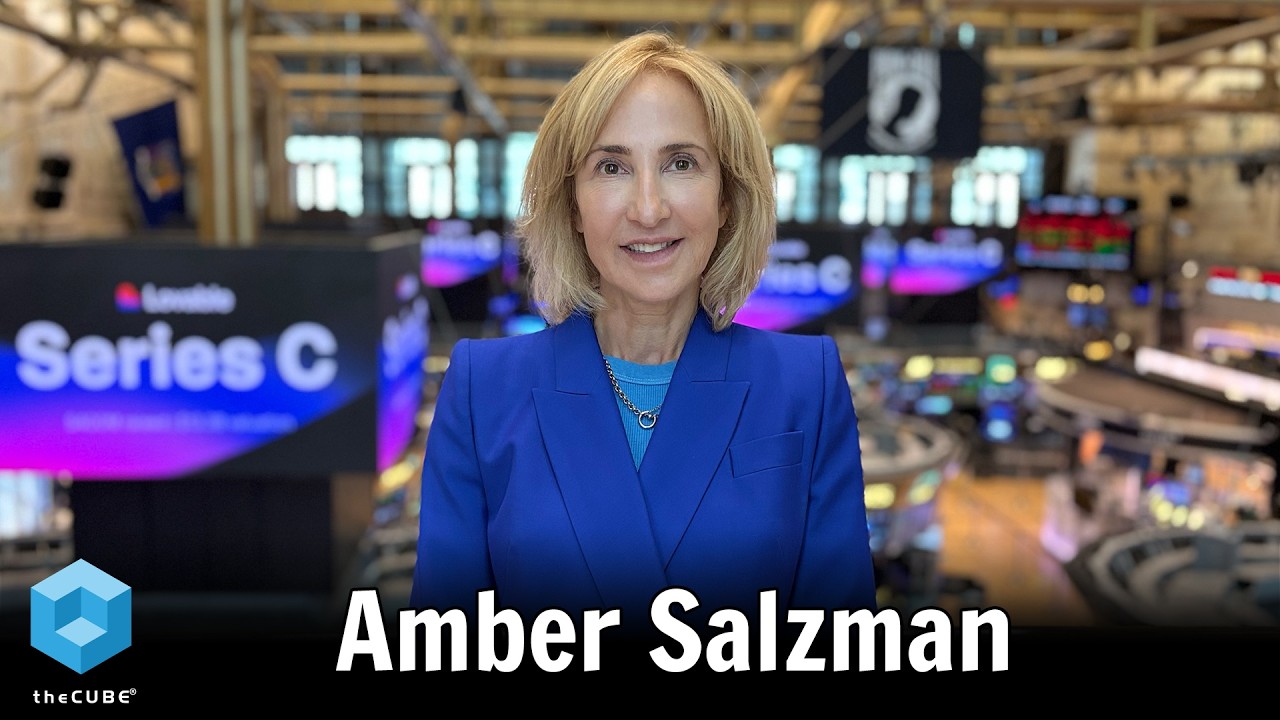
Amber Salzman, Epicrispr | theCUBE + NYSE Wired: MedTech Unplugged
Watch on YouTubeVideo summary
Amber Salzman, CEO of EpiCrispr, introduces her company's groundbreaking approach to treating diseases through epigenetic editing, a technology that functions like software updates rather than hardware replacements. She explains that while DNA serves as the body's biological hardware, the epigenome acts as the software that dictates which genes are active or inactive in specific cells. By regulating this epigenetic layer, EpiCrispr can turn toxic proteins off or activate healthy ones without altering the underlying genetic sequence. This capability allows the company to address debilitating conditions where the body's natural instructions go wrong, offering a potential cure for diseases that previously had no treatment options.
The primary focus of this technology is currently on facioscapulohumeral muscular dystrophy (FSHD), a rare disease that causes progressive muscle weakness and loss of independence, often starting in a patient's late teens or early twenties. The root cause of FSHD is the expression of a specific protein called DUX4, which poisons muscle tissue. EpiCrispr aims to stop this expression at its source, allowing patients to recover residual muscle function. To validate the efficacy of their treatment amidst the natural variability of disease progression, the company utilizes advanced machine learning and "digital twin" models derived from extensive MRI data of hundreds of patients. These digital twins predict individual outcomes, enabling more precise clinical trials that can definitively show whether a drug works without relying on traditional placebo controls that might be skewed by biological differences.
Currently, EpiCrispr is conducting its first-in-human study for FSHD and has already released encouraging early interim data showing patients gaining lean muscle volume and improving functional strength. The company is actively engaging with the FDA to align on endpoints for a pivotal study, aiming to file for approval in the near future. While Salzman acknowledges that biotech startups face significant funding challenges compared to tech companies, she highlights their successful Series C round backed by major investors, which provides the necessary runway to continue development. She emphasizes that while EpiCrispr can operate independently, the platform's potential is too vast to be utilized solely by one small team, making partnerships with large pharmaceutical companies essential to bring treatments for various diseases to market quickly.
Looking ahead, the company plans to release further data at upcoming medical conferences and expects to have twelve-month results for all patients in their trial within the next year. Salzman believes that if a biotech company focuses on delivering meaningful value to patients, financial support will naturally follow, a philosophy that has already attracted top-tier investment. The long-term roadmap involves leveraging this proprietary epigenetic editing platform across multiple indications, potentially through licensing deals or collaborations with big pharma, to ensure that patients suffering from currently untreatable conditions receive the help they need. Ultimately, the mission is to transform how diseases are treated by fixing the software of life, offering hope for a future where debilitating genetic disorders can be managed or cured.
Read the full video transcript
Hello out those studio connecting
Silicon Valley and Wall Street.
>> I'm John Furrier co-host of the Cube
here with Dave Vellante my co-host.
>> Welcome back to the Cube studio here at
the New York Stock Exchange. I'm Gemma
on with NYSE Wired's MedTech Unplugged,
a show we connect Silicon Valley to the
folks shaping what's next in technology,
business and health right here on Wall
Street. Today on MedTech Unplugged we're
talking to a company developing what it
calls epigenetic editing. Essentially
changing where the regime is switched on
or off rather than changing the
underlying genetic sequence.
Amber Salzman, CEO of EpiCrispr, welcome
to NYSE Wired's.
>> Thank you very much for having me,
Gemma.
>> So I'm going to be honest, like that is
a lot to understand. So maybe let's just
start there. Break it down for us,
Amber. What exactly is EpiCrispr? What's
the mission?
>> Sure. So as we probably know
DNA I kind of view as the hardware of
our body, so that's the machinery, and
then the epigenome is the software. So
the software basically tells the
hardware what to do. And the example I
used to give is look, you have the same
DNA in your muscle cell versus your
hair, and yet it's expressing
differently even though you have the
same DNA in every cell, but that's
because of the instructions and telling
it what to do. So when it comes to
diseases often what's happening is your
DNA is not expressing the right thing.
It may express a toxic protein or it may
not express a healthy protein. So if we
can go in and basically give the right
instructions and say, "Hey, turn it on,
turn it off, turn it on halfway, turn it
on full way." Depending on what you need
for that particular disorder, we can
really address a huge amount of
very debilitating unmet need. So, we're
super excited to be able to use this
technology, which is really proprietary
to our company, and reg- as we say,
regulate any gene anywhere to address
disease.
>> Wow, well, it certainly fills us with
hope when we think about the future of
technology and where it can really serve
the public good, right?
>> [snorts]
>> You say this technology has lots of
transferable opportunities, and I want
to get into that, but first, what
problem are you seeking to solve first?
Like, is there a very focused use case
for this right now?
>> So, we had to pick which diseases we
would pursue first, and some ways to
validate that our technology does what
it supposed to. So, our lead indication
is for a disease called
facioscapulohumeral
muscular dystrophy, FSHD. And like the
name says, it starts in your face, so
people don't they have trouble smiling
cuz they can't smile, can't close their
eyes, so often people sleep with their
eyes open, and then it travels down to
the scapula. You can't brush your own
teeth, wash your own hair, so it's
really takes away your
independence, travels down about a
quarter of the patients end up in
wheelchairs. Um
for the most part, the symptoms start
late teens, early 20s, so it's
heartbreaking cuz it's just when people
think what career they're about to
undertake, and then they start to lose
their
independence and ability to take care of
themselves, and sometimes, as in my
family's case, um
my cousin-in-law, who was a wonderful
producer for NFL films, could no longer
work because he wasn't able to.
>> Wow.
>> So, it's really it it's heartbreaking,
and the fact that there was no treatment
for it was really tough. So, when I
learned about the technology that this
company had, I'm like, okay, we can we
can cure this disease because this is a
disease that it's very well-established
cause. So, we know that the problem is
that there's a protein that gets
expressed in the muscle. It's called
DUX4 and that poisons the muscle and
little by little you lose your muscle.
So, what we knew we could do is we could
go in to the root cause of this disease
and stop the expression of DUX4
and stop the muscles from being poisoned
so that the patient would have a chance
to recover, well, not everything, but if
you still have some residual muscle,
once you stop the poison, you're able to
do recovering.
>> So, Aubrey, you've been in the industry
a while, right? You start GSK, you've
worked in cross-functional companies,
you're on multiple boards. There's a lot
of excitement around biotech and health
tech and the world of AI and how these
two worlds will hopefully collide in a
very
fortunate way, right, for many
individuals and we certainly hope that
to be true, but we also know that there
is a lot of money being spent. I think a
few weeks ago we talked with some folks
in the AI bio space, about $60 billion
in investment and still not a whole lot
of FDA approvals, right? There is still
a road and a bridge to be crossed here.
Talk about that process. Like you you
know your technology is solid, you know
you you got all the data. Why is it like
what what is the bottleneck? Like break
it down for us.
>> So, I think it depends how and where you
apply it. So, for example, where we're
using AI
is that as I described, this is a
disease where patients lose
their abilities, but there's a lot of
variability. So, when you want to test a
new drug and see if it works, when you
have that kind of variability, it can be
challenging. So, where we're using AI is
we're working with a company called
Springboard Analytics and what they do
is they have
data from hundreds of patients where
they've taken whole body imaging of
those patients at baseline, 6 months, 12
months, 18 months and they basically
look at their lean muscle volume in
about 140 muscles and they also look at
fat fraction. And what they've been able
to do with machine learning based on
that is say, for you as an individual,
if this is your baseline MRI, and you're
this gender, this age, this severe, this
is what we predict you will look like on
your MRI in 6 months, in 12 months. So,
it really gives a sense of for each
individual patient what their what we
call digital twin would look like, or
digital placebo. And that really helps
when it comes to showing that a drug
works because you almost have a very
well-matched placebo for each individual
patient. So, to me in that regard,
that's that's a brilliant way of using
machine learning because it's taking,
you know, data from hundreds of
patients, and from that being able to
figure out for you what your how your
MRI's going to progress. Because what
happens if we didn't have that, and we
did a placebo-controlled trial, and we
enrolled, let's say, I don't know, 50
patients and 50 that we treated and 50
placebo, there's still so much
variability that you could accidentally
show the drug works when it didn't, or
accidentally show that it didn't work
when it did. But if you have for each
patient their exact placebo twin, then
you can say, here's what you would look
like, and here's what you do like like
treated. So, at least from my
perspective, it's like a really good use
of machine learning. I think you just
have to be very focused in terms of what
it can do and what it can't do. And
as you mentioned, like the FDA and other
regulators, they're trying to leverage
it in a constructive way. So, we just
have to be very thoughtful about how we
use it.
>> Absolutely.
Let's talk about data for a second
because when we think about data from
the perspective of biotech and clinical
data, I mean, it's a fascinating space,
right? And you know, we know that there
has been bottlenecks to data
accessibility and data scaling in every
industry and I'm sure health is
absolutely no different. But, it's also
the fundamental piece that's needed to
prove if efficacy, right? How are things
changing? Like, you mentioned digital
twins, which is very interesting
concept. You see that in tech all the
time in manufacturing and automotive.
You know, are we going to see that in in
more and more in biotech? And does that
then make it synthetic data? Does that
kind of Is that some sort of workaround
from some of the issues that we've seen
of old? Do you think that could speed
things up?
>> So, for rare disease, it actually could
speed things up because of that
variability and you can't be enrolling,
you know,
thousands [snorts] of patients. It could
potentially really help with that issue
of variability and speed it up. Now, I
will say we're very fortunate in FSHD
because, as I mentioned, there's been a
lot of MRIs collected over hundreds of
patients.
Um, and that
as you know, with machine learning, you
need a lot of data to learn from. But,
if we start to set our mind that way, I
think we can do more and more of it and
really speed things up that way or even
do a trial that in the past we couldn't
do. There's been some notable
challenges that some companies have
faced with the FDA when they tried to
talk about using natural history as a
comparator and it kind of went to the
challenges of variability. Was that
natural history comparable to the
patients that they enrolled on the
study. So, I think this is a place where
regulators and sponsors and patients
could really put some more into to help
speed up and get things to market that
potentially otherwise would never make
it.
>> What stage are you guys at from the
perspective of FDA approval? And what
does the kind of 10-year strategy and
roadmap look like? Obviously, your
technology is very useful and
proprietary and highly transferable, I'm
sure. What what's the road map here? Is
it to secure the drug, get a drug to
market, which we know is a lengthy
process, and also look at the
commerciality of the tech, or
>> So, we have Yeah. So, I feel like we're
we're sitting on a technology that is
too good to keep to ourselves. Um look,
I
as I grew up at GSK, I know that some of
the bigger companies have a lot of
understanding of disease, and if they
knew what our technology could do, they
could really leverage it based on their
understanding of which protein needs to
be suppressed or activated, and they
also have sort of the testing
environment to be able to see in a rapid
way whether it works. So, at one level,
that's one way to use it. But, for us
personal, you know, within the company,
we want to progress particular
indications that are hugely meaningful
to patients. So, the first indication,
as I mentioned, is FSHD.
Um we're we are uh running our
first-in-human study. We released early
interim data at a recent FSHD meeting at
the end of June in Chicago. And there
was huge excitement because we were able
to show that the patients that made it
to their 6-month visit, when they did
the MRI at 6 months and compared it to
their MRI at baseline, they actually
gained lean muscle volume instead of
losing lean muscle volume.
And while the
it's early and small numbers, the really
encouraging part was that in addition to
seeing the lean muscle volume increase,
we also saw that on functional measures,
looking at strength of muscle and
certain functional things like 10-m walk
run, the patients were also trending in
the positive direction. And even more
comforting was there's a novel
circulating biomarker that we were
looking at in collaboration with
University of Colorado, and when we
looked at that circulating biomarker, it
also was trending in the right
direction. So, we were pretty excited
with this kind of early we I mean, to
have such phenomenal data so early is is
super. So, based on that, you know,
we're really driven to get it to
patients as soon as possible. We're
pulling together a request
um
to have a meeting with the FDA because
we want to make sure we're aligned with
them. I mean, we've always had great
exchanges with the FDA and you know,
this is a novel technology. So, we want
to make sure we're in sync and we really
want to have a shared understanding of
what it would take to do a pivotal study
so that based on what we would look at
as an endpoint and what it would look
like in terms of predicting clinical
benefits so that we could pursue a
pivotal study and file for approval in
the not-too-distant future. So, we're
we're looking we we you have to engage
with the regulators especially when it's
something so novel.
>> Talk about the role of big pharma, big
health tech, right? What in this? We
know that, you know, when I mentioned we
had a lot of folks on, there is
definitely a mixed view in terms of the
role they play and at what stage, right?
Depending on your longer-term strategy.
>> Yeah.
>> How do you see this kind of like and it
there's a lot happening. I it's so great
to see so many like young companies and
young guns and enthusiasm and excitement
in something as critical as public
health, right?
>> Yes.
>> you see things changing? Like you said
you were at GSK, there's always been
like a bit of a big bad elephant in the
room. We think about the world of large
pharma broadly as and as it comes to
buying up companies and convergence.
>> There's Yeah, now you bring up a really
good point because big pharma, I mean,
we're working on a disease which we
could probably do relative relatively
small compared to like obesity or
something like that. I mean, those are
big big studies. So, those are really
situated better for big pharma or
mid-size pharma. So, the way I view it,
we're all part of that same ecosystem
and the main thing is to be in
conversations and engaging because
there's different ways that we can
leverage each other's strengths.
>> Mhm.
>> So, like I said, this technology that we
have could totally be leveraged in some
of these big pharmas to address some of
the diseases where they really know the
ins and outs, and they have the
testing infrastructure and really a deep
understanding of how you would design a
clinical trial. So, that would be a good
partnership. Look, there's always an
opportunity.
Look,
where they could do more, and they could
really leverage our technology in a
greater way. They may want they may even
be interested in FSHD. FSHD, while it's
rare,
as I say, it's medium rare. I mean,
there is at least 40,000 patients in the
US alone, and there's nothing for them.
So, for even a big pharma, that's that's
a reasonable size market. So, there is
interest in it. Um and some of the big
pharmas have actually programs in the
space. Um so, there's different ways we
can engage with licensing, with
partnering, with us doing things
collaboratively, potential I mean,
there's always M&A. I think we're in in
a great position to go it alone and
really leverage the hell out of this
platform that we have. But as I said, we
could never, no matter how I mean, we
just couldn't do all the things that
this platform enables. So, I want to
make sure that others leverage it to go
after all these diseases
because patients need our help. And
that's that's why I that's what gets me
excited in the morning, just knowing
what we can do to help patients. So, we
can't do it ourselves, and that's where
we want to leverage sort of the broader
environment.
>> zoning out for a second and looking at
this from the perspective of women who's
been in this industry a long time and is
quite seasoned. When we think about tech
investments, right? Companies can be
hemorrhaging cash and completely lost
bearing, but they have ARR, they have
customers, they have early proof that
the money will come, right? When it
comes to biotech and the space,
obviously there is a different challenge
there, especially for all of these
startups with so much enthusiasm in the
industry. How do you think about that?
Like how do you think about survival of
the fittest in an industry like this?
>> Well, this
kind of work does require much in some
ways significant much more significant
funding than some of the tech companies.
Just the cost of running trials, etc.
materials. We've been incredibly cost
efficient in terms of getting to where
we are. So we wanted to be heads down,
watch our cost, and make sure that we
could get to the point where we got
proof of concept that this novel
technology works, and it works in a very
meaningful disease.
As we started to have that incredible
data emerge, we just announced last week
that we closed a series C 90 million,
but not only is it 90 million, we have
an unbelievable like who's who in the
syndicate. I mean, I just feel so
privileged to be surrounded by such
great funds. I mean, you know, the
Genesis, Fidelity, Cormorant, Toucan,
Aberdeen, and on and on. I mean, these
are really good investors. It was
oversubscribed, which means that we're
in a good position as we keep going to
have that kind of excitement. Um but as
you said, it's expensive. It's hard to
get the funding. So we constantly have
to make sure that we're being
laser-focused and delivering what the
market needs, which nicely does coincide
with what patient needs. I mean, I've
always thought that if you do right by
patients, the money does follow. So we
kind of hand-in-hand make sure that
we're doing putting meaningful drugs on
the market and getting the funding to
keep taking it to the next level.
>> Well, that's what it's all about, right?
So Amber, congrats on the raise. That's
a nice little bit of runway, too. Last
question to you, what's ahead? Like what
does the next 6 to 12 months look like
for you and the team?
>> Well,
we will be releasing additional data,
you know, more patients farther out at
the World Muscle Society meeting in
Hiroshima. That's the beginning of
October.
Um and then there's other medical
meetings next year. And this time next
year, we will have all 12 patients
12-month data. So, that should be a
super exciting time for the company
in terms of showing for all 12 patients.
And we had six at the start, and those
six at a higher dose, and really have a
meaningful readout at that time while we
progress other indications as well. So,
we're pretty excited.
>> I love it. I'm going to finish on your
own words. If you focus on what's right
for the patient, the markets will
follow. I certainly hope that's true.
Amber, wish you and the team all the
best. Thanks for joining us in the Cube
and NYSE Wired.
>> Thank you so much for having me, Jenna.
>> I'm Jenna Allen here at the Cube studio
at the New York Stock Exchange. This is
MedTech Unplugged, one of our programs
with NYSE Wired, connecting Silicon
Valley to the great minds on Wall
Street. Thanks so much for watching.