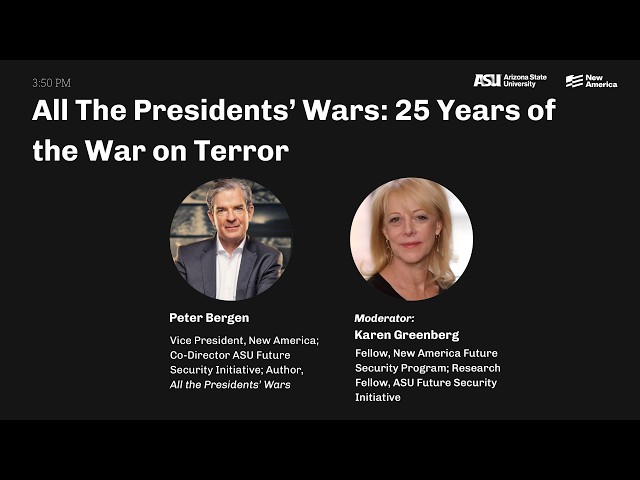
All The Presidents’ Wars: 25 Years of the War on Terror (Future Security Forum 2026)
Watch on YouTubeVideo summary
The central theme of the discussion revolves around a critical distinction between intelligence failures and policy failures within the context of the War on Terror, arguing that many perceived gaps in knowledge were actually failures of imagination or political will rather than technical shortcomings. The speakers emphasize that while tactical errors occurred, such as the CIA's delay in sharing specific names with the FBI, the strategic landscape was not ignored; rather, policymakers like those in the Bush administration, who viewed themselves as "Vulcans" focused on traditional state threats like Iraq and Russia, deliberately chose to ignore warnings about al-Qaeda. This policy failure was compounded by a refusal to investigate deeply or act on available intelligence, leading to a massive overreaction after 9/11 where the administration searched for other monsters immediately following the attacks, effectively creating a self-fulfilling prophecy of fear that overshadowed nuanced strategic thinking.
A significant portion of the conversation addresses missed opportunities in conflict resolution and the long-term consequences of military interventions, particularly regarding the Taliban and Iraq. The panelists argue that the United States failed to capitalize on moments when peace treaties could have been established with factions willing to negotiate, such as certain elements of the Taliban after their initial defeat in 2001, which would have split the movement and reduced long-term instability. Furthermore, the discussion highlights the dangers of not planning for the "day after" regime changes, citing Libya and Iraq as examples where the lack of a sustainable post-conflict strategy led to prolonged civil wars and humanitarian crises. The speakers note that while tactical successes like the anti-ISIS campaign were achieved with relatively low American troop footprints, they often resulted in devastating collateral damage, such as turning Mosul into a "parking lot" by displacing its entire population, raising questions about whether a more targeted approach could have achieved similar security goals without such human cost.
The dialogue also explores the evolving nature of domestic threats and the limitations of current security strategies against lone actors and emerging technologies. Unlike the coordinated networks of the past, modern terrorism is increasingly driven by individuals radicalized online who do not need to cross borders to cause harm, rendering traditional border control measures like travel bans less effective. While the panelists express optimism about the United States' robust defenses and the multiplier effect of public knowledge, they remain concerned about future threats involving synthetic biology and artificial intelligence, using the case of Bruce Ivins and the anthrax attacks as a cautionary tale of how access to advanced technology could be catastrophic in the coming decades. Ultimately, the conversation concludes that while the U.S. has learned some lessons through trial and error, such as adopting a "go light, go long" strategy for counterterrorism operations, there remains a profound lack of understanding regarding foreign environments and a recurring tendency to misidentify the nature of conflicts, which continues to hinder effective policy-making.
Read the full video transcript
Our
next panel is really a conversation uh
with Karen Greenberg and Peter Bergen.
So Karen is this is like sort of almost
like a family event for all of us. Uh
Karen's a research fellow with us uh at
ASU and also a key part of the New
America team. And then Peter doesn't
really need an introduction. That fair
to say. Um, and so, so they're going to
be talking about Peter's new book, which
of course is there for purchase and
signing if you want. And
so, thanks so much.
>> So, hi, Peter.
>> Thank you, Karen.
>> I heard you have a new book.
>> Yes.
>> Exciting. Um, I counted and this is your
eighth book. That's not counting your
edited books. Um, I think it's your
best.
>> Thank you.
>> And they're all really great, but um,
the reason I'm saying that is I know
you've been introduced with all your
titles before and all your
organizational work. Um but you really
have been the the writer, the thinker
that has taken us through this era, you
know, sort of year by year, decade by
decade, agency by agency. And I just
want to thank you for that before we get
into that. So um so one of the things
that you point to in this book um is the
distinction between um an intelligence
failure and a policy failure. Yeah.
>> And you focus very I mean we've and so
there's a couple of questions here. I
want to ask you one is um the difference
between a failure of intelligence and a
failure of imagination which seems to be
coming up in the conversation today. But
my my deeper question to you is um do
you think that um that we've evolved in
a way that the kind of intelligence um
that we were getting that you say was
not a failure. Um it's that we're in the
same place today. um or are we more
robust, more like what lessons did we
learn about that that and and and to to
put a finer point on it, the policy
failure, right? Um when did that policy
failure stop happening as a failure?
When did the policy get smarter, wiser?
Because that's sort of at the heart of
your book, right?
>> I think there might be five questions in
that.
>> Yeah, there is. There's at least five,
but you get what I'm saying.
>> Okay, I'm get I get get what you're
saying. Look, um I'll answer in this
way. When October 7th happened, I wrote
a piece for CNN on October 8th and said
which said because
of course they said it's an intelligence
failure and I was like I'm pretty sure
this was not an intelligence failure. I
can't tell you. uh but the you know the
easiest thing in the world for policy
makers to say is is an intelligence
failure because the intelligence uh
community works for the policy makers
and they can't contradict them uh as a
matter of policy and they can't
contradict them because as a matter of
classification so this is the easiest
dodge which is blaming the intelligence
community and in fact in the summer and
spring of 2001 CIA was doing uh exactly
what they're supposed to do um what is
the job of the CIA it is to provide
strategic warning to policy makers and
the policy makers make policy. Um, and
there was a tactical failure by the CIA
which is they knew that two people
associated with al-Qaeda were living in
the United States and they didn't
communicate that fact to the FBI until
August the 25th, 2001. That's a pretty
major tactical failure. It is not,
however, a strategic failure. You know,
the Bush administration fought tooth and
nail not to have a 9/11 commission. and
they said, "Well, we can't investigate
what happened because we're in a war."
There were eight separate investigations
of Pearl Harbor during World War II,
which was, you know, um, and you know,
we need to know what and it's very
interestingly, no COVID commission in
this country and no Iraq war commission.
Joel Rabin, who was here earlier, led
the, uh, US Army history of the Iraq. We
didn't have a chillcot inquiry as they
did in Britain which produced two
million words
of you know it was very thorough
investigation of how the British handled
the Iraq war. There was never an Iraq
war official investigation except by the
army and of course by its nature it was
limited in to some degree. The
conclusion of that uh invest of that
investigation is 1500 pages was Iran was
the sole winner of the Iraq war. This
was not Nam Chosky. This was a group of
official army historians. The point is
I I have two levels of it. It was
certainly not an intelligence failure.
Um I mean we had you know it the um you
know Condisa Rice uh one of the 9/11
commissioners it was who who worked for
Nixon as um anyway I'm forget his name.
He he asked Connie Reese Rice to to read
the name of of a particular presidential
daily brief and when she was testifying
and it was uncomfortable moment for her
because it said Osama bin Laden
determined to strike in the United
States. Now we would never have known
about that particular PDB and by the way
a bunch of them were just released on
Friday which I thought were pretty
interesting. We would never have known
about that without the 911 commission
because they be declassified a bunch of
material. And then the 911 commission is
really two books. There's the narrative
and then there's the notes. And the
notes are as useful as the narrative
because they're a road map to a lot of
other things that we need, you know, we
could investigate. Um, so I don't think
it was an intelligence. It was a massive
policy failure because the guys in the
people who came in, you know, they they
they styled themselves the Vulcans
because in Birmingham, I've never been
to Birmingham, Alabama, but there's a
big statue of Vulcan, uh, the god of
fire. And that's where Connie's rice
hometown. And they called themselves the
Vulcans because they thought, well,
those Clintonian liberals and they're
peacekeepers and they're kind of pinko
liberals and they're, you know, we're
the real hard guys. And they came into
office with that and they the the real
hard guys concerned themselves with Iraq
and Russia and state threats.
Cheney had worked for President Ford as
his chief of staff. Rams had worked for
for Ford as his chief of staff and
secretary of defense. Condisa Rice was a
Soviet. So they were sort of like
steeped in cold war analyses of what the
problems and they'd been out of office
for eight years. And so they came in,
you know, unconcerned about al-Qaeda at
all. And um, you know, they on the this
bin Laden determined to strike the
United States was briefed to George W.
Bush in August the 6th, 2001 at his
ranch in Crawford, Texas by Mike Morell,
who eventually became the acting
director of the CIA. Uh, President Bush
chose not to interrupt the longest
presidential vacation in three decades.
He also and Connie is I include all
these all all the people in the war
cabinet. They didn't pulse the national
security operators to say well yeah
we're getting these warnings is and
let's ask our informants. Is there
anybody from al-Qaeda living here? Is
there let's really shake the trees. That
didn't happen. So it was a massive
policy failure which partly getting to
somewhat something that Jame Louise rich
Richardson said earlier. It partly
accounts for their massive overreaction
because they were so they they knew they
knew that they had been warned and they
started searching for other monsters to
destroy literally on the afternoon of of
911. So that's the sort of easy
question. And then the 911 commission
said it was a failure of imagination.
And of course the 911 commission was an
amazing piece of work. We can't do it in
these in this country anymore because
you you could never have a bipartisan
serious investigation. Well, we like
I'll give you there is an exception. The
Afghan war commission that's coming down
uh will be published next year is a
serious piece of work and I think but
this failure of imagination was uh
seemed to be right but it's not really
right. Um,
I think Dame Luis Richardson referred to
the planned attack on the Eiffel Tower
by GIA, an Algerian terrorist group,
using a plane as a weapon. And there
we've been attacked at the trade center
on February 26, 1993. I mean, it's not
the same target. We, a guy called Aman
Rasam tried to get across the Canadian
US border. He was arrested by a female
uh custom border agent called Diana
Dean. and she was notice noticing that
he he was sweating in December and she
thought he was a drug dealer. Well, he
wasn't. He had a trunk full of
explosives and he was going to blow up
LAX airport in the middle of Christmas
and luckily that didn't happen. and he
trained in an al-Qaeda training camp and
anyway so the point is you didn't the
failure of imagination is actually it's
a less strong
I it's more I I quote Thomas Shelling in
the book um in his forward to the great
Roberto Wolstead book about Pearl Harbor
which is I'm paraphrasing it but simply
because um it appears improbable doesn't
mean it's impossible so um you know uh
so it's the failure of The failure of
policym is very clear. The failure of
imagination seemed like a more
reasonable answer, but it's not really
entirely correct either.
>> Yeah. And you and you thank you for
answering five questions. And um and and
you um talk about that in very, you
know, specific terms in terms of what
was known, who knew it, who was saying
things in terms of, you know, not just,
you know, it's the the lights are
blinking red, but even more, you know,
um outrage over not being taken
seriously about the threat. And so I
guess, you know, we heard these panels
today talk about is there a threat?
Isn't there a threat? And what's
happened in this in this 25 year um
retrospective is there's been a lot of
talk and um journalism about the the
growing threat and the the fact that
there's there's terrorist threat you
know growing in number of parts of the
world. Now, do you see that this do you
worry about the same disconnect between
um intelligence, both open source
intelligence and the kind of
intelligence we're talking about now?
And or or is it something you're not not
yet worried about?
>> I I I'm I'm I've never been a sky
falling guy. I'm sort of basically an
optimist and um I mean not an optimist
about human nature necessarily. Um but
um we're well defended. So on 911 there
was no TSA. On 911 there was no
Department of Homeland Security. On 911
we quintupled our intelligence budget.
We tripled the number of joint terrorism
task forces. Uh we've we're a pretty
hard target. And I mean and also public
knowledge is a huge force multiplier to
what I've just described. So um you know
that said our problem is domestic. I
mean we've just heard from Josh Geltzer.
Um the whole the travel ban was a a
solution to a problem that didn't exist
because the problem is Americans who
live here already either jihadist or
right-wing extremists are getting
radicalized by what they read on the
internet and they're they don't need to
you know go through customs at JFK. So
that was a kind of misconception of the
actual problem at the time. But there's
a limited
right now there's a limited um amount
that a domestic an American citizen
legal permanent resident here whether
he's a farright extremist or a jihadist
there's a limit to what they can do
because typically they're not working in
groups and groups are susceptible to are
easy to penetrate and they have to
communicate and so so what we see are
these lone actors and you know they can
kill people. We saw Omar Matin, who was
born in Queens, New York, just like our
present president, you know, killing 47
people at a nightclub in Orlando. A, he
had access to semi-automatic weapons,
and B, he conducted it, you know, the
attack at 2 in the morning in the middle
of a very crowded nightclub, so he
killed a lot of people. Uh, but we
haven't, you know, that's been the
largest, most lethal terrorist attack um
since 911.
Um, and so I'm not I am concerned about
some of the things we discussed with
Dame Louise, which is, you know, uh,
synthetic biology, AI, you know, that's
not going to happen tomorrow. I mean,
you know, the the barriers to entry to
that kind of thing are pretty high right
now. But think about Bruce Ivans who
was, you know, the the attacker of the
the anthrax attacks, which had a huge
effect on the Bush team. They happened a
few weeks after 9/11. People were
getting killed in New York and
Washington. The journalists were being
targeted. Congress was being targeted.
Now imagine if he had access to bio4 bio
level 4 labs.
Imagine if he was now empowered with AI.
He you know Bruce Ivans was a very
strange dude. Uh he had very
idiosyncratic views. But a Bruce Ivans
with access to uh the kind of new
technologies we have 10 years from now
could kill a lot of people.
>> You know, one of the things that didn't
sound really optimistic. You said you
were optimistic. I'm just saying.
>> Um u one of the things that you you lead
to in the book and you sort of summarize
at the end are the lessons learned and
the lessons learned from things that
were overlooked, things that were more
um clearly mistakes of judgment and
things like that. And I'm just curious
where you think um what you think our
options are today. I mean, one of the
things you talk about in the book
repeatedly is the lost opportunities
with the Taliban to talk about.
>> Yeah, I Yeah, I mean, that's really and
I I was going to ask De Louise this
question. Um you know, we there's a
narrative that at the bomb conference we
made a mistake. So, the bomb conference
started on November 25th, 2001. and um
Laksha Brahheime who convened it has
publicly said you know we should have
had the Taliban at the table I actually
think that's wrong because the Taliban
were still fighting on November 25th
2001 they hadn't surrendered there's no
way the Northern Alliance would have
agreed to have them at the table and
there was no way the United States but I
think in the larger sense he was right
by January 20 2012
um the Taliban were utterly defeated uh
and I you know I come back to Clauswitz
in the book uh a few times because he
tends tends to say some pretty smart
things that are actually common sense on
some levels and you know when you do a
peace treaty he I'm quote paraphrasing
him the smoldering emble smolding embers
of that whatever that conflict are sort
of extinguished and we never made peace
with the tal by the time we made started
having peace agreement with the Taliban
that was 17 years later and they'
obviously you know had a lot of success
so what we should have done January 2002
was make peace with the Taliban at least
the ones willing to make peace because
there's two ways that that's helpful.
one you create fissures in the movement
between the hardliners and you know so
you you you split the movement and then
secondarily you obviously make peace and
you don't necessarily make peace with
Müller Omar but there were plenty of
people in the Taliban who uh were ready
to surrender amnesty engage in normal
politics and we sent them to Guantanamo
and interestingly Bob Gier who's a CIA
station chief in Pakistan in at that
time was like why are we sending the the
foreign minister at the time is a guy
muta kill. He was a he hated bin Laden.
He thought bin Laden was a huge problem
because it was interfering with their
ability to get international recognition
and we'd put him in Guantanamo and so
what he you know we basically and we
bracketed the Taliban together as sort
of the same and that you know that
became a self-fulfilling prophecy on
some levels but it was completely
unnecessary. Uh and so I think we had we
missed we missed that opportunity when
we could have done a great deal with the
Taliban, the the Afghan government and
us. And then we remissed the issue again
after the Obama surge in 2010. The Obama
surge really put the Taliban back. And
I'm not quoting the US military on that.
Carlotta Ghoul who I met in uh
Afghanistan in the mid '90s when she was
an aid worker. She became you know the
best correspondent in the New York Times
in Afghanistan the most well-informed.
So in 2010 she was saying the Taliban
had been really defeated in Kandahar.
This is not a US military assessment.
This is Carlo Goul's assessment a
frequent critic uh and realistic critic
of American foreign policy. Um and that
was also there was a there was a an NGO
that worked in Helmond a lot. that was
also not a fan of the uh of the US
military or its or its policies. But
they also said look in Helman they've
been you know I I was embedded with the
Marines in Helman in 2009 with Anderson
Cooper. Now the Marines are well known
to have the best PR operation in the US
military. The one thing they were not
going to have is Anderson Cooper dying
in Helmond.
And so we went into Helman place called
Nawa which we had we thought was going
to be super dangerous and great you know
and it turned out to be like the Marines
had already cleared that area but the
point is is there were there 13
districts in in in Helmond at the
beginning the Taliban I think controlled
most most or all of them and then by the
end of that campaign they were down to
down to one. So that was really a missed
opportunity. You know Richard Hullbrook
had been appointed to be the special
representative to Afghanistan Pakistan
in 2009. that seemed to be a indicator
we might do a deal but we did we didn't
do a dealbrook a you know died
unfortunately you know uh relatively
early on and he did reach out to
low-level members of the Taliban there
was a beginning of a discussion but it
wasn't real so the Obama administration
missed an opportunity
going back to some of the discussion
we've had earlier I mean we had this
operational success we had a tactical
success but it wasn't married to a
strategy where we said let's try and
make a deal and I talked to Dr. Abdullah
at that time who was one of the leaders
of the Northern Alliance and I asked him
like if there was a peace deal what
would you be okay with and he said well
provincial governors could you know
Taliban provincial governors Taliban
district governors if they I mean they
represented
conservative rural ptoons they would do
well uh so anyway that was definitely
there were so many whatifs and roads not
taken in this book unfortunately or not
they're not not this book it's this
history and I think those are two of
them. Yeah, two other things that you
talk about before we get to the
questions in terms of just, you know,
lessons learned. One is not thinking
about the day after,
>> you know, and what that means and maybe
you could talk a little bit about that.
And another one is lack of knowledge.
Just this lack of knowledge on a part of
Americans that you keep coming back to
and I'm a little embarrassed when I was
reading it and just I just sort of
wonder if you could talk a little bit
about about that both those things. Um
you know Yanni Koskinas who spoke
earlier um spent um he mentioned he so
Yanni was in JC then he spent from 2009
to August 13th 2021 one living in
Afghanistan then he moved to Bill and
basically he was trying to understand
the environment but that was that's kind
of the exception that proves the rule um
you know we Susie Hansen wrote a book
about being an American and then one was
nominated for Pulitzer for it uh which I
think you know we We
we don't understand the environment and
it's just like and I think there's a
number of reasons for that. A the United
States is an anti-mpire project and when
I say this I'm not trying to defend the
previous empires but if you were British
official military officer in India you
spoke the languages you stayed. Same
with the French and Algeria. And we just
don't we go in, we think we always think
it's going to be over in three months or
six months and that's kind of part of
our thinking. And then we we understand
almost nothing about the environment.
And um that's been one of our major
problems. And then not planning for the
day after. Obama has said that, you
know, his biggest mistake was not
planning for the day after the overthrow
of Muhammad of of Moar Gaddafi. Um you
know, you can debate if that was his
worst moment or not, but that's
certainly his view. And you know, Libya
then did have a 10-year civil war and we
still have two governments in Libya. So
that's an example of not planning and
obviously we didn't plan for what
happened after the fall of Saddam and uh
it just seems to be sort of I I we a
group of US naval strategists came
actually here relatively recently and
they're sort of the le they go to the
naval war college and then the top level
>> you know become US Navy uh strategists
and I says it's kind of a depressing
thing because like these are really
smart people but it doesn't really
matter the com whoever the
commander-in-chief is he or she if they
have some sort of terrible policy and
make certain assumptions that are wrong,
it doesn't matter how great your
strategist or how your great your
intelligence community is. And it's a
sad fact.
>> So, what did we get right?
>> Well, it's already been discussed
>> that that that we haven't had another
attack. So, would you say it's the
reorganization of government that we got
right?
>> Well, you know, I I I think we got right
by trial and error what I call go long.
Uh it was referred to um earlier uh with
General Votel and Kane Glimman. I mean
look going to war is never that's like
not the right thing to do usually as a
but if you're going to go to war what is
the least bad approach and in life least
bad approaches are probably the best
approach. So the least bad approach I
think during the war on terror was what
I call go light go long which is we
heard about Ken Glimman was very
involved in the Philippines that went
well. Abu Sai was an al-Qaeda affiliate.
Very few Americans working with the
Filipino army. It was a success. It
hasn't got the attention it deserved
because it was a success. And but you
know, the anti-ISIS war was a success.
5,000 American soldiers in Iraq, 2,000
or so in Syria. Obama and Trump
basically did the same policy. And that
was aligned with the local Iraqi
counterterrorism service and the Syrian
de Democratic Forces. The big caveat to
that is we turned Mosul into a parking
lot. Um, a million Mosul residents had
to leave the country, the the the the
city. We had 35,000 American air 35,000
America American air strikes. So, there
was a tremendous amount of of American
air power. Now, from American
perspective, it was relatively cheap,
politically sustainable, financially
sustainable, was virtually, it was a
non-issue. Most Americans were happy
that there was this campaign against
ISIS and it worked. The but the you know
tens of thousands of Iraqi military
forces and and Syrian forces did die.
The on the plus side when liberation
came it wasn't Americans on Humvees. It
was Syrians and Iraqis liberate their
liberating their own territory. But I
mean this is really a question for the
audience and for the future which is
could we have got done a go light go
long policy that had a more targeted
kind of air strike component didn't
involve the mass movement of Mosul uh
you know a million members of the the
Mosul city population out of the city
and didn't involve turning Mosul into a
parking lot. And I, you know, I'm not a
I I don't know have an exact answer to
this question, but the even the go like
go long approach had significant effects
for people in the countries where this
happened. Uh but it it it did in the end
succeed in liberating um territory from
ISIS.
>> All right, quick questions right here.
>> That's not my fault.
Hi, uh my name's Edge Corpensky,
unaffiliated. Um I haven't read the
book, but I always try to read the last
paragraph. So the last paragraph was
basically uh to understand the nature of
the conflict you're embarking on. And so
my question is about um particularly
Iran and also Ukraine.
I mean Ukraine started before Trump came
in so I can't blame him for that. But
but what what what is the nature as far
as you can understand and why can't we
understand why do we not have any
interest in understanding?
>> Well, I go I mean I I go back to Clam
Switz. It's a very famous
kind of observation of his which I will
paraphrase which is the most important
uh role for the policy maker when he or
she decides to go to war is what kind of
war are we embarking on and not
mistaking it for some kind of war that
it isn't. And that's an easy thing to
say, but I think it's a hard thing to
do. Uh, so an example, you know, if we
if if if you there have a scene in in
the White House, Regina Bennett was
actually briefing President Bush along
with Bob Gier, who was the Iraq mission
manager, and it I think it took place on
Veterans Day, maybe 2004.
Um and uh so November 11th and they
they Gina was saying hey look I've been
studying this for a long time we're just
this is a all these foreign fighters
coming in pouring in they were carrying
out all the suicide attacks so they were
the people in many senses driving the
worst part of the civil war and they
were foreigners and bugier said look
there's an insurgency happening here
this is it probably the first time the
word insurgency had been used in the
white house And George Bush said after
the meeting, "Look, I I don't disagree
with you, but we're not going to use the
word insurgency when we leave this
room." So, this is a classic case. If
you can't identify the war as being an
insurgency, then you can't use
counterinsurgency tactics against it.
And so, the real world, I mean, when we
elect our commander-in-chief, he or she,
if they're going to go to war, really
has to think very carefully about what
kind of war are we embarking on. Uh and
in the case of Iran, I mean, I think
everybody in this room knows enough
about it and that we have not we we we
made false assumptions. There was a
supposedly imminent threat that wasn't
the case. You know, we didn't have a
congressional authorization, which I
think is very important. What I mean,
you create public buyin by having a
debate in Congress. I mean, it's that
basic. And so, at at the beginning of
the Iraq war, 75% of the Americans were
in favor of the Iraq war. Why is that?
Because the Bush administration waged
one of the most effective propaganda
campaigns in history against its own
people, which was connecting Saddam to
9/11. 70% of Americans believe that
Saddam was involved in 9/11 2 years
after 911 happened. Now, that was after
the largest criminal investigation in
history. The 9/11 investigation involved
150 thou,000 uh interviews and 165,000
leads, not one of which led to Saddam.
Um anyway, so the big the big moral is,
you know, don't I mean uh
>> as you pointed out in your Guardian
article before we went to
>> Well, I wrote I wrote a piece for the
Guardian two or three months before the
war saying like there's no I we we met
with Bin Laden. Bin Laden at the end of
the interview said, you know, Saddam's
not a good Muslim, which is about as bad
as it gets. So, I mean, I knew a lot
about al-Qaeda. I didn't know much about
the WMD. The unfortunate thing about the
WND, the only way he could prove or
disprove was to go and invade because
Saddam himself of course had lied during
the 1990s about his web WMD program. Uh
a guy called George Piro who's a friend
of mine who was spent six or seven his
book will be coming out December 1st. So
he spent seven months with Saddam 8
hours a day. Saddam thought that George
Piro was like, you know, some senior
general that and in fact he was an FBI
guy who spoke perfect Arabic and
Lebanese American and you know Saddam
eventually told him hey you know I
always thought Bin Laden was a loose
miss you know unguided missile. I didn't
like him and very importantly I had to
signal to Iran that I still had WMD.
They just fought an 8-year war. A
million people had died. So it was kind
of too clever by half by Saddam. uh
there were you know so I'm not excusing
any of it but I'm sort of saying Saddam
himself
uh was kind of misleading about the fact
that he hadn't that that he'd actually
disarmed and at one point he told his
senior generals they were surprised that
he had disarmed so
>> okay let's get one more question
>> one more question quickly way in the
back
>> Abas from the national defense
university thank you so much kind of you
thank you very much for another
wonderful book my question is As regards
um the debate about the counterterrorism
in the counter narrative realm the soft
power we we had so many conversations so
much was happening on softpar side ex
the religious extremists they can be
challenged by the moderate Muslim
so-called or or the kind of soft power
uh channels how much of that has
succeeded because there was this debate
earlier this morning between Nelly and
Bruce also al-Qaeda is dead or not but
how much credit we can give to the
Terrorism has gone down in many ways.
How much credit goes to that soft power?
Some from us from some globally. Any
thoughts on that? Thank you.
>> Okay. And Hassan has a really
interesting background. He was a senior
police officer in Pakistan who then
became a professor at Colombia, which I
don't think there are that many people
who've taken that particular route and
now he's at the National Defense
University. But um so look I mean I um I
mean I soft power of you or good
ultimately what really did these
jihadists in is their own actions. Um
you know they they presented themselves
as the defender of Islam and yet their
victims were mostly Muslims. And Bin
Laden himself in his last years of his
life was planning to relaunch al-Qaeda
as a gentler kindler al-Qaeda
um that would really emphasize not
killing Muslim civilians. Um and he
would write letters to the Pakistani
Taliban to Shabb al-Shabaab in Somalia
basically saying let's try and avoid
killing Muslim civilians. So they
understood this as their real ultimately
they they defeated themselves to a large
degree. the soft power that we
implemented, you know, sometimes may be
unhelpful, other I mean there was a
period when President Bush's like chief
communications uh person, I've forgotten
her name now, just you know went on a
tour around the Middle East just saying
how great America is and you know that
did not go well. Uh that you know so it
wasn't very sophisticated particularly
at the beginning. I'm not a I mean so uh
you know there are some things that we
got right last night we we some of us
were talked about the American
University in Afghanistan which produced
more fullbrite scholars uh than any
other institution by by proportion uh in
in the world and you know the Taliban
are not going to be in power for every
forever and so educating the next
generation of Afghan leaders whether
they take whether the Taliban falls 10
years from now or 20 years from now. I
mean that's the right kind of soft
power. Um and um
so that's it.
>> Okay. So the subtitle to the sub
subtitle to the book is lessons learned
and lessons unlearned
>> and then Right.
>> Well and I think I think Yanni had
another good line which was lessons
identified.
>> Yeah.
>> Did we really learn them?
>> Um thank you Peter for
>> Thank you. Find it.