Alexandra Florea: Simultaneous non-vanishing of L-functions at the central point (NTWS 295)
Watch on YouTubeVideo summary
The talk focuses on a classical problem concerning whether Dirichlet $L$-functions vanish at their central point within the critical strip. While vanishing can occur for trivial reasons or due to deep arithmetic phenomena like those described by the Birch and Swinnerton-Dyer conjecture, it is generally expected that without such specific causes, these functions should be non-zero. This expectation leads to Chowla's conjecture, which posits that $L$-functions associated with primitive Dirichlet characters never vanish at the center of the critical strip. Extensive research has quantified this phenomenon by studying families of characters; for instance, while only about 38% of all Dirichlet characters modulo a prime show non-vanishing behavior in general, real quadratic characters exhibit significantly better proportions due to symplectic symmetry which causes zeros to repel from the central point.
The speaker then shifts attention to simultaneous non-vanishing results, where one seeks $L$-functions that are all non-zero at once for a given character family. This area is motivated by its connection to Landau-Siegel zeros; proving strong lower bounds on these specific values would rule out their existence. Previous work established positive proportions of forms with double or triple simultaneous non-vanishing, but extending this to four functions proved difficult using standard moment methods because computing high-order moments like the sixth becomes intractable without a mollifier. The speaker presents new results that improve upon earlier bounds by Zacharias, demonstrating under the Generalized Riemann Hypothesis (GRH) that there exists a positive proportion of characters modulo $Q$ for which four twisted $L$-functions are simultaneously non-zero and bounded below by an exponential function involving $\sqrt{\log \log Q}$.
To achieve these improvements, the proof strategy relies on computing modified moments rather than relying solely on one-level density arguments. A key innovation involves defining a mollifier not as a simple Dirichlet series with Möbius cancellation but through an Euler product that splits primes into intervals to handle small and large prime behaviors differently. This approach allows for sharp upper bounds on high-order modified moments, specifically the sixth moment, which is essential when applying Hölder's inequality to bound the proportion of simultaneous non-vanishing cases from below. The speaker explains how this refined mollifier interacts with twisted fourth moments involving convolutions of characters and root numbers, effectively eliminating problematic oscillations found in earlier approaches by leveraging properties derived from GRH approximations for logarithmic $L$-functions.
Finally, the presentation addresses unconditional results where no hypothesis like GRH is assumed. In this setting, the goal shifts to proving that an infinite family of such simultaneous non-vanishing characters exists, even if they do not constitute a positive proportion of all characters modulo $Q$. The proof involves analyzing the pure fourth moment as a sum of six distinct terms arising from character swaps and dual sums in approximate functional equations. While each term is individually significant, ensuring their combined sum remains non-zero requires careful handling of cases where coefficients might conspire to cancel out; this is resolved by reducing specific difficult instances to showing that certain $6 \times 6$ determinants are non-zero using computational assistance like Mathematica. Beyond mere existence and non-vanishing, the work also establishes a Central Limit Theorem-like behavior for these values, confirming that it happens very frequently for the twisted $L$-functions to be simultaneously quite large rather than just avoiding zero.
Read the full video transcript
So, today I will talk about
non-vanishing of L functions and
everything will be joint work with Hung
Bui and Micah Milinovich.
So, let me start with a classical
question. So, the main question that
we're interested in is the following. If
we have an L function associated to a
Dirichlet character, does that function
does that L function vanish at the
central point 1/2? So, the center of the
critical strip.
And there is this general philosophy
that if we have an L function, it
vanishes at a special point. Usually, we
look at the center of the critical
strip. In this case, it would be 1/2. It
vanishes either for very special reasons
or for trivial reasons. So, for example,
if you have an L function with root
number equal to minus one, the L
function will trivially vanish at the
central point. But apart from these
trivial reasons, if we have vanishing,
then the rule of thumb is that it it
should happen for a very good reason.
So, one example
would be given by the Birch
Swinnerton-Dyer conjecture. That would
be like the prototypical
arithmetic reason for vanishing at the
special point. And this conjecture says
that if you have the L function
associated to an elliptic curve, then
the order of vanishing at the central
point of the L function is equal to the
rank of the elliptic curve. In this
case, the critical strip is zero to so
the central point is one. Okay? So, if
the L function of the elliptic curve
vanishes at the point one, it vanishes
exactly
when the rank is greater than zero. So,
E has infinitely many rational points.
So, in this case, the vanishing encodes
some deep arithmetic. Okay? If there are
no such meaningful reasons to get
vanishing, then one should expect that
the L function
is non-zero at the central point.
And indeed, this is the statement of um
Chowla's conjecture, uh which says that
L of 1/2 chi is never equal to zero for
any Dirichlet character. This was
originally uh conjectured by Chowla for
um quadratic characters, but you can
extend it to any um primitive Dirichlet
character.
And there has been done a lot of work um
towards Chowla's conjecture. I'm not
going to mention everything that has
been written in the literature on it.
I'll just highlight a few results.
So, if we look at the family of all
Dirichlet characters modulo Q,
there is work of Iwaniec and Sarnak who
got who showed that more than 1/3 of the
L functions, so more than 1/3 of L of
1/2 chi as chi varies over characters
mod Q and Q goes to infinity, uh more
than 1/3 have this non-vanishing
property.
And this proportion has been improved
over the years, uh for example, by Bui
who got roughly 34%
and uh um
the record for the family of uh
characters mod Q is due to Khan,
Milicevic, and Go, who looked at
characters modulo Q where Q is a prime,
and they got roughly 38%.
So, if you look at these proportions um
of non-vanishing for the family of all
Dirichlet characters, they are somewhere
in the range 30 to 40%.
Now, if you specialize to other types of
uh
uh characters, for example, the most
natural
next family to look at would be the
family of real primitive characters.
Uh there are better proportions in this
family. So, uh Sound showed that more
than 87.5%
of these characters
uh have uh non-vanishing central L
values.
And if you assume GRH with Loukanidis
and Snyder,
uh improved the
the percentage to 93.75%.
So, the first four results all compute
moments of L functions. The last one
computes what is called the one level
density of zeros.
Um and as you can see in this family of
uh real primitive characters of
quadratic characters, there's the
proportions are much better much better
than the proportion for the entire
family of Dirichlet character
characters. And one reason that would
explain that is that um this is a family
with symplectic symmetry and for that
kind of family we expect to have some
repulsion of zeros from the central
point. So, L functions don't want to
vanish at the central point and we get
better proportions.
Uh the question that I'm interested in
in this talk is that of uh simultaneous
non-vanishing. So, I want to give a bit
of motivation uh for studying this kind
of simultaneous non-vanishing results.
And this goes back to Iwaniec and Sarnak
who proved the following results. So, um
if you look at holomorphic cusp forms of
weight K, uh fixed K and square-free
level N. So, N is the parameter which
goes to infinity. And uh you fix two
real primitive characters chi one and
chi two, then a positive proportion of
these holomorphic cusp forms have this
double non-vanishing property. So, L of
half F twisted by chi one and L of half
F twisted by chi two are both non-zero
at the same time.
And this kind of results um has been
improved over the years in various
directions. So, another result with a
similar flavor is a result of Michel and
VanderKam who proved a simultaneous
non-vanishing result for three L
functions at the same time. So, in their
work, they fixed primitive characters
chi1, chi2, chi3. They are no longer
assumed to be
real.
And then they looked at holomorphic
Hecke cusp forms of weight two and prime
level Q, and Q is the parameter that
goes to infinity. And then they showed
that a positive proportion of these
Hecke cusp forms of um
weight two and prime level Q have this
triple non-vanishing property.
So, why would we study uh simultaneous
non-vanishing? It turns out that these
questions are related to um
Landau-Siegel zeros. So, in the paper of
Iwaniec and Sarnak uh that's uh I
mentioned uh before,
they compute this average, this moment.
So, they sum uh L of 1/2 F * L of 1/2 F
twisted by chiD. ChiD is the quadratic
character, and they sum over forms
either in the weight or the level
aspect, and they get an asymptotic
formula. And that asymptotic formula has
on the right-hand side an L of 1 chiD.
So, if you want to get uh to show that
there are no Landau-Siegel zeros, so you
want to show to get some kind of uh
lower bound on L of 1 chiD,
then you should show that the L
functions on the left-hand side, so uh
these two L functions, you would want to
show that they are both non-zero a
positive proportion of the time. So, we
know that each of these L functions is
greater than or equal to zero. So, if
you can show that the set where both of
them are non-zero
um has positive measure, then that would
give you a lower bound on L of 1
uh L of 1 chiD, and you would be happy.
Unfortunately, this approach doesn't
work. So, Iwaniec and Sarnak showed that
more than 50% of the forms have L of 1/2
F um
non-zero and more than 50% have L of 1/2
F twisted by chi D non-zero. So, you
can't force these non-vanishing sets to
intersect in a subset of positive
measure. So, this barely fails to give
you a lower bound on L of 1 chi D.
There are also results in the other
direction. So, for example, Bui, Pratt,
Zaharescu
and Chek and Matomäki showed
that the existence of Landau-Siegel
zeros would imply, for example, 100%
non-vanishing for Dirichlet L-functions
at the central point.
Okay, so the main result that we're
trying to
improve is the this theorem of
Zacharias,
which is a triple non-vanishing
statement for Dirichlet L-functions.
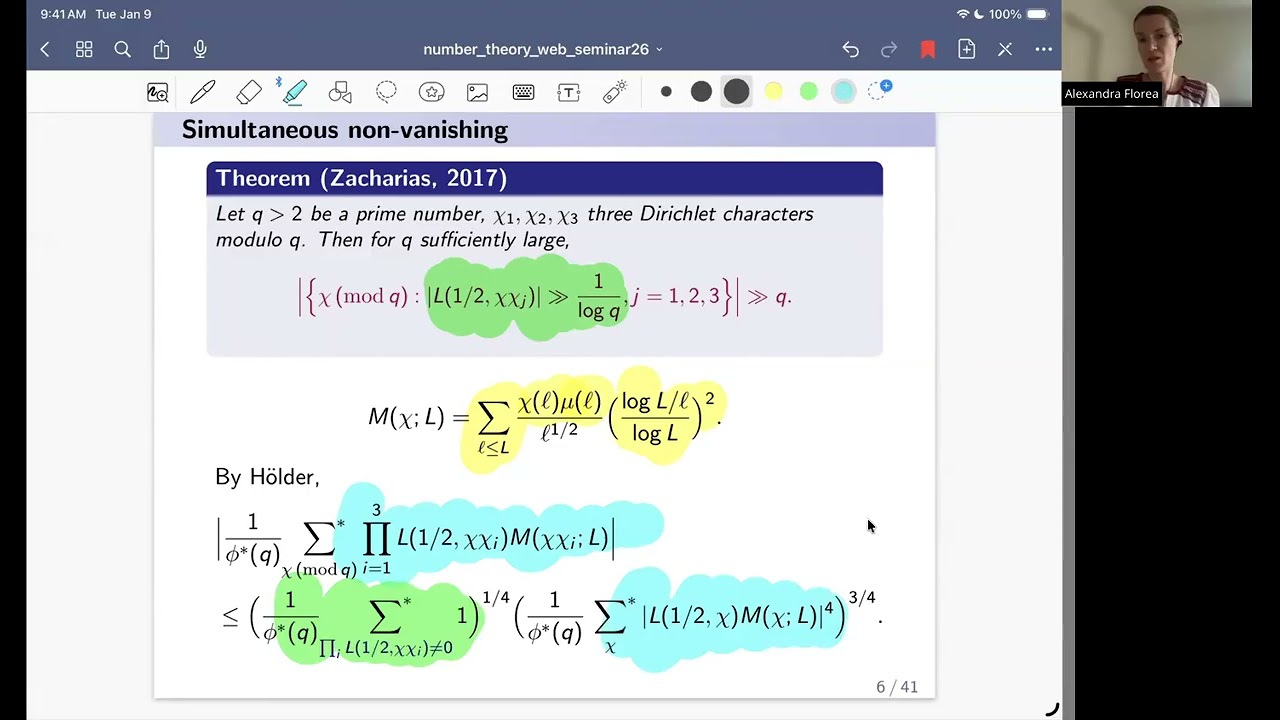
Okay, so he proved that if you take Q to
be a prime number and you take chi 1,
chi 2, chi 3 to be three Dirichlet
characters mod Q, then a positive
proportion of characters mod Q have the
property that L of 1/2 chi chi 1 and L
of 1/2 chi chi 2, L of 1/2 chi chi 3 are
non-zero. And in fact, he also gives a
lower bound on the value of the central
values, namely 1 over log Q.
Okay, when Q
gets large, this goes to zero.
So, it's not a very strong lower bound,
but in any case, he gets non-vanishing
for a positive proportion of characters.
He doesn't actually write down the
constant that he gets, but if you go
through his proof, it should be possible
to do it.
And what are the main ideas to prove
this kind of result?
So, he computes modified moments.
So, what is the idea behind this? The
idea is that um,
you want your mollifier to um, this is a
Dirichlet series, a truncated series,
and you want it to behave roughly like
one over your L function.
So, um,
he defines the mollifier
uh, as this Dirichlet series over say L
up to L where capital L is some
uh, power of Q, and then you have chi of
L and uh, mu of L, the Mobius function,
and the Mobius function is uh, the one
that ensures that you your mollifier
behaves like one over L, and then you
have some weight here.
And what is the main point for this
mollifier? Well, you use Holder's
inequality, and that gives you a lower
bound on this triple non-vanishing pro
uh, non-vanishing proportion. So, you
get that um,
the proportion of characters chi for
which L half chi chi J is non-zero for
all the J's, that's bounded below by um,
this cubic moment here,
and by this fourth moment here.
Now, if heuristically your mollifier
behaves like one over the L function,
then the cubic moment that I have uh, on
the left-hand side is roughly like
summing one, so you should be able you
would ideally want to show
that uh, this side here is
some constant times Q, and the same
thing for the fourth moment. Again, if
heuristically your mollifier is one over
your L function, then it
it's like summing one, and then that
would also be of size Q.
So, if you can show that uh, both the
fourth moment and this cubic moment have
size Q, then you get a lower bound for
the proportion of uh, triple uh,
non-vanishing and it will be a positive
proportion. The The idea is that these
moments grow at the same rate and if you
didn't have these mollifiers, then you
would have various powers of log Q
appearing and that would destroy your
positive proportion um
result.
Okay, so uh
now there are basically two parts two
independent parts of the proof. The
first one is computing this cubic
moment. The second one is computing the
fourth moment. Uh you see that the
fourth moment has absolute value in it
and the cubic moment doesn't. So the
techniques will be quite different.
So for the fourth moment, Zacharias uh
computed
um
obtained an asymptotic formula. So when
uh L, the length of the mollifier, is a
small power of Q, he computed this
fourth moment and he got um
some constant. So um
So uh this here is a polynomial in 1
over lambda. So this is just a constant.
Um and uh to do this to compute the
modified moment, he had to first compute
a twisted fourth moment.
And this has connections to the
breakthrough work of Matt Young who
computed the fourth moment of L of 1/2
chi with absolute value without a
mollifier. And then there has been a lot
of uh work on this problem. For example,
Hoff considered uh twisted um moments
with uh square free conductors. I will
just briefly mention these results.
We'll go come back to them.
Uh there's work of Blomer, Fourie,
Kowalski, Michel, Milicevic, Blomer,
Milicevic, uh Kerr, Parlinski, Wu and
Xi, Wu and so on.
Uh Uh, so I'll come back to this fourth
uh moment later. Now I want to focus
just a little bit on the cubic moment.
So, um, as you can see, he also obtains
a formula for the cubic moment.
And he gets a main term of size uh well,
constant size if you normalize and then
some error term.
So, you see that both of these formulas,
if you normalize, you get something
which is a constant. So, if you do the
ratio, you will get your uh non-
non-vanishing constant.
So, how do you compute this cubic
moment? Well, you start um
in the standard way using the
approximate functional equation for
these L functions.
And after you uh apply the approximate
functional equation, you end up with two
uh terms, a principal term and a dual
term.
And the dual term um involves averages
of this form. So, you need to average
the root numbers. Epsilon chi is the
root number of LFS chi. Here I renamed
my characters instead of chi1, chi2,
chi3.
Um I let chi chi1 be um chi and then I
get chi chi chi1, chi chi2.
So, I have a twisted average of root
numbers and it turns out that that is
related to a hyper-Kloosterman sum.
Okay, so then the idea is that you want
to uh bound sums of this form.
So, you have three L functions, so you
have three parameters here and not N1
and N2
coming from the three L functions. Then
you have this weight function here V of
N0, N1, and N2 over Q to the three
halves. So, this roughly means that N0,
N1, and N2 is less than Q to the three
halves, let's say, plus epsilon.
You have the hyper Kloosterman sum.
And then you need to multiply by these
characters, chi1 bar of n1, chi2 bar of
n2.
And it turns out that the
critical range where you want to
understand and bound these sums is the
range where
one of the parameters n1 is say square
root of Q, and then the product of the
other two
parameters is roughly Q. So I group the
two parameters
um
let's say n0 and then two, that's of
size roughly Q. And then I have these
averages of hyper Kloosterman sums,
which are twisted
by sums of this form.
So I'm summing over divisors of n, and
then I have chi2 bar
of n2.
So for example, if chi2 is just the
trivial character, that sum is just the
divisor function d of n, the usual
divisor function, which counts the
number of divisors.
Uh so and there are results due to
Kowalski, Michel, and Sawin, where they
bound precisely
averages of hyper Kloosterman sums
twisted by the divisor function.
Uh but this is a generalization, so
essentially this is what Zacharias had
to do. He had to generalize the work of
Kowalski, Michel, and Sawin to allow
weights which look like the divisor
function, but they are not quite divisor
function.
And all this is using algebraic geometry
techniques.
Okay, now the question that we want to
ask is can we say something about the
simultaneous non-vanishing of more than
three L-functions? Okay, so we're trying
to improve Zacharias' result.
Now, if you compute the one-level
density of zeros, which is a way of
studying the zeros which are close to
the central points in the family,
then on GRH, Murty and Carneiro, Chirer,
and Milinovich, um,
in separate papers, showed that more
than 1/2 - epsilon of the L-functions
are non-vanishing at the central point
1/2.
Okay. Now, if you want to use this
approach, uh, it's not enough to
provide, uh, conditional simultaneous
non-vanishing result for L-functions.
And why is that? Well, if you let, uh,
P, let's say P is the proportion of
non-vanishing for L of 1/2 chi, in this
case, under GRH, it's 1/2 - epsilon from
the work of Carneiro, Chirer, and
Milinovich,
then, uh, from the proportion of
non-vanishing, you can get a lower bound
on the proportion of simultaneous
non-vanishing just by doing a simple
union bound. So, then you would get that
the proportion of, uh, simultaneous
non-vanishing is greater than one minus
four times, essentially, the proportion
of, uh, non-vanishing of L of 1/2 chi
chi j, which is the same as the
proportion in the family, if you,
uh,
if you re-index your characters. So,
then you get that your proportion of
non-vanishing is greater than, uh, 1
minus four times, um,
the proportion of non-vanishing in the
family, which is 1/2 - epsilon, so
that's negative, so it doesn't give you
anything.
So, in order to get a positive
proportion of simultaneous
non-vanishing, you would want one
uh, minus, um,
4P to be bigger than zero.
So, you would need, uh, P to be at least
three-quarters.
Uh, so, we're very far from proving
something of this form.
So, the one-level density approach
doesn't work, so instead, we go back to
computing moments, but in a slightly
different way. So, uh, the result that
we proved is that if you assume GRH, so
all of this is conditional on GRH, and
we take Q to be a prime number,
then we take four characters chi1, chi2,
chi3, chi4. Now, they will be primitive
characters modulo DI, and the DIs will
be small powers of Q. So, we can't go
all the way up to Q. We can't get We
can't take characters chi1 through chi4
modulo Q. They have to be modulo small
powers of Q.
For simplicity, we assume that the DI
are square-free and pairwise coprime.
Then, for Q sufficiently large, we get
that a positive proportion of characters
we specialize to even characters, uh but
that's just a minor technical thing. So,
we show that a positive proportion of
these characters have um
a quadruple non-vanishing property. So,
L of 1/2 chi chi j non-zero uh at the
same time for all the four L functions.
And we also have a weaker unconditional
result. So, we have the same
restrictions on the DIs. So, they are
small powers of Q, square-free, and
pairwise coprime.
Then, we get that the proportion of um
simultaneous non-vanishing is bigger
than Q to the 1/3 minus epsilon times
the maximum of the Djs to the minus 2/3.
So, the Djs again are small powers of Q.
So, this gives you an infinite family of
characters,
but not a positive proportion, because
we have roughly a constant times Q
characters, and this is um
this is not a constant times Q. So, this
um
the proportion goes to zero in this
case, but it is an infinite family.
Um now, another question uh that we want
to ask, if you uh recall in the um
Zacharias result, he was showing that,
uh, there
uh, there is a positive proportion of
characters mod Q so that L of 1/2 chi
chi J are bigger than, uh, 1 over log Q.
So, this was from, uh, the Zacharias'
paper.
Uh, for the three, uh, three L functions
result.
Uh, we actually improve this for four L
functions. This is work in progress with
the same co-authors and Bojan Mikanovic.
So, again, we assume GRH and then we
show that there exists a positive
proportion of characters mod Q so that,
um,
this central L values, L of 1/2 chi chi
J is bigger than the exponential of, uh,
a constant times square root of log log
Q.
Okay, so, um,
this,
uh, bound, this lower bound here is to
be compared with 1 over log Q. So, this
is, uh, these are quite large values of
the L functions.
Um, and also, we show that we have a
positive proportion of characters so
that the L functions are, uh,
simultaneously
uh, small. So, smaller than exponential
of minus a constant times square root of
log log Q.
Okay, so, um,
what is the strategy of proof? Well, we
go back to computing moments, modified
moments, because the one-level density
approach doesn't work in this case.
So, let's assume that we have a modifier
which will be defined later.
Then, if we use Holder's inequality, uh,
in this form, we will get a lower bound
on the proportion of quadruple
non-vanishing.
So, um, over here we have, uh, I I
[clears throat] a plus on the sum, that
means that I sum over even primitive
characters.
So, what I highlighted here in green is
the proportion of quadruple
non-vanishing for even primitive
characters chi mod q. And we get a lower
bound in terms of two quantities. So, we
have a ratio
of something that looks like a fourth
modified moment. So,
we have a sum over chi mod q of L M
chi chi 1 L M chi chi 2. Then we have an
L M chi chi 3 bar and L M chi chi 4 bar.
I'll come back to explaining why we put
the bars on the L function a bit later
on.
And it's when we apply Holder, we also
get uh in the ratio, so in the
denominator, we get this uh sixth
moment. Sixth modified moment.
So, um
if we have in mind that approach of
Zacharias, he actually computed uh for
him he had a cubic moment and a fourth
moment. He actually computed the cubic
moment and the fourth moment, and he did
the ratio.
Now, for us this is not going to work.
Why? Because we don't know how to
compute high moments of L functions. So,
for example, we don't know how to
compute the sixth moment of L of 1/2 chi
when we do absolute value. So, I
mentioned the previous work on the
fourth moment, the work of um
the work of Young and improvements by
many other people.
But the sixth moment is completely out
of reach, and if you want to introduce a
modifier, that's even um more
unfeasible. So, you could compute a
sixth moment if you introduce an extra
average over say little q up to capital
Q, but we don't want to do that. We just
want to sum over characters mod q. So,
uh computing this sixth moment here
is out of reach.
But one observation is that if you want
to get a lower bound on the highlighted
green proportion of non-vanishing, then
in fact you don't need
to compute the sixth moment of
the sixth modified moment of these L
functions, but it's enough to get an
upper bound for it. So this is our
strategy. We want to
define a modifier so that we can prove
an upper bound for the modified sixth
moment, which would be sharp. So we want
to show that this is bounded by a
constant times Q.
And then we also want to show that this
fourth moment here is bounded below by
another constant times Q.
So if you have a lower bound on the
fourth modified moment, and if you have
an upper bound on the sixth modified
moment, then when you do the ratio,
again you will get a positive proportion
of uh simultaneous non-vanishing.
So this is what we will do. It turns out
that
uh the first two parts go hand in hand.
So
um
to we define the modifier and we prove
upper bounds for the modified sixth
moment, but it also kind of goes the
other way. If we want to prove upper
bounds for modified moments, then that
kind of tells us what the modifier
should be. And these ideas go back to
work of uh Soundararajan, who proved
upper bounds for moments of the Riemann
zeta function. That
uh those upper bounds were almost sharp.
They were in
Harper, who got sharp upper bounds for
moments of the Riemann zeta function.
And then there was work of Lester and
Radziwill on
uh upper bounds for modified moments in
uh various uh certain families of L
functions. So with that work in mind, so
inspired by these kind of ideas, we
define the mollifier through an Euler
product. So, what does that mean? We're
not going to define our mollifier in the
way
I showed you before in Zacharias work
where he has a sum over Dirichlet series
and he has the Mobius function which
ensures that you have cancellation with
your L function.
Instead, we start with work of Chandee
who bounds log of the L function, log of
absolute value of L by a sum over
primes.
Well, prime powers. So, he she has sum
over
n up to x which are prime powers. So,
this is the von Mangoldt function here
which is just supported on prime powers.
And really the most interesting are the
primes.
And then you also get some log Q over
log x. So, we're truncating
have flexibility in how we truncate the
sum over the primes. So, let's say we
truncate up to some point x and that
introduces a log Q over log x term.
So, if you exponentiate this, you will
get an upper bound for your L function.
Okay? So, the L the L function in
absolute value will be essentially
bounded by the exponential of the sum
over the primes. So, roughly we have
that L of 1/2 chi
is bounded by the exponential
of the sum over the primes.
Roughly chi of p over square root of p.
I'll put it in quotes. It's not exactly
this, but roughly this. You have some
weight for the chi of p and you have
this extra factor, but roughly you have
this exponential of the sum over the
primes. And now the main idea is that
you can approximate the exponential by a
truncated Taylor series. So, if you want
to approximate the exponential of T and
T goes up to say H over E squared, then
you can truncate the exponential of T
by the Taylor series truncated at the
point H where H is the upper bound on T.
So, if you replace your T by
the sum over the primes, then you
roughly would get that the L function in
absolute value is bounded by sums of
these forms. So, when you expand
everything, you truncate at some point
H, let's say.
So, now you're summing over N whose
primes are all less than X. Let's think
of X as being roughly Q to the epsilon.
We truncate at the point H, so we sum
over integers N with at most H prime
factors. So, this capital omega of N
counts the number of primes of N.
And then we have chi of N. We have this
new function U of N, which is just a
multiplicative function which um
um which controls the repetitions that
we get. So, how many times you get this
N when you expand
when you expand
the Taylor series.
Um and this is roughly what sums we
would have to consider.
So, if we keep in mind this um
model of Zacharias where he was defining
the modifier um as a Dirichlet series
with mu of L chi of L over square root
of L, then maybe this would uh
lead us to say that, okay, then maybe we
can define our modifier in this form.
So, it would be exactly the same uh
series that I have over here. So, we
have the same kind of sum over integers
whose primes are all less than say Q to
the epsilon with at most H primes and
then we just throw in this
Mobius function here which takes care of
cancellations.
But it turns out that if you run this
argument with an optimal choice for H,
so the point where you truncate, this
does not lead to a sharp bound for the
modified moments.
So we have to refine this argument
and then what we do is we
apply these ideas behind Harper's work
on
moments upper bounds for moments of the
Riemann zeta function where instead we
split our primes into infinitely many
intervals and essentially we use the
fact that primes small primes behave
differently from large primes. So we
don't want to deal with the small and
the large primes in the same way.
So we split the primes into all these
intervals. It doesn't really matter at
this point what the intervals are.
And then we stop when say BK is a small
constant, so we have like Q to the
epsilon. Okay, so we only consider
primes up to Q to the epsilon.
And then we define our modifier on each
of these sub intervals. Okay, so the
J'th piece of the modifier
will be a sum over integers n whose um
primes are all in the J'th interval and
they have at most let's say HJ prime
factors. These are parameters that you
need to choose carefully.
And then the modifier has the same
structure from before, so you have chi n
mu of n over square root of n. And then
you define your modifier as the product
of all these pieces.
There are of course constraints on the
parameters, so you want all of these
when you expand them, you want to get
certain Dirichlet series so that you can
actually compute moments of those
polynomials. So, you have certain
conditions on the beta
betas and the H's, but that's a more
technical thing which doesn't matter too
much right now.
Um so, if we if we adapt the method of
uh Soundararajan and Westerlund
Radziwill, then we get that uh we have
um
sharp bounds for uh any
uh
any mollified moments, not just for the
sixth moment. We need it for the sixth,
but we um can make this work for any um
any moment.
Okay, so that finishes the
uh
the discussion about the upper bounds.
Now, we also need lower bounds for the
mollified fourth moment. And here the
techniques are completely different. So,
now our modifier is set. We already
chose it so that it allows us to prove
these upper bounds for uh high mollified
moments. Now, once we have modifier, we
want to show that we have a lower bound
for the fourth moment here.
So, notice that we have the absolute
value on the moment outside, so it's not
in the L function. But, if you look at
this moment, for example, if you
specialize to chi1, chi2, chi3, chi4
being uh the trivial character, then you
actually recover the fourth mollified
moment with absolute value. So, although
we don't have absolute value in the L
function in this average over
characters, it kind of behaves like a
moment with absolute value.
Okay, and there has been a lot of work
over the years. I will not mention
everything.
Um
as I said, this
uh
the first power saving uh asymptotic
formula goes back to work of Young.
There were improvements by Blomer,
Fourie, Kowalski,
uh Michel
There has been work on twisted fourth
moments, twisted mollified moments,
shifted twisted moments, and so on. So,
a lot of work. Some of these papers deal
with Q prime. There's been recent work
where the the assumption of Q prime was
removed, and so on.
So, for us, we want to generalize all
these results. So, now we want to
consider a moment where in the character
we twist by these characters chi one
through chi four. So, we want a twisted
fourth moment with character chi one
through chi four, and the twists are the
ones that come from the Euler product
mollifier.
Okay, so um
uh
If we want to do the modified moment, we
need to do a twisted moment. So, this is
the main object that we're interested
in. So, we have the product of L of 1/2
chi chi one, chi chi two, chi chi three
bar, chi chi four bar, and then we
multiply by two twists chi of L1 and chi
bar of L2.
We start in the classical way. So, we
use the approximate functional equation.
Uh we get a principal term here.
Um and the coefficients are
these convolutions of characters. So,
chi one star chi two. This is a
generalization of the divisor function.
So, it's a sum
over, let's say, AB is equal to M of chi
one of A, chi two of B.
Um so, again, when chi one and chi two
are trivial, then this is just the usual
divisor function. And then, one um one
appealing feature Okay, so I should say
we also have this weight function here,
V.
Um which is rapidly decaying. So,
essentially, you need a man
to be uh less than Q hat squared. So, Q
hat here is roughly, let's say that
D is the maximum of the DIs, the moduli
of the four characters that we start
with. So, this is roughly Q times D. So,
we have a sum over MN up to roughly QD
squared.
Okay, so it's like you're truncating.
And then you have a dual term here.
And this is very different from
Zacharias' work. So, in his work, I
showed you that the dual term was
involving this
twisted average of root numbers.
And we have the same feature here, but
now the root numbers have the the
appealing feature that we have an
epsilon of chi chi one,
epsilon of chi chi two,
epsilon of chi chi three bar, and
epsilon of chi chi four bar.
And chi and chi j have co-prime moduli
because Q is prime. So, actually, they
split from the Chinese remainder
theorem. So, you can write epsilon of
chi chi j in terms of epsilon chi times
epsilon of chi j. And because we take
the bars on these second
L values, the epsilon chi and the
epsilon of chi bar will combine, and
then you don't need to deal with the
oscillations of the root number.
Okay, so this is very different from
Zacharias', where the bulk of the work
was going into controlling the
oscillations of the root number. For us,
we don't have this feature here because
we get rid of the root number.
Uh so, here, epsilon is just something
which depends on the DIs, and it has
absolute value one.
So, it's not a root number anymore.
So, once we know how to deal with this
principal term, Dealing with the dual
term will be very similar because the
dual term is
very very similar to this principal term
except that you
put the bars on chi1 chi2 and the bars
on chi3 bar chi4 bar and you need to
multiply by this extra chi factor of d1
d2 d3 bar d4 bar.
Okay, so
if we use the approximate functional
equation, we get
um
two terms, the principal and
dual.
And now we introduce the sum over the
characters. So we need to use
orthogonality for even characters and
uh the orthogonality relations um
isolate the terms with m congruent to
plus or minus n mod q. So we will have a
diagonal term which comes from m is
equal to n and then we will have
off-diagonal terms from m is not equal
to n.
Um so we compute the diagonal term. This
is all quite standard. So if we compute
the diagonal term,
uh what's interesting is that we get a
product of four L functions evaluated at
one.
So recall that we started with chi1 chi2
chi3 bar chi4 bar. So now we get a
product of combinations of products of
this. So we have chi1 chi3 bar chi1 chi4
bar chi2 chi3 bar and chi2 chi4 bar.
And then we have some factors here which
depend on the twist. These don't really
matter. These are products over p
dividing L1 product over p dividing L2.
So just some finite Euler products and
then we have some function here which is
absolutely convergent, so we don't worry
about it too much.
Okay, so now we want to introduce the
mollifier. So keep in mind our main
goal, we want to get a lower bound of a
constant size for the modified fourth
moment.
So, when we introduce the modifier, we
have the product of the four modifiers,
and each modifier is a product of
infinitely many pieces.
So, if we expand, it kind of looks bad,
but it's not so bad.
Um there is a lot of structure in the
product of the modifier
uh
in the product of the modifiers. So,
you're summing over integers
um
m and n, and you write them as products
of m naught up to m k and naught up to n
n k, so that
uh the m j and n j are only divisible by
primes in i j.
Uh recall that we had the modifier the
Mobius function in the modifier, so we
get mu m mu n, the characters, and then
we have these extra
um sums here, which again look like the
divisor function. So, if chi 1 chi 2 chi
3 chi 4 are 1, again you just get
divisor of uh m j and divisor of n j.
Okay, so
um
then when we introduce the modifier and
we have the the product of the four L
functions, we essentially
need to compute this twisted moment,
which we just did.
And now we introduce this diagonal term
from the twisted moment.
And uh if we use our formula for the
diagonal term, uh recall that we had a
product of four L functions evaluated at
1, and then we have some term which
comes from the modifier.
Okay, with these coefficients, say a p,
which is chi 1 plus chi 2, and b p,
which is chi 3 bar plus chi 4 bar.
So,
if we're careful, we can actually write
this as an Euler product over P, let's
say P less than Q to the epsilon.
And
um
this will be 1 minus
So, I need to multiply AP and BP. So,
it's something like chi1 chi3 bar over P
and then 1 minus chi1 chi4 bar over P
and so on.
Uh but the L functions, again, if you
think of truncating them, then that
would be like a product up to Q to the
epsilon of 1 plus chi1 chi3 bar over P
and so on.
So, if you combine these uh together
So, if you combine, say, this term with
that term
um you multiply them, you get rid of the
term which involves 1 over P and you
only get things of the form 1 over P
squared and those are convergent um
Euler products.
So, this is how we get our lower bound
of constant size. To make it precise, we
need to use a result of Granville and
Sound on GRH which approximates
log of L of 1 chi by a sum over the
primes. So, essentially, truncated sum
over the primes. So, you approximate the
L function by uh a truncated Euler
product.
Okay. Uh so, this is what happens with
the
uh diagonal term. So, you have these
things which are of the size 1 over P
squared. So, that's why you get your um
lower bound of constant size. But there
is an issue. There are, in fact, six
main terms, uh not just this diagonal
term.
Uh there are five more terms, but these,
after you introduce the modifier, are
negligible. Okay? So, you're only left
with the contribution from the modified
diagonal, which is bounded below by 1 by
a constant. Uh so, you're good.
Um
so
I won't say too much about how to
extract these other terms and how to
bound your off-diagonal term because I
don't have a lot of time.
Um I will just say so right now
um
we have the sum over M and N and we have
these uh convolutions of uh characters.
Um now we assume that M here is of size
uh let's say roughly M and N is of size
roughly N. And we use ideas from the
work of Young and also from work of
Zacharias. So we have two different
types of regime, the balanced case and
the unbalanced case. So when the the
variables are far apart, when M and N
are far apart, we follow Young's proof
and um that works even when we have
these uh more general coefficients, not
just the divisor function.
Uh when the variables are close
together, we follow Zacharias and that's
using spectral methods. So we start with
the delta method of Duke, Friedlander,
and Iwaniec.
And um
we end up with sums of this form. So we
have a sum over M and N of these
generalized coefficient times
exponential functions. So then we use
Voronoi summation on the sum over M and
N. We use it twice, once for the sum
over M, once for the sum over N.
And in fact, we need to prove a Voronoi
summation formula because we uh couldn't
find one in the literature. So the point
is that when we prove Voronoi summation
this on the right-hand side, you will
get uh three terms. One term involves L
of 1 chi 1 bar chi 2, L of 1 chi 1 chi 2
bar, and then a dual sum. So we need to
bound the dual sum.
and
um
we have these main terms here and these
will be secondary main terms. So, this
be
essentially what you see these L
functions here. So, this is like
swapping your character. So, you get
certain one swap terms coming from here.
So, you swap um
So, we start with chi 1, chi 2, chi 3
bar, chi 4 bar and this is like swapping
chi 1 and chi 3. You have another one
swap term which swaps chi 1, chi 4,
another one which swaps chi 2, chi 3 and
chi 2, chi 4. So, in total you have four
one swap terms. So, you will get a new
term which involves a product of L
functions, but now your characters are
swapped. So, you get four of these.
And you get one more term which is a two
swap term. Uh this comes from the dual
term in the approximate functional
equation. So, this corresponds to
swapping chi 1 and chi 3 and chi 2 and
chi 4.
Okay, so we get
uh one diagonal, four one swap terms and
one two swap term and then we bound the
error terms using spectral methods.
Um So, that concludes the discussion
about the conditional result on GRH.
Now, we also want to prove unconditional
non-vanishing. So, how do we do it? We
don't do modified moments anymore.
So, now we start uh with the fourth
moment.
The pure fourth moment, not a modified
one. And if we use um
the upper bound for these L functions
due to Petro and Young, so you get a
cute D to the 1/6. If you multiply by
four, you get QD to the 2/3. So, this
fourth moment is bounded by QD to the
2/3 times the number of characters with
this quadruple non-vanishing property.
So, the proportion of non-vanishing is
bounded by QD to the minus 2/3 times the
fourth moment.
So, if you want to show that you have an
infinite family of characters for which
you have this quadruple non-vanishing
property, then you should show that this
fourth moment is non-zero. That's all
you need to do.
Uh it turns out it's not extremely easy
to show it because the fourth moment uh
is a sum of six terms.
So, you know that each of the terms is
non-zero, but you don't know that when
you put them together, you also get
something non-zero. It could happen that
they conspire somehow, and when you add
all of these terms together, you get
zero. So, we need to deal with that.
Um so, we have a sum of six terms. Each
of the terms is um
of this form. So, this is a product of
four L functions evaluated at one, and
all the other terms involve products of
character swaps of these uh L functions.
So, uh you have the one swaps and the
two swaps and so on. So, you want to
show that when you add all these six
products of L functions evaluated at
one, you don't get zero.
So, what we do that So, if we permute
the characters, we can assume that the
first product of L functions is the
biggest without loss of generality.
So, then we get that the main term is
bounded below by an expression of this
form.
Now, for R, we do have a lower bound,
which comes from the Siegel bound for
the L function. It's ineffective at one.
And we have this expression which
involves the DIs, and it turns out that
this is positive for most DIs.
Um but there are a few small cases for
the DIs where this is negative. So, in
that case, we don't get our result.
So, then we are left with a finite
number of cases, and we didn't really
know how to deal with it.
So, this reduces to showing that a
certain 6 by 6 determinant is non-zero
and then we use Mathematica to do it um
because the characters are already built
in and we know exactly what the
coefficients are equal to.
And the very last thing that I will say
is that building on this work and using
uh work of um
Bui Evans, Lester Pratt, and Radziwill,
we can now revisit the this question of
how big and how small can the values L
of 1/2 chi chi j get simultaneously. And
we have to prove some kind of version of
CLT and that allows us to uh get this uh
result which says that not only do you
have non-vanishing, but in fact it
happens uh very often that uh the L
functions get simultaneously quite
large. So, I will stop here. Thank you.