AI Won’t Replace UX Researchers | SAP Researchers on Ethics, AI & Human-Centered Design
Watch on YouTubeVideo summary
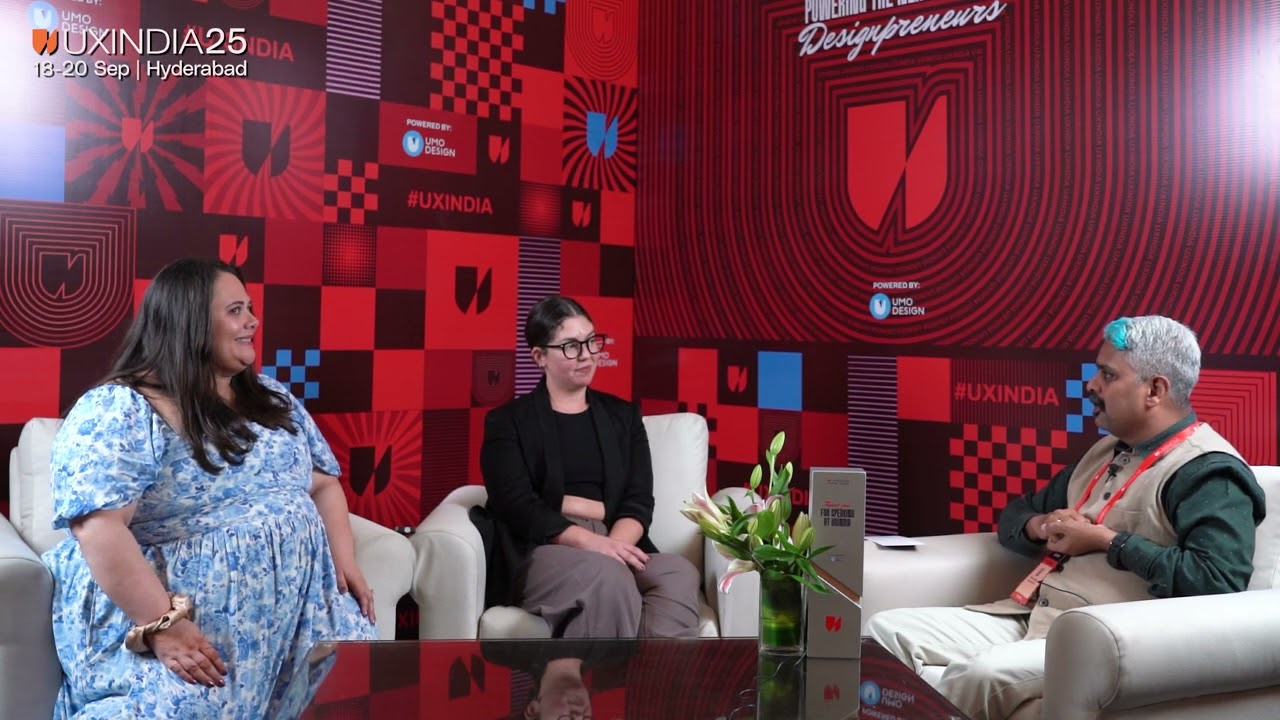
The video features a lively discussion between SAP researchers Gabriel and Tyler at the UX India 2025 conference, highlighting their positive experiences in Hyderabad and reflecting on the growing maturity of the design landscape there. Both speakers express deep appreciation for the welcoming atmosphere and note how Indian UX professionals have evolved from simply executing executive directives to actively challenging assumptions and driving insights that truly benefit the business. This shift represents a significant step forward where researchers are now taking ownership of their work, pushing boundaries with stakeholders, and securing a vital seat at the decision-making table rather than just acting as order-takers.
A central theme of the conversation is the responsible integration of Artificial Intelligence into user experience research, emphasizing that technology should serve human needs rather than dictate them. The researchers argue against becoming "AI solutionists" who rush to implement AI without understanding real user problems, advocating instead for a balanced approach where tools like AI are used ethically and effectively alongside other technologies such as computing power. They stress the importance of maintaining human intelligence in the loop, suggesting that professionals should always formulate their own thoughts before prompting an AI tool to ensure they remain critical thinkers who solve genuine pain points rather than just generating content or answers without depth.
Language diversity is presented as a unique superpower for researchers like Gabriel, enabling inclusive studies and deeper cultural understanding across global markets. The speakers illustrate how multilingual capabilities allow teams to adapt instantly during interviews when participants are uncomfortable with English, ensuring that data collection remains authentic and representative of the entire ecosystem. Beyond language skills, they highlight the value of diverse personal networks in fostering empathy and broadening perspectives on reality, which ultimately leads to more robust research outcomes. This human-centric approach extends to stakeholder management, where building genuine relationships and trust is essential for uncovering truths that users might otherwise withhold, thereby creating a competitive edge through authentic connection rather than just technical prowess.
In their rapid-fire segment, the researchers describe themselves as passionate risk-takers who thrive on collaboration and storytelling, whether in film editing or exploring ancient practices like Ayurveda. They identify moments of silent co-working and idea jamming as the most productive times for innovation, reinforcing the belief that magic happens when teams come together to synthesize data and brainstorm solutions. Ultimately, they envision a future where every product team includes a dedicated UX researcher alongside engineers and managers in an integrated "three-in-a-box" model, ensuring that human-centered design remains at the core of all technological advancements while protecting users from potential harms caused by unchecked automation or dark patterns.
Read the full video transcript
It's been a very exciting journey so far
with UX India 2025. We have a lot of
speakers coming on the ground, taking a
lot of insight. We in UX India, all
people on the floor are getting so much
energized with the knowledge that's
flowing out. Uh we have people coming
across different part of the world. We
have today Gabriel and Tyler. Thank you
so much joining us here.
They're the part of the SAP team in
research, of course, but
it is an opportunity for us to host you
in India.
At the same time, we have a lot of
questions related to how things are
changing in the world of research. In
SAP, how are you adapting? And that's
why we called you here.
>> Right. No pressure.
We love questions.
>> That's great, because usually you ask
questions. This is the time you have to
answer this question.
Okay.
>> I never I I always ask the questions,
except I never answer the questions, so
I'm like, "Oh, no pressure."
>> Now you have to answer.
>> Oh, no. Okay, we're ready.
Do your worst.
>> Okay.
So, uh
today um Tyler, I remember you were
talking things up there and uh you just
have completed your session there. First
of all, let's start understanding how do
you find this UX India 2025 vibe?
>> I love it. I I really like the location,
and every single year, like every single
year the people are super super nice.
So, that that goes without saying,
because the UX India crowd is fabulous,
but Hyderabad is my favorite city in
India. So, I'm very happy we're in
Hyderabad.
>> That's great. Gabriel?
>> No, I'm I'm I'm having a blast. I mean,
it's uh I I I feel so lucky to be here.
And like Tyler mentioned, like everyone
is so amazing. And it feels also so nice
to to see a lot of people that watched
us last year coming back, you know, and
wanting to talk to us. So, it feels a
little bit like it was my first time in
India last year and that was the second
time and I'm like feeling every time a
little bit more at home in India, which
feels like, you know, my home is getting
bigger. So, uh
that's just a great feeling.
>> That's great. That's great. And I think
we are also talking second time on the
camera and that's a good platform that
we also have uh UX India here.
Uh similarly, um if you want to
I mean, you you are talking, you're
going across world, talking with your
users.
I would like to know how do you see how
this design maturity in India
you are seeing from the global lens.
>> Um what we have been saying uh from our
company perspective is that uh there's a
lot of hiring happening in in in India
right now. So, I'm like um and I mean,
this is like happy and sad news. I'm
like uh changing my teams. So, I am like
going out to a new team. So, we're going
to we're going to have to think how
we're going to be collaborate. We're
going to have coffee calls, for sure.
Coffee We have our coffee calls.
Everyone knows we like coffee calls.
But, I'm really excited that my new
team, for example, we have uh two new uh
Indian researchers that I'm I'm so happy
that I can also like, you know, uh be
here, better understand them, and and uh
be exchanging with them. So, like I feel
like uh there's a big market growing now
uh for yeah, new uh jobs. So.
>> Yeah.
>> Your version.
>> I agree that the market in India is
growing and it's really cool to see UX
research specifically grow in India.
Um
the thing that I'm seeing is that
the researchers in India are learning to
shift their mindsets a little bit
because like
6-7 years back,
they had a little trouble, I noticed
like breaking outside of like the
directives of their executives. They'd
be like, "Go research exactly this. Here
is the research prompt." And they would
go, "Okay." And they would give you
exactly that. But now what I'm seeing is
they're pushing back and they're pushing
boundaries and they're taking the
research into their own hands. And an
executive might give them a directive
and they'll be like,
"Cool. I'm going to interpret that how I
need to interpret it, cuz it's kind of
squishy and needs to, you know, subject
to interpretation." And they'll deliver
the insights that the business needs
rather than what the business is asking
for. And that's what That's the maturity
that I want to keep seeing the the
Indian researchers pushing. And I'm like
very excited cuz it's it's happening and
I see it. It's very cool.
>> You must be having certain expectations
from them, because now you already
mentioned they're already doing a lot of
things. What's your expectations from
them now?
>> Keep killing it. I don't know. They're
They're doing great. So, just keep
pushing boundaries and keep challenging
people and like pushing back with
executives, cuz design, UX, research, we
all have to push back and kind of take
seats at the table. And people don't
necessarily know what they need from
design, cuz they don't understand
design, right? So, I I want to see the
the UX folks in India
kind of take control, grab the seat at
the table and be the bosses that they're
meant to be.
>> That's good. Okay.
And uh
this this year we have a theme of
AI, entrepreneurship, and design as a
total com- combination of the flavor.
Uh so, where I also need
um you know,
need to know your insight.
Uh especially there are many companies
rushing towards AI.
Okay?
I need to know, I mean um with a truly
uh un- understanding with the user
expectations, right?
How we actually can
bridge this gap of AI
and experience design, or maybe you can
say user experience.
>> Um yes, well, like we've mentioned in
our talk, we are not AI solutionists.
So, we want to focus in uh the users' uh
real needs and pains, and I think uh AI
can be awesome, but we should also be
taking consideration other uh
technologies uh as well. So, I think
that that's like, you know, we don't
want to just like cool use cases, like
also Tyler mentioned in in our talk, we
want to see something that is actually
helping the end users. Uh so, I think
that's my nugget. And
>> Yeah.
>> You take it away. No, exactly we said we
want to be helping the users, cuz
something's not going to make nothing's
going to make money if you're not
solving a problem. So, rather than
starting with a technology, which I
think a lot of companies are doing,
they're like, "We have AI, let's smoosh
it into our product."
Whatever happens, happens. People will
pay for it. Rather than doing that, we
need to be asking, "What are the
problems?" And maybe AI is a solution,
just like Abby said, but starting with
the problems, cuz that's where you're
going to drive business value. People
will pay for their problems to be
solved.
>> Absolutely. I mean, AI is the one of the
tools, I mean, we've seen transitions in
the technologies, design to, you know,
experience design to research, to
everything that's changing things. I
think AI is also one of the tools that
it just groomed in. Of course, it is
going to stay. It is definitely help us
wrapping up the things faster.
But, when you said other tools, other
technologies, especially Abby, you said
about it.
>> Yeah.
>> So, what are those other takes?
>> I mean, computing, the power of
computing, like, you know? So, that's
what I mean about it. Yeah.
>> Okay, great. Okay.
>> Yeah.
>> Um I know Gabby, you are working on um
multilingual aspects. You have
championed five different languages
across
things. I would like to hear something
about this. I mean, how this is changing
the approach um matching the unique
asset for you.
>> Thank you. Thank you. Yeah, that's my
superpower. That's what I'm like proud
of.
I used to be a UX
uh designer, and when I was
transitioning to UX research, I was
looking into my skills, and as a
designer make speaking multiple
languages doesn't make of a difference,
but like as a as a researcher, it does
bring difference into the table. So, we
did had uh
situations where we had interview
subjects that they couldn't speak
English fluently. So, it's always makes
it research much more inclusive. Uh
besides, I'm also um pretty proud that
I've
had a fellowship in Shanghai this year.
>> Wow.
>> So, I've lived in in China for for 10
weeks. So, I'm like I'm like India last
year was the first time I was in Asia.
Now, I am like, you know, understanding
more about like the Chinese market as
well, and uh and and then of course, I
am
originally from Brazil. So, I I know
South America, and living in in Germany
now for
16 years, I I understand a lot about,
you know, German culture, and have a lot
of like friends. So,
um My tip is also like have have a
diverse group of friends, you know?
Like, when I am like recruiting, I'm not
only recruiting for interviews. I'm like
also like the friends I have around me,
they all have like different
backgrounds, different cultures,
different languages, and just by living
that, you can understand so much like
different ways of like perceiving
reality, and uh that mind uh maybe sound
like that's like not maybe the urgent
background of like business priority,
but it does make a small difference that
has like a huge impact, and so uh that's
a a a subject that I'm
personally very passionate about it. So,
Tyler knows.
>> Yeah. This is why
she she brings so much richness to our
research. We we had an emergency
situation. We we were doing an
an interview with a user in Mexico,
and we had like an emailing in English,
so I was like, "I'll run the interview
in English.
No problem." We get on, and it's
immediately apparent that he is not very
comfortable with English. So, I Slack
Gabby in the back, and I'm like,
"Please run it in Spanish. I know you're
not like you weren't planning on doing
the interview, run it in Spanish." And
she goes, "Go." And she just jumps right
in. She just ran this whole interview in
Spanish. I have no idea what happened.
But
she said it was good, so but she doesn't
give herself enough credit. This is She
is This is like an amazing superpower,
very underrated.
>> and I mean, and also no, man, just thank
you to you that you allowed me to use my
superpower, because I think this is your
superpower. You really leverage the best
of everyone that you work with, and
you're like elevating everyone. So, uh
thank you to you.
>> So, actually, languages definitely gives
us power to understand the entire
ecosystem, okay? And that's where we
will be able to understand
culture, the thought process, where they
came from, what are the touch points
that they are going to have, be digital,
physical, and that helps us
check the pulse. And that is I think
being very fundamental aspect. Language
helps us to get that, you know, pulse of
it.
I've asked you two questions. One is
about the foundational part, which is
because the language that you are
getting a championship on this.
And I asked you one question about the
AI. I want to see because you're you're
in the industry
9 years? 5 years? I mean you will have
almost, sorry, 6 years. You will
definitely have um
um next 20 years at least in line.
What do you see
with AI, with other technologies, other
tech?
Uh where will
design industry will lead?
And what's your thought about?
>> Man.
I think about the AI is a tool like any
other tool. And if you take like, you
know, history, let's say, like when a
man started like working with fire,
right? Like we didn't nominate it fire
and we burned ourselves. Like we burned
forests, maybe. So, it's like but then
if you know how to use this tool, there
there was a huge potential, you know,
like to bring us where we are right now.
And I feel like I always every time I'm
talking about like any technology, I get
back to this because it's so fundamental
in like every tool that we are learning.
And you see, you know, how how
technology has been, you know,
developing. And in every case, there is
like really positive benefit, but
there's also a lot of danger there. And
that's why we want to always focus in
the needs. We always want to focus on
the pains because that that drives us in
leading, uh you know, use cases that
like best in class and that will
actually makes people lives better. So,
I think that's that's why we want to get
back to this car and so
yeah, just to to go back but but yeah, I
think
we're living in an exciting time but we
really need to be watching out about
like the consequences and like how we
are using this tool because if you're
like asking something to AI and you're
not thinking twice, you know, and we're
just getting an answer are you really
exercising your brain to have our unique
cuz like we are like, you know, like
position unique positioned
>> Mhm.
>> our brain to like look into things that
like even be on AI. So, if I may have an
ask for everyone of us excited about AI
before you using AI tool before you ask
before you make a prompt, think what
would be the answer from your brain.
>> Mhm.
>> I Don't wait for the and then you look
at the prompt.
And then for me when I'm using AI tools,
it's always like a conversation. I use
nuggets of it. I've never used the full
thing cuz my brain I am taking care of
my brain in the first place, you know,
and that's exactly why I'm like I'm not
afraid that AI is going to take your
jobs because I'm taking care of like my
my my, you know,
>> intelligence
>> human intelligence
in the first place.
>> Your HI.
>> I I think you've inspired me.
You've helped me build my answer cuz I
was like I don't know but
I I want to build off of this and go in
a little bit of a different direction.
>> it.
>> But we're user experience people and
we've always been the champions of the
users and I feel like it's our job to
like advocate for like the users' best
interests, right? We're all about like
do no harm. We always like talk about
how bad dark design is and I feel like
moving into the future as AI starts to
become more and more prevalent, it's
I feel like it's going to be the duty of
the UX
professionals to really be advocating
for ethical AI as we move forward. Gabby
touched on it during our presentation,
but
>> I the technologists, they get cut they
get really excited because it's you
know, maybe they don't see too far ahead
or maybe they're really excited about
what's in front of them of like the art
of the possible, right? They're like,
"Oh, what can we make?" And they're
pushing technology boundaries,
technological boundaries. But
for the UX folks, I think we have we're
uniquely positioned to see where there
can be harm done to the user and it's
going to be on us to vocalize this and
really really advocate for protecting
the user. So, it's going to be less
user experience and more user protection
and we're going to have to be the
champions of that.
>> One favorite question.
>> Oh, no.
>> Followed up.
A favorite question of UX researcher.
>> Okay.
>> Okay?
>> So, we'll like it?
>> Yeah, you'll love it.
>> good, good.
>> But the answer is tough.
>> Ooh.
>> Given a magic wand,
>> I Okay, okay.
We love the magic wand.
>> Yeah.
>> What that
tool look like to you for UX researcher?
>> What would the tool look like?
>> Or what kind of experience that feel to
you for UX researcher which will give
you quick answers, quick things going
out.
The system will do the interviews. They
will empathize with the human.
Is it something really possible done?
Given a magic wand wand, I mean,
come on.
>> Yeah.
>> Blow your creativity.
>> I won't do the interviews. I don't Mhm.
I like to be One, I like doing
interviews, but I feel like
for me at least the way I do interviews
kind of deviates from
maybe what you're supposed to what
you're taught that you're supposed to do
as a researcher. So like
interviewing always depends on the the
answers you're getting and like the tone
and the needs of the participant and the
feelings of the participant. I don't
think AI can read that and get the
correct answers because sometimes you
we've had this you ask a user a question
and they'll just go yes or you'll ask a
user a question they'll like hey do you
like this and they'll be like yeah I
like this and I feel like an AI would be
like
okay they said yes they like the product
cool. But I can hear yeah I like this
and I can push back and say hey hey
why why do you like this sell it to me
and push push and I know where I need to
push cuz I've been doing research for
almost 10 years right? So I don't want
to run the interviews but I would love
it if transcriptions actually worked hmm
because transcriptions are very not good
right now and especially with accents
they're all trained on like a like
Midwest American accent. So if I talk to
anybody from Germany I get like mishmash
of words coming back. So I want
transcriptions to work in different
languages in different languages. I
would love it if it could translate for
me so that if Gabby's not there to
translate a German recording for me I'm
okay. I can be an independent girl.
>> Yeah.
>> Um
but also like just the act of getting
the transcripts into like a mural to to
synthesize that's like my biggest pain
point and I hate it and I'm
procrastinating on that right now sorry.
Um
so I would love it if it could start
doing early synthesis for me and then I
could build off of the synthesis it's
done. That's that would make my life
easier. I don't know what what's in your
dreams.
>> I fully agree with you so I'm down on
you. I feel like I'm going to shift this
question a little bit and instead of
like using a magic wand for like the
tools I want to
shift the magic wand for like we we
where we want to be strategically and I
think I want to use the magic wand to
say that I would love to see every
product team having an UX researcher
directly talking at the same table with
the main engineer, with the chief
engineer and with the product manager to
make decisions.
>> We got to work in a three in a box
model.
>> Three in a box model, yeah.
>> So every every team has chief experience
officer.
Probably that's that's going to run the
entire show to ensure that we are
human-centric, human experience centric.
>> We need more UX researchers at the table
making sure that
>> Every project because we are in a very
very less in a size and we we we don't
we don't have that luxury of having a
volume of experience researchers on the
plate. I think that's fantastic thing
that we should have.
>> We're walking through that but I think
we are
>> we have we're we're we're building
toward our our har- our harmonized
operating model, right? And that's
really H palm. It's really shifting
toward the the three in a box. I think
they're adding a fourth but like a four
in a box working model. So SAP is
shifting in that direction which is
>> We are walking into yeah.
>> Superb superb superb. Okay.
Um
I just move to the next part of the
discussion and uh I know you know this
answer but I still want to know your uh
uh understanding because typically what
happened today we do
research for every project.
We forgot that we are not here to
reinvent the cycle
or reinvent the wheel. It is something
already done and dusted.
>> Yes.
>> What's your thought of reusing that?
Now can I save entire industry time?
>> You know I have feelings about that.
>> Go for it.
>> I have
I have so many feelings about this cuz
I've been on projects with maybe some
more junior UX people, right? And
there's a question that they're asking,
the product team's asking the question,
and the more junior people are like,
"Okay, we have to go do brand new
research. Let's go and interview people.
Uh and but we also have to move really
fast." And I look at them and I'm like,
"You know that probably like five other
companies have done this exact research,
and they've probably published it. So,
why don't Or someone in our company has
already done this research. We don't
have to do brand new research. Let's go
find out what's out there. We can always
do secondary research. That's fine and
get the answers that the product team is
looking for.
But we don't need to duplicate effort.
It's a waste of our time. It's a waste
of our company's resources when another
company has probably already invested
money in getting the answers to things.
So,
it's always best to do like a cursory
search internally in like a research
repository or through like talking to
people.
Or and also doing research externally,
doing a secondary, like do a Google
search. Go look on Google. Ask the
question. There's probably some like
academic papers out there that could
answer some of your questions. And then
build off that.
>> Same what you're doing?
You also have the same?
>> everything. I mean,
Did I? No, no, no. I love it. I love it.
No, that's it. I mean, I think it's like
what also Tyler said about like, you
know, the Indians researcher also like
pushing back. And I think you also are
you also are amazing like a stakeholder
management. So, I'm like
just happy that we can, you know, share
all like this goodness that I
I could experience like working together
with you, my friend. Thank you.
>> I feel like product managers sometimes
treat UX researchers like we're Google.
>> Ah.
>> And they'll ask us questions
that they could have Googled themselves.
And I'll go I'll go Google it for them
and be like, here you go. Cuz there's
secondary research out there, but a lot
of times people don't think to like just
go look outside.
>> And that's why we also talk about like
how do you want to like how are you like
looking into the problem, right? Like
when you understand a problem, then you
can frame the research questions. And if
this is like a very like decisive way of
like you want to do like good research,
like understanding the problem and
understanding what is the the the the
the research question. And I think
that's like a
really good to to to have it aligned
with the with the stakeholders because
then it shifts the whole the whole
research.
>> Cool. Great.
This is very specific to Tyler, to you.
>> Okay, I.
>> You are leading this
experience research in SAPs, okay?
What are the things that you are running
differently
in your team
which gives you extra edge to get the
exact result. I'm very specifically
asking this from your intrapreneurial
activity that you're doing internally.
>> So, what am I doing that gives us the
extra edge?
>> To you getting the exact result that
>> I can answer this.
>> Oh, okay. You tell you answer.
>> I think this is what the Tyler's the
best with and you were talking about is
the human problem, you know? And that's
when the researchers come and in into
place and I think you do this great. So,
take it away.
>> Thank you.
>> Yeah.
>> I I also think it comes
>> human communication.
>> Yep. Yep, that's exactly what I was
going to say. Human communication. Thank
you. It comes down to
It's all research is all human
communication. It's all you got to
manage your stakeholders, but not just
be like here's business. It's like
forming bonds with your stakeholders to
really understand what's important to
them.
And if you're connected with your
stakeholders, then you're driving value
for them and for the business.
And then building connections and
relationships with your users and making
them feel comfortable, I think is like a
big thing researchers need to do. So,
that kind of gives you the edge cuz if
you can build a rapport with the users,
they will give you truths that they
didn't even like they didn't that they
didn't think they were going to speak
today. They're like, "Oh, like they'll
be like here's all of my encryption
secrets. Don't tell anyone." So, if
you're if you make a user feel
comfortable, they'll tell you they'll
tell you whatever. But that's like human
connections, that's what it is.
>> And that's why it was so nice that we
were like relating to the last talk from
last year because building trust, what
we talked last year, right? It's
fundamental for like all to to pave the
way really for it for back for research,
which was exactly the title
of our talk. So, yeah, it was perfect.
>> That's great.
I have a rapid fire section here.
>> So, we have to be short, too.
>> Just describe yourself in one word.
>> Friendly.
>> My gosh, I hate this. I'm a risk taker.
I feel like Oh my gosh, I'm I am I take
things seriously. I'm serious. I'm
serious.
>> So boring.
>> Here, that's the word.
>> I'm passionate. I'm passionate.
>> That's better. That's a better word.
>> And I I take things yeah, I'm
passionate.
>> Passionate, that's the right word.
That's good.
>> Okay.
One movie or a book
which inspired you lifetime.
>> You go first. I don't know.
>> Oh, I'm like I'm terrible with this. So,
I'm like I go first.
Okay, oh my gosh, I love I love movies
and books. Uh Uh I had the the unknown
artist, actually. It's a it's a book
about handcraft, the difference of
handcraft from Japan and and Korea. It
talks about industrialization phase and
like how uh design shift uh
yes, the this scenario but ultimately
about
uh the beauty of imperfection.
I'm sorry, I'm a nerd.
I
I really want to say Harry Potter.
Well, I really don't want to say Harry
Potter because of
some things got some political things
right now. She's not the nicest person
but Harry Potter minus the problematic
stuff but it's all about like
be In theory, it's all about like
breaking out of your comfort zone and
like being nice to people and being
inclusive despite some things right now.
>> I can sense what you're doing, you're
really
hiding.
>> I'm being recorded.
I'm a nice person.
>> Okay.
In your work days,
what's the best time in your work day?
>> When I go and get my iced coffee.
>> Okay.
>> I always mean to do
>> Oh, and
Yeah, yeah, that's true. When I get to
see Gabby in the morning and then I go
get my iced coffee.
>> When we co-work.
>> Yeah.
>> Co-work. When we are like when we we we
collected a lot of data and then we are
jamming ideas.
>> present.
>> That's when the magic happens, I think,
working together.
>> I like when we're just like on Mural
together silently like
>> Super.
>> yeah, that's fun.
>> Uh what do you love about
UX India?
>> The people.
>> Yes, the people. Absolutely. Absolutely.
>> Okay.
>> 10 out of 10. That was easy. Thank you.
>> Yeah, that was so easy.
>> Okay, if you're not designing,
what are the other field that you might
have championed with?
>> I like a job?
>> I didn't I didn't mention job.
>> Oh.
>> A field that you would
>> A field. Um
I think if I wasn't doing research, I
would enjoy doing film editing.
>> Wow.
>> of attention to detail and like creating
a story. It's all about storytelling. In
my research, I get to
>> Superb. Wow. Okay. What about you,
Gabby?
>> Oh, that's a hard one. I don't know.
I've been uh considering maybe doing uh
some Ayurveda courses. Uh
>> Ooh.
>> Yes.
>> Ooh.
>> To learn more about Ayurveda because I
think it's such a a beautiful
uh
a know-how and you can take care of like
uh you know, yourself and the loved
ones. So, it's something I'm
considering. So, that's
>> Superb. Welcome to India.
>> You're so thoughtful.
Uh you're so
You're so lovely and calm and I'm like
uh
Really, we balance each other nicely.
>> Yeah, we really do.
>> Okay, I just need uh one answer. Again,
one word.
How will you describe UX India
2025 in one word?
Sing in that camera.
>> Ooh.
Um
>> One word, UX India 2025.
>> Uh fierce.
>> Ooh.
>> Which camera? That one?
>> Yep.
>> It's looking at me now.
>> Um
energetic. Yeah, energetic.
Yeah.
>> Superb. Thank you. This is This is very
awesome discussion. I enjoyed it.
>> Yeah.
>> I enjoyed this. I mean there are several
few questions that I asked again later
which is just turning the curves and
checking what do you guys really are
thinking doing. It was fantabulous
discussion. Thank you so much Gabby.
Thank you so much Tyler.
And it is really honored to have you
guys here today on UX CD 2025.
Perfect. For sure.
Thank you.