AI-Powered Content Intelligence: Multi-Modal Analysis for Drupal Media Management
Watch on YouTubeVideo summary
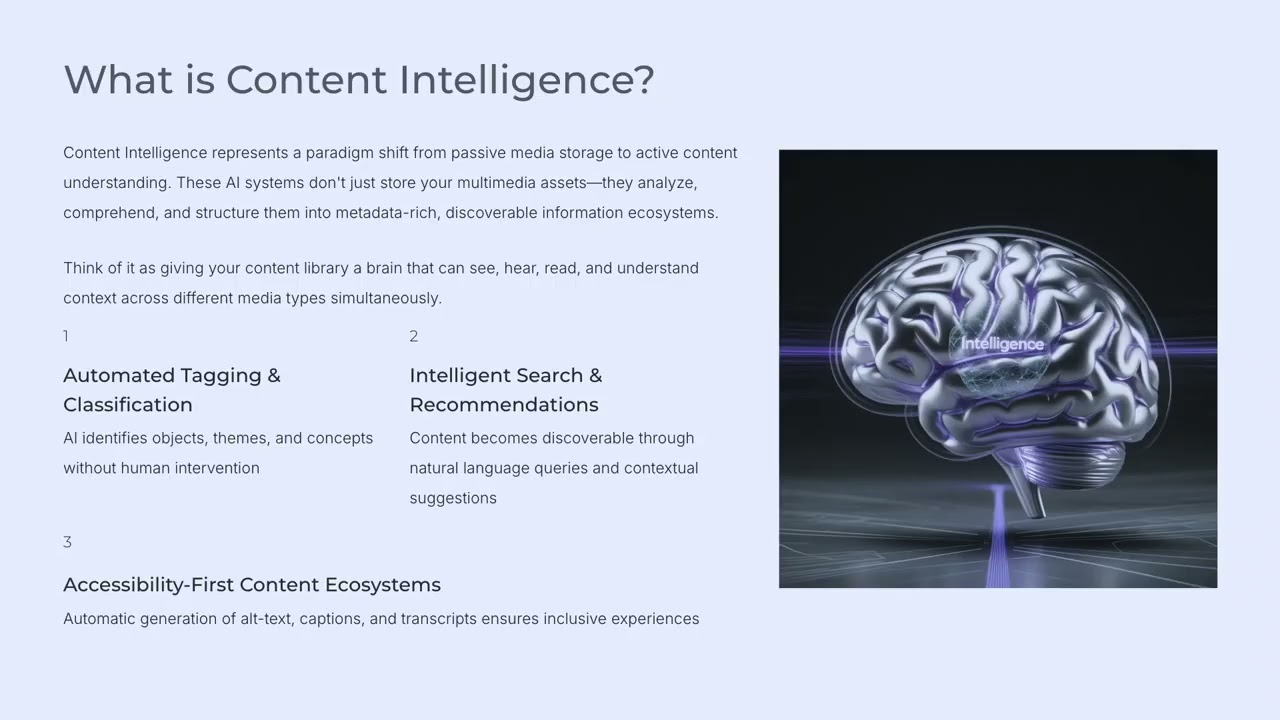
Satish, a multimedia expert at Zuks who works on sensor data for driverless cars, introduces the concept of AI-powered content intelligence as a transformative approach for Drupal media management. He explains that while traditional systems store multimedia files passively based on file names, active content understanding leverages artificial intelligence to analyze images, videos, and audio to extract meaningful context. This shift allows platforms to automatically generate metadata, such as identifying objects in photos or transcribing speech in videos, which significantly enhances the speed and efficiency with which website builders can discover and utilize relevant assets.
The core functionality of this system relies on multi-modal analysis that combines computer vision, natural language processing, and audio recognition into a unified workflow. For instance, AI tools can detect specific actions like jogging in an image or identify speakers and emotions in audio to filter out undesirable content. Furthermore, the system employs smart cropping to optimize images for different display sizes by focusing on important elements and uses semantic relationships to connect related documents, such as linking master's degree tutorials with postgraduate materials. These capabilities ensure that content is not only easily searchable but also meets accessibility standards by providing text descriptions for visually impaired users.
However, integrating these advanced AI models into a Drupal ecosystem presents several technical and ethical challenges that must be addressed through careful planning. Key considerations include managing high GPU costs for inference, ensuring privacy compliance by stripping personal data like emails from processed files, and maintaining low latency during file uploads. To mitigate these issues, Satish recommends best practices such as implementing edge computing to reduce processing delays, utilizing content delivery networks (CDNs) to serve results closer to the user, and adopting a "human-in-the-loop" strategy where human feedback is used to fine-tune models and ensure editorial trust before full-scale deployment.
Ultimately, the goal of adopting content intelligence is to achieve an operational transformation from manual, repetitive tasks to automated, scalable media ecosystems. By starting small with image tagging and gradually rolling out more complex video and audio processing, organizations can build future-ready platforms that are both compliant and accessible. This strategic approach not only accelerates website development but also creates a robust infrastructure capable of handling the explosive growth of multimedia data while ensuring that the AI systems remain reliable, transparent, and aligned with user needs.
Read the full video transcript
All right. Um, hi. Hello all. Um, I'm
Satish. I'm working as a staff engineer
at uh, a company called Zuks. Um, Zuks
is acquired by Amazon. Uh, at Zuks, we
work um, on the technology to enable
driverless cars.
Um, if you're interested, um, the cars
are we we have launched the cars in San
Francisco. you can install the app
called Zuks and then explore uh the
driverless cars. Um and uh on the
website I'm a multimedia expert. Uh I
work on video, image and audio
processing and also I'm a EI engine. Uh
I closely work with the multimedia teams
uh to um because for the cars I work on
the sensors like cameras and lighters.
uh I write the software to capture all
these data and process them and making
sure that the machine learning teams are
uh happy with that their data to make
the decisions. Uh that's how I'm I'm
closely working with the multime media
teams and um I when I'm going through
the some of the work that Drupal has
been doing uh it's it's tremendous um I
thought the content intelligence uh
artificial intelligence powered a
powered content intelligence um would be
really um keep the Drupal at the next
level. Um that's uh that's what I I
believe in and um uh I'm happy that the
community is is also in the thinking in
the same direction and it's been a great
work is going on in the community
and today's uh agenda um what I'm going
through is I'm going to talk about what
is content what I mean by the content
and uh what is content intelligence and
how it is going to be very useful in
creating the websites.
uh as fast as possible. Um and then uh
what uh Drupal's uh like how does the
content content intelligence going to be
useful for the Drupal Drupal foundation
like Drupal CMS uh platforms
and uh coming to the content when I say
content it's uh video image and audio
files that has been uh widely used by
the people uh day by day it it has been
like uh explosively increasing the
amount of multimedia data that has been
used in creating the websites. Um, and
it is it is a huge challenge for the uh
for any platforms to manage such a huge
humongous content. Um, and then making
the content more accessible to the
people who are building the websites.
Uh, that has been a key uh key thing
here. Um
well in in case of challenges right uh
what's happening is let's say we have a
company logo that's an image um let's
say 10 people are building the websites
with the same logo right so it is it is
not recommended to keep 10 different
copies in the system it will wastage the
memory right so
uh that is one of the challenges as as
like the multimedia content is growing
day by
And discovery of the content is one of
the very important. Let's say somebody
is building the website and they want to
grab some of the images or related
videos, related audio to to add to their
websites to build their websites. So we
have to design the system the platform
so that people easily access the content
related content what they are exactly
looking for.
uh that's that's one of the challenge as
the content uh size is increasing number
of content is increasing and and also
meeting the accessibility SEO um search
engine optimization gaps. So we have to
me make sure that the content is meeting
uh the SEO um standards which means the
uh the alternate text let's say the
image there is some image and video
files um we we should we should be able
to pass the content and um add what
exactly happening the context context of
the content as as part of the metadata
to each file so that it is easily
accessible for the website builders.
Um and yeah and and the rankings
rankings are very important. Let's say
somebody is building website and they
want to search for some video and we
have like 50 videos. Um how do we keep
them in a series right? What videos we
are going to keep as the first and
second in the category right? So that's
when that's where the rankings will
come. So uh there is something called
the the relevance relevance uh index
that is a models will go through the
content and then add this relevance uh
score uh with the with each uh media
data so that we can rank these files and
then show in a in a list. Uh then then
it should be more relevant to the uh
person who is visiting the website. Then
they can they can fast they can fastly
build the the uh complete work.
And to do all of these things only one
solution is uh we should have smarter
and automated context workflows uh sorry
content workflows which means that let's
say somebody is is uploading some files.
Um there should be a system which goes
through those multimedia content uh like
image or video and audio and it has to
be automatically uh understand that
content pass through the content and
understand and add the the um the
concept of that content as a metadata
and we have to tag that metadata. If
this flow can be automated and and
stored in the system uh that can be uh
that will be like more reusable for
everybody to to access the content.
Um that's about the content and the
content intelligence.
This is this is a a huge shift between
passive media storage and uh the active
content understanding. This this is two
different very important things. Um most
of the systems today of course they
adapting to AI but still so much of work
is there to adapt to the AI. Lot of
systems where you're storing the
multimedia content in a passive format.
Let's say there is one two different
images are there but same content but if
the file name is different we'll store
it as two different files. But in case
of active content understanding, let's
say we we watched a YouTube video, a
2-minute video. We understand who is the
speaker and what the speaker is talking
about and what is the topic they're
talking about. All those things. So at
the end of the video, we gain some
knowledge. Let's say there is a system a
content library uh has all these kind of
capabilities and and uh we we upload the
files and this content library is going
through all the media content and gain
all these capabilities and understanding
about the multimedia content and then
adding this as a metadata tagging with
each file. That would be the uh that
that we would call it as the content
intelligence and that is going to be um
uh a phenomenal shift for the people uh
who is building the websites in a fast
manner
and um at the same time uh let's say
there is an image uh there are some AI
tools like OpenCV all such kind of tools
it can detect the objects it can detect
the human pose it can uh uh give the
context text about like uh if a person
is running so it will give you uh it it
will understand and add the track to the
image. So you can search like okay I
want to see who are people who are
jogging. So you can see all the kind of
images. So this is all possible with AI
tools by adding the by by AI tools
analyzing this content and then adding
the metadata to the content
and uh the discoverable is uh
discoverability is is one of the very
important thing uh there is a natural
language uh processing um let's say
there is a content library which goes
through the video and understands what
exactly happening and then there is NLP
processing which goes through this text
and extracts the keywords and then
understand the content and the topic
attached to the uh video file so that we
can easily um search related videos and
then uh get the work done quickly and
accessibility first the all text let's
say for the people who are disabled who
cannot see the video they can play the
video and then they can understand what
exactly happening in the video uh these
all text will explain uh what is
happening in the video let's say there
is an image it will speak the text uh
can be played and then it will explain
what is happening in the image. So such
kind of things uh can be done and
accessibility first is designing a
system keeping the accessibility first
in in in mind so that uh the things can
be uh developed quicker um for the
website developers
and that's about content intelligence
and any questions uh please stop me if
you want to discuss anything deeper
and multimodel AI sensors there are many
tools in the artificial intelligence.
There are many modalities like computer
vision, computer vision libraries,
OpenCV uh libraries are there. Uh they
are featurerich libraries. Uh they can
detect the objects, faces, logos and uh
text scenes all those things and they
can also give us the description about
that image. Uh what's happening in that
image and also and so there is something
called smart cropping and focal point.
um it can it can identify what is the
important portion of the image. Let's
say you're opening a website in a in a
big display. You can see complete image.
Let's say you're opening the website in
a mobile phone. You don't have that much
space but still you want to see the
image content. Then the smart cropping
will be very useful where it will detect
the important portion of the image and
then crop and show only that portion of
the image in the smaller displays. So
such kind of things uh are very such
kind of tools are very important in
building the websites
and of course natural processing it
analyzes the transcripts extracts
keywords and understands the topic what
people are talking about in that
particular um content multimedia content
and the semantic relationship this is
this is very important let's say
somebody is building a website to host
master degree uh tutorial
and the person is checking for the
documents and let's say there are more
documents regarding postgraduation. So
how do you relate these two technically
these two are master degree and
postgraduation. So you have to
understand the context and then grab all
these files and show in the search
results. So that's where these semantic
uh relationships will come into picture
and there are many a models that that
are capable of doing all these things
and u it is important to understand uh
and identify such kind of models and use
for the uh uh the platform build
and um audio AI recognizes voices it
understands the speakers and it
understands the the emotion under the uh
uh emotion of the speaker and let's say
somebody is trying to post some violent
video uh that has the violence. So it is
very important for us to understand the
emotion of the uh audio uh and then if
if that is creating some uh something
undesirable we should be able to block
or we can bring in human uh into the
into the loop and then ask hey this
video is good for the uploading or not.
So such kind of decisions uh where these
kind of tools uh will be very useful
and crossmodel fusion uh now we have
this open CV NLP and audio. So we can
combine the output of all these models
and then uh generate a meaningful
context metadata and then attach with
the metadata. This is the next level of
uh uh creating the metadata and and we
can track this kind of metadata with the
files.
So this is called cross model fusion
and why Drupal foundation of course
Drupal Drupal foundation is a great one
a great content management system that
has been widely used in the world and uh
this is the platform where I feel like
it has to take the advantage of
artificial intelligence uh and then uh
uh integrate all the um uh services EI
related services into the platform. from
so that website builders can can get the
benefit out of it. Um the the main
important reason is the the media
architecture in the Drupal it has been u
designed in a modular way like the media
entity media types media libraries such
kind of low-level basic blocks are well
designed uh for example media entity
means what is the file um uh we can add
some fields to the file uh there are
many many aspects of the file which we
are calling it as a media entity and
then media type is is it a image or
video audio such kind of details and and
supporting libraries underlying
libraries. So these are all the things
have been designed very well where uh we
can integrate the AI services um as a as
a microservices uh because of this API
first approach uh has been very uh very
welcoming to integrate the AI services
easily into the uh Drupal foundation
systems
and entity relationships. uh as I
mentioned we need to create uh we should
be able to create the the relationship
between different media files so that we
can uh quickly access the related files
in the search results
and uh human in loop um of course we
cannot do everything uh relying on AI we
have to make sure that human in the loop
and making sure that the the AI is doing
what it has to do uh so that uh it is we
safely enabling MBA into the systems
and enterprise scalability. It has huge
scope for the enterprise scalability. Uh
there are many many companies are
adapting. Uh so uh the the basic system
is well designed so that more more
models can be integrated and can get the
benefit out of it.
And this is about again image image
tagging. uh we can detect the if the if
the what is kind of image it is a car or
it is a what what exactly happening in
the image and I was mentioning about
smart cropping this is the example of
the smart cropping let's say there is a
there is a big image where uh the person
is sitting in the corner and rest of
rest of this is just trees right see if
we have smaller display then the smart
cropping can understand the image where
the important portions are there in the
image and it can crop and it can show
the the uh very relevant parts on the
display and the focal points is it can
the openc libraries can understand the
important portions of the image where we
can enhance enhance it and then the the
display on the websites will be even
more better. So those are called focal
points
and video intelligence there is a
automatic transcription where uh the
models understands what speaker is
talking and then transcripts will be
generated and uh then the topic
understanding NLP will understand the
text uh and then uh it will give you the
topic what what kind of topics the
people are discussing and then content
summarization uh thereby we can sum we
can have the summary of the content and
then we can make it uh more searchable
content. That's that's where the video
intelligence and the uh natural language
processing libraries are being used
and audio like speaker recognition and
then again topic detection sentiment
analysis if they uh what is the
sentiment uh has been uh let's say there
is a podcast uh what is the topic people
have discussed and what is the sentiment
uh what is the summary of the content so
those kind of things are very very
useful for the discoverability purpose.
And of course this has very uh there are
many technical challenges to integrate
the AI. Um it has to be done in a in a
uh constructive way. Um if not uh GPU
resources are
that's very huge uh it can es escalate
the the cost of the uh G video inference
or multimedia inference processing. So
these these are some of the things we
have to take into consideration. There
are there are couple of challenges here
and also privacy compliance. Let's say
there are some documents the a content
library is processing. Uh it should not
capture the personal details like email
photos those kind of things those are
very very important to individual. So it
has to capture only the relevant content
and and then neglect the rest of the
personal details. So those things are
very important. Uh we have to keep the
user consent management uh in place for
it.
and um editorial trust uh we have to
always keep the person in loop human in
loop uh initially when we are rolling
out the EI make sure that we are getting
the feedback from the human let's say
there are 100 files at least for 10
files you get the feedback from human
making sure that the is doing the right
thing and then we should also get the
opinion from the from the user like how
they are so that feedback is also very
important to make sure that we are uh
taking the feedback and then making
necessary changes like for example model
fine-tuning uh we can get the models
open source models and then we can also
fine-tune for the healthcare
applications for different different
kind of applications
and the performance uh integrating AI
can can easily in sometimes can easily
improve the latency let's say the some
somebody is uploading a file the content
library is going through the file and
then takes some time So this is also we
have to keep in mind uh making sure that
uh it is um it is taking as less as
possible. Uh the best we have to do and
then making sure that the website
builder uh the person who is building
the website they have the right um right
environment to construct the website.
Um and yeah challenges are solvable but
then uh take it take it in a proper way
and and then uh plan planning is very
very important in this case to solve all
these problems
and some of the best practices edge
computing let's say EI model is running
if we can split the task and and assign
to different devices so that can be we
can get the result faster so that the
the it takes it will be less latency
So that is edge computing. So make sure
that edge computing in the in place and
privacy preserving a as I mentioned it
is very important to have the privacy
preserving a and human in the loop and
also performance um there are content to
delivery networks. Let's say one person
is building a website in new years. So
there should be a server close to the
that person so that they can upload the
video and gets the uh result from the
video and then they can they can make
the progress fast. So that is that is on
the CDN
and implementation strategy is like
small start small. We we cannot enable
ya for everything at one go. Start with
images and then see how the uh how the
work is going on and then roll out for
video and audio because video and audio
are very complex uh in nature uh in
terms of processing.
Um and then a gradual roll out uh as I
mentioned and user training um the
capabilities and limitations educate
educating the teams like how how exactly
it works and continuous monitoring how
how it has been doing we have to
continuously take the feedback and see
how this is working out and refine the
models as I mentioned fine-tuning the
models the models can be uh fine-tuned
the models already built also can be
fine- tuned for our own applications um
which is called transfer for learning uh
that is that is also very important in
case of uh rolling out these models into
the system. Those are some of the uh
best practices
and uh yeah finally the key takeaways is
uh operational transformation moving
from manual to the uh automated uh
content processing. uh that's where the
content intelligence is is more useful
uh in in case of building the uh
websites and uh compliance compliance is
uh compliance and accessibility is more
important that makes it even more
faster. Um if the if the files are
attached with the proper metadata and
tagged with right right information then
we can quickly access the uh multimedia
content for building the websites and
scalable media ecosystems. um uh these
are like future ready multimedia
ecosystems. Uh the moment we we enrolled
all these uh AI models once we proved
that it is working for for some kind of
system it is more scalable uh because
most of the multimedia content is is is
similar so it can be easily scalable.
Yeah, that's um that's all. Um any
questions?
So, so you basically, if I may
summarize, you came up with a strategy
on how to implement
media uh moderation for Drupal sites,
but uh
are you planning to do any of this or
yeah, I have been exploring into Drupal
uh websites uh like building the
websites, but this is something I found
out that uh like content intelligence is
more important uh like one of the uh
very important aspect that keeps the
Drupal foundation to the next level. Uh
and and people can easily build their
websites in less time. Uh this is one of
the strategy that I was I I could think
of.
>> Okay.
Very good.
>> Thanks.