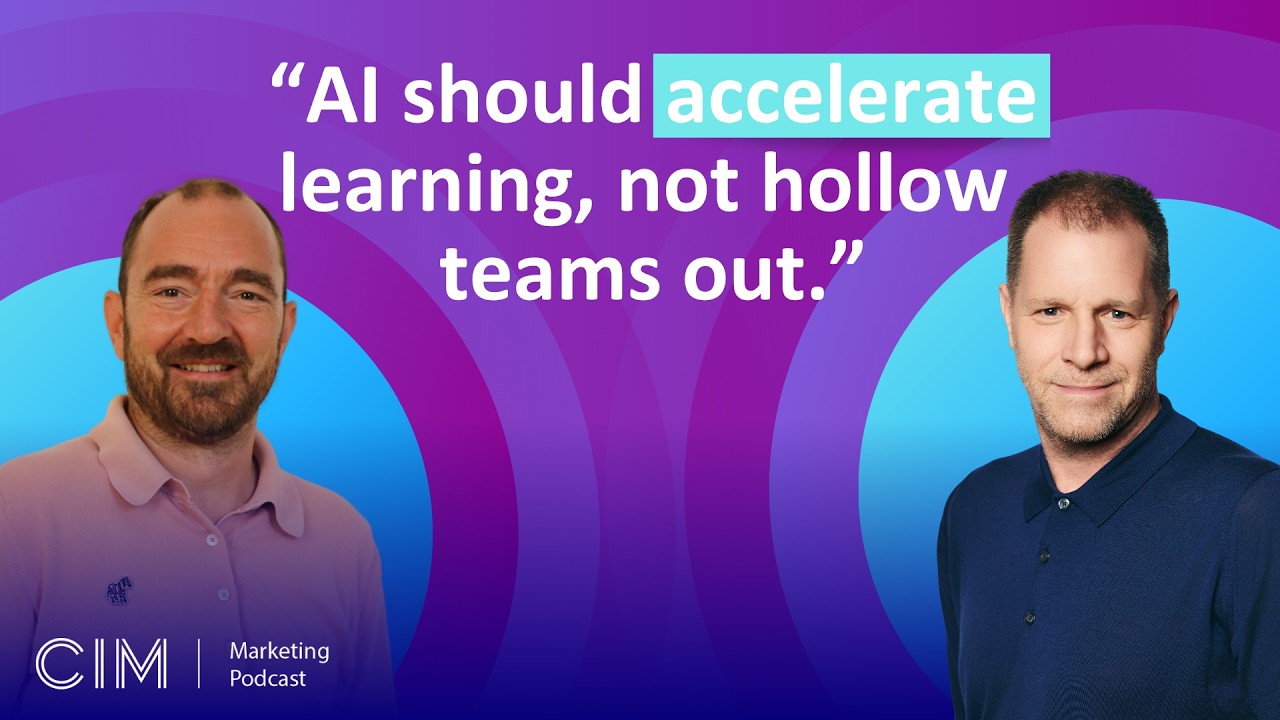
AI-native marketing teams: Rethinking roles, skills and structure
Watch on YouTubeVideo summary
The concept of an AI-native marketing team represents a fundamental shift where artificial intelligence becomes deeply integrated into every stage of the workflow—from understanding customers and planning strategies to content creation and decision-making—rather than merely automating isolated tasks with machines. Scott Allen, General Manager at Microsoft, argues that this evolution does not eliminate roles but instead transforms them by freeing junior staff from routine operations to focus on higher-value activities like audience comprehension and creative judgment. In this future landscape, non-managerial employees will manage multiple AI agents alongside human colleagues, engaging in iterative processes where they seek clarity on outputs while maintaining final authority over brand standards and objectives. The primary goal is not to hire a small group of specialists but to build fluency across the entire team, ensuring that technology serves real customer problems within existing workflows instead of operating as separate projects or commodity tools.
However, this transition requires careful attention to human strengths such as context, creativity, accountability, and ethics, which machines cannot replicate. A critical challenge lies in redesigning apprenticeships to pair inexperienced juniors with experienced mentors who can guide them through an AI-enabled world where "good taste" involves curating outputs against brand values rather than just writing prompts. Organizations must avoid outsourcing their own transformation efforts and instead focus on rewriting job descriptions as responsibilities shift, prioritizing the protection of a human premium that ensures distinctiveness and responsibility. Success depends heavily on matching intelligence with trust by establishing clear security, privacy, and compliance measures so customers feel safe at scale; this means treating consumers as adults to provide respectful relevance rather than engaging in creepy data harvesting or defensive over-disclosure about AI usage.
To successfully adopt these changes, teams should start small by addressing specific weekly pain points like reporting or briefing before expanding into customer-facing tasks, framing adoption as a trust exercise that requires safe spaces for experimentation. Leadership must visibly participate in learning processes to foster confidence and change leadership capacity, which are often the primary skills gaps rather than technical ability alone. For organizations lagging behind, honesty about pilot results is essential; if an AI tool does not provide immediate help, teams should stop using it elsewhere and evolve their approach accordingly. By focusing on these practical steps, marketing departments can stay ahead of other sectors in upskilling because they are already close to the content workflows that AI directly impacts, ensuring that determined learners do not fall behind as technology evolves roles rather than simply replacing them.
Ultimately, the future marketing team will be defined as a hybrid entity where humans act as architects of outcomes focused on strategy and sense-making while AI handles execution. This model ensures that faster processes never compromise customer experience or ethical standards by retaining human control over judgment and care throughout the process. The path forward involves rebuilding talent pipelines by changing entry-level roles to reflect these new realities, ensuring that confidence in safe and responsible use becomes a core competency for all marketers. By balancing AI's speed with necessary trust and transparency, organizations can create better experiences while maintaining their unique identity, proving that technology evolves teams to be more effective rather than hollowing them out or causing job loss through fear-based narratives.
Read the full video transcript
For me, the most important principle is
that the customer experience continues
to come first. If AI makes the
experience faster but less trusted,
we've not move forward 100%. The future
has to be built on the concept of
intelligence and trust working together.
[music]
Hello everybody and welcome to the CIM
marketing podcast. And you know today
we're going to be looking at the
marketing teams of the future. What do
they look like? How are they composed in
the age of AI and the advance the
relentless advance of technology? You
know where is human judgment
irreplaceable? Where can we use
machines? How do we protect this thing
that we all love? distinctiveness when
execution becomes increasingly automated
and is there a risk of over reliance on
AI uh and how do we manage that as
marketing leaders and we've got a very
special guest today who should know all
about all of this because it's Mr. Scott
Allen. Scott is general manager of
global marketing, privacy, and agency
management for none other than
Microsoft, one of the biggest techs in
the world. Scott, it is an honor and a
privilege to have you on the show. How
are you?
>> I'm really good. Thanks for inviting me.
I'm a massive fan of the CIM. Uh, and I
am very excited to talk to you, Ben.
It's an area we've talked about. I love
speaking about. So, please stop me if I
talk too much, but I've got a lot lot I
can can share and hopefully it's useful
for the people that are listening.
>> Absolutely. [snorts]
People come on this show to get that
insight and expertise from our guests.
So, I think it highly unlikely you'll
talk too much. Um, I have done a bit of
reading though and I, you know, we've
got a advanced copy of the new CIM
report into the effect of AI on the
sector. Um, it's a fascinating
fascinating piece of research. There's
lots in there, lots and lots in there.
But one perhaps of the most scary uh
findings is the amount of people that
expect AI to take their jobs. The amount
of marketers that expect AI to take
their jobs. Particularly prevalent in
what you would call the Gen Z, the
Zoomer if you like, generation, the 18
to 24 year olds that are already working
as part of a marketing team.
Um, one in four expect AI to reduce
their team size. Only 6% expect the
technology to create new roles. Teams
are shrinking and respondents don't seem
to think these roles are coming back. Is
this a trend that's here to stay?
>> I understand why young marketeers and
frankly all marketeteers anxious. Every
major technology shift has sparked fears
about jobs, right? And AI is no
different in my eyes. For example, like
when photography arrived, some people
thought painting was finished and it
wasn't. When computers came along, many
thought office jobs might disappear.
History usually shows that technology
does change work. Yep, absolutely. But
more than it simply eliminated it, it
changes it is is my view, right? All
these views are my own. Yes, I work for
Microsoft, but this is where what I I
truly believe. Now, roles do evolve. Old
tasks will disappear and for some that's
great because some people don't want to
do some of the tasks that they're
currently doing but I always see new
opportunities emerging as old tasks
disappear and we have to predict where
do we start and where do we stop so I
wouldn't dismiss the concern absolutely
not I hear it myself but I would also
not jump to a fatalistic view that this
is just fewer people and bigger machines
because that's definitely not the case I
the right answer is different
development
faster learning and more intentional
coaching that we're going to have to
give as leaders and AI should empower
people and organizations not hollow them
out. So wrap that up right the concern
is not irrational absolutely we should
be honest that some tasks will be
automated and some companies will look
for cost savings absolutely but the
answer is not to remove the
apprenticeship AI should accelerate
learning
>> it's interesting you use this word of
hollowing out and also another word
opportunities you know one of the things
that one of the potential futures that
we can see is that actually AI in its
totality doesn't reduce the totality of
jobs you know there are there are plenty
of roles sort of higher more creative
levels with this as a tool. The problem
still exists or there's a potential
problem that still exists is that the
junior level roles where people cut
their teeth will be removed because some
of the more routine tasks in marketing
will be we know taken over by machines.
>> How do we test that? How do we stop that
hollowing out of the junior tier given
the decline in entry- level
opportunities? Some junior tasks will
change um without a doubt. Some entry-
levelvel work will become more automated
without a doubt. That's a real risk. So,
we should not pretend it's not
happening. It absolutely is. Right? But
if we think about jobs as collections of
tasks rather than one fixed role, the
opportunity becomes clearer in my eyes.
Right? AI may take on some of the
repetitive or administrative work, but
that can free junior marketeers to spend
more time on what I would say more
exciting stuff like audience
understanding, getting your brief
better, better creative judgment because
judgment from human is always going to
need to be there, how they measure, how
they do customer tradeoffs, you know,
really getting into the the meat of it
that needs that human involvement. So,
the real message here is the humans and
AI are stronger together. You'll hear
that a lot. I'm a big believer in that
AI absolutely can accelerate work but
people still bring context judgment
creativity and accountability that makes
that work valuable and I think that's
really important to understand and there
is a role as marketing leaders and
employers also that we need to be much
more intentional about how roles evolve
how I look at it is you can't just go
and pull out the job description from
three years ago because you're replacing
somebody who's left and just expect that
job description to be dust off three
post it's exactly the same as it was 3
years ago. You've got to rewrite that as
responsibilities evolve, role
expectations will evolve, the way people
learn will evolve. So the answer to me
is junior pipeline challenge is not
simply hire fewer people. It's more
about automate the bottom layer of the
work they do. It's redesign the
apprenticeship for an AI enabled world
and then pair juniors with experienced
marketeers so that we can explain to
them how to navigate through what is a
fundamental change in how marketing is
done.
>> It's very very interesting isn't it?
It's almost down to the organizations to
have a rethink to recreate the front end
of careers if you like. Yeah. Yeah.
>> To enhance this critical thinking to to
to develop this idea of audience
understanding, critical thinking, all of
those human judgments that we seek in
marketeteers
um and to and to do it quickly.
>> Having a junior marketeteer and making
them a prompt machine for AI is
absolutely missing the point, right?
Yes, human and AI together, stronger
together, but redesign what the role is
of the apprentice alongside or the first
jobber alongside what AI can do for
them. So don't just recycle those old
job descriptions. Start thinking about
what type of roles and responsibilities
do you want your marketeers to do
whether they're entry level coming out
of university etc. just got their CIM
qualification or there's somebody that's
been 10 15 years in role because all of
us including myself are changing and
adapting.
>> Call me an optimist if you will but such
a scenario if they were to do what you'd
advise would actually enhance the
enjoyment and the interest in entry-
level marketing wouldn't it?
>> That's the point right I think it's like
think about what tasks drive you insane
every day. What task would you just wish
like we talked before in the podcast,
right, about how long you take to edit
before AI came along and how that's
saving you time. Now, that could give
you time back to do other things in your
job, but we could actually just allow
you to to do a bit of thinking, do a bit
of ideation, do stuff that you have on
that to-do list you never get to because
you need to do this today or that
mundane thing tomorrow, right? So, I
think you're right. you can get rid of
some of that to start with and then
focus on things that you either don't
get to or new ideas that you've just
never thought about. And that's why we
need levers need to help define what
does a role look like if AI comes and
plays a role. There's a really
interesting table in the report
uh which looks at how the sectors
uh vary in terms of upskilling staff for
this new technology and you know
marketing advertising and PR is streets
ahead they're miles ahead of any of the
other sectors you know if you go down to
sort of hospitality and leisure there
sort of lagards you know there's you
know less than 10% of of their teams are
being upskilled to AI so maybe they feel
they're going to need it. But marketing,
advertising, and PR, the one thing we
can say for our industry, we are way out
in front when it comes to upskilling
existing staff. What's driving that?
>> Well, I think the first thing is
marketing is close to the customer.
Okay, sales is close to customer, but
marketing is as well, especially if
you're working together. I mean, I'm a
massive fan of connected sales and
marketing. Actually, the role I have in
Microsoft is all about connected sales
and marketing. Marketing is close to the
customer. It's close to the content.
it's close to the performance pressure
that you have as a business alongside
the sales tunes. So the impact of AI
just shows up much more quickly as a
result of the role that you're doing. So
you see it in things like research
planning content workflows doing
localization you know I had to do
localization with a global team all the
time running events running social
salary enablement reporting back of how
you're performing that makes skilling
urgy for me because marketing teams
cannot outsource their own
transformation it just it just isn't a
thing that you can do you can get advice
but you can't outsource it so the people
who really understand the brand the
customer the market and the sales motion
needed are the ones that learning how to
apply AI well and marketeers are very
much at the forefront of that. So for me
that's a key driver. AI is not just
another tool sitting on the side of the
marketing department. It really in my
belief is starting to change how work
moves from audience insight to campaign
execution to sales follow-up really
connecting sales and marketing. If we
only hire in a small group of AI
specialists, we will miss that bigger
opportunity in my eyes. So the real
unlock for me is helping every
marketeteer build enough confidence,
judgment and fluidity to use AI in their
flow of work rather than just this thing
on the side and stay anchored in the
fundamentals like customer obsession,
measurement, trust, accountable
decision- making. So wrap that up. The
best marketing organization for me will
not be the ones that buy the most of AI
or hire a small group of specialists and
call it done. It will be they are the
ones that teach people how to use AI in
the right way with purpose.
>> Interesting. Yeah. A focused approach to
the technology. Where are the biggest
skills gaps do you think at the moment
in our sector?
>> It's a good question. I get asked it
actually quite a lot. And I'd say the
biggest gap is not just technical skill.
Everyone defaults to AI. It's a
technology. We have a technical skill
gap. I actually think it's a big thing
is still confidence. A lot of people do
not lack ability, right? Most people do
not lack ability in the roles that they
do. They lack clarity. Clarity on where
AI is right to use, is safe to use, how
best to use it, what does good look like
in their own work, how far do they go
with it. That can create a fear of
getting it wrong. So people go the other
way, right? And they go, I'm going to
avoid AI altogether or I'm going to use
it in a very very shallow way. And
shallow is maybe not the right word
because that what I mean by that is that
just using it to get notes from a a
tease meeting that you've been on and a
transcript that's what I call a shallow
way is you're not you know it's like
buying an iPhone at over £1,000 and
using 10% of the functionality just
doesn't doesn't make sense right so I
think the capability gap is really the
mix of marketing judgment data
confidence responsible use and that
concept of change leadership so as AI
gets better, the most important human
skills may become even more valuable in
my eyes. So, this thing that we've got
as humans, curiosity, creativity,
communication, compassion, courage,
right? Machines don't have that like we
do. Um, you could argue they don't have
any of that, right? Businesses still run
on trust. Like customers still want to
run on companies that they can trust,
have relationships, they need leadership
show from those companies and they need
those companies to use in their best
judgment. So I think AI can support
those things but 100% cannot replace
them.
>> Do you think it's a danger it goes too
far the other way that you know
organizations you know marketing
departments marketing agencies think
gosh we've got to get all our teams
upskilled on this technology. They focus
too much in the technology and they
forget some of the fundamentals of
marketing that you've cited. You know
audience understanding, critical
judgment, uh originality, creativity,
those sorts of things. they go, you
know, they they throw too many of their
chips into the technology and not enough
onto the human.
>> Yeah, it's a it's it's a really good
point and there is a risk if AI becomes
the subject rather than the enabler and
and and actually it does a lot, right?
If you think about people talking about
AI, they talk about that AI and you're
just talking about it as a as a subject
rather than what can AI do for me. So
the fundamentals still matter like as a
human audience understanding positioning
brand measurement creativity commercial
impact ethics trust it's all there and
AI can help you with all of that. It
can't replace you for all of that. So if
your brief is weak or AI gives you a
fast weak answer then you sort of missed
a point. If the insight is shallow AI
can scale shallow even more and that
becomes a problem for how you do your
marketing. So I feel that the way people
who are coming into AI and how they use
it, AI to me is something that raises
the floor on the execution but it does
not automatically raise the ceiling on
marketing and I that's where people
getting caught up is that he's just
taken everything from bottom to top. The
ceiling still set by the human insight
craft judgment for me has to be human
led not machineled.
>> Interesting. Yeah, judgment. I mean, we
I I was once told that it's not possible
to teach good taste. A female relative
of mine who told me, I don't hope she
wasn't talking about me.
>> I think my kids will probably subscribe
that my taste has gone in the wrong
direction, but you know, it's each to
our own, right?
>> Well, you know what? We're going to
we're going to be the the deciders,
aren't we? As marketers, we're going to
be choosing. We're going to be our
taste, you know, our preferences are
going to be uh the key differentiator
between uh you know, our agency here,
our department and our opponents, our
competitors. You know, how does the D
job change when you've got a machine
creating the content and you're doing
the curation of the content? You know,
how do you actually teach teams, teach
young marketers this thing called good
taste?
>> Well, it's interesting. How many times
are people listening sat there and gone
right I've got to start this project
today and it's that blank page and you
think gosh where am I going to start and
you then put it aside or you go and
spend hours thinking about starting
something starting is always the hardest
bit finishing is a lot easier so for me
the day-to-day job becomes less about
starting from a blank page and more
about making better choices so you
become more of a choice person and the
blank page can be started with AI if
you're push pushing it in the right way
and ask it to do the right thing so
what's on brand, what feels generic,
what will the customer actually care
about? That is where people sometimes
misunderstand AI. It's not a it's not
magic in isolation. It is building on
what you ask it to reason over. And
that's the important thing is that a lot
of that AI is pulling on if you give it
the right guard rails and criteria is
stuff you've given it. You've given it
context how to think about things.
you've told it about your company's
brands, their objectives, the needs of
your customers, the previous work you've
done, the previous briefs you've
written, all can be used to think about
the tone, the standards you want to set,
what you're trying to achieve. And
that's where AI really can help you when
you train it to be part of your
workforce, so to speak. So, teaching
good taste is not just teaching people
to write better prompts. And I think
that's what people get hung up on. You
know, I hear a lot about there'll be
lots of prompt officers moving forward
and yeah, you've got to write a good
prompt, but it's not about writing
better prompts. It's teaching people to
brief properly, curate what AI gives
back and know when the output is not
good enough and question it and keep
pushing and use some of that human
element to it. So teams need strong
examples, clear standards, and they just
need to review rituals where they talk
about why something works. Like that is
built into a culture. Is that working?
Why is it working? Is it good? Does that
sound like our brand? Will it serve our
customer? Will it support our
objectives? And why should it or should
it not be used? Right? So, there's still
a lot of human judgment that's needed
there. So, AI gets stronger when it can
reason over your brands, your
objectives, your previous work, and your
customer needs. That's that's my my real
belief.
>> It's a fair belief. It's a great
analysis. A lot of people listening,
those who worked on client side will be
thinking yes and I need some help with
that you know I need my agency I need
the tech the developer to show me how to
implement this stuff you know to give me
the good use cases where I should be
using AI and where it's less useful for
me how I implement it how I integrate it
into my department into my business um
the report is quite skeptical about how
agencies and tech developers are doing
on this side. It's just that actually uh
you know what marketing departments are
reporting that um uh they're not
providing enough support. Is that fair?
>> Well, look, in my job title, I have
agency manager and that means uh my team
is responsible for the top 25 agencies
that we use within Microsoft Glob. So, I
spent a lot of time on the agency. I was
actually yesterday I was uh I was with
one of my big agencies and I recognize
the tendrum. I absolutely do. But it's
more about teams not being abstract
about a the AI conversation. So I think
the better the agencies and partners can
help make it real um is going to be
important. So and then talk more in the
language of getting stuff done, how to
connect your workflows, what data is
needed, what governance is needed
required, how is value measured, like
building all of the criteria and the
guard rails in for AI to work
effectively for you. And I think that
partners, agencies, and and I'm lucky my
agencies very much are partnering with
us. I'm lucky to go to New York next
week and meet some of our other agencies
and we're going to talk about AI and
what they're doing and how it could help
us and what we're doing and how it can
help them. So that sort of sharing piece
and partners have a huge role to play
where how do we use AI to push that bar
up. So for me to summarize it the
partner conversation has to move from
look what AI can do here is the business
problem this is the workflow the value
of what AI can do and how it will land
safely. So start talking in real terms
rather than abstract about AI.
>> Don't throw every function and every
feature of your piece of software at
your client. Ask the client what they're
doing. What's their business look like?
What's their workflow like? And then
tell them what your what features will
work for them and where they should be
deployed. And look, and it's like when
our sales teams go, oh, if I go and
visit a customer, I spend the first 20
minutes just listening, half an hour
just listening to the customer instead
of going in and going, hey, we can do so
much for you because we can. It's not on
the hard pitch. It's like, what are you
trying to solve? What are your
workflows? What is it a customer issue
you got? Is it this? Is it that once you
listen, that's when you start talking
less abstract about AI and about, right,
let me share some examples what we've
been doing with other customers, etc.,
etc. So I think and there's more
examples coming out like two years ago
or a year and a half ago it was very
hard to get how AI is working. Now you
can you could just go to the internet
and find lots of case studies but also
go spend time with peers go and spend
time at events go and learn more about
some of the great stuff that's been done
with AI regardless of whether that's
from Microsoft or whether it's from any
of the other big AI suppliers.
>> Yeah. Interesting. Um, do we need to
become more technically proficient in
this AI era? You know, we we have a
level as marketers, we each have a level
of technical proficiency. Does is that
going to go higher or is the opposite
going to happen that we actually need to
become more generalist in our approach?
Do you think?
>> Yeah, it's a good it's a good debate to
have, right? And I think you could apply
this to leaders and to to marketeers
more more generally, but I'm not sure
marketers need to become engineers,
right? That's not the point here, but
they on the flip side, they can't stay
distant from the technology. You got to
you got to think about how you don't
become like a a level 400 engineer on
theirs. But you need to ensure that
you've got enough fluency to understand
what is possible. Also counter to that,
what's risky? What data is involved?
Where is human oversight required in
this work that AI is going to help you
with? Um, and for me, this is about
relevance. Marketing leaders like myself
should always be evolving, learning, and
reinventing themselves. I talk a lot
about reinvention. I probably reinvented
myself six times in my career, right?
Because I'd be totally irrelevant as a
marketing leader if I hadn't have. And
like reinventing themselves as mark as
the market changes, that's really really
important. AI is the next reinvention of
marketers roles including leaders as far
as I'm concerned and it's right in front
of us now right so it's not something to
watch from the sidelines it is something
that leaders and marketers need to learn
into and they just need to be curious
look at the judgment of how to use it
and have enough understanding to make
informed decisions about how I use it
and importantly how I don't use it
>> it's interesting you me mentioned risk
there and and approach the way the
approach to risk is So, one of the
things we've been discussing in this
season, this series is this concept of
distinctiveness. You know, something
that marketers all seek. Um, the
generative outputs tend to be based on
probability of what they think the
audience will like, not creativity. And
the result sometimes, I mean, let's be
honest here, the result sometimes is
that, you know, the output can feel a
little bit bland, you know, and
undistinctive, the opposite of
distinctive. Do we need to encourage our
teams to be a little bit more risky,
take more creative risks?
>> Look, my view is 100% yes, teams should
take more creative risks. But like
anything like I'm not encouraging every
marketer to go and take all these risks
that causes damage to your brand. What
I'm saying is take creative risks but
with discipline. And what I mean is if
everyone uses the same tools in the same
way, the work will just converge, right?
So AI can help explore more roots and
and more ways to be creative, but humans
still choose the route that is most
distinctive, relevant, and responsible
and true to the customer. So take some
risk about how you can use AI to create
stuff for you, but the human will always
have the final decision. So wrap that up
like AI gives you the route to explore.
Humans still decide which route has the
meaning.
>> Is there still a role for gut instinct
do you think in modern marketing?
Look, I'm I'm big on gut instinct and I
think there is still a place for gut
instinct, especially the more experience
you get, the gut does tell you a lot.
But actually, I probably just reframe
that to informed instinct, right? Rather
than gut instinct. So the best
marketeteers that I've met and I tried
to build model myself from this, they
build pattern recognition over time by
being in the work, right? So spending
years in a row or industry or meeting
customers or listening to marketing
peers, seeing what lands, seeing what
fails, understanding the context behind
the numbers. That lived experience as a
marketeteer really happens. So AI can
absolutely surface patterns. It can
challenge assumptions that you you've
got and can give you more evidence to
work with, but it cannot fully replace
the judgment that comes from being close
to customers, colleagues, partners, and
the market over time. And that is really
really important to to understand when
you're worried about what AI can do.
Like so gut instinct 100% still matters
when it's earned for experience and
tested against evidence. That's going to
be the core mandate if you like for the
human marketer is the is the judge is
that is using the judgment the human
judgment when we're trying to describe
that role or sort of framed that role to
to our colleagues or employees or
whatever it may be you know how do we
how do we present that how do we say you
know this is what we used to talk about
hybrid teams as being you know one
person at a desk in an office in London
say and another person you know working
remotely from their home in the Peak
District. You know that that that
definition of hybrid now is dying out in
favor of a team of which is human and
some of which is robotic, some of which
is digital and some of which is uh flesh
and blood, you know. So when we're
trying to describe to the flesh and
blood part the human beings, our human
colleagues, how their core mandate, you
know, how are we framing that? Are we
saying to them, you are the judge and
the jury? You're the per people whose
job it is to decide what works.
>> We let me talk about the human markets
here. The human market here to me moves
closer to the strategy to the sense
making the accountability. We talked
earlier about you're so busy doing these
sort of paths down here. You don't get
enough time for the strategy the sense
making the accountability. AI can help
with production right important. It can
help with patterns. It can give you
speed but people still define what the
customer problem is. the promise we're
making to those customers, the trust we
need to earn, and the trade-offs we're
willing to make. So, I think the future
is less about whole jobs disappearing
and more jobs changing. And if AI takes
on more that repetitive load, marketer
can spend more time on that judgment,
creativity, relationship building, and
the choices that shape true customer
impact like because the end of the day,
don't forget the customer here. The
customer is what you need to be closest
to and really understand what is it they
want from you as a brand and what you're
offering to them. So for me the human
marketer becomes less of an operator of
tasks and more of an ogre of outcomes.
And we have a big thing in Microsoft
about um outcomes not activity. Don't
come and tell me the thousand things
you've done. Come and tell me the
outcome you've done. If I took a
thousand things to do great but don't
start with that right. So I AI changes
to work. It should not remove the human
accountability behind it.
>> Interesting accountability. Now there's
a word. There is a big theme in this
report. It's not a particularly edifying
or encouraging theme which is there is a
trust deficit uh amongst the public uh
our customers uh namely uh in in AI uh
to the point where there is some
evidence that if people think that
output has been produced by AI
regardless of its sort of emotional
quality that they're much less likely to
trust it or or become engaged
emotionally in it. Um part of it seems
to be about transparency that you know
if as marketers we're using this AI we
need to somehow communicate that to our
customer base to our audience to say
look we have used AI for this um and
then if we can be transparent about it
it can help build integrity you can
build build trust if you like.
>> Yeah.
>> How do you do that? How do you make that
calm, that communication to your
audience without actually having the
opposite effect without you then end up
losing trust because people then think,
well, goodness me, these people are just
using machines to do all their outputs.
Why should I believe anything that
they're saying?
>> It's definitely a fine balance for sure.
I would say trust ultimately comes from
being clear, consistent, and
responsible. That's what customers are
looking for, right? You do not need to
overexlain every tool in every process.
That's, you know, that's too much,
right? blah blah blah you do need
transparency where AI affects the
customer experience how you're using
their data
how you know decision making or that
brand promise that you're given so for
example if AI is visible to customers on
a website or if AI is being used to
contact customers directly which it
absolutely is then you need to be open
and transparent that that is happening
so you should not be hiding that trust
customers trust you if you are secure
and you put them first, right? And you
are treating them like grown-ups and you
are not trying to hide things from them.
So things should not feel hidden,
unclear or like the customer will be
surprised if they found out later. So
there is a massive role for this concept
of trustworthy AI. It has to be grounded
in the security, the privacy, the safety
and the accountability that you have as
an organization to your customer. But it
doesn't mean you need to disclose every
single time you use AI to produce like
content for a website or for an ebook or
whatever it might be. So the way I look
at it is transparency should not be
treated as a defensive disclosure. It's
more about if AI is visible to customers
or is acting on behalf of you and your
company and the brand. Customers will
trust you more if they know that you are
being open with them. You're secure and
you've put their preferences first.
>> It's interesting, isn't it? this privacy
piece because
one thing in the reports is that the the
the youngest generation, the youngest
adult generation, the Zoomers, are the
least likely to want to give you their
personal data. So, you know, they're the
most nervous about it. Uh they're almost
or similar in nervousness to the to the
oldest generation, the boomers. um you
know we we seek hyperpersonalization and
in order to hyperpersonalize our output
as marketers we need personal data you
know are we any closer to achieve it
when achieving that hyperpersonalization
when the privacy concerns seem to be
going up um is it even something that
consumers want do you think
>> yeah I again it's a good question right
I think are we closer we are closer
technically absolutely we are closer
technically but the better question for
me is whether we are making experiences
more useful or just more targeted.
>> So customer we got very demanding
especially when you you think about the
consumer world and the B2B world they
never got so much closer together in
terms of expectations that we have when
I'm doing my day job and when I'm at
home with my family I expect the same
sort of experience. So customers just
want you to be more relevant to them.
They want to be easily easily work with
you and they want to be able to respect
and value you right. So I also want to
feel secure and control and clear on how
data is being used as a company to my
customers. But privacy change is the
standard, right? I mean, the way I look
at it is just because we can personalize
something does not mean we should,
right? Customer has to come first. And
that means, you're going to hear me keep
saying it, security, trust, consent,
transparency is the aim of the game
here. And we need to build that into the
experience, not added afterwards.
Because people are choosing brands that
they 100% trust. And all those sort of
words I just put in there are a key part
to that. So for me the future is not
creepy personalization going on. It is
respectful relevance is how I would put
it. Customer first, security first,
trust first and always clear about
preferences and how you use customers
data.
>> Very interesting. Let's let's talk a
little bit about the Microsoft
experience. Let's look inside Microsoft
for a moment. Um you've been right at
the heart of AI adoption at Microsoft
itself. What was the mood like there
when it all kicked off this sort of
massive paradigm shift?
>> Yeah, look, I mean, we we've been on
this journey for longer than than
others, right? Because we we very much
do test our own stuff before it goes
anywhere near the market. So, you know,
we very much were at the forefront of
this a couple of years ago as we worked
through what AI was going to mean when
it went out to the wider world. So the
answer to your question the mood was a
mix of excitement probably stuff that
people are going through at the moment
excitement curiosity and honestly
uncertainty as well and that is
absolutely normal. So everybody's
listening to this who's new to AI is
feeling that that's exactly how we felt
and we are a company that is very big at
the forefront of AI. Meaningful
transformation for me creates energy and
anxiety at the same time. It doesn't
matter what your transformation project
is there's always that mix of energy and
anxiety. What mattered for me was the
company as in Microsoft went top down
and made it clear this was an area that
we were going to focus on as a group of
employees and leaders together and that
is a really nice feeling to have. So how
can us build the skills? How can us test
and learn? Bringing training where
needed to to help us get us to fully
embrace the fact that we did not know it
all and we didn't have all the answers
on day one. That's okay. The leadership
support has also been super important in
this at Microsoft because people need to
know their leaders are not standing at
the side of the change. They are right
in the middle of it backing them to
learn. The experimentation is something
they encourage and the responsible
adoption is there. And that is also the
opportunity now for other companies as
far as I'm concerned and and marketing
leaders. There are more examples, more
peers, more lessons to learn than there
ever has been before. When we were
starting out, we didn't have any
blueprint. sort of to go from. So it was
a little bit harder. So I would
encourage people that are listening, go
embrace the learning. Go to events, talk
to marketing peers across industries,
compare what's working, understand what
is not, and bring those lessons back
into your own organization. I'm doing
that still constantly. I don't just rely
on what we're doing internally. I'm
often talking to other marketing leaders
to learn what they're doing. You don't
have to have every art before you start.
That was important for us in Microsoft
as well. We didn't have every answer,
but you do need to create a culture
where people feel supported to learn and
to try and improve. So our our teams in
Microsoft didn't need the hype around
AI. They needed to ensure that their
worries weren't just brushed aside and
that was really important and leaders
visibly back in the learning and
training and test and learn adoption was
important and we did all of that and as
a result we didn't just build products
that we took to market. We are now
actively using AI across all of our
different workflows.
>> Absolutely. Nice supportive experience,
supportive culture. Did you encounter
many hurdles and if so, what were the
biggest ones that you encountered?
>> Well, look, I mean there's we've got a
lot of high performing teams across the
Microsoft uh ecosystem internally. So,
high performing teams can be hard to
shift, right? Because their current
model is working. So, why would they
bring new stuff in? I think the hurdle
is not always resistance to AI and and I
didn't see it as resistance to AI. It's
much more practical. Where do I start?
Where do I bring it in? Why would I
bring it in? Am I being backed to spend
time on this? Is it clear how my role in
AI are meant to work together? Will this
help me or make my job feel less
certain? Those are absolutely fair
questions that all of us had or a lot of
us had. Um, and leaders were there to
answer them with clarity, not slogans.
And that's really important that we
wasn't, you know, we wasn't playing buzz
word bingo on this. So supportive
supportive culture comes from how can
teams learn, experiment, embrace AI.
That was super super important in a way
that feels that we can use it in a safe,
useful, and a connected way to our work.
So I would start with things that can go
wrong without damaging the um the
customer experience. So pick a workflow
or workload that maybe isn't so
customerf facing to start with and go
try that out. Test AI on internal
workflows first. Summarize what you did,
how you maybe improved the brief, how
you reviewed content better, how you
sped up reporting that you're doing or
finding patterns in different feedback
that you need to give to your your exec.
So I would learn there first, build
confidence there first and then move
closer to the customerf facing work
which requires you know much more
governance a higher quality bar and much
more human o oversight um than stuff
that you do more internally. So I think
wrap it up. Adoption is not a technology
roll out. It's a trust exercise in my
eyes. People need to know where to start
that their leaders have their back 100%.
How AI fits into the role that they're
doing. How does it coexist and can they
experiment safely?
>> Yeah. Interesting that you you sort of
you sort of say stop the back office
stuff that's not front of house.
customer facing and then segue on to
>> if you're starting from scratch, start
there. If you've already been doing
that, start thinking about how you do
the more frontfacing stuff because
you've got experience and there's the
clarity and the employees feel that
they're in a place that they can
actually do that moving forward. You got
to start somewhere, right?
>> What's the one piece of advice you would
give to those people who do feel that
they are lagged, that they're somehow
falling behind on this?
>> Yeah, look, let me let me get Microsoft
to the side here. I've got lots of
friends who are in startups or sebased
companies. I spend a lot of time with
peers at events who are not in the the
organization the size of Microsoft. And
obviously there's challenges being in a
big organization versus a small one.
Right? We all have challenges. I think
the big advice is probably in a couple
folds is start smaller. Like I said,
start smaller and closer to the work.
Pick pick a real problem that your team
is facing every single week that they
complain about that. Oh, if only we
could do this or if only AI could help
us do that. Reviewing content,
reporting, briefing, localization,
customer insight, campaign setup. Use AI
there first, right? Learn from it. Then
be really honest about what happened
when you did that. Did the pilot
actually help you or was it actually a
hindrance? Did it reduce time to to do
tasks? Did it remove rework? Did it
improve quality? Did it create real
efficiency? Ask those sort of hard
questions. Could it have been better?
Was it the right thing to test first?
Because you don't necessarily have to
carry on. You could stop and move on to
something else. And maybe you did start
in the wrong place. You have to do that.
So the point I'm trying to make is that
not every pilot has to be kept alive
because AI is attached to it. So do not
try to be that AI expert overnight.
Become a better marketing leader with
better tools and that will give you that
strong judgment. So if you are not
behind
um if you're learning with intent I I do
really believe that you're not behind if
you want to learn with intent. So start
small analyze hard be honest about
whether it helps then stop evolve or
scale based on the evidence.
>> That is a very heartwarming lesson is
that you are not falling behind if you
are out there determined to learn. If
you're determined to learn and you're
fed to learn, you are certainly not
falling behind. So take that one thing
from this show. if you only take one
piece of advice. Um, look, when we get
past this point, when we get past the
learning stage, when we get to a stage,
we're always learning, of course. So,
when we get to a stage where we are
proficient in this stuff, and more to
your earlier point, we are using it in
the right spaces for the right things.
We get to something that is called or is
becoming core, this thing of the AI
native marketing team. This is where
humans and and AIs, humans alike, work
together as a close colleague. What does
that experience and skill set actually
look like? You know, what are its
advantages over an all human team? Say
>> it's something that people are really
starting to think of now if they're
moving on to that next phase of AI. And
we certainly, you know, are there, you
know, on our journey. So for me, an AI
native marketing team is not a team
where machines are running marketing.
Let's be really clear about that. It's a
team where AI has just been built
naturally into how people understand
customers, plan work, create options,
measure impact, improve decisions. So
they they just become another member of
the workforce. And I also think that we
need to start imagining a world where
members of our teams are not only
managing people or projects, they're
also managing agents as well. So I can
really see and we're going to see this
for my team. You know, we just moved
into a new financial year. Some of my
team who are not managers today will
start to manage agents and I mean like
five agents, 10 agents and they will
start to do work with them and for them
like they are a member of the team. Now,
that might sound strange at first. It
absolutely does if you're not only just
starting out on AI, but it's a good
thing, right? I think it's a good thing
if you have an agent working with you on
tasks, probing you on what you are
asking it to do, pushing you for
clarity, helping you think through the
work, that becomes part of how the team
operates. So like I can send some stuff
to my agent at the end of the day. It
will go away and work on some stuff and
when I wake up it's got some questions
for me and I have to answer the
questions and then we're going backwards
and forwards like you would if you were
talking to a human who needed clarity.
Right? So I think that this mindset
shift of you can have agents working for
you is important because managing an
agent is not something to apologize or
be scared of. It's one of those next
capabilities that modern modern
marketing teams will absolutely build
and you'll be able to learn from others
that have done it how it works. So the
future team for me is not humans working
machines.
It's more it's humans doing more
meaningful work with AI and increasingly
managing agents as part of that team. Um
and I think that's this is not something
to fear or apologize for. It's something
to embrace especially as a leader and
think about how you build that into your
operating capability.
>> Interesting. Um we're wrapping up. A
quick plug to the audience. Again, I do
commend this report to you. It is
absolutely fascinating. It is based on
hard research in more than 2,000
respondents um across the industry. So
it's it's it's really serious piece of
research from Yuggov. Um it identifies
three key priorities. You know, one is
protecting the human premium. We talked
about that earlier in the show. The
second is like making transparency a
signal. You know, be open about this
stuff. We also discussed that. And the
third, right at the top of the show, we
discussed which is rebuilding the talent
pipeline. You made some suggestions. You
know, the way to rebuild your talent
pipeline is to change the nature of
entry- level jobs. Fundamentally, change
the nature of them. Um, is there any
other advice beyond those three
priorities that you'd like to add by our
audience?
>> Yeah, I think if people don't listen to
this whole interview, this might be a
good last question for them to listen
to. So, I would say first of all, make
AI practical, make it human, and make it
trusted. That's the important thing,
right? Organizations that win will not
be the ones that chase every new AI
moment or treat it as a separate
technology project or this language
models just launched, I need to get it.
I mean, language models will become more
commodity over time. They will be the
teams that really will succeed will be
the ones that connect AI to the real
customer pro problems and also build it
into their workflows. You're going to
hear that a lot. build it into your
workflow. It's not it's individual side
projects that you're you're running, but
the governance behind it and make sure
you're learning from it and let the AI
uh agents learn with you. So, protect
the human premium by investing in
people. That's my first of the message
to to employers. U make transparency a
trust signal. Rebuild the talent
pipeline by giving your young marketeers
new ways to learn and keep the person in
control. AI should help people reason,
create, decide, act better, not remove
the judgment, accountability or care
that customers expect from us. And for
me, the most important principle is that
the customer experience continues to
come first. If AI makes experience
faster but less trusted, we've not moved
forward 100%. The future has to be built
on the concept of intelligence and trust
working together. That's important.
Intelligence that helps us understand
our customers, improve work, create
better outcomes is really important and
trust that gives you the things I've
mentioned previously, security, privacy,
compliance, transparency and responsible
use of customer data. So the AI works
more about how when the intelligence is
matched by trust, then customers feel
that you are operating safely at scale.
So, and then finally, keep asking
questions. Um, keep learning how AI can
play a role and look for guidance from
trusted bodies. The CIM is a great
trusted body to listen to your leaders,
other experts that are out there. Go
listen and go learn because to wrap it
wrap it up. It would be the opportunity
is not to make marketing less human,
right? We will talk a lot about humans
and machines. It is humans with AI. I
will say that to the day I retire with
the person still in control using
intelligence to create better
experiences operating with trust
security privacy and compliance at the
core. That to me is how marketing
becomes faster, more modern and
importantly that's where humans will
make it matter the most. And I do
believe there's an exciting future with
AI and human.
>> A very positive and interesting and
fascinating and heartwarming outlook.
That was Scott Allen who is general
manager of global marketing, privacy,
and agency management at Microsoft.
Scott, thanks very much indeed. It's
been great to have you on the show.
>> Thank you, Ben. I really appreciate you
inviting me and I hope that everyone
listening takes some value from from
what I've said.
>> Cheers. [music]
Ready
[music]
to stand out in your industry? Discover
CIM membership and unlock exclusive
benefits designed [music] to accelerate
your career. Gain the professional
status and recognition you deserve. Find
out more about how CIM can [music]
support you at cim.co.uk/membership.
The contents and views expressed by
individuals in this podcast are their
own and do not necessarily represent the
views of the Chartered Institute of
Marketing or the companies they work
for.
[music]