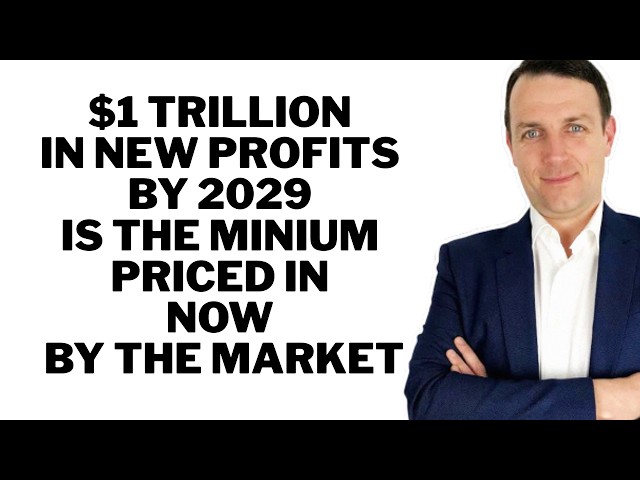
AI BUBBLE OR NOT… IS IT TIME TO GO SHORT THIS NOW?
Watch on YouTubeVideo summary
The video explores whether the current artificial intelligence boom represents a genuine bubble or a unique technological shift, arguing that while projected earnings look impressive today, they rely heavily on future commitments that have not yet hit the financial statements. The speaker highlights that companies like Nvidia are forecasting massive growth based on spending trillions of dollars in data centers, but this creates a significant accounting lag where depreciation and amortization costs will eventually pile up on the balance sheets. Once these infrastructure costs are recognized, the current high margins will likely vanish, requiring corporations to triple their profits just to cover expenses and remain profitable, a feat that seems increasingly difficult given the market's current pricing assumptions.
A critical concern raised is the fragility of this growth model, which assumes no competition, no price wars, and continued monopolistic control, all of which appear unlikely as regulatory scrutiny increases and geopolitical risks from competitors like China emerge. The speaker draws parallels to the dot-com bubble and the Lululemon stock chart, noting how Wall Street ratings flip from "buy" to "sell" once growth slows or prices revert, suggesting that the current AI enthusiasm may be driven by desperation rather than sustainable fundamentals. Furthermore, the video points out that while internet usage became cheap and ubiquitous over time, the high cost of building AI infrastructure means that returns on investment will differ significantly, potentially leading to a scenario where overcapacity causes supply gluts and bankruptcies once the initial hype cycle peaks.
To navigate this uncertainty, the presenter discusses hedging strategies using put options as a way to protect portfolios against a potential catastrophic reversal in the AI sector. He explains that while buying out-of-the-money options offers high leverage with limited downside if nothing happens, there is a substantial risk of losing the premium paid if the stock price does not crash as predicted. The speaker suggests that 2027 could be a pivotal year when accumulated capital expenditures and rising interest rates begin to weigh on earnings, potentially triggering a market correction similar to historical cycles. Ultimately, the video concludes by questioning whether it is too early to short the sector or if investors should consider small, strategic hedges to prepare for a possible downturn without betting entirely against the current momentum.
Read the full video transcript
Good day fellow investors. Is it a
bubble? Is it different this time? We
all have the data, the numbers. But the
key is what can we do about it? Should
we go long or short? If we look at the
situation, we are only just seeing the
higher part of this pyramid on the
financial statements. This pushes
earnings higher, growth, everything
looks great because the below part of
the pyramid, the future commitsments
that are five times the current
spending, the current financial exposure
have not yet trickled down to
financials. And therefore, Nvidia
forecasts 70% growth next fiscal year.
And that is completely right. If these
companies stick up to those commitments,
Nvidia simply doubles. On top of it all,
the projected spending ahead is for
trillions. A trillion per year at least
indefinitely. Those trillions of
spending simply increase earnings for
now at huge growth, huge margins.
Everything looks great because
practically there is no depreciation and
amortization yet coming into the system.
when that comes and we are going to
calculate how big of an impact that
depreciation and amortization will have
when everything comes on balance sheet
then all these great earnings that are
expanded now because this is Microsoft's
[snorts] gain from the valuation of open
AI that then recursively purchases from
Microsoft creating circular revenues and
the profits are there. But that 3
trillion of spending in 3 years, general
value creation of data centers or
expected life, let's say 6 years at
best, even if some argue that the chips
bought last year are already old. That 3
trillion spent should just cost
depreciation and mortization and
everything half a trillion on the
balance sheets. That means that the
hypers scalers need to triple that
current profits just to justify the
spend to cover the depreciation
amortization and then to make some money
on it. Top 10 of the S&P 500 we are at
600 billion in net income. everything
great minus 500 billion in depreciation
that leaves a hundred billion in net
income which is nothing compared to the
market capitalization. Therefore, to
justify the trillion dollar spend, they
need to make an extra $1 trillion in
profits minus half a trillion to add
here half a trillion in profits to
justify the spend. They need to add 1
trillion in operating profits by 2029.
That is what the market is pricing in
now at the moment. the total gains
because all the customers need to spend
more money and they will spend if they
make more money. S&P 500 earnings not
adjusted valuation centropic open AAI
earnings need to grow at least a
trillion to justify what we have by
2029. So in the next three years those
are the projections. We have seen the
growth projections in the S&P 500. But
that assumes no competition, assumes no
price wars, assumes China doesn't exist,
assumes monopolistic pricing growth and
everything. And we are already seeing
issues with that with the amo days of
the world screaming about safety to
create a monopolistic situation, not
safety. And even Elon Musk has recently
discussed there is a good chance China
will be the world leader in AI.
If there is a good chance China will be
the world leader then it will be very
hard to make a profit like anything when
you compete with China anyway that's a
risk. Further internet changed the
world. What's the price you're paying
now for watching me now? Nothing.
Practically nothing. It's a fraction of
what it used to cost 25 years ago when
this would be absolutely impossible
given the cost. Now it's completely
different. And the same will be for a
commodity like AI. And yes, I agree. AI
is changing the world. I'm using it on a
daily basis. But it's so cheap. It's
great. It's cheap. which means return on
investment will be different and it's
very possible that we have the same end
as last bubble 80% down and therefore I
would not bet a scent on AI so going
long is a nogo for me and there is so
much smoke now one side is screaming
about growth one side wants protection
to keep the monopoly to have some
glimpse of hope about profits
The chips are being bought not
installed, thus not yet hitting that
accounting cost. There is so much smoke
currently going on and Yansen Huang is
so loud in just telling the whole world
how great his company will be next year
and next year. And I feel it's the
marketing has become a little bit more
into the desperation to keep the circle
going because they all know as soon as
the situation stops. As soon as the
first hyperscaler calls Yensen squank
bluff, if they say no thank you,
everything the whole upside becomes
quickly the downside. And I've read this
really take the time. It's just
screaming for regulation so that they
that already have a position eliminate
all other competition and can try to do
these things profitably. If there is
illegal actions have liability for those
companies providing those tools. Very
simple. actually the law is already
there. Then the key question is if it's
not long, is it a short or even better,
when is this a short? I recently
received this email from Michael Bur.
Great discussion on what's going on.
There should be an email coming in
today. Maybe we'll discuss it in some
future video. But he starts with
Lululemon and whether Lululemon is a
buy. He has made it his biggest
position. But this is a great chart just
discussing
where is investing in general when it
comes to Wall Street prices, risk, and
reward. Lululemon just a few years ago
was the darling of Wall Street. As the
price was going up, as revenues were
going up, as everything you can see
here, 80% of the ratings were buy. Now
that everything has reverted, so 80%
here at the peak, everyone was say
screaming it is a great buy. Now that
the stock is down 80%, nobody calls it a
buy any more. That is Wall Street.
Similarly, now that the stock of Nvidia
is up 20x, of course, everybody has it
as a buy to have it as a hold sell and
only one has it as a strong sell. Only
one that dares. And you can see here
Nvidia the price target was 24 years
ago. And just as the stock kept going
up, so they have increased the price
target to now above 300 because they
need the stock to go higher. Could
everybody on Wall Street be wrong? Well,
here is the answer. It can happen. We
need to keep that option open. Okay, if
they're all wrong, what can we do about
it? A great comment in Michael Bur's
letter was that stock market booms tend
to peak at halfway through the capital
cycle spending already before Yansen
Kuang Nvidia demand will keep on growing
when the market senses that Nvidia will
not grow anymore that the cycle is
reverting that there are plenty of data
centers or that the chips are not worth
the money then everything starts to
revert. And I have the feeling now that
they are all going all in on this simply
because they feel they have to do so
except Apple. H I don't know whether I
snipped the right book, but capital
account and money manager reports on a
turbulent decade 1993 2002 discussing
the capital spending in the dotcom
bubble. The summary there, high capex
leads to its own destruction, high
demand for the infrastructure, revenue
growth, profits, everything looks great,
high returns while the cost of equity,
the costs are very low. Everybody is
investing, growing demand, everything.
But the cost of that spending is not yet
reflected in the financial statements.
It will be later. And therefore now
everything looks great. But as that cost
starts piling in, the same with US
government debt. The last 20 years
interest rates are very low and they
were just borrowing, borrowing,
borrowing. The economy was just growing,
growing, growing and the costs were
irrelevant. Now with higher interest
rates, the costs, interest costs start
to be hugely relevant. Same with AI.
Same with all these spending cycles.
Overinvestment
leads to over capacity and from
extrapolating infinite growth that Wall
Street is doing now everything reverts
on the opposite side of things which
leads to supply glass price wars
competition bankruptcies name chat GPT
perhaps the first one costs hit back and
AI is great I asked it to show me what's
going on in line with that book to
summarize it in a picture and this is a
wonderful situation. Where are we? We
are Q3 [snorts] here. The buildout is
accelerating. The AI infrastructure is
in a bull run. The stock market is still
in a bull run. Explosive capex growth.
Infrastructure providers squeeze. Simply
they cannot keep up with demand. there
is supply demand imbalance. Then halfway
point the capex boom this is what also
Michael Bur discusses
then we start to see that the data
centers are there new technologies make
it faster new technologies make it
easier things like that then you see you
don't need so much open-source China
competition there is over capacity there
is a collapse on return on investment
especially When depreciation and
mortization things hit all the gains on
entropic open AI valuation revert it
looks very ugly and the stock market is
down 80% like the NASDAQ from that
perspective also I think what Michael
Bur is sensing 2027 should be a very
very interesting year because those
costs will be hitting and if the revenue
growth growth doesn't reflect not the
circular revenue growth. the true
revenue growth doesn't show up in
earnings in other companies in everyone
because that is what we are looking for
then it might be over perhaps it's too
early still if we look at Nvidia it's
still booming but the stock is a 20x and
then we have to see okay what is the
price of going short how much money can
we make by going short so is it now the
time perhaps before the cycle peaks to
hedge our portfolios in a way because a
reversal in the AI situation might be
catastrophic. There is a huge range in
the stock price 164 246 we are on the
higher side there and then I went to
look a little bit at the option put
options that's what we are interested we
want to buy something if we lose we lose
everything but the upside should be much
higher if I look at the put options
there at the current strike price we
have to pay more than 10% of the stock
price to bit protected that. So to make
some money there, you need to go 20%
lower on the stock price. Option guys
will explain that in the comments. I'm
sure about that. Then I look a little
bit out of the money and this is perhaps
interesting. If I can buy an option for
$1 or something to protect me at 100, if
Nvidia in the next 12 months goes to 50,
I can make, let's say, 40 times my
money. If you put one, you get 40.
That's 40% of your portfolio if you put
1% of your portfolio. Can Nvidia stock
price in the next 12 months return to
where it was in 2023?
That seems extremely far-fetched, but
that's why the price is around $1 for
that. But if you want to be hedged for
crazy disastrous situations,
this is that out of the money hedging
situation, you can put it in 10 various
0.1% of your portfolio. Those put
options you decide to put every year 1
2%. If the brown thing hits the fan, you
are hedged in a way and you can get a
lot of returns if you nail the absolute
crisis. However, it's very hard that
Nvidia loses 80% of its market cap. It
is possible but hard because fullear net
income 120 billion is it going to trade
at a P ratio of 10 and they are still
going to double in the next year already
on revenues that have been committed. So
net income will be a quarter of a
trillion. But if there is no growth, if
the cycle reverts, if prices crash,
revenues, income, demand, everything,
then we might be looking at this. Looked
a little bit further. This is I think
2028 or December 2028. I already have to
pay free 380 for that put option. So if
it goes to 50 in the next two years, I
make 10 times my money. Still good, but
not great. However, with options, we
have to keep in mind that this is from
two years ago. The option for Nvidia to
go below 100 was priced at 760. Now, it
is priced at 1 in the next 12 months.
So, you must keep into account that if
nothing happens, you will likely lose
80% to 100% of your money. Michael Bur
is exposed to this option put strategies
he constantly changes that but Palentin
Oracle he has them all he has taken some
risk off the table but that's simply a
different strategy I'm looking forward
for your comments if this bubble
continues into 2027
and the options are priced equally for
2029
it might get interesting we'll See now
we first have the midterms. There might
be volatility, interest rates, costs,
debt issues, private equity. A lot of
things will happen this year and next
year will be very very fun. Just
consideration.
I'm starting to think about these put
options to add to my diversified
portfolio. One 2% of the portfolio just
for fun. But I'm looking forward to your
feedback. I'm thinking perhaps when it
will be so obvious that the cycle is
over but the market doesn't want to
believe it. We are not yet there.
Perhaps it will be a great time to buy.
Looking forward to your comments and
I'll see you in the next