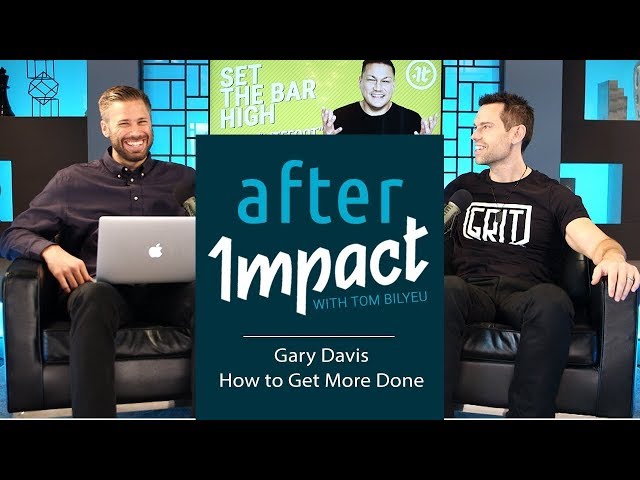
Video summary
In this episode of After Impact, host Tom Bilyeu interviews Gary Davis, a legendary Native American rapper and entrepreneur known for his diverse career spanning music activism, record label creation, and the grueling "Rez Tour," where he drove around the Earth twice in one year without leaving the United States. The conversation begins with reflections on their recent vow of silence experiences, which Bilyeu used to manage back-to-back Q&A sessions lasting up to 11 hours straight. Davis draws a powerful parallel between his own relentless work ethic and Bilyeu's approach to building Impact Theory, emphasizing that true success requires grinding harder than others and being prepared for unrelenting schedules. A central theme emerging from their discussion is the necessity of having a "chip on one's shoulder" or something significant to prove; Davis argues that those with perfect circumstances often lack the drive needed to reach extraordinary heights because they have already achieved 80% of what success requires, whereas adversity provides the fuel necessary to push beyond comfort zones. Davis shares his story of overcoming familial and financial instability by refusing to accept rejection from record labels before the internet era existed; instead, he created his own label and learned every aspect of distribution step-by-step. He compares this pioneering spirit to Roger Bannister breaking the four-minute mile barrier, illustrating how inventing a path when no model exists allows one to wake others out of "the Matrix." This concept extends to the idea that baby steps are not merely logistical tasks but hypotheses about how to achieve larger goals. Davis explains that entrepreneurs must identify these incremental actions—such as securing singers or raising capital for specific phases—and treat them as testable theories where failure is simply data used to pivot and refine strategies rather than a reason to quit. By removing the option of failing from one's mind, individuals can maintain discipline even when facing catastrophic setbacks, such as equipment malfunctions that initially seemed like dead ends but ultimately led to re-engineered solutions. The dialogue also explores the critical role of enthusiasm in leadership and community building. Davis asserts that if an entrepreneur wants others to be 100% excited about a project, they must first possess at least 150% excitement themselves; without this internal fire, momentum cannot be generated. Bilyeu recounts how his passion during Q&A sessions drew crowds of people into hallways and extended event hours simply because the energy was infectious enough to pull others in. This enthusiasm acts as a gravitational force that attracts support and resources, making it essential for anyone seeking to lead or innovate. Furthermore, they discuss identifying stagnation through both measurable metrics like follower counts and speaker fees, and an ineffable sense of progress felt intuitively when people begin treating the leader with increased seriousness and respect over time. Finally, the conversation addresses self-worth and mental resilience in relation to community dynamics. Davis advises that individuals surrounded by those who share low self-esteem or negative sentiments should immediately distance themselves from such environments, as one's state is often an average of their five closest associates. He suggests finding optimistic people who add value while simultaneously identifying personal metrics that can be changed versus those that cannot; for unchangeable traits like height, he recommends discarding them entirely to avoid unnecessary worry. This philosophy aligns with the concept of serenity: focusing energy exclusively on things one has control over and attacking problems only when there is enough passion to overcome fear or laziness. Ultimately, both speakers conclude that success is not just about talent but about a relentless commitment to forward motion, viewing every challenge as an opportunity to refine hypotheses and prove oneself against the odds.
Read the full video transcript
Hey everybody, welcome to another
episode of After Impact. I am your host
Tom Bilyeu and I am here with
the legendary Agent Smith, Mr. Bilyeu.
What is up, my man?
How's it going? It's going very well,
thank you. I'm speaking again, which is
exciting.
Yeah. You had that vow of silence going.
I did, 3 days.
Were there any interesting revelations
that came about like how Vanessa Van
Edwards talked about that when she does
her vow of silence?
Yes, definitely.
Not the same ones that she had. It It is
surprising to me how much I absolutely
loved not needing to talk. Like loved
It was amazing.
Nice.
Yeah.
Did you find that people acted
differently?
Yes, they forget that they can talk,
which is pretty funny. Like they will
literally start texting me. I'm like,
you I can still hear okay. Also, my wife
treats me like I'm sick routinely. Like
she'll go to kiss me on the cheek. She's
like, "Oh yeah, I keep forgetting that
you're not talking cuz you're or you're
not not talking because your throat's
sore. You're just not talking. So,
that's pretty funny.
I feel like I kind of took advantage of
the opportunity.
Rightly so.
Yeah.
In what way though?
Um just like I knew you couldn't talk so
I could like crack jokes.
It was fun.
But anyway, that's good. Uh all right.
Welcome everyone After Impact. This is
the show where we unpack the impact of
this week's episode with Gary Davis,
pre-recorded today because of scheduling
conflicts. So, we're not doing it live,
but thank you for joining us nonetheless
and for watching the episode of Impact
Theory with this man Gary Davis, who is
very very impressive, very interesting
person. Um I want to dive into that in a
little bit, but if you don't know who he
is, he has a very exciting career,
diverse. He's um was the first Native
American rapper. He created his own
record label.
Um when he's he's done hundreds and
hundreds of shows. He's also a um he's
an activist. He uh speaks at at Congress
a lot. Um act um he's an activist for
Native American rights. Uh works a lot
in his community. What else does he do?
He's an entrepreneur.
He did that whole res tour. Where uh
yeah, entrepreneur that's a great point.
Um but he did the res tour which was the
total of driving around the earth twice
and he did it in a single year without
leaving the United States.
That's madness.
That's crazy.
Madness.
What's the application?
That it's very impressive and I not not
miles traveled but so the whole reason
that I addressed my voice is because I
do the endless Q&A's. Right? So we did
the 20 This all started with the 24-hour
live. When I told the throat doctor that
I was on camera for 24 hours he was
like, "I'm sorry, what?" He was like,
"Who does that?" So we did the 24-hour
live then 3 days later I did a 9-hour
Q&A and then it just like I kept being
in these loops of um doing either like a
whole bunch of podcasts in a single day
and then I would have another Q&A, a
meet and greet Q&A. And so and the most
recent Q&A, the one that I just did in
Vegas
was 11 hours actually 11 hours in change
of just and that was after my 45-minute
talk. So it was like just
it's unrelenting madness. But when I
think about him and what he did like
that is how you get ahead, right? So I'm
in the phase now where I I need to make
a name for myself. I need to build this
community and the only way it's going to
happen is by putting in Gary Vaynerchuk
levels of work. Like you you just have
to be prepared to tour around, grind it
out, do more than other people and if
that means following it by, you know,
days and days of silence you do it. In
his case like being in the car non-stop
like tour tour tour tour to add value.
It's it's pretty impressive.
Get out there and pound the pavement.
Um I see a lot of parallels between the
way that the two of you think. So I
wanted to ask you just off the bat um
would you agree with that and what are
some of what are a couple of the biggest
intersections that you see?
So, I would agree with that, and I think
that putting in the work, like, and
always be moving forward. Those were two
things that just really, really
resonated with me.
Um, and man, if if I can throw in a
third, like, when he couldn't get anyone
to sign him to a record deal, and they
said, "Dude, that's just ridiculous." He
didn't go, "Yeah, gosh, I guess that is
ridiculous." He created his own record
label, man. Like, but but really think
about that for a second. This is before
the internet. So, he's not creating a
record label, and it's like, "I know
exactly how I'm going to get this
distributed." He's like, "I'm creating a
record label. I've no idea how to do
that. I don't know how the record
industry works. I don't know how I'm
going to get um the music actually out
there." But, he does it anyway, and he
starts learning step by step, realizing
that, "Okay, I have to figure all this
out, and what are the incremental steps
that I need to do in order to execute
against that? Um, how do I get the funds
that I need to make this album?
How do I convince people to be on the
album with me? How do I support it by
touring?" But, just like figures every
step of the way out, and he's like the
the Roger Bannister, right? You can't
run a 4-minute mile, and then he does,
and then everybody starts doing it
after. It it's just really, really
impressive when somebody's the person
that woke themselves up out of the
Matrix, and that's that's him. Like,
there was no model for him to to take
out of his community, anyway.
Yeah. Yeah.
no Native American had ever done it
before him, and so
not only do people not take him
seriously, but he has to like invent
everything from the ground up. Very,
very impressive.
That's very cool. Um, I want to talk
about how he did have to build all that
up from from nothing, and really he
cites in the interview
uh the familial and financial
instability that he experienced when he
was younger as really being the impetus
for his decision to sort of take it upon
himself, build things
um for both himself of what he wanted,
and to support his family and his
community.
Uh what would you say this is a bit of a
curveball question. What would you say
to people who
um are in good circumstances where they
have support, they have a great family,
they have um financial stability, they
have love in their life, money isn't a
problem.
What then?
Oh man, here's the honest answer.
I I don't think you can pull it off
unless you have a chip on your shoulder
of some kind. I You've got to have
something to prove. And here's the
thing, it like when I talk about the
80/20 rule,
make no mistake. If you've got 80% of
what you need to be successful, you're
light-years from actually being
successful. And so all the beauty in the
world gets you to 80%. That's it. Like
all the gratitude, all the wealth, all
it it's 80% because why? And
remember, I there's no moral imperative
to be {quote} {unquote} successful, to
play um on a uh global stage, right? You
don't need to want that. And what
inevitably happens when people have it
that good is they go,
"Why am I working this hard?"
Mhm.
And and I will ask you the same
question. Why are you working that hard?
Like if you already have the things that
you want, you have a deep sense of
fulfillment, like rock that out. But
it's when that you're a sucking wound of
a human being that you like you you have
so much in the reserve tank to keep
pushing, to go farther, to do more, to
prove to yourself, to prove to others.
Like And here's the thing,
I love that more than I can tell you.
Mhm.
Jared, I [ __ ] love that. I was having
breakfast this weekend. So literally
imagine I um go to Vegas, I do the epic
unbelievable 11-hour Q&A. I it was just
madness. There was a woman in tears. She
was like, "No, once Once out of college,
nobody gives you this kind of time and
attention. She was like, "This is
crazy." She's crying. I do that, I get 4
hours sleep, which you know for me is
like even for me that's [ __ ]
ridiculous.
Yeah.
I get up to an alarm, which I try never
to do. I fly back. I have a meeting that
morning. I go to the meeting
and I'm talking to that person about
what's pushing me at this very second.
The reason I'm not at home playing video
games with my beautiful, beautiful wife
is I have a chip on my shoulder. Like,
that's what shows up for me when I'm
[ __ ] exhausted. That's what shows up
for me when like I come home and I'm in
the beautiful Beverly Hills mansion and
it it is it is the chip on my shoulder
that drives me to prove something to
people, to prove something to myself,
absolutely. And I love it. There's a
[ __ ] intoxication. It's that same
thing I tell people like rage has a use
and it is the certainty, the clarity,
the intoxication, the drive, the energy
that that [ __ ] gives you. And if you can
learn to harness it, you can do
incredible things. So, to all of those
people out there where it is all
perfect, just go enjoy it. Just go enjoy
it because nothing is going to show up
for you in that moment where
you're exhausted
and you've got to keep pushing if you
want to get on people's radar. Like,
you've got to go, go, go. And so,
another one. When I was doing the Q&A,
there's always in my Q&A's, this drives
me [ __ ] crazy. There's always the
false end.
Every time.
Yeah.
There's, all right, no more questions,
no more questions. Awesome. Guys, thank
you so much. All right, let's final sub.
Yeah, yeah, yeah.
And then by the time we finish doing the
final selfies, someone's like, "Just one
more question." And then that turns into
cuz we thought we were done at 9 hours.
And then that turns into 11 hours, the
false goodbye. And so, I was like,
[ __ ] exhausted. And in that like,
they can't know that. They can't know
that like, okay, I'm ready to be done
now. Like, they need to know I'll be
here as long as you need me. And in
those moments, dude, if there isn't
something that you are beyond hungry
for, you will never make it through.
Yeah, I actually wanted to ask you about
that. So,
it seems like based on the interview and
hearing Gary talk about his work and
what he does,
it that he real he feels a real sense of
responsibility for
um everything that he's doing um both,
you know, with his business and within
the community. And it's almost like a
duty. So, I wanted to ask,
do you feel that way about your mission
with Impact Theory?
I don't feel a sense of duty or
obligation. For me, like pulling people
out of the Matrix is it falls into my
beauty. Like that's that is the amazing
thing. That is techni, right? That is
feeling like, "Oh my god, this skill set
that I have worked my ass off to obtain
is useful to other people." Like that's
really that is a gift to me. That I'm so
grateful, like beyond measure, that
that I can touch somebody's life and
bring beauty into their life where there
may not have been any. So, the woman who
was crying and just like nobody nobody
gives this kind of time. Or the um
former employee of mine who's like, "You
care more about my success than my own
mother." Like those are those are
beautiful things, man, and I love those
and I spend 80% of my time there and
they make me feel so so good. Um and I
don't like if tomorrow I was like, "You
know what, I've done enough." Like I
wouldn't be conflicted about that. I
don't feel like I need to save the
world. This is not a savior complex.
This is just like, "Wow, man, I am so
[ __ ] stoked that
I've learned something, it was hard to
learn it, and it's valuable to other
people." That is a great [ __ ]
feeling.
Nice. All right.
Um
I want to talk about concept of baby
steps, um which he lays out um he talks
about it pretty in-depth in the episode,
but he says, you know, you need to look
at what your larger dream or your your
big goal is and then break it down into
baby steps and then assign those steps
time frames uh
and then those phases so that you can
kind of really tackle them individually,
right? Um and it's so logical and so
seemingly straightforward, but my
question to you is
why do you think it's so hard to do?
I actually don't think it's hard to do.
I Here's where I think um people either
can't identify the steps.
Okay.
That is probably crushingly difficult.
Um or they're just not they're not
excited enough about it to like
do those things. So, people get
themselves into trouble in a few ways.
Um
they are looking at the whole picture
and so that is the real danger.
Um
thinking like without doing the baby
steps. And why don't people do the baby
steps? Yeah, I'm they're they're not
excited enough about it. It's not a
compelling vision of the future where
they really buckle down and sit down and
go, "Okay, this is where I need to get
to. This is where I'm at. What's that
chasm of skills?" And he and I talked
about this in the episode, like how do
you And in fact, the baby steps was his
answer to this question, but but my
question lies even a layer deeper, which
is how do you know what the baby steps
are?
Mhm.
And he rattled them off in in terms of
his specific baby steps and I really
music, right?
Yeah, and I really hope people listen
because hiding in the details is a
thought process and it's the thought
process that I don't know how yet how to
articulate to people,
which is, okay, how do you begin to
identify all those things that you
actually have to do? And so he's talking
about, okay, how many songs are going to
have like a singer on it? How do I go
get the singer? How do I raise the
capital for the different parts of this
and and, you know, know that I'm going
to have to pay them out and and he gives
like I mean he probably rattles off like
eight to 10 like really fast things and
I was like, that that is the magic,
right? Is the thought process that leads
you to be able to do that. And I've
tried to and I can do a similar thing
where I can walk you through the actual
thought process that I went through with
Impact Theory where how we end up as a
studio that thinks of ourselves as a
merchandising company and like why and
self-signaling and all I mean like I can
walk people through this the stream.
What I haven't been able to do is is
codify what that stream is. So that then
anybody can apply it to whatever they're
doing, right? So it you do the same
thing we did the same thing at Quest.
You do the same thing at Impact Theory.
He did the same thing with his life. But
like what is that codification? I don't
know how to give people that. Um so
I would just be repeating myself to
answer your baby steps question. It
isn't hard.
Mhm.
You just have to do it. But
the the the tricky part that I don't
know how to teach is
what are the baby steps? Like how do you
make sure that you identify the right
ones? And the the best thing I've ever
heard is what he says, but this is way
messy. You go, you trial, you fail, you
learn, you try again, you fail, you
refine, you learn, right? So that that's
it. But like
that's a really messy way to tell
somebody to do this.
And that speaks to the the reality that
a lot of the baby steps are hypotheses.
It's not like you're on the road to
entrepreneurship, you're inevitably
going to have to pivot. And so you put
this together. This is my hypothesis of
how we're going to get there. And if we
fail at one of these steps, then we have
to pivot. We have to change our
approach, our strategy. Would you agree
with that?
Jared, that's so brilliant. I love that
so much.
They're hypotheses.
That
I really like that. I'm going to steal
the [ __ ] out of that. Um a silent
trademark to you every time that I say
it.
Um, but wow, you're absolutely right.
The baby steps are your hypotheses.
You've got to get good at coming up with
a hypotheses. That remains the tricky
part. But at least when you
conceptualize them as like, okay, this
is what I think, so I'm just going to
try it. And if I fail, I'm going to
refine. I'm going to pivot as um, Gary
so eloquently said, then I think, you
know, it's it's messy and I don't want
it to be the answer, but that's really,
really true.
Yeah.
That kind of leads into the next
question.
Something that I thought was really
brilliant that Gary said in this, um,
when he was talking about, um, breaking
down each phase. He He said it was kind
of like a a throwaway comment, but he
said you have to figure out how much
capital you need to raise for each of
those phases.
And I was like, whoa, this guy's
thinking very, very detailed, very
strategically. Um,
that's something that I took away. What
do you think entrepreneurs can take away
from his story?
Whoa. Um, so that's a really big
question because
One thing that jumped out at you from
the interview or from his from your
research.
I I'm going to give you the answer, but
I'm not sure this is actually what
you're asking, so please help me if if
I'm not getting there.
He He is
He removes not succeeding as an option.
Mhm.
And one thing that is like an absolute
must entrepreneurs have to do. And I
remember, um, so I'm living through that
right now at Impact Theory. When I tell
people what we're doing, it's so big,
they can't like They've never allowed
themselves or trained themselves is the
true answer. They've never trained
themselves to think that big and to have
the discipline to figure out what all
those thousand little steps are that are
going to get you there. So, he does
that.
We went through the same thing at Quest.
And when you remove failure as an
option, then you're only thinking, this
is a hypothesis. what did I learn, how
do I tweak, how do I refine. So I
remember one night we were we had just
gotten the equipment at Quest and it was
it just wasn't working and we'd moved
backwards. So it it took us like I
forget like eight or nine hours for
seven eight of us
to make 1200 bars by hand and then it
was taking us longer with the same
number of people to do it on industrial
equipment and we had just sunk um
essentially all of our investment
capital into it. So it was like
uh like did we just make a catastrophic
error? And so you're you do that one
night, okay, two nights, okay, three
nights starting to be scary, right? And
and I remember at that point going I'm
I'm not scared. Like I know that we will
figure this out because I have totally
removed the notion of failing as an
option. Now maybe we end up doing
something different and that different
thing was that we re-engineered the
equipment, but
it never crossed it and and I mean this
sincerely, it never crossed my mind that
I would quit. It didn't even cross my
mind. And I remember it didn't even
cross my mind that it hadn't crossed my
mind until somebody said, "Do you ever
think about quitting?" Like when it was
really really hard and I was like no.
Like that was the one thing going into
all of this like I considered not
starting
but once I started I never considered
quitting and that's how I feel about my
marriage.
I considered not proposing, but once I
proposed I never considered breaking up.
So it was like people always talk about
how their wedding day is like this day
of like it's tumultuous emotions and
like cold feet and all that. I thought,
"Wow, that that was the furthest thing
from my mind." Now that crossed my mind
before buying the ring.
Before buying the ring I was like
do I really do this? Like this is it's a
big compromise
and
that was a weighty moment for me. But
once I crossed that bridge, and so
that's something that I think Gary
personifies so magically is he just like
it it's not something that weighs on his
mind, right? And Jocko Willink talks
about that. Discipline equals freedom.
Like once you remove that you might not
show up, once you remove that you might
not go to the gym, once you remove that
you might not do the next leg of the Rez
tour in Gary's case,
um then there's no debate. Like you just
[ __ ] do it. And I can't tell people
it is it is a weight off of your
shoulders to know that you'll you'd
never consider that.
Love that.
Um all right, got a couple more
questions here.
Let's see. Uh
by the code. Um
here's something this also relates to
entrepreneurship. So he says, "If you
want to be if you want people to be 100%
excited about you and your project, then
you need to be 150% excited about it."
And I thought that was awesome. So I
wanted to ask you, can you talk about
the importance of enthusiasm when
leading people and sharing your vision?
I'm so I was really really hoping you'd
bring this one up. It it is it is
absolutely critical. And what does he
say in the episode? He's like, "If
you're going to ask other people to be
about it, you've got to be about it."
Mhm.
That is so true, and that is one of the
and I'm sad I didn't bring this up when
you asked the original question, that is
one of the secrets of of leadership for
sure. Definitely one of the secrets of
entrepreneurship is you you literally
have to light up every room when you're
talking about something. If you're not
the one driving a Ford, it is never
going to happen. You've got to be the
creator of momentum. You've got to be
the generator of excitement. And I don't
think like if you're if you want to be
an entrepreneur and you're not an
excitable person, immediately get a
partner who's excitable. Like you you
must [ __ ] have that. And it is it is
amazing. It is one of the coolest things
about being the human animal.
When you're on fire for something, the
way that people gravitate towards that,
man, it is really [ __ ] cool. It is
one of the greatest experiences of my
life to like find myself in private of
the chills, to find myself in private
getting really amped up about something,
really excited about something, and then
to like start sharing that with people,
and then see the way that people come
and gravitate towards that, the way that
they want to be around it. Like when I
was doing that Q&A, dude, I wish you
could have seen it in in Vegas. In fact,
you'll see the footage. So, it's
literally I had no We ended up being in
a hallway the whole time. I had no
intention. I'd made this big
announcement on stage, "Hey, everybody,
I'm going to be in this like back room
thing. Um it was like where like the
lunch happened stuff. I'll be in the
back of that room, like come and find
me." And I am walking to that room.
And somebody stops me. "Hey, Tom, is it
really true that you'll answer any
question?" I was like, "Yeah, man, of
course. Like what's what's the
question?" And he asked. And then I'm
getting into the answer. I'm, you know,
passionate, excited about it, and then
another person comes. And another, and
another, and and then by, you know,
I don't remember how long it took, an
hour, two hours, whatever. There's
70, 100 people just mobbing around me
because of the enthusiasm. Like that's
how it starts. Like people are just
drawn to that. And if you can And by the
way, we did the whole 11 hours just
standing in the [ __ ] hallway. Because
people just as soon as they see that,
right? It's like the excitement of the
crowd. Like when you get one person and
then another and then another,
eventually like people are far enough
out on the ring, they just want to see
like what's all the excitement about,
right? So, that you've got to be able to
generate that. You have to.
That's awesome.
Um let's go back to the concept of uh
keep moving forward. I know you're big
on momentum matters. See a lot of
similarities there.
Um another curveball question, what does
it look like to not have momentum or to
be stagnant? How do you identify that?
Cuz you can get caught up doing the busy
work, right?
Yeah. Doing the day-to-day.
Okay, so here's what I I look for. God,
it's interesting. This is one of those
words I wanted to define with the word
itself. Uh momentum is when there's
momentum. Uh so I'm really looking for
I'm looking for things that are taking
concrete measurable steps forward and
then I'm looking for the inevit-
ineffable how I feel.
So, invariably there are metrics. So, if
you look at what we're doing with Impact
Theory, there's numbers, right? So,
followership numbers, engagement
numbers, we look at that. Then there's
um my speaker fee, like how much can I
charge for that? Then there's how many
people are applying for internships, um
how many people stop in uh if I'm giving
a talk, like how many people roll up to
that? So, those are all things that like
you can measure and then there's the
ineffable sense of like
we're going somewhere. People are
reacting to me differently and that gets
it's impossible to measure, but it's
little things and I won't reveal, I'll
tell you off camera, but I'm not yet
ready to to talk about this on camera,
but somebody sent me a text yesterday
and I just sent uh a screenshot of that
text to my wife and I said, "You're not
going to really understand why I'm so
excited about this, but I can feel that
this person is now taking me way more
seriously than they did 6 months ago."
Mhm.
And because they're watching. They're
just looking at what's happening in our
community um and they've been around
this world long enough to go, "No, this
is different. This is This isn't like
the other people I've seen do this. Like
there's something happening here." They
never said that, but I can tell by the
way that they treat me.
Mhm.
Excuse me. The way that they treat me,
the the meetings that they're lining up
for us, the way they're trying to draw
me deeper deeper into their world, um
you can just feel it. And I'd I'd never
be able to measure that and most
importantly, when that's not there, I
know it's missing. So, if the numbers
are happening, but like, hmm, ineffably,
like I can feel like I'm moving
backwards or and I've felt this way
about the show, and this is one of the
reasons that I think the show has
continued to be um fresh and good is
that when we're like
holding steady, I I am filled with
terror and unease because that's how get
to the top and then fall.
Yeah.
Because they they can't feel that
they're they're flatlined cuz they're
not declining, right? So, there's
like there's nothing to be paranoid
about, but in those moments, if you can
train yourself, and I and I have trained
myself with my obsession over momentum
to notice moments where it's just not
progressing at the rate that it could or
should be.
Yeah.
Um
one last question.
Gary, he in the episode describes that
within his community he feels like
people don't really know or understand
their value and purpose.
Um and he talks about this in relation
to self-worth and having having that in
your life and why it's so important. So,
I wanted to ask you, if you're someone
who has low self-worth and you're around
people who share that sentiment, um what
do you do?
Meaning they share that sentiment about
me or about themselves?
Themselves.
Immediately get away from them. So,
that's step one. Um step two is meaning
you need to find the you're at the the
average of the five people you spend the
most time with, so find people that are
optimistic, upbeat, whatever, um that
are going to be positive and value add.
But then to yourself, you need to
immediately identify what would make me
feel good about myself. Um and if those
are things that you can change, then
immediately begin taking the steps to
change them. If they're are that you
cannot change, I wish I were taller,
um, then immediately discard those as
measurements. They will not serve you.
And there's,
um, um,
a really cool thing. It's kind of like
the prayer, grant me the serenity to
change the things I can, to, like, feel
fine about things I can't, to know the
difference. I I'm [ __ ] butchering
that. And it's so famous. Um, but
there's another version of that which
now I'm totally blanking on. But, oh,
uh, I think it's like Plato. Like, never
worry about the things that you can
change and never worry There's two
things you should never worry about,
things you can change and things you
can't. There we go.
Um, and 100% true, right? If you can
change it, then go change it. Don't sit
there and fret about it. And if you
can't change it, why are you worrying
about it? There's nothing you can do.
So, immediately you move your attention
onto the things that you can change. So,
if you're holding yourself to a metric
that just doesn't make any sense cuz
there's nothing you can do about it,
then that's stupid. Pick a new metric.
And then if you're obsessing over
something that you can change and you're
beating yourself up over it, it's like,
the only thing you should be annoyed
with is that you're too [ __ ] lazy to,
like, attack it. Now, figure out why are
you lazy? And the answer is universally
because you don't care enough about that
thing. You're not on fire enough about
it. Because, man, if you're super on
fire for it, even if you're afraid
you're going to fail, chances are you're
going to give it a shot, right? So, that
to me, like, really, um, developing that
level of interest, developing that level
of excitement about something, that's
the key.
Awesome.
All right. Well, I think we got to wrap
it up there. It's short one today.
Boys and girls, sorry that we couldn't
do this one live. Um, I'm off to New
York. I'm very excited. Hopefully, I
think this airs after I get there, so
it'll be too late. But, for those of you
in New York, I'm excited to see you
guys. Going to be amazing. For everybody
that joined me in Vegas for the talk and
the live Q&A, uh, that was absolutely
incredible. Mad shout out to Thrive for
having me. You guys put on an amazing,
amazing event. Your community is
unbelievable. Cole, thank you so much.
Uh, that was really, really great. And
to Jordan Harbinger who hooked me up
with those guys, The Art of Charm. You
You are going to hear me going hard on
Jordan and The Art of Charm because I
that dude has done more to help us grow
than any other human being outside of
this organization. Literally, he is so
over the top about helping
like even I'm like god damn like this
guy is not playing around. We have paid
him exactly $0.00.
Like he's just [ __ ] gone way way way
out of his way to help us. So man, if
you want to do me a solid, go subscribe
to The Art of Charm.
That dude has just done so much to help.
And look, I know secretly in the back of
his mind it was to create moments like
this, but he's done an amazing job. So
Jordan, thank you dude. You've become a
fast friend of mine. I am super stoked
every time I get to see you. And for the
intro at Thrive, I will forever be
grateful both on stage and off. So thank
you brother. Amazing amazing amazing.
Guys, if you haven't already be sure to
subscribe. If this added value, please
do share it. And until next time my
friends, be legendary. Take care.