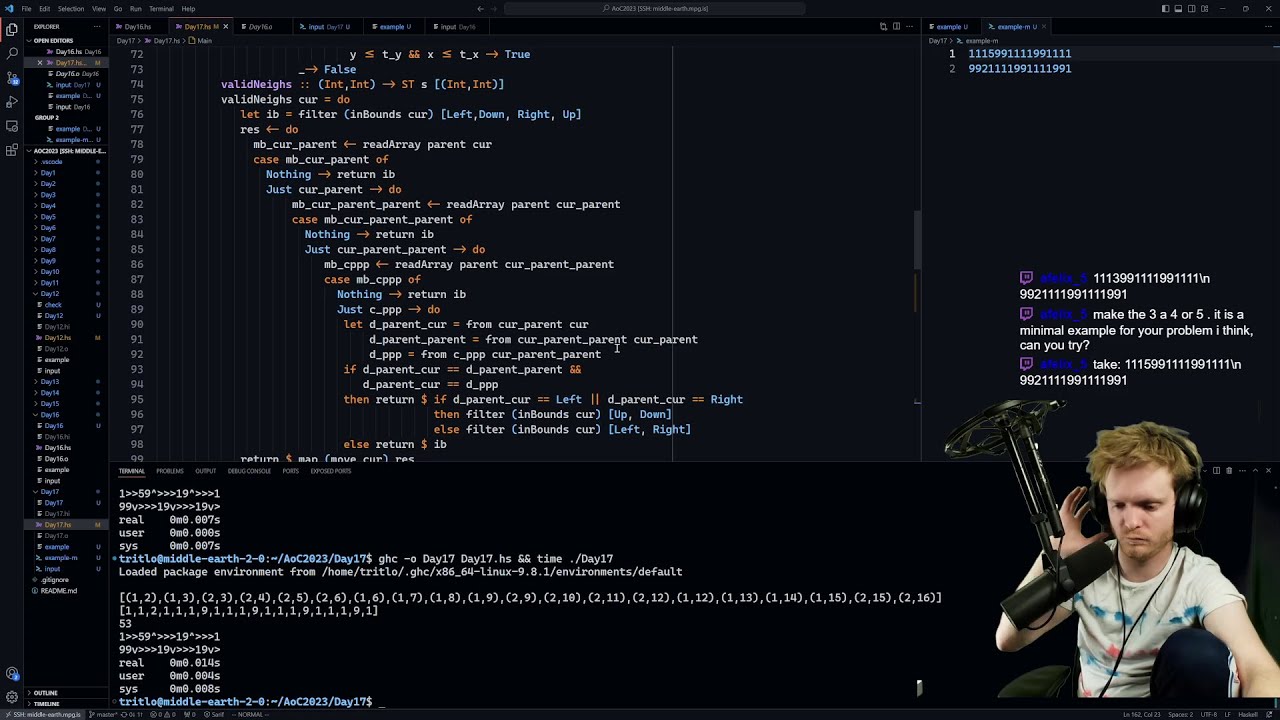
Video summary
The video explores Day 17 of Advent of Code in Haskell, focusing on a pathfinding challenge where the goal is to minimize heat loss while navigating lava flows under specific movement constraints. The core difficulty lies in adhering to a rule that prevents more than three consecutive moves in the same direction, requiring the implementation of a Dijkstra's algorithm framework within `ST` monads and mutable state. The speaker initially attempts to parse the input into mutable arrays and set up neighbor generation logic that respects grid bounds and tracks parent directions to enforce the "three-in-a-row" restriction. Early experiments using standard lists and basic sorting for priority queues prove insufficient, as they fail to correctly handle the necessary tie-breaking logic and specific movement constraints, leading to incorrect paths or suboptimal results that require extensive debugging of path lengths and neighbor calculations.
To address the issue of the algorithm being "too greedy" by only considering immediate neighbors, the speaker modifies the approach to evaluate potential moves three steps ahead by generating all combinations of directions repeated three times. This involves implementing logic to track tentative distances and update parent pointers whenever a shorter valid path is discovered, while carefully managing visited nodes to prevent infinite loops without discarding potentially better routes. The process highlights significant challenges in Haskell, including debugging array indexing errors, handling recursion issues, and reconstructing paths when multiple valid parents exist for a single node. Although this refined logic eventually produces the correct answer for the example input, the computational cost of generating and filtering all possible paths becomes prohibitive when attempting to solve the actual challenge input efficiently.
Despite six hours of coding and streaming, the session concludes without finding an optimal solution for the full problem, as the current method of exploring every combination is deemed computationally expensive. The speaker realizes that simply expanding the search horizon by generating multiple steps ahead does not scale well and fails to provide the performance needed for the larger dataset. Throughout the debugging process, there is a continuous effort to refine neighbor filtering logic and define custom `Show` instances for direction types to better visualize and trace the algorithm's behavior. The segment ends with the speaker acknowledging that while the example cases are solved, the approach requires a fundamental rethink to balance the strict movement constraints with the efficiency needed to handle the real-world input size effectively.
Read the full video transcript
all right
welcome to
today's a of code well yesterday's a of
code we're doing day 17 today
um we did day 16 yesterday we're still
catching up but uh we had a sneak peek
at this yesterday and we did the parsing
but we figured out that we would need to
do some
[Music]
um path finding algorithm stuff and
uh 40 minutes didn't seem me enough to
get it done so I decided just to do it
uh now in one
day and and let's see how it goes
um all right so we cated up the parsing
so we are taking this example text here
paring it into an array and uh you can
do arrays in has schol uh they can even
be mutable they can have you can do
mattresses it's not too bad actually but
um um
obviously they're a bit diff more
difficult to work with because you you
know have like built in Syntax for a
race as you do with lists but it can all
be
done where there's a will there's a way
so let's remind ourselves what we are
doing uh uh so we're kind of we released
the lava and now it's flowing down and
we want it to flow faster so we put it
in something called a
crucible uh which is this kind of
thing it's just a big pot
basically and uh we're we're taking that
down and we want to find the one that
involves at least heat
loss and uh so we get this and then uh
what we want to do is we want to get
from this top corner here to this bottom
corner here but we want to do it in a
way that minimizes the Heat lots um and
the way we're going to do it is that
we're going
to look at the numbers here and pick the
shortest path according to these numbers
which is just a Dess algorithm I Str
algorithm and
um we're probably do something like a
star actually which is dyra but with
some extra her istics which makes it a
bit
faster um so
dyra what does d so what do you how do
you do
dtra uh what you do is that
you
um you have a graph like this and then
you have some neighbors and so you
basically yeah exactly so you mark all
nodes is unvisited and then you have all
the unvisited nodes and then you have a
tentative distance such as zero for
initial node and to Infinity for all
other nodes now during the run of the
algorithm the T to distance so then you
just get the shortest
path so it's basically breath first
search
um but with
a uh with distances instead of just
always picking some neighbor
[Music]
okay and through the current compar one
currently assigned to the neighbor and
assign
[Music]
it compare okay so I assign every a
tentative distance I set it to zero for
our initial node and to Infinity for all
other nodes dur run the algorithm dis of
node the length of the shortest path
discovered so far since initially no
path is known to any other Vortex it's
going to be
infinity and uh then we just find the
shortest
distance um
okay so let's H now my mouse start
working again let me plug it in and plug
it plug it out plug it in
again
I Mouse which stopped working and it
started
working uh but then it stopped working
again and now I'm back to this one uh
which works again but it keeps stopping
keeps dropping out but I think I get a
new mouse for Christmas so don't worry
about
that
um so let's keep this to the
side and
um don't worry about the copyright on
this picture cuz I took it
actually let me see um we are going to I
want to put it like
this and then we want this
one over
here and then we make this example a bit
smaller cuz it doesn't really matter
okay
so
D we're going to take in the array of in
comma in
in and we are going to um make a copy of
it I
think
uh for the distances data.
[Music]
array okay and can I map over the array
it's full foldable it's a
funter okay
and accessing arrays and this is
LMS ah of course I
can't easily update the
array uh let's
see we'll
go Mr
array so we have mutable arrays as
well
um so let's do this so dtra is going to
be take it in the initial
array and we are going to take in
the initial Noe and we're going to take
in the Target
node so now we're just going to do a
dtra uh uh simple Tyra and then
afterwards we're going to do this cuz we
can only move uh three in a row at the
start so we're just going to do that a
bit later so this is going to be um
Monet M SD array something like that uh
M we can actually just make it an IO
thing IO in
cuz now we're going to have a bunch of
side effects ah let's make it
STD of
int I like that better so I want to see
so St
array is the it's going to be an
[Music]
st
[Music]
and
so I kind of forgot how to do these let
me see
um
in so now we're going to
do n extra is equal to do so we're going
to say run
St do now this run SD comes from the St
monad which is
in um
import control.
mad. uh we have some mutable arrays
also
import data. m array. m
[Music]
array Mr array and we're going to say
import data.
array.
MRA m r
a s m m a let's see
[Music]
qualified how's everyone doing
today um run
St and we are we want
the Mona array so we want to say here
do um
[Music]
X is
um ma do new
array and we
want we're going to have it the same
dimensions let's see R init Target run
St do
so so r.
bounds um
[Music]
R so Converse so Tha yes I think I can
just actually convert a mutable array
into a mutable array so I can just do X
is ma dos
[Music]
R and I think it's going to complain now
that it's not return zero it doesn't it
won't know what H value will the
be
[Music]
so because uh it's
saying so not it's supposed to be
ins but it doesn't know the s so I think
I want
the add
s
array and then I need
the language GSC
2021 does this one
work
[Music]
um oh maybe I have to do m. SD array
um it doesn't want that either so what
is this data. array.
SD import data.
arr.st what what is this
save h
hogo
data. array.
[Music]
S.C they save API of
only
oh okay I think it's uh going to be
[Music]
fine but
um let's
see now it's complaining I
[Music]
think Stu array has kind star are okay
yes St
[Music]
array the state variable argument for
the St
type
let me see can I just do
um run SD array
here
cannot okay and then
um and made. freeze
[Music]
X because it's saying this okay
array in comma int
[Music]
int okay so now this one is is an sray
as and then it's it allows me to just
return
it
cool what do I get if I
do read
file read file
example print. pars do lines so here
this returns an array in in so if I
do okay I want going to do
this actually just need the
[Music]
arate cuz I know I'm going to go from
the top left to the bottom
left
and where init is equal
to in it comma Target is equal to r.
bounds
r
[Music]
and now let's print Parts
into T
[Music]
extra oh it just
works okay cool uh
then I can probably do
um
so I can saw the
array and then I can I can also do
um uh let's
see I don't need to Sol the array I can
just do uh this is
a ma do new
array and I want it to be
Bounds at bounds and I want everything
to
be uh so the
enum type class so I want it to be just
Max in
right uh
enum is the bounded
[Music]
class and let's see
enum Max bound it's called
bounds Max
[Music]
bound Max bound at
int and now it doesn't know what to do
so it's saying new array
um let's see what is the type of X here
s array
s at s
array
s okay so it's a big a here and it
doesn't like this because
[Music]
um
so let me
see if I can find the S inside
here uh let's
see this is going to be
St array s in comma
in
[Music]
right
[Music]
h no ST int int int right so this is
going to be the S and
in I think let me
see as kind
uh what do you want okay
um what do you want
here new8 okay okay A a z So
Okay add in
Comm is ADD
um
SD
yes
nice so now because I I bound the
and the S there so now this is all Max
int cool okay let's go back to D
St Mark all noes as Mark all notes
unvisited okay now I also want to
modify I want to set the
um read array right
array exactly so I just want to say here
uh right
array this H 0 comma
0
[Music]
Z so then we just set the distance of
this one to zero and then create a set
of all the unvisited not call the
unvisited
[Music]
set let me see
um so on the St
monad I have some state
right and I can do stuff with that
[Music]
state
uh and I can have the
SF and then let's just do
here scene is
s
new import data.
array. no import
data. SD
ref who says you can't do
imperative programming it's also the
best imperative programming language in
our high school let's see a SD R and now
we have data do set already this is
going to
be set.
empty and now it doesn't know what scene
is to be
but uh Mark all notes create a set of
all the unvisited notes called the
unvisited
set okay okay assign to every not a
tentative distance Z for inial infin
noes okay so
um for the UN current node consider all
of its unvisited neighbors and
calculate their tentative distances
through the current
node okay
um
let me see let N is equal to map
maybe so we have here x so
Point p is a point map may be
um f to left right up
down where
um let a
p where
F okay so let's first write the F here f
is equal to
move FP is equal to move this is FP
d k mve
of M D of
[Music]
um y comma
X then we check that
um you it
[Music]
add i
y IX
and Target is equal
to
i
t oh t y
TX okay so just have to check that I is
less than or equal to is bigger than
equal to
[Music]
I it just make it like this case so it
should be larger than equal to iy
and X should be larger than equal to IX
[Music]
and
um and then we should have y less than
equal to T Y
and X less than or equal to
TX and they should go to Just y
x
otherwise we go to
nothing
and now map
maybe is not
imported uh cuz we don't import data
Maybe import
data
Maybe map
maybe okay so now we have the
[Music]
neighbors okay
uh
so this is the
initialization
initialization do I need this x here
yes do
um run SD
array so let me just say that
[Music]
can I do something like
this just to get the
[Music]
um
he doesn't like
this what is the type of
this uh return ah okay let's just grab
the SD here from the
X not like it takes long so then we
initialize
it and then what are we going to
do how's the audio and everything by the
way I hope it is
good looks good on my end but let's
see okay now
um so we write the discs 0
0 then we say go is equal
to H so we have this
go ding ding ding ding
[Music]
ding go empty is equal to
um tests of
[Music]
Target
tests um M
A why doesn't it like this I think it's
just
bang
um
do what is it so go
TS
do I have to do
M go uh
next so
uh okay the current
the tentative distance of a node V is
the length of shortest path cover so far
between consider all of its unvisited
neighbors I calculate their tentative
distances through the current
Noe so then we do here
um
where let me see uh nay of next
let NS equal
n of
next and
um
map
r.
um
and
to
[Music]
at why can't I how can
I couldn't match expected type array in
in all right why so what is the type of
of
go
go takes a list of int comma int and
returns uh
STD
as
um int okay so here we're going to
do
thiss bang and H
Target okay so how do I access is Mr
array uh I have to do read
array right is
sorry so I'm going to do
this uh
m a. read
array
Target okay that one works okay good
okay uh ma a. read array
discs
um
these is equal
to ah I need to do this
actually these so this is two okay
DS map
M um and then this one
is was type of this so this is just a
list of
inss and what is can I do uh zp with
[Music]
him let me see and then I want NS
NS I just want to
do I need that app map
M
and and I just want to
do and comma
over so then this is a list
of neighbors and their
distances from the current node
to the current
distances
right okay so tentative distance for
current consider all of its unvisited
neighbors okay so I also have to
do
so I'll to read SD ref un
visited un visited ref okay
so and visit it is like this and then we
have neighbors and we say
filter
um not do uh set.
member flip set.
member visited right
maybe not
[Music]
flip nice okay and I just need to do
like
this so these are the unvisited
neighbors and then I read the distances
to
those consider all of its unvisited
neighbors and calculate their tentative
distances through the current
node okay so the tentative
distances so the distance of the current
Noe is going to be
curist uh ma. read
array uh uh
next
um
this next okay and then the the
tentative
[Music]
distance so so read
array this
next and then I read all
the compare the newly calculated T
distance of the one currently neighbor
and assign it
um if not a is Mark distance of six and
the edge connecting with B is a link to
then distance B A will be 6 + 2 okay so
then I want to
say
um all right so that's okay so
the C this is a so this is the distance
of next so DS uh
tentative DS Cur is going to
be it's going to be but here don't read
the this we read the
um uh we read the
X okay and here we don't just do and
Prime we actually
do
um Plus
cist okay now we have
the DS sentative and we have the DS
[Music]
Cur we can actually we don't need to sip
this
let me do it like this
just removing some
craft I think I need to do F
map
do okay uh DS C
there's a list of ANS and this is list
of DS
tentative and
then
[Music]
oh and we also want
to write the
parents okay let's see and
parent and we have the same pounds but
here
the max
[Music]
bound let's just have this
um
nothing the parent of every note
is
nothing so I want to say
here map
M um on sip
DS
tentative
um DS
Cur that's actually have the node here
as
[Music]
well okay
um let F equal so we're going to say
here F and this is going to take in the
the
neighbor and the T
dist and the C
disc
equals so if the distance curv
dist is less than T
[Music]
dist then we do
um right array
uh
parent uh the we write to the parent
array and we
write parent of
n is going to be
uh next let changes next to Cur
okay
Cur
or M
uh and
then these all changed okay right I need
parent parent
and just
curve okay so and then I write the array
parent just and I write
array H
discs uh
um
curst so that is like if it's the case
else
why return I don't do
anything there right array
return yeah I shouldn't return anything
right h
[Music]
m
okay f um this type takes in
the in comma int the neighbor and then
the this and then the current this to
SS
[Music]
um ah and it doesn't have
the
oops
okay so then I
map the
[Music]
esur and now I've also discovered the
new
neighbors so I want I'm going to add
those to the
[Music]
queue will be checked
again okay that's Mark
visited
m
okay go is
C KC is equal to
[Music]
Target then I just read the distance to
the Target because I have found
it okay otherwise we update
the parent we update the
dists and then we go
go and now we just add the
neighbors and
is to in front of the
rest I think this will
work uh let's
[Music]
see
uh but I never did go so I'm going to
say uh T
this is
go in
it
mhm
ah but I
didn't I also have
to I have to
write s ref
uh
unvisited
ref H set. insert Cur and we it
[Music]
it okay it's saying the
distance to the Target is
[Music]
79 let's just consider this for a
[Music]
moment of course this is
the PA
I want to so I want to actually say
here I want to return a list
of
um so path that's your so path is going
to
be reconstruct path
reconstruct
pass a cur is equal
to
uh
curve so we do uh read
array parent
curve so case red parent curve
of
nothing empty list it just P to curve um
reconstruct
path and then we just
Ur over Rec construct path
P now reconstruct
path uh
readay is going to be uh in comma int
to
SD s
um
in uh we need to turn here and uh this
one is supposed to be comma
in and reconstruct
path so
P case read
array okay just P why is it maybe
maybe
[Music]
apparent okay
read
array
[Music]
parent
read
[Music]
array it should not be this okay so
parent is
a maybe in
in okay
now
so we take in the Mr
array a
[Music]
n why is
it just just
P that is where very
strange uh
return Rec
construct
pass
[Music]
and no instance for m s maybe maybe
me yeah because it's not just
[Music]
just okay okay so
[Music]
here so Target is intent okay
Cur so do
uh
PS
[Music]
why uh okay
two see read
array parent
curve uh okay just because I don't do it
KC
of there we go
so this is the shortest
path but it probably yeah so it
takes right A lot of
times which is not
good but
um m
[Music]
I think this is actually
um you want to have the actual
path okay so how does it go we go
um
01 02 03 04 0 five 07 08 09
01 11
12 and then it just goes
[Music]
down okay that's
[Music]
funny
okay
[Music]
um anyway we have a pretty good D TR
now
uh with the distances and paths and
stuff like
[Music]
that and then if it's within
bounds
um
[Music]
then we're okay
otherwise let's
see this is the heat loss of
[Music]
102 so what I think is a trick that we
have to do
[Music]
here let's also just let's just
um let's see if this Dy stra works on
the
[Music]
input I don't have the input yet but
it's going to be
huge
uh we already have
input what okay save
it I just want to see like if the
trivial
path okay so it takes us doesn't take us
that
long
[Music]
um
[Music]
so what I can also do is I can make this
into and we can add a heris stic
right
by sort
[Music]
by import data
L sort
by and then
um
htic so then we add theistic here array
in
um that basically makes this an a
star uh let me see uh
we go
sort
on is probably better
[Music]
actually int
int
to
int and then let's make this sort
on sort
by sort on here
we're going to call
[Music]
it
here
and r d stra and then this is just going
to
be first first
[Music]
uh yeah
[Music]
first
[Music]
so actually it's better to have I
think a
[Music]
b like int comma int to in comma
int to
ordering
and then we actually do do sort
bu
by then let's have it take theistic fear
first just to make it
smoother okay
um
[Music]
so dyra is just
saying they're all
equal so then basically nothing should
happen but it takes a lot longer but
here actually if I then make this um
X comma Y and then let's
see FX comma a comma
B let here equals f
a uh here uh a comma
b c comma D is equal
to so then we're just going to take
the we're going to compare them on the
distance to the
Target that's like a star
right
so so uh and for us that's actually just
going to
be um
compare a * A + B *
B with C * C + D *
D ah but this is
actually wrong so we want the opposite
order
because we wanted to so
that the uh bigger one is
[Music]
first okay it just doesn't it doesn't
really help the uh sort by theistic here
so then let's just go and uh we always
so I think it's also because here also
always
putting the biggest
one first okay uh so let's not bother
with a star or anything like
that now let's focus
on making the
path like
[Music]
um
making the path
[Music]
proper what if I
um so you might not always have this on
a grid right
[Music]
so this is dtra with
[Music]
rays
let me just
[Music]
uh
[Music]
okay maybe I can do it like
this Trace show M if I want to just see
the
path so the shortest path is
892 uh if I ignore
this takes X3 distance
rule so let's
[Music]
see
[Music]
I think this D TR
works but it's this is dyra on a 2d grid
right
um
[Music]
dtra let's rename
it
2D um so what we really want is we want
to we want to make sure that so that I
think we can kind of Do
It
um so instead of giving it just like the
ones that are one step
away we want to give it the ones that
are
um two steps away and then then three
steps
away and then just do the
[Music]
some
[Music]
it would be nice if this was just a d
stra cuz then we could also test our D
St
right I feel like also this would be
like a
nice nice part
two but what do I know uh let's
see okay so let's
actually let's just convert it into a
map okay so
t
let's do this all over
again then call it D
extra
map okay so
now what I am going to
do okay I have um
[Music]
cuz I don't know need to know the so
then okay so
[Music]
neighbors so map may be FP left right up
down so the f is just uh
let's change that to
be
inbounds
inbounds okay
[Music]
um in let's
see this is such a stupid name
actually uh cuz we're not actually doing
anything with
the so let's
write inbounds p d
[Music]
uh
true
false
filter okay and then
map will
be can we just filter them first first
and then we do map
M okay so neighbors so this is uh the
onestep
[Music]
neighbors so let's let's make a list of
the neighbors
okay uh these are going to be pths okay
so we have
nay
so for
every path we have we can take
[Music]
um we can take a left we can take a
right we can
take
up and
[Music]
down uh
[Music]
um we can
[Music]
take we can take uh left
left we can take
um
left
left I think I'm doing this in a weird
[Music]
way so the idea is to
just
[Music]
okay maybe I can filter out the legal
[Music]
neighbors uh okay so I have TR so I have
these are the ones in
bounds
okay let's
see this
[Music]
is Curtis
um
[Music]
okay so first we will say
okay
[Music]
do so
IB let IB
equals
[Music]
okay so then I want to see what is the
path to the current
one uh
parent okay but this won't so we seeing
an array again it's not good but it's
okay uh no this is the one path we can't
got to the current one okay so let's
just say
um
so
just p is going to
be so let's do a read
array P
current
[Music]
okay
and reader a
curve uh
CP and then
um
CPP is going to be case CP
of
nothing then so if it's nothing it's
just
[Music]
um
nothing um just
P read
array p uh
parent
P okay rate P
rate
parent the N Okay
so
nce
okay this is
curb let's see
um
[Music]
so I want to see here
um so CP
is read array parent curve so if there
is no parent k
cpf
nothing then the main neers are just
move uh
Cur Cur
IB it's
map move
curve IP so if a CP
is
something if it we have a CP
just uh
[Music]
Cy then I want to see how did we get
there
[Music]
um so
from is going to be y comma
X
uh and then so y1
X1 Y 2
X2 case a x is = to
X2 uh so if it's the
same
um let's Y is equal to y1 so it's the
same
line
a is equal to if
X1 less than
X2 so to get uh then so to get
from uh y y y1.1 to0
2 you had to go
right lse
left
otherwise so then X1 is equal to
X2 if uh y1 is less than
Y2 so then to get from there you had to
go then
down else
up okay so to get from uh Cur
parent then
[Music]
um
[Music]
so we want to do here
actually case just so if we have a
parent then we want to get the parent of
that one
CPP to okay CPP I know I can just like
do some uh map so maybe won't add stuff
here but cor parent
parent
yeah but I don't feel like it h it's uh
I don't exactly remember how to do
it but it would be very nice
um let's just uh cuz I cuz I also need
to do the reading of the array
[Music]
right let let me just see what maybe I
can just do
it um
[Music]
pH okay so
do just
read just
curve parent read
array parents
curve okay and
then
just Cur parent
parent read array parent
Cur
[Music]
parent return
[Music]
maybe does it work like
this oh okay I guess
so um rate parent curve rate Cur parent
[Music]
parent and now let's see
if
um so let h d Cur is equal
to
from so to get from y1 to Y2
right uh so to get from yeah from curve
parent from uh curve parent to
curve and
the the parent Cur and then D parent
parent equals from a cur parent
parent Cur
parent and let's
[Music]
see mhm then
if and if the parent curve is equal to D
parent
[Music]
then filter is equal
to so not equal to De parent curve so I
just remove the direction that would
cause it to be the third time
[Music]
okay
um return and then this is
just Cas res
of let's just say here Rob
maybe IB res
[Music]
and this I need to import from data
maybe and then I want to do map
move map move
curve from
maybe uh
IB so Ras
here
[Music]
oh
[Music]
okay
[Music]
yeah and there's no moad fail
right because this isn't
[Music]
um cuz it it's not in the map mode at
right and I have to lift and something
like that ah
okay let's then just do it different
friendly okay
[Music]
um
okay MB Cur parent do mb2 Cur parent
case h MB Cur parent
of
nothing return IB
okay
um just Cur
[Music]
parent
[Music]
two
MB C parent read a parent case and be
Cur parent
parent parent
of nothing return
IB
just Cur parent parent
[Music]
no
do and then we're going to go
let we're going to go
let and then we're going to
say
if
then
else
okay now we don't need any Monet fail
instance now it's not
finishing that's not good um
[Music]
m
[Music]
uh it's just not
finding any route to the Target I
think or is it because I forgot to
filter
by the
unvisited
no ands Prime NS Prime
[Music]
ah
yes okay but it's saying
uh 1 533 instead
of instead of uh 102
so it's something wrong in the example
at
[Music]
least okay so it goes
[Music]
and and I think it's doing something
correct okay so it goes
uh
01 then it goes down one
one okay and it
goes one two okay then it
goes this is
so it goes
010 it goes 01 okay this is 01 then it
goes
um
ah then it goes one one then it goes one
two one
two and then it
goes 2
one or 2
two yeah goes down again and then it
goes two two two
three
3 4 4
four so it's not it's not getting the
right
path does get to the end though which is
nice did I maybe flip the
[Music]
from let's
see let's actually make
this a lot not less
[Music]
indented
oh right
so I filtered out the same direction so
it
went okay it went okay so it went
um let me now actually do
um okay let's just look at it
okay so it went H
01
02
okay and then one
two okay and then I
want 2
two
um right let's see so 0 one here 0 1 02
1 2 2 2
two 2 three 2
4 2 3 2
4 3 4 4
4 four
five 4
six 5
six oh no 56 66
67
six
67 68 7 8
88 8
9 8
10 9
10 uh
911 okay I I got the got something wrong
for
sure let's
[Music]
see all maybe we maybe we can't do it
this
way
so we're getting the shortest path to a
no and then we're just making sure
that if we have two
[Music]
parents maybe I should always
update
no we get the
[Music]
same oh we got to get a different P path
though
[Music]
oops
[Music]
so this is Neighbors
[Music]
Cur let's call it valid
neighbors okay left right up
[Music]
down
[Music]
and
then yeah cuz they're not valid
neighbors right cuz you we so now so
we're looking at the
neighbors and we're saying that
if the way you got here is left and the
way you got there is if the way you got
here is right and the way you got there
is
right
um then you should not take the right
neighbor
right
[Music]
we I got this one
wrong valed n let me
see
[Music]
okay this one is just doing
nothing
okay maybe C parent of
nothing Cur parent
parent so how did you get from Cur
parent to
curb so if if the lines are the
same
um if the lines are the
same so if so
then get from X1 to
X2 if it's right it's right otherwise
it's left
yeah okay so
otherwise so let's just see X X1 =
X2 so if you're in the same
column then to get from y1 to Y
2 ah this one should be
up if y1 is less than y 2 then I get
from y1 to Y2 you
go no it's down
actually uh yeah it's down
[Music]
wait
H let me just
check
[Music]
uh a
search
that
move the parent curve uh
[Music]
move a curve
parent the parent
curve is equal to
curve
import control.
exception
[Music]
search and I want
to I want to make sure that move Cur
parent parent
the D
[Music]
parent parent is equal to C
parent valid n is apparent to too few
arguments mhm
[Music]
mhm
map
why R
is map move
C
res turn
our oh they should be a list
[Music]
actually okay let's write it down valid
n int comma int
SS in comma
in
valid non exhaustive
patterns in function
from otherwise equals
error from and then
show
P1
P2 P1
P2 okay and why is it calling
that
[Music]
so there's no way to get from 01
to one 2
right okay uh so it must have written at
some
point
why is it writing that it can
[Music]
go so all of them are
really generated by this NS function
right
so I'm going to say let NS
[Music]
Prime over valid nice
Cur and we just do this in
[Music]
thing
D ding
D what's the type of
uh
assert
um
I
search
okay
um
two TR show
m
c her
parent ratio M
Cur
CB
[Music]
PE
okay and then so I do
Cur and Cur
parent ah they should be Cur
parents okay then these were the right
directions
okay so it's not so the direction thing
is correct it's just that it's
not good enough I
think
[Music]
so the FR function is correct
[Music]
also and now
[Music]
if yeah so if you took the right you
took the
[Music]
right I think I need to do one more
layer
maybe I just think it's the yeah I think
it's one more
layer okay let's do it again
uh
do
[Music]
MB let's call this one
C
PPP is
read read
array parent Cur parent
parent do uh case MB CBP
[Music]
of
nothing turn
IB just CPP CPP is going to P PPP
actually TPP and
do and then we're going to do this whole
thing let the parent the parent
parent D PPP is equal to
from
[Music]
Cur from um C PPP to
curve
parent
and if the
[Music]
parent
and CPP p p is equal to
the
the parent
parent
[Music]
what's wrong with this whole thing I
think it's just indentation
right and the parent Cur is equal to
DPP so they're all the
same then we can't go right
anymore DP
[Music]
H we're still getting
117
uh so if it
is then we have to turn 90° we're not
allowed to go
back I think that might be the
thing
so let's see
um then if D PPP is equal to
[Music]
um
remember ITB is equal
to left or D PPP is equal to
right
then filter
inbounds
or right up
down
[Music]
else and then
uh
left
right
no I still
[Music]
get
let me
see okay it's not enough to just go and
say like the list hey L
Lenny it's going okay I guess and we got
the breath for
search implemented but we are
still we got the dyra implemented but
we're still working
[Music]
on we're still working on the the extra
thing so see if I just
return I be always so all the neighbors
is valid then I get 79 right if I try
and filter so
that
um let's see okay but it seems like I'm
closer now so now it goes from goes to
01 first right and then
02 and then it goes to
[Music]
03
okay and then it goes
a 1
three 14
ooh some Indian
candy super
good it's called kajuk
[Music]
catly he's like cashew
[Music]
flow and ghee and
sugar it's quite
[Music]
good
[Music]
let me printcess p on
[Music]
the that's to
good sugar ghee
cardamom
and U cashew
[Music]
flour so the anim takes care of the
um filter
something is wrong here also so here it
goes one step two steps three steps to
the
right so it was doing the right thing
before
cuz now it's just taking two step four
steps in right wrong wrong
yeah in the same
direction
so we have to remove this
step
the parent
[Music]
girl so there go 2 three
4 and then we change Direction four five
4
six so here we don't have any three more
than three in one direction
okay so here we go you
know we went uh we
go okay so we
go
down down
so down and
then right
right
down
down right right
down down right
right
m
[Music]
down down
[Music]
right
[Music]
if I make this a largest larger then I
can oh
yeah
[Music]
now a bit stuck
actually
again left right up
down still right
uh
down left up let's just make it in that
order and then it gives it a different
response which is like okay that's not
good
and it goes
um goes
right it goes
right we go right
right down
down
[Music]
oh wait sry we go uh right
right
down right right I I do think it's
actually the other
[Music]
one
cuz we're allowed to have uh right right
[Music]
right H MB
CP read
[Music]
Ray array um
parent parent
parent
case
MB C PPP
[Music]
of nothing return
I there the
PPP
of
to the
PPP
from C
PPP
C uh sorry
C
[Music]
PPP PPP
um to curve parent parent parent
parent the parent curve is equal to
[Music]
PPP then you have to turn okay we get
115
then it goes uh right
right
right okay it goes
um right right
right let's have this actually
be
m i
[Music]
it let me just change the bounds here so
that it is
um from one
one to so just that it matches the uh
lines here cuz there's no reason to have
zero index
rates
okay so we go
um one two
a 1
3
14 and then it goes down to 2
4 and then 2 five No 2 four 2
five right 2
six to
s and then it goes to
17
[Music]
18 18
um it went to
17 18 1
n
110 210 10 2
11 2
[Music]
12 now this
is oh we went
110 so 210 okay then 21
[Music]
22
213
313 413 513
[Music]
52 so we we're we're having we're
getting a similar kind of shape of path
but
[Music]
not
[Music]
but we really shouldn't be getting a
different okay yeah because it's uh it's
not breath for
searchy
[Music]
m
[Music]
okay if we don't have a parent then we
can go
anywhere if we do have a parent then we
need to check if that one has a
parent if that one has a parent then
it's current parent parent and
parent and none of them have say okay so
then
okay and they all the same direction
then we have to
turn and then we
turn and if we were coming to the left
or right then we have to take a 90°
turn which means we have to go either up
or
[Music]
down otherwise we're coming from up and
down and we have to take a left or right
right let's make this
uh down up and
this right
[Music]
left then it also changes the path again
which
is very
[Music]
annoying
well that I that's what I don't
understand why does it change
the
path I me obviously it selects a
different path but it should be
still they should still be equally
[Music]
short
[Music]
so if I got that's the shortest path to
getting there
right
[Music]
maybe I should
[Music]
um return in
here
return just and otherwise return
nothing and let's say this is in comma
in so I'll only
return the ones that I found the
shortest path
to
[Music]
maybe so this
is map maybe M no let's just map map
MF
MB
NS May NS Prime and this is then cat
maybe mbns
Prime
import data that maybe can't
Maybe
okay it doesn't change that
[Music]
one to just add the ones that we just
[Music]
saw
[Music]
maybe we're seeing
nodes um
twice that could also be
it
filter not do
flip that.
member and visit
[Music]
it uh but we
[Music]
already no we already take care of
that by and whenever we look at the
neighbors we filter if they're in the
visited
set
um and they're never going to be they
might maybe they're added
[Music]
twice but they're never like looked at
if they see them
[Music]
again
[Music]
all right
[Music]
I think we always need to explore all of
them and this is
and the distance to the
Target so
do DT and then it is actually DT plus
uh plus
[Music]
um so it's we read the distance to the
Target and then we also want to read
[Music]
the Cur this the fre yeah okay
[Music]
so it is this so ma. read array
[Music]
X
[Music]
Plus
uh ma read
array but we need
[Music]
the are are bang
Target so because we need to get to the
Target and then we need to
get a then we get out of the target
[Music]
mhm
[Music]
but so
um maybe
not
so we we get the the target is in the
path
right okay and
then this target go in
it so then I'm just going to say uh
reverse reconstruct
path and let's
see what happens if I just add together
all the ones in the
path a
map r r do
mang
as let a
links a
race show M path TR show m p lengths
mhm okay so we're getting the
right pass length as
well that's like that's not the case um
[Music]
so 4
one and then why does it choose the
three and not the
one let choose this
as three and
[Music]
five and then
four
three and
five and then four but why doesn't it
choose one and five and four that
doesn't make
sense
so it sees
[Music]
the H this is c
d ahuh I
think so this should not be curist I
think this should
be
um h no okay it is uh so we read the
array of X yeah okay this is the this is
the length if we get
there
[Music]
let me see uh what if I
just reduce the example a
bit let's
see example me
m okay oh this is
not this is the
[Music]
wrong so here let me
see I want to go
um
let's just do it like
[Music]
this and now let's
print the example men here example
M okay then it will goes
um it goes 4
1 1
3 so it goes 4 1
3
5 and it should go 4
1
15
can we even delete
this it goes 4 One Go 4 1 three 35 and
it should go 41
one5 okay and that's just uh let's just
see
here Trace
show
M
Cur ratio m n
s okay then it looks at so the current
one is 1 one the neighbors are one
two one one neighbors
are one two and 2
one
and let's actually do
Trace but let's just do
um I show um
just I can't do that
because I can't show the
discs um read array
get ass
Haw ma
do okay I think I have to
do do like this okay
so
okay uh so it's 1
one so we have 2 one and so one two two
one and after I found it okay so then
this one is zero that's
true the distance
to distance to one two is uh
[Music]
four okay then this is to 2 one is
three yes okay that's correct so then I
go to one
two and its neighbors
are
uh his neers are 2 two
and
2 1 three okay yes and then I get that
the distance to 22 is six that's 2 + 4
plus yes and the distance to
uh to uh
21 21
is uh let me see 2 one is
three yes two on is three still okay
from the distance to 2 two
should be
six and the distance to
13 is five so 4 +
1 okay then 1 three so there 1 4 and 2
three then 1 4
becomes 8 which is 5 plus okay and H
two and and 2 3 is
six okay so it goes
41 um okay so now it's it's correct
right it's
six okay so now it goes
[Music]
to it goes to 14 and that it's only is
24 and it finds out that the distance 24
is
[Music]
13
okay 24
is
13 ah I think it's maybe just because
I I finished the search too
[Music]
early then it goes 4115 okay I
think maybe what does it say for the
example
now
[Music]
still says one two
one maybe I need a
um I probably need a priority
Cube
[Music]
maybe I can uh so when I do Neighbors
here I'm not going to so this is going
to be list of income
in
and this Cas going to be like
this so always want to select in the
right order I
think okay and the
rest cat maybe
mbns so this one is actually going to be
it's just going to be it's not going to
be map Maybe anything okay we're just
going to have in Comm my int but we have
also going to have the new
distances oh my
God so then this we write the parade
parent and then we write the new
distance let me say
cist otherwise a
otherwise we
return and comma T
dist and then we might see noes multiple
times but with a
different parent so then we just
say NS
Prime we add NS Prime
here and we so we go the in it and it's
going to have distance
zero and now we are going to do
sort on
second we going to
say sort on
here
[Music]
we actually don't need to trace this
[Music]
much
[Music]
U maybe
the maybe it's if it's so then now we
can throw out the visit if it's
visited um
let's sort on
second filter not do
first not set me member
[Music]
visited do
a
oh this is actually
visited it's not
unvisited
[Music]
um
[Music]
so then we visited then we're getting
there at the shortest
path we don't want to go backwards okay
let me just fix
this so we don't want to have a visib we
also want to remove all
the we want to remove also the curve
right think it might not be going twice
into curve
filter a not
equal first
curve not equal to
curve
[Music]
I think we need to actually print out
the
um the
lines cuz now it seems to be going 3
2 1
5 3
2
5 we not supposed to be going 4 1
[Music]
5 let's have this left
down right
up okay so now at least it doesn't
change the
out
town okay so now at least it doesn't
keep changing depending on what I
write so four
115 has a path length of
11 3 215 also has a path length of
11 so those two are
fine so it goes
um
three uh 3
2
1
so we should be getting 102
here but we are
getting one we are
getting
13 let me just make sure paste this
again deep
[Music]
let's see uh 21 22 it would be very nice
if I could
actually let me see
um
so let's give me the
PA and
[Music]
um
[Music]
weint the
path what I want to do is I want to do
the pars
again except this time I'm not going to
return Ray I'm just going to
return
I'm just going to return a list of list
of int comma
int comma
int firsts
two and I think it's just the
r now let's
say P2 is read
file
example
return. pars to do
lines now let's uh say
here uh let P set equals set. from
list
path and then we're going to say
uh map
M map
M
um put s
ln.
f on
P2 so let F equal so we're going to say
here this is
f coordinate value equals
KC member set.
member
pet so let's just say if C is member of
P
set
then we print
X else we
print a
show
[Music]
V uh this is going to be completely
messed up
and cuz we don't want to put string
Len put string and
then we want to
say
[Music]
lenis
[Music]
I think they should
work okay so here we do get the
path that we
took 3 2
1 ah but then it goes okay it goes
up and then it goes right four times let
me
see we're allowed to do that right so we
go
up and then we go right three times and
go
down and then we go right and we go one
two three and then
left down right one two
three it seems to be a valid path at
least but it's just not the shortest
one
[Music]
so
DB file equal do
so this debug
file f
file
[Music]
file DB example
[Music]
m
[Music]
and then we want to
debug okay what if I try
and what if I just return IB
here
so I say return
res I get a different shorter path right
yeah so then I just
go to the right and then
[Music]
down
[Music]
okay but I do want to return resz
[Music]
here
[Music]
I do less than equal to this it does do
give something
else uh Trace show
[Music]
um
okay
[Music]
um but it turns
one
earlier so go right
down right right
right and it's 535 and it's instead it
goes
[Music]
for after it may only turn left continue
straight maybe there some other rule
that I'm
not
[Music]
m
[Music]
it's also just hard to kind of spot a
wrong choice
here let's
[Music]
see it should
go
so it goes uh
353 but could go 633
yeah let me see but here it goes
um he
plation stra for very long it can move
most three blocks in single Direction
before must 90° left or right can't end
after em left continue
straight or turn
right and that's all taken care of with
his visited right so you were never
going
back
what does it say for the
[Music]
input
and it certainly seems to be
doing something for the
input I'm going to just check
this probably too
high
yeah
I it's not like oh this one looks super
silly
right weint do the debug thing again
um
[Music]
let's see so we have the
path I am going to add
1.1 to the
path full path okay and then I'm going
to say
um get de and I'm going to say X
XY press is equal to
um how to get how did I get from y to
x x comma from
YX
um get
d y as
and then H get
there
um let P we D equals
uh
get the on
reverse full
path okay and
[Music]
um now I'm just going to write
here so we're not going to derive show
we're going to
say instance show dear
Weare show
up is ital to the up
Arrow this
one
show down is equal to V show left is
equal
to show right is equal
[Music]
to okay and then so
here I'm going to
say case
a
c map.
bang uh
um map. from
list PV
D
of DSD we're going to
say show
D show
V
[Music]
right so this is actually PV D and this
is
C
right and get te ah okay and then get te
we just keep the first
[Music]
element okay then we go down
left it's not as nice actually let me
see this is a different letter is
it maybe it's just
uh
[Music]
okay we certainly have
the we got an nice debugging thing going
on that's
[Music]
something I still wondering what
to
[Music]
so we go right right
down right right and then we go
up a instead of going right and up we go
up and
right let's see down right right right
so in instead of
going
[Music]
uh so here we
go up and right so we go it c three and
two and instead we go
three no we go up one
earlier so instead of getting uh four
and
three so we get four and three
[Music]
whereas this
path let me see so it gets 4 One okay
one yeah and then it
goes 5 4
five three but we go 5 4
43 we go uh
[Music]
um we go uh
[Music]
five so here here they're the same again
right but maybe that's because now they
can do three times
here uh okay and we can't do that
because we chose to go up
earlier right and the problem here is
that yeah there is a shorter
path that
um that still allows this so it's just
this valid neighbors
thing it's just uh it's not
doing it's not what we
[Music]
want okay so it's it's a complication
right we did we did dyra
[Music]
correctly but uh we're getting wrong
path because there are shorter
[Music]
paths
[Music]
H I still want to see this on the input
it's going to be
nice with
the updated
[Music]
version
[Music]
so we are too greedy in
[Music]
selecting in selecting The
[Music]
Neighbors
[Music]
maybe I can do something like
um
that the possible neighbors are always
just so not just the ones that are right
away but also the ones that are farther
away so let's see
um
[Music]
do do do do do do do
Oscar Allen was yesterday like oh this
is so easy uh but I'm not getting the
complication right
here let me see so
um let's just uh start again okay uh let
me get so
so I'm going to just take more steps
every
time okay a valid
neighbors so I'm going to take like
three steps at a
time we just uh get
commit get add day
17 get commit um day 17 par day 17 not
working just so that we have we have
this
code so now I'm going to make it so
instead of giving the
immediate instead of giving the
immediate neighbors I'm going to say so
the let me see take
[Music]
path let me see okay
so
um all paths so it's going to be
um up down
left
right and we're going to make a
combination of the
[Music]
these
um so I think what we can do is we can
do x y
z and do um X colon Y colon Z colon like
this and then we just do like
this
like up down left
right up down
left
right oh and this needs to be a
dollar
[Music]
now let me do here so this is these are
this is all
Paths of
length
three
[Music]
okay and
now I'm going to do something different
here I'm going to say
um I'm going to say uh do okay okay I'm
going to
[Music]
say and be Cur parent of something if we
have a
parent now we're going to say case and
be current parent
of nothing all
pass okay
[Music]
so so we're going to say here map so
moves is going to take a list of
int
in an in int and a list there I'm going
to do int and moves it's just fold
L uh
[Music]
Prime
move
[Music]
oh I think okay
[Music]
maybe why not
fold l a
flip move so fold L has
type
oh
[Music]
could match type there
okay it's again I am forgetting fold
[Music]
L yes H okay fold L and
[Music]
then do we have the
list
okay was just the fact
[Music]
that so we do uh
moves for All path
stret
[Music]
return moves H
oh map moves
[Music]
curve
let
X um P NS
equals uh no it's actually not like it's
just map
moves yeah so it's the final neighbor
that
[Music]
we
just
CP let D CP equals
from cp2
curve
in
so we just want to filter
um so we if the current previous
[Music]
parent m
[Music]
I feel like I'm trying to do it
[Music]
again I'll just see let's just see what
happens if I just
[Music]
to I just return like
[Music]
this okay so first I want to let me
see do let so let me see we do
um we have all
paths so let me see
F
Cur nothing is equal to
Cur
F or D DS is equal
[Music]
to
[Music]
is equal to uh Cur applied
to
fds
um but we are going to
say
f
move move Cur
d
[Music]
and this is going to be
map uh
[Music]
F map
a PS is equal to like
[Music]
this
[Music]
in
filter
inbound let just say inbounds
p a
[Music]
p filter
inbound do
last
filter
all
[Music]
inbound
[Music]
PS ah this should not be in of
[Music]
course
okay so I will have
here
not
[Music]
any so we don't want any of them
visited
okay
so now let's figure out the path
cost path
cost
int so we have a list of
ins and uh we're going to
give s the
as ah thank
you path
cost XIs is equal
to so we're going to do a
map r
r
[Music]
bang
CS some
[Music]
okay
um so we have
all
[Music]
paths that are
valid
and let's just
actually we want all of them to be in
bounds and let's just say
um case so let's just
say MVP is read
array parent
curve case and we DP
of just P then let
dpals H from P
curve a
in R is equal
[Music]
to
so we have to do this before
[Music]
actually so if there is nothing then we
just do give all Paths of nothing map F
curve all
paths in
a otherwise we we
return
map F Cur and
then
filter we're just going to say not DOT
first equal D
B so we're just going to
remove all of the ones that take the
same I think otherwise it would have
shown
up
earlier okay now we have the all of the
paths that are
not and
um now we have the
so we look up the
tentative of the last of all of these
and the
current is going to be
um let DS
curve is equal to map plus curve
dist
um
okay so right so here we are not going
to say read array X we are going to
say we're going to say
um yeah we does not let s Cur equals
map and plus Cur
dist as
cost okay
so now I have a cost of taking all these
paths okay and now we are We Sip the NS
here
so let's make
this actually an
list and then we're going
to
map okay so here if if we find a shorter
[Music]
path
[Music]
so we do white array dists and then this
is just going to
be last
[Music]
of and we are going to say last event
here
and last event
here but so here we took a
[Music]
path so then we are going to say
[Music]
um so
F
XY rest is equal
[Music]
to right
array
um so I'm going to reverse it actually
parent and we're going to say
y just
and don't just just
X cuz H okay yeah so an F
[Music]
of and if we're at the
[Music]
end no right so this is actually going
to be
X parent and Y and
WR X is equal to right
[Music]
array okay so I'm going to write rep
parent and then I'm going to f y
[Music]
rest uh but here and then here I'm just
going to say right
aray
arent
X just
[Music]
curve so now we are jumping three at a
time error in Array
[Music]
index
[Music]
um ah and I have to do
here
filter
all
inbounds over this
thing
okay it didn't crash but it
certainly did not do
anything let see Trace show NS M
NS just crashes right away
[Music]
mhm
oh it's because I
didn't actually write any
parents down here
um
f
[Music]
and
[Music]
and I forgot to reverse
[Music]
here
[Music]
so they should all be in
bounds and you
cannot
let me see uh
filter
ddop so we don't want like
repeats that's messing things up here
and let me
see
set that from
list
P length p is equal
to set out
size uh set up from l
[Music]
p
doesn't
[Music]
work so these are all the combinations
of all the
paths of
length
three okay yes all paths
[Music]
three
uh all paths
to all paths
one
that's actually just like
[Music]
this all
paths is equal
to all paths one all paths
two all paths
three okay I'm going
to I'm just going to cancel this
okay
return map F curve
have
Cur all
[Music]
paths
[Music]
so the parent
of
Y no I reversed it yeah
[Music]
okay it's strange right cuz it's
it's looping infinitely but then it's
not
um let's
[Music]
see
[Music]
but then it just adds the empty list
[Music]
right traal M length
rest
M what is it looping
on
[Music]
m
[Music]
ah this is not supposed to be
curest I think no so it is supposed to
be
C so the one at the end of the past is
in
okay so it has to
not so then this will just be empty
right and this will just be empty
uh maybe it's trying to reconstruct the
paths Trace show
M
TD this
target let's getting
99 which is exactly
um this one plus
the okay so no okay yeah so the
um path to the Target is wrong I
think there's like a loop in a path
somewhere
um so
99 is
um it's exactly the length of the P so
the so minus the last one
[Music]
right
um tra show
m
[Music]
p
[Music]
PR show
MP okay uh so right array
parent so somehow 113
became its own parent
right and I think
it's okay so we root to visit
it
and let's see uh this should maybe not
be
[Music]
okay
[Music]
let me
see so here we all the have all the
possible
[Music]
paths
so here we just return
nothing okay and here we're just going
to
say
um right array so the
parent of
Y is just
X and we are going to
[Music]
say and I'm going to say
um
parent right array
parent head
and just
C the first one should be
hey
um okay now at least I don't get
[Music]
the ah because I don't do recursion
anymore f
y
all
right okay I still get
the
we don't need we don't need these
parents just not construct the
past I think it's actually supposed to
be this
target
um
and plus the
[Music]
target
[Music]
so now I want to just say that it's
extra
2D I want to say it's
a this target
plus
r r
bang
Target
[Music]
so then we get the flight answer but
this yeah this plus Target thing is just
something I just made up
right but let's see what we
[Music]
get
[Music]
don't want
to Brint so much out
[Music]
actually
okay it's not
finishing for
the
[Music]
input the one we did before was at least
correct it was just it was just
uh not
doing the right number of paths like the
right
paths like like there were other options
for
[Music]
paths
okay let's just do get
reset
I want to grab this at least uh CU one
was
cool maybe get reset uh get check
out day 17.
HS can we back to this
point where
we got the wrong paths
and it's because we're too greedy here
right we always just say okay
just
[Music]
okay it's been super long uh where we
have dyra
correct uh but we don't
have we don't have
the we don't we don't we're not doing
the path
correctly we don't have the right way
the right
um it's it's annoying right cuz we're
doing part one and I think probably part
two is not too hard or maybe yeah maybe
it's just exactly the
[Music]
same
m
[Music]
so I could also generate just all
possible paths
right
um no that's
crazy would make sense to generate all
possible paths filter out legal valid
pths and
then
um
[Music]
m
that would at least get us part part one
right if we just generate all paths but
that's so stupid right and especially
for the for the input it's not going to
work hey a
Felix we have the breath first search
CED up we just uh you're too
greedy with
the paths so it doesn't
work what if I
um just go the other way
[Music]
around
[Music]
um
[Music]
and then we get an error in
from and this one should be
actually 13 13 so it doesn't
crash let me
see p length uh Trace show
M uh
[Music]
some so here we get
[Music]
106 so we're going to say
um let is
PL equal
to to SPL is
this and then we're just going to
say
um Trace show
M SPL
minus r r
dot
so we don't enter the m in it but
our R
do if we do enter the
[Music]
target
[Music]
107 then we at least get this initial
part part right
now no because we
go we go
here no it's
not we're still too
greedy do you update the path if you
find another way to a
node following path can be chosen better
or longer because A New Path does not
have to reach the limit of three
I I do update it
right so it says
here if the current this is less than a
tentative this or equal
to
um then I update the
[Music]
path
[Music]
so it does do
that but it's still
[Music]
uh still gives the
wrong
[Music]
path
maybe I should not filter visited
here let me also not filter visited
here I think they have will
Loop
yeah okay
and yeah no we definitely don't want to
visit yet visited
here and is oh r and
then filter not do set.
member so you're only into visit it if
we're
like do you research the path after it
or only update
[Music]
so I don't look at anyone I've found
cuz the argument is that if I get
somewhere that is the shortest valid
path to get there
right do you re search the path after it
or only update the path to that no no I
don't I don't research right cuz
it's okay so what you're yeah so what
you're saying is if I found a better
path to a
note then I
should research that
Noe NBN is
let's try
that
um so I will not filter
[Music]
visited and let's see so now I
found
let's see
um if and set that
member visit
it
then Trace show
m
n I'll read
turn let me
see I mean so it's never the case that I
[Music]
hit that I found a new valid
neighbor that I had not seen before
right
[Music]
because you could come from a second
direction to that node that with what
allows you to choose a better path
[Music]
afterwards
yeah
[Music]
but it's never the case right it's I
like I I I never see a node
[Music]
again
let me
see why don't I ever see a note
[Music]
again I should be seeing them again
right
ding
ding visited curst rerat
[Music]
curve so I get the distance to the
current
one let's do this here
also
[Music]
yeah so it's often the case
that I'm seeing again something that has
a larger tentative
distance m
you just do it this
way
[Music]
so there
and if
Cur mhm
h
[Music]
m
[Music]
but I think the thing is that it uh cuz
it uses the parent
arrays and when it's checking
this one
[Music]
right
what is this
11339 I don't get
it
[Music]
m
[Music]
make the three a four or five so which
which three four and
five
[Music]
H okay so you want me
to
okay let me copy this
[Music]
in
[Music]
so what is the answer supposed to be
[Music]
here
[Music]
sh
so this one here is not
included as an option because that would
mean I would have to have
come up
[Music]
here
okay now I'm sorry I'm talking about my
example the one in
the Adent of
code we're quite close
[Music]
though
[Music]
yeah I mean so I mean I know I know what
the solution should be right so the
problem is that the one here is not
offered as a valid neighbor because
we're coming from the left to it right
but the problem is that we wouldn't be
coming from the left to it if we had got
gone right here and
up right so that's the
[Music]
problem
so we can I need just
yeah so it's path dependent what the
shortest shortest route there
[Music]
is
[Music]
m
that's the thing right it's not like I'm
suddenly going to come up to a point
from some different
route because I'm I'm not taking any
different routes right I'm just going
the shortest route always but so I but
route I've chosen shortest routes to
this point
here
is uh this path right this is the
shortest valid one of the shortest valid
PS okay so I guess I
um let me see
okay
if it's like
this uh C this is equal to T
[Music]
just two and
then T
show
MN return and C
just
okay so these are the notes where there
are two possible
[Music]
paths so then let me write change this
parent list
here
[Music]
empty
let me see so
right right away let me
say
um modify array
parent and then
and maybe that's St maybe I just have to
do
um
[Music]
here we
had modify
array and the
array the
index all
[Music]
right
so now we're just going to reconstruct a
[Music]
pass uh now let me
see PS so then we're going to say
um
[Music]
okay
um
this is to to say that there are two
multiple
paths two paths to the
parent
um
let me see so these
[Music]
are car
[Music]
parents
okay
um so the valid name so the possible
paths here let me
see and then we're going to
say map
M read
array
parent
car
[Music]
parents C
parent
parent okay and this is going to
be
[Music]
a list of list of
inss so they so they have the possible
[Music]
parents okay and um
for each of those parents we have the
list of possible
parents and
[Music]
then okay so this is just C parents so
um let's
see
so the the the possible paths to
curve is a c
parent
a P2 curve we're going to have here
um so there's going to be reversed okay
and a
curve
curve uh no
sorry the curve parents is
like
this so here I'm going to have a zp with
M no I'm just going to have map
M and then a CP and I'm going to have
reiterate the parent of that one
[Music]
so now this is
the this is the list of
paths um C parent
parents this is the list of paths
to
[Music]
curve
me see okay so CP
[Music]
is uh I think I think I get it
now okay so these are the possible paths
to
[Music]
to
curve and now curve parents parents I
what I want to do is I want to take
a c parent parents so all of the
[Music]
paths and this is a
p okay what I want to do
is
I want to say
here so read array of
the last
p and
then we are going to
do p concatenated to that
[Music]
right
um so we take the last of the
path no
okay
[Music]
let see grace show her
[Music]
parents okay
[Music]
and let's see let's map
cp2 uh curve
[Music]
CP
[Music]
oh so we're going to say um over this
map
so one of the parents we're going to say
curve
[Music]
CP so
now these are the paths to
curve and now okay we want to do the
same here so Cur parent
parents so we're going to say
[Music]
um so map
M so we have the a path here and we're
going
to read array
apparent last
p over um Cur parents
[Music]
um okay let me
[Music]
see
so we we added
the for each of the parents we found the
last yeah and then we just
[Music]
um map to that I
[Music]
think okay
[Music]
wait so this is
a path we find the rest of the
path this is going to be the same as
this one okay and
[Music]
then why can't I map like
[Music]
this
what is
this ah okay so for yeah so I'm going to
add that to
the this going to be the head
and this is going to
be
[Music]
T and then
again no now it's too
many
car parents
okay so we and
[Music]
then we conat map like
this and then we do it
again so these are all the possible
paths to
curve
pass to
curve care parents
[Music]
parents
okay and then this is maybe has it's
just going to
be an empty
[Music]
list try show
um let's you see what it is for
[Music]
the
example okay then it's just an empty
list
good so now these are the paths to
Cur
so
the uh these are the
IBS okay and I'm just going to
say h
[Music]
move
uh map move
[Music]
curve okay so we have the ibas
here
so now I'm going to say uh all PA
n is equal to
um so path and new
neighbor and we're going to do dollar
and we're going to
say h paths to Cur and we're going to
do
IB okay and this is going to
be paths to Cur so we reversed it
actually no yeah so car was at the end
here and then this is just so this is
going to be
P
and H poate
paths okay and then I want to
[Music]
say
filter
is
valid I'll pause n
pads
where
um is
valid uh what is valid is going to
[Music]
do it's first of all it's going to find
the the the directions it took okay uh
that's the similar that we did
here
is this gets
[Music]
function so is valid so an empty
path empty path is
[Music]
valid
so now let's see what the actual path is
[Music]
right um like left here left right left
right so
uh
turns
XY this is going to be
XY X is is equal to um
from how to get to X to
Y uh
turns y
[Music]
AIS
[Music]
okay so if I end up with
something this is going to be you know
from
so the first one to the SE
one yeah okay so this is
fine so is valid p is equal to
[Music]
um is equal to case
turns
P
of
return
um map
last case turns P of
um and then let's just say
[Music]
um x
y
s
uh
w x isal to
Y is equal to set now let's just say
turns P of
a yeah okay XY
s so they all have to be equal x
y and x X = set and x
[Music]
= =
w false
[Music]
and let me see I think and they should
all be of length this link I think
true error is
valid uh I think I I I know I I know
what is wrong right uh the problem is
more how to implement
that a
ex okay
[Music]
um
110
[Music]
m
[Music]
so if pass the Cur is
[Music]
empty if no pass to
go then I be
return
I
[Music]
else
[Music]
we see
and and C
parents
[Music]
m
okay and
[Music]
let see if
any
then return
IB m
H if not her parents
or
[Music]
so these are all the
paths 2
One X is
case length x is less than
four 1 3 2 3 2
4
[Music]
h
let just see if I just put contr
here H but then it's saying that there
like there is a valid
path but we didn't take
it
[Music]
m
let me just see equals a
group map
links
um well
[Music]
so it says 2333
1 3 2 3 3
3 and then
um okay let me see
[Music]
from pressure curve
trao Cur
parents Trace
[Music]
show so I have 2 three and 3
[Music]
three
and then we have
um so for 3 three we had two possible gr
we
have I think something is
wrong TR M okay read okay and then read
array parent
[Music]
C trce
show why does it okay so it has two
valid parents two
parents
okay so I should not make it here I
should have this
[Music]
as
nope
something wrong with a conat map
[Music]
here
[Music]
okay I think I just need
to conat
[Music]
here I was conting at the wrong level I
think
[Music]
you want to one
one parent
C Okay traa C parents
parents okay this is C and then parent
C her
[Music]
parents if null C parents or any null C
parents
parents or
n no par care or no Cur parents
parents
so 4 three
and so 43 we could have either come
[Music]
from we could have either come from
33 or
42 okay so that's three
three or 42 43
okay and then it's either
uh then it's 23 33
43 that's
valid
um I think I did it again here
concat
and again
it's if
null pass the
car turn
IB
then
else
do
let me see 4 43 something interesting
right
so for 2
two so now we're looking at
um 2
three so the parents of two three are
either
it's either 1 three or 2 two cuz it
would have been four +
[Music]
1 uh I think if it's
[Music]
less uh okay if it's less then it's
just
[Music]
C and then it's just
um right
array
curve
okay
[Music]
if I find another path then I do the n
[Music]
curve so for 11 to 125 this parents 115
and 124 and I could have come from
[Music]
115 or 124 so apparently I could have
come from 114 then
115 or 114 12
4 or 12 3
[Music]
124 oh
[Music]
okay
[Music]
mhm less than
[Music]
three
okay I guess maybe I'm
not I need to try show again here I
[Music]
think tra show
[Music]
M path to
curve and
then TR show
um All Pause na path and then this
should
be
okay this is lesson L to four
okay cuz they should not all be the
[Music]
same
this me
nu.
[Music]
sort import that from dat
[Music]
list
okay so these are the possible
paths
let see if I say less than three
here then
[Music]
there's
then should never be more than two
right yeah maybe because there is a
possible path
that
[Music]
ding dinging
ding
[Music]
d
[Music]
oh my God there
is
uh there is an
[Music]
eruption uh in Iceland not
bad
[Music]
hey
[Music]
wow
and it is uh Not underneath the
town which is great means that the
town should be
fine for a
bit well meanwhile I'm doing adid of
code okay so what I think is happening
here is I now I'm riding all the
possible
[Music]
paths um but I
should like
fix5 said I should
um I
[Music]
should
let me
[Music]
see C
parents C parents par
R yes
[Music]
good
[Music]
so that when I
do
um when I do make a
[Music]
choice I think I should just return
here
[Music]
um I do return map
[Music]
last
let me just remove this all these
tracing if now no okay then there's
[Music]
nothing
let me rewrite
this valid
[Music]
pads they can int comma
int s s in Comm
in and then we here we
return
maybe with the
[Music]
paths may we will do
this let I
be a valid
paths equals
do and valid nay so here we
[Music]
turn nothing here we
return nothing
and here we
return
just okay uh but we do so we will just
recalculate this and say
valid BPS is a
a valid
paths Cur case VPS
of just
PS uh then we
return map last
PS nothing return
[Music]
IB
then turn nothing then turn
nothing okay so
basically what I have to do
here and is
[Music]
um I have to if I if I got there by A
New Path I have to say
um what does it say
now
but we're still getting
110 and it's still not selecting that
one
[Music]
there
[Music]
so the thing is basically that if I if I
chose one of the paths to get
there
[Music]
um so let me see here this is NS so okay
so here I'm basically saying Okay found
a shorter
path then I'm going to do
[Music]
um uh
VPS is
um valid
paths
curve and I'm going to say um a
VPS
up nothing then we just
write this parent if I I have some
paths then I have to say uh let RPS
equals
filter uh is equal to n blast of
PS and then we have the New
Path and then we want to say
um f XY
XIs equal
to right
array
parent
X parent
X
the parent of Y is just going to be
X and then FY
AIS and then finally F of Y is equal
to so this will be
n right
array
parent
[Music]
why right array
parent
[Music]
yes and then F
RPS
[Music]
map
and
[Music]
um why am I
[Music]
getting so I'm doing the valid neighbors
and then I filter all is
[Music]
valid
and then I can just do
[Music]
map just
[Music]
empty right array parent
inur otherwise it's
[Music]
RPS it's going to be one
right in F
RPS so how can I have
a I have the valid
[Music]
paths
and I add
the end to the end of
[Music]
it and then I
[Music]
filter okay and
[Music]
then
[Music]
tutu
[Music]
re uh okay the pass
[Music]
what so you have valid neighbors
curve and it was a
[Music]
just
[Music]
this should be G
[Music]
really
[Music]
1 one one 2 1 3
[Music]
2322
[Music]
mhm so here there are two valid
paths are through one one or one
[Music]
two 233 okay which is to be expected
right
right but I
found
right but if they are the same length uh
then I really should
not I should not change them
right
[Music]
okay but
[Music]
um
[Music]
because it might have changed the set of
valid paths
[Music]
right
[Music]
I see okay so I have to just do here um
RPS and then here I
write I don't write a r parent so
first first I
actually so let me see so
clear
um
clear uh
X
XIs right is equal to right R parent X
empty clear
axis and then I want to fil them
again I do
um I do this not
dot
sort sort
dot
[Music]
x lab.
sort.
x
so we are going to say here
do
clear map and clear RPS so first clear
all of
them and then
we up the
all
[Music]
and this is going to
be
Cur but it doesn't like
this because it should
be modified
[Music]
array and
113
[Music]
and if there are no valy passes just
because I'm in
that
in that uh easy
[Music]
case
okay I clear all of
them and now I'm writing a
parent
ah no the parent
why
[Music]
tra show
M
um
I shouldn't clear
the map
[Music]
clear
[Music]
tail okay I did the clear but now it's
still giving
me same wrong
[Music]
path
[Music]
valid paths let me
see ra show
M
BS
[Music]
maybe we should um
[Music]
ch
[Music]
m
[Music]
okay tra show M and
then have
links
F I have it here uh P
length let me
see ra show m RPS come on
[Music]
map
[Music]
okay so there are shorter
paths the two of them might be
valid but uh there are shorter
[Music]
paths
um
[Music]
let me see here reconstruct
P
[Music]
um
[Music]
pause okay and then I'm going to setad
of reconstructing this I'm going to
say
[Music]
um
I should really just be keeping
the the last one
[Music]
right
so after I've seen all of
[Music]
them what does it say at the dist the
target
is as it's the same
actually ding
[Music]
ding
[Music]
I still feel that we should be getting
closer here so we whenever we find A New
Path right we
clear the Old
Paths we just write the New
Paths so for some of them there are two
valid
pads
[Music]
let me see
um what if I reverse
[Music]
these still get the
[Music]
same
[Music]
okay now I finally selected the right
one and I'm getting a length
of
95
which is the S minus the Target
right
so now let's see if I want to
reconstruct the
path okay it seems like clear then I
clear too much
right
clear
dot tail
of
head
[Music]
all I have seen so but once I I think I
once I visit a
note then I need to finalize the path to
which okay
and so then I
[Music]
do let me see um finalizer let's
[Music]
do uh but the paths
the pass I take next depend on the
current path
[Music]
to Cur
right up the RPS let me just see what
happens
okay um
this target
minus r
r
bang
[Music]
Target then I get the right answer here
and let me just do it for the
[Music]
input and I get preload Mt
list what does it mean for valid
paths so there's no valid next ones
[Music]
what does that mean
then
okay so I'm having I'm looking at 15
comma
2
ah yeah okay now this is sorry this is
the input so 15 comm2 is perfectly
valid
um now if I
[Music]
have tro and then n and NS what is the
NS
[Music]
then
[Music]
so CU V valid pads Cur and I
map last
PS
[Music]
right
do Trace show
[Music]
um
[Music]
he
[Music]
what I don't understand how can this be
how can I have a
neighbors and I I'm getting so the valid
neighbors is the valley path of C
okay and then I do it again and I'm
getting different
results
uh
[Music]
okay so because in the
meantime the paths have been filtered
out because I updated
them so like the
[Music]
two two are
interfering
t
I'm going to try this
guess but yeah
okay I had an even a better guess
before
[Music]
let's just remove
[Music]
this
1035 one left
guess to wait five more seconds we guess
1036 we're still too
high and it's also giving the
wrong on the
[Music]
example given the wrong
and it's because it doesn't pick this
path even though now it like has the
option to do that
right let me see
and uh
get
assw
um
parent tra show
[Music]
M so one
six
this
is
110 reach 110 is 1
n it's the one wa reach
34 there are two ways h
you come
from 2 4 or
33
so if you get the pause let me see we do
um map reconstruct
[Music]
path
[Music]
pause map and reconstruct construct
[Music]
path these are going to be many path
reconstruct
path uh taking in comma
int and
STS in comma
int
so two
ends
let's see
um so this is going to be a list of list
of
things and we're going to say
map we're going to be doing the same
thing as
here
I
[Music]
think let's see
[Music]
um so Con
cat map
m
p
map
T
[Music]
DP
over reconstruct
path
[Music]
um
[Music]
me see I think I what I do
is so I do um I do map and reconstruct
path
[Music]
pause so PR
[Music]
Prime it's going to be a list
of list of
lists Okay
so
so for all of these lists I'm going to
do
map there going to be list of
lists map
[Music]
curve
[Music]
um
okay find still paths but they are both
the
[Music]
same
[Music]
paths
so and then F
here is um
path we're just going to make it to all
the work
plus PVD there
is this is actually going to be taking
the
path
as
[Music]
uh
and now we are going to say
um
[Music]
and now we see that there are multiple
[Music]
paths and they
[Music]
differ but they just go slightly
differently here but it's not allowing
the other
[Music]
one
[Music]
put
[Music]
what
maybe I should just always modify the
[Music]
parent
[Music]
unless I find a shorter path I
modify
[Music]
so here I'm just always adding
parents
[Music]
we see Trace
show M
Cur is it just
looping uh
maybe train is show um this
target I get
[Music]
78
okay n of this clearing
business I do get
um so then I get so then I always get
all the valid
paths to a
node
[Music]
let me
see so this is the same as when I had
the when I didn't do any of the
[Music]
filtering
[Music]
let me
see
these are the valid paths for all of
them okay so one
one can be reach by one two and two
[Music]
one
[Music]
m
[Music]
this could actually be the stupid
um stupid way to do it
right so here we get all the
paths
[Music]
and then we can just
um show the minimum path
[Music]
length
[Music]
like it's not even working for the
example
right
[Music]
and it's going to give us the shortest
path which is the
distance
the problem is that
[Music]
um this one here 1
n it says it can only be reached
by
29
[Music]
but should also be able to be reached
by 18
[Music]
right and why is it doing that wrong
it's
because so one two can be R by
one one one
[Music]
okay me just
[Music]
see
[Music]
um okay so the problem is
that we go to this three four so this
three
here
um can be reached by
going up like this this three should be
reachable from so 17 should be reachable
from
16 16 and
27 so
[Music]
16
six hey Chris I've been coding now for
too long 6 hours but I'm not making it's
not
happening so 16 should be reachable
from so it's saying 16 is reachable from
15 but 16 should also be reachable
from 2
six what is it saying about 2
six 26 is reible by
25
[Music]
wow
follow what I
am
[Music]
so now we get a one six is reachable by
15 17 and 2
six
okay
[Music]
um
filter not
do flip set.
member
visited.
[Music]
last
[Music]
now I seeing
102 96 it's
saying
if I add the
parents and I filter the
[Music]
visited
the paths are all
[Music]
wrong
[Music]
m
[Music]
okay it generates a lot of
path at least some of them have
[Music]
the right
[Music]
length
[Music]
just going to show the shortest
[Music]
path
it's almost there but it does allow this
um uh
multi- group thing
[Music]
right
[Music]
feelings I went
to a university of
Iceland and then I went
to
Charmers which is
good tra uh let me
see we're not interested in
this let me see
um
sorted is equal to uh sort on P length
paths so we do
head sort
it and then we do
[Music]
um Trace show
M map
healing
sorted okay so here we are getting the
right
[Music]
PA Trace show
MP p
length head sort
[Music]
it okay at least it finishes for the
example it's currently going to be crazy
slow for the
input but let's let it
run
[Music]
to
[Music]
yeah it's missing one put string at the
end and to show the bottom
[Music]
one now it's basically just creating all
the
paths and
[Music]
um
[Music]
let me try make it a bit
faster
[Music]
a we can say
here
pass
two
[Music]
and I'm going to say here
um
filter
is valid
[Music]
paths I need to do it a bit
later then I can kind of throw out um
invalid pass right
away
let me see did this make make things
slower
actually
[Music]
let's
see
[Music]
h
[Music]
de
ah let's
[Music]
see
[Music]
m
okay this is not going to
finish anytime
soon
so I mean at least we're getting the
right answer now for the example
um we are doing it super
slowly um we could probably do it in a
better way H we have D just algorithm
coded
up but we just not able to kind of make
it take all the valid
paths in a nice
way so I'm going to call it a day for
now I've been streaming for like 6 hours
or
something H I'm going to let this finish
call it a
day and uh yeah keep trying tomorrow but
o
this is a difficult one I I don't know
why everyone's saying like oh it was so
easy I something I'm not some way I'm
recording it is that I'm
not I'm not able to make it
work all right but uh thanks for tuning
in sorry for how extremely long this
was and uh see you tomorrow where we can
hopefully finish this all right
bye-bye
[Music]