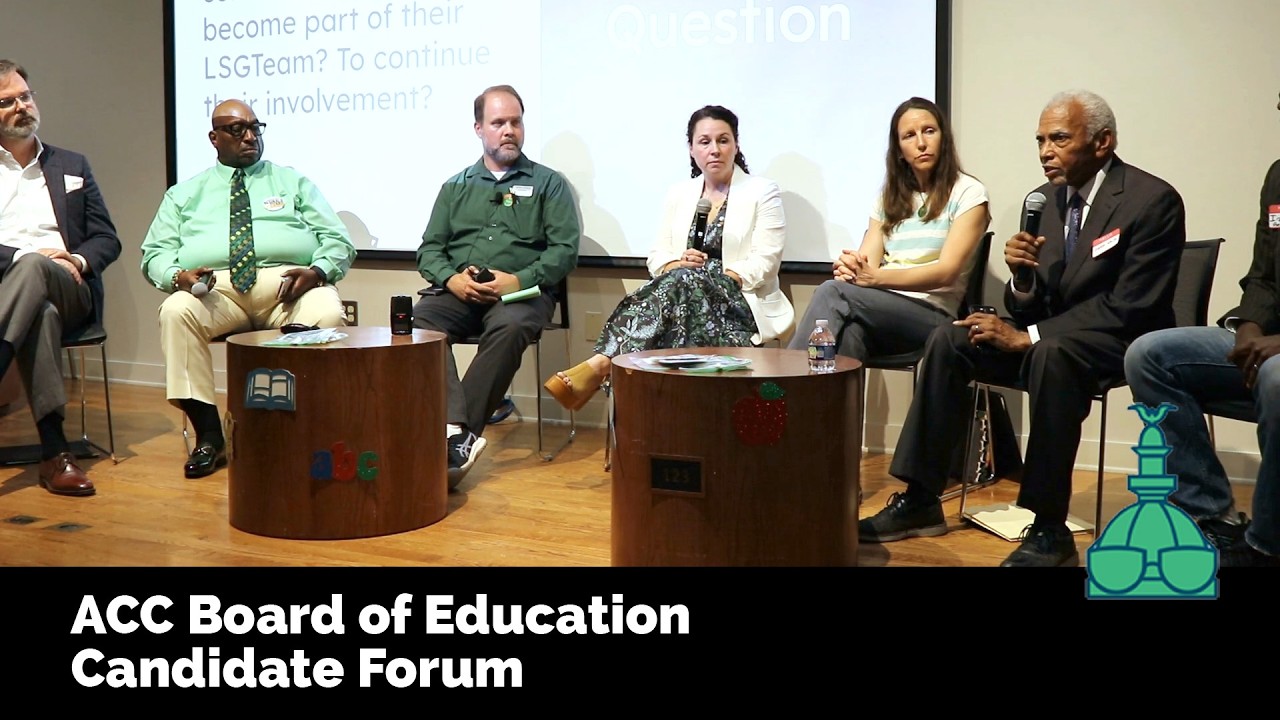
ACC Board of Education candidate forum hosted by the Family Advisory Board
Watch on YouTubeVideo summary
The Family Advisory Board hosted a comprehensive candidate forum for the Athens-Clarke County School District Board of Education, bringing together five primary candidates alongside other community members to address systemic district issues. The event featured introductions from Carl Blunt, Reginald Willis, Adam Shirley, Lily Brooks, and Heather Fletcher, each highlighting their unique backgrounds ranging from small business ownership and long-term teaching experience to real estate brokerage and booster club leadership. Additional figures such as Fred Smith, Mark Evans, and Jose from Hong also participated, offering perspectives on empowering Local School Governance Teams and fostering a board culture that prioritizes listening over ego. The forum established a clear mandate for the new board: moving beyond individual school complaints to tackle district-wide challenges through proactive communication with legislators, careful scrutiny of charter school renewals, and creating an inclusive environment where parents feel heard rather than dismissed by bureaucratic barriers.
A significant portion of the discussion focused on critical educational policies and resource allocation, particularly regarding literacy rates and curriculum standards. Candidates expressed deep concern over specific data points, such as the high percentage of fifth graders missing English Language Arts milestones at Holston Elementary and the low pass rates for eighth graders taking high school physical science. The group debated the heavy reliance on technology and standardized testing, arguing that cognitive science supports writing on paper as essential for learning and warning that current methods may widen achievement gaps rather than close them. Furthermore, the candidates addressed the need to balance university pathways with trade skills and high-skilled professions, advocating for leveraging the University of Georgia for phonics-based reading interventions like the "Mississippi Miracle" model to specifically support Black students who are currently struggling with literacy.
Beyond academic metrics, the forum tackled financial sustainability, community engagement, and the structural barriers facing nonprofits within the district. Candidates discussed the threat posed by potential legislative changes to property taxes and emphasized the necessity of creative budgeting amidst rising costs. They also highlighted systemic obstacles for African-American-led organizations, noting that restrictive memorandum of understanding requirements often prevent meaningful partnerships even without monetary exchange. To combat these issues, the candidates proposed a "village" approach where community members, retired individuals, and local residents can fill voids left by working parents, providing mentorship and resources to families facing economic hardship. The consensus was that effective governance requires transparency in fund usage, collaboration among all stakeholders including teachers and superintendents, and a commitment to retaining failing students through clear protocols rather than relying solely on financial fixes or board decisions alone.
Read the full video transcript
Hi guys, welcome.
We're going to go ahead and get started.
Um my name is Jamie Mace. I'm the family
advisory board president um for the next
school year 26 to 27. Um this is the
first time that we've held a candidate
forum as the family advisory board. Um
so we're going to we're going to get
through it together.
Um I've been a member of the family
advisory board since it was reignited
after the pandemic. Um there's a lot of
lore about the family advisory board. Um
not a lot of it's written down. There's
not a lot of good accounting for it. And
so um when Lily Brooks called me um a
few years ago and asked me to help her
kind of recreate the family advisory
board, we kind of rebuilt it from
scratch. Um so um wanted to say thank
you for coming. Um thank you to the um
subcommittee that helped organize all of
this and bring all those delicious
treats out there. Um, I had said, "What
if we have some cookies?" And it looks
like I'm wetting out there. So, it's
nice to see that. Um, thank you to
Fletcher Johnson, who is our
videographer for the night. Um, if you
need someone to take great video for you
or edit video for you, this gentleman is
your your point of contact. Um, thanks
to the library for hosting us here. Um,
it's it's nice to have a great big
library that has a great big space like
this. I'm really looking forward to
having a library on the east side as
well so that we can do this all over
Athens. And thank you to the candidates
who are here tonight. So I'm glad you're
here. Thank you so much.
>> Uhhuh. So um probably a lot of you know
Jamie. Uh my name is Emily Malso. Um I
am very new to the family advisory
board. So I think we sort of represent
like the opposite ends of the spectrum.
I just came on as the representative for
Barnett Scholes Elementary this year. I
have two sons. One of them is in
kindergarten at Bernit Schles and one of
them is about to start prek. So, I'm
coming here as sort of a new parent and
I'm going to be helping moderate the
discussion.
Uh we have a new website. Um it's
fabcsd.org.
Um on that website we have a directory
um which shows you a lot of vacancies
because we're trying to fill all of our
seats right now. Um, so if you're
interested in learning more about
joining the family advisory board, um,
we'd love to talk to you about it. Um,
you can find anybody here that has one
of these tags on that's standing up
right now is someone that you could talk
to about it. Um, so if you're not aware,
the family advisory board is a little
different than PTO's or LSGTs. Um, those
focus on individual schools and the
needs of individual schools and
individual student bodies. Um, as the
family advisory board, we pull back and
we we bring those individual issues
together to kind of tease out systemic
problems that can be addressed at the
district level to make schools better
for everyone in the whole district. Um,
so it's it's a little bit different. Um,
I know the previous iteration of the
family advisory board was called the
parent advisory board and one of the the
channels to bring in membership was the
PTO. But if the school doesn't have a
functioning BTO, they just didn't have a
voice. And so we have um kind of
reworked it to make it um a little bit
more broad and open. So you don't have
to be a parent, you could be a family
member, you could be a community member.
Um we just want someone that's really
dedicated to an individual school um to
to run that place.
So this is tonight's format. Um we're
going to do introductions of the
candidates. Um we're going to read
through. We've got five submitted
questions that we've selected tonight.
Um we're going to play a little fun game
called who has authority. Um and then
we're going to do some questions from
the audience. Okay. Um and there's cards
at the back so you can ask questions at
the mic. Um if you want to do that way.
There's also some note cards at the back
if you'd rather write down your
question. Um, right when we get to
number four, I'm going to run back there
and grab all the questions that have
been submitted and then we can like ask
those questions for you if you'd rather
not do it on the mic.
>> Yeah. Or feel free to give it to Jeremy
back there in that corner or to Caroline
over there in that corner.
So, we're going to do two minutes for
each um candidate. Um, apologies to I
did not include you on this. Um, that
was just an oversight on my part, but um
you're
eight.
>> Eight. Okay. Eight. Okay. So, um we'll
start with district three with um Carl
W.
>> Thank you very much and thank you um
very much for hosting tonight's debate.
Um my name is Carl Blunt and I am
running for board of education in
district 3. And one of the principal
reasons that I am running is actually in
this room. It's my oldest son. He is a
sophomore at Clark Central. I also have
a freshman at Clark Central. Um, through
the eyes of my two children, I have seen
many great things with Athens Clark
County School District. Um, they have
given a lot to my children. They've
given a lot to my family. Athens Clark
County in general has done a lot for me.
I'm a small business owner. I have an
insurance agency that I've had for 20
plus years here in town. And um I am
running for the school board because I
am a firm believer in public education
and its importance in a community.
Without a functioning school system, uh
it's hard to have a community that is
growing and thriving. We have a
wonderful school system here in Athens.
There are some things that obviously we
would like to do better. It's like that
in any organization, especially one of
this size. But we have a lot of good
things going on here right now. There's
just a few things that I would like to
see addressed
to take us to that next plateau and give
all children the ability to thrive,
grow, and be the best they can be in
life.
>> Thank you. So then we'll go to uh Mr.
Reginald Willis.
>> Good evening. I am Regina Willis. I am
not new to Clark County
as I am a 1984 graduate of Cedar Shoes
High School and I am a 30-year veteran
of Clark County School District. I
worked for 30 years at Barnett Scholes
Elementary School. I just retired in
December of 2024.
I am currently a substitute teacher in
Clark County and I co-directed the
afterchool program at Barnes Elementary
School and I started about 10 years ago
a program entitled Boys to Men where I
work with third through fifth grade boys
in the afternoons with our core
principles of respect, responsibility,
and accountability. So I'm not new to
Clark County. I retired but I continue
the work. I think as a board member I
can be effective because one I plan to
bring common sense. Sometimes we kind of
get caught up in a lot of other stuff
and just overlook the simple things. And
I also plan to bring my experience of
being in the school system, walking the
halls of the school, knowing the
children, knowing the staff, and working
with parents, and as a board member,
working closely with our administrators
to make our schools the best they can be
for everyone. Thank you.
>> Thank you.
Um, and next we have um, Adam Shirley.
>> Can you hear me? It works. Hi everybody.
My name is Adam Shirley and I'm a middle
school teacher and I am running for
school board for district 7. Uh there
are two main reasons that I'm running.
Uh one, I have a deep passion for
helping young people learn. I've been
teaching for 18 years in various
capacities. 14 of those have been middle
school, mostly 8th grade science. That's
uh introductory chemistry and physics.
We light things on fire and blow stuff
up for science. Um, and I just I love
the look on a kid's face when they get
it and when it just the connection gets
made. And I love being a part of the
team that makes that possible. I don't
dare take credit like it's all me. It's
not all me. It's everybody in the
building, everybody in the district,
everybody in the community that makes it
possible. And so that appreciation, that
motivation was the first thing that made
me want to run for this. The second
other motivation was I understand I have
the patience and the skill set to to be
part of a board with a charge of this
magnitude, right? 13,000 students that
we have to do right by. And I worked for
5 years on the board of elections
downtown. And I learned the hard way
many times that the wheels of government
have to move slowly sometimes. And it's
infuriating and boring at the same time.
And so many friends and family that I've
spoken to, some of whom are sitting here
now, their eyes kind of glaze over when
I mentioned the the ins and outs of
board of elections things. And it's just
I learned that it needs to move slowly
because there's so much writing on
getting it right. And in the same way
with so many students who need us to do
right by them, we don't get a second
chance with their education. And so we
must at times move slowly and deliberate
and be patient. I'm not running for
superintendent. I'm running for school
board. There's nine of us for a reason
to listen to each other, build
consensus, and make sure that when we do
move that huge ship in a new direction,
everyone is on board, and we all get
where we need to be. So that's why I'm
running. Thanks.
>> Thank you.
>> Um Heather Fletcher of Um,
>> oh, sorry, Lily. Sorry, Lily Brooks.
>> Hello. I'm Lily Brooks and I want to
start off by saying thank you to Jamie
and Emily and Jeremy and all the
Caroline and my fab crew that um I have
now moved on from. I was the president
for two years like Jamie said and I was
honored and privileged to be a part of
that group um as we brought it back to
life. So, thank you all so much for
doing this tonight. Um uh let me just go
down the list. I am a former teacher. I
am a passionate parent and I am a
committed community member. And those
three things together teaching in many
different um variety of classrooms,
children with autism, monastery
classrooms, the prek at Barrow here in
CCSD. Um I I taught for a few years
before I uh moved on. And then being a
passionate parent, I uh have been a part
of every PTO and PTA of the schools that
I've um encountered. My kids have gone
to schools all across the county. Um and
I uh have done everything from working
spring clings and and fall festivals and
and running literally running 5Ks. I
mean putting on a 5K. I didn't actually
run it. And um and those sorts of
things. and uh currently the president
of the booster club for the track and
field team at Clark Central. And those
are my parent things. And then as a
community member, I have been on the um
foundation pract board of trustees for
four years, which I rolled off a few
about a year ago. And I um I've
currently um actually today was my last
day as a CCSD representative to the
entire Georgia Department of Education
parent advisory council. And it was a
huge honor to also participate in that
as I got to meet parents from across the
state and listen to all of the
departments across the department of
education and all the great things that
they're doing for our kids and and our
students and our teachers and those
sorts of things. So
>> yeah, think all that together. That's
what made me run.
>> Thank you. Now Heather Fletcher.
>> Hello everyone. Uh my name is Heather
Fletcher and I am running for um the
district 5 uh school board seat. I moved
to Athens in 2002 to go to college and I
never left. I'm I'm one of those. I've
actually lived here longer than where
I'm from um in Albany, Georgia. But I am
a former Cedar Scholes High School
teacher. I currently um own and operate
an independent real estate brokerage and
a nonprofit dance school Athens. And I
just started back in the classroom
again. at this time um a part-time
faculty at UG teaching Spanish. I just
think that education is the most
important and the most um
invaluable thing that we can give to a
child that sets them up for learning not
just what they need to know to get
around in the world but also learning
who they are which will you know set
them up for success in the future. Um my
reason for running was very simple. I
wanted to make sure that whoever
represented my district cared about the
students and their outcomes. Um, after I
left Cedar, I joined their local school
governance team and I served there for
um, two terms and my friend Satrina
Watson and I set up a career ready
program which is still active. They just
started doing some career mentoring with
students this year. And the whole goal
of that was to funnel into work-based
learning and bolster that program
because while I'm sitting here with a
master's degree, I'm also working in a
profession that I could have done
without the master's degree. Right? So,
we want to make sure that students are
doing what's best for them in their
future and not just feeling compelled to
go to a university just because that's
where everyone should go. we're
forgetting about our trade skills and
these um high highskilled professions
that are in dire need here. And so I do
want to see more of a balance. I'm not
saying we shouldn't push university, but
that shouldn't be the only thing that we
push. Um so I'm I'm here to serve.
>> Thank you.
>> Uh Mr. Fred Smith.
>> Thank you very much. I'm Fred Smith. Um
I've been in Athens since 1968. I'm a
proud graduate of Claus Central. Um, in
fact, the first class of Claw Central
1971.
Um, and I want to start out by saying
that Athens is
for in a lot of ways a very u great
community. There's a lot of wonderful
people, a lot of great resources here.
And I know that because I spent much of
most of my adult life involved in
community uh abuse activities that
serve. I was part of the group that
started that the Athens tutorial program
in 1980 and I'm still still involved in
that to to some extent. In 1989, we
started a program with some parents and
uh and in in in Athens called the
Creative Vision Foundation, which was a
youth enrichment program. That program
lasted for uh almost 14 years with
volunteers where we provided youth
enrichment on on Saturdays and sometimes
in the summer. And that was a very
successful program where the kids got uh
exposed to u banking uh public speaking
um small business etern
uh and now a lot of those um youngsters
have grown up and they come back and
they tell us uh how important that was
to them. Um so again I'm I'm been very
involved in the community. I know the
community. Uh and so the the uh Creative
Vision Foundation is one of those
things. Um also I'm I'm big on
collaboration. I I can work with people
uh who uh are different from me that may
not look like me if we got common
interest. And so I've done that in a lot
of cases. We started the the East Athens
tennis program for youth tennis. That's
uh 2 minutes. Sorry.
>> Mo late.
>> Thank you for your time. I want to start
off by thanking the facilitators of this
and this is the exact quality of
discourse that we need in order to
improve our schools. Unlike I think some
of the people on the stage, I actually
am not satisfied with the quality of
education in our schools. I have three
kids, two I guess two and a half. I just
pulled my oldest out and I want to
mightily keep them in the Clark County
schools except
I not satisfied with the quality of
content that is delivered onto uh my
children and so I I took my oldest out
of Hillsman and now I homeschool and my
younger two are uh currently bents but
my younger two are very good students
and unfortunately I think that's in
spite of going to bars and not because
of it and I And all of these problems
are fixable, I believe, if we take
public schools seriously as community
projects and get parents in the schools
um working alongside teachers and
administrators and and delivering
content because a public school is not
just a school that takes everybody. It's
a school that is a community project.
And the moment we've become an
administrative project rather than a
community project is when we've lost our
way. And that doesn't mean that I agree
with all the parents. Um but it does
mean that if I'm elected for uh or
appointed then elected for the
schoolboard seat, my first duty is going
to be maximally
um interpreting the charter that will
empower LSGTs to make the schools as
they see fit.
>> Thank you.
>> He didn't get introduced.
>> You're right.
Um I brought me um Jose from Hong. He's
um interested in running for um Nicole
Hall seat that she's vacating at the end
of this school year. That'll be a
special election in November.
>> Thank you.
>> All right.
>> I didn't know if you want to introduce
me.
>> This is Mark Evans. He's next.
>> I don't know how I'm supposed to follow
that.
>> That's okay. I'm Mark Evans. I represent
District 9. Um I am the uh vice
president of the school board. Um Dr.
Anderson is the president of school
board. Um I shared some of your
frustration
and um where we are now is a lot
different than where we were when I
started.
And uh we haven't gotten to where we
need to be. And that's why I'm running
again.
Um, you know, we all have a vision of
what school can be
and we all have an idea of what school
should be.
You know, now we just have to find a way
to uh work together to get this. Uh, the
amount of growth that this board has had
over the past four years is pretty
amazing. You used to have a board that
didn't talk to one another.
And uh part of it is is that a lot of us
decided that we were going to shed ego
at the door
and listen.
And that's a hard thing to do,
especially when you're us, right? I
mean, we're up here for a reason, you
know. Um but the the greatest skill that
I I have taken away from this is that
I've learned how to listen. learn how to
listen to the people in particular
and represent them in the way that they
want to be represented.
So, thank you.
>> Thank you, Mark.
>> Um, so we are going to go through our
submitted questions now. Um, these we
collected I think about 18 questions in
total on our website over the past month
and a half or so. Um, these questions
have not been shared with the candidates
ahead of tonight's forum. Um, the family
advisory board executive board narrowed
the list down and kind of edited them um
to remove some of the combative language
um and um make them a little bit more
appropriate for our forum. Um but each
question is going to be posed to all of
the candidates. Um in the spirit of
managing time um we are going to limit
the time for answering each question to
5 minutes. So, um the goal is for you
guys to interact with each other. Um to
bounce off each other, um not I I know
sometimes in these forums you go each
candidate gets the same question, it
just kind of becomes an echo a little
bit. Um so we're kind of hoping for some
dynamic answers between you guys. Um
it's also good practice because that's
kind of how it works when you're on a
board together. You kind of have to jump
in and talk and be patient and figure
out how to ask for your turn. So, this
is going to be um kind of an interesting
experiment for all of us. Um so, if
you're still answering your question and
the 5 minutes has come up. Um myself or
Emily is going to kind of come in your
like we're going to kind of come around
and like get your attention and that
means we're not going to have another
person speak after that. So, you can
finish your thoughts. Um but at that
point, we're going to move on to the
next question. Does that make sense for
everyone?
>> Awesome. And just to be clear, it's five
minutes per question, not five minutes
for one person to talk about the option.
So, we do want people to um share the
the options.
>> 35 seconds.
>> You got this. All right. Are we ready?
>> And I know so some of you can probably
see this. I'm going to read them, too.
So, if you can't see it, don't worry
about it. But they are up on the board.
And we have a fivem minute timer for
those of you can see it. So, the timer's
going to countdown if people want to
look at that. Um, how would you
encourage the board of education to
become more actively involved in shaping
state level policies?
>> I can talk to this because I actually
just experienced a very small form of
this today. We were talking about the
kids being prepared for the milestones
and all the different um all the
different uh you know preliminary tests
they take all through all the throughout
the year I Ready and STAR and MAP and
all those things. And did you know that
there is one that's specifically
formulated for the milestones, but the
state legislature said no to it?
>> The beacon was denied. Anyway, I we
actually spoke about this. So knowing
that and knowing that things like that
are happening at the state level, th
those are things that we as a board
could potentially bring to the table and
and find somebody, our legislators, and
educate them on what is going on in the
day-to-day of the schools and they're
not just saying, "Oh, this this thing
that makes the most sense and you just
shot it down because I don't know, you
weren't paid enough money for it or
whatever." Anyway, that's very relevant
to what I discussed today at the state.
>> Just just very quickly to piggy back off
what Li is saying there, a lot of this
is going to boil down to personal
relationships with our local legislative
delegation. Those are going to be the
first people that we're going to go to.
Those going to people that are going to
listen to us more so than from any other
parts of the state. It's going to be our
responsibility to explain to them what
are the issues we're facing, what need
to be addressed, and
if possible, as much as we can, cuz
obviously they're the legisl
legislators,
explain to them what we think they could
do, how they could be impactful in
addressing these issues that need to be
addressed. I think to to add on with
that, um, they have the votes of course
in the general assembly, but they listen
to all of y'all, I would expect, more
than they listen to any school board
members, if not for anything else within
sheer numbers. And so another dimension
to this would be our role would be going
out in the community if if not at least
knocking on doors, if not trying to have
little gettogethers, coffee, that kind
of thing, and mention to people how this
works, like helping people understand. I
didn't know 10 years ago just the levels
of funding and where all the funding
streams come from and what exact power
those legislators have and like where
the school board's power ends and where
their power begins. We have a very
narrow lane on the school board. It's a
lot of stuff to do, but it's not that
expansive of a thing. We can't wave a
wand and do this kind of stuff. So,
helping our neighbors understand this
would help y'all be on our side and help
also knock on their doors and tell them,
"Please change things in Atlanta." Well,
and also if whoever is elected from this
group to the board, it's our
responsibility to be a breast of new
legislation coming down um regarding
education and what I would say is let's
go on field trip once a year. The
realtors do it day of the day and we go
and we meet with our legislators and we
hear about legislation and they're happy
to meet with us. I think they would be
just as willing to meet with the school
board.
>> Yeah. I think it also boils down to uh
ongoing communications with the um with
our representatives. they are elected
and so I know that they have some
interest in in what we think and so
ongoing communications.
>> Yeah. Okay.
Something else we also not this
conversation but it's going to be very
important to be proactive and not
reactive especially things as it relates
to schools and especially school
funding. You're going to have to make
sure that we as a board know what
they're considering and address
something before it potentially becomes
a problem for us months and years down
the road. Well, there was a couple of
things here. First, we had to clean our
own house.
We had no problems. Um, about four years
ago, uh, we almost lost our
accreditation because we couldn't act
like grown-ups. Uh, but that's off the
table now. Now, we have, uh, we, uh, we
become more forceful with the Georgia
School Board Association. Uh we
participated in uh in February the
Georgia School Board Association uh had
all of the school boards uh come to
Atlanta uh two Tuesday in a row uh and
we brought students uh to talk to our
legislators. Part of the problem we've
had with our legislators is that they
really haven't cared too much about our
community.
They have gone out of their way to pass
bills and things that have strike money
from our schools.
they they have done that even though we
talked with them and we said hey this is
going to hurt us they were more involved
with political ideology than the actual
care of their community
and um you know I I don't care I don't
care what party you are as long as the
children of Clark County are taking care
of and they are not being taken care of
by this legislation at all
>> got four Thanks.
>> We'll see.
>> It's a different kind of format, but we
got we got five questions. Okay. Um
Okay. With the upcoming charter renewal,
what is your stance on creating a
charter system advisory committee and
who would be on it?
Well, since I since I I I handed out
start um first I'm I'm not really
thrilled about charters to begin with.
Uh the idea of the charter system is
that we're supposed to do new and
innovative things. And I would challenge
any of you to walk through any of our
elementary schools and then go to any of
the Atlanta schools and see if there's
any difference. There is not. They're
the same. They're doing the same stuff.
The only difference is that we get
waiverss now so that way we can have 40
kids in a classroom instead of 20.
So, you know, I I think that if we're
going to do the charter system, we need
to do the charter system. We we need to
really dig down into, you know, um the
idea that the teacher is the leader of
that classroom and allow them to do that
work. So, yes, charge this revised.
Absolutely. But beginning the charter
renewal, first off, I want to know why
we want to renew it since we're not
doing it.
>> A piece that comes to mind for me with
this is uh as Mark said, the charter
system, the history of it and how it
came about. It's I understand why it
began, but it just seems to be kind of
lingering without there's not enough
political will to to really get it
right. Uh, I believe it was like a
band-aid because of the recession uh to
relax the requirements because school
systems couldn't make ends meet. And
rather than legislating something, the
state said, "How about we just relax the
laws we've already written for you?" And
like Mark said, you get you relaxed your
class size requirements. You relax your
your teacher planning protection. You
relax things like that. And so what I
think of first of all as a schoolboard
member is how soon does this decision
have to be made? If it's next month,
that's too soon. Like I we I've learned
a board as large as nine people, we
can't and we shouldn't move like that
with 13,000 kids looking up at us hoping
we get it right. That's way too late to
be saying what should we do? This should
be a year'sl long conversation. So an
advisory board sounds wonderful. I do
not envy the board members currently
because I understand it's a pretty soon
decision that has to be made this year.
I don't envy that because I want to be
able to listen and talk like this for
I'll be honest over many months to hear
everyone's conversations, hear what our
neighbors have told us, talk to
legislators, get their feedback because
it's not a decision to be made lightly.
There's there's reason that went into
the laws that were written and I feel
like they were waved in an emergency,
but the emergencies passed like the
recession's done. It's it's there's no
need for that band-aid anymore.
Yeah, I feel that um everything should
point back to um instruction
and so um if the charter system is
renewed, there should be more attention
on what um create or what support uh
effective instruction and I think we um
spent a lot of time talking about other
things but not that and that's should
the uh the central uh issue here uh
concern here um to be uh instruction and
um in one thing I did when I I said this
a long story so I have to make it short
but when I retired in 2013 from the from
the labor department I was so afraid
about what I would be doing the next
year that I volunteer in a classroom and
I can tell you that that model of one
teacher and 20 kids with different
levels of background does not work.
>> And so it's kind of it's kind actually
kind of sad that we uh continue to do
that and we know that it's not working.
It didn't take me long to know that that
didn't work. And so the charter system
uh if it going to be a redesign so that
it focus so that that it clearly focus
on instruction then uh I'm forward but
otherwise it
>> we got one minute left on this one. So
>> yeah if the charter system the system
that established the LSTs um I don't
think we're actually taking it seriously
and implementing it. So I don't think we
even know what the charter was supposed
to be because we're not serious about
one of the key um aspects of it which is
the uh LSGTs and we're not serious about
it's just what uh Mr. Smith said about
spending a day in the classroom and
seeing the lack of content that is being
uh disseminated is haunting. I was a
cross country coach at Hillsman and I
was a girl soccer coach um last year and
I was cross country coach this year. You
know, I had 13 year olds who couldn't
tie their shoes. Um we're in a system
where half over half of the black kids
can't read and only a fraction of the
black boys can, but everyone's acting as
if that's like everything's good. We
just need to kind of paper over some
aspects when we're talking about
illiteracy um in a way that is
disgusting. But I don't see enough
disgust
um being manifest from the
administrative class or the teachers
actually. But I do see it from the
parents and that's why I want to get
parents in the classroom. I went to a PE
class.
>> Yeah, somebody's keeping time.
Finish your thought. Finish your
thought. I went to PE class um because I
was I was a cross country coach and
soccer coach and you know the boys were
just kind of free fall and the girls
were gossiping on their phone and I was
like oh maybe that was a that gossiping
and playing on the phone and then I
thought well maybe that's an anomaly.
Then I went to to that same class 2
weeks later and you know what is
happening? The exact same thing. I don't
think you understand how dysfunctional
and
reproductive of ignorance our current
schools are. And I think like if you
did, you should be horrified or you
should not have a job in CTSD.
>> Okay, next question.
>> How would you encourage parents,
teachers, and community members to
become part of their LSGT team to
continue their involvement?
>> I have a quick question. Can you just
tell us what the acronym means?
>> Yes. So, I'm so sorry. Um, LSGT means
local school governance team. Um one of
the conditions of the charter system
agreement is that um school-based
decisions like budget um personnel and
some curriculum choices um the local
school governance team is an elected
body at the individual school comprised
of teachers, parents, community members
um and they um they have parliamentary
procedure on u having meetings with the
principal in that building.
So, um, having served on one for two
terms, I'll I'll start this one out. Um,
to the point of what Arammy was saying,
um,
it's not an easy task to get people to
participate because they are not taken
seriously. We had to really by I had to
go over my administrator's head to get
traction on a program that Dr. Hooker
met with Katrina and I on the career
ready program. We had a Zoom meeting
with him and he was like, "Yes, I just
came back from Lincoln, Nebraska. I like
that you guys are taking this
initiative. Let's do it." But we were
not getting support and buyin at Cedar
Scholes. So had to break chain of
command for the students. It should not
be that way. It didn't cost anything.
The Clark County mentor program, they're
still they're doing all our onboarding
and background checks for free. They're
pulling from their own mentors to go
into our schools and talk to kids 5:1, a
much better ratio than 20 to1 to help
them figure out what they want to do
post, you know, high school.
>> So, let's redirect the question. What
would we do to encourage people to
>> that's the problem?
>> I think I think uh we should encourage
um parents to get involved period. And
so uh that that is one way to get them
into the system so to speak. So again
because we don't have enough of that we
do not have enough u parent or community
involvement in the schools. And uh going
back to my story of spending the a year
in a classroom, um I made a difference
and and the principal and the teacher
told me I made a difference because it g
it freed the teacher up to to give more
attention to to the students
>> and I could um u do what I could. I
could walk around the class and I could
uh kind of um help with uh uh classroom
uh maintenance, so to speak. And I'm
pretty good with at that with working
with young folks. And so again, we we
need more uh parents. We need more
community people in the school. And and
at the at the center of my platform is
uh support for the classroom. And so and
one way to one u means of providing that
support would be to have more people
involved and have um parents involved.
So again the uh uh getting on the
governor's team would be one step of how
to get connected to the schools.
>> I I think I echo a lot of everything
that's been said. I think educating the
parents on the importance of not just
being a part of an LSG team but just
being a part of their students education
is super duper duper important because
if we don't have the parents on board we
we lo we we lose them the minute they
step in the classroom and so I I think
that just the education of them and them
understanding that the importance of
this education is education is is a
ticket is a ticket for them to to move
along in life and and do and be the best
they can be and and get the the highest
level of education they can come and go
and move on and and be the best they can
be.
>> I think as I
as I stated at a former forum um and
then as being a part of LSGT before it
truly takes a village and if we're going
to want the best for our children be it
being a member of LSGT or whatever as
Mr. news state. We've got to become
involved and concerned. We've got to not
so much point the finger blame to say
this is what's wrong with the school,
but point the finger of how can I help
make the school better. Like Mr. Smith
said, "We've got to get in the schools,
be willing to volunteer,
but volunteer in a sense of not trying
to take over the school. Schools have
rules.
Excuse me.
Schools have rules for a reason and
we've got to be able to work within
those rules or you'll end up with just
total chaos in the school and the
children won't learn. Teachers won't be
able to teach. So, we've got to be able
to find that good medium and work
together to do what's best for the
children.
>> And we have to take the LSG team
seriously. The reason it didn't work was
because we couldn't get people involved
is because they knew that they weren't
being taken seriously. So if you're not
being taken seriously, why would you
sign up to do the work?
>> So I will say that I think that there's
actually a conflict of interest between
the administration of the school and the
parents. And I don't think anyone has
anything invested in the school like the
parents of the children of that school.
We don't get check from it. We don't
it's not a pension. We don't get paid
for moving people through. We only get
some sort of sustenance if our children
learn and their community learns. So I
think that to pretend that the interests
of the administration that gets paid and
pays the mortgage from um working in the
school and the interest of the parents
are the same interest is I think a
little bit naive in a way that doesn't
work for the students. Right? So, I want
to um shift.
I think I think as a parent of three
children who moved through Clark County
Schools, I thought that the
administration wanted out of me money
and snacks. Everything else just hush
and lets George out. You can't even go
in to the school. If I need to like drop
off my sweatshirt for my kid, um I
should be able to flash my ID. should
they should recognize me as a parent of
like a zillion kids there. I should be
able to drop off my uh sweatshirt, PEEK
INTO MY CLASS ANYTIME I FEEL LIKE IT. I
should be able to walk in and and peek
into and peek into a class. Of course,
you can say like, well, you know, uh
safety, but you know, parents aren't
cheating up schools. It's it's it's
siblings and alumni. It's not parents.
So,
>> we're going to move to the next
question.
>> Jamie, this is I think this is a really
important question and I think we're
dancing around it.
>> Here's the problem. Schools want
compliance. They don't want creativity.
Okay? The reason they want compliance is
because they've got a tough job. They've
got to take four to 500 children, keep
them safe. And you do that by keeping
things locked down. You want you want a
real interesting field trip, go to the
jail, take a look at the color scheme of
the jail, then go to your local school.
It's the same bloody thing. When I
talked to Cap, I saw the same thing. I
went and painted my my mother helped me
paint my my my wall purple cuz I'm a
Ravens fan.
The kids from Atlanta love that very
much, but that was okay. All right, so
that's that's that's the first issue.
The second issue is that parents don't
have time. Most of the parents that are
that are that live and work in Clark
County have two to three jobs.
When do they have time? They've got to
make ends meet,
>> right? We have we have we have our
largest employer that suppresses wages.
They just do, right? And that's and and
that's something we don't talk about
because we we want to get along. We want
to we want to have a pilot program. We
want to do all these things. And I'm I'm
all for collaboration.
But you have you have got to recognize
that the main problem is is that we have
some societal issues that have to be
addressed, right?
before we can even begin to think about
how great an LSGT team is.
>> Thank you.
>> Yes, we're going to move to the next
question. Okay, guys. Thank you so much.
We we have time to talk more about all
of this stuff and we should.
>> All right. What are your ideas to open
or expand communication with local
universities for volunteer opportunities
with CCSD?
>> I think we should resign.
>> Yeah. Yeah, I think that's a great idea
again cuz we need more people in the in
the schools. Uh because when you talk
about trying to um uh bring more support
to the classroom, uh one of the first
things that brought up who can't afford
it, but um having uh volunteers who can
uh and able to do it would would uh
answer part of that that dilemma. And I
agree with Mark about you can't expect
uh you know not everybody has has the
same uh uh parent situation and they
grow up with the same parent situation.
So you can't rely expect from parents of
three jobs or whatever to be able to do
that. Uh and often time they have three
jobs because they have low-level jobs
and they can't take off. But again,
that's where the community comes in and
that's where what uh Regin talk about
the village, you know, is that's that's
real. If we're really serious about
this, the the village got to got to chip
in where where there are voids.
>> There are certain programs that I know
that we've had with the University of
Georgia over the years, some that have
been expanded here in the last couple of
years, but quite frankly, that's one of
those things that I've never
particularly understood. We have the
flagship university of the state of
Georgia right down this road. There is a
wonderful education department in there.
When my two boys were in elementary
school, when you had the college kids
come in there for whatever reason, it
just was the highlight of the day to
have them in there, their energy, their
wanting to teach these kids. And we've
talked about this in a lot of these
forums. One of the big things in
education especially in the south that
has developed over the last 10 years is
what Mississippi has developed and what
they have achieved in the last 10 years
and it spread to Louisiana and Alabama.
It's commonly referred to as a
Mississippi miracle. I talk about it
nauseium in these forms but it takes
these kind of relationships. It takes
people in there focusing on with
Mississippi Miracle phonics based
reading as has already been stated. We
have a problem with people that cannot
read in our school system. And if you
can't read, you can't do anything.
So, we have got to do better in this
particular regard.
>> And I I will go ahead and do my um my
books for keeps plug because
applications are now open to be a
literacy mentor as I have done for the
past um since 2022. I've been at Strath.
I'm about to switch over to Fowler um in
the fall because of my schedule, but um
getting students and I probably will
before the ends the before their final
on Friday send the link to my students
at UG and say, "Hey, here's something
you can do in the fall because they
always have even if they're not doing it
because they're just being altruistic.
Sometimes they have requirements to do
community um engagement and involvement
for whatever you know they have going on
on campus. But any of you today to go in
just read with a student. The
Mississippi Miracle, we we have that
coming in Georgia. Science of reading,
phonics based instruction. We've already
been doing phonics based instruction.
Now we're going to get, you know,
literacy coaches. But it doesn't have to
cost $61 million. We just need to read
to children. You know, parents aren't
literacy experts. They just read to
their kids, but some don't because maybe
they can't read. My own sister probably
reads at a fifth grade level. So my
nephew struggles with reading, right? So
I I I've I've experienced that in my own
family. It can happen anywhere. And what
do you do about it? You know, well, you
have to start somewhere. And I say go
read to some kids in our schools.
>> Got one minute left on this one.
>> Well, to answer the question, how to
expand communication. I think it would
be a great idea if there was a liazison
between UG, Athens Tech, and the school
district so that we could have one point
of contact. I think I spoke with Emily
earlier this year about the same thing.
A lot of times you don't know who at UG
you need to contact. So you send blanket
emails out but then you don't know if
it's going to the right person so they
don't get responded to. So I think we
need some point of contact at both you
know UG Tech
uh wherever and some direct contact
person with Clark County. so that we're
not spinning the wheels in the mud
trying to figure out who we need to talk
to and then that person can disseminate
the information that's needed by the
schools to get volunteers and that sort
of thing in the schools.
>> Thank you.
>> What what I've found in working with the
the university is uh it's more effective
to work with people than with the
institution if that makes sense.
>> Yes. Uh I get a lot of support from
people that are associated with the
university on individual basis. Uh we
started a a uh vital uh in contact
program uh six years ago with uh
professors in the school of social work
and interns and we just complete the
sixth year of that. And so, but again,
uh, we have to go out and talk to folks,
communicate with folks who are
likeminded, and then we we can get
somewhere. I'm not I'm not for uh
meeting with the uh the administration
at the University of Georgia to try to
solve this. It it just
>> we're we're going to mention the next
question. Okay, guys.
It's impossible to be an expert on every
subject and elected officials have to
rely on the expertise of others. What
topic is an area of expertise for you
and why? Who and how would you learn or
lean on others?
>> So the area that comes to mind for me
first of all is classroom teaching. And
I know that were I to be on the school
board, I would bring that perspective
in, not claiming to know exactly what
the teachers here are going through in
every classroom, but having more of a
baseline understanding of when the bell
rings Monday morning and those kids come
down the hallway, what is it probably
like for them? In a way that other
candidates don't don't understand. Uh,
and I know that I need to check that,
too, because I might go too far with
that and say, "Oh, I know how it is in
fifth grade. I know how it is in nth
grade." And I don't, but I have a basic
idea of it. And as far as leaning on,
learning from other people who don't,
who have expertise that I don't have, I
have to remind myself that I have
thoughts and passions as a parent and as
a teacher, but as a schoolboard member,
there's a different a different lens
there. There's a different it's a
different hat that we're wearing. And we
need to be careful because our only
employee is the superintendent. That is
the point of contact between us and
everybody in the school system. We stray
from that at our peril. We need to talk
to them and only to them about the
school system. give them an earful every
chance we get because they're our
employee, but we should never meddle
with getting involved with principles
and what they do in their buildings,
least of all the teachers and how they
do their day-to-day things. We've gotten
in trouble as a system over the years
for with the best of intentions veering
over a little bit there. And so I think
about leaning on expertise of the
superintendent that we will be paying a
lot of money to who has earned that that
that salary phone fell down and is able
to speak to their principles and their
instructional coaches and all the
experts that we're paying all of our
money in great big heaps to. If we try
to second guess them or try to step over
them, we we're just wasting money and
wasting your money and my money. See, I
I would say that we need to ask the
teachers what they need in the schools
because they're the ones spending time.
It's not that we tell them how to do
their job, but that's not what we're
here to do. But we're here to listen and
take community feedback and community
feedback and talking to teachers who are
in our community is actually part of the
structure of this of this board. Um my
background is also in education. Even
before I, you know, taught at Cedar and
and now at UG, I worked in food service
and I always leveled to be a trainer.
So, I've been teaching people how to do
something whether it was hostess or
weight tables or bartend or dance. I'm
also a dance teacher. So, education is
just it's been in me since I was like 18
years old. Um, and it's the most
important thing that we can do. So,
who's the person that education? The
teacher. We need to listen to them and
get feedback from them so that we can
then make better decisions on policy
because a lot of the policy impacts what
teachers can and cannot do and it might
be as we've said stifling innovation.
>> Specifically, one of the some of the
things that I think I would bring, you
know, besides the fact that I've got two
children that I've already mentioned
come along in the district and they are
active obviously at Clark Central. My
mother uh growing up was also a public
school teacher. She taught second grade
most of her career. Uh so I've seen that
aspect of
what it's like in the school system
through her. But specifically probably
the biggest thing with me and it's
become more and more relevant here in
the last 6 months to a year is the
business perspective that I would bring
to this as the owner and operator of a
business and now partner in a firm and
having done this for the last 20 years.
And I want to make this very very clear.
I am very much aware that a business is
not government. Those are two different
things. And to try to conflate the two,
you do that at your peril. But we are
having a lot of push back on property
taxes here in the state of Georgia. More
so though than what may change there is
that we have had an extraordinary
explosion of property values over the
last 5 years. And as everyone knows, the
majority of your property taxes are
going to to the school system. We are
not going to have that kind of growth
over the next 5 to 10 years. We are
eventually in this country going to have
a recession. That is another thing we
have got to get ready for. And I think
when those challenges confront us, I
think I will be in position with my
skill set to be of help.
I think what I can say about myself and
everybody up here is that our expertise
might be in our passion. We are experts
at our passion for the kids of this um
county and for the the community here.
And I think that we take that passion
and then become not experts but we learn
more about things that become relevant.
the literacy, the CCRPI scores, the the
behavior things that we need to learn
about, the budget things we need to
learn how we take that passion, we put
it into that, and then we become the
experts. We can't all be experts.
>> 20 seconds.
>> Okay. I would say collaboration uh and
um I feel like I'm an expert in uh in
working with others and I got numerous
examples. I've mentioned some of them.
uh during co we did a uh online math
camp and and and again I work with some
people from University of Georgia
individually professors and then others
who I've known that have volunteered
throughout my uh other programs and we
put it all together and we did during co
we did an online math camp. So again, uh
the ability to work with people.
>> Um okay, we're going to switch it up
now. Um it's time to test the knowledge
or CCSD schoolboard candidates. This is
something super fun. I'm really excited
about it. Candidates, on the tables in
front of you, there's little bags. Um
each of you should grab the bag. Um
inside your bag, there's
>> I think I have eight. I should
cuz I brought 100 case. Yeah.
>> So, inside the bag they have signs. One
says uh board of education, one says um
the superintendent and one says state of
Georgia.
>> You have the best.
>> The game that we're going to play is
called who has authority.
All right. Does the board of education
superintendent or state have authority?
Um, I thought this would be a fun way to
um help everybody understand that this
is a really super hard job. Um, that
your your boundaries are really really
tight. Um, and so there are definitely
wrong answers, but I don't want you to
feel bad if you get them wrong cuz
that's how you learn.
>> Yes, this is how we learn.
>> All right, so um there's no time on this
one. I'm going to pose a question. I
want you to look at your your uh little
signs and hold up your answer. Um and
maybe how about Lexi? When you notice
that everyone has their signs up,
that'll be my signal that we can reveal
the answer.
>> So, we're not supposed to look at other
people's signs.
>> Uh I don't care if you what if they have
>> Well, no. I mean, I sure do not.
>> You can use whatever strategy you want.
>> This is why we have a lawyer.
>> All right. Who is responsible for
ensuring that board approved policies
are implemented in schools?
>> We can't say that.
>> Yeah. Can we That's okay. Can you read
that like in the audience? We can't
read.
>> Just let's start with Mark and go down
and tell me who you got.
>> Superintendent.
>> That's what I
>> Yeah. Everybody got that?
>> The superintendent.
>> Yeah, we have some people.
>> I have a state.
>> Oh,
>> superintendent.
>> All right. Ready?
>> It's the superintendent. I wonder can I
hear items?
>> I I would just imagine that if there
were complaints and I could be just
wrong, but I would think that if there
were complaints, they could be raised
with the GDAU and the governor's office
and the legislature.
>> Yeah, I mean maybe eventually, but in
the day-to-day process.
All right, next one. Who has the
authority to create and approve school
board policies?
All right, shout out your answers. Board
of Education.
>> Board of Education. Board of
>> Education.
>> Yeah, Board of Education.
>> Board of Education is the correct
answer.
>> Be smart.
>> I have a question.
>> Sure.
>> How about you have a systematic? So,
what can the state do visa v the board
of education?
>> That's a that's a conversation that we
can have over a beer.
Well, so what the state does is the
state six GDO or the PSC
>> the Georgia Department of Education. My
bad. Sorry. I'm a professor of
education, so we speak in those
languages.
>> My bad. Um, yeah, they they sit their
dogs on here.
>> So, they can actually police.
>> Oh, they can they can they make laws.
They make like we've got to put in metal
detectors in every single school in
Clark County outside the board of
education. That was not a board of
education policy, but not coming in. We
have to make
>> That's not a state policy either. We
actually had that conversation today
also. It's it comes from the board. It
comes from the from the local district.
>> Yeah. Yeah.
Metal detectors.
>> Yeah.
>> Metal detectors are not coming down from
the state mandated by the state.
>> He's coming he's coming he's coming from
he's coming from. They pass. We actually
had a specific conversation cuz a a
parent asked our our state
superintendent, Richard Woods, this
morning that he she said, "Are it we
have one metal detector at our school.
Is that coming from the state?" And she
and he said, "No."
>> Well, yeah, the state's paying for it
because we're not paying for it. I mean,
they're the ones who just gave us $61
million for it. So I
>> I mean
I WILL and if that's a 361 million
bucks, I will be glad to talk to the the
board attorney and be like, "All right,
let's let's buy some books."
>> All right. All right. Let's stay on
track.
>> Realators.
>> WELL, NEXT QUESTION. WHO HAS THE
authority to place an item on a board
meeting agenda in practice and policy?
Actually,
can I hold up
>> too?
What are you guys holding up? Cuz they
can't read it. Superintendent.
>> Yeah, we can both put things.
Superintendent is part of the board. So,
>> no, no, no, no, no, they are not. No,
no, they are. No, no, they are an
employee. Their job is to uh bring up
the issues and problems from the school
system to us and when it's in our
purview like we got to spend money.
>> But the superintendent is the one that
actually drafts
>> the secretary agenda. Really?
>> Yeah. We do it.
>> It's written on the school on the on the
website that the school that the
superintendent is the secretary of
>> Yeah. Dr. Anderson and I are the ones
who set the agenda and all that. That's
that's what we we're going to do it on
Friday. Okay.
>> Yeah.
>> Who has the authority to approve or deny
a charter school petition submitted to a
local school district?
>> Petition state of Georgia.
>> We got state of Georgia
>> to a school district.
>> State of Georgia and the board of educ
board of education. State of Georgia.
>> It's the board of education. Oh,
>> now the state of Georgia does so they
can they can which they have in the
past. They have appealed and the state
of Georgia has that they they do have a
final say but the
>> the first the first sticky point is us.
>> Interesting.
>> Who has the authority to approve or deny
a charter school petition submitted to a
local district? So the the the the
charter schools applying to the local
school board to to siphon some of that
money out of their budget.
>> This example someone has
>> such a
helping me know
>> who to vote for.
>> I'm sorry.
>> Candidates, do you feel like this is
helping you flex and think a little bit?
>> I mean, if she has kind of fun.
>> I'm happy to be here.
>> Yeah. Yeah.
>> Yeah. What you want to hear? outside.
>> This This is silly. I'm sorry.
>> We only have a couple left.
>> Um, who sets the minimum number of
instructional days for schools?
>> State.
>> Well done. State of Georgia.
>> I was wrong, but
>> who makes the final decision on student
expulsion after a tribunal
recommendation?
board.
>> So, what what are you guys holding on?
>> Everybody's saying the board of
education. Yeah, that's the one.
>> And let me explain some of my reasoning
for this. I understand some of these
questions might not be things that make
sense to you guys, but what I'm trying
to tease out here is um the awareness
that these candidates have on where
their lane is. Uh it's an important
thing to kind of tease out. Um and so
this is as much for them as it is um for
you guys. Um, so I appreciate you. Um,
>> can I make a comment on that?
>> Sure.
>> I don't believe that's correct. The
alternative school being school
district.
>> That's that's incorrect, ma'am. The uh
the parents can they have 10 days any
ruling on anything that they can appeal
to the board and then it comes to the
board and the board listens to what was
presented in the tribunal.
Then we have to make a decision on what
we do with that. So we can either uphold
what the school says, we can we can
lessen it or we can dismiss it.
>> So that's if the parent knows they can
do
>> the parent the parent is told by the
tribunal council. There is a letter that
is sent home to the parent that I mean
you can shake your head and know all you
want, but I'm telling you this is what
it is.
>> I believe she's making it up.
>> No, I'm not saying she's making it up.
I'm just saying that I'm the one who
sits on these tribunals. I know how they
work.
>> I think I think the question, gentlemen,
I think the question here is do parent
do all parents actually know? Do they
actually receive these letters? Are they
aware and in full understanding that
they only have 10 days to make this
appeal?
>> Yeah.
>> And it sounds like the feedback from the
community has said no.
>> I would say that we we do a really good
job of making them aware of what their
rights are.
>> She's saying no.
>> That's okay. That's one person.
We're going to move to the next one.
Okay. Who has the authority to wave or
modify certain state rules through
flexibility systems or waiverss?
This one's tricky because of the way
it's worded. Who has the authority
to wave or modify certain state rules
and flexib
What are you holding up?
>> State board
and the state board of education. Board
of Education. Some people have not
raised their hand.
>> Is this
>> Yeah.
>> I think this is the last one. Um Oh,
shoot. I just messed that up.
>> I did. I won't answer
>> that one. Sorry, I messed that up.
Fingers. Who has the authority to
approve contracts entered into by the
school system? Is the board of
education? Sorry. contract.
>> My bad. Nice.
>> All right. Uh, thank you for indulging
us in that fun little exercise. I hope
it was a little bit of a different
flavor from uh what is typical in a
forum. Um, we have a couple of questions
that we've received um on FAR. Some of
the questions we received are um
specific to an individual. So, we're
going to pass those to the individual.
Um, but we're not going to have them um
here. and I'm going to wait and see if
there are any other questions that jump
in and we'll kind of splice them in
between.
>> So, as we all know, we have parents
working multiple jobs, very long hours,
doing a trick back and forth to get to
work wherever they're at.
We also have things called like class
dojo, automated phone calls, emails,
whatever.
Um,
do you possibly feel like parents feel
like they're already overly involved
because they're aggravated with all of
the notifications
and so they just can't think about one
more thing. What I'm actually getting at
is how could we mainstream
so that there are less pings on a
parent's phone, per se,
um to encourage maybe more participation
in things like PTO's and I'm going to
get the acronym wrong cuz I'm bad with
the acronyms, but whatever that L was
>> do you think we could somehow come up
with an idea to mainstream that so that
we're not And I know for me when my
daughter was in high school, I get
notifications all the time. I'm just
like, "Oh my god, we'll fix the phone."
So that's that's just
>> I think the the problem is you want to
hit multiple points of communication
because um having been a teacher in the
district, sometimes the phone numbers
don't get updated. So you got to make
sure because if you're if you're just
sending a text message to avoid sending
an email, what if the phone number is
bad? What if the email's bad? The phone
number is good. So you send something
because it's better to overcommunicate
whatever it is um than to not have
communicated it at all.
>> I think to to jump in I think that when
I taught at Coil uh it was it's been a
few years ago but when I taught at Coil
I remember making those phone calls and
you get to the third or fourth phone
number and you know for different
reasons life happens the phone doesn't
the call doesn't connect and for a from
a compliance perspective we must be able
to tell our principal that we have tried
to call home and so there's that level
but that's I don't think that's what
you're asking. One thing that comes to
mind first is the way we don't do it as
a school board is we don't tell the
superintendent tell your teachers five
messages maximum per day. I don't think
that's the way we do it. We ask our
superintendent, our employee, what are
you hearing from your principles? What
are you hearing from your parents? What
are they telling you? Let's have a
conversation and what do you think
superintendent is a reasonable way to
navigate this because we're hearing from
the community? Leave us alone please.
But also we don't want to go too far and
say hey we never hear from you. So I
think the dialogue, the conversation
with our superintendent and hear from
them and do the chain of command kind of
a thing. So the principles don't feel
undue pressure from us. The
superintendent can talk to the
principles, principles to teachers and
work out a solution that's not a
one-sizefits-all, but make it fit for
maybe it's different for high school and
different for middle school, maybe it's
different for central and different for
Cedar, but just get it right for the
parents as much as we can. Yeah, I hear
you about streamlining uh because often
times it comes down to uh a checklist
and he alluded to it trying to uh make
sure that they can say that we made
these attempts. But what we need really
is true communication and partnership
between the parents and the school
rather than um like I say letting the uh
interruption of the phone call become
something that not even uh positive
anymore. It's not doing what it was kind
of set out to do. So the real thing is
to work to develop uh work on de
developing true partnerships between
that parent and that school and that
teacher
>> something I can certainly understand
where you're coming from with some of
the frustration u because believe me not
to keep saying it with the two kids I
get a lot of notifications and and what
I have just found personally with school
communications and frankly a lot of
communications just in life nowadays. Is
there certain avenues that I just find
easier to work with? Um, so I just know
I can keep up with everything that I
need to keep up with using Class Dojo or
whatever it may be. Um, and that's what
I focus on so as to not be completely
overwhelmed
and and sometimes I think that the
technology is introduced to families
without them understanding how to use
it. So that's frustrating with in
itself. It's not that communication back
and forth like it's some black people
envisioned it. So So that can be a
problem too is not making sure that uh
uh the the communication is effective.
Another aspect of that is a lot of this
communication becomes noise because we
don't have good relationships with the
internet or weapons at the school. So
you don't know what's noise, but it's
all kind of high stakes because you miss
one of the long class dojo and all of a
sudden the kid doesn't go to the field
trip. So like doesn't play soccer. So
like it's high stakes noise um in a way
that I think could go away if there were
more meaningful relationships between
the school and not and I get upset about
the the coordinated or um uh elaborate
the theater events like the only
interaction and the only interaction you
have with your school is a a quality of
uh I don't know launch on the lawn or
some of these choreographed events that
don't actually give you like a real
sense of your school. I I think that it
just it makes the minor bits of
communication a little bit more
stressful because you don't know what's
real and what's not and what's important
and what's not. So real meaningful
participation communication.
>> Um I'm going to do one from the cards
and then we'll go to you next sir. Okay.
Um this is kind of two cards in one. So
I'm going to kind of smush them into one
because I think they go well together.
Uh what financial chops do you have? The
Georgia legislature wants to slash
property taxes. What effects will this
have on CCSD? How should we prepare? And
does CCSD have professional grant
writers on staff? Why or why not?
>> I would love to jump in and talk about
the funding side of things for the
school system. I think that a a huge
part of understanding as a school board,
we need to know walking in that the
money does not all come from the local
government. A lot of it does, but not
all of it. There's a lot from the state,
a lot of share from the federal. And so
I think the the it's very important that
we know first of all when I'm talking to
our neighbors that we're not treating
this like a pot of money in the sky.
It's your money and our money and we
need to be good stewards of that and the
the financial chops I believe was the
phrasing used. Um when I look at our tax
bill um that my wife and I got our
property tax bill the $2,500 for school
M like the we have our you know our
monthly budget date we on our
spreadsheet and say if that something
like that pops up we would say does that
need to be that high? Can we make it a
little lower than that, please? And
that's the the mindset that I bring to
it is should we be spending that much?
Should we be charging that much of our
people in town? And the neighbors that
I've met who are suspicious and
skeptical of that very concern, which is
real, that speaks to me that we need to
do a better job as a board of making
sure that folks understand why we're
spending the money the way we are, where
the money's coming from. And when things
like the property tax change that Carl
alluded to earlier, the the law that it
it was not really close, but it was
pretty close to passing this
constitutional amendment that was going
to do away with the local property tax
funding schools and replace it with a
pittance of a sales tax. It was going to
completely blow a hole in our budget.
And if we're not careful, if the school
board doesn't represent that well to the
community, folks will think, why is
Clark County Schools blowing up our
budget? And we have to explain to y'all
as well as we can. It's not us, it's the
state. We cannot change that. y'all
need, we all need to call our senators
and the governor about that. So, I think
the understanding of the diversity of
revenue streams and the understanding of
the fact that I strongly believe, I
could be wrong, but I strongly believe
there's no one twisting their mustache
in the back room at CCSD saying we're
going to spend $80,000 on some random
stuff. Maybe there is waste, maybe there
is inefficiency, and I want to
investigate that. But the trust that's
been eroded over the years with our
community, the fact that so many of my
neighbors that I'm knocking on doors
with are saying the same basic thing. Do
y'all really have to spend that much
money? I have a hard time believing 50
years ago that many neighbors were
having the same conversations. I just I
have a feeling that long ago there was
more trust that's been corroded over the
years. And I think the more transparent
we can be with the community, the better
we're going to get along with the
community and rebuild that trust.
>> There's something that has always sort
of reflects me about the um the property
tax question. So about 50% of our budget
comes from property taxes. About 50% of
Clark Countyy's budget comes from
property taxes. But for some reason,
it's like, well, why are we spending all
this money on education? We wouldn't be
so quick to cut our police and our
firemen and our public works, but we're
very quick to want to cut education. And
so, the 50% we get from property taxes,
half of that goes to pay teachers, not
administrators, teachers. So, we want
more teachers, want better for our
teachers, but we don't want to spend the
money for it. It's just a perplexing
thing. Everybody wants a discount. Um, I
I am also concerned about the bill. I
don't know that Kemp has signed it. Um,
does anyone know if he's actually signed
the bill?
>> The terrible one didn't pass.
>> I I
>> Well, there was one that passed that was
going to limit it to 3% year-over-year.
I suspect he will veto it because while
it it won't impact Athens or Atlanta
very much if we get the little sales
tax. Think about your rural schools. You
know, I went to school in Worth County,
Georgia, if anybody knows where that is.
There's no industry down there. there's
no um you know rental income there. It
means where would they get you who's
going to are you going to go to the
peanut festival and spend some money? I
mean so um not to make light of it but I
I really think um in a certain way if
you're paying property taxes that's a
privilege. It means you own a house
right so I think our education should be
more valuable than oh we want a discount
on our property taxes. Why is the school
board spending all this money?
>> I don't want to say what I've already
said. I mean what I said about 15
minutes ago is exactly how I would
answer this question. You know, again,
given my business background,
this is not a this is not something that
we are going to be able to ignore. We
are going to have to address the fact
that property taxes just simply cannot
continue to go up because property
values cannot continue to go up. And
we're going to have to be creative with
our budget to make sure that we are
getting what we want um from those
taxpayer dollars. Um, and I think I
think it here in Athens, Clark County,
one of the things that will address a
lot of the issues and the feedback that
we get from people, the constrnation
about property taxes and how they
continue to go up is to address some of
the issues like we've talked about
tonight. You know, the the reading
scores, the math scores. Um, it's I
believe I'm wrong here that we spend an
enormous amount per capita per student
here in the county. People want to see
what we're doing to get those numbers
up, getting our children educated,
getting them to where they need to be,
getting those graduation those
graduation can't say the word for some
reason, graduation rates to where we
would like. Thank
>> can I I just want to say yes the
property taxes are high and all those
sorts of things but what a privilege it
is to educate our kids and it is
important that a school board is
utilizing the money in the in the most
efficient and most proper way. I'm I'm
go back again and say effective
uh instruction because as has been
alluded to uh for a lot of the minority
and African-American youth particularly
young boys um um they're not being
educated and so that um their parents
should be asking uh are we getting our
money worth? And so that's why it to me
it's this the it we should focus on
effective communication. He mentioning
the the the Mississippi miracle. What
was uh to me the the biggest miracle out
of that was that it was it was
bipartisan
that southern uh Democrats and
Republicans got together to put together
something that really works
>> in Mississippi.
>> In Mississippi, right? So they went from
the bottom to the top.
>> And so again, my the focus has been on
uh uh evidencebased instruction,
doing those things that work. And so and
and it's not that they went and invented
those things, they pulled things
together that work. And and hopefully I
know Georgia just passed the law too
that based on that. and hopefully some
of that come to Georgia and even to
Clark County. But effective
communication because again when we
don't have effective communication, you
do open yourself up to criticism from
people who really want to take the money
from public education, right? And so we
we we got to do a better job.
So experience has been that my
experience has been that parents will
pay for programs that work and they
suspicious of programs that don't and
most programs don't do what they're
supposed to do and and so when I was a
uh I was a coach soccer coach when my
kid was on the team at Hillsman they
didn't win any teams they didn't win any
games before they didn't win any games
after but they won games by year I got
buying from the parents I was a cross
country coach this last year at Hillsman
program was in shambles
the year before, but um you know I got
buy in from the parents. So I started a
parent booster a group and I got to pay
for figured out how to pay for what we
needed. And I think actually my biggest
flex on this issue is I have three
rather outstanding kids um you know last
this weekend and now they're state
champions and the mile and the two mile
play violin and piano and chilling like
a dream and I did all of that and they
read very well and I did all of that um
you know while being relatively broke.
So it doesn't actually take money if you
if you systematically actually address
the problems. And whether you look at
the programs that I I I ran at Hillsman
or my own kids, like you can do it on a
budget if you're competent at addressing
the problems and you're not just kind of
paying it. There are a lot of programs
in Athens and I have frustration cuz it
takes 10 years to figure out how to
raise a kid in Athens, but by that time
it's too late. um
that say they do things that they don't
actually do in terms of delivering
content and so we need to actually do
the thing that we say that we're going
to do um and then the parents in the
community will buy in. Expecting a blank
check for like a record of failure um is
I think a little bit ridiculous.
>> All right, you're going to let Mr.
Willis speak on this because I know he's
trying to chime in and then we're going
to move to that question in the back.
And I'll I'll be brief to the lady that
made the statement about the game didn't
make sense. And as an incoming board
member, hopefully
um
>> I think some of the questions
are not really to our expertise because
we as incoming board, we don't know all
the ins and out of what the previous
board has done. So, as an incoming board
member, we would have to look at the
data, dig into the data, figure out what
worked, what didn't work, why it didn't
work, and then make the best decisions.
I think the questions, in my opinion,
are a little one-sided cuz the answers
we're giving are not really answering
the question. And I look on the faces of
a lot of the people in the audience and
they're like, well, they didn't answer
that. They just kind of danced around.
And I feel like we've done that a lot
tonight because we don't know the answer
because we are incoming. We've not seen
the information, the data that we need
to seek to answer the question. So, I
think again, as I've said from day one,
my strong suit is to bring some common
sense to the board that everything isn't
going to be an overnight fix. That we're
going to have to listen to our
constituents, to the parents, to the
teachers, to the administrators, and
then we've got to do the work to figure
out what is going to work. We can't just
say this is going to work and you know
I've every forum I've heard about the
Mississippi miracle. You know, okay
great Mississippi. We're in Athens. We
can't keep talking about what happened
in Mississippi. We've got to look at our
students here in Clark County and what's
going to work for them. And we can't
keep comparing them to other students
and other places. We've got to know our
families. We've got to know our students
and then make the best decisions to make
our students successful.
>> All right, thank you guys. We're going
to uh move to this question from this
gentleman.
>> Good evening.
>> Hi. Just a quick question.
What policies and procedures would you
guys enforce in terms of doing business
nonprofits doing business with the
school district in terms of memorandum
of understanding getting signed by
nonprofits who has program that's been
effective and efficient within the
school district? So what policies and
procedures would you enforce uh for
nonprofits working with the school
district?
>> This is an unfair question.
>> It's an unfair question. Oh,
>> cuz cuz I know this is Ernest Ellard. He
runs one of the best programs in our
county. All right. CDO is one of the
best in the county. Um, and we have a
real problem. We have a we've had a real
problem with that in the past, right? We
don't we have made it almost impossible
for nonprofits to come in and operate,
especially nonprofits run by
African-Americans. Let's just talk
plainly to one another, shall we?
All right.
And why is that? Well, there's all sorts
of reasons. Socioeconomic, there's
cultural, right? There's all sorts of
things. But so, the first thing that we
need to do is we need to we we need to
kind of as a board take our head down
and and take a look and be like, "Hey,
we're we're just like y'all. We want the
best for our kids." Right? And if that's
a nonprofit that can do it without
without buying interference, more power
to you.
Okay. We need we need to create a
highway for nonprofits to come in.
>> Right.
>> So what what is the current policy if I
don't go?
>> The current policy is we don't have
>> Okay.
>> The current policy is
>> but I want to hear his experience. What
was the what are the obstacles? top two
obstacles you have getting
>> well my organization like Mr. Mr. Mark
said he's been really supportive of
everything that we've done we created
the first time ever if you see the third
fourth and fifth sixth grade basketball
the athletic program CD created that
program
>> what was the problem how what like what
stopped you from doing it immediately
>> I think the partnership with the school
district uh Dr. Booker didn't want to
sign him with the memorandum
understanding because I guess it was no
money exchange within that. Um but then
another organization came in and took
the idea took and and ran with it and
they did business with them because they
were school they work with the school
system and we was a nonprofit
organization that you know I wasn't
employed with the school district. So it
was hard to the the agreement was that
the facilities custodians would be as
long as everything was free for the kids
then the school district will provide
facilities custodians and for them to
play and to participate. So once um that
happened so we couldn't get a agreement
we couldn't get it stated that this is
what has been going we did this for
almost four years. Now, I I kind of know
the answer to this, but what was the
usage fee um that they were expecting
from you?
>> 13,000
>> for to for custodians and security.
>> But what did we do? What did your what
did the board do?
>> What did the board the school district
board weigh those fees for us for the
last next two years?
>> Yep. And we're about to wait for five.
>> But we just couldn't get the the
memorandum understanding with the
program. Like we have an athletic
program that's combined with the
academic program with the tutorial
program. You know, we we know there's a
crisis in our schools because the
proficiency rate in math and reading is
low in every school in Clark County. And
that's a fact. And we have a program
that gives data every month to the
county, to the government, to add a
housing authority, to the school
district, monthly reports, and we still
not getting funded for that. And we want
to know why these kids can't read. These
kids can't read.
>> They are preparing them to go to the
county jail 13. They're not preparing
them to go to college to to to get an
education in my opinion.
>> And to go back to the last question
about the the budget and the chops and
all that good stuff, right? We're going
to have to learn how to work with folks
like this.
>> Yes.
>> Okay. Right. We're going to have to
start making inroads. We're going to
have to actually like I don't know
actually go out into the community and
sit down at these board meetings and
listen to what they have to say.
>> Y
>> there are what like 8 million different
nonprofits in this country 14
million but there's a lot there and
they're all people with good work. We're
all about the same thing.
>> Only about 35 work
but that's why 35
>> but I but we got to listen to them all
because they're all our citizens. It it
takes a village,
>> right? It take the take a village, but
the the village is broken.
>> Yeah.
>> People can't get in.
>> I think to to just kind of add something
to what Mr. Elder was saying, the the
district's policy with establishing aou,
which is a memorandum of understanding,
um, which doesn't have a whole lot of
legal bearing, but it's just kind of
like a formal agreement. Um the district
only really establishes those with
businesses when there's money
transacting.
>> Um and it's kind of to cover cover their
tails.
>> Yep.
>> And so when a nonprofit comes in and and
wants to do it for free and they have
figured out a way to have volunteers
show up and there's no money exchange,
the district doesn't have a tool for
that.
>> And so I think that's what uh Mr. Elder
is speaking.
>> But they also don't they also don't have
a will for a will. Yes.
>> And that that's that's the bigger issue
is that there's there's a cultural
>> issue inside. We don't care if these
kids actually learn the skills.
>> No, what the problem is the district
can't figure that out. I'm sorry.
>> Well, and I think I think it's I think
the thing that we're looking for is
systemic solutions, not just individual
nonprofits going through all of these
steps to get it waved,
>> but creating a highway like you were
saying.
>> Um, I'm going to pull one more question
from here. here. I do want to say one of
my youngest was part of the pilot
program when I first started and it I
think it's so incredible that the
elementary schools and the middle
schools are able to in sixth graders are
able to play the sports like all the
other kids. So kudos to you. Thank you
for being
>> to to it being started up again next
year.
>> Yeah.
>> And and Ernest, would you tell them
>> I took your microphone's off.
>> Oh, sorry.
>> Thank you. There you go. Ernest, would
you tell them that it was always more
than about sports?
>> Yeah, of course.
>> Sports in school.
>> Sports in school is a lot more than just
a game.
>> Yeah.
Yeah, the basketball was just a the
athletic program was just a a platform
to reach the kids. But they had to learn
the 12 principles of character
development which is life skill, social
skills, conflict resolution, leadership,
honesty, integrity, etiquets, just to
name a few of them. And they had to be
able to they had book bag tags and they
had they put on their book bags. They
had to be able to uh learn all 12 of
them and apply them to their life. And
we believe if they apply them to their
life, they become better young men and
better young women. And that's what we
wanted. That's what we tried to
implement with with the the athletic
program. Just we reach we have girls,
boys and cheerleaders. So we serve over
400 students within the Clark County
School District. They're trying to get
the athletic to reach them and then
academic piece to help them to become
better better young men, better young
women.
>> Yes. It's like a voucher from the
backpack dags, baby backpack deck.
>> Yeah.
>> Um so I'm going to read this this
question. This is kind of another um two
two kind of coming together. Um so let
me get through kind of both of them. Um
CCSD does a great job of highlighting
achievements and opportunities. We don't
hear much about the shortcomings and
what's being done about them. Um there's
an example here about Holston Elementary
um that 97% of fifth graders do not meet
proficiency um on the milestones for ELA
and 100% of black fifth graders are
below grade level in reading. Um do you
feel like CCSD owes its stakeholders
transparency about school performance or
do you feel like posting data online for
those who know where to find it and how
to interpret it is sufficient?
Additionally, all of the middle schools
chose to have eighth graders take high
school physical science instead of
eighth grade science. And then the pass
rate on the milestones and course test
is 39% at VHL, 37% at CMS, 28% at
Hillsman, and 12% at Boil. Do you feel
like we're doing students a disservice
by having them take a course when the
majority of them are unable to pass the
end of course test?
>> So, I teach this Carl, may I jump in?
I'm sorry. I teach this class. I teach
this course. And I can tell you right
now, I vehemently oppose that policy.
Now, as a board member, I would not say,
"Superintendent, stop that." I would
want to hear them out. And so, I'm
trying to think. I'm a teacher. I come
in with the knee-jerk reaction of how
can you possibly put eighth graders, all
of them, whether they are whether they
have an IEP, whether they are gifted,
all of them, everyone through a program
where they have to have taken eighth
grade already and they're doing eighth
grade math already from day one in
eighth grade. all these things they have
to know already. I'm literally getting
my kids ready for the EOCC next Monday
and it I have a panic attack thinking
about all of my babies having to take
that class and that EOC. I but again I
would not jump in and flip the table
over and say make it stop tomorrow. I
would want to hear the reasoning behind
this. Maybe there is a poorly
articulated but good reason,
well-intentioned reason for this. Uh as
far as transparency with the community,
absolutely. My neighbors that I'm
talking to, I know that every single
person I've spoken to when I've knocked
on these doors, they want to support the
school system. Most of them have great
stories about the school system. But
even those that are concerned, I know
they want to support the schools. Like
Marcus has been saying, we've all been
saying, we all want to help our kids.
There's disagreement on how we do it. So
transparency, absolutely. You have the
right to understand exactly what your
money is buying, what your money is
funding. Now, you may still disagree
with the way it's being spent, but you
at least we owe you the the the we need
to dignify your concern with the
transparency of here is where your
dollars are going, but the next part
that gets lost, we're all busy. We have
so much stuff going on. The money
decisions don't all get made by us. The
state signs some of the checks that come
our way. And so, we have to abide by how
much they're sending and what strings
they attach to it. But, we need to do a
better job of articulating that to you
and not sound like we're passing the
buck or trying to pass the blame. We all
got ourselves into this mess. It wasn't
one person. As much as we might want to
think it might have been one person we
could blame, it's going to take a bunch
of us to get us out of it. So, I just
there's so much to that question. The
physical science for 9th graders being
good to eighth graders sounds terrible,
but I would want to hear out the
superintendent. I don't want to violate
chain of command. I want to hear from
the teachers through the principles
through the superintendent before I jump
in and say stop that. I just want to go
through the process.
>> So, I just I'm going to speak to um the
the lack of proficiency, the lack of
reading. again, literacy mentor. Um,
it's and when you start with literacy
mentoring, the students you get are they
have to be two grade levels behind,
right? And we have a lot of students who
meet who meet that standard. Um, sadly,
the literacy um mentor program works
well. like the students at the control
school don't close their gap as well as
the students and and you know jump back
up to you know move up a grade level as
um with the same you know percentage as
the ones who have a mentor. So if every
student could have a mentor but really
what it boils down to for me um is I
think onetoone technology was a mistake.
It was a mistake uh we rolled it out
when I was at Cedar in 2012. I taught
Spanish. I literally made worksheets on
Google Docs just to check the box when I
was observed because if anybody in here
has ever studied a language, you got to
write it down. We talk about visual
learners, um, kinetic learners, um, you
know, auditory learners. Everyone is all
of these things. It's just you might
have more of an inclination to one over
the other, but all students need to
write things down on paper in order to
learn it. And we need to go back to
that. There was a recent um data dive
that this I'm a big nerd. I love to
listen to all kinds of podcasts.
Cognitive science is one of my favorites
recently. But um Jared Cooney Horvath is
cognitive scientist just pulled data
from 1992 to 2012. Top percentile bottom
percentile. There was only a 10%
difference looking at math, reading,
science scores internationally. Now it's
20%. We're going the other direction.
And on top of that, in these
standardized tests, they sprinkle in
cognitive tests as well to see, you
know, creativity skills, executive
functioning skills. They don't have
them. They're they're basic. They're
really good at like it's something
called um rapid visual sensing, Tik Tok
videos essentially, um some sort of
rapid
>> basically. And so um I it's not that we
need to just throw away the computers. I
I think that ninth grade is a good time
to introduce it maybe with the class
because they couldn't type and I was
like oh what is this keyboarding class I
was a new teacher that was my first year
it was piano it wasn't I was like
keyboarding it's going to maybe beacon
or something Oregon trail you know
that's what I thought was going to
happen but no so you give a kid a tool
and say this is going to equalize
education but it doesn't if students
don't already know how to learn they
cannot learn on a computer
>> the science is out there and if we're
going to be data driven and let's follow
some some cognitive science data too,
you know.
>> I love that. I'll I'll piggyback on
something there. Something I realized my
son um is in fourth grade and last year
when he took the milestones for the
first time um he had to write his his
like essay questions, his paragraph
questions. He had to type them and he
types like this
>> and it's a time test and I was like when
are they learning how to type? And don't
the teachers were looking at me like
they don't. And I was like, "What?"
Like, that was the first time that it
had really like connected the dots for
me that they really aren't teaching them
how to use the devices. They're just
giving them the devices.
>> I I brought this up in another forum. Um
I love Oregon Trail, by the way. I
brought this up in another forum, and I
know it seems somewhat crash to do so.
Um because we're obviously here because
we love children, and we want their
education to be as much as they can be.
But there's a um there's a practical
aspect to this.
The school system is a foundational part
of any community. If we do not have this
right,
it is going to be poisonous to the
growth of the community, especially
economically
because what's going to happen, this is
a story I tell over and over again
because it had such a pr profound impact
on me 11 years ago. I was with the
Chamber of Commerce and we went over to
Atlanta one day to the Georgia Power
Office where they entice businesses to
come to the state of Georgia and I asked
the question when they were showing all
these wonderful things they do, all
these plots of land, um all these
resources they have, rail, access to
rail,
access to seapport, the demographics of
the area.
Well, when you get to the school system,
do you bring up any private schools in
the area? to bring up schools in the
surrounding counties. And the person
paused and said, "If we have to do that,
we are going to lose the business. They
are not going to come here. If we can't
address these issues that we have in the
school system with these test scores and
the fact that the kids can't read,
>> if we don't fix it, it may not happen in
five years. A lot of us in this room may
not be here anymore.
But if we don't fix it, Athens Clark
County, even with the University of
Georgia, is going to be in economic
trouble time and time again. Mississippi
had to do what it did. It got all these
people to agree, Republicans, Democrats,
white, black, men, women, it doesn't
matter your background, because the
state was dying. And they knew if they
didn't fix it, it was never going to get
any better. It's a matter of will. Well,
first thing is we need to admit that we
can't read like that's even at the
beginning the introduction said like oh
you know CCSD is great except for these
these
>> let me comment on that for some
um is working very well
>> I bet I bet your kid is doing fine uh my
kids both went through this through this
system and they did very well and I know
others but what we have have not given
attention to for the for those who it's
not working for. We have just sit back
and let it happen. Know that it's not
not happening and just showing up. I'm
running for the school board cuz I want
to make it work for all students.
>> That's okay.
>> Also to go along with what Mr. Smith
just said, and I've said this before,
we've got to stop lumping all the
children in the same basket. We keep
saying they can't read. Like he said,
there are several children that can
read. My do my granddaughter is a ninth
grader in Clark Central and is doing
well. My granddaughter and my grandson
took the science test in 8th grade for
9th grade and passed it. This is where
parents and the community have to get
involved. We've got to say and
communicate with the teachers and
administrators and see if your child is
failing, don't wait until they get in
middle school and high school and then
say, "Well, they didn't teach them
anything in elementary school." It's too
late to try to turn the clock back.
>> Start communicating at the elementary
level. Talk to the teachers. Talk to the
administration. See what your child is
doing. We can't say that the school
board's going to fix it, that the
schools have to fix it. It is going to
take all of us working together. And
again, that's why I keep saying it takes
a village. But we cannot say that every
child in the village cannot read. Those
that can read, okay, pair them with be a
reading buddy.
>> Let them help that one that can.
Sometimes peer pressure works better
than an adult standing there saying,
"Oh, well, you need to do this and you
need Okay, if they see someone on their
level that's doing it, that may aspire
say, "Oh, well, Johnny can do it." Maybe
I can, too. But if we say, "Well,
Johnny's doing a great job, but Billy,
you just don't you can't read. I just
don't know what to do with you." We've
got to stop putting all our children in
the same basket. Address the ones that
can't to push them forward. move them
ahead. And I think as incoming board
members,
we don't have all the answers.
The questions are kind of geared for us
to say this is what is going to happen.
This is what's going to be done. We
don't know what when Mr. Elder asked
what policies are we going to enforce.
We don't even know what the policies are
because we are not on the board. We've
got to sit with former board members,
talk to them, see what they've done in
the past, and try to see what we can do
to make it work. I I don't seem to be
this out.
>> Take one more little comment from Billy.
We're going to take one more comment
from then we've got two more questions
that we want to do. We've only got about
15 minutes left in this.
>> So, there's a scam that I think that's
propagated on to the public that annoys
me and probably annoys some other people
in the audience where like the top 15%
of of CCSD, that's fine.
You'll hear someone, oh no, there's a a
kid who graduated who went to Brown, so
obviously Ste is doing great. No, no,
it's generating illiteracy. I don't I
don't think that makes
>> as long as there is a no fail uh policy
and and that it's going to continue to
happen.
>> It's going to continue. Well, I don't
think it's just a no fail policy,
>> but I think that is a huge piece of it.
I think that's a huge piece of it. But
also the parents don't know how bad it
is because the exceptional students,
you'll say, "Oh, well, you know, Bar
soccer team is great because like they
did fine in the game." No, they did fine
cuz my daughter my daughter graduates.
The team's going to be horrible next uh
next year. I'll tell you why. Because
we're bad as a system of skill
development. And I'll tell you something
interesting about girls sports. You can
judge a school by their girls team
sports because if you can't teach girls
how to do the skill at a team level and
you're going to have to do it because
it's kind of counterultural, then you're
not teaching boys how to read. And so
this like Clark County is bad at skill
development. We're not admitting it. And
we're using all of this kind of smoke
and mirrors and choreographed dance to
kind of pretend that we don't have a
fundamental problem of teaching people
who don't want to learn how to do hard
things. And that's the business of
school, teaching kids who don't want to
learn how to do hard things.
>> Okay, Jeremy, we're going to move on to
uh the last two questions.
>> Excuse me. Can I I'm sorry, but I may I
know I'm out of order. Just cuz you kick
a soccer ball don't mean you agree. And
I don't think to say because girls are
good at sports that boys are flunking
academically. Well, that made very
little impact.
>> I'm going to stop you right here. This
is a discussion that we can definitely
engage in later, but we want to take
these two questions. Okay.
>> Thank you.
>> Hey, you guys provided the perfect
segway into my question. So, look, when
you look at the data, third grade, fifth
grade, 8th grade, high school, 30% of
the students cannot pass the milestone
in ELA or in high school in the lake. If
you look at black students, it jumps to
80 to 85% cannot pass it.
>> Yet, we do not retain.
>> There might be a few exceptions, but as
a general rule, Clark County has not
retained in 20 years. 20 years ago, they
piloted the transition academy for
eighth graders. I mean, it was a
disaster. I would say implement that
again. But so many of you brought up the
Mississippi miracle but didn't bring up
the fact that retention was a major part
of that plan as was ability grouping
which is a political hot is a mess. I'm
glad I'm not running because I wouldn't
want to get into that. So I'm curious
how many of you would support creating a
policy to retain students who are
failing and if so at what grade level
would you do it?
>> 100%. Can I can I
when you get on board, you give it a go.
>> Yes.
>> Right. But I think we're looking at this
the wrong way.
>> Okay.
Right. We're looking at this kid. We're
like, you are a failure, child. That's
what we're saying. But we're not looking
at ourselves.
Right. The biggest problem we have is
that we we we we trust a test over a
teacher.
That's our biggest problem.
>> You're giving me all these numbers. Give
me a name.
>> Exactly. You can't. That's the problem.
But my teacher, Hold on. MY TEACHER CAN.
MY teacher can. Give me a name of that
kid who can't read. You know how I know?
Cuz I was that teacher. I knew the kids
who couldn't read. And guess what I did?
I stopped everything that taught them to
read. And I didn't give a damn about the
test. Right. You want to fire me, Cal?
Go ahead. Fire me. But you know what?
That kid's going to read. That kid's
going to succeed. But that kid's not
going to go and sit in the jail on
Memorial Drive.
That's what we're talking about.
We would rather trust all of this other
stuff than the people who actually we
train to do the work.
>> Right.
>> I like this.
>> That's that
>> I mean that that's that's just that's
just the bottom line. The Mississippi
miracle happens because they decided to
trust the people that they and they got
and there don't get me wrong, there are
some people that need to go. Okay, there
are there are some there are bad
teachers. I'm not not going to say that
there are there are right and those are
the people that we have to encourage to
go and work for Carl.
>> That's that's frankly that that's
frankly and I'll be very brief. Um
that's the hardest part of it. what they
did in Mississippi.
>> That was
>> I'd like to speak to
>> I would say to answer your question,
third grade.
>> Third grade. That's when third grade
actually actually lived in Mississippi
for a year and a half and they it's
right when they started the third grade
is what they called it.
>> So sorry you guys, I'm just going to
interrupt. We actually have two more
questions which means we got five
minutes I think. So, if I was listening
correctly, you were asking how many
people would actually support retention.
>> Can we just do a quick show of hands?
Okay.
>> And third grade. And third grade is the
is where you would start
>> cuz on the flip side,
>> what's worse
>> holding them back or keep passing them
on and they don't have the basic correct
and then they end up jail. But
to throw this in very quickly,
>> what happened in the Mississippi
miracle, so to speak, the projection
about how men would be held back was was
way over the board. Small small small
end up being a very small percentage
being held back. So again, cuz the kid
and everybody understood that there was
consequences to not learning to read,
but right now we just pass them on. Pass
them on. That to me that seems
>> and the longer you wait the more
difficult it becomes.
>> Very very quickly two points on this.
That was one of the problems of of the
state of Georgia's implementation of
this is that you didn't have that
component. They are addressing that and
it's gotten better. But the other thing
about this is if you're going to do that
you've got to have clear protocols in
place about okay you had an issue this
last year. You can't just do the same
thing again. What are you going to do in
terms of getting resources to that
particular student so they can not only
>> get to where they should be, but they've
now got to catch up, right?
>> It's not just telling them that they're
failing. It's telling them that they're
going to repeat a grade and give them
the support that they need within that
time frame to get them. That's why it's
called a reading gate. You don't go
through the gate until you are prepared
to go through the gate.
>> Tell them tell them we failed him.
>> Yeah,
>> that's the part that Yeah. what what
gets me as and believe me this time of
year as the test scores are coming out
and we're taking our tests uh we
teachers believe me we we wonder is that
student like what's best for the student
what's best for all of us what's best
for the kids that will be dealing with
that student when they come up like I
teach eighth grade if we retain three or
five or 30 of our eighth graders who are
failing perhaps the seventh graders
coming up we now have plus 30 in that
grade level and Lily is completely right
it's it's a money thing like and and so
the better that we can articulate the
reason I didn't raise my hand to your
simple the simply put question of would
you support retention I don't view it as
a simple issue I don't think any of us
do but the nuance the devil's in the
details right if we just say if you
don't get this if you don't get a 70% on
this you're back here next year bub that
what happens when half the grade level
fails and we didn't budget for that for
this next year so I support the intent
absolutely but where the rubber meets
the road is how much more we're willing
to pay in taxes to cover that how much
more we willing to lobby our state
legislators and the federal ederal
government to give us money to make up
that difference. I'm with you 100%. But
when we all start saying if it's going
to double my property tax, no, make it
cheaper than that. If we're going to
give the interventions to these kids to
get them where they need to be so that
we're not failing them, I just I I
hesitate to say yes, third grade or
fifth grade or eighth grade, whatever. I
just think a lot more conversation needs
to happen like this with systems where
it's working with our superintendent,
with our teachers, with our principles
to take all their perspectives into
account because heaven help us if the
nine people that y'all elect for the
school board are the ones making the
final call on this. It shouldn't be in a
vacuum. It should be all the
stakeholders, y'all included. It's not a
simple answer, right? There's so much
writing on this that I just I I couldn't
do a quick yes.
>> All right, we're going to go to the next
question so we can make sure we have
time.
>> Hey y'all.
Um,
>> so I heard something that horrified me a
little bit and I I this is mostly kind
of a clarification give me more
information question. Um, I heard the
word control that there was a school
that in the mentorship program maybe
there was a control school and compared
to
>> Yeah. Yeah. There's always a control
school when you're doing a an empirical
scientific experiment. So I guess my my
question is is this clarify for me in
the district is there a school that has
intentionally not given a mentorship
>> but this is all related to the
>> this is program yes this is all related
>> storytellers which partnership with with
the school district to go in and mentor
and so in order to you Grace Bagwell
Adams would be the better person to ask
because she's the one who runs all the
data for it at the um the education
college but you the control school is
just there There has to be a school that
doesn't get the mentor otherwise you
don't know if the mentor program is
working.
>> And to clarifate
is there are we picking one school
that's not getting
>> we are not this is books for keeps not
books for keeps and so books for keeps
is running this program and the only way
you can you can't test data if you don't
have a control group. It's just
impossible. And so I mean this is
something that is
>> I can jump in on this too. I'm a
four-year literacy mentor as well. Um so
the the control group um was the second
school that was selected.
>> So they started with one school with the
program and the control group was the
very next data set that was almost
exactly similar. Same school size, same
demographics, same scores. Um, and so it
wasn't necessarily that we're we're
looking to have a group that we're not
giving stuff to a student schools that
need it and this is them in hype order
essentially and we're expanding to a
general school in the fall like we're at
we started at Straoud and then now we
have Fowler and we're adding that hasn't
been announced yet prove that it is
correct before you can get into the
correct
>> Thank you. I just really needed the
clarification. Yeah. Yeah, that problem
>> phrasing broke my brain.
>> What it proves is that when you work
with kids,
>> it works.
>> It works.
>> Exactly. When you work with you read
with kids, they learn how to read.
>> We spent $100 million.
>> And guess what? It cost the school
district.
>> Nothing.
>> I have a I think I want to hear what
everyone feels about like technology in
the classroom. So, you know, I already
said
>> Yeah. minute cuz like
>> like like a hand raise.
>> Well, can everyone talk about it for a
minute or people?
>> We've got one more question from a
constituent and then
one more question there.
>> Hey. Um, hi.
>> I recognize
>> I'm a little disobed. But, okay. So, my
question is I keep hearing that the kids
don't want to learn. They don't want to
read. And I grew up in a school district
straight out of the homes apartments. We
have a program with UG with mentors. We
have big sister programs. We have big
brother programs. We have none of that.
Our community has turned their backs on
our children. Lake Park does not have a
program where we used to be able to go
and sit down and do homework, do work.
So, what can y'all do to give back to
these kids who are struggling, who are
not getting it at home because mom has
to work two jobs because everybody wants
to charge $2,000 for a twobedroom. So,
there there are things that's happening
in the community that our kids are
coming to school and reflecting off of.
So, I just want to hear some thoughts
about that because I hear what we're not
doing as teachers and I hear what our
kids are not doing, but what about
y'all? What about the community? What
about the people who are looking down on
these kids? These 39 40 kids that come
in that haven't ate breakfast that live
from Monday through Friday because mom
can't afford it and food stamps are cut
off because she makes two or $3 more
than what the econom is asking.
>> Good.
Um, I I've I spoke about this in a
previous forum, but it's it's it's
getting community members and getting
these nonprofits that are that are
willing to help in situations like this
on board and truly engage, not just
saying, "Oh, we're doing something with
such and such or whatever." It's truly
taking the time and and personally, are
you asking us personally if we've um
I've never done it, but I've considered
doing the books for geeks mentors. I
think I talked to Jamie about it, but um
those sorts of things and I I mean I run
the the booster club at at Clark Central
for the track team and I make sure that
the kids have sandwiches when they go
out to meets and that they you know as a
booster and that we provide that through
the booster club and it's just it it
takes community members like that and
the involvement and the engagement of
community members like that. We have to
lure those either nonprofits or just
individuals in and like we say it's a
village and all those sorts of things.
>> I heard Dr. Hooker say many times when
he spoke to various groups uh that I'm a
part of. I I've got to have time. I got
to have time. And I not to speak for
everybody else up here on the stage, but
all of us recognize
to some degree or another, and I think
it's a lot all of us that it's the
individuals. It's It's not. Yeah, you
can throw all the money in the world at
something, but if that's just another
computer, if that's another book, if
that's some new get, you know, fix it
fast thing that just going to handle all
this in the next 6 months, it's not
going to work. It's going to take
individuals that are going in there and
I really don't care who they are. U
students, someone who's retired, someone
who's got an hour and they just want to
go make a huge impact on a kid's life.
It's going to take those people going
into the schools in some way, shape, or
form having an impact on that child. And
what's so sad about the whole thing is
don't take much.
>> It's the smallest things that will
transform that child's life. Again, I
mention collaboration
and working with people. And if I'm on
the board, if and if I'm not on the
board, uh I'm going to be still doing
that. But if I'm on the board, I want to
push strongly for us to reconnect and
bring those resources back into the
community at the grassroot level to work
with to work with our kids. I started by
out by saying this is a great community.
There's a lot of great resources around
pound for pound, population to
population, a lot of folks, but we're
not reaching out to them and and getting
them to get involved. So, I'm going to
push to bring that back.
>> You have to you have to meet people
where they are. We always expect parents
to come to the school, but sometimes the
school needs to go to the parent. We
need to be in the communities. I served
on um the feed my sheep board. It kind
of dissolved in the pandemic with
Reverend Ellison and uh Rodri Flanigan
and and Mary Bakby and we would do
tutoring. I would go over, you know, to
Nelly B and we'd sit in the resource
center and do tutoring and the kids
would come in to get that help, but we
we need more of that. It has to be
targeted because people take it for
granted that, oh well, the kid could
just go to the library. I I actually
took the time to explain to someone how
long it would take to ride a bus from
Cedar Scholes to get to this library and
they'd have about 30 minutes before they
had to get get back home to get the last
bus and they wouldn't even get home till
almost 9:30 at night. So, it's this lack
of understanding of what it takes to get
to the children and give them the
resources they need. And parents need
help, too. They don't know what they
don't know. They can't participate if
they don't know they're being given the
opportunity. And we can't just say,
"We're going to have a meeting at 5:00
on Tuesday." Well, they're still at
work. you know, have it have it more
accessible. You know, that that is what
we can do with community and
collaboration and communication is make
it more accessible and take it into the
neighborhoods. Now, I know you're going
to be mad at me, but it's 8:00. We need
We need to wrap this up.
I
>> We're going to have to go see what
I heard Dr. to speak at the town hall
meeting at Clarkson City shows and one
of the things that he said was they was
building prison system based on our
>> third exactly which is what he as a
board how are we going to counteract
that as a community as a what are we
going to do to stop that because that's
the really important thing that I'm that
I want from from the board of members is
how are we going to put our set our kids
up for success
>> well I'm going to cut you off
>> I'm I'm going to cut you off this early
because it is 8:00 we got to get out of
this room What I will say is that the
family advisory board is an incredible
opportunity to do just that kind of
thing. Um, so I want to make sure
everybody knows that these kinds of
conversations are the conversations that
we have in family advisory board.
They're it's where we distill a lot of
that information that we then take to
the superintendent that in influences
change on a systemic level. Um, thank
you guys so much for coming tonight.
Thank you. I appreciate you guys coming
here. We're going to get inside this
room at 8:00, but the library closes at
9:00 and so we need to be outside of
that room and continue.
>> Absolutely.
>> Absolutely. Thank you so much, guys, for
coming. I appreciate it so much. Good
night.