A retrieval-augmented-generation pipeline to help users query system-provided documentation
Watch on YouTubeVideo summary
The presentation introduces a proof-of-concept retrieval-augmented generation (RAG) pipeline designed to help users query system documentation, specifically the extensive man pages found in Debian. The developers identified that while over 50,000 packages exist with high-quality documentation, this information is often difficult for newcomers to discover or understand due to its telegraphic style and lack of searchability. To address this, the team created a system that allows users to interact with local system documentation using natural language queries without needing an internet connection or revealing sensitive user data. This approach aims to bridge the gap between complex technical manuals and user needs by suggesting relevant tools and packages directly within the local environment.
The technical foundation of the pipeline relies on transformer architectures, particularly the attention mechanism introduced in 2018, which enables semantic understanding based on context rather than just keyword matching. The system employs a retriever to find relevant chunks of man pages and a generator to convert those findings into human-readable answers. To keep computational costs low and avoid the need for powerful GPUs, the team utilized small, open-source encoder models like T5, MiniLM, and BGE that can run on CPUs. They generated their own training dataset by using a large language model to create positive pairs of queries and corresponding documentation chunks, focusing on a subset of user-share man pages to demonstrate feasibility within limited hardware constraints.
During the fine-tuning process, the team used an Adam W optimization algorithm with a contrastive loss function to align query embeddings with relevant document chunks in a vector space. Although the initial results showed some limitations, such as a relatively low area under the ROC curve for the T5 model and a tendency toward false answers common in early language model applications, the system successfully demonstrated the ability to retrieve relevant information based on semantic similarity rather than geometric distance alone. The developers also noted that while they explored encoder-decoder models for more comprehensive learning, they opted for B encoders to maintain efficiency, requiring custom wrappers to handle specific pooling calculations for certain architectures.
In conclusion, while the project is currently available as a service and not yet integrated into the Debian archive due to ongoing discussions regarding pre-trained model guidelines within the free software community, the team plans to publish their fine-tuned models on platforms like Hugging Face in the future. The presentation highlighted that although the current implementation has room for refinement to reduce false positives, it represents a significant step toward making system documentation more accessible through natural language interaction. The developers expressed a desire to eventually offer this as an online service once hardware limitations are addressed, emphasizing their commitment to refining the tool before considering broader distribution or integration into official repositories.
Read the full video transcript
Good morning everyone. I hope you all
had a good breakfast. Let's jump into
the next session. It will be
retrieval augmented generation pipeline
to help users query system provided
documentation.
And it will be given by Zoltan and
Gunnar. A warm welcome applause for
them.
>> [applause]
>> Okay, so one of us has to start
speaking. That that should be me, I
guess.
Well, hello. We're
we want to share with you a proof of
concept
an
an example implementation that we made
to help users well, as it says, query
system documentation.
>> Yeah, and well, this whole idea came up
one day we were we met together. We were
talking about what would be the possible
next step uses
between
that would fuse
AI and Debian. So we came up with this
idea. It's a rack pipe rack pipeline.
Something that has been going on for
quite some time. So we are using these
methods that are
that well, they arose
these methods in 2018
some more or less.
So is it too low?
Okay, yeah. So we use these methods that
were first polished in 2018. So these
are very
novel methods.
>> Okay, so
what is the problem that we're facing
that we're trying to help solve?
We tell developers to write the F man
page to we tell users to read the F man
page, but
but
we know that it's culturally difficult
for a newcomer to understand to to query
the system provided documentation. We
have a lot of documentation that's very
good, but it's written in a form that's
not very easy for a newcomer to explore
and to understand. Besides, we have over
50,000 packages, and
people that don't have a given man page
installed, well, they will not know
about it. So,
well, there are many ways to query for
information, but we try to make I I mean
my our target our objective is to
propose a pipeline that enables natural
language interaction with system
documentation
encompassing all of
all of Debian.
We're not giving much the I mean I I
just set up this proof of concept, but
you can see it online. It's working now,
and you can query what we're about to to
to explain now here
on on on my personal
network space, but well, never mind. It
will be somewhere else at some point.
Please.
Oh, okay, this is mine as well.
Okay, so
well,
we have a lot of text. We have very
little time, but
the thing is uh
if a user knows which tool they will be
using, it's easier to query, but we want
to suggest what packages can help them
and how to how to get to the right
documentation. We know the unique style
leads to having telegraphic man pages
that say the things once, that says the
things
in the right place, but
they're not very discoverable.
This style has been criticized. We have
written guides that encompass multiple
tools, but they're not very discoverable
anyway. Um
uh
It's hard to query a system
as to how can I achieve a given goal. Uh
as a related development, less than 2
months ago, we heard we we were
we read about
Red Hat's new tool that came out with
their version 10 release called Light
Speed.
Uh
we haven't tested it. We we asked some
people about it and it goes along the
same line. Of course, ours is just a
first step into this, but
and we were also told to something about
the Microsoft's
well, they have a similar facility in
in their PowerShell, but the thing is
one thing that we wanted to achieve and
they we we managed to is to have
everything queryable on a system on a on
any given system installed locally
without going to the network, without
revealing user
information
with a reasonably small package
installed without requiring powerful
GPUs.
>> I think this is yours, Frank.
>> Yes.
Yes.
>> Um
um oh, yeah. Uh so,
one of the main tools that we're going
to use is
the attention mechanism or the
transformer architecture. Uh
these type of models, they
they were published in 2018 and uh uh
with the paper very famous paper
attention is all you need.
And what these does is it really changed
the paradigm of how how we think about
semantic in the in I mean, we've been
talking about semantics here and there.
Uh but the the main advantage that give
us that gives the attention mechanism
value is that we're starting to talk
about semantics in a contextual way. And
now we can choose like the span of the
attention or the context that is going
to be taken into consideration in order
to extract the actual semantics of a
given word or of a given sentence.
So,
well, I invite you to to read the paper
attention is all you need.
It was published by Google and well,
next.
I think this is here.
>> Okay. Okay, so particularly what we're
doing is retrieval augmented generation.
We were discussing quite a bit because
all the rage in
language models is the the generative
part. How a chatbot answers to you in
natural language. Well,
we wanted to understand the the natural
language and in the end we decided not
to do the generation because
it
well,
we we are still discussing whether it
adds value or not. But
what what we do here is to take a simple
large language model as
a
as a Gemini or or Lama or GPT and
add to its training the the set of
knowledge that that we have. So,
we have the retriever that learns all
of this information and the generator
that converts it back into into human
language.
Well,
I I I I don't think we
we have time to explain the the three
types and all all of these details. But
the thing is
we are
teaching language model all of the
all of the manual pages that that we're
using to train this. I think I'm getting
ahead of myself in terms of the of the
presentation itself. Okay.
So,
uh
we can choose
to use an encoder-decoder.
This gives it more more information and
more learning, but it has a high
computational cost. So, the the training
was uh quite
intensive.
Um
or we can use
a B encoder that has a
an efficient uh
an efficient interface that
that's a bit easier to uh
to work on. So,
we ended up using a modular way.
The where we did some fine-tuning so we
can use B encoders for finding the not
not just the answer, but the relevant
man page that that a user would be
looking for to achieve their task.
>> So, um I think this is
>> That's mine as well, I think. Okay. So,
what what we did is
to to keep things within the reach of
the hardware we got we we got a somewhat
old Nvidia card
to to do our training. We decided just
to use
section one of the man pages. So, we
took all of the user share man man one
from all of the packages available in
Debian and
trained our model with it. Uh
and well,
of course, that gives us some blindness.
We're not covering a lot of use cases
that something like
production tool like this one should
have been covering, but it's just as a
proof of concept. Uh
we're we're training
Yeah, we're training with 34,000 man
pages out of four times as as much
that we have. And the man pages are
between very small like less than 200
bytes to over 2 megabytes 2 and 1/2
megabytes. So, that's that's what the
our model had to learn.
>> Okay, yeah. So, um the way in which we
chopped the problem was first we use an
encoder model and then
uh decoder model. The what the encoder
model does is it's improve say the
understanding of the of your training
data or of the data that you're going to
use. And the purpose of using this is to
find a numer- a numerical representation
for the text that you have. So uh using
different
how do you say using layers and neural
network layers and attention layers. So
these attention layers are um what what
I what I explained before. But what
we're going to do with this is we're
going to start mixing the queries. The
queries being the questions that you're
going to make to the system say what is
the best tool that I can use for sorting
my files
in natural language.
And you also have like all this universe
of chunks of the of the man pages little
pieces of of the man pages that are
that are going to respond to that
question. So what we did is we took
we took a B encoder model. What does
that mean? We're going to encode the
query and we're going to encode the
respective chunk
where the where that where the answer of
that query is found. And then we're
going to put like in the attention
mechanism like attention mask when we
encode the query we we put the
the chunk the corresponding chunk and
then we train we embed or encode
and then we take separately we take the
chunk and we embed the query inside and
that is what B encoder means in this
context. So
um so in order to be able to do this
training what we did was well we started
having these problems. Where do we find
the correct the necessary data for
training our models?
There's no such a thing. There's no data
sets that will tell us okay this is the
ground truth. So we had to generate our
own
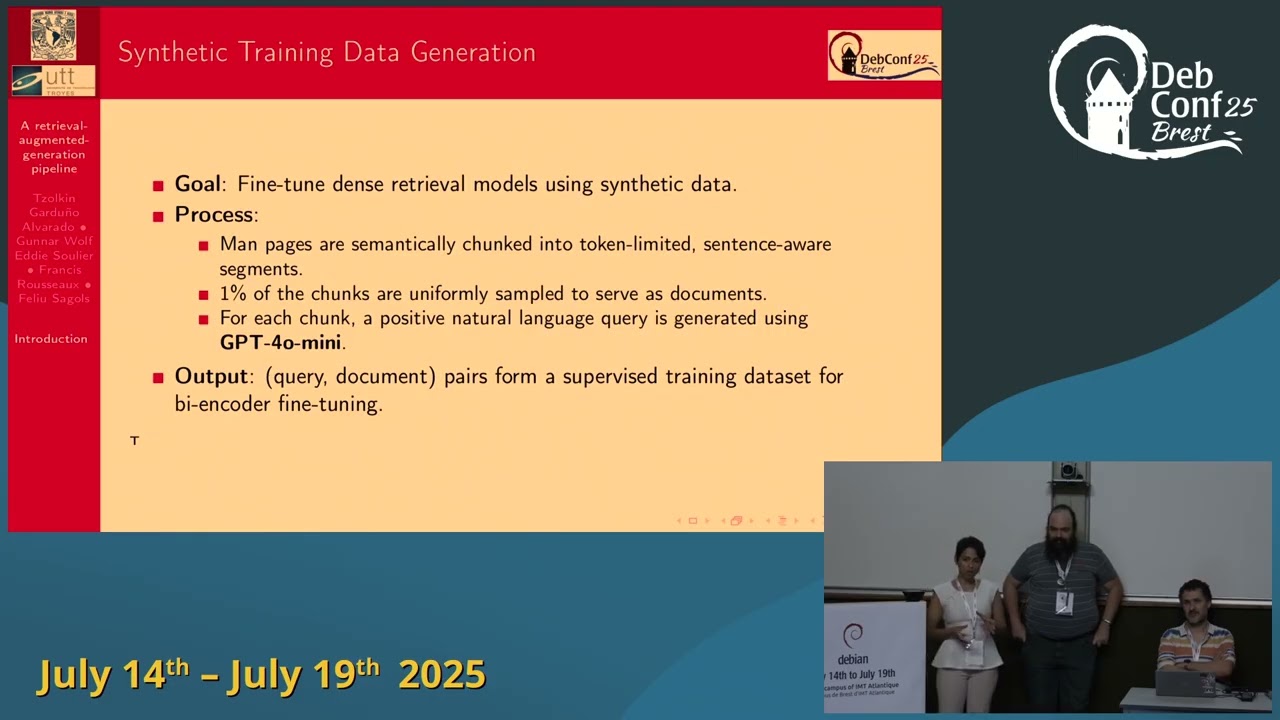
uh data set. And for doing this, we used
GPT.
Uh we of course are assuming that GPT is
would be our
uh gold standard or ground zero.
Uh and we
uh we sampled uh 1% uniformly uh all the
chunks that we found in uh in the man
one uh documents.
And uh uh we extracted uh posi positive
pairs, meaning uh chunk query are our uh
well, the query uh
the the response to the query is found
in that chunk.
And the output were these type of pairs
that we're going to use for training our
model next.
Um oh, yeah.
So, uh as we as I told you, there we
chose an encoder-decoder model. So,
we're we wanted to search for
pre-trained pre-trained models that that
is models that have already been trained
using a uh general purpose data sets,
and we we want to adjust the weights and
the biases of those models to be able to
uh
to answer questions on this specific
context of man pages.
So, we went through searching for
different encoder models, and we found
uh we chose these: T5 small, mini LM, uh
BGE um
small in English, and multilingual E5
small.
Uh some of the reasons why we chose
these is, of course, they have these
architectures. Uh their their
architectures are not exactly the same,
uh but they have they meet some other of
our requirements that are um
they're very small. They're really small
models. They can fit They can be used in
CPUs, and uh they were also um
open source. You can download and play
with the architecture and such. So, that
meets that met our our requirements.
Um
Uh so, here in this table we show you
the sizes of
of these models.
So the the highest being T5 small, it's
60 million parameters.
Uh but this is
this is not the size for the encoder.
The encoder is smaller because T small
is encoder decoder.
And and the uses for them. So here we
can see the the uses for each one of the
models. The T5 of course it's a full
rag. So we will see that this turned out
to be a
obvious afterwards.
And um
and the the rest is we have embeddings
local embeddings for Mini LM. We have
BGE that is good for query alignment
meaning
you're able to
mhm
in your to make the query and the chunk
come closer together in your embedding.
That that means query alignment. Um
multilingual 5 that is for multilingual
rag.
And um
Oh yeah. So
once we pre-train on
Well, the next stage is to fine-tune our
models. That means for that we use the
Adam W optimization algorithm meaning
that we are able to not always when
we're doing our our um
our adjustment of the loss we can always
adapt the learning rate meaning we can
every time work on smaller steps. That
is why we chose Adam W. And the contrast
and we for the loss function we use the
contrastive loss.
The reason why we chose contrastive loss
is that we only use positive pairs.
So we didn't use any negative. So we had
to find a
uh function for which the
the positives would have would be
meaningful as opposed to the rest of the
queries and chunks that do not
correspond.
Uh so
uh that's uh that's what we used for our
our fine fine-tuning.
And um some of the
um
uh characteristics of our of our
training was we only used 50 training
epochs and the size of our batches was
really really small.
The learning rate uh that we uh used was
also like very very tiny. We didn't do
any regularization.
Uh and even with this we we get to we
got to some um interesting um outcomes.
So um
so we um pre-trained well so we encoded
all the rest of the of the
um directory of the of the man pages. We
encoded it all.
Uh we got the our our embedding space
and then we started making questions uh
to this so that we were able to evaluate
what we what we uh obtained uh or or the
quality of our encoder.
And
uh
oh yeah, something I I had not uh hadn't
uh told you is that we had to write some
wrappers for some of the models in in
particular. We had to write a wrapper
for T5 so that we so we mean had to
calculate our mean pooling for
for the T5 model.
And uh well, what we got was uh here I
think we have a
well
this is the difference between what we
the well or the of the weights between
the trained the pre the fine-tuned
models and the vector store what we got
uh what the vector store meaning
uh that
once you have the vectors or the the
encoding or the embedded space, you have
all your representations, but all these
representations are
mainly geometrical. Meaning that uh
well, you don't have lists of uh or
tables of your data, but you have um um
uh similarity or semantic similarity
between them. So, we needed a vector
store so that we were able to search in
our space uh
for uh for neighbors of these
uh for the neighbors of the embedded
queries.
Uh so, oh, yeah.
>> Okay. Uh I I think this one we should
skip. We're
running a bit late, so so let's get to
the next one.
Okay. Uh it's your turn again.
>> Yeah. Okay. Um
Oh, yeah. So, for generating the queries
for which we're going to evaluate, we we
also generated like a completely random
queries, and we started uh seeing where
these queries fell. Once we embedded a
query, we did a uh K-nearest neighbor
inside our embedded inside our embedded
space to retrieve all the chunks that
were uh
significant or that were the nearest the
nearest in the vector uh
in the vector space.
And uh and then to evaluate, we used uh
precision and recall, and we used uh
the ROC curve. Uh
for this, we used the distance the the
distance in the uh vector uh well, in
the embedded uh embedding space.
And what we got was this uh being the
area under under the curve, the
greatest that we got was T5 using T5,
which got 0.67.
Well, there's a lot of uh things that
could be said about um the the results
that we got, but um it's important to
note that uh in these using these uh oh,
sorry.
Uh it's important to note that we did a
very very tiny training, so there is a
lot of opportunity here to refine the
results that we have.
>> Okay, this is just a an example of the
interface we had until 2 days ago. Uh as
I showed you that at the beginning and
I'll show you later, we also put this on
online so you can query this via the
network. The important thing I wanted to
show you here is that you can see how
how we can query how can I submit a bug
in a package? And this will
give us something that that's on a given
distance,
uh so it's a confidence measure. It's a
very
very bad confidence measure, but that's
what what what we got.
And uh well,
uh our time is I I I'm
sorry, just let me Yeah, please go back
to to where we're sharing the URL, so
>> Oh, yeah.
>> It was the second page, I guess.
So, uh yeah, here.
Here. So,
it's published there. And well, I would
love to have questions now, but yeah,
it's too much information. We could not
convey it
more quickly.
>> Okay.
Right.
>> Oh, well, I will Yeah, I will Here is
our GitHub and the source of our
checkpoints of the models.
>> Mhm.
Thank you very much.
>> Yes.
>> Thanks. Thanks, everyone.
Does someone have a quick question on
the room?
>> Yes.
>> Do you have plans to integrate this in
Debian proper?
>> Sorry?
>> Do you have plans to get this into the
Debian archive?
>> Uh
no.
Uh
that's the short answer. First, we
as
many of you know, we have been
discussing in the project whether
pre-trained models such as those
distributed by
Hugging Face are acceptable for our free
software guidelines. We haven't arrived
to a to a decision on that. So, at least
until then, we cannot
do it. We would like to at least offer
this as a service. Right now, I lack the
hardware to do so. Uh we were told of
some ongoing developments. We may get
the hardware to to put something like
this online.
As it is right now, I think it still
leads to too many false answers, which
is the usual case for for language
models, but we want to refine this. But
yeah, the the the answer is do you
can I make it into a dev package that
you can install? No, we cannot right
now.
>> Okay. So,
last one.
>> Uh
uh yeah. So, so
um
So, I noticed that you used a very
generic
language models for embedding for using
Uh have you considered using
a more specific small model which is
adapted to the domain? This is the first
question. The second question, if you've
uh fine-tuned your own model, are you
planning to publish it on Hugging Face?
>> Okay. So, for we we didn't find any
model that was trained on this specific
for this specific use case. So, that is
why we used
a pre-trained model and then we
fine-tuned it.
And
if we would be planning to publish it on
hugging face, yes, of course we we would
like to do so.
>> Would be nice.
>> So
we are running out of time so next paper
please.