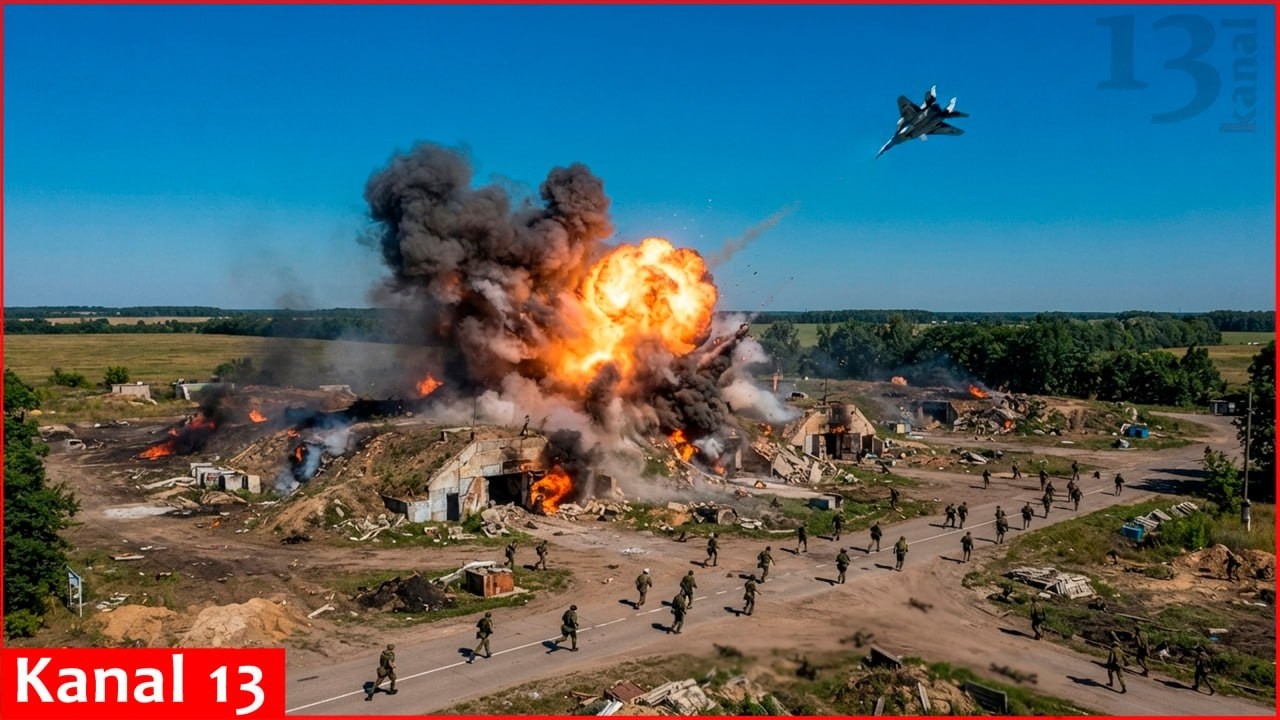
A MiG-29 destroyed a Russian infantry concentration: Russian manpower has been eliminated
Watch on YouTubeVideo summary
A Ukrainian MiG-29 fighter jet successfully targeted and destroyed a concentrated group of Russian infantrymen who failed to receive reinforcements during an ongoing engagement. Footage of this decisive airstrike was released by pilot Podsolnukh on his Telegram channel, detailing how reconnaissance initially identified the enemy position before immediately transmitting coordinates to Air Force crews. The video captures the precise moment the munitions were dropped, resulting in the complete clearance of the area where the troops were hiding and effectively eliminating the infantry concentration. This combat sortie has already garnered significant attention online, highlighting the effectiveness of Ukrainian air power in disrupting ground operations.
In parallel with these aerial victories, Ukrainian defense forces have continued to systematically dismantle enemy drone infrastructure across multiple regions. Specifically, they struck five UAV control centers and destroyed several ground relay stations used to manage Geran/Gerber type attack drones, including two repeaters near Zaliznyi Port in the Kherson region and others in the Kursk area. These ground-based repeaters are critical for transmitting control and communication signals between operators and their drones, thereby expanding operational range and stability. By disabling these nodes, Ukrainian forces have significantly degraded the enemy's ability to coordinate unmanned aerial attacks, forcing them to rely on less effective or shorter-range systems.
A major intelligence operation recently resulted in the catastrophic destruction of a logistics hub transporting North Korean ballistic missiles along the Trans-Siberian Railway. According to serviceman Kyrylo Sazanov and sources within intelligence circles, an explosion occurred more than 6,000 kilometers from the Ukrainian border, completely obliterating the train cars, locomotive, and missile warheads. The detonation, equivalent to tens of tons of TNT, created a crater over 15 meters deep and triggered a chain reaction that destroyed the entire rolling stock. This strategic blow not only prevented the missiles from reaching their intended targets in Ukrainian cities but also severed a primary artery through which the Kremlin receives military aid from Pyongyang, causing fires that engulfed adjacent forests and railway infrastructure.
Read the full video transcript
Another group of Russian infantrymen
failed to receive reinforcements when a
Ukrainian MiG-29 fighter jet struck
their concentration. Footage of the
fighting was published by one of the
pilots on his Telegram channel
Podsolnukh. According to preliminary
data, reconnaissance initially located a
concentration of enemy infantry. The
coordinates were immediately transmitted
to Air Force crews, who then bombed the
target. The video shows the moment the
ammunition was dropped and the result.
The area where the occupiers were hiding
was literally cleared and the enemy
infantry was eliminated. The video of
the combat sortie is already gaining
views online. The defense forces also
continue to disable enemy drone
infrastructure. Specifically, Ukrainian
forces struck five UV control centers
and destroyed enemy ground relay
stations both in the temporarily
occupied territories and in the Kursk
region of the Russian Federation. Two
ground-based repeaters for controlling
Geran/Gerber type attack UVs were hit
near Zaliznyi Port in the Kherson
region, the statement said. As the
General Staff explained, the
ground-based repeater ensures the
transmission of control and
communication signals between the
operator and the drone, expanding its
range and stability. According to Kyrylo
Sazanov, a serviceman of the Armed
Forces of Ukraine, citing sources in
intelligence circles, at a distance of
more than 6,000 km from the Ukrainian
border, an explosion occurred on the
railway tracks and the rolling stock
itself on the Trans-Siberian Railway
during the transportation of North
Korean ballistic missiles. The powerful
detonation of missile warheads resulted
in the complete destruction of the
logistics hub and the disruption of rail
service throughout the entire area.
Details of the explosion.
"Nothing survived," Sazanov wrote. It is
noted that the main intelligence
directorate had been tracking the
strategic cargo's route for a long time,
directly from the border with North
Korea. Explosive devices were planted
under the tracks and critical components
of the train along a complex section of
the highway. The explosion of the first
train cars triggered a chain reaction
and the detonation of the KN-23
ballistic missile warheads. "The
resulting explosion, equivalent to tens
of tons of TNT, created a crater more
than 15 m deep, and the train itself,
including the locomotive, was completely
destroyed," Sazonov added. According to
him, the scattered debris caused the
fire to engulf the adjacent forest belt
and railway infrastructure. "This is
being recorded, among other things, by
satellite systems. The cargo the enemy
planned to use to terrorize Ukrainian
cities was completely destroyed before
it even arrived. Not a single missile
from this train will be fired again. The
logistics pipeline has been
significantly cut off," a GR source
noted, adding that the operation
completely blocked the main artery
through which the Kremlin received
military aid from Pyongyang.
>> [music]