A Maze without a Plan? Display in Sir John Soane’s Museum by Bruce Boucher FSA
Watch on YouTubeVideo summary
Sir John Soane's Museum stands as a unique historical repository that defies traditional categorization, often described by nineteenth-century German critics as a confusing labyrinth or a feverish dream due to its eclectic mix of eras and styles. Bruce Boucher, the museum's former director, argues that this perceived chaos stems from Soane's deliberate strategy of creating a "mood journey" rather than following a rigid plan, a concept inspired by Renaissance display methods where shifting light, space, and mirrors manipulated the visitor's experience. Although Soane initially intended a coherent ground-floor layout, his architectural evolution merged his office with adjacent properties to form an inverted L-shape before expanding into a T-shape, resulting in an environment that blended classical casts, medieval works, and modern pieces in a way that was typical for London townhouses of the time but rare in its survival. This approach prioritized provenance and thematic connections, such as linking Egyptian and Roman architecture through floral motifs or juxtaposing the Englefield Amphora with his wife's memorial to highlight themes of loss, effectively turning the building into a study for Soane's own mind rather than a standard gallery.
The collection within these unconventional spaces reflects Soane's deep political engagement and patronage, featuring British art alongside antiquities and personal tributes to mentors like Joshua Reynolds. Key rooms, including the Picture Room designed with specific viewing planes and recesses dedicated to Shakespeare or even a shrine to Soane himself, demonstrate his innovative use of architectural elements to enhance understanding. While early observers struggled with the lack of explanatory labels and the arbitrary mixture of originals with plaster casts, later figures like Jacques Ignace Hittorff recognized the museum's immense educational value, particularly because it offered essential architectural instruction at a time when the Royal Academy prioritized painting over architecture. This unique resource allowed budding architects to access materials that enriched their knowledge of tradition until the late nineteenth century, preserving British sculpture and archaeological specimens through Soane's strategic acquisitions and connections within the art world.
The museum's establishment as a national institution was driven by urgent personal circumstances rather than purely artistic ambition, specifically the need to protect Soane's fortune from his younger son, George. Despite displaying busts of his wife and children, including those of his elder son John who had tarnished the family reputation, Soane faced significant conflict with George, an aspiring actor who failed to support himself and caused a scandal by living with his family in 1832. Fearing that George would dissipate the family wealth, Soane successfully lobbied Parliament in 1833 to secure legislation for the museum, overcoming opposition from MPs who argued it was unnatural to disinherit children or claimed the endowment funds belonged to George. This legislative victory transformed a private townhouse into a public repository, ensuring that Soane's vision of an architectural and artistic legacy would survive beyond his lifetime and remain accessible to the public as a singular institution dedicated to the study of architectural history.
Read the full video transcript
hello and welcome to the Society of
antiquaries of London lecture today I'm
really pleased to welcome Bruce Boucher
who's going to talk to us about sjn son
Bruce was director of the S John son's
Museum from 2016 to
2023 uh and he is a fellow of the
Society of antre he's published numerous
books on art and architecture and
sculpture and he's currently working on
a book about yakob Burkhart the 19th
century Swiss cultural historian his
latest book is John Z's Cabinet of
Curiosities Reflections on an architect
and his collections which was published
by Yale University press in 20124 thank
you Bruce and over to you thank you
anusa I've called my lecture amaz
without a plan which is a reference to
um Alexander Pope's poem an essay on man
which begins with an invitation to the
reader to expatiate free or all this
scene of man a mighty maze but not
without a plan
and it seems an apt way to begin a
discussion of display in s John son's
Museum there is no
doubt that the subject is fraught and as
with son's architecture in general it is
an experience that could never be
described as
neutral ever since the museum first
opened its doors visitors of all kinds
have tried to make sense of it or at
least to let it wash over them and when
I first came to the museum as director
I'd known it of course but I was struck
by the fact that there have
traditionally been no labels um the
juxtoposition of Works Greek Roman
medieval non-western even uh is uh often
uh baffling uh and
provocative
and I remember um Mark block the French
historian once said that it's always
useful to explore the history of a word
and I think one can expand this to the
history of an institution so for my own
satisfaction I wanted to try to
unpack what was what I could find behind
the uh display in the sewn itself of
course John son said that it was um
everything was arranged as studies for
my own mind but he never divulged what
he meant by that so it's as if he
withheld the key and over the years
people have been trying to understand
what he meant by this and also try to uh
make sense of the phenomenon uh of the
Zone Museum and I
think one way of um exploring this is by
looking at three different reactions to
it by all three of them German uh in the
19th century the first is the great
architect and contemporary of son's
called Friedrich shinkle who saw son's
house in London in
1826 and was baffled by it he wrote in
his travel diary like all private houses
in London this is small but it contains
a great number of casts fragments of
antique statues and buildings vases
sarcophagy little panels and bronzes all
exhibited in the riskus manner in small
spaces lit from above and the side often
spaces only 3 ft wide medieval antique
and modern works are intermingled at
every level in Courtyards resembling
cemeteries in Chapel likee rooms in
catacombs and drawing rooms ornamented
in herculian and Gothic Styles little
deceptions
everywhere clearly he wasn't impressed
and shinkle also felt the same way about
Bank of England which was son's greatest
architectural achievement which he
toured during his time in
London perhaps shinkle was also
surprised that a collection which
foregrounded architectural casts and
fragments did not incorporate a
developmental approach to the history of
the
discipline and indeed son was professor
of the history of architecture at the
Royal Academy and he was certainly well
aware of the Arc of civilization
although this was not the focus of the
display in his house Museum
the second observation uh I want to uh
allude to is by the great German art
historian and founder of the Berlin
museums Gustav vagen who published in 18
38 um a work on uh the art and artists
in England which was like a kind of
guide book to public and private
collections this was a year after son's
death sorry
the uh what he says is the rooms are
small and such an immense
number of uh
works are crowded together in three
different stories so that it is the work
of some hours to gain even a suff
superficial view of them I observe that
the whole not withstanding the
picturesque fantastic charm has in
consequence of this an arbitrary mixture
this AR mixture of heterogeneous objects
something of the unpleasant effect of a
feverish dream it is he concluded a
splendid example of English
whimsic as the organizer of the Berlin
museums vagan would have had little
appetite for the jumbled presentation of
son's Museum which ran counter to the
principles of the nent discipline of art
history next and finally uh in 1882 the
German archaeologist Adolf miches was
even more damning in his assessment of
what he
saw known molam said
molter not much but many appears to have
been son's motto in collecting for there
is something of everything along with a
few Choice specimens of high value or at
least of considerable interest there is
an immeasurable chaos of worthless
fragments of all types from all
countries of all kinds of art original
and copies mixed together all this is
crammed into the narrow limits of a
private house and is arranged in so
ingenious a manner that no Corner
however dark is left
unoccupied in this respect the architect
has achieved Marvels nevertheless this
Labyrinth stuffed full of fragments is
the most tasteless Arrangement that can
be seen it has the same kind of
perplexing and oppressive effect on The
Spectator as if the whole large stock of
an old clothes dealer had been squeezed
into a doll's house
then again the impression conveyed by so
wild a confusion of promiscuous
fragments is necessarily bewildering and
fatiguing to the V visitor so all three
of these comments fasten on the what we
would call today information overload
that can make visiting the sewn and
uncomfortable
experience if there's a common theme
underpinning them it is uh eclecticism
which was and still still is an issue
both with son's architecture and the
display of his own
collections elements of his display can
find points of comparison in other
collections of the period yet there is
much about the son Museum that is
Sous and this can be explained because
it is a rare Survivor of a kind of
Private Collection that was common in
the London of his day nevertheless the
fascination of the S Museum also
reflects its place on the cusp of the
shift from the Renaissance cabinet of
curiosity towards the post Enlightenment
Museum and looking back uh one can see
the prototypes for the way in which SE
composed a situation like the wall this
wall in
the dome area the very heart of the
museum it was both a reference library
visual reference library for himself and
uh his pupils
uh but also it was the kind of thing
that he would have seen in other
collections of the day this is a
watercolor of the entrance hall of
Charles townley's house on Park Street
um which was crammed with uh rare
classical uh marbles uh and was a
tourist attraction uh long before it
ended up in the MU British museum in the
early 1900s as the town Le
collection indeed a special
BR group of uh galleries was built for
the townly collection in the old British
museum uh in the first decade of the
19th
century so it wasn't uh it was typical
of the kind of uh collections that son
would have seen Thomas Hope's collection
which we know he visited several uh
times and with whom he corresponded also
was um a virtual Museum in an era before
um museums really became took hold on
the public
conscience and again when SE formulated
the idea of leaving
his house and collection to the nation
it wasn't as unusual as it may seem now
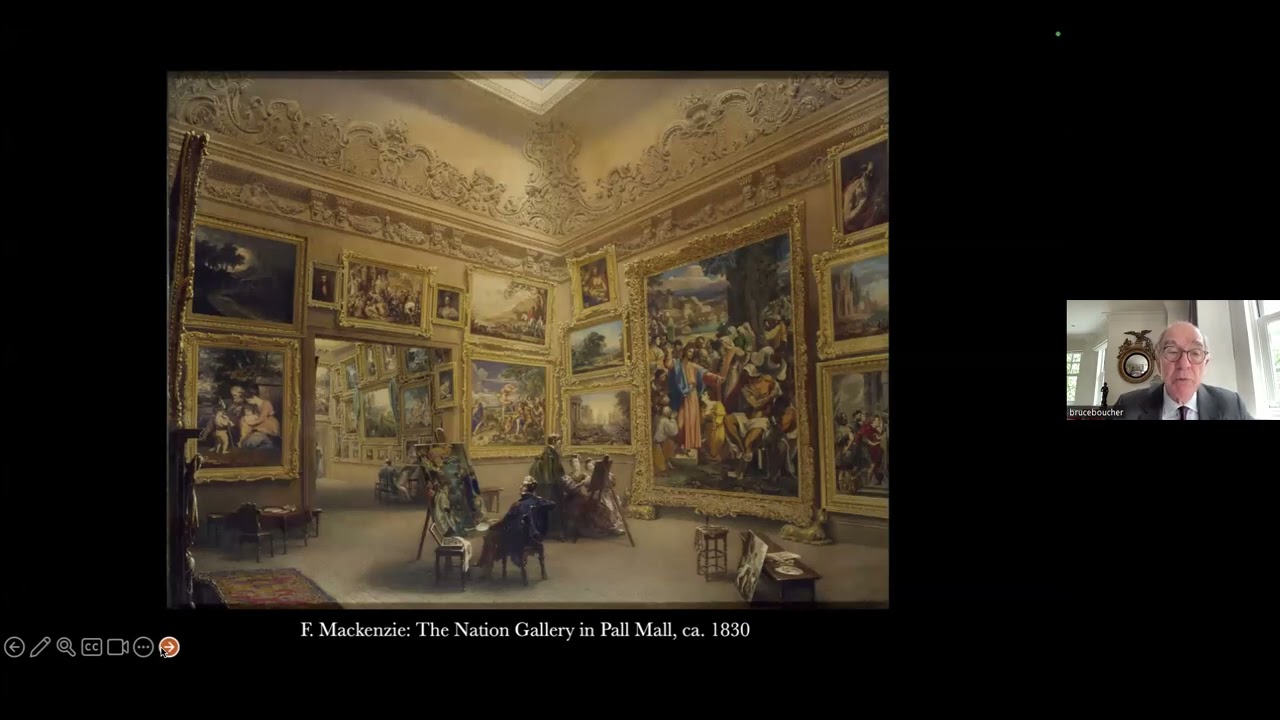
because of course in 182 4 the National
Gallery
opened in uh palmel in the house of John
Julius
angin and this is a view of uh the
Interiors around
1830 and of course there were complaints
about the fact that um Paris had the Lou
but uh London only had a small townhouse
undistinguished townhouse in uh the West
End so so this was not an
unusual thing and of course bear in mind
that after son's death the um National
Gallery moved into its new premises in
travala square and of course in these in
the same years the late 1830s 1840s the
British museum was rebuilt from the old
17th century monague house into the
great neoclassical Temple that we know
today
and here I'm showing you another view of
the house as it appeared in 1825 SE had
a number of watercolors uh done
particularly by his emmanu Enis Joseph
Michael Gandy who is a undistinguished
architect but quite a great um
watercolorist and really with s's hand
um
presenting to the public his ideas and
you can see the view of the monks parlor
and looking above the Vault with the
light shining into the picture room
recess it
um
was a type of uh experience which SE
really conceived as a kind of mood
Journey you go and you still go from
large Open Spaces to small spaces you
encounter as um shinkle noted uh little
spaces um with um deceptions that uh
really manipulate uh the The Spectator
it is in in many ways a a total work of
art and the source of this goes back
really to the way in which works of art
particularly uh classical reliefs were
displayed from the Renaissance onwards
here one's looking at the Garden facade
of the Villa medich the um French
Academy now uh as it would have looked
in in s's day and of course um the
reliefs and statues on the facade had
come from earlier collections notably
the plazo de laal which had a courtyard
with many of these reliefs uh displayed
in the
16th century where people like
Michelangelo uh saw and copied them and
one can see uh this
in private houses plazo corini in
Florence also has a wall which has Roman
inscriptions embedded in it and if we
look at the drawing office
um really the earliest surviving
architectural uh Studio in uh the UK um
which son created in um the early
1820s um the plastic casts on the wall
uh were meant to be um study uh objects
for his pupils who would uh copy them uh
at various times of of the day um it
didn't matter so much
to where they came from and there is
mixture there are some that are even
medieval but the idea was to be able to
capture the three-dimensional quality in
uh two-dimensional drawings SE like
Thomas sanby who is his predecessor as a
professor of architecture at the Royal
Academy believe that it was much better
for students to copy a three-dimensional
object rather than a two-dimensional
drawing or engraving because the um
drawing or engraving would essentially
flatten out the physical nature
of the work itself you'll also notice in
this which was uh really the last major
part of the museum to be restored it was
restored between 2021 and
2023 um some of son's models he was very
keen on models as touchstones for
buildings and also you can see a um cork
model of an at truscan tomb on the left
we'll come back we'll touch on this uh
again later um these were very popular
in the 18th uh century and by Son's day
had largely um waned in in in
popularity so SE um as you probably know
originally um made pitanga Manor which
was his country house that he owned
between 1800 and 1809 uh the focus of
his experiments with uh display of this
kind and creating a medieval monks
dining room and uh Folly of ruins
classical ruins uh but he and his wife
decided uh in 1809
to focus on Lincoln and field where he
had his first house um which he uh built
in 1792 on the North side and then in
1808 he negotiated the purchase of
number 13 the house next door um you can
see on the right hand screen the um plan
as it is today and it really composes
three buildings but what I wanted to
focus on first was that around 1810 when
he was building um beginning to build uh
number 13 He conceived of a totally
different plan which was to turn the
ground floor of 12 and 13 into something
like a coherent uh Museum as we would
recognize it um with Library
um plaster casts galleries uh gallery
for drawings and prints so on so forth
um an area in which he would in part
live there was an eating room which
could double also as a as a picture
display as at um pits hanger but
presumably like thas hope he would live
on the floor above and this would be
given over to a museum however as it
turned out he did something much more
interesting if complicated because he
decided that he couldn't really afford
to um keep both uh merge both numbers 12
and 13 so he swapped leases with his uh
tenant in number 13 and he took from
number 12 the area or kept from number
12 uh the area at the back of the
building which was his architectural
office and added it to number 13 and
what one notices when one looks at the
plan of uh the building today after he
bought number 14 to expand his
collections in uh
1822 the old yards of the houses um on
this 17th Century Square were turned
into a series of interconnecting
galleries top lit uh much like uh dulich
uh itself
and another point one might make while
we're looking at these um plans is that
in s's mind there was no clear
distinction between there was a
distinction between the house and the
museum or the academies he referred to
the area in the back of the house which
was where he kept most of his
collections but gradually over the years
as his collection expanded this um was
eroded and here I'm showing you another
one of the Gandhi uh views um it was
displayed like virtually all of Gandhi's
major work for zone at the Royal Academy
summer
exhibition where it would have been seen
by tens of thousands of people and uh
this was displayed in 1822 it merely
says it was a townhouse in London but it
would have been fairly clear to most
people that this was son's townhouse you
could
if you've been there you can recognize
the library dining room which occupies
the center space the facade which was
much attacked when it was built in 1812
it was considered an eyesa and in fact s
got into trouble for projecting it in
front of the line of the other houses on
the Terrace um eventually he he was
taken to court but he won the uh the
case and so today we as we see the son
Museum it really calls attention to
itself on the North uh side of the
museum and then you see the plan which
is like an inverted L and this is before
he added number 14 uh in 1824 which made
it more of a t-shape as I said and in
the lower right hand corner one of the
most celebrated and imitated of the
rooms the uh breakfast room what zone um
liked in terms of collecting was what
one of the things that interested him
and also reassured him was
provenance he bought from collections
which in a sense had already vetted
these objects and I'm showing you a
famous
example a
double double scarium which he bought at
the sale of the Earl of bestboro in 1801
along with a number of other marbles um
he spent over 200 pounds 211 if I
remember correctly
and this one would have been
particularly interesting to him because
of the fact that it had belonged to
bartalo cavi was one of the first
great restorers of Roman uh sculpture in
the middle of the 18th century and then
pesi whom he actually had met and this
particular scarium had been the subject
of an engraving by pesi dedicated to one
of his English patrons
so works like this or indeed the Diana
of Ephesus one of the major classical
sculptures which may have come from The
Villa Julia and certainly was in the
collections of cardinal Rio Rolo P DPI
and again the Earl of bper um these
Works would have attested to st's
position as a man of means but also a
man of discernment um a conosur much
like uh Robert Adam who in many ways was
uh his role model
here going throughout the house uh to a
large degree the marbles are
intermingled with plaster cast which was
typical of 18th century collections you
can still find it today in places like
newbie Hall in Yorkshire but this view
of uh Roman floral fragments which was
arranged in son's little study um really
part of the house as opposed to what he
would call The Academy of Museum um was
kept together
exceptionally it was put together by
Charles heathcot taam who had been the
architect of Thomas Hope's uh galleries
in uh the his house in the West End uh
he' collected them in Rome for Henry
Holland for whom son worked um early in
his career uh he collected them between
1794 and 1796 and then had to sell them
and Son acquired them from Holland's
heirs but uh he put them together very
much as they were engraved by taam in a
book that he published on this
collection um in I think about
1812 and it was arranged according to
motifs like floral motifs or the
anthemion and you can see here that what
son often does throughout the building
is to take a visual theme and put works
together whether or not they belong to
the same uh period or indeed the same uh
culture to show a kind of kinship across
the ancient world and this is something
that he had uh imbibed from the writings
of the um
French theoretician um amateur
archaeologist the baron daville he knew
dunville's Works donaville had catalog
the townly collection of marbles and he
Advanced rather daring ideas that
suggested that the um there was one un
common religion in the ancient world
from east to west and that was why
images turned up uh across cultures from
Greece and Rome to India and finally to
uh to
Japan the apery of son's collecting in
this area was really the acquisition in
1824 of the sarcophagus of the Egyptian
pharaoh C the first which was installed
in the Crypt in 1825 we're looking here
at an illustration of it as it first
appeared in uh the museum uh from uh an
unusual but very interesting book uh by
John Brittain an antiquarian and uh
something of a kind of Lackey of sons he
often did Sons bidding for him at
auction and things like that um it was
called the union of sculpture
architecture
uh in
um and basically the focus of it was
son's house in um Lincoln's INF field
and it was an early attempted a guide
book it wasn't a great success and in
fact it prompted son to write his own
privately printed descriptions of the
house um but what's interesting about
this is that se is created in the in the
Crypt which was Under the Dome the very
heart of the museum an area where he
wanted the um a great showpiece um and
he tried many different things before he
found the right one with the sarcophagus
he he referred to the area as a crypt
because in his mind and in terms of the
things that were shown there it was
associated with death burial uh funerary
uh earns and the like and here he's put
together as you can see in the
illustration a um plaster cast of a head
of a pharaoh which had come from the
collection of Samuel Rogers and to the
right of the illustration you can see a
black marble Egyptian Capital uh which
he had acquired in 1818 from the
collection of Robert Adam when he
acquired the bulk of Robert Adam's
drawings and a number of books and uh
Marbles and so he he's really creating
here a kind of Nexus of pieces of
Egyptian art uh including the the wooden
sarcophagus which was on the floor but
what's in what I find really striking is
that he acquired with the sarcophagus
about 16 pieces of the lid which had
been broken open in the Middle Ages when
the tomb was
rifled and he simply puts them
underneath as if the tomb has just been
been broken open uh it's a kind of
poetic touch which needless to say when
the museum turned into a um Public
Museum had to be uh tidied up and then
on the right you'll see eventually he
was constantly changing where works of
art uh were placed according to his
fancy right up to his death in January
of
1837 and what's telling I think about
the where the Egyptian Capital ended up
in the Cor or outside the picture room
is that it's stacked uh between a
rosette that is a copy of rosette from a
Roman triumphal Arch and above it is a
plaster cast of the Corinthian capital
of the Temple
of the Cil at um tily which had a very
distinctive sunflower in the uh in in
its Center and it was a kind of motif
that um SE used in his own architecture
particularly in the in the Bank of
England so he seems to be suggesting
that the Egyptian Lotus Motif and these
uh floral motifs in Roman architecture
are somehow uh kindred
spirits and I mentioned earlier uh cork
models he collected uh a number of these
um and he was he began collecting them
really at the time when their value was
falling into in terms of uh the market
they origin of these was the Neapolitan
uh nativity scenes the preap where the
architecture sometimes imposing
architectural backdrops were created out
of cork which had the ability to be of
course easily carved but also it could
mimic uh the effects of weathering of
brick work so on and so forth and
SE in the 1820s put together um
what he called the model room which was
in a way a kind of conspectus of
architecture classical and later
architecture initially was on the uh
third floor of the number 13 um and then
uh he brought it downstairs to the
second floor to what had been his wife's
bedroom um in the 18 mid 1830s but
what's noticeable here as you can see on
the top level you've got in the center
the round Temple of
the cilet tiv flanked by two replicas of
the Greek Doric temples at pum and then
down below on the main level uh is a
large model of Pompei as it appeared in
1820 which he acquired from the estate
of one of his early um pupils and then
there was a
cupboard beneath that in which he kept
drawings which went back really to um
the 16th 17th century England and
contained drawings by Adam and um
Chambers Chambers and other uh
Architects so it really was a kind of
conspectus and then Below on the bottom
was were models of son's own
architecture so he insinuates himself
into as the often does in the building
into the uh discussion you can never be
very far from a reminder of SE and on
the wall are illustrations
of architecture which um again was to
give you a more rounded view um of the
models that you were looking at and the
idea for this was not uncommon um other
people had collections John Nash's rival
had a collection of architectural models
but I think one of the ones that spoke
to him particularly was the
architectural Museum of Louis franois
Casas in Paris son owned the catalog of
this and was quite interested in it and
he would have seen it when he went to
Paris in
184 uh and again in
1819 but what was interesting about
cass's um collection was that it
contained these uh plastic cast
reconstructions of ancient works and
watercolor showing their actual State um
so this was The Germ of the idea that
eventually filtered into Stone's
treatment of such uh of of this part of
his his
collection now we think of the
Zone certainly I did before I uh became
director it's largely devoted
to archaeological specim to the
classical world but in fact um son was
very heavily invested in what we would
call or what would have was then modern
British art and this was because
he was an intensely political animal and
having become a an associate Royal
academician in 1795 and then a full
academ mission in
1802 he um used his money and I should
say I haven't me mention the fact but he
was not only a successful architect but
uh he also married successfully he
married an ays and he used her money uh
as well as the money that he gained from
his salary at the bank of England in
private commissions to um create a
lifestyle and a collection which was um
would have been
improbable uh otherwise and
in 18 199 he decided to create the first
picture room we're looking at an
engraving of it um by pugan in fact uh
which was published in a book by John
Brittain about collections in
uh London in 1820 which was published in
1825 um and what it stood on the site of
what had been son's
architectural Studio behind number 12
Lincoln INF field um what you can
probably make out are certain Elements
which are familiar from the museum
itself the chairs are the Chinese um
export uh Rosewood chairs which are now
in the drawing room we don't know when
he got them but um on the right is a
window which has Stained and colored
glass which eventually was moved down to
the
uh basement and is uh features in the
monks parlor on the left uh one can make
out the panels of the re's progress
which son bought in 1802 when he had
become a full academ mission um Again
part of this strategy to um
impress other people and probably
himself with the fact that he had
arrived above them uh is a long
horizontal landscape which he
commissioned from Augustus cat fellow
academician and what
um I discovered
that almost without exception the
paintings that he Acquired and also
sculptures were by fellow academicians
so he would use his patronage as a kind
of Leverage within the academy itself um
the gallery that he was creating um here
um were really created during the period
um almost side by side with dich college
picture gallery uh so that he could
benefit from experiments in both areas
to achieve a kind of series of toplit uh
galleries this one as Britain notes uh
in the text that even as he was writing
it was being demolished because s was
creating a new picture Gallery which is
the one that we know
today which is on the opposite side of
the back of
the museum at the end of this sequence
of galleries um he built it in 1824 and
I think it was
uh probably prompted by the fact that he
just acquired some very large pictures
um he had of course the canaletto uh the
big can which you see above the
fireplace here but also he had Acquired
and you can just see on either side uh
half of four of the great hos of the
humors of an election which he acquired
in 1823 from the estate of the Widow of
the painted the um actor David Garrick
uh for um over 1700 pound it was the
second most expensive thing in his
collection after
the set
the sarcophagus of Siti the and
um
he went pull out all the stops in
creating uh this room um for instance
the floors are oak trimmed in Mahogany
the dwarf cabinets are mahogany with uh
ebony inlay you have uh a very
elaborate marble fireplace which is comp
has a mixture of Gothic and classical
elements its own like to mix and of
course the um the ceiling with these uh
vaults was a mixture of classical and um
English Gothic
um what you can also see and I've put on
the left a drawing by sanb uh of the
East wall of the great room of the Royal
Academy as it was in Somerset house in
those days where uh he is proposing a
hang for the summer exhibition and you
can see that it is very dense and it
goes right up to the sky and
um it's the kind of thing that son would
have seen and em bibed and replicates
really in the picture room in the museum
and you can also see that again the
sandby here of course the prominent
place above the fireplace is given to
the president Benjamin West you have The
Usual Suspects hopner OPI um
beachy um Morland Etc um in prominent
positions um and then less prominent
ones below the line and of course as as
I said these exhibitions were
tremendously important for selling uh
not only for painting but also for
sculpture and uh two degree architecture
uh architectural
advertising the the canaletto the big
canaletto he acquired in 1807 from um
William Beckford Beckford was selling
the contents of his father's house
fontil splenden um in preparation to
create fontil Abbey his Gothic folley he
bought it
for 150 ginies which was less than he
paid for paintings by kulat or uh
certainly Turner and some of his uh and
Henry Howard other of his contemporaries
who are fellow academicians it wasn't
the first caletto he' bought he acquired
two small ones which are above it as you
can see from the um Earl of butes
collection uh notable collection already
in 1796 he had bought these before
either when he was living in number 12
and again it was part of this strategy
to create um a sense of wealth and
well-being and you can see either side
of the large caletto a couple of the
over 20 gaches by
claro the French architect who taught
architecture in uh Rome at the French
Academy and also collaborated with
Thomas Jefferson among others on
architectural projects um which he began
buying in the
17
90s the room is a small room it's a
parks approximately 14 by 13 by1 19 ft
um but with the use of the famous
picture planes um son was able to create
the uh effect of a much larger room
which would have been 25 by 40 ft as he
notes in his private descriptions
um the picture
planes were not an invention of SES they
had uh been uh in use for many years
George dance his his early Mentor had
created in the Shakespeare Gallery in
palmal a series of these and Samuel
Rogers among other private collectors
had um planes like this uh which were to
enable you to view paintings in
different lights and from different uh
angles um what you see here again is a
conjectural display probably
not ever uh actually
uh created as such but one of Gandhi's
um studies which s used to consider the
impact and you've got in the center one
of the site of
four Anglo Indian or Indian uh Ivory
chairs and an ivory table on suite and
on top of that uh you have uh the model
of the Temple of Vesta tiv which
probably never uh stood there but it was
a kind of Suma summarum of all of the
things that uh meant a great deal to son
and you get a good view here of the uh
ceiling what he called arched canopies
which again is this Fusion of classical
and and Gothic which SE relished uh and
was much criticized for in his own time
because it seemed a flagrant um disavow
of uh classicism and on the left you see
the nymph by um West
mcot which um he makes a focal point of
the picture room recess which is uh as
you open the several panels it suddenly
comes into view in this Extended space
it's a kind of
Catra uh and interestingly
enough West mcot it was a bit of
um transactional uh dealing because West
mcart either gave him or sold him the
chair and the table and in return son um
gave West mcot a great position in the
um in this uh display and of course by
the 1820s people realized that s was
creating a museum even though it was at
that point not uh formally acknowledged
he had he only went to Parliament for a
bill to preserve his house and
collection in 1833 but already by this
date the death of his wife 10 years
earlier in
1815 and his disappointment with his
sons uh affected uh determined him to uh
preserve the
collection there are some strange
elements in the collection uh which can
only be explained Again by personal
associations for instance he obviously
uh revered Reynolds Reynolds was the
first president of the Royal Academy and
Reynolds had presented the young johnone
with the gold medal for architecture in
1776 and at the presentation he
prophesied such great future forone that
one of the people who was there said
that it was worth more to Zone than the
medal itself um he
couldn't find Space he couldn't
accommodate one of reynolds's great um
portraits a fulllength portrait uh but
this
Painting came from reynolds's niece's
collection um and he acquired did from
her estate in
1821 it's um one of his fancy pictures
and it is uh certainly of a of a size
that you could accommodate over a
fireplace and indeed it had a
specific focal point it was a specific
focal point in the picture room in the
1820s and then laterally son moved it to
the library dining room where it sat
behind his seat in uh the library dining
room facing uh his Portrait by the third
President of the Royal Academy Sir
Thomas Lawrence so sitting between the
two of these he could commune with these
figures in his uh past and present
likewise uh the painting um he has a
number of paintings by Bourgeois who was
uh a mediocre painter at best and this
is one that's in the picture room recess
in a rather prominent position it's a
painting of kemell in a scene from Cory
elanus and again son was loved acting
loved the theater he was uh he collected
memorabilia of Garrick he was a Founder
member of the Garrick club and
buir was important to him because when
bis died in 1811 he uh left his
collection of paintings to dich P dich
College on the condition one the
stipulations was that son be the
architect of the Galleries and uh which
turned out to be the case Bourgeois was
also part of a a clack that supported
son in his efforts to unseat George Dan
as the professor of architecture and
then when s uh was in dispute with the
Royal Academy itself and was threatened
with expulsion rallied round and
supported him uh bis and beachi in
particular um there are very few
paintings by Foreign artist in the
collection uh which is unusual at the
time when there were certainly
collections of Dutch Masters um French
paintings and the like one exception is
this painting by vatto uh the marriage
contract or La du Village uh which he
acquired in 1802 too um from auction I
suspect that this may have been a
painting that had been sold by
Bourgeois um to
uh accommodate himself I suppose in the
years when he was stuck with this
collection of paintings which he and his
colleague no desant had put together for
the um king of Poland and then after the
partition of Poland were it was on their
hands uh in any case it's an unusual uh
work for for son and I suspect that uh
he bought it on the recommendation of
bis uh in he bought it in 1802 and he
paid 40 guine for it which was a
considerable sum of money but it was
more than he paid for uh 40 vases uh
Greek vases that he acquired from the
state the estate of James clar the same
year
1802 um I think there was a great deal
of Acquisitions in that year because
that was the year that he became a full
ra and again this was a way in which he
could um set the seal on his arrival in
the great
world another um aspect of the the song
which is quite U puzzling is the fact
that there are two areas which are
devoted to uh one is devoted to
Shakespeare it's called the Shakespeare
recess and the other on the uh floor
above is the tiv recess they're really
Pockets off the staircase um leading up
through the center of number 13 and he
could achieve these because the boundary
line between number 12 and number 13
wasn't uh a straight right angle it was
um an obtuse angle because the boundary
between 12 and 13 reflected uh one of
the medieval boundaries in the pieces of
land that constituted Lincoln in fields
uh in the Middle Ages so son could take
advantage of the fact that the plan of
of number 13 was shaped rather like a
funnel to create these areas which were
initially used for storage you can see
that behind the Shakespeare recess it
was a China cupboard which he used as a
China cupboard uh the tiv
recess was
um almost from the beginning given over
to uh celebration um soon was very much
taken with the idea of of Great British
worthies he'd worked at Stow at the
beginning of the uh 1800s um designing
the gothic library and he would have
known the Temple of British worthies
there and the idea obviously struck
struck with him because he um as I said
created this
um Temple this alter piece almost to
Shakespeare which included a uh plaster
cast of the bust in uh the Tomb in U
Stratford um and uh two paintings
relating to Shakespeare the drawing on
the left shows an
earlier creation
which uh has a large painting by William
Hamilton another um not particularly
distinguished Royal academ of the
arrival of Richard II at Milford Haven
uh and then above a scene
of Leah and Cordelia on the uh beach at
the end of uh King Leah um it was later
replaced by another painting uh which we
see today which was Shake exper inspired
by the muses more interesting um is the
way in which this is linked with uh the
original display of the
tiv recess called The tily Recess
because the freeze on the wall which
we'll see better in a photograph in a a
few minutes is taken from the Temple of
Vesta ATIV but originally in 1830 this
was a shrine to se himself you'll see on
the lower left on a monop Podium um
chantry's bust of sewn
above the cupboard in the back is Son's
first teacher and Mentor George dance
and then surrounding the bust of son are
works that s uh executed while he was at
the Royal Academy which won him the
silver and the gold
medal it
um was um in 1833 this was rethought
because in 1833
soon secured the survival of the museum
with the act of Parliament that turned
it into uh a
museum but and so at that point the bust
his bust of of himself was moved down to
the Dome area uh and the bust of dance
was moved elsewhere and it was turned
into um
a display of British sculpture which
I'll come on to in a moment but I just
wanted to show you briefly this painting
by Henry Howard uh one of two that se
um commissioned uh from Howard this was
before the Shakespeare recess was
created and then after the Shakespeare
recess was created he created a a a
painting of Shakespeare Seated on a rock
surrounded by the uh Muses um
the interesting thing
about this is I mean who is Henry Howard
Henry Howard was the Secretary of the
Royal Academy he occupied an important
position and also he was a goet between
SE and the academy in the years in which
son refused to give his lectures on
architecture and was almost um
excommunicated as it were by the academy
and then in the 1830s when son's
eyesight was it was Howard who read his
lectures on architecture and also Howard
facilitated the arrival of some of the
pieces of sculpture in the collection
he's been called uh flaxman in color and
that is perhaps uh a good way to
describe him and certainly son
repeatedly employed his um Services um
most notably in the paintings in the
ceiling of the library dining room the
classic inspired uh paintings the tiv
recess as I said once the museum was
turned into a um a national
museum became a repository of what would
be described as contemporary
British sculpture you can see on the
left a Banks's um one of Banks's reliefs
no two of banks' reliefs I'm sorry and
then in The Recess at the end um below
the freeze of
the Temple of vest atively uh plasticast
of flaxman um Shield of
Achilles um chantry's sleeping child and
then Cupid and psyche Again by um
flaxman um I think when people realized
that son was creating a museum that was
not going to be dispersed uh they became
interested in giving
works of art and this was one of the few
places uh in the early 19th century
where you could see um examples of
British sculpture so um John flaxman
sister-in-law uh gave him a large number
of reliefs by flaxman which helps to
explain the fact that there are so many
there today um these came from his
studio and she was very res in trying to
um find a good home for all of these
pieces a number of them went to
University College
London but you can see that uh one thing
you the chapel like nature of this area
and because it was off the house it
could be top lit uh on this floor so it
it it gives it a wonderful atmosphere
and it would have been enhanced
originally or was enhanced by a
copy of the Stained Glass by Reynolds of
Charity from the chapel of new College
Oxford which calls quite a stir when it
was unveiled in the late 18th
century I mentioned vases and finally I
want to uh touch
on the display of vases particularly in
the dining room end of the library
dining room um if you've been to the
museum you will know that um there's a
suite of vases Chinese 18th century
Chinese
vases Italian Stone vases and then in
the center a great volut crer um from
Southern Italy um which belonged to the
baron cardor and was acquired by S from
uh the cardor sale of, 18800 for 68
pounds it was a considerable amount of
money um but these kind of vases were
very fashionable in the day you see them
often in paintings from the late 18th
century onwards um they largely came
were found in southern Italy so they
were often called A truscan and S
continued to call the atrasan right to
the end of his life even though there
was ample evidence that they were Greek
in origin for the most part um but what
is interesting
here is the again this idea that there
is a kind of connection between these
vases from Asia through um the
Mediterranean
Basin and in addition to this either
side of this Suite of
vases above the Chinese vases sewn
placed these pieces of Ash which had
been struck by lightning and it formed a
kind of
sinuous design that I think he's
suggesting is comparable or maybe an
inspiration for the first ceramists who
created Pottery so in other words it's a
reference to the idea that art imitates
nature and there are only
two vases of any particular importance
in the in the collection um one was the
cardoval which we saw in the last slide
and here is the englefield barrel Amper
which for which he paid um over 20
pounds in uh the sale of uh
the englefield collection in
1823 and significantly he put placed it
Under The Canopy that divides
the library from the dining room in uh
his house in Lincoln and field and it's
facing the model of the Tomb that he
created for his wife um in
1816 and as I mentioned earlier the
death of Eliza s was a great trauma for
him and um he fetishized her memory
throughout the house there various
illustrations of the Tomb throughout the
ground floor so he was never out of
eyesight of it
and putting the englefield AER opposite
it I think was can be explained because
in the catalog by James Christie the
younger who is something of an
amateur uh classicist and archaeologist
Christie described this scene that we're
looking at as a woman seated in a tomb
and on the back which you can't see in
this image but is visible from a mirror
that's own place behind it there is uh a
young man running and Christie imagined
that it was something like a V variation
on eriche and orus that the young man
was running to liberate the woman from
the tomb so the juxtoposition of these
two I think was had resonance for to se
which um was that uh you had a a figure
in a tomb and then uh the tomb of his
wife opposite it and it's a kind of
poignancy of uh of loss and longing that
um one feels throughout throughout the
house and in fact there is
a letter by James Christie the younger
ton in 1825 he he kept in with s because
son was a good customer particularly for
books uh but also for he had purchased
vases and other um
classical Antiquities and in this letter
he says that there had been
some a ship coming from the
Mediterranean with vases and he he
remarks quite tellingly that they're not
particularly um significant but they're
quite showy and he illustrates uh two of
them with with these drawings but um son
didn't really um respond to this so
finally by way of conclusion I I just if
you don't know the motivation for son's
going to Parliament in 1833 it was
largely down to his younger son George
whom we see here in a bust by Thomas
Banks who was a friend of of sons was
made in
1804 and and Son kept it on display as
he did with um many images of his wife
and children um even though his memories
were um tarnished by the fact that his
Elder son John um who became an
architect never amounted to much and
died early um and George um was The
Thorn In the Flesh he wanted to be a man
of the theater but uh he wasn't um ever
able to support himself entirely so he
was constantly going back to his father
for money uh and there are series of
letters between the two uh George
weedling and sometimes threatening
suicide and things like that
um son discovered In
1832 that George was living in a menaj
ATA with his wife and his sister-in-law
and had had a child child by the
sister-in-law and I I think this was
probably the final straw that led him to
go to Parliament in 1833 and have a bill
passed to allow the creation of the
museum which was the first time that a
national museum had been U put
established in in such a manner the
British Museum and the National Gallery
had evolved uh over the years um and
there was a debate about whether this
was a sensible idea much along the line
of the debates over the British museum
in the 1750s who is the public what is
this intended for and S
um stuck to his guns even though um one
MP said that it was unnatural to cut off
your children and also insinuated that
the money that was being used as an
endowment for this Museum was in fact
his wife's um dowy and therefore by
rights belonged to to his surviving son
but so knew that if George inherited um
he would dissipate the fortune so um
Sone prevailed the museum opened
and I began by quoting the negative
opinions of
three German um Scholars and I just
wanted to close
by making uh
quoting uh jacqu ignas hitov who was a
Franco German architect of the 19th
century who had visited the SE house and
also seen the bank of England and wrote
an appreciation of SE which appeared in
a French publication in
1836 um and it was written in response
to having seen a copy of the French
edition of son's privately published
description of his house and museum in
1835
that son had sent to the Society of soci
De b um it the article contained a brief
biography and appreciation of s's
commissions especially the bank of
England with its as hit off said
calculated effects of light and
perspective included concluded with
remarks on son's house for its ingenious
sequence of spaces magical treatment of
light colored glass and mirrors as well
as its enormous quantity of riches Hof
concluded by noting that the son Museum
not only contains all that could serve
for the education of an architect but
everything that could render it
attractive such an ensemble would be
very precious but it has an inestimable
value in England where the elements
necessary for the instruction of
architecture are comparatively lacking
in the only public institution the Royal
Academy and this is an important point
because uh painting always took pride of
place in the academy since it offered
more lucrative careers for budding
Architects than did sculpture or
architecture and tone was aware of this
uh defect and therefore his threats at
times to form his own um Academy were
taken seriously by the uh academicians
and it never happened but down to the
late 19th century the son Museum was the
only place where an architect a budding
architect could find material that would
enrich his knowledge of the
architectural tradition so by conclusion
I would say that if you want
to learn more buy this
book thank you very much