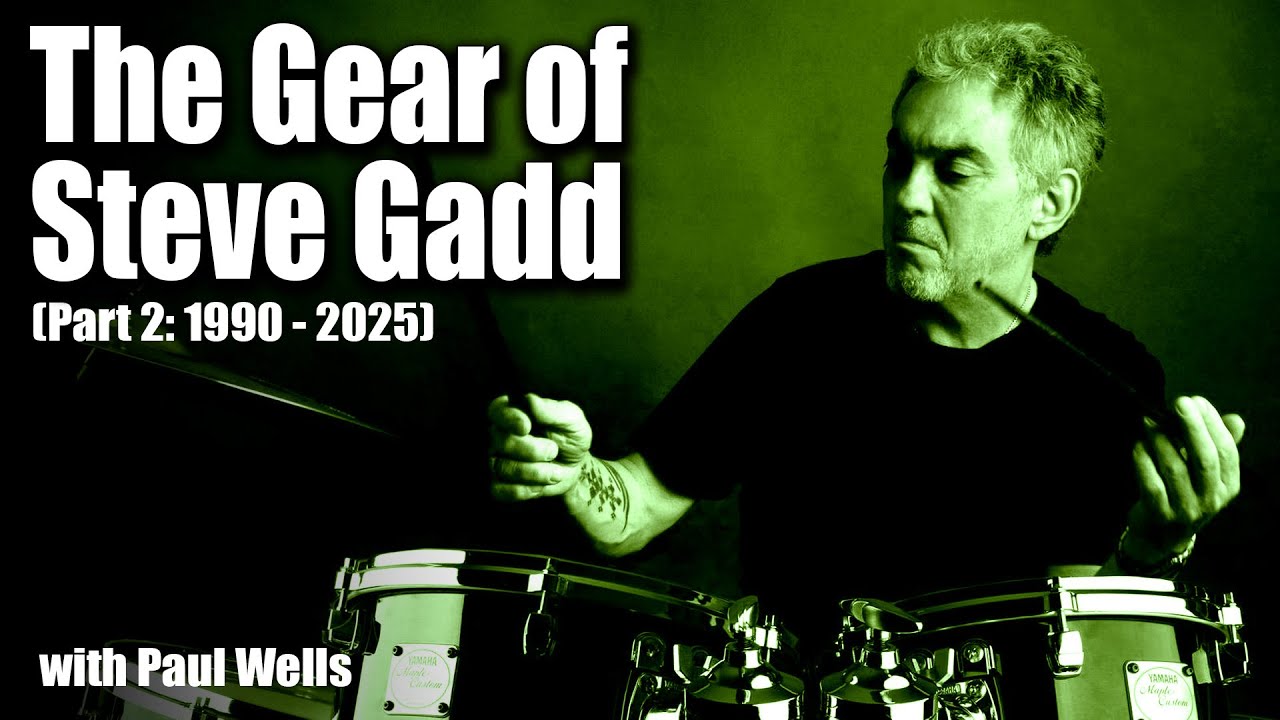
Video summary
In this comprehensive exploration of Steve Gadd's drumming history, hosts Bart Vandery and Paul Wells delve into the evolution of his equipment from 1976 through the mid-2000s, clarifying details about his iconic kits while debunking common misconceptions. Early in his career, specifically during CTI Records sessions at Rudy Van Gelder's studio in the mid-1970s, Gadd played a Gretsch Blue Sparkle kit without front heads on the bass drum for many recordings. By 1975 and into the late 1970s, he was utilizing distinct "Recording Custom" Yamaha kits in New York; one featured a unique rack tom with snare lugs, while another had unusually high-mounted badges and likely square shells. The hosts analyze evidence suggesting Gadd initially used single-ply heads rather than Evans Hydraulics before transitioning to coated Ambassador heads by the mid-1990s for a warmer sound. Furthermore, audio analysis of Steely Dan's "Rikki Don't Lose That Number" reveals that despite assumptions he brought his own gear, he actually rented a Ludwig Red Sparkle kit provided by SIR Studio Instruments, which included clear-headed Luedig toms and specific Zildjian cymbals, including two cracked crashes for fast decay.
As Gadd's career progressed into the 1990s, his setup shifted significantly with the introduction of Yamaha Maple Custom drums in late 1990 or early 1991, which featured a distinctive black wood-stained finish rather than solid lacquer. He adopted these on tours starting in 1992 and eventually created a hybrid signature kit by pairing Maple Custom bass drums with Recording Custom birch tom shells fitted with Maple Custom lugs to combine the warmth of maple kicks with the punchy, shorter sustain of birch toms. This era also saw the launch of his signature snare line in 1996, where he primarily used steel shell versions despite a personal preference for brass, featuring black hoops and carbon steel wires as requested by him. His cymbal choices were equally deliberate; during R&B dates in the late 70s and early 80s, he combined an "A" and a K Zildjian ride based on musical style, often favoring high-pitch Avedis rides with large bells for their clean sound over standard models. Hardware changes included switching from his long-time Gretsch floating action kick pedal to a Yamaha double pedal around the mid-1990s, allowing him to experiment with different bass drum sizes, such as using a 20-inch model on risers for specific tonal characteristics during Eric Clapton and James Taylor gigs.
By the late 2000s and beyond, Gadd's setup had refined further into a consistent configuration that balanced tradition with modern adjustments. A notable photo from 2015 shows him using coated Ambassador heads with diecast hoops on all toms alongside a 20-inch bass drum equipped with weighted lugs for improved sound quality, a finalization of testing conducted in Japan around 2016-2017 involving various ply layups. While he maintained his core preferences, such as the DW 5000 high hat stand and Yamaha FP7/HP7 pedals, he occasionally utilized stripped-down setups or house Club Custom kits from a shell bank for venue-specific constraints like performances at Carnegie Hall or Birdland with pianist David Matthews. The hosts also highlight historical nuances, such as the limited-edition signature kit released in 2006 to commemorate his thirtieth anniversary as a Yamaha artist, which featured birch floor tom shells contrary to some press releases claiming they were all maple. Throughout these decades of change, Gadd's gear reflected not just technological advancements but also specific artistic choices regarding sound decay and attack, ensuring that whether playing on rented kits or his own signature hardware, every element served the musical requirements of the session at hand.
Read the full video transcript
[music]
Hello and welcome to the Drum History
podcast. I am your host Bart Vandery and
we are back for part D of the Steve Gad
gear series with our good friend Mr.
Paul Wells. Paul W.
>> Hello. Thank you. Thanks Mark. Great to
be here again. I appreciate it.
>> Yeah. So part one was extremely
wellreceived. I mean, the the the good
comments, the information,
um the the views, just in general,
everyone uh is loving it. And I know you
got some great feedback as well, which I
always love to hear.
>> I you know, I have gotten more feedback
on this one than I think any of the
other ones we've done. And it's lovely
to see the enthusiasm people have for
the uh the great Steve Gad.
>> Yeah. which surprises me from based on
the Neil series because I always Neil is
very like die hard. There's so much
gear. It's like it's just a gear,
>> you know, a gear heads dream. It
>> but Steve is is has his own section of
just um you know of dieh hard fans as
well.
>> Absolutely. Yeah. And it was just it's
nice to see how many of them and how
vocal how vocally they love him
basically like how much just enthusiasm
there is for this guy and his I think
not just his contributions but I mean
this is the case with Neil too. Neil was
a very special person and by all
accounts a really lovely guy and that's
definitely who Steve is as well and I
think people just just love him and and
it's it's really nice to see that.
>> Really thank thank you to everybody for
for reaching out for the kind comments.
Um, I have gotten a lot of really great
information too from from fans who have
photos that I'd never seen or had done
research on things that I didn't know
about. So, um, I actually would love to
start today by actually going back over
a couple of the things that we that we
did in the previous episode because a
couple of new things have come to light.
Thanks again to the community of people
watching this. Uh so again, thank you.
>> Yeah, for sure. And I think it's good to
give the um you know, in case someone
stumbled on this or it opened up in
their feed first, you I think you you
can jump in here and just kind of pick
up here and then go back and watch
listen part one. If you're listening,
these are totally fine to listen to. We
try to explain, you know, um, you know,
out loud what we're looking at, but
these are very much YouTube focused um,
episodes. So, we kind of want to give
people that nod that like, hey, there's
a lot of pictures. Paul has a huge
folder of pictures which he's sharing
with me and then I kind of superimpose
um, over the video while we talk. Um, so
all that being said, I I will put a link
in the description for both part one and
I'll be sure to include all of the other
episodes. Neil, Tony Williams, uh,
everything that Paul has done on the
show in the past, all 6,000 episodes,
um, featuring Paul Wells, which everyone
loves. All that being said, we got a lot
to cover. So, Paul, yeah, go ahead and
go back and then we'll move forward from
there. So, um, a, uh, a drummer named,
um, Maro, who I believe is based in, uh,
Italy, uh, reached out to me via
Instagram and sent me some screen grabs
that he made of, um, Steve Gad appearing
on, it's during the first the very first
season of Saturday Night Live um, in
1975,
I guess. Um, he I believe is appearing
here with um with Paul Simon, although
you don't really see him in these
photos. You see Richard T on piano and I
think you see Tony Leven in the
background. But um these are some really
great
um screen grabs, some great examples of
of Steve playing his Pearl/Gretch kit,
the the kit with the Pearl fiberglass
tomms
10, 12, 13, 14, and the 20-in Gretch
bass drum, which we covered. Um but
what's significant about these is that
there are a couple of shots from behind
the kit. Now, I don't know if you'll
remember this, Bart, but um Steve was
famous for using Evans hydraulic heads
on this kit, but I had this theory that
when he first put this kit together, he
was using some sort of single ply heads.
Um and that's based on um you know, just
kind of uh subjectively
feeling like the sound of the toms. If
you listen to The Leprechaun by Chick
Korea and also um Journey to Love by
Stanley Clark, both of which were
recorded around 75, the tom sound is
different than what you hear in 7778.
It's a little bit, it's still great and
very meaty, but ever so slightly
thinner, ever so slightly, maybe a
little bit more responsive. Basically
what you expect from single ply heads.
And then um from research point of view
I I mentioned this that there's an
interview with Steve Jordan in modern
drummer in 1985 and he talks about this
kit and he talks about how influential
Steve was to him. Steve Gad was to Steve
Jordan and that Steve Jordan had kind of
early on had copied some elements of
Steve's kit. Um, but he talks about how
Steve used hydraulics later, but he kind
of implies that he liked his single ply
head sound on this pearl kit a little
better. Um, so that led me to think, oh,
maybe he was using different heads, not
the hydraulic heads early on. So, we
actually now have photographic evidence
of this. Thanks to Marorrow um in the
form of this screen graph
>> where this is Steve on SNL 1975 playing
his own drums. These are not backline
drums. This is Steve's special kit. And
you can see on the 10 he's got a CS
Black Dot. And then we can't tell what's
on the 12, but it's definitely not a
hydraulic head. It's some sort of clear
probably single ply head.
>> Mhm. And on the first floor, Tom, that
is I'm pretty sure a clear head. I don't
think that's a coded head.
>> Yeah.
>> Um
>> looks like a Remo logo, I guess. Or he
was Evans, maybe, but it looks like
Remo.
>> He wasn't an endorser of either at this
time. His first endorsement was was
Remo, but I don't think he was
technically a Remo endorser until maybe
the late 80s at the earliest.
>> Got it. Cuz he used the Evans hydraulics
after this. up until about 83 he was
using Evans hydraulics. So
>> got it
>> but with Remo on the snare drum and you
know so it was a mix
>> but yeah so this shows that kit at least
you know and this is 1975 in fact I
think I have a date I think Maro
>> the name of the file is 75 1975 SNL yeah
he tells me though he cuz he did the
screen grab um October 18th 1975 it's
apparently the second ever episode of
SNL
>> Wow. Wow. Um,
>> you know, this isn't isn't really
related, but I just watched a docu. It
was like a movie
>> about the first airing like the night
leading up to Essen. It was like I think
it was called like it's Saturday night
or something.
>> It was really good. But it showed the
band and the performance and getting the
stage set up. And it's interesting to
think the next week,
>> you know, after the first week Gad was
there and boom, this is it.
>> That's right. That's right. Yeah. Yeah.
So, we also get a nice view of some
symbols. the the symbol, his main ride
is is obviously an old K of some sort. I
don't want to get too deep into this yet
because we're going to talk about
symbols later in the episode, but it
it's a it's a great photo. Um, and it's
amazing to see those those drum heads
and
>> these are the Pearl toms with with uh
Gretch 20-in bass drum and then a a
Lewig superonic snare. Um, so yeah, this
is the classic kit that he used from
around 74,75
until he started using Yamaha regularly.
Uh, around 79 is when you see I mean
there are photos of him earlier in Japan
using Yamaha, but I think he got a kit,
you know, in the States certainly by 79.
Um, so this was the kit kind of I mean
it's funny because it's really a short
amount of time that he had this Pearl
Gretch hybrid kit, but it's a very
significant part of time. This is this
is a period of time when Steve really
blew up and became very wellknown and
very influential. So it's it's a very
important kit and as we've discussed
before this is the first kit other than
you know Rick Marado was experimenting
with these sort of sizes but this is
this is the kit that really put the 10
and 12 setup on the map as sort of a
standardized setup. It's also the kit
where mounted floor toms became a thing,
you know, because that, you know, that
did not exist, you know, really before
that. And unless you're talking about
like, you know, 1920s, 1930s, you
sometimes see
>> a a little tom and a big tom mounted on
the side of a bass drum. But mounted
floor toms as we know them today. This
is the kit. Steve Yad is the man.
>> Wow.
who who invented that basically
>> to this day it's [snorts] used to this
day popularly.
>> Absolutely. Yeah. So so that's pretty
amazing. I wanted to talk a little bit
more about the uh recording custom kits
to as well. And we made this distinction
um again everybody should watch the uh
the episode one to know kind of in
detail what we're talking about but that
there were two recording custom kits
that Steve had in New York. And you
sometimes see him, you know, in Japan
playing a different kit or on the West
Coast or doing a clinic somewhere, he
might be playing a different kit. But if
he's in New York from about 79 onward,
there are two recording custom kits that
you see him using. And kit number one is
distinctive in that it's it's the one
that we see with the shorter 10-in tom.
It's the one that has I'll I'll call up
a picture here. Um, we call it recording
custom kit number one. This is the
classic photo of Steve playing recording
custom kit number one.
>> Now, this this kit has most
distinctively
is um a kit with a 6 1/2x 10 in rack
tom. And in order to facilitate that
size, they used snare drum lugs on that
tom. And [snorts] you see some other
endorsers. Jerry Marota had a kit.
Sorry, Jerry Marada had a kit that also
had, you know, similar lugs on the
Rackto. I believe Charlie Drayton had a
kit that had lugs like that, but I think
it's not something I don't think you see
those. Um, you definitely don't see them
in cataloges and you don't, you know, I
don't know if you really would find them
on a consumer kit. I think maybe these
are things that were either custom made
for artists or um were just kind of
experimental at the time. But anyway,
this is kit number number one. And um I
found some further evidence that um
tells us what the tom sizes might have
been. Now I had speculated that the
first sorry the the the floor tom sizes
I should say. I had speculi speculated
that the first floor tom was a 12 by 15.
And this is based on um looking
endlessly at Yamaha cataloges from the
80s and looking at recording custom toms
and getting an idea of what lugs they
used and how. So they they had a few
different versions of these what they
call high tension lugs which are the one
piece lugs and you know basically like
the lug would have to be a little bit
incrementally longer for each
>> y
>> tom size where the depth gets longer,
right? And the tension rod could be
longer and shorter.
>> Well, see that? Right. So, they didn't
have a lug for each size. They didn't
have a lug that fit a 12, a an 8x12.
Yeah.
>> They didn't have a lug that fit a 9
by13, a separate one. They would use the
same lug on the 8x12 and the 9 by13, but
the 9 in deep drum would have longer
tension rods in order to facilitate
that. So,
>> that's how we can kind of get a sense of
what sizes these drums are. Um, so I
thought that was a 12x5 and then
probably a 14 by6 floor tom and that's
based on there's another photo uh where
you can see that floor tom really well.
Here we go. This is at 1987 Modern
Drummer Drum Festival. And you can see
that that tension the the um the lug
>> the t the the lug is very long and then
the tension rod is very short. And you
see that if you go to
the Yamaha catalog, this is this is a a
>> a recording custom kit and this is a 91
catalog. same sort of lug spacing and
tension rod spacing where you have a
long lug with short tension rod
>> short little amount of tension rod.
>> So Maro, our buddy Marorrow
[clears throat] also sent me this
interview with Steve in an Italian
magazine. Now this is all in Italian,
but when you translate it, this section
here, this is this is uh 1988 Italian 2
is the name of the photo. Um he he's
basically talking about um when they
filmed One Trick Pony in 1979.
Um Steve, this is this is one of the
first times that you see the recording
custom kit number one is in One Trick
Pony.
>> Um and I have a photo from Yeah. Well,
actually I think it might have been
1980, not 81.
>> Gotcha. Um, this is This is Steve in
that film, which is a fun film.
Everybody should watch it if you're a
Steve Gad fan or a Paul Simon fan. So,
he lists the sizes that he used in the
kit for One Trick Pony down at the
bottom, and he lists 10, 12, 15, 16, and
a 22in bass drum.
>> H.
>> So, that kind of confirms what I thought
about what those sizes were of those
floor toms. Um, so another interesting
development that I've learned um about
these kits that um a couple different
drummers pointed out to me was that um
when we talk about kit well all right so
another photo surfaced of what we call
recording custom kit number two and this
is the one that I discussed that I think
has a longer
12 I think it's a 9x by 12. But one
thing that some people pointed out to me
was that the floor toms are very
interesting because the badges are
mounted much higher than you would
normally see on recording custom
>> uh toms basically that usually the the
the the badges are roughly in the center
of the drum. But on this kid, and I have
a screen grab from a video 1989 at the
bottom, 1988 at the bottom line, he's
playing with the Gad Gang where you can
see how high up on the drum these uh the
badges were. Now, one person had thought
that um had noticed that uh when Yamaha
in the early late '7s and early 80s were
still making concert toms, you could buy
recording custom concert toms. And the
recording custom concert toms actually
had the badges mounted kind of high like
that. And somebody had thought maybe
they modified some concert toms
>> in order to make these because they
didn't have those sizes, you know, big
floor tom sizes in double-headed toms at
that time.
>> I don't know.
>> There's no there's no shell construction
difference. It would just be they just
didn't drill bottom,
>> right?
>> You know, they didn't drill holes for
the bottom lug,
>> but they use different lugs. They use
different lugs. So, I don't really know.
It's that it's sort of a mystery, but
but it is an interesting distinction
that Steve's kit, recording custom kit
number two, has very highmounted floor
tom badges.
And um I also did a little bit more
poking into the sizes and I was unsure
when we talked about this last time as
to whether that was a 14 and a 15 or a
15 and a 16 or maybe a 14 and a 16. So,
in in looking into that, I also took a
close look. So, there's a there's a um
these are obviously very deep toms.
These are not sort of standard power
sizes.
>> Um they may actually be square sizes. Uh
and Yamaha offered very briefly in Japan
only in 1984,
they offered what they called turbo
sizes, which were basically squareiz
toms.
>> I remember. I remember those ads.
>> Yeah. Yeah. And they they there's a
there's a Japanese catalog from 1984
that show, you know, that have like all
of these different sort of turboized
toms listed.
>> And if you look at this kit, I believe
this is in cherry wood,
>> which was eventually wckles finish. This
is a kit and it's listed in the catalog
with um I guess seven toms
uh 8 10 12 13 14 all mounted and then a
15 and a 16 mounted floor tom. So, I
compared this kit and particularly that
that 14, which is the largest of the
sort of upper toms, with Steve's tom
here. This is virtually identical to me
>> because you have the very long lugs and
very short tension rods. And you have
the same thing here on the 1984 Cherry
Wood tom. very long um lugs and very
short tension rods. And if you look at
these two floor toms, the 15 and the 16
in this kit, you can actually see that
it's the same size tension, sorry, the
same size lug, only the tension rods get
incrementally longer with each
>> tom spacing. Yep.
>> Exactly. So then if we go back to this
photo,
man, this is so deep in the in the in
the weeds. If we go back to this photo
from the bottom line, you see that his
biggest floor tom here has very long
tension rods.
>> Yep.
>> Which I think matches with the 16 on
this cherry wood kit. So that leads me
to believe again Gad may have had a 14,
a 15, and a 16 and maybe interchange
them.
>> Yeah. But I think that in these photos,
you're seeing a 14 and a 16 square sized
floor toms in recording custom kit
number two. Now, yeah,
>> another theory that has been proposed to
me and is actually I I'm not going to
mention who it was because I think they
want to remain private about this, but a
a couple of very very well-known
drummers
are very very big Steve Gad fans. And it
actually reached out to me after this
podcast, which was really um an honor to
me that to to hear from these guys
because I'm a big fan.
>> Yes. Um, and they actually they're
friends and these two drummers and they
actually have this theory that this
deeper
second racktom they think might actually
be a 9 by13 and that Gad may have used
an 8x10 as his first racktom with this
kit only and then a 9 by13 as the second
racktom. Now I love and respect these
guys. Personally, I disagree with this
because I don't I still think that looks
>> I don't I I feel like a 9 by13 again has
a sort of specific look to it. And I
don't know if I have any
Let me see if I have any um No, these
are all power toms, aren't they?
I mean, you can look easily at, you
know, any number of Yamaha cataloges
that have Now, we're not talking about
the current um
>> the 80s or the
>> the current No. Well, no. Yeah. '8s '8s
uh recording customs, ' 80s or '9s.
>> Um,
you know, not the current version, which
the lugs are a bit different on those.
Um, but the space I mean this is so this
on the on the far left here is a black 9
by13 tom and
I don't know it just they don't quite
look the same. I mean obviously the
depth is the same because you see the
same lug and you see the same length of
tension rods but I also just see a
little bit more space between the hoops
here.
>> Yeah, I would agree.
>> I don't know. I I think it is possible.
It is possible, but Steve has always,
whatever the floor tom sizes are, he's
always talked about his rack toms being
an eight, a 10, and a 12.
>> Not ever. He's I've never seen him
mention
>> or list a a 10 and a 13 as his racktoms.
So,
>> which to Yeah, him him mentioning it cuz
he knows his stuff and he knows what
what he's had. But um
>> yeah, I don't think he knows details
like the depth of the, you know, the the
two floor mounted floor toms or
something, you know, things like that.
He doesn't get as as into the weeds as
that. But there are things that he is
very specific about
>> and I think that the 10 and 12 as his
racktoms in that era is is one of them.
So um
>> but it's possible. It is it is it is
possible and I like that theory. I think
it's very interesting. Um, and it and it
is possible.
>> This episode is brought to you by GM
Designs symbols. GM Designs is
redefining what symbols can be. They
believe percussion should be personal,
expressive, and inspiring. A true
extension of the player behind it. Every
symbol GM Designs makes is handcrafted
with purpose, blending traditional
artistry with bold, modern ideas to
create sounds that are truly one of a
kind. They're not your average symbol
company. They're a movement for drummers
who love exploring sound. GMDs is here
to help you expand your creativity,
discover new textures, and make your
voice heard. Explore more at
gmdsymbols.com
or find them on reverb and symbol swap.
No, speaking of the the floor toms, it
if you look at kit number one also that
has the same sort of phenomenon where
the uh the floor tom the badges on the
on the mounted floor toms are high on
the drum and you just don't find that. I
don't think that's the case with any I
mean if I look at you know I mean I'm
looking at a Yamaha catalog. It's a
little hard to see cuz you don't usually
see the badges, but in Yamaha cataloges,
even from the late '7s, the badges, I
think, are always Yeah, they're always
centered on the drum, as far as I could
tell. Again, this is something for like
there are people that know so much about
vintage Yamaha drums. Um, and they may
know better, but um, I was told that it
was floor tom uh, uh, sorry, concert
toms were the only toms that Yamaha made
that had those sort of badges up higher.
Hence the theory that his floor his
mounted floor toms might have somehow
started their lives as concert tom
shells where they might have put a badge
on
>> before they put the lugs on. But anyway,
just a theory. Maybe a Yamaha expert can
comment and say, I bet they could look
at that and go, "Oh, no, that is um you
know, those are 79 to, you know, January
to
July. [snorts] They had them up there
and then they lowered them down or
something." So, comment if you know.
>> Yes, please. Please. I mean, it's great
having having people comment on this
stuff.
>> Yeah.
>> Um, another interesting recording
custom. I don't think I showed this
picture last time. Um, but this is a
photo from the 80s, I believe, from a
tour in Japan
where he is using, and I don't know if
this was just like a a kit that he used
as sort of a supplement or if he used
this for the whole gig, but this is sort
of like a little Bbop version of his
setup.
>> Yeah.
>> Um, it's got his So, the GG on the bass
drum head is for the Gad Gang. That was
the logo that the GAD gang originally
used.
>> Um, but this is a 10-in rack tom, a
single 10x14
uh, mounted floor tom, and then an 18-in
bass drum, which we
since, you know, he stopped using that
Gretch Bbop kit in the early '7s, I'm
pretty sure this is the only time I've
seen him use an 18-in bass drum.
>> Yeah.
>> Now he's uses uses a 20 sometimes
lately. Uh but yeah, this is an 18 with
no uh with a with a full front head, no
hole in the front head.
>> Um you know,
>> it's interesting how it is like super
high, you know, tom on the uh arm coming
out of the bass drum, the floor tom is
mount. It's It looks so naked.
>> It's an interesting layout. It almost
looks like one of those um Lwig
breakbeat kits or something where things
are like little bass drum, super high
tom, one of those, you know. Well, he
sits he he's always set up, you know, in
the 70s he was a little bit higher on
the kit and the drums were a little bit
lower, but gradually he's sort of over
the years he sat lower and lower and the
drums have kind of gotten a little bit
higher and sort of, you know, you see a
lot of drummers set up like this and
it's very comfortable for them where
they're low and the drums are kind of
high and kind of like almost facing them
so that the drums are sort of like, you
know, they're they're doing their
operations like here as opposed to like
being over the drums and having things
lower. You know, if you look at Antonio
Sanchez, he tends to sit high and have
everything very sort of below him and
that's what's comfortable for him. Gad
sits low and has everything sort of
above and almost in his face. So this I
think what you're seeing is is is some
of that. I saw Antonio Sanchez at Pacik
around the time it was like not super
far after Birdman came out and he
performed some of that stuff and boy
that was incredible. Total side note,
but seeing Antonio Sanchez just
>> I saw him here in Brooklyn um a couple
summers ago for Celebrate Brooklyn. He
did the entire Birdman film. He played
along. It was just him, a drum set and a
and a screen and he played along. He did
the live soundtrack thing but on drum
set and it was absolutely mind-blowing.
He's he's such an amazing drummer and
he's doing this is a total side note.
He's he's he's he does the music for the
uh Apple TV show called the studio which
is a couple episodes. Very good.
>> That's all his drumming. That's all him
improvising along with, you know, like
just
>> playing. Yeah. does. And I believe um
there's a great podcast interview with
him with um oh, what's the guy's name?
Um Elmo Leavano.
>> Do you know this guy? Has a great
podcast. Um he did a a really great
interview, long interview with Wckle.
Did a long interview with Antonio and he
talks a lot about the studio and how he
how he
>> he's apparently does all of that in his
home studio. Antonio does. So
>> very cool.
>> Great stuff. Yeah, heavyweight guy.
Anyway, side note, I love it. Sure, he
was influenced by Gad to tie this to
make this relevant whatsoever.
>> I mean, it's hard to find people that
aren't really, you know. Um
>> uh so before we move on sort of getting
into where we left off, I wanted to talk
about some uh backline kits
>> um that Steve has used. And and it's
largely because I think people sometimes
get confused and they hear recordings
and think that Steve is using his own
drums, but there's some well doumented
um examples where he is uh not using his
own drums. Um, and I I actually have I
have props with me. I I I got my first
subscription
for I guess I don't know which birthday
it would have been, but the first issue
I got in the mail was March 1986.
>> Okay.
>> Uh, which was Jerry Marada on the cover.
>> Nice. Um, and but I I then started
buying a lot of back issues. And I
remember sending away for a back issue
of July 1983
with uh Steve on the cover. This is my
original. I've had this since I think I
got it in 1986. Wow. You see, it's
pretty beat up.
>> It's my original copy. Yeah.
>> Um, great interview with Steve and
he So, I am a really big fan of
um, one of the first producers that
started hiring Steve for a lot of
recording sessions. And this is around
7273
was uh Creed Taylor who was a jazz
producer and had the label CTI which was
Creed Taylor Incorporated I guess or I
think maybe it might have been Creed
Taylor International. I'm not sure but
CTI Records was a famous sort of
crossover jazz sort of funk label. made
a lot of really great recordings and um
Steve is on I don't know a lot of CTI
records. They were all done um mostly in
the early days they were all done at
Rudy Vanelder studio which is the famous
studio where almost all of the Bluenote
records were made the great impulse
records like Cold Trains records uh Love
Supreme and things like that all made at
um Riv Van Gelders. Um, and I think we
talked a little bit about Van Gelders
when we did the Tony Williams episode
because Tony recorded uh a lot of
records at at Van Gelders.
>> So, um, in this interview, Rick
Mattingley asks Steve um
um I've heard they're talking about your
sound, about your personal sound as a
drummer. Um, Rick says, "I've heard
drummers complain and say,"Yeah, but if
I do whatever the engineer wants, how
will I ever get known for my sound?" And
then Steve says, this is Steve speaking,
his response, "I never tried to get
known for my sound. I've never tried to
do that. I don't really have a sound."
Huh. Which is, of course, we Yes,
[laughter] he does. But he says, "I
don't really have a sound. I mean, a lot
of the CTI dates I played on Rudy
Vanelder's Gretch drums. So, that's
Steve confirming that on a lot of the
CTI dates, he's playing uh Rudy's house
kit. Now, Rudy's kit, I've done a lot of
research into this as well, separate
from Steve Gad. Uh, in 1966,
um, this is from looking at session
photos from the Blueote catalog. Around
66, you start to see a Blue Sparkle
Gretch kit 12 14 20 with a matching
snare. Um, that pops up in tons of
session photos. Mickey Roker always used
this kit. I've heard some people say
that it was actually Mickey Roker's kit
that he left there or he sold to Van
Gelder or something. Um, Mickey use this
kit. Uh, Billy Higgins uses kit. Freddy
Weights is pictured using this kit. A
lot of drummers use this kit. at Van
Gelers and it continues to be used. That
kit, the Blue Sparkle kit 121420 is
still at that studio and people still
use it to this day. Um, from what I can
tell, Elvin always brought his own drums
in that era from like ' 67 on.
>> Uh, Art Blakey always brought his own
drums, although Art never recorded there
after 64 or ' 65 or so. Anyway, that's
another story. That's another podcast
part. Um, but [snorts] these are almost
certainly the drums that Steve used. And
by the time they're doing the CTI dates,
you can tell the toms are a little bit
muffled. You can tell they have the
front head off of the bass drum. In
fact, to this day, that kit, I think,
doesn't have a front head on it. I think
they took the the front head off in the
early '7s to get that
>> sound that Ringo pioneered
>> um, and never really stayed off. I think
they probably lost the the hoop and just
never put the stuff back on.
>> I always I wonder if that affects the
roundness or the
>> I think it definitely could
>> after after 50 years. I mean, it's kind
of like if you have strings off of a
guitar for too long, the b the neck gets
gets out of whack. I wonder if that
>> I think that's entirely possible. Yeah,
but that that um so anyway, those are
the drums that Steve is using. Um, I
mean, if you listen to, um, Joe Frell,
Penny Arcade,
um,
uh,
Hubert Law in the beginning,
um, the early, uh, uh, Bob James one,
um, is an amazing record. Steve is on
all of these.
>> Um, you listen to those records. I mean,
he's he plays, you should listen to
those records because he plays so
brilliantly. These are some of my
favorite recordings of Steve Gat,
especially that Hubert Law record. It's
incredible. But you hear only a four
piece kit. You hear two toms, that's it.
Um, and you listen closely. I think they
sound like wretch drums. They have that
sort of twanginess even though you can
tell they're kind of muffled, which was
the sound of the day.
>> All right. So, for more backline,
um,
there there are various photos like this
modern drummer. I think I showed you
this before, October 78.
Steve's first modern drummer cover
story. All of the photos here are taken
at some sessions. The uh the the Aaron
Wald is uh the guy who did the article
and he also took the photos. Um and he
says um I cornered Steve during a series
of recording sessions for a Japanese
keyboardist who specified Steve Gad on
all contract sheets. I sat through two
or three sessions taking photos when I
could, trying my utmost to be
unobtrusive. So, these photos were taken
by Aaron Wald at some of these sessions.
This is a great one. This is Steve. This
is actually at Power Station.
And this is Steve. Did I show you this
at the last?
>> Yeah, we saw that last time, but yeah.
>> Yeah. So, that's a that's obviously a
backline kit. Steve Symbol, Steve Snare
most likely, but that's just a a house
kit at the studio. And this happened a
lot. Yeah. So, this happened a lot. And
what's significant about this is when
you start to think about what probably
maybe Steve's I'd say Steve's most
famous recordings, Steve most famous
performances
are probably Paul Simon, 50 Ways to
Leave Your Lover. Yeah. But the other
one most famous is probably Steelely Dan
Asia which is you know to me one of the
greatest drum recordings of all time. I
mean it's just a miracle this this
recording beginning to end. Everything
he plays is so beautiful and so perfect
while still being extremely expressive
and soulful and
>> and it features these two sort of drum
solos where he's playing over this sort
of these rhythmic figures. I'm sure most
everybody who's watching this is
probably familiar. Very familiar. If
you're not somehow, please go stop this
podcast and go find a recording of
Steely Dan Asia. AJ AA is how it's
spelled. Oh my god. You your life will
be that much better.
>> Your life begins today after listening
to Asia.
I have seen and heard so many people
speculating about what kit Steve is
using, what drums Steve is using on this
recording and a number of people assume
that he was using his own drums and
Steve definitely so Asia was recorded
the track was recorded in Los Angeles um
and uh what was the studio the producers
workshop shop was the name of the
studio. It was um was on Sunset
Boulevard and um Steve definitely
brought his own drums to LA to record at
times. He's on record as saying that.
And if you remember last time we have
some photos of the Chick Korea recording
session that produced both the Madhatter
and Friends 1977. And Steve definitely
has his own drums on those recordings.
Those were both recorded in LA, actually
in Burbank. So, he had his drums there
at times. He flew them over, but um I
have always been sure that Steve is not
using his own drums on Asia. And there
are two things to listen for that I
think prove this. Um, besides the
anecdotal evidence that I'm about to get
to, but if we're just talking about
using your ears and especially if you
listen to Asia, good quality recording
or stream of Asia with headphones where
your your AirPods or whatever, just like
highquality headphones of some sort.
You'll notice a couple of things that I
think make it impossible that this is
Steve's own kit. The first thing is that
throughout the track and Steve is
playing a lot of stuff in those solos.
But if you really analyze it and you
figure out what he's playing, you're
only hearing three tomtoms. You do not
hear four tomtoms. It is three tomtoms.
And it is two rack toms and one single
floor tom. When Steve has his own drums
and he has an opportunity to play a
solo, I have noticed I would say 85% of
the time at some point in the solo he is
going to use all four tomtoms. He
usually, you know, I'd say like the 10
and the 14 get the most workout and then
the 12 and then the last the biggest
floor tom kind of gets the least action,
but
>> he almost always is hitting all four of
those drums if you listen if he has it.
Yeah, there's a short a couple short
solos on Chick Korea Night Sprite. We
know he has his own drums uh recording
the leprechaun that album and all four
drums are used in both of those short
solos.
>> Um but you only hear three toms. The
other bit of evidence is that in the
bridge, I guess he'd call it the bridge
of Asia, there's a part like it starts
very delicately and he's playing some
grooves on the high hat, rim clicks, and
then high hat and open snare. And then
it goes to this sort of middle
instrumental section where he plays this
groove where he plays a halftime
backbeat on a tom.
[clears throat]
You listen to that and listen for the
pitch of that tom. That tom is tuned
quite low. It's tuned very very low and
it's a pitch that I re I mean his
fiberglass kit had a very wide tuning
range but you could not get a 10 to
sound like that. And the reason that I
know then maybe somebody would say well
maybe he's playing that backbeat on the
floor Tom. That's why we're listening
with headphones because if you listen
with headphones, the drums are
everything is close miked and the stereo
spread is the natural spread of you know
what you'd hear. I can't remember if
it's drummer's perspective or audience
perspective.
>> I was going to say the and to explain
that the flip of it is if you're looking
at it from it where you're snare's on
your left, floor's on your right,
drummer perspective, you're looking at
it, flip it.
>> So snare's on the other The way
>> the easy way to tell is listen for the
high hat. And if you hear the high hat
coming from your left
>> headphone perspective,
>> then it's drummer's perspective. If you
hear the high hat coming from the right,
then it's audience perspective
>> cuz you're looking
>> when you hear that tom backbeat, it's in
the same ear that you hear the high hat.
>> Okay?
>> So that tom that he's hitting on that
backbeat is the first rack tom. And that
means that that tom has to be bigger
than a it's a it's at least a 12, if not
a 13.
>> Those those three toms that you hear are
tuned very very low. And they do not
sound anything like his pearl fiberglass
toms that he was using at that time. Nor
do they sound like the Yamaha recording
customs that he would use shortly after.
They just don't. They sound very
different. So I listening to it had
always theorized that that was the case
that he was using some studio drums. And
I think that Steelely Dan, you know,
they would often record tunes with
multiple drummers. They tried different
drummers on different tunes and I think
they would often have guys all playing
the same kit. They would just have a kit
that was there at the studio a lot of
the time and
>> you know different people would play it.
Now an interesting thing has happened
where um and this is where you know one
of the reasons that we actually kind of
like the internet is you have people now
of course there are a lot of crackpots
who like to go on the internet and lie
right but
>> I have no reason to necessarily believe
that this guy's lying a a guy named
Scott Moyer M O Y
who I've never heard of and I don't
really see anything else about him but
Scott Moyer has commented a couple of
times on um so he has commented on an
article that you can find I believe it's
mix magazine it's one of the audio
>> you know like like audio engineer
magazine
>> um there's an online article about the
making of Asia
>> and then there's also um a video of the
making of Asia uh on YouTube a
documentary that features um Donald
Fagan and Walter Becker and Scott Moyer
also commented. I believe it was on that
video on YouTube basically saying the
same thing. And what he says is Scott,
this is Scott Moyer talking. For a brief
3 months in the spring of 1977,
I worked at SIR. SIR stands for studio
instrument Reynolds. There's there's an
SIR in LA. There's an SIR in New York
and uh an SIR in Nashville.
>> Okay. Um, they provide instruments for
gigs, for drummers, basically back
backline for any instrument. You know,
you come into town, you need some drums,
SIR will bring you drums. They have a
warehouse full of
>> huge backline.
>> Yeah. So, he says, I worked at SIR in
Hollywood and was the head of the drum
department there. I delivered the red
sparkle Lwig set to the Steely Dan Asia
session and had the opportunity to hang
out at length with Gad while we set up
in preparation for the take at the
producers workshop located at the
crossroads of the world on Sunset
Boulevard. Um, so
yeah, he says, "FYI, the drum set Gad
used on Asia was a Red Sparkle Lwig set
with a basic Lewig bass drum pedal.
Steve used his own 21-inch rock ride.
This is interesting. And two cracked
crash symbols, which he preferred for
their sound and quick uh dying effect.
Um,
okay. Now, this is the comment he left
on the making of Asia video. This is the
YouTube video I talked about. Um, for
those of you who are curious about Steve
Gad's drum sounds on Asia, I can help.
His drum set was a red sparkle Lewig set
rented from SIR. The three toms had
clear heads with black dots on them. He
had two mounted toms, a 12 and a 14,
plus a 16inch floor tom. Uh the the
snare drum, oh, he had a basic $15 Lewig
bass drum pedal. I'm not quite sure what
that means.
>> Maybe a speed king. The snare was a
Lewig Chrome 5 1.5x4. That would
actually be a 5x14. I'm sure he's
talking about Gad Superic. symbols were
Ziljen, a 21-inch rock ride, and 14-inch
high hats with two crash symbols. Unsure
of their size, but they're no longer no
larger than an 18 and no less than a 16,
which were both cracked for a fast
decay, which Steve preferred. [snorts]
Um, yeah, he goes on a little bit. Um,
the drums were not tuned at all, but
simply played as is. I delivered the
drums for this session and already tuned
the drums before I left SIR that day.
Gad brought his own symbols and
especially loved his 21-in rock ride.
Um, so this is these are these are
different, you know, these are two
different accounts that he has talked
about with this kit.
>> Uh, sounds like he's
knowledgeable and there's no reason to
really make that up.
>> It's it's sort of like oddly specific
and also oddly like it sounds like he
has a good memory but is also kind of
recalling 40 50 years ago, you know? I
think these comments were left years
ago, like maybe 10 years ago. So, you
know, this is maybe 40 rather than 50
years of memory, but still it sounds
like the kind of thing that somebody
might remember. And to me, soundwise, it
really adds up that this could be a
Lwood kit, which would have a darker
sound. Um, he doesn't mention single
heads necessarily, but he mentions three
toms had clear heads with black dots,
which would be a bit of a muffled sound.
There was probably tape on them, but
this to me adds up with what I hear
100%. Um, now we're going to talk about
symbols later, but I do want to address
the rock ride thing because our buddy
John de Christopher had commented um
there was a thread about this on drum
forum about the [snorts] Asia recording
session about these comments that this
guy Scott Moyer had left. And um
uh Johnny D kind of didn't agree with
this. He said, "I don't know about the
symbols. I can't imagine Steve ever
using a 21-in rock ride, let alone on
that song. So, I'm going to have to
disagree with with John. Um I love you,
John. But I have some evidence to
>> Yeah. Right. Right.
>> Um banned from the drum industry
forever. I I am now done. So, um, I have
some evidence to to to to retort that
because, um, Downbeat magazine, uh,
December 2nd, 1976 interview with our
our friend Steve Gad. So, Steve is
talking about his symbols in this
interview. I use two zilans, K and A off
of this. I've got a K crash, a K ride,
and a K high hat. This is where it gets
interesting. I recently purchased the A.
The bell is bigger on the A, which is
why I bought it. I would use the K for a
jazz job. They don't blunt blend in with
too many instruments, but the A has a
higher pitch and blends well. It's also
better for recording. It's clearer. The
A is too clean. The K has that garbage
can cover effect when you play time on
them. The bell on the A is more
effective, though. So here he is talking
about having his K's but also having
recently bought. He says that right? I
recently purchased the A. This is
December of 76. Now Asia is recorded in
the spring of 77.
>> Okay.
>> I recently purchased the A. The bell is
bigger on the A. Now which A in 1976 has
a big bell? The rock ride and um I
believe the Ping ride may have been
around at that time. They both feature
the larger size bell.
>> Sure.
>> So, [snorts] um, another, if we go back
to this October 78 interview in Modern
Drummer, he also discusses his symbols
and basically says the same thing. Aaron
Wall asks, "What about symbols?" Steve
says, "I use a combination of K and a
Ziljen, one ride and one crash. I have a
high pitch A with a big bell that blends
very well. It's good for recording, very
clean. I vary my symbol depend I vary my
symbols depending on the date. It's a
matter of what the tune is supposed to
sound like and what the style of music
is. Uh what the style of the artist that
I'm playing for. For an R&B date, I'd
probably use both. Meaning I think what
he means by that is he would use both an
A and a K or some combination.
>> Sure. So this is two interviews right
around the time period of Asia where
Steve talks about having a an A with a
large bell.
>> And further evidence um the 1976
concert of uh Stuff in um at at the
Montro Jazz Festival. And this is
another example. Actually, this video is
amazing. Steve playing with the band
stuff. This is another great video where
you see Steve using backline drums
assuming it's you know it would be
difficult on a on a stuff was a popular
band but they were essentially you know
not a jazz band per se but they were
sort of playing this jazz festival
circuit apparently this summer might
have been hard to bring a full drum set
>> for this tour and that he would use
backline but this is him but here he's
got his own symbols I'm not sure about
the snare cuz that's actually in this
video he's playing a six and a half
super far, which I'd never seen him play
elsewhere.
>> Um, and it has a Lwig silver dot head on
it, which would is also a head that you
wouldn't see Steve using on the snare,
but you definitely are seeing his
symbols. You see his classic high hat.
You see a cracked crash symbol. The main
ride is an old K. And then on his far
right, look at this.
>> It's a big bell.
>> Big. It's a big bell on a big very, very
shiny looking like a brand new A. Yeah.
>> Now, that symbol has a pretty high
profile, too, which looks a lot like a
rock ride. I'm pretty sure rock rides
were 21 in high profile, high bell,
relatively thick symbol.
>> And I don't think they were stamped
boom, name of the symbol right on top of
that.
>> No, they they have a trademark stamp on
them. But you're right, it wasn't until
later that you see black ink.
>> Yeah. That big bladder videos where it's
like it push pushes [snorts] down the
the logo, which to
>> Yeah. to his credit would be like you'd
say it's an A with a big bell you
wouldn't he if it doesn't clearly say
rock ride medium ride whatever ping ride
then it's
>> I think I think they might have had a
model stamp on them at some point in in
that era they might have said rock ride
maybe kind of light you know a light
>> yeah there's an episode that
>> oh good yeah I can watch that episode
>> dating your ziljans
>> yeah yeah you mean like taking them out
for lunch maybe for lunch maybe dinner.
>> Yes.
>> Sorry. So that's yeah that's basically
it what I want to say about the backline
stuff but I think it's interesting
evidence uh towards you know what Scott
Moyer says about the drums and symbols
used for Asia. Again my ear tells me
that I'm hearing three toms. I'm hearing
bigger drums than what Steve was famous
for using at that time. Uh, and I'm
also, you know, I I hear as far as the
ride, I hear a kind of dry but also kind
of bright ride symbol. If you listen to
Asia, you know, he's crashing on it a
fair amount. And, you know, the the rock
ride would have been pretty heavy and a
little difficult to crash. when you hear
him crashing the ride, it's a little
more clunky than you hear and it's not
as dark as you hear around that era when
he is probably using his K's. Like
again, if you listen to Chick Korea, Mad
Hatter or Friends, which recorded also
in 1977, but where we know he has his
own toms, his own kit.
>> Um, I'm assuming that's the case. Um,
again, I'm sorry to get on to the
symbols because we have to talk there's
drum stuff we have to talk about before
we go in depth on the symbols. But
>> it's all this is what they say.
>> Yeah. Right. It's all good. So, all
right, getting back to the drums. So, we
talked about the last kit we talked
about was the 1991 Paul Simon tour. um
which was the last sort of harrah of
Steve using recording customs until we
get to the relaunch um that happened
more recently. But a new photo has
surfaced. Um well, it hasn't surfaced,
but I found this this photo recently of
Paul Simon again in 1991 in Central
Park. And you have a nice sort of
straight on view of Steve here playing
his his kit. Um and there are some
interesting things. Now, I had assumed
that this was I wasn't sure basically if
this was a new kit or if this was, you
know, a kit that was made new for the
Paul Simon tour or if Steve was sort of
recycling one of his older kits. And I
had um originally thought that this was
maybe a new kit. And Steve's uh one of
Steve's drum techs who I spoke to, Tony
Formosa, who was a wealth of
information, told me he thought that
this was also a new kit. However,
looking at this photo and some other
photos, as well as some things that were
brought up to me by some of our
listeners, um I think this is actually
recording custom kit number two. And the
reason is, um, one thing, this is
something I didn't know at all, but if
you look inside of the 12, you see that
there are three screws holding on the
lugs. You see that there are screws. So
you can see inside on the inside of the
shellar metal obviously.
>> Yeah. Apparently early recording custom
lugs had three
>> screws that held them onto the shell and
slightly later certainly by 91 they only
have two. So this apparently is a way
one of the ways to date how you know
what era a recording custom drum is from
is by how many lug screws there are.
Perfect picture for that.
>> Yeah, exactly. Now, we also look at
these floor toms. Not only do we see
some pretty deep floor toms, mounted
floor toms, but we see they have the
badges up near the top.
>> Yep.
>> Which is a distinctive, you know, that's
something that we only see in those two
early kits. Um, recording custom kit
number one and number two both had their
badges up near the tops, close to the
top rim. So, that's pretty interesting,
too. Now, I mentioned that there was
this 18-inch floor tom that he added
that likely I mean it's possible that
they sent Steve every size of recording
custom drum available when he first
started using them in the late '7s.
>> Um,
>> and he just picked and choosed.
>> Yeah. But but this also could be, you
know, he decided he wanted a big floor
tom on his left and they sent him one at
that time in 1990 or 91 or whenever. So,
um, that's, you know, to me, this is
this is probably proof that this is
actually recording custom kit number
number two, as we call it. Um, yeah. So,
just some some extra evidence.
Basically, after that, after 91, now the
Yamaha released the Maple Custom line. I
believe they were announced in also in '
91. And
let me see if I actually have evidence
about that. I mean, I remember when they
came out. I remember going to a modern
drummer drum festival, the ' 91 drum
festival, and um picking up a Yamaha
catalog from ' 91 that had the Maple
Customs in them.
>> Um the first time that I have seen Steve
using Maple Customs is a Chick Korea
tour in 1992.
And this is an interesting I there are a
couple photos I have of him. But the
playing this kit, the best place to see
this kit though, and again, I don't know
whether this was Steve's personal kit or
whether this was something that Yamaha
in Europe provided for the tour, but
these are Maple Customs uh 10 and 12
rack tom 14 and 16 floor toms. This is
when he kind of finally
solidifies his sizes for a while. You
don't really see the diff. You You
basically see him with a 14 and 16.
>> Yeah.
>> For eternity beyond this.
>> Looks like a stain though, like a black
stain or something as opposed to
>> They initially only offered Yeah. So,
there are no wraps in the the Maple
Custom line ever. I don't think
anybody's ever had a wrapped Maple
Custom kit. Maybe somebody had a
one-off, but um they didn't make a solid
black lacquer initially. They only had
the only black finish they had was this
sort of black wood stained finish, which
is really beautiful.
>> Um there's another I have a few good
photos of this kit, but the best place
to see this, there are a couple of
really amazing videos of Chick Korea 92.
It's usually listed as Chick Korean
friends and it's uh Bob Berg, Chick
Korea, Eddie Gomez, and Steve Gat. And
they're playing a lot of uh Chicks music
from the '7s. They actually play a lot
of the music from uh Matt Hatter,
Friends, um and three quartets, which
are all three records that Eddie Gomez
and Steve Gad are on together with Chick
Korea. So, they're kind of recreating
some of that music. And um the videos
are amazing and there's a lot of great
footage where you can see the kit very
well. But an interesting thing, and I
don't I have to find you some screen
grabs. What's interesting about this kit
is that for this tour anyway, Steve
actually uses a 20-in bass drum. And you
can kind of tell, well, I know it's not
an 18 because an 18 Yamaha Maple Custom
would have eight lugs per head. And you
can see this drum has 10 lugs per head.
So, it's at least a 20, but it doesn't
look like a 22 just because of the
distance between the bottoms of the toms
and the top of the bass drum. Uh, so I
think that that Chick may have requested
that Steve play a smaller bass drum
because this is acoustic jazz and, you
know, it just kind of makes sense. Or
maybe Steve made that decision himself.
This week's episode is brought to you by
Claw. How many times have you looked
down midset and realized your bass drum
slid forward 6 in? It's frustrating,
right? That's why there's Claw, the
small but mighty kick drum anchor that
keeps your bass drum exactly where it
should be. Here's how it works. Claw's
backward-facing spikes dig into your
drum rug every time you kick, locking
your drum solidly into place. No Velcro,
no special rug, no hassle. It's tiny,
about the size of a deck of cards, so it
fits right in your gig bag or stick bag.
Setup takes just seconds. You just slip
it right in front of your bass drum,
then grip it and rip it. It's made from
durable shockproof ABS plastic. Claw can
take a beating without budging, no
matter how hard or fast you play. And
thanks to its premium TPU top layer,
it'll never leave a mark on your drum.
Claw is simple, tough, and totally
invisible once it's set up, but you'll
know it's there every time you kick your
drum, and it stays perfectly locked in.
Head to clawrum.com. That's klaw.com,
where you can purchase it for only $29
on Amazon. And if you use promo code KL
AW15
off, that's claw 15 off, you get an
additional 15% off when you're checking
out on Amazon. Get the claw and never
chase your bass drum again. When I first
saw So, the very first time I saw Steve
was on that Paul Simon tour in 1991,
which I think I mentioned in the
previous episode. The second time I saw
Steve was uh in 1990. It's either 96 or
97 at Birdland in New York City and he
was playing with Michelle Petrriciani
who is a French pianist. It was a jazz
trio with the uh very sadly recently
departed Anthony Jackson on bass. of
this amazing trio and they did a week at
Birdland again either 96 or 97 and it
was my first time seeing Steve up close
and it was amazing and it was um my
first time meeting him and he was so
incredibly kind and friendly to me and
he was playing this kit. This is
actually a later photo. It's from 2002,
but this was I again I don't know if
this is the same kit as what we see in
the uh Chikaria concert. Um but it's a
wood grain. It's a very it's so we know
that this is from the first year of
Maple Custom production which I believe
was 91 because the toms are mounted the
bracket is mounted directly to the
shell. And very shortly after this, I
believe in '92 is when they came up with
what Yamaha call the uh Yes mounts,
which are the isolation mounts.
Basically, it's sort of their version.
It's not really a rims mount. It doesn't
go around,
>> you know, attaching to the uh tension
rods like a rims mount does, but it's an
isolation. It kind of isolates the
bracket from the shell.
>> Yeah. Without punching a hole into the
>> Exactly. Yeah. But the first year or so
of Maple Custom production had the
earlier style where you have the
brackets directly attached to the uh
shell of the drum. So we know that this
kit is from that first year of
production. And again, we see that wood
grain. I believe it's called black
maple. I think that's what the finish
was called. But that's the um that's
Steve's first recording uh maple custom
kit, which I think he still I'm pretty
sure he still owns this kit. Um, I've
seen pictures of him using it into the
2000s, which is, you know, well into the
period where he has, um, the signature
kit, which we'll talk about in a second.
Um, in fact, in this photo, he's playing
one of his signature snare drums, but
he's playing this older Maple Custom
kit. And, um, these photos are actually
from a great video that you can see in
2002.
Uh there was a um I think it was a
drummers collective 20 year anniversary
concert and Steve plays um plays with uh
sort of an updated version of the gad
gang. It's a great concert and um in
these uh this is a still from a drummer
world video as you can see it's got that
stamp on it.
>> Yep. But Steve is playing this black
maple kit and uh 10 8 by 10 8 by 12.
Actually, that might be, you know, I
think the recording the maple customs
were maybe a 7 and 1/2 by 10. I have to
check my cataloges. Um, you know what?
Sorry, give me one second. I This will
just take me a second. I just need to
check that first year catalog. Um,
[snorts]
oh, it's actually maybe 1990 that they
released the recording the the Maple
Custom. I keep saying that. Yeah.
So, sorry, checking the catalog. 1990 is
actually the first year of the maple
custom catalog. That finish is called
Black Maple. And the the 10-in tom was
Yeah, it was an 8x10. So, what we're
seeing is an 8x10, 8x 12, and then two
power toms for his mounted floor toms.
14x uh 12x4
and um 14x 16 and then a 14x 22 bass
drum and these are all maple maple
custom
>> beautiful drums. Obviously he was he is
there any information about him being
>> you know oh no I guess he would if he
wanted to just keep using his recording
customs he would have used them or did
they was he obligated to play the latest
and greatest?
>> He wasn't obligated I'm sure to play
anything. Um, and we see, you know, as I
just saw in this catalog, the the Maple
Customs were actually released or at
least announced in 1990, but for that 90
1991 Paul Simon tour, he is still using
recording customs. So, that was what he
was comfortable with and familiar with.
>> Um, but what it I'm glad you asked that
because what it leads to is
>> what becomes known as the signature
kits. um which is this sort of hybrid
kit that he starts using in the mid90s.
um the earliest
evidence that I could find of him using
this kit because as I told you when I
saw him I believe it was 96 the first
time he was playing this black maple
finish kit at Birdland but by the modern
drummer festival in 1997
he is seen using sort of like I don't I
wouldn't say it's a prototype but it's
the first sort
time that I see him using basically what
becomes known as his signature kit.
>> And we call it the signature kit because
um Yamaha actually released it in um
2006.
>> They they initially called it his
anniversary kit. Um well, they called it
the Steve Gad signature 30th anniversary
kit. This was in 2006. So, we're jumping
ahead, but this is when they actually
sort of put it into production and
started talking about the specs of the
kit. But what this signature kit
actually was is a
maple custom. So, all of the lugs are
maple custom lugs. So, they're those
small uh square lugs, but the bass drum
is a maple custom shell, but the toms
were actually recording custom birch
shells with maple custom lugs. So, that
becomes for a long time Steve's sort of
preferred spec of his setup. I guess he
decided that he liked the extra warmth
that the maple bass drum gave him, but
he liked the punchiness and sort of the
the shorter maybe shorter sustain
>> and the less the little bit less
mid-range that you get from Birch
recording custom style birch tomtoms. So
the tomtoms of this kit were birch. They
were basically the same as the recording
custom shells.
So, I think that's basically what became
his preference. And it's it's really
interesting to me. Um, simultaneously,
well, another interesting thing about
this kit is that it was solid black, so
similar finish to what you see on the uh
on the recording custom drums, but he
actually went even further and started
using um drums that had black finished
um rims. the the hoops of the drums are
black and I think even some of the metal
parts I have to look at some of these
actually no um so the hoops the hoops
are are black um and I believe the
tension rods and the bassrum T- rods are
black but
>> like tom
mount is normal and actually the the
lugs are normal sort of chrome lugs
So maple customs
>> people did that for years but like 97
2001 these pictures we're looking at
that was definitely
>> pretty popular to do. Um
>> it was starting to become more popular.
That's right. Yeah. I think DW had that
maybe I mean I know they later had that
as an option in the 2000s but I think DW
were doing that for some people.
>> Yeah.
>> Um it's awesome.
>> Black Yeah. The Vinnie Kaluda Gretch
line of drums had
>> Yeah.
>> Yeah. black powdercoated hardware. Um
that yeah, I don't know who started
that. I don't know if Steve was the
first or or who who kind of started that
[clears throat] trend, but yeah, that
did start to become a thing. So Steve's
but but an interesting distinction is
that the the Maple Customs, not just
Steve's, but all Maple Customs had
goldplated lugs. Those little square
lugs were um were goldplated or at least
brassplated. Let me let me look at the
catalog and see what it says. I should
know this because I'm a I'm a Maple I'm
a Maple Custom fan. I really really love
those drums.
>> Yeah,
>> Maple Custom. It just says small lug. It
doesn't say
ah um
doesn't say what their what their finish
is. I'm looking at the original 1990
catalog. It's either brass or gold. I
would imagine maybe it's brass because
gold would be kind of expensive.
>> Yeah.
>> Um I think they're brassplated
lugs normally on the maple customs, but
Gad's signature kit has chrome finished
uh lugs. I guess he preferred that look,
especially with the everything else
being all black.
>> Sure. Um, around the same time he starts
using this kit is when actually a year
before, 1996
is when we see the introduction of
Yamaha's Steve Gad signature snare drum
line. And this to me is such an
interesting thing. Um, because, you
know, these are kind of a similar spec
where they have black hoops, black
shells, chrome finished lugs. Actually,
you see the tension rods are also chrome
and the throwoffs are chrome. Um,
so I talked to Joe Tesa. Joe Tesa was
with uh Yamaha at this time and and I
think he was involved with the launch of
these. Um, I also in in my interview
with Steve, I asked him about these. Um
he
I think he had I think the idea was to
have a lot of different options of
different sizes and different shell
types. But it sounds like Steve himself
mostly used the steel shell version of
these. But basically there were
initially let's see 1 2 3 4 5 six
different Steve Gad signature model
snares which is pretty crazy.
>> Yeah.
>> That there were so many. And if you at
any time if you go on eBay or reverb,
you'll see a very sort of combination of
these things. You know, people are
selling all sorts of different versions.
Like you can you'll see like, you know,
the 13 birch is for sale or the 14, you
know, steel or, you know, you'll see
them different models pop up. So, I
think they were all relatively equally
popular, but I think Steve mostly only
used the steel shell version. well
received. I mean, it's I loved a
>> lot. I I believe so. Yeah. I don't know.
I'm sure they were well reviewed. Um
I've played them. They often pop up
oddly in in Europe. I I see them in
Germany a fair amount with backline
kits. like you know when I order my
rider isn't particularly specific except
for you know sizes are specific and I
want Yamaha drums obviously but I
request you know two when when I when
I'm on tour with Curtis Stigers I ask
for two snare drums
>> and I'm not particularly I don't say
like I want two 4x14 brass snares or
something that specific just two
>> highquality Yamaha snares so I usually
get an interesting variety I I only use
one at a time. I I ask for two to have a
second as a backup in case anything goes
wrong.
>> So So yeah. So I I do tend to get these
and I always enjoy playing them. That's
cool.
>> Um they're very interesting drums
because well, first of all, the six
models are there's a a 5x14 maple, which
is a 7 ply shell, 7 mm 7 ply shell, and
then a 5x13 maple with the same shell.
>> Yep. Then there's a 5x14 birch and a
5x13 birch. Those have a six ply 6 mm
shell. So for whatever reason they had
gone with, you know, a slightly thicker
the the maple shell is slightly thicker
than the brass uh sorry the birch shell.
So that's kind of interesting. And both
of them are available as a 14 or a 13.
>> And then the two metal shell drums are 5
1/2x 14 steel shell with a 1.2 2 mm
shell or a 5x14 brass shell with a 1.2
mm shell. Now, knowing my taste, I
probably prefer the brass shell myself.
I tend to like brass better than steel,
but apparently Steve likes the steel
shell better. That's what he usually
used. They have this this great badge
that has a signature. The metal drums
have an have a a what do you call that?
Indentation in the middle.
>> A bead.
>> A bead. Thank you. Yes, they're beaded,
but they're beated towards the inside,
which is interesting. [snorts] A very
distinctive thing about these drums,
though, is they have a pretty deep snare
bed, and they have these really
interesting carbon steel snare wires.
And that it's just a 10. There's only 10
wires, which is not very many by, you
know, most sort of, you know, most snare
drums have like what, 12 or even 16, I
think, is a little bit more common. Um,
and one of I think it was Tony Formosa
told me [snorts] that Steve, you know,
he tend when he was using superonics, he
would play them with just their standard
wires on the bottom and he would play
them to the point where the wires would
start to fall off.
>> We've probably all seen snare drums
where, you know, one of the wires is
sort of broken off and the other end is
hanging there. And then Steve would just
have, you know, he would clip off, you
know, whatever had broken off. And he
would sometimes end up with not a whole
lot of wires left on the snare drum, uh,
on, you know, for the actual snares. And
he apparently kind of liked that sound.
So he requested a, you know, for these
signature snares to have just 10 wires
on them.
>> Interesting.
>> So that's kind of
>> And the hoop is the rim is cut there.
Normally there's like something to
>> There's like a little There's like a
little
>> That's right. piece of metal, but it's
like
>> Yeah,
>> maybe that's maybe that's so that
they're, you know, quicker to change.
You don't have to thread the uh you
don't have to thread the cord,
>> the little
>> Yeah.
>> bridge or whatever you call it.
>> Yeah. I'm not actually sure. I didn't
ask him about that. Um but one thing
also that's really specific about these
is that um some of the drums have coated
ambassadors. The wood drums have coated
ambassadors on the top. This is the how
they're speced out, how they come from
the factory. But the metal drums have
Powerstroke 3 coated Powerstroke 3 heads
on the tops.
>> So that's kind of an interesting
difference. And then what's also very
interesting and very specific is that
all of the drums have a Remo Diplomat on
the bottom. And I guess we can talk
about this, but Steve has a very strong
and very specific preference for Remo
Diplomat snare side heads as opposed to
most of us tend to use ambassador snare
side heads, right? But Steve is a
stickler and insists on his snare drums
having a diplomat for the bottom. And we
talk about this in my interview and he's
he's really adamant about this. And he
also really he he he wants me to try a
diplomat on my bottom snare. Like he
really thinks that all drummers would
end up preferring it. He thinks that
it's a really superior diplomat is
thinner.
>> It's a single ply thinner.
>> They're all thin. They're all single
ply. The bottom snare head is all going
to be single ply, but it's a matter of
the thickness of the myar. And I see um
[snorts] emperor there is an emperor
snare side which is single ply but it's
a thicker single ply and then there's
you know most of us use an ambassador
weight uh bottom head but Steve insists
on a diplomat weight which is insanely
thin very very very thin
>> but I'm going to try one I next time I
place an order with Remo I think I'm
going to order a couple of diplomat
snare side heads just to try them out
because if Steve Gad tells you to do
something
>> you do No
matter what it is, you got to do it.
Yeah.
>> So, these snares changed a little bit
over the years, but this was the initial
and apparently this is 1996 when the
initial run of Steve Gad signature snare
drums came out.
>> And um these are all of the models.
Yeah. So, they did change them a bit
over the years, but um
>> let's see. uh we can get let's uh yeah I
mean we get further into when we get
into the 2000s Steve is still using this
you know signature kit um in various
formats but one thing that starts to
happen is that um in the early as or
sort of mid as you start to see him um
so he's touring now at this point pretty
regularly with Eric Clapton he's touring
um you know with James Taylor he's doing
these these tours that are a little more
kind of like rock band tours and he
starts to find apparently he's
experimenting with tom sizes and he
starts to lean a little bit towards
instead of using a 10 and a 12 as his
main rack toms he starts starting to
favor a 12 and a 13 with these heavier
rock gigs and you see him use this these
uh setup um these sizes with Clapton but
also So when he's doing in 2007208
he starts doing um what they called
mission from Gad which was a clinic tour
that Yamaha and Zilchin co-sponsored and
a lot of the time on the mission from
Gad
uh clinics you see him using 12 and 13
again with his you know signature kit
setup. um 12 and 13 as his as his two
racktoms, which is, you know, kind of
his Clapton set that he ends up favoring
for a while. Um, which is pretty
interesting. um especially considering
that he is really the guy who
popularized the 10 and 12 as we
mentioned before, but he kind of goes
back to what had been a little bit more
of an old-fashioned setup of 12 and 13
just to get a little, you know, deeper
tones, lower pitched, a little bit more
volume, a little bit heavier sound,
which probably does work a little better
with Clapton. Um, but speaking of
Clapton,
there is there's some interesting photos
where in 2004
he did a little bit of touring with
Clapton where he was really getting
experimental with his drum sizes and he
does this a few dates in in Europe with
Clapton in 2004 where he's using really
enormous racktoms,
>> huge. And I'm not exactly sure if this
is a 13 and a 14 or even a 14 and 15.
And then you can see he's using a
regular floor tom as opposed to a
mounted floor tom. And I don't know if
he has two floor toms or just one, but
that might be a 16in floor tom. And it
also looks like he might be using a
20-in bass drum here,
>> which adds to the [snorts]
>> large look of a tom obviously having it
makes the toms Yeah, it makes the toms
look even bigger, but These are some
sort of power tom that I mean it's very
strange. It's it's very interesting. It
might have just been like you know maybe
he was
>> just a little bored wanted to try
something different or if he was
experimenting with heavier sounding tom
sizes for whatever reason during this
year. But yeah, he's he's this is
another period of time where he's this
is another photo from that tour
>> that same date. I think it's from Munich
where he's really experimenting. I mean,
you can barely see him over these giant
tongms, but he's really experiment. I
mean, he's I think he's always been an
experimental guy, but he's really
getting into, you know, he's still at
this point
>> still experimenting and still trying
different things and still, I think,
inspired by different setups and
different sounds. Um, again, you can see
this is the signature kit where you have
the solid black shells with black rims,
black hoops, and chrome finished uh
maple custom style lugs. Um, so yeah, it
kind of interesting stuff. There's a
video of um Eric Clapton from around
this time period uh where they're doing
um there's this documentary about this
album he made. I forget the name of the
album, but it's uh they're doing all
songs associated with uh um what's the
uh Robert Johnson. That's the blues like
blues legend, right? Robert Johnson.
>> Um
>> and in the video you could see him
actually using a fourpiece kit, just one
rack tom, one floor tom, and a bass
drum. It's sort of a stripped down all
acoustic type of a album. and and you
know they're sort of running through
these tunes in this video and Gad's
using just a four piece kit, but you can
see the rack tom is very big. It's like
a 13 or I think it's a 13 power tom and
then there's a big regular floor tom uh
in this period. And this is around the
time that I start to see him starting to
use regular floor toms sometimes. It's
sort of in the mid to late as that he
starts to transition a little bit away
from using now you see on this 2008
mission from GAD he's using mounted
floor toms on this uh uh clinic but
around the same time let me see if this
is uh no that's mounted floors
>> while you're looking does he
>> prefer the
flexibility or the look of a mount
counted or the resonance difference.
>> I'm not sure what led him to
I'm not really sure like whether it was
a resonance thing. I I feel like it was
probably a resonance thing and probably
having to do with like uniformity in
sound between the four toms that if
they're, you know, all mounted in some
way, like if they're all on a stand that
they would have a little bit more
consistency from drum to drum and just
have different
>> same style of mounting cuz famously you
do lose some. There's the whole thing
where Don Lombardi is like, "If you
don't if you want to change the
resonance of your floor tom, flip the
leg upside down and and all those
tricks." But, um, I've I I used to have
a mounted um DW floor tom
uh when I did the poor man's, you know,
buy a floor tom, buy a tom, buy a bass
drum, piece together a kit, but
>> they can be a little unruly. I mean,
Steve Gad's obviously got the best
hardware on Earth and people's helping
him set it up. For me, it was like,
"God, this thing keeps falling over and
my mount wasn't strong enough and it was
dropping." And
>> it's really interesting. It's so funny
that you you are bringing these things
up. It's almost as though you've already
seen my interview with Steve Gad, but he
>> it was like two months ago that I
watched it. So, give me, you know,
>> he addresses this exact quandry that you
were talking about. It's it's I mean
it's like
I I'll you know I I could explain it to
you what he but but I think everybody
should just watch episode three which
episode 3 is just going to be my
interview with Steve
>> and he explains exactly why he
transitioned kind of away from mound of
floor toms into regular floor toms you
know on legs. Here's a photo. This is
much more recent 2015 from the UK drum
show. But this is also sort of this a
version of the signature kit. And you
see mounted floor toms 14 and 16 mounted
uh sorry you see regular floor toms on
this kit. 14 and 16 on
>> he certainly likes that like uh
>> the tilt right.
>> What was what I mean I'm trying to think
of the angle of that so people you know
listening online can or I'm sorry
listening
>> the the floors are they're angled very
much towards him. Yeah. They're not
flat. They're not like a tabletop.
>> They're flat mounted. So that you know
basically you know they kind of I think
the idea is for them to follow the angle
of the stick you know and when his stick
>> when he's hitting a a drum
>> like this he wants the tom to be angled
towards him so that it matches the angle
that the stick is coming in as opposed
to if he was sitting higher. That's
where it makes more sense for the drums
to be flat because you're higher up. The
end of your stroke is more where the
where the stick is at a 90° angle, the
same angle as the floor.
>> It's not even a a little bump up in the
or a little lower in the front and a
little bump in the back. It's like a
dramatic bump in the back. He's got it's
like they're shooting up at him like
he's got a really cool It looks cool,
>> right? Yeah. Yeah, definitely. I I sat
at his kit once. Um, I happened to be at
the Yamaha Los Angeles drum the the Los
Angeles headquarters of Yamaha drums and
he had just filmed a promo video
>> um on his recording custom set. They
keep I guess they keep one of his kits
at the uh at that facility in in in Los
Angeles. And um they had they he had
just filmed something for them in the
room. So, the kit was still set up and
it was still sort of at his angles and
to his sort of setup spec. And I sat
behind it and it actually I mean it's
definitely you're sitting low. The drums
are kind of set up in front of you like
like I mentioned before, but it was
actually pretty comfortable for me. I
don't really set up like that, but it
all made a lot of sense to me. It
actually didn't feel particularly
awkward to me to play. Um, so that was
interesting. Um, but just to look at
some of these kits a little more. Um
there are some other interesting
details. Um he has also started to favor
using a 20-in bass drum again. Um
somewhat more, you know, again getting
into the as early sort of 2010s. Um here
is another clinic photo. And you can see
the way that I know that this is a 20-in
bass drum is that he discovered that he
liked a 20-in bass drum on a riser.
>> Yeah.
>> And Yamaha make these interesting
risers. Yeah. Which are they're Yamaha's
risers are basically sort of like well
the early versions anyway were like
another bass drum hoop with a couple of
like sort of attachments to the bottom
of the normal bassrum hoop. And you can
see that the in order to accommodate
this, you have to lengthen the you have
to use the spurs of the bass drum all
sort of all the way out at their maximum
length.
>> Yeah, that's probably three or four
inches off the ground or something.
>> Yeah. I don't know. Yeah. Well, he he uh
>> he talks about this a bit in the
interview um that I did with him about
why he prefers that and and just that
that's sort of become his thing at
least. I mean, he'll still use a 22, I
think, in certain times, maybe with
Clapton. Um, but I believe when I saw
him recently with James Taylor, I'm
pretty sure the kit had a 20 now that I
think about it. Very great sounding bass
drum. Like really, when I saw him with
James Taylor, the bass drum was was
super tight and punchy sounding and
really suited the way Steve played and
really suited the gig and suited the
sound of the band. Um, sure.
>> So, yeah, this photo is from 2008.
There's this other photo that I showed
you a minute ago where you see the
regular floor toms from 2015.
>> I don't know if this is the same kit
with different floor toms, but you can
see very clearly you can see the riser.
>> Yep. Oh, yeah.
>> That the that the pedal is attached to
there.
>> Yep. Um, and
that kind of leads me into the latest
version of the um
of the uh the Maple, sorry, of the
recording customs. But before we talk
about that, I want to talk about the
revised versions of the snare drums. So,
in 2005,
they changed the snare drum models and
added these different versions that have
wood hoops and slightly well, it's
basically they they they so they got rid
of the 13-in sizes and then they they
they went down to offering only a maple,
a birch, and a seal. They also got rid
of the brass drum. And they have a new
badge. You could see like a different
badge than that. The the other ones, the
original ones had kind of a square badge
that looked more like the maple custom
badge. But these hoops are really,
really interesting to me.
>> Um, they're the standard Yamaha black uh
standard Yamaha wood hoops that they had
at the time, but finished in black,
which I think looks really awesome. And
they have these really interesting the
bottom hoops were actually sort of I
don't know if it's an octagon or I guess
whatever tetragon right is 10-sided
because these have 10 10 lugs per head.
So they would have sort of 10
>> like sides and the idea
>> it's it's boom boom round. Yeah.
[snorts]
>> And that's just for the bottom head. And
the idea is so that it will fit on a
snare drum stand easier. H. Um,
yeah, that's the that's the idea.
Vintage hoops with cuts for easy
mounting on a snare stand.
>> Yeah.
>> Interesting.
>> The the top hoop. It's just I always
like that. There's other, you know,
drums that have it where like it's like
the it looks like the um tension rods
are counter sunk a little bit where like
it goes in. They're not they're not
sticking up, which is cool. Sleek look.
>> Yeah. Yeah. Yeah. Um, also interesting
to note is that all three of these drums
now have a Power Stroke 3 coded
Powerstroke 3 head as standard. Before,
if you remember that the the 1996
versions of the signature snares had
coded Ambassadors on the wood drums,
Powerstroke 3es on the metal drums. Now
all three drums, wood and metal, have
Powerstroke 3s,
>> which I think at this point had become
Steve's preference. I guess I should
also mention since we're kind of talking
about heads as we go, it was also around
the mid90s that Steve started to prefer,
again going back to using coded
ambassadors mostly on his toms. Now, he
continues to prefer using a clear power
uh sorry, a clear pinstripe actually on
the bass drum. Um you can kind of see
that here. This is back to the 97 Modern
Drummer Festival. But I remember when I
saw him at Birdland, he had coated heads
on the maple custom toms. And but back
when we when we go back to '92, the
Chakaria tour, you can't really see them
in these photos, but you can see in the
video that he's got pinstripes on his
initial set of, you know, he's using
Maple Customs in the early '9s. He still
has pinstripes, which is what he was
using previously on recording customs,
but by 9697, he's preferring
>> um uh coated
uh ambassadors, which is an interesting
thing. You know, great heads and a very
different sound than clear pinstripes.
Really different sound, more attack,
>> um simultaneously a little thinner, but
also more warm, uh more warmth. So,
yeah, very interesting. um change and
that's kind of what he stuck with. I
mean, all of these photos I have of
different variants of his signature kit.
Actually, this one in 2007, this is a
tour he did with the Jazz Crusaders.
He's actually got a coded ambassador on
the bass drum,
>> which is very interesting. It's not a
setup you often see him. And he's got a
coded ambassador on the snare. He
doesn't have a power stroke three here.
>> So, he's again still experimenting.
>> This looks like the 12 and 13 mounted
toms.
>> Yeah. Yeah, that's Yeah, that's right.
Thank you for reminding me.
>> Um around so this is a turning point
actually when we talk about 9697
when he starts using the signature kit.
He also as I said this is when the
signature snare drums come into play. An
interesting thing about the signature
snare drums is once they come out you
never see Steve using a superonic again.
These signature snares as soon as they
came out have effectively entirely
replaced Steve's, you know, up until
this point career long use of a Lewig
Superonic. He has used a Lewig Superic
since at least 7475. You can see it in
that um Saturday Night Live
>> uh you know those those screenshots that
I showed you. Um you can see a superonic
there. So from 75 20 years until 95 he's
using superonics all the time. Um and
you know the once the signature snares
come out this basically replaces that
for him. And I've never seen him use
anything other than his signature
snares. You know when he has his own
drums. Yeah actually that's not always
the case their own snare.
>> That's absolutely true. and he does seem
to really like them and he does seem to
be really happy with them. You see them
in all of these photos. Um
>> yeah, it is. Yeah, good. I'm glad he's
he's happy with those. Um but around the
same time, and again, the first time I
saw him in 96,
he starts to get into using a Yamaha
double pedal. And this is interesting
because this also replaces the his
longtime again career-long use of the
Gretch Floating Action/Camco
pedal. He had used that pedal all the
way through. He was apparently using it
on, you can't really see it here, but on
[snorts] the 1991
um uh Paul Simon Rhythm of the Saints
tour, he is um still using his Camco or
Gretch floating action pedal in that
period. But by the time he switches to
using his signature snares and using his
uh Maple Custom Signature kit, he has
started using, you see it a little bit
here, he started using a Yamaha double
pedal.
>> And
it's very interesting. He uses the pedal
in a different way than a lot of people.
He kind of develops his own language
as a double pedal player. And the best
place to see what he does with it is I
mentioned a little bit earlier the
mission from Gad tour uh 2008 or so
doing this these clinic tours. There's a
video that you can get of him uh at um
in New York at Manhattan School of Music
uh doing they filmed a full mission from
God clinic and the whole clinic is
wonderful
and um somebody asks him to demonstrate,
you know, I ask him about the double
pedal and he spends a good amount of
time kind of talking about it and
demonstrating some of the things that he
some of the language that he has come up
with using this double pedal. And it's
really interesting stuff. Um, watch the
video. But he talks about how he's not
really comfortable playing right, left,
right, left, right, left, right, left,
16th notes. Yeah. But that he likes
playing right, right, left, right,
right, left, right, right, left, right,
right, left. But phrased as 16th notes.
Like if you're going one, two, D, right,
right, left, right, right, left, right,
right, left, right, like that, which is
and then plays he does that and then
plays all kinds of stuff with his hands
over it. It's actually pretty amazing
and really challenging.
>> Yeah. Seems harder than
>> pretty.
>> Yes. Yes. But apparently for him that's
easier. So, you know, can't argue with
Steve. Yeah,
>> of course. Yeah. Um, [snorts] so before
we get to back to the recording customs
and that sort of relaunch there
relaunch, um, sometimes you see Steve
playing sort of a it's almost like a
negative, you know, like a photo
negative version of his signature kit.
He apparently there's a there's a kit
floating out there that he uses
sometimes that is white maple custom
Steve Gad style signature kit finished
in white with powdercoated sort of it's
sort of like gunmetal gray
>> Mhm.
>> hardware.
And I I don't know if this is a one-off
kit that was made for Steve or made for
somebody else. But I believe this kit
resides in Rochester, which is Steve's
hometown.
And whenever, not all the time, but
often when he plays in Rochester, this
is the kit that is brought to him to
play. And maybe he just has somebody in
Rochester that keeps this kit for him,
or he knows somebody in Rochester who
owns this kit and brings it out for him
to play. This is another thing that I
forgot to ask Steve. Um I It's funny. I
I'm always apologizing in these in this
podcast for like, oh, I forgot to ask
Steve this. I forgot to ask Steve that.
I did ask him a lot. You will see
there's a lot of stuff covered.
>> But um but there are some things that I
it was a combination of either me
forgetting to ask him or I didn't I also
was careful. I I was conscious of not
wanting to overwhelm him with too many
questions. you flow with the
conversation and you also can't take up,
>> you know, six hours of time, which we're
happy to do with each other, but uh
>> Yeah.
>> Yeah. So, so anyway, yeah. So, so
there's there are a few
>> there are a few variants out there like
this one and people had had mentioned
this actually in I think some of the
comments to the first video. I was like,
"Oh, what about this white maple custom
kit?" So, that is out there, too. Don't
really know anything about it, but just
to acknowledge that that exists. Um,
there are also some kits out there like
here, um, is basically what what looks
like a Steve Gad signature kit. Black
toms with black powdercoated,
um, hoops, but with absolute style
Yamaha lugs as opposed to the maple
custom style lugs. So there may be one
or two of these kits floating around too
that Steve uses whenever he's you know
maybe maybe one of these kits is in
Japan or maybe one of these kits is in
Europe or something and it gets sent out
when he's over there. There's another
photo from 2015 where we see this is
actually pretty interesting. If you
notice the first Tom has absolute lugs,
the second Tom has maple custom style
lugs. And you can also see completely
different badges.
>> The first tom. Yeah. The first tom says
Yamaha custom drums
>> and it's [clears throat] a gold badge.
The second Tom is actually a Steve Gad
custom model um badge.
>> So,
>> yeah, I mentioned this in passing
earlier, but in 20 in 2006, Yamaha
actually released a limited run of the
Steve Gad signature kit. Um, and it was
commemorating Steve signed officially as
a Yamaha artist in 1976. So, it was
commemorating the 30th anniversary of
his uh, becoming a Yamaha artist. And
this was basically the same spec as what
he used, which is, you know, um, a Steve
Gad signature 5 1/2x4 snare, a 14x 22
maple custom bass drum, and then the 10,
12, 14, and 16. Oh, this is interesting.
I'm looking this is actually the press
release and they actually list this as
the 10 and the 12 being maple rack toms
and the 12 the 14 and 16 floor toms
being birch but my understanding was all
of the toms were birch not just the not
just the floor toms. So, this may be a
mistake, or maybe I'm mistaken, but I
thought that all of his toms were birch
and the bass drum was maple. But
>> it wouldn't be the first time that a
press release or a catalog had something
wrong.
>> Yeah. And what's interesting, too, is
all toms have chrome maple custom style
lugs with black hoops. And the snare
drum features black chrome aluminum
diecast hoops. Um, in some of the photos
it looks like the Tom Some of the photos
the Tom hoops look like um
triple flanged hoops that would have
been standard for the Maple Customs
>> or um but some Yeah, that's what we see
here. But I think there were other
photos
like this kit. Yeah, this kit has
diecast hoops. Aluminum diecast teams.
Looks like
>> this is 2015. Yeah, this is shortly
before the recording customs are
re-released. This is a 10 and a 12 14
and 16 floor toms. This looks like it's
probably a 20-in bass drum. This is all
kind of standard for his signature kit
except that the hoops on the toms are um
die cast as opposed to triple flange.
Another interesting thing about this is
he has coated ambassadors on the bottoms
of the rack toms and probably the floor
toms as well. That's another thing you
start to see him experimenting with a
bit around 2015 or so. Um oh this is the
same kit. Oh yeah, this is actually I
think that this photo is from the
rehearsals for the UK drum show and this
photo is actually from the UK drum show.
So it's the same kit. Yeah, you see
coated heads on the bottoms of all the
toms, 20-in bass drum and diecast hoops.
So there are a lot of variants of this
signature kit floating around for him.
>> Yeah. Um, now [snorts] one last thing to
cover with his kits is in 2016. I think
they were actually released in 2017,
but the here's an interesting photo of
him um when they were sort of developing
the new recording customs.
And this photo is apparently from 2016.
This is Steve in Japan apparently with
some Yamaha drum sort of developers.
Um, I don't know any of these gentlemen,
but um,
>> yeah,
>> what we see is a
>> um, what looks like a Steve Gad
signature bass drum on the far right
here. That's his spec, black with the
with the chrome lugs. And then he's
testing a couple of different um,
recording custom bass drums. And it
seems to me and he's pointing to one of
them is just to say, "Yeah, this one is
my favorite
>> or maybe yeah, this one is not." Yeah,
seriously. So, they have a few different
specs. You know, they they were
experimenting with, you know, when they
redesigned the recording customs, likely
experimenting with, you know, different
ply layups, different, you know, just
trying different things. And they they
what they went with ultimately
[snorts] um with the recording custom
redesign when they came out was actually
using weighted lugs in the bass drum um
that they found that having weights
inside the lugs actually helped to make
the sound better.
>> Wow.
>> Yeah. I know. Yeah. Very interesting.
>> Lot of technology. I mean Japan is known
for their
>> Yes.
>> innovative technology.
>> They are. and Yamaha particularly are so
innovative and and just put so much
thought into everything that they do.
Um, that's one of the things that I love
about them. And they they take their
time with everything they do. They don't
hurry. Um, you know, they will take
years to develop a new line if they need
to. If they're not ready, they won't
rush things out, which I think is great.
Um, and a very interesting thing about
this photo though is that in the
background, you see a whole bunch of
snare drums.
>> And what I see on the far right there is
what looks like right by Steve's head, I
think is a Steve Gad signature snare. on
the floor. The first on on the right by
Steve's elbow, I think is an aluminum
Yamaha snare, which is looks similar to
what they released as the Yamaha
recording custom aluminum snare, which
is actually my personal favorite snare
drum that Yamaha make right now is the
aluminum recording custom snare. It's a
really great sounding snare, and I also
love it because it weighs almost nothing
and it's really easy to shle around New
York City. But all of these other snare
drums lying on the floor, there's like
four snares on the floor and one snare
on a stand. I'm not sure, but these all
kind of look like Lewig Superonics to
me.
>> They do.
>> And I wouldn't be surprised if maybe
that was kind because that was a
favorite of Steve's for so long that
that was a model of, you know, what they
were going for. So, this is actually
unrelated to the recording customs, but
I found a couple interesting photos of
Steve playing at Carnegie Hall in both
2018 and 2019.
Um,
playing a very sort of small version of
his Maple Custom Kit. Well, they're
actually, you'll see, they're actually
two different kits. So, this photo is
from 2018
and the toms look to be from that. I I
see the the wood grain finish. Oh, and
also we don't have Yes mounts on the the
toms.
>> Sure.
>> But we have a very small bass drum and I
think this is a 20. This might be the
same
>> pieces of the same kit that he brought
to Europe with Chick Korea back in '92.
and he has one of his signature snares,
one floor tom, a regular 14-inch floor
tom. And then a year later, he played at
Carne Hall again
2019.
And now we have basically the same setup
we saw before, but this is a
this is his signature kit spec out. So
10 and 12 rack toms, a single 14x maybe
a 13x4 floor tom. Um, and then probably
a 20-in bass drum. So, you know, playing
a room like this, this is actually the I
forget the name of this this uh this is
actually a smaller recital hall within
Carnegie Hall. It's this isn't the main
>> Carnegie Hall stage. Yeah, I've played
this this this little recital hall. It's
actually really beautiful and it does
look like a miniature Carne Hall. Um
this is Mika Stoultzman uh who is a
amazing uh MIMA player and her husband
um Richard Stoultzman who is a a
world-class clarinet player. Eddie Gomez
on bass. So for this this is a very live
room playing very acoustic music. Eddie
Gomez has a very small amp. We can
assume that Steve wanted to kind of keep
the volume down. He only has one symbol
in this photo. keep the volume down and
use a smaller version of his kit,
20-inch bass drum, one floor tom,
>> uh, to cover this music and to play, you
know, to make it work in that in that
venue. Um, so Steve was very Steve was
instrumental in getting the recording
customs reissued
and um,
I guess it was 2016 when they came out
because I have these photos that I took
at the Blue Note in 2016 where he's
playing these kit uh, playing the new
recording customs. You know,
the recording customs,
were they ever actually
I'm trying to think when the last
catalog was when the Recording Customs
were actually made, uh, the originals,
but they were redesigned in 2016. The
lugs were changed a little bit. Um,
shells and edges and everything were
kind of changed and updated. Um, but
they still really retain that original
recording custom sort of magic. Um, but
I think they're even better now than
they used to be. I really love playing
the new recording customs. I don't own a
set of them, but I play them a lot as
backline and I really like them. And and
Steve was, you know, a big part of the
promotion of of, you know, when they
came out. And um, I went to see Steve
right around the time they came out. He
played at the Blue Note with Chick
Korea. These are photos I took from
behind his kit at the Blue Note in 2016.
And you know that these are sort of like
the blue stage lights before the band
comes on. So it's not the best lighting.
>> Yeah. Blackage. Um
>> yeah 10 12 a single 14-in floor Tom. He
doesn't have the 16. And you know again
I'll let him explain why. But basically
it's a small stage. He didn't have room
for the 16. So he only has one floor.
Tom. I know this kind of um I when I was
talking about Asia before and I said,
you know, when Steve has all of his
toms, he usually plays all of them. This
is an example of him not having all of
his toms. Yeah.
>> But yeah, this is sort of that five
piece setup that nowadays he does
sometimes use when he is, you know, he
doesn't have a lot of space. But um this
is the 16 by20 uh recording custom bass
drum which is on a riser. Um again to
Steve spec, you know, he was when when
they redesigned the Recording Customs,
Steve insisted that the 20-in bass drum
be made with a riser because he really
feels that the drum sounds better that
way. Not the 22 and not the 18.
Interestingly, 18, just the 20. Yeah. So
the the 20 comes standard with a riser.
Um so a little a slight difference here.
So Steve's using coded ambassadors
actually with the Yamaha logo, but they
are coded ambassadors by Remo. The bass
drum here, he actually has a Power
Stroke 3 coated, which is different cuz
I've usually always seen him with a
clear pinstripe.
Um, an interesting little tidbit about
the bass drum pedal. He's got his double
pedal, but you'll notice that he
actually has a wood beater for the left.
He has a regular Yamaha felt beater for
the main pedal, the right pedal, but the
left slave pedal actually has a uh a
wood beater.
>> Is that just a different sound?
>> I think so. I think I asked him about
this, but the answer was a little bit
non-committal other than just confirming
that that's what he did.
>> Um he uh he he, you know, just for some
reason prefers it. Maybe it feels, you
know, it's a little bit heavier or just
has a little bit of a different feeling.
>> Um
>> or if it's strictly a sound thing, but
that is something that he that he goes
for. Now,
>> when I do it, it's cuz I broke one and I
don't want to buy a new one. When he
does it, There's a very valid reason.
>> That's an entirely good reason.
>> Um I also went to see him in 2017 also
at the Blue Note,
>> also with um Chick Korea.
>> And interestingly, at this gig, he's
back to using his signature kit,
>> not recording customs. He actually has
his signature kit here. Uh 10, 12, 14,
16. He did manage to find room to bring
the uh 16inch floor tom. Um, same pedal
spec,
>> uh, double pedal with a wood beater in
the left. Same bass drum spec with a
coated, uh, Powerstroke 3 as opposed to
the pinstripe.
>> Yep. 5000 high hat. [snorts]
>> Yeah. Yeah. That's the thing. Like he
often is seen for kind of the last 20
years or so, he will often be seen using
a DW high hat stand. Um, [snorts] some
of these photos I think you'll see that.
Um, and I again I don't really know why
other than he probably just liked it.
Here, here's 2001. This is also at the
Blue Note with Chick Korea, but this is
from way back in 2001. I didn't take
this photo. An interesting little tidbit
here is for some reason he's got his
signature kit, but the 10 is a black uh
the black maple 10. Hm.
>> I don't know why, but that's what he
used that day. Later in that week,
here's another photo from the Blue Note
in 2010, uh, 2001.
>> Everything is the same, except now he
does have the signature 10. So, sometime
later in that week, he got the 10 back.
Maybe he broke a head on it.
>> Sure.
>> Or something. Or maybe the backline guy
brought the wrong 10-in tom. You know,
easy mistake to make, I would imagine.
Um, but yeah, a lot of these photos,
let's see here. Yeah, this photo from
2007 Crusaders Tour Yamaha 5000 high hat
stand. Sorry, DW 5000 high hat stand.
Thank you.
>> Yep.
>> Um, yeah. I don't know why.
>> Here he's got a Yamaha in 2008. Yeah.
>> I think it's just kind of like he had a
couple different things and
>> yeah, this is all Yamaha.
Um, I guess he likes that. Um,
he seems to like that DW pedal. I know
that now he's using the latest model of
the the Yamaha. Um, Yamaha just somewhat
recently in the last couple of years
updated their um, bass drum pedals and
high pedals. They have a new sort of
very high-end. I think the bass drum
pedal is FP7 and maybe the high pedal is
HH7 or HP7.
Um, they're very, very good. very sort
of advanced technologically.
Um, and um,
yeah, that's what Steve has been using
ever since those came out a year or two
ago. Um, and he talks a little bit about
that in my interview with him.
>> Um, so I think
>> we've more or less Oh, one other thing I
could show you. Here's a good photo of
him in 2023
recording at Power Station with a new
set of recording customs. Um, you can
see again the 20-in bass drum with the
riser. Um, but you can see him using
these drums. You know, he's has them out
in action at a at a recording session.
>> Mhm.
>> Um, here's a very recent photo from
2025, the Paul Simon Tour. He did a he
did a short tour with Paul Simon earlier
this year. And on this tour, he's got
his recording customs. But what's the
new recording customs was very
interesting is he only has one rack tom.
You can see he only has an eight a
single 8 by 12 rack tom, two floor toms,
and no 10-in tom, and just generally no
second rack tom at all.
>> He's got one of his signature snares
here. Um, and you're going to have to
wait for his uh interview to find out
why because I did remember to ask him
why did he use just one rack to he tells
me. So watch the interview to get the
answer. It's pretty interesting. Yeah.
Here's another recent photo from 2024
where you can see him using the the
latest versions of the Yamaha bass drum.
The double pedal. Yeah, those are great
pedals. I have the single pedal version
of this and I really love it. Um, he's
got the double pedal version. You can
also see he's got the high hat stand,
the the latest high hat stand. Um,
[snorts]
>> and yeah, 10, 12, 14, 16.
>> Moon gel recording.
>> Yeah, Moonong's tape, you know. Yeah,
he's very like, you know, he'll work
with the soundman. He'll work on like,
you know, whatever the room is. He'll
kind of, you know, fine-tune his toms
both tuning wise, but also muffling
wise, uh, for whatever whatever works in
the room. he's he's happy to to make
some changes and make some alterations.
Uh so, you know, just to circle back a
little bit to some of the backline kits
or actually very at the very beginning,
let's talk about um I think I showed you
this photo of of um Steve in this 1985.
>> You know, these are these are those
turboiz power toms. This was a kit that
Steve never actually really used.
Although I mean I think he there's some
there's some videos of him using
backline kits that are power toms like
all power toms. Um but you know
sometimes he would he would do a photo
shoot for Yamaha where he would be seen
using a kit that wasn't necessarily his
kit. There was a a Maple Custom ad that
I remember seeing all the time in Modern
Drummer where he's playing he's he's you
know seen in this photo with a kit that
he never used. You know, this the again
a 10 x 10 power tom, 10 x 12 power tom.
These are clearly brand new ziljans, not
his symbols. You know, it's just kind of
like, you know, he did a photo shoot for
them, the maple customs, but it's not
really his setup.
>> Um, but also a couple little funny kits
that I have photos of him playing. Uh,
he appeared at Pac in 2012.
Um, and the kit, this was just something
that Yamaha brought. This isn't Steve's
kit at all, but he used this little kit
with this funny little setup with a just
a single 10-in tom, a single 14-inch
floor tom, the bass drum. Not sure if
that's a 20 or a 22.
>> Looks good,
>> just a bass drum. Yeah. And and then a a
wood snare drum. This is a Yamaha Club
custom kit. Uh which, you know, this is
not a setup that or even a line that
Steve ever used. Um but it's just
something that he played at PAC. This
this is a very unique kit because they
put wood hoops on it, which also was not
normal spec for the club customs, but
just a kit that he happened to play that
one day that he seemed to enjoy playing.
Um, but you sometimes see photos of him
with that kit. It's not not his kit, not
even really his setup, but you know,
it's something he used at that event.
>> Uh, another time I happened to be lucky
to see him was in 2019. Uh he played a
week at Birdland with a uh pianist whose
name um he's actually a a well-known
pianist in the 70s and 80s named David
Matthews. Unrelated to Dave Matthews,
the singer, songwriter, and guitarist.
Um David Matthews is a uh pianist and
writer. And you know, he he lives in
Japan now, but he he did a he did a week
at Birdland with um his old buddies
Eddie Gomez and Steve Gad. used to
record with these guys all the time in
the 70s and 80s. And when Steve did this
week, he played, again, this is another
club custom kit. This is the house kit,
one of the house kits at Birdland. Um,
and Steve used, again, a 10-in rack tom,
14-in floor tom, 20-in bass drum. Just
stuff he kind of pieced together from
the ve, you know, they have kind of a
shell bank of these club custom drums at
Birdland. And Steve just kind of pieced
these together from what they had there.
He did bring his own snare. That's one
of his signature snares. I'm not exactly
sure which one, but you can see the case
for it down here.
>> And he's got his sticks and stuff on
that case. But this is a very stripped
down setup for Steve. He's only got two
symbols and high hats.
>> Um, but this is just kind of like a
little club gig, you know, there for a
week.
>> I mean, he can play anything. We've
we've seen him play that that tape box
in an instructional tape. I mean, he
could be he could play anything and
sound fantastic.
>> Of course. Of course. Yeah. And
sometimes does just play a very sort of
stripped down setup, not really his
normal sort of setup, but this is just,
you know, what he used that week. So,
you know, it's it's uh it's interesting
to see. And, you know, he always sounds
like Steve Gad. He sounded great this
week. you know, I I went to see him a
couple times that week and it was it was
wonderful to see him, you know, and it
was cool to see him play that setup, but
>> it was 100% Steve Gad, you know. Yep.
>> It's not and nothing is going to be uh
>> nothing's going to slow him down.
>> Yep.
>> Absolutely. All right. Well, uh Paul and
I took a little uh you know, a sidebar
and then said to our we kind of
discussed that we're we want to do
symbols and sticks and just cowbell
accessories and we are uh we started at
10:00 a.m. and it's now almost 100 p.m.
So,
we are going to uh which I think
everyone actually enjoys. We're going to
push symbols and sticks and accessories
and whatever else and maybe kind of we
usually discuss things we learned on the
previous episode after it comes out uh
to a part three. Then the GAD um
interview that we've discussed and uh
you know talked about throughout these
these two episodes will be part four.
>> Episode 3 might end up being 3 hours
just talking about his cowbell knowing
the way that [laughter] I go,
>> you know. And then we're going to have
to do we'll have to do episode four is
going to be on his left stick
>> and episode five is going to be on his
right hand stick. Yeah.
>> Right.
>> That's the kind of detail that we're
known for.
>> Yep.
>> Anybody who was waiting for symbols in
this episode, I apologize. I really
thought that we were going to get to
them, but you know, I guess it took
longer to to deal with the uh signature
snares and maple customs and everything
as well as what we started out with
talking about the drums on Asia, talking
about different backline, updating the
recording customs. So, yeah, sorry. It's
I I think people appreciate this detail.
I hope you do.
>> Yeah.
>> Um, so yeah, next episode will be
symbols.
>> Uh, and we'll talk, you know, we'll talk
about his old K's. We'll talk about the
modern KS. We'll talk about his session
line stuff that he's using nowadays. And
then I I'm very excited to talk about
the sticks. I'm particularly nerdy about
Steve sticks and the evolution of, you
know, the various signature sticks that
he's used. So, I can't wait for that
episode. But yes, that will be the next
one.
>> That'll be cool. You know, it's I'd
rather not rush and have people go,
"Wow, you really skipped a lot of stuff
at the end there." Um, which which this
happens literally every time. So, you
think we would learn after
>> nine episodes or whatever we've done on
this stuff. So, um but it's all good. I
get to spend more time with Paul and um
which is always fun. And
>> thank you.
>> If you enjoyed this, um be sure to
comment.
>> We love reading that. It helps and
subscribe and all that stuff. But
really, we love reading the comments.
>> Yeah, like and subscribe. And also,
please if anybody has if if I've made
mistakes that you know, oh, he didn't
use this. it's actually this you know
please comment or you know get in touch
with us tell us it's it's very helpful
and and some of these things have been
um you know I as we did in the beginning
of this episode um Maro had sent me
those great uh screenshots from the SNL
episode that show the heads on the uh
the early heads that he used on the
pearl fiberglass toms. That's so
helpful. So thank you to everybody who's
who's contributed to this and added
things. So, please continue to do so if
anybody knows info about the maple
custom drums that I skipped or missed
out on or about the signature snares,
you know, it's all it's all really
great. So, thank you to the community
for for adding to this.
>> Yep. Absolutely. Lots to look forward
to. Um again, subscribe, you can stay
informed. Uh check out part one if you
haven't done that. And um I'll put all
Paul's info. you can you can check the
description of where to find him and all
that stuff and and see his schedule um
with the links down there. Um so Paul,
on that note, my friend, I look forward
to part three. Um so Paul, thank you my
friend.
>> All right. Thank you, Bart. [music]
[music]