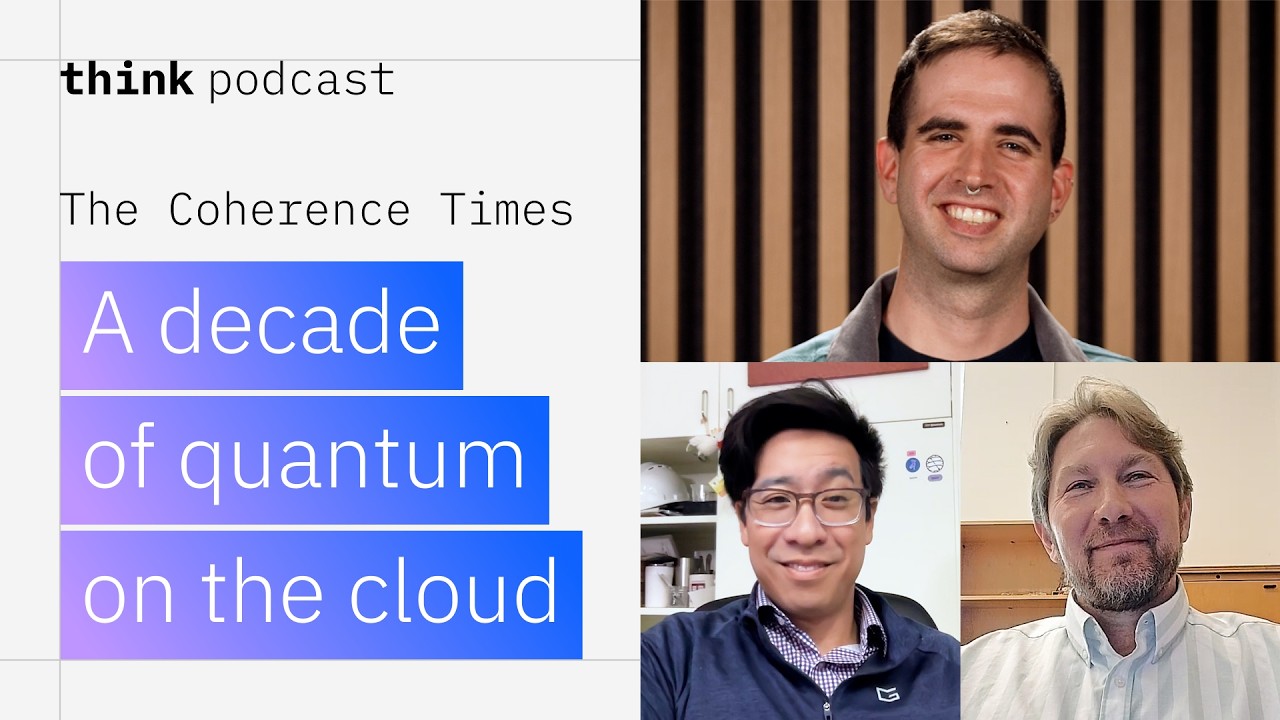
Video summary
Ten years ago on May 4, 2016, IBM made history by launching its Quantum Experience, a pioneering initiative that allowed anyone to access real quantum computers via the cloud for the first time. This decision was driven by strong community interest observed at the 2015 "Think Q" conference and aimed to democratize access beyond specialized laboratories where researchers previously relied on theory, manual hardware requests, and simulations due to risks associated with coherence times and accuracy. By bridging the gap between abstract physics concepts and practical application, cloud access fostered a collaborative ecosystem that evolved from basic experiments into sophisticated hybrid computing models integrating quantum processing units with high-performance systems.
Over this decade, the field has transitioned significantly from early exploratory phases involving small processors with only 5 to 17 qubits to today's advanced capabilities featuring devices like Heron and Nighthawk, which boast over 100 logical qubits. Key milestones include overcoming initial technical limitations through innovations in error correction, data validation, and the development of open-source software such as Qiskit, while solving fundamental problems like simulating hydrogen molecules and achieving quantum advantage in scientific simulations such as neutron scattering at Oak Ridge National Laboratory. This progress has transformed a niche experiment into an industry-wide reality with tangible real-world applications across chemistry and physics, enabling non-specialists to contribute to innovation by integrating these powerful tools into broader computational workflows.
The journey from 2015 to the present highlights how open access was crucial for community growth, driving the evolution toward fully error-corrected systems expected by the end of this decade while pushing the boundaries of what is scientifically possible. As the technology matures, it continues to extend beyond current developments into a future where quantum computing plays an integral role in solving complex global challenges through advanced simulation and processing capabilities that were once purely theoretical. The collaborative spirit established during these early years has laid the groundwork for sustained innovation, proving that sharing resources and knowledge accelerates progress far more effectively than isolated research efforts could ever achieve alone.
As we look toward this promising future, it is clear that quantum technology will continue to reshape industries and scientific discovery in ways previously unimaginable when IBM first opened its systems online a decade ago. The success of the past ten years serves as an inspiring testament to the power of open collaboration and shared vision, encouraging researchers, developers, and enthusiasts worldwide to subscribe to ongoing updates via platforms like Spotify or Apple Podcasts and engage with further resources available through official channels. Ultimately, this story is not just about technological advancement but about a collective commitment to exploring new frontiers where quantum mechanics meets practical application for the betterment of society.
Read the full video transcript
Welcome to the
second season of "
Coherence Times," where we bring
coherence to the tangled world of quantum computing
. This is your host
, Ryan
Mandelbound.
Every two weeks I will bring you stories
about how
scientists, developers, and
companies are turning
quantum computing into a
tangible reality. We will explore the latest
research and developments,
highlight
new advances in
the field, and see how
users are trying to
expand the uses of
quantum computing
to include practical,
real-world applications.
This year marks a
milestone in the history of
quantum computing. On
May 4,
2016, IBM launched the
IBM Quantum Experiment.
For the first time,
anyone can conduct their
own experiments in
quantum computing on a
real quantum computer
accessible via
cloud computing.
This event sparked a
decade of exploration, and
today there are hundreds of
thousands of users
who have performed
trillions of operations
on IBM's
cloud quantum computers.
Today I am pleased to
welcome two guests who have been
present almost from the beginning
. The first one is Jerry
Chow from IBM.
Jerry worked at IBM for 15
years and was part of the
team that put the first
quantum computer into
cloud computing.
Today he holds the position of Chief
Technology Officer
for
quantum supercomputing, and
is an IBM Fellow working
on the large-scale development of quantum computers
. I am also pleased to
share with you Travis
Hempel, director of the Quantum Science Center
at Okiage
National Laboratory.
Travis has been involved with these systems
since their inception. His 2017
research paper
with Keith
Brett was among the first to
use IBM's
quantum experiment. Today,
Okedge scientists are conducting
stunning molecular simulations
on IBM quantum systems.
I thought it would be
interesting to go back to the
beginnings of
quantum computing on
cloud computing, while being aware of
how much progress
we have made since then
. So, maybe we'll start with you,
Travis. What do you think about
taking us back to 2015?
How did you feel while
conducting a quantum computing experiment back
then?
Well, in 2015, the
situation was
very different from the experiences of
many today.
Access to quantum computers was
extremely limited compared to the
current situation. In
fact,
quantum computers were the
preserve of laboratories
that invested in building their
own quantum computers. If you were
lucky, you could
collaborate with one of these
labs and get a
chance to try
new things. But even those
experiments at that time
were fraught with risks
, and focused mainly
on developing the latest
technologies in the field of
coherence and accuracy, and even the
invention of pixel units.
Therefore, much of the work has focused
on theory,
modeling, and simulation.
This is what I spent most of my
time doing, trying to
think about what it would look like to access a
quantum computer,
and how to run programs
on these systems. I have
spent a lot of time
thinking about how to
scale up
quantum computers, and how we will
eventually reach sizes
capable of handling
extremely difficult problems.
But our understanding back then of what structures should look like
, and what
applications should be like,
was far less mature
than it is today. So I
would say that at that time
, in 2015,
much of our effort was
very exploratory, and
we were not yet ready to
move into
applications and implement them; it
was more like wishful thinking
about the types of software we
would like to
write.
Absolutely true. And Jerry, for
your part, how did it feel to be
responsible for owning a
quantum computer and allowing
others to use it? Have
you worked together before
? And how did you make it accessible
?
Yes. No, I mean, at that
time, I think it was an
area for
physics laboratory experiments
that we were conducting in
these
various laboratories. As Travis pointed out
, it was really about
conducting
experiments on these
devices. It was
about who you knew and the type of
academic collaborators you had, wasn't
it? I mean,
this goes back to my days before I
joined IBM at
Yale University, where we were
working with theoretical scientists who
wanted to conduct experiments
on a device the size of a cube or
two, right?
Even at IBM, when
we started developing these
devices, and while we were
improving them and participating in
conferences to present our
results, we were getting
questions like: "Can we
perform X, Y, and Z on this
device?" But we were
always in constant motion
, weren't we? We were
always trying to do
something new. We didn't have
enough time
to sit down and plan together
to develop a research plan,
submit a proposal, and obtain
funding to conduct this
experiment. Therefore,
we often had to
refuse
many requests, didn't we? We
simply couldn't go
in and try out
their ideas. Well, that was a
completely different time, wasn't it? The
whole thing was in
the hands of those who had
actual control over the
equipment in the
quantum physics laboratories. completely
. And then, Travis, there was
no interface
for these computers either, was
there? So, if
you wanted to conduct an experiment, you had to
write everything down
manually and tell the
hardware development team exactly
what you wanted to do,
right? What was the situation like?
I think the gap between
theory and experiment
was very deep at
that time,
partly due to the circumstances
described by Jerry, where I
needed to
invest in
experimental development, and that was a
full-time job. The idea of being able to
support programming, evaluation,
and applications simultaneously
, as you know, did not yet
exist. So, in
theory,
developing algorithms
and applications, you were
wondering, you know, what would
this
future design look like? Regarding
these computing platforms, there
was much less talk about
hybrid computing,
as well as about integration. The
focus was on the
idea that
quantum computers, as a
computational model, would allow us to
test
new algorithmic principles and solve
problems in innovative ways. And
of course, a
sudden and significant change occurred, which proved to be
enormous. But at that time
, this division was
very clear, and
the demands for progress that
we were imposing on ourselves did not
encourage this kind of
cooperation. Jerry, can
you tell me
a little about the debate
surrounding putting a
quantum computer on the cloud
and starting to provide access
to it?
Well, I think it was
part of one of our sessions
... I didn't know that
at the time, but it seems
there are cycles of being able
to suggest
new ideas and projects. Thus,
Jay and Mita, at the
then IBM Research Spring Strategy Meeting, floated the idea of
trying to make a
quantum computer accessible via
cloud computing
using the appropriate application programming interface
(API)
. We wanted to
obtain approval for the
project plan and its funding.
We thought about it from an
amazing perspective, as we were
constantly hearing from
everyone that our devices were
extremely stable, and looked
very good in terms of
coherence times. We
knew it was stable, so
we decided to find a way to
make it available to people. And so the
project began internally.
Then
how did it go from being just a
project plan to something that was
actually implemented? We
then had to draw up a
detailed plan of the project's layout. It is truly
fascinating that
initially we were aiming for
something too big to be published.
I think in the
first version of the schematics I was
trying to add a
13-bit or 17-bit processor,
right? But, as you know,
during this design process
, and what could be built and
what was possible, both in
terms of hardware and
software, we gradually narrowed down the
scope of the project
. Then we reached a
stage where we were able
to determine that this was a
genuine MVP product that we could
develop and deploy with confidence. And
we started implementing it, didn't we
? We had a team that
focused on the hardware side
, another team that focused on
software implementation and
programming, as well as a
user interface development team, responsible for
how the product is presented to
users.
All these
efforts had to be combined to complete and launch this
project in a very short time
. Tell me
if I'm right, but
if memory serves,
there was an
IBM conference in 2015 where
someone went up on stage and asked
: "If we had a cloud-
based quantum computer
, would
you use it?" Can you
tell me more about that?
Yes. Yes. It was at
our conference at the time, which
was called "Think Q," and
Professor Ike
Truang from MIAT had
gathered the attendees and asked them
if they were interested in
using such a
device. We had certainly
made
great strides in its development by then, hadn't we
? So, it was
really exciting to see
this huge endorsement, with so
many people raising
their hands to express
their desire to try,
explore and use a
capability like
cloud quantum computing
.
Travis, would you have raised
your hand then?
Oh, definitely. I think I would have been one
of the
first to do that because
this type of opportunity
was very new, wasn't
it? It was something we had never
seen before. So,
this was innovative and exciting
.
amazing. Now, let's go back
to launch day.
So, what were you
thinking, Jerry? As
you know, you are about to
release this thing to
the world. How did you feel
? Well, the
launch day was May 4,
2016. I remember we turned it on
very soon,
around midnight,
and we started to see some of these
jobs coming in.
That was around the same time as the release of
Crest, wasn't it? So,
articles about him also began to appear
. We
knew the platform was working, did
n't we? Because we conducted a
media tour beforehand
to showcase the
demo version, and to demonstrate
everything. I worked there, you
know, on all sorts of
tasks that we had
. But when I
started to see the
real work begin to flow
, it was a little funny
. Jay and I were
monitoring the
control unit, making sure that
everything was working and that everything was
going well. I think we
stayed up
for hours after
midnight to make sure everything was
working properly.
But, in the
few days following
the launch, we started to see
a lot of people
using it, talking about it, and
tweeting about it, and that was
very exciting.
Then Travis, when did you first realize
that this thing had
become available, and what
was your first reaction?
I think, as Jerry said,
that was important news for the
community. I don't think we
all realized at the time how
important this radical
paradigm shift was
. But within about a
year,
people began talking about
using IBM's
quantum computing systems
for testing, evaluation,
measurement, and demonstration.
I mean, by
everyday standards, these might seem like
tiny chips to
most people. But
the truth is, it was the
only thing that needed to be
obtained.
This also contributed to understanding the
practical aspects of
trying to program a
quantum computer, and building a bridge over
that gap
we talked about earlier. I
truly believe that one of the most
important benefits of this
whole experience was that
shift in the
intellectual paradigm, and the unification of the
community’s efforts around the question: What does it
mean to own
and use a quantum computer? What
early work did
your team do back then,
and how were you working to
bridge that gap
using these
early
5-kilobyte cloud systems?
At that time,
the focus was largely on
understanding the language of
quantum computing and overcoming the
obstacles to its adoption. Of course,
people were aware of the theory of
quantum computing, but the rules for
programming a
quantum computer, the tools
needed for it, and believe it or
not,
error correction and
data validation, all of these
things had to be
built up while we were in the
process of using these
systems. Much
of our early research at
Okedge focused on trying to translate
concepts
previously used in
quantum computing theory into these
practical applications.
I believe one of the best
problems solved
in the quantum computing community
is the energy of the
hydrogen molecule, and I believe
it is available. It could be
implemented on a relatively small number
of
central processing units,
but the tools needed
to manage all that
specialized knowledge,
chemical knowledge, as well as the
quantum computing interface that had to be
built, were
complex. And the people who
built it were not in
Okedge, at least, the same people
who built the
hardware system. And so
we found ourselves in a
vicious cycle of feedback
. Perhaps one of
our early experiences is understanding
how to provide feedback
to help the
next generation of
devices and interfaces
progress. So I think
that in the early days,
a lot of
attention and effort was directed towards
this aspect. Simply put,
we documented what we accomplished,
explained the challenges
we faced and how we overcame
them, and then passed it on to
future generations to make
these explorations
largely repeatable. That's definitely part of it
. The
other part was trying to
prove the validity of our position all the
time. As you know,
once you get hold of this
quantum computer,
you will do something that will make all the
time and effort
spent so far
worthwhile.
These early demonstrations played
this role. It has shown
that quantum computers have
scientific importance, not only
because of their
computing capabilities, but also because they are
used as tools for
other types of
exploratory discovery processes
. So I think that was on our
minds as
well. Despite
our great enthusiasm,
we know that the long-term success of this
program, this
quantum computing campaign,
depends on
how we take advantage of this
opportunity. Jerry, as
you know, you have this
emerging research,
the researchers who are
facing these challenges
, and so on. In those
early days, how do
you respond to the community that
writes this research,
and how do you begin to develop the
program to interact
with them? Yes. So, I mean, a
big part of the
beginning was about
developing this community:
working with them,
listening to
their feedback, figuring out what they
were using, and in
many cases, even
connecting with people to
work with if they
had certain problems that weren't
working well.
Much of this contributed to
our design of how to program
these devices.
Almost a year after launching the
Quantum experiment, we
unveiled KissKit, an
open-source software toolkit for
programming. And from here
we were able to obtain
another set of, as
you know, to begin
this development journey for developers
, to program
quantum computers.
And so you began to see, as
Travis mentioned,
different layers of people
who were not
hardware specialists,
but who gained
access to
different parts of the
ecosystem, and saw where
they could
best get in. Thus, we moved
from a basic physics experiment
to presenting it in an
elegant way, through an
application programming interface (
API). Now you have begun to
build this
rich software package and
software ecosystem that should
ultimately be geared towards
applications. We've broadened the
scope of work to include a
larger number of people who
can now interact
with this, haven't we?
For us, a
big part of it was seeing
this openness,
listening to what the
community was looking for, and starting to
incorporate that into both the
software and,
where possible, improvements
to the underlying hardware and
hardware developments,
in terms of, for
example, a larger number of
cubes, etc. Was
there any research,
work, or anything that
someone did on the system that made you
feel that it had
taken off, that people
were doing what you
hoped, and that it was pushing the
field forward? I
mean, I think you know
that a lot of that has
always been about
testing the performance of devices,
determining how well they
perform, and showing some
things about their
stability and ease of
use. Therefore,
those experiences have always been
special to me.
There are other
unique experiences as well. We started to
use it to study
some kinds of
chemistry problems, like what
Travis mentioned, even in those
early days when
people started to study the
hydrogen molecule or something like that
, right? To program a
variable quantum analyzer into a
simple five-
or sixteen-bit quantum processor,
we began to see that it was possible.
Good.
Understood. Solving
inverse quantum equations is one of the
early applications
of these algorithms,
used to solve
chemistry optimization problems
, thus demonstrating the capabilities of
quantum computing, isn't
it? Well, then
Travis, you know, pointed out
to Jerry about
performance measurement and
early chemical experiments, and
I know that most of
your work back then
focused on that
particular aspect. But what
really surprised me was how forward-looking
some of the early research was,
focusing on things like: "
How can we integrate this
technology into
high-performance computing?" Even
I was genuinely surprised that your
team was thinking from the
beginning about how to
use this technology as a
real solution to
science problems. Can you
tell me more about
how you thought back then?
Yes, the
Okeege National Laboratory has long been home to some of the
world's fastest supercomputers, and this is
generally due to our
forward-thinking approach and
our search for tipping points
in this technology.
Quantum computing has always been a top priority for
us, because we
know it has
strong theoretical reasons to have a
huge impact. But
the question of how to balance the
capabilities of
quantum computing with the latest generation of
traditional high-performance computing technologies
remains a hot topic
even today. In fact,
this is what we continue to work
on. At that time, it
was much more unclear what
quantum computing systems would look like and how they would be
integrated. I think that at that time we were
relying heavily
on the GPU acceleration model
for building supercomputers
. I
clearly remember that I was advocating
for a quantum
processing unit
(QPU)-accelerated architecture, where I would
replace the graphics processing unit (GPU) with a
quantum processing unit (QPU)
everywhere. Regardless of
infrastructure,
technology,
compatibility, or even
cost, right?
This must be the
best way. I would
say that over the
past ten years, things have shifted
from this perspective
to what I consider a
more balanced perspective on
how quantum computers and
high-performance computing work together.
But it was important
for us to try it
at that time because it
was the latest
technology. As
you know, this was
our understanding of computing and its
available limits.
I believe that access to
this technology was a game-
changer,
because it clearly showed us
what the
additional costs are associated with
putting things together.
What tools are needed for
integration? And perhaps
unexpectedly, what
language barriers do
people face when
trying to do this? We are still
educating ourselves
in the field of high-
performance computing to make sure that we
understand what it means to talk about
quantum computing in
this context.
Now, I really hope to
talk about this in detail
. Well, maybe I could
ask Jerry this question
and ask him the
same question, which is, you
know, at that time -
I mean, today of course
this is starting to take shape
in society - the importance of the
quantum supercomputing model, and
the need to build these
things together. But were you
thinking about that too
at that time? Or how did
this topic
take shape as a dialogue? I mean, it has
always been a
direction we have been guided by, and
Okedge has been a
great user, in terms of his ability
to take advantage of these
types of devices, and
to study how this
type of
hybrid architecture has evolved. Let's be
realistic too, at
that time we were working
on these devices on a
limited scale, devices
we were running on
simple experimental problems, weren't we
? So, for me
, the main motivation
was how to put the devices
on a path of
continuous improvement and push them to a
level beyond what could be
achieved by
traditional methods. A
large part of that was the
continuous updating of
our hardware, as well as
following a roadmap that
eventually enabled us to
surpass 100 kilobytes for
our processors. I believe
this has brought about a qualitative shift
in guiding society towards
expanding the horizons of what can be
achieved in the field of
quantum circuits,
at a more advanced level
. So, when we talk about
society, I think it's
great to have this two-
part dialogue, isn't
it? As you know,
Travis and Jerry,
your teams are trying to shape the
future, but
you can't do that unless
there are people who have
access to
these systems and know
how to use them.
Okay, let's start with you,
Jerry. Initially,
these systems were offered
free of charge and openly to
everyone. So why was it so
important that people could have
open access to it? Because this
is the best way
to develop this type of
system, isn't it?
The term "
quantity" is clearly a barrier
for people, isn't it
? We don't want
people to be immediately put off by it. But
the main idea was that we
looked at it
from the perspective of the entire Kiskit community
, and how we could
encourage more
people to successfully run the first
"Hello
World" program on a
quantum computer. And if
they wanted to do that, we wanted to
make sure they were able to do
it, and that wasn't
limited to a subscription fee
, but was part of their education and
understanding of
quantum computing. And then
going deeper, we have seen
tremendous growth in the
use of KisKit and our community
, especially with regard to some of the
core capabilities we provide. That
was
extremely rewarding. Even today, we still
offer
free access to our latest
devices, as they
remain an excellent starting point for many
users.
So, Travis, you
know, as you're forming this
team at the Quantum Science Center
, how do you encourage your
team to start working
on programming
new quantum computers on the
cloud computing model?
How do you build a team around
this topic and develop
individual skills,
etc.?
correct. It is certainly a
very important priority
, not just for the
Okedge Center, but I would say more broadly
for the Office of
Science in the Department of
Energy. They recognized
early on the value of access
to
quantum computers,
precisely for the reasons
Jerry just mentioned. You
want people to be
innovative. You want them to have the
tools
they need to test
those ideas, and you want to
create that community,
that cycle of feedback
and dialogue. Therefore
, at Okedge, we have
already started a quantum
computing user program
as part of the
Leadership Computing Facility
to enable people to
access these
computers. IBM was
our first partner in this
in terms of providing access
to their hardware so that
people could test the
software. What distinguished the
QUP program, as we call it,
was our ability to target
this user base
around applications for
scientific purposes.
Chemistry,
high-energy physics,
materials science, and
nuclear physics remain
priorities. What was
interesting at the time was
that these
communities were
traditionally early
adopters of
high-performance computing technology
, as they had a background
in quantum mechanics and
quantum physics. Therefore,
the ideas of accessing
these systems, overcoming
language barriers, and
enabling the development of tools were a
ready-made set
of people.
Through the program, we have found that we have been able to
develop a
group of
scientific end users
capable of supporting and
maintaining these ideas
. I can say that they have
grown along with the
systems themselves,
reaching 100 billion bits
and more. They serve as the
first line of defense in learning
how to use this
technology.
This is a concept I've previously
brought up in the podcast,
but I really feel it
after talking to
many people: we're
always talking about
quantum utility, or
quantum advantage, right
? Any benefit
people derive from
quantum computing. But it seems
that since its emergence on
the cloud, there has been a
quantum benefit, because
researchers have been able to
do things they were not
able to do
before. I mean, and it sounds like you're
saying the same thing, that
these early adopters are
very excited to get this
technology so they can do the
work that
excites them. Do you feel
this enthusiasm, and do you agree
with this opinion?
Yes. Therefore, I say that
the discoveries
made possible by access
to this technology,
the ideas, the development of
methods, numerical analysis, and
normative evaluation have all contributed
to enriching the
scientific community. As you know, nothing
attracts crowds like
crowds. This in turn
propels people forward in
a way that we were not enthusiastic
about or focused on
before we gained
access to these
systems on a large scale
. I think there are
subtle technical differences that explain why it is
necessary to limit the benefit and
advantage to matters with
economic impact,
etc. But I
think your point is
correct. The ability
to run
quantum computing programs in a
tangible way is extremely
important, and I think we are still
gradually discovering its benefits.
Understood. So, we're not announcing the
advantage of
quantum computing in this
podcast episode right
now, but it makes perfect sense that
this
excitement, acceleration, and refinement of
research will happen once
access to these
systems becomes easier. As
you know, it was clear
how important it was to read
research, and perhaps...as
you know, IBM's job is to
respond to these
needs,
to respond to this
growing enthusiasm,
more research,
and so on. So, how do we
jointly develop our systems in a way that respects the
needs of these
researchers?
Yes, of course.
I will address only one aspect
, which is the
societal aspect in terms of
the value provided to
society. We see that in
more than 5000 research papers
, don't we? Which were
produced using these
capabilities. But
also, a large part
of enabling this type of
research comes from our response
by putting forward
better and better treatments. Therefore, a
large part of this
joint development lies
in identifying needs
in terms of
readability improvements, or improvements in the
accuracy of
basic binary cubic gates.
So, we always make sure to
update our devices, right
? We added, for
example,
dynamic circuits, to be able to
create more
adaptable circuits, and to expand the range of
circuit types that
can be operated. So,
we always listen to
your feedback, don't we
? From a software perspective
, the software was designed to be
scalable, with a
focus on both
scalability and performance,
right? This has been a
major strategic shift for us with
KisKit, especially when
we launched version 1.0
a few years ago, hasn't it?
We needed to make sure that it
evolved from just a
software development kit to showcase a 5KB processor for
the first time,
to ensure that it was improved to a
level that would benefit Travis and
others who use
these processors
extensively beyond
100KB, right?
Well, as you know,
this kind of
feedback from the
ecosystem, which
stimulates usage and drives
new discoveries,
is what we're
all focused on at IBM.
What excites us
all is
precisely this scientific aspect. I mean,
after ten years, we've reached
this point where
we're pushing the boundaries of possibility
with these
cloud-based quantum computers, and we're
actually entering an era where we've declared the
viability of
quantum computers: they're capable
of doing things that
traditional classical simulations can't
. We are
approaching the
point where
quantum computers appear to be
publishing research that shows
circuits testing the limits of
classical computing capabilities. Okay,
Travis, how does it feel to
look back and see that we've
come to
this point, as a
member of a team that operates like this
? It's very
easy to look
back and see the path
that brought us here.
Well, that's the benefit of
looking back. If
we go back to 2015 and
2016, and ask: What
will things be like in ten
years? I don't think I could have
predicted
it accurately, because the value of
this collaborative development
, the feedback, the
ecosystem, and everything we
were focusing on here,
was aimed at pushing the
field in a direction that was
difficult to predict.
We are now at a stage
where quantum computing is moving
from being just an
experiment to an aid
in other experiments, isn't that
right? As a tool in itself
, it will likely require a
great deal of
work to refine and perfect it
, to get it
to a stage where it can be
widely adopted. But we are already seeing it happen
, and that
feels great. Because you know
how difficult it is to adopt these
new ideas,
bring these people
together, and develop these
tools, and despite everything I've
suffered over the
past decade, I say it's all
worth it,
considering what we're seeing
today. Before we talk
a little about the future
and integration here, I would like to
ask if you could
tell us about the results of
Okedge’s recently published research
on
neutron scattering, which
roughly defines what I just
explained, using
quantum mechanics not just as an
experiment in itself, but as an
aid to it.
Can you give us a
brief overview of what happened and why it
was so exciting?
Absolutely. I would like to
mention that this work was
sponsored by the
Quantum Science Center. One of the
National
Quantum Information Science Research Centers
of the Department of
Energy, in partnership with
IBM and Purdue University
at Los Alamos, as well as
several
other institutions,
aimed to verify the
possibility of using
quantum computers
themselves for this purpose, i.e.,
creating a scientific simulation. I do
not mean here to evaluate the
performance of the quantum computer
, as we have been doing that
throughout the past decade
by using
scientific problems to evaluate the efficiency of the
quantum computer's performance.
What's new in these
latest results?
This is called
quantum simulation evaluation using
neutron scattering experiments. We are
now actually running a
simulation of one-dimensional material models
on a
quantum computer.
This was at IBM's headquarters in
Boston, if
memory serves. Then, by comparing
that simulation, which
relies primarily on
time dynamics
to calculate what is called the
dynamic structure factor, with the
neutron scattering experiment
carried out at Okage's
home neutron source
,
one of the brightest
neutron sources in
the world, which
directly measures the dynamic structure factor of scattering, we find that the
simulation and
experimental results match
perfectly, which strengthens our
confidence in both the
quantum computer—
something we had anticipated
—and the model
that the quantum computer represents
, and the
dynamic structure factor that it
calculates, which is
in fact similar to the
model in the
experimentally tested system.
Yes, as Richard
Feynman stated, nature is
not classical; it
needs something quantum to
simulate something else quantum
. That's what we're already seeing,
isn't it? We have
experiments that conduct in-
depth quantum research into the
internal structure of the
molecule, and we have a system
designed to simulate the
quantum behavior of the molecule. So, it seems
like it is actually happening
. This is an example of it
happening. It's truly amazing
. correct. completely
. correct. I would
say that the
added benefit is that we know
how quantum computers will evolve
in the future.
We are confident that as it
becomes more complex, as it
gains access
to more complex materials
, and as it looks at more precise energy accuracy
, all of these things will become
within our grasp
. These are things that are
currently beyond the reach
of our
traditional methods, so this is very
exciting.
I mean, Jerry, you
know this is a
challenge for you, right?
How do you feel when you look
at that research? Now,
our mission is to expand, is
n't it?
I mean, that's the
basic idea, we have plenty
of time ahead of us.
Now, it
really comes down to how we
deal with these
real problems,
specifically in
areas where we know there is no
chance of even looking at them
using
conventional approximation solutions or, as far as we
know,
only conventional computing methods. This,
in my opinion, is
precisely why there is a
public and
transparent roadmap outlining our destination,
both to unify our efforts
internally regarding the
actual technologies
that need to be developed, and to
serve as an indicator to the community of what
is coming, and how we
can begin to
optimally plan for
the problems we want to
study at these
different stages,
such as the next Nighthawk release
increasing the
number of gateways it
supports, or when we get,
for example, to our fault-proof
systems
that we plan for
later in this decade.
As
you know, I think
everyone has seen the
roadmap, but
where are we headed? And how will
we continue to achieve our vision for
quantum computing in the
cloud over the
next two years? Okay, so where are
we now? Today we have
amazing devices, with
capacities exceeding 100 cubic units,
namely the Heron and
Nighthawk devices. These devices operate
electrical circuits with a scale of up
to thousands of gates, even
more than 5000 gates, and
by using
error reduction techniques, we
obtain accurate results.
We are currently conducting several
experiments using
these devices. For
example, the neutron scattering experiment has been successful
,
in addition to some
recent research that has
pushed the boundaries of what can be
done with these types
of devices. Therefore,
we will continue this phase
where we will make improvements
to these devices
available to our customers in the
cloud, and we will increase the number of
gateway operations. So, we
will reach more than 7000
gates. We already have
over 10,000 gates,
and over 15,000 gates in the
next few years. But at the
same time, we are
already focusing on a quantum leap
in what we can deliver
near the end of this decade,
namely a fully error-proof quantum computer
. This quantum computer will be
error-resistant on the
scale of 200 logic units in
our Starling architecture. This
computer uses a new
error-correction code that we
developed, which is
extremely efficient. We aim
to be able to
operate circuits with up
to 100 million gates,
right? Therefore,
we will open up new horizons
for algorithms
and applications that
scientists have
theoretically proven over the years.
Well, however, the
connection also to the type of
exploration and
heritage feature offerings that
we are trying to see and
actually enable through the
short-term roadmap is
amazing. And then I mean,
Travis, where does
your business go from here? I mean,
when you hear that you might be
able to
achieve an
error-proof quantum computer in the next three years,
how does that affect you? What is the
roadmap for
actual research?
Yes, this does indeed affect the
future of research in
many positive ways. On the
one hand, it takes us to a
fault-resistant model
where I can start
recruiting users who
know more about the details of
the algorithm than they
know about the details of the
quantum device.
Therefore, the separation of
interests that
Jerry talked about earlier becomes more
apparent, and the benefit of
this lies in expanding the base of
users who are interested
and willing to adopt this
technology. I think
adoption will
eventually become an important factor
in all of this. But in
addition,
you can start to define
these boundaries, these
problems that we
just mentioned we cannot
solve by
traditional methods at the moment. Therefore
, we know that we can
surpass certain points, and
this in itself stimulates
investments in
other types of devices
and experiments. I will give you a
great example of this
with the scattering of neutrons
in Okedge. We are
currently building a new generation
of neutron scattering facility
called
Target Station II,
which is specifically designed to
provide us with
access to
low-energy neutrons
that can explore
finer details in these
materials. To complete this,
we need plans related to
quantum computers
and their applications that
can analyze the
signals and fingerprints
resulting from these
experiments. You can imagine
that with many
other types of devices
, such as microscopes, cameras
, and others.
Quantum computing and
the existence of these maps
that point to this,
as I say, the
quantum advantage in this
context. Good. This
points to a promising future for
quantum supremacy in
scientific discoveries.
It is very impressive, and
I think it is
technically exciting. It also stimulates the
scientific community,
increases its adoption,
and frankly, expands its integration
into our
scientific curricula. I think
this is a great outcome for the
field. As for
you, as the person in charge of
managing users and
witnessing these changes,
I would like to know how you build a
team that is not limited to
experimental
or theoretical physics, but includes
chemists and researchers who
use quantum mechanics in their
research. How do you know,
for example, what a
listener should
do if they want to work
in the field of
quantum computing? And how does he join a
team like this?
That's an excellent question, and
we do have some experience in
this area on the side of
high-performance computing
, which as a society is going through
generations of new architectures and
hardware acceleration, which can sometimes
be revolutionary
. I think it's
not as
chaotic as we're
currently seeing,
partly due to
tools,
computational models, and the like.
But at the Center for Quantum Science
, the
Quantum Computing Users Program, and
other parts of the
National Laboratories,
we are essentially building these
teams from scratch to
focus on these
scientific problems. The
value of their expertise lies in
their ability to now make
tools available to the
scientific community, such as
open-source software,
libraries, and
datasets, all of which make it
easier for others
who wish to participate.
If I had an
application library that I developed
specifically for
quantum computing, and I published
its interface in an
application library so that a
computational chemist could
use it, I might not be the one to
discover the
next breakthrough in
chemistry, but they
would be able to use
that tool or library
to perform
simulations. This of course applies
to many
different fields, and
goes beyond scientific research to include
industry and
other applied fields.
Therefore, I believe that part of the
challenge going forward
lies in supporting and sustaining
this infrastructure
that we have built, with the expectation that
people will increasingly need it to
encourage its adoption.
We are nearing the end
, but Jerry, I want to
hear from you about how, as
someone who cares about
these systems, you support and help build this
growing community
. Yes,
I mean that this is a big part
of our current focus on
quantum supercomputing. We are seeing a
strong trend towards what we call "
high-performance computing specialists". There are
many people at
Okeidj and other parts of the
U.S. Department of Energy who embrace a
supercomputing mindset as their
area of expertise. How can we ensure the
integration of
quantum computing into this
ecosystem? Well
, a big part of
our approach with Keyskin has been to
develop the software package
in ways that make it
easy and intuitive for
these users to use.
In addition to providing
appropriate coordination and resource management tools.
We want to speak the language of
high-performance computing users, and this will
enable them to access
it as quickly as possible. I see
this as similar to what
happened with graphics processing units
(GPUs), which were
initially marketed for
vector graphics and gaming.
But who contributed to
its development to a
higher level? Users of
scientific computing, such as
those working in
national laboratories.
Therefore, we want to see this
same enthusiasm driving the wheel of
science using these
devices, and we are working
with them to achieve that. I would like to
ask one last question
, which may be more
interesting. Well, I usually
like to ask
what excites you most about
the future, but
on the occasion of the tenth
anniversary, I would like to hear
your look back at the
past ten years. Let's start
with you, Jerry. What is the
biggest surprise? What is the
biggest shock you
have faced now after everything we
have been through?
What is the biggest surprise?
I mean, everything was a
surprise to me, wasn't
it? I thought we would make a
big splash by
posting it online and
attracting people's attention
and enthusiasm. I never imagined it would
change
almost an entire industry. I assure you
there is an entire industry dedicated to
quantum computing,
isn't there? There are
startups, software,
software integrations, and an
entire ecosystem of
economic entities
that all rely on
quantum today. Seeing that
, you know, it's
certainly gratifying to be in such a
prominent position as leaders in
this field at IBM,
but also to have such
great relationships with
National Laboratories and
with Travis at Okedge is truly
rewarding.
amazing. Okay, Travis,
I'll ask you the same question
. As you know, looking
back, I've been here
almost from the beginning,
managing the users. So
, what was the thing that surprised you the most and that you didn't
expect at all
at that time? I had a
conversation with my wife
. That was over 10
years ago when we were
first talking about
quantum computing, and she asked me,
"Well, what if it does
n't work?" And I think she
was healthyally skeptical on her
part, and I said, "
Okay, we're not going to give up."
I think the
past ten years have proven
that; getting
to where we are today has been a
huge challenge. I believe
that the enthusiasm and excitement
that
society enjoys is not just a
passing and temporary phenomenon,
but something real, something
contagious, and something we discover is
constantly growing stronger.
So I think this is the
biggest surprise
for me. It's easy to
look at this as
just a job, isn't
it? As a
professional scientist, I can say that
there is
something very inspiring to the
human spirit that pervades the
quantum computing community right now. This makes me incredibly happy
.
amazing! Thank you
all very much for this
conversation. It was
truly enjoyable, and we thank you
very much for your experience, and
we wish you another ten years
and more! Thank you
very much.
Thank you very much.
Absolutely. Thank you all. This
concludes
this episode of the
"Coherence Times" podcast. If
you enjoyed the conversation,
don't forget to subscribe to
whichever platform you use to
listen to
podcasts. Share
your opinions in the
comments section, and share
the episode with anyone interested in
quantum science. You can
listen to us on
Spotify, Apple Podcasts and YouTube
via the IBM Research Channel.
For more episodes,
resources, and in-
depth analysis, please
visit our website
ibm.com/thinks/mpodcasts. This is
Ryan Mandelbomb. Thank
you for listening,
and remember that the future of
quantum technology is not limited to what
you are building now.