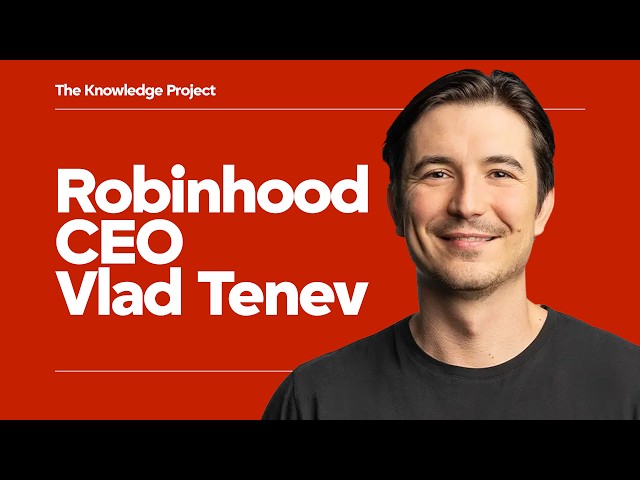
A Conversation with Robinhood co-founder and CEO Vlad Tenev
Watch on YouTubeVideo summary
Vlad Tenev frames the GameStop incident not as an admission of guilt but as a unique crisis where standard risk management was distorted by viral narratives that falsely accused Robinhood of colluding with hedge funds or acting under White House pressure, noting that sensational falsehoods often overshadow boring truths. While he recalls only a chaotic morning filled with angry user calls before trading restrictions were lifted after one day, the company faced far more significant challenges in 2022 when macroeconomic headwinds like inflation and high interest rates caused an eighty percent drop in sector valuation. To survive this downturn, Robinhood aggressively diversified beyond its zero-commission stock trading roots by launching "Robinhood Gold" for cash yields and a highly successful retirement product that now serves over 1.5 million accounts across eleven different business lines.
The company's operational philosophy is built on core values of safety first, lean discipline, and rewarding high performance rather than organizational size, with leadership actively fostering early-career talent to prevent generational disconnects while using green-yellow-red status systems in meetings to track goals effectively. Tenev highlights the firm's advanced adoption of artificial intelligence, where agents handle best-in-class customer service by deflecting tickets and engineering teams utilize tools like GitHub Copilot; furthermore, the company is pushing AI evolution from read-only data access toward non-read-only actions that allow models to execute tasks such as processing refunds directly within backend systems. This technological edge extends to their approach on news updates and sales conversions, where they leverage a mathematical superintelligence model named "Aristotle" trained on synthetically generated, machine-checked data rather than internet scrapes to solve complex problems like unsolved Erdős questions at the International Mathematical Olympiad.
Beyond technology, Tenev addresses critical market inequities by aiming to give retail investors access to high-growth private markets in AI and space tech through tokenization outside the US or traditional 401(k) structures domestically, thereby correcting a system that previously shut ordinary people out of ownership opportunities dominated by giants like SpaceX. He explains how Robinhood's revenue model relies on interest income, lending fees, and efficient financial products rather than transaction commissions, while its simple three percent cash-back credit card succeeds because it offers an uncomplicated default option without requiring complex points optimization strategies. This integrated approach creates a flywheel effect where credit card users deposit funds into brokerage accounts to increase engagement across wealth management tools, allowing the company to close the gap between network rebates and customer payouts while avoiding the legacy banking practice of penalizing consumers for moving money out of checking or savings accounts.
Ultimately, Tenev attributes Robinhood's rapid growth to strong word-of-mouth driven by peer-to-peer reviews, which keeps acquisition costs significantly lower than traditional credit card companies that rely on expensive marketing and large manual headcounts; replicating this model requires a painful structural shift involving massive investment in automation and underwriting capabilities. Regarding mortgages, the company prefers acting as a network allowing competing banks to offer the best rates rather than immediately securitizing loans or using tokenization, believing they must first meet legacy institutions where they are before transitioning fully on-chain over the next five to ten years. Tenev defines personal success through creating significantly more value for society than oneself, aiming to increase ownership across private and public sectors so that individuals have "skin in the game," a strategy he believes will lead to smarter wealthier citizens and foster optimism about capitalism's future stability.
Read the full video transcript
I want to come to GameStop for a moment.
You need billions in collateral. You
make a decision to restrict the trading.
How did you make that decision?
>> It was a situation which had no
precedent.
>> The narrative that came out was you were
in bed with hedge funds.
>> A juicy falsehood is more powerful than
a boring truth.
>> What did you think of the movie Dumb
Money when you watched it?
>> I didn't see the entire thing, but I did
see the clips that I was in.
>> Wait, come on. You haven't watched it? I
think what most companies suffer from is
>> I want to come to GameStop for a moment.
So, take me back to the moment your
phone rings, you need billions in
collateral, maybe set the scene for us,
and you make a decision to restrict the
trading. How did you make that decision?
>> I have very fuzzy recollection of that
time. You know, sometimes you talk to um
>> uh
>> trauma victims
>> or like uh
I I've heard a lot from people that have
many children uh including myself. I
have more than one. It's like uh uh my
wife says, you know, it's very the
pregnancy and the child birth very very
painful, but for some reason I don't
remember it. And then that sort of like
uh evolutionarily g gives you the signal
that you should do it again. Um, and I
think we're doing a Yeah, I think um I
was at this IPO round table at the SEC
uh about making the IPOs great again and
with Rob with Robin Hood Ventures were
taking that fund public. So, we're doing
another IPO and I joked that um yeah,
it's kind of like that the IPO process.
I remember being painful and I didn't
like it, but I don't really exactly
remember why and now I kind of want to
do it again. Um
but yeah, that's a big aside that has
nothing to do with GameStop. Um other
than yeah, that that was a very
challenging time. It was towards the end
of COVID and I felt like everyone was
going a little bit crazy. They'd been
cooped up at home for about a year
without much humanto human interaction.
I think from a crisis management
standpoint, it was very difficult to
deal with because we're doing these like
conference video calls with all these
different stakeholders. The regulators
weren't in office and so um yeah,
basically what happened was we got this
like automated file in the middle of the
night and it had big numbers on it,
right? It it had big numbers that kept
changing and uh it was a situation which
had no precedent and um you know we we
had to make a tough call to
uh put GameStop and a bunch of other
companies on position closing only which
basically meant
uh you couldn't open up new positions
take on more risk uh for a period of
about one day. So, wasn't even that
long. But because there was this
narrative that had taken over social
media, this like viral narrative that it
was the the retail investors taking down
the hedge funds and we were kind of the
tool. um people wanted to put it was
like a good versus evil thing and and I
think what was just um
what would have at any other time for
any other stock been kind of an
innocuous riskmanagement decision to
control our internal risk turned into
Robin Hood's on the side of the hedge
funds colluding against the the retail
investor and I think the fact that the
name of the company was Robin Hood made
this like a juicy false narrative to uh
that that continued to go viral. So, I
remember in the beginning of the in the
middle of the night when I woke up, my
phone was basically unusable
because it was like those videos you see
of what happens if a Kardashian turns
off uh do not disturb on their phone. It
just is a constant buzzing thing. Um, so
that that was that was my morning. I was
like, the phone is completely unusable.
I can't even get on a Zoom call because
there's just random people calling me uh
telling me to to turn it back on, you
know. Uh just to give people context a
little bit um if they're unfamiliar with
the situation. The narrative that came
out was you were in bed with the hedge
funds because the hedge funds were
trying to close their short positions on
a stock that was basically going
parabolic,
>> right? Um, and it was a unprecedented
situation. I've never seen it before
anyway. I I can't. But you also
>> It's never happened before.
>> One of the interesting details of the
story that I don't think many people
know is you had given GameStop shares to
people when they signed up for Robin
Hood, didn't you? Like
>> that's absolutely right. So, you can
make the argument that we kind of
started the whole thing. you know, every
everyone if if you were joining Robin
Hood in the year 2020 leading up to the
whole GameStop thing, uh which by the
way, a lot of people joined Robin Hood
that year, GameStop was one of the
collection of free free stocks that was
given to customers.
>> So, yeah, a lot of people, you know,
just came in, get got their free
GameStop share, and maybe they weren't
engaged that much, but then when they
saw GameStop going up, suddenly those
shares were were worth a lot of money.
What's one thing the world still gets
wrong about that time?
>> I mean, I think the major thing is just
that Robin Hood colluded with hedge
funds to shut down trading. There was
also another false narrative that I
think is funnier. I uh but yeah, Sequoia
had to refute this. Someone put on the
internet that uh the White House
actually called uh Sequoia Capital, one
of our venture capital investors, and
got them to pressure us to shut down
GameStop. So, um yeah, that that was a
particularly funny one. But if you look
on Reddit, that had like thousands of
reposts. Um,
so yeah, I think that I mean we don't
really have any business with with hedge
funds. So the the idea that somehow a
hedge fund would collude to have us shut
down trading of a of a stock um I mean
always seems silly to me, but I think
what we learned is
a juicy falsehood is more powerful than
kind of a a boring truth.
>> Yeah. And you can't fight story with
facts. It's like so weird.
>> Yeah.
>> Like once a narrative gets any traction
whatsoever. It doesn't matter how crazy
or false it is, facts do not tend to
refute that. You see this in politics
all the time, right? Once somebody tells
a story and the mind share goes to that
story, no amount of evidence or data
will ever overturn that story and and
they'll believe it for like 20 years.
>> Yeah.
>> It's crazy. Uh, one of the byproducts of
that though is you got to talk to Mark
Zuckerberg and Daniel Ek. I'm curious
about like what you learned during that
period of time um from those two. I
think Daniel had talked to you about
like going through a PR crisis or
>> Oh, yeah. Um, actually I didn't talk to
Daniel at that point, but I did call him
when he was um
dealing with his Joe Rogan thing.
>> I don't know if you remember that.
>> Oh, totally.
>> Yeah. like Joe Rogan was in the process
of getting cancelled and uh I mean
Spotify was getting immense pressure
from both sides, right? Do they
deplatform Joe Rogan or
>> Yeah.
>> do they piss off all the people that
want Joe Rogan to be deplatformed? Um so
that that was probably I mean Daniel's
I'm sure dealt with his share of of uh
crises, but that was probably his
GameStop moment. So yeah, I called him
to pay it forward to to offer whatever
support uh I could have and and
hopefully that was helpful to him, but
he's actually um yeah, probably wiser
and uh and better than me in these
things. So I don't know if he needed it.
But yeah, at that time Mark Zuckerberg
called me and Elon Musk called me, Mark
Beni off called me and uh a nice
positive side effect was these people
probably wouldn't have cared about
little Robin Hood at at the time and
suddenly I think uh I got to talk with
these business magnates that have uh
have built massive companies and they're
giving me their perspective on the whole
situation. One of the things that I
loved that you did during that period of
time was you went on a clubhouse with
Elon. I don't know if you regret that
now. Um,
>> no, no, I thought that was probably the
the best uh media appearance of the week
for sure. Not saying much because I I
had some bad ones, but
>> what did you think of the movie Dumb
Money when you watched it?
>> I didn't see the entire thing, but I did
see the clips that I was in. And
>> Wait, come on. You haven't watched it?
Um,
well, I did see the parts that I was in,
which was about six minutes. Um,
uh, and some of the rest. Uh, I I
actually thought, you know, I know it
didn't do very well, but, uh, I found it
more or less entertaining.
My favorite part, which maybe wouldn't
uh wouldn't be other people's favorite
part or or maybe it would for for for
some ladies there, was that my character
um was played by a very good-looking
actor, Sebastian Stan, which, you know,
I wasn't displeased about. Um I would
have thought Adam Driver would also be
good, but um Sebastian Stan maybe a
slightly less good actor, but probably
uh easier on the eyes, right? And the
thing that I enjoyed most is that in
every single scene he was shirtless. So
it was like in the kitchen grinding a
smoothie talking about, you know,
GameStop or in the bathroom shaving.
Just the idea of me being shirtless
dealing with all these complicated
business situations just made me laugh a
little bit.
>> You're going to be the first physics
math person on the cover of GQ, I think.
I mean, I see what they were doing. Uh,
I'm I'm flattered, but yeah, I was I I
wasn't solving all these business
problems. Uh, you know, grinding my
smoothie, finishing my workout. Most
people assume that GameStop was the
hardest time for you and Robin Hood, but
actually 2022 was harder. What happened?
>> I think 2022 was harder in the sense
that it was sort of like a gradual,
slower burn. I mean, GameStop was acute
and very painful and stressful for a
short period of time, but once we
resolved the situation, unlocked the
shares of of GameStop so they could
start being purchased again, and you
know, I basically like
did my congressional hearing and uh did
my roundt of different podcast
appearances, the acute part of it was
over. Like the acute part of GameStop
was really one day.
>> Yeah. Whereas in 2022,
it was a gradual shift of all of like
the economic trends that had been
tailwinds for the business during COVID
reversing rapidly into headwinds. So for
example, um I mean first the
the uh COVID relief uh stimulus check
stopped,
>> right? And then it became clear
inflation was ticking up
>> and that was having a a big impact on
people's discretionary spending and and
investing. And then layer on to that
uh the interest rates
>> government went from a long period of
rock bottom interest rates to the
highest interest rates in over 30 years.
they went to, you know, four or 5%. And
and when that happens, actually
investing becomes less attractive
because you can get your average 7%
uh rate of return from the stock market
after inflation. Um or you could get 5%
just sitting in cash.
>> Yeah.
>> So people naturally reallocate a little
bit and start holding more cash and and
buying less stocks. Um, and our business
was first timers getting into the stock
market, buying buying stocks. Um, so all
of the tailwinds for our business turned
into headwinds. And of course, when that
happened, it was obvious to the market
as well. And not fair to to be fair, not
just Robin Hood, but our entire sector
got hit hard. We went from IPOing at
about a $ 32 billion valuation in 2021
to in 2022 we were we were trading at
like $6 and change.
>> So we lost 80% plus of of our market
value since IPO which you know a lot of
time people were calling Robin Hood a
broken IPO
>> right and I was getting advice that
maybe I should try to figure out how to
do a buyout and go private or something.
Um, so yeah, all of these things start
coming up that don't actually have much
to do with running your business and
building products. They become kind of
distracting. So yeah, that that was very
very tough to navigate. And I think I
took some solace in the fact that it
wasn't just a Robin Hood specific issue,
but nonetheless, I mean, uh, we, uh, as
as an entrepreneur,
uh,
yeah, it's very competitive and you
really just, uh, want to win. And so I
said, you know, I'm not going to be one
of these people that either gives up
because a lot of founders,
unfortunately, we lost a lot of great
founders in that time where they just
left their companies, right?
Uh but so I'm not going to give up. I'm
also not going to batten down the
hatches and say we're just going to ride
this out and hope for interest rates to
go to zero uh in the future and just
like uh not do anything and and turn
into an ostrich or a turtle. A lot of
businesses were doing that. For example,
the mortgage companies, a lot of the
mortgage companies, if you if you listen
to their public statements, they were
like, "Well, the market's going to
improve at some point and people will
want mortgages again."
We said, "What can we give to our
customers that will actually let them
thrive in this particular market
environment where you see high rates and
cash is attractive?" And that led to the
birth of or the I should say the revival
of Robin Hood Gold which started with
how do we give customers the absolute
highest yield on their uninvested cash
so they can put that onto the platform.
We followed that up with Robin Hood
Retirement which has over one and a half
million accounts. I think it's the best
retirement product on the market by a
wide margin. We give everyone a 3% match
if you're a gold member for for making
contributions into retirement. And so we
we really started to think about, okay,
how can we diversify the business away
from trading, but also away from being
sort of like a zerointerest
uh business that thrives in that
environment, but maybe doesn't do as
well when when we're in a high interest
rate. And so we ended up doing that. We
diversified the business tremendously.
And then quicker than I imagined, um,
you know, we become a business that has
11 business lines now with, uh, over 100
million in annual revenue.
>> I talked to somebody, uh, and they
characterized this, and maybe they're
wrong, so correct this, as uh, you
basically fired the nice version of
yourself and be turned on like founder
mode. I forget their exact words, but
uh,
>> yeah.
>> Is that true?
>> I don't know if I would characterize
that. Uh, I still think I'm very nice.
Uh,
basically what it was was I had to spend
a lot of time thinking about how to fix
things. And um
I think that
when we went through co
there was a lot of pressure not just
from what other companies were doing but
also just because we were doing very
well during COVID and growing very very
quickly right we went from I'd say end
of 2019 we had 700 people and something
like 200 200 200 and change million in
annual revenue.
>> Yeah.
>> To
in the next year end of 2020
we had thousands of people and
close to a billion in revenue.
>> So it's like a three threex plus in
growth. And you look around us and you
know during co a lot of our contemporary
companies were struggling
>> Airbnb
>> which we always to some degree like grew
alongside Airbnb we started at similar
times they were a little bit before
>> um so that
>> what was swirling in the air was we've
got to batten down the hatches co you
know but our business was booming and in
fact what we were hearing was customer
support is getting strained our
engineering systems were strained we
ended up having to hire a bunch of
people uh during COVID just just to keep
up. I think we continued that hiring and
became a big company very quickly.
Things didn't really work very well
together. Um a lot of the people that
joined since we were remote had never
met in person. Uh and so it it wasn't
just that
we were being nice or we were like
coddling employees. I think that
the the inputs that led to that
tremendous acceleration in the business
and the headcount growth um were not
sustainable inputs like you only have
one COVID. And so when that reversed, we
actually it gave us an opportunity to
rethink all the changes that we made to
keep up and and reset a little bit,
which I think at the time was painful,
but
it led to a much healthier company. It's
like um
it's like, not to use another
weightlifting analogy, but they're so
good. Um, if you want to get really
really strong, um, there's one way where
you just like gradually build up muscle
mass and keep your fat uh, low over long
periods of time. But what what Robin
Hood did was we bulked up gigantically
and also gained a lot of fat in the
process and then we did like a massive
leaning out. Um, I think that works for
for a lot of people and you end up
getting to the same place. And in in
retrospect, I'd say
may maybe
um
it's too much to say that I would have
done it differently. I think we we had
to we had to adapt to
to to what what our reality was at the
time. So I don't know if we had
>> a great I probably would have
>> done things differently around the edges
with the culture and thought about the
values and and really um sort of like
enshrined them earlier. you know the
values I mentioned earlier high
performance safety always um lean and
disciplined one Robin Hood but um
>> in practice fixing things
>> everybody says that but we're it sort of
like meets difficulty is that means
undoing something I've already decided
and that means admitting that I was
wrong and so people sort of like tend in
general not everybody they tend to like
slowly sort of like oh I'll undo little
bit of it and then I don't get the any
of the results.
>> Oh yeah. So I have a good business
suggestion. Um usually things uh things
get easier if you do them multiple times
and uh you could practice
doing this once and making a big show of
it. Like actually maybe you take a small
thing that you were wrong about that you
wanted to undo and just say I want to
tell you about something that I
completely screwed up. It was a wrong
decision and now we're taking it back.
It could be like the snacks in the
office or something. Got rid of
>> got rid of uh uh Sichuan food uh
catering on Wednesdays and then you know
see how it goes and then you realize
well maybe it's not so scary then you
can do it for
>> a serious thing and then maybe
eventually you can do it for three or
four things simultaneously.
Um I'll give you an example during co we
introduced um a lot of uh it it was this
thing that from the beginning I just
like didn't really like the idea of but
a lot of people fel felt very strongly
and there was just too many things
happening but yeah we were like uh we
had these wellness days where entire
teams would like take a wellness day
after working particularly hard
>> and At one point I was just like, "Let's
kill these wellness days." And there was
just a lot of fear. I mean, some people
actually legitimately like the idea of
wellness days. I was like, I I don't
want to be a wellness day company. We
have generous PTO. Take a PTO. And this
whole idea that an entire org or team
would take the same day off,
>> that seems like a problem. What if
there's an issue and we need someone the
entire org is taking a day off? Doesn't
make any sense. Um I think this was like
one of those COVID era things that some
companies probably still have. But um
yeah, any anyway um and there was fear
like we were were taking back a perk
>> from employees. They like their wellness
days. They'll complain.
>> Well, we took off the wellness days.
There was complaining for one day and
then we never heard about it again. So I
think when once you start doing these
things and you realize our deepest fears
about the consequences were were wrong
and uh
yeah you you learn some things.
>> You're in meetings all day. You're
trying to stay present but you're also
worried you'll forget the decision, the
action item, the important next step.
That's where Granola comes in. Granola
is an AI powered notepad for meetings.
You jot down rough notes like you always
do. And in the background, Granola
transcribes and turns them into clear,
useful notes when the meeting ends.
There are no bots joining your calls, no
distractions, just a clean notepad that
helps you focus. During or after the
call, you can chat with your notes. You
can ask Granola to pull out action
items, help you negotiate, make a
decision, write a follow-up email, and
so much more. I even use it when I'm
listening to podcasts. Once you try it
on a first meeting, it's hard to go
without. Head to granola.ai AI/Shane and
get 3 months free with the code shane.
That's granola.ai/shane.
Most things worth having in life reward
focus. Dating should too. The league is
built for people like me who know who
they are and what they want. Instead of
endless options, it delivered me a
curated set of profiles each day so my
time and attention stay directed towards
what matters. What stood out to me most
is the community. High-quality people
who are intentional and serious about
building something real. If you're ready
to approach dating the same way you
approach the rest of your life with
clarity and purpose, this is worth your
attention. The League. Find someone in
yours. Download the app and apply today.
How does Robin Hood operate internally?
like if you were to distill the
operating principles that you use to run
the company, what would they be?
>> Our values are high performance. So, uh
we make it clear to not just employees,
but anyone applying for a job that this
isn't meant to be like a cushy, chill
job. like this is for people that want
to stretch and to do in one year what
maybe another company would expect you
to do in 10 years. Um so we we keep a
very very high performance bar
and that filters into how we compensate
like we we we reward people
disproportionately based on impact and
we try to stay away from rewarding
people on conventional things. Think
about a typical company.
People are paid generally proportional
to the org size that they manage. And if
you think about what that incentivizes,
that incentivizes empire building. I
want to have a big org with a big team
because then
>> according to traditional HR metrics,
>> I'm more important.
>> Um, but really what we want to
incentivize is the opposite. Can you can
you have a lot of impact with the
smallest possible team? So high
performance is one of them. Safety
always. We have a safety always value
which means sure we're going to move
fast. You know, sure we're we're holding
ourselves to an absolute performance
bar, but you can't use that as an excuse
to cut corners or compromise on uh the
security of customers and and their
money. So that's a very important one.
You know, regulatory compliance is very
very important to our business as a as a
trusted financial platform. So, we have
that one. Lean and discipline. Another
one I always ask, how can we do more
with less? We scrutinize every dollar
and every process as well. Um,
and uh,
yeah, I mean, I think that if if I think
about culture, uh, I I won't go through
every single value, but uh, those are
the big ones. If I think about culture,
it's it's a few things. It's how we hire
um the talent that we that we bring in,
how we performance, manage and and
reward people. Uh and also, uh the
working environment, what's the
environment like in in the office? So,
hiring uh it's really top talent. I'd
rather have a small team of the best
people than a large team of of mediocre
people. And that goes goes along with
the high performance
uh how we compensate and performance
manage. We want to make it we want to
reward people disproportionately based
on impact. And also if it's not working
with someone, we want to make it as easy
as possible process-wise for that person
to go somewhere else, right? We we don't
want to we don't spend too much time.
>> How quickly does that happen? Is this
like, you know, somebody's there for 3
weeks and you're like, "Oh, this isn't
working out." Or is it do you give it 6
months, which sounds like an absurdly
long period of time, especially given
what you're trying to accomplish?
>> We want to make it I mean, sometimes
it's pretty obvious that uh you know,
for for whatever reason, um we made a
hiring mistake usually that that
someone's not a fit. And at that point,
we want to make it easy as easy as
possible. So yeah, if it's three weeks,
doesn't make sense for us or for the
person to to to continue. Um
>> I think six months
once you know it's not a fit is way too
long. But of course, sometimes we've had
people that have come in and for
whatever reason they don't hit the
ground running right away. But if if we
see potential in someone and they're
extraordinarily good at at a particular
thing, um you know, sometimes they they
actually they get there and that could
take six months. But yeah, generally
speaking, I think what most companies
suffer from is
process getting in the way and actually
making it very very difficult for people
to uh to to get rid of low performers.
and and I think we try to make that very
very very easy.
>> If I was looking from the outside in, is
there anything about your hiring process
that would stand out as unconventional
that works for you?
>> Well, I I should say I'm not super
familiar with how every company does it,
right? So, I'm sure some companies do
many of these things, but um
yeah. Yeah. Perhaps one thing that's
unconventional at least in financial
services is uh emphasis on early career
people. I think from a very beginning we
put our company next to Stanford
University. We would spend a lot of time
uh you know recruiting uh interns and
and engineers from there and that was my
alma mater and and Beiju my co-founder
as well. So we would spend time actually
when we were individually hiring
everyone going to career fairs at the
top tech universities
and you know I still spend a lot of time
with early career folks and interns and
I think it's very very good for the
company because a lot of the companies
in our space tend to get older as they
get further along and you know the folks
working there
>> can be more disconnected from from the
young people and then that puts you puts
you at risk of becoming a more of a
generational company in the sense that
you know Charles Schwab serves baby
boomers very well. you had Erade coming
later that was really a Gen X company,
but I think they've struggled a little
bit getting the younger generation
excited. And I know, you know, it
they they try very hard to to get there,
but I think the best way to do it is to
actually make sure that the company
itself has the point of view of of young
people
>> and you're sitting with them, working
with them, and learning from them at the
same time.
>> Yeah. Yeah. Yeah, sitting right next to
them. You know, I I always like to have
uh some interns or early career people
working on important things and I like
to be around the people that are working
on the key priorities as well. So, yeah,
we don't just stick them in the basement
and and have them fetch coffee. The big
thing is we actually want you to have to
to work on projects that ship to
production and and do meaningful work.
And what I like to say is I started off
as an intern at Robin Hood. I mean, I
didn't have any career experience. I
went straight from school into becoming
an entrepreneur. And so, I kind of have
empathy for what it's like. And, you
know, if I can succeed and become the
CEO of a of a company from a internship
and uh then everyone should have the
ability to to do that.
>> How do you run your weekly leadership
meeting?
>> Yeah. So, weekly leadership meeting is a
big meeting. Uh there's there's a lot of
people involved and I like uh having
large groups of people involved because
then everyone can sort of like hear
what's on everyone's mind. I don't like
having a lot of one-on- ones. Uh and
some people are big one-on-one fans, but
over time I've, you know, my my one-on-
ones are basically on demand when you
need something critical or or some
important decision needs to be made. Uh
so the leadership meetings are either
important information that I want to
cascade like they're at the beginning of
the week. So a lot of it is you know I
spent some time thinking over this
weekend about this or we should be
moving faster on this or it's uh we we
also review goals. So I I like a very
simple mechanism for
uh sharing progress on goals. It's
either green, yellow or red. If it's
green, we don't really have to talk
about it. If it's red, I think it
deserves some scrutiny. So, you know,
sometimes we go through the red goals
and see how we can help turn it around
as quickly as possible. And that
involves a little bit of ceremony. You
know, I have a gavvel and I I hit the
gavvel on the
>> Do you actually? That's awesome.
>> Yeah. Yeah. Um, and yeah, you know, it's
uh I I think that sometimes it's it's
really nice to lighten up some extremely
serious things so that people actually
enjoy uh talking openly about, you know,
goals that things that aren't going well
because the assumption is everyone in
the leadership team is uh if not
exceptionally strong at least very very
strong. So usually if things aren't
going well, um you know there there's a
good reason. It's usually not for lack
of effort and sometimes having the
perspective of multiple people can can
really help us quickly improve things
and turn them around.
>> Are there any other meetings that you
have on a weekly basis? Like I I think
about a founders's time being the most
valuable and most highly leveraged.
>> Yeah. And then where do you get involved
uniquely as a founder to add that
leverage to the organization and where
do you sort of like get hands off?
>> Yeah, I mean usually I'm I'm involved in
uh the most critical product launches or
or projects that are going on at any
given time. And a lot of times we are so
we do a lot of product events. I think
this year we're going to have five of
various sizes and scales, but but
usually the product events tend to have
themes. So, actually we're doing one in
a couple of weeks. Um well, I should
probably be more explicit about the
date. We're doing one on December 16th
of this year. So, uh towards the end of
the year, and it's called Yes No. So,
it's an event on prediction markets and
uh and AI.
And
I we spend a lot of time just making
sure the messaging is right, the design
of the the event, the look and feel, of
course, the products that go into it.
Um, so yeah, there there's a big
component that's just making sure that
the next event that we're going to do is
>> Are you in the weeds on that?
>> Uh, yeah. So, um, I, you know, present
at the events and I introduce the
products, not not just me, but with with
the teams that are that are working on
them. So the the event is like um
television show.
>> Yeah.
>> I'm excited to watch. What factors do
you think makes your marketing
communication so good? Like you're it
seems so clear and crisp and like on
point.
>> Well, thank you. It wasn't always the
case. Um I think we have great people
that think uh entirely about the
storytelling of of what we're doing,
what the purpose is. I think the events
themselves are a good forcing function
because if you're communicating a new
product to 20 million people,
it really forces you to distill it into
the essence of what 20 million people
can understand. So
I think where where I tend to
uh sometimes make make mistakes in
communication is I can get too jargony,
too in the details um because I just
assume the average person watching is in
the details of the business like I am,
which I think is uh not a great
assumption. So I think like really
thinking about it from first principles.
If you're someone who has never heard of
a prediction market for example, how do
you explain what a prediction market is
and why why it's innovative? Why it's
important for society for these things
to exist? We we start there and then I
think once you have the foundation, you
try to make sure all the products plug
into that foundation. You you you tell a
coherent story. I think it's it's really
just about storytelling and you have to
spend time and have people thinking
about it and you know if uh if I don't
think about it or if the CEO doesn't
think about it then I don't think the
story gets told. So as a founder and CEO
you have to spend a lot of time
personally getting involved in that. I
think
>> I as you were saying that you what came
to mind is like Steve Jobs and features
and benefits like he he didn't come out
and say like um you know here's 32 gigs
of music capacity he's like a thousand
songs in your pocket. Is that what you
mean by that?
>> Well actually yeah you know when we
started doing this events that was a
huge inspiration. We were like well we
should just make them exactly like the
Apple events because they've perfected
it. But then you know now now we're on
our fifth event this year. We started it
last year and it's really just we don't
think about the Apple events at all. We
I I think I think it's almost like um
learning to play a new instrument,
right? When you first learn to play an
instrument, you know, you just have to
practice and do what the other greats
have composed in the past, but then once
you get to a certain level, you you know
enough to to innovate and to like break
rules and to change things. Um, so yeah,
now now we really like try to make it
different each time. Like how how can we
from first principles make this event as
as good as possible and uh we we don't
feel like we have to be tethered to the
the old Apple model which some people
just replicate. Um, but to answer your
questions, no, I I think I don't think
that was necessarily a rule that Apple
had for the events. Actually, in a lot
of their events, they get really into
the technical details of the computers
and they share the megahertz of the
processors and they'll they they even
had bake offs where, you know, they
would load a website with a PC and they
would load it with a Mac and obviously
the Mac would load 10 times faster and
everyone would be like, "Oh my god."
Yeah.
>> You know, 1 second, 1.5 second load time
versus 7.9. Um,
>> well, Jobs was I mean, he had this
element and you see it throughout
history and showmanship, right? Like
there was a
>> absolutely
>> a story to it. There was a presentation.
There was like you were anticipating.
You were like you could feel what was
going on.
>> Yeah. And I think you know he was
basically uh an artist. He was probably
the the greatest of all time at at that
particular element of it.
>> How are you guys using AI internally?
Like what would surprise me about how
you're using it?
>> Yeah. Um, I think we haven't talked too
much publicly about it, but we're doing
a AI event on December 16th, which is
our first uh our first big event focused
on AI as well as prediction markets, but
AI is going to be a big part of it as
well. Um I think that when we talk about
internal operations,
what we told the team from the very
beginning is look, there's two areas
where we want to start with and be
absolute best-in-class in our space. And
that's customer service and software
engineering. Because if you think about
what really moves the needle, those are
the big teams that have multiplicative
impact. customer service interacts with,
you know, all all of our customers that
are having issues or need help with the
platform. And traditionally that's been
a big cost center for our peers and
competitors because it scales with uh
with number of customers on platform. Um
and so we've we've done so much
innovation there. By and large, if you
interact with customer service on Robin
Hood, you're you're interacting with our
AI agents. Um and and I think we are
best-in-class uh on that side. On the
software engineering side, you can think
of it as accelerating
product velocity and and development.
So, we've seen tremendous increases in
product velocity uh from from our
engineering teams because
from a very early point, we've made it
as easy as possible to use every AI
tool. Uh it started with a GitHub
copilot because that was the only game
in town and then of course cursor and
wind surf until that got acquired and
then of course uh claude code has been
very popular uh command line interface
tool recently and and I think the
important thing about AI adoption is you
have to track the right metrics and and
actually look at them very very
carefully and I think the the great
thing about software engineering and
customer support is the metrics are
pretty easy, right? For customer
support, you have to look at AI
deflection rate. How many what
percentage of tickets that would
otherwise be going to an agent are
actually being fully self-s served by by
AI? Uh, and you you want to drive that
up as high as possible. And for software
engineering, you're looking at
percentage of code commits generated by
AI. But you also want to check that with
is the total engineering velocity or the
are the total you know monthly commits
per engineer continuing to increase
because
um you want to make sure that it's not
just AI is doing a larger and larger
percentage of the software engineering
contributions but that in aggregate
you're you're making more contributions
and and being more productive. And so I
think we started with those internally
and now we're we have it baked into the
process where we almost think of it as
headcount. Okay, how much how much
compute do you need next year? Uh
instead of this headcount, how hard have
you tried to like use AI agents in the
workflow for every team? And and I think
the next frontier where we're going to
see really interesting stuff is on
creative and marketing. So you can
imagine to create really high quality
advertising collateral would have taken
a lot of like
>> deep work over a long period of time by
by great artists. But if you can empower
those artists with the best tools, 11
Labs, Midjourney, Runway, you know, the
the total amount of creative can
increase by 100 or a thousandx and you
can actually make them much more
personalized. So, so I think that's
that's the next frontier that companies
aren't really talking about, but I think
we'll get to the point where next year
you'll see you'll see a big step change.
>> So, what does that mean though? Walk me
through the second and third order
effects of that. Like, if you can do
that, that means anybody can do that.
>> And if anybody can do it, well, all of a
sudden, like what is the consequence of
that?
>> I actually don't think anybody can do
that. Um, I think these are really hard
problems to to get right. Um,
yeah, because it's not just, of course,
most people don't even have metrics to
track this stuff, which is, uh, I can
give them the metrics. Hopefully,
they're they're useful to to listeners.
But
thinking about, let's just say customer
support, for example,
I like to break down customer support,
progress in AI into three stages.
uh and and you'll you'll see or more uh
more phases
than stages I should say.
Phase one, phase two, and phase three.
Phase one is uh a company puts the help
center into the AI chatbot. And so the
chatbot can answer any question from the
help center. Most companies doing AI for
customer support are in this phase,
right, where it's just
>> that's pretty easy to to get going. Most
people just
>> like a better search function.
>> Yeah. Better. Well, you know, and it's
better than actually having links to the
help center that you'd have to navigate,
which actually I think probably still
most companies aren't using AI for
customer support and they're still
pushing you towards just navigating a
help center. We were there too, probably
five years ago, 5 to 10. Phase two is
all right, you're getting a little bit
more sophisticated. You're not just
taking the data from your help center
and feeding it into the AI, but now the
AI can actually go into the database.
>> They can say, okay, I can see Shane's
account. He's got, you know, $50,000 in
there and he just deposited some money
yesterday from Chase Bank. Okay. So, you
can pull that data and you can use it to
provide better contextual support, but
it's still read only.
>> Yeah.
>> Right. So, um rough numbers, let's say
90% of companies are in phase one. 90%
of the ones that aren't in phase one are
probably in phase two. Then you have
phase three, which is okay, now I can
actually do non- readonly actions. I can
change stuff. maybe I'll refund you if
you know you're not happy with your
purchase. I can refund your gold
subscription fee. Um, so that involves
actually some pretty deep
>> work, deep integration into all of like
the backend systems. Uh, so you can
imagine the utility goes up as you get
deeper, but the cost also goes up. Um,
and so actually I think very few are in
phase three. That that's where Robin
Hood's in. Um, and uh,
yeah, it's it's it's actually not easy.
And I I think that most companies are
vendoring this, and this is the thing
that vendors are hard at because, you
know, vendor is not going to be able to
save you much time in the actual process
of plugging into all your systems.
That's going to be work that your
engineers internally are going to have
to do. But I think what made it easier
is from a pretty early point,
we wanted to make our data easily
queryable internally because we wanted
to run good analytics to understand what
was going on. And so once your data is
queriable, it makes it so that you you
generally have good systems hygiene.
It's, you know, in one place. Uh it's
like got clean interfaces. You spend
time making sure that it's correct. Um
and and I think the work that we did not
really thinking about AI made it a
little bit easier to plug plug in these
models and and actually run inference
and you know build build agents and and
that's just the stuff we do internally
in the product. We have Robin Hood
Cortex which is our AI model and um the
most visible use case of it in Robin
Hood right now is stock in crypto
digest. So, if you go to a stock that's
moved, it'll give you uh a real time
view of what's actually driving it. I
think some of our competitors have done
this as well. Um, but I think what makes
our offering especially compelling is it
updates
>> basically every minute. uh it it updates
whenever new information comes in
whereas you know
I think most companies do it once per
day and it's just it's it's basically
stale for companies in which lots of
news happens
>> you know people talk a lot about product
market fit sales tactics or pricing
strategy but the truth is success in
selling often comes down to something
much simpler the system behind the sale
that's why I use and love shop pay
because nobody does selling better than
Shopify. They built the number one
checkout on the planet. And with Shop
Pay, businesses see up to 50% higher
conversions. That's not a rounding
error. That's a gamecher. Attention is
scarce. Shopify helps you capture it and
convert it. If you're building a serious
business, your commerce platform needs
to meet your customers wherever they
are. On your site, in store, in their
feed, or right inside their inbox. The
less they think, the more they buy.
Businesses that sell more sell on
Shopify. If you're serious about
selling, the tech behind the scenes
matters as much as the product. Upgrade
your business and get the same checkout
that I use. Sign up for your $1 per
month trial period at
shopify.com/nowledgro.
All lowercase. Go to
shopify.com/nowledgro
to upgrade your selling today.
Shopify.com/nowledge
project.
If you're a founder, you know naming
your startup takes forever. You finally
land on the perfect name only to find
out that Peter from Delaware got to
the.com first. So, you're stuck with two
bad options. Pay up and fund Peter's
retirement or tack on random words until
your domain looks like a Wi-Fi password.
But after all the time and money spent
on naming, you don't want that. And
thanks to tech domains, you don't have
to. Withte, you get the name you
actually want. It's clean, sharp, no
compromises. It instantly tells
investors and customers that you're
building technology. CES.te, the world's
biggest consumer tech event, uses tech
domain. So does 1x.te
and OpenAI backed startup along with
hundreds of thousands of tech companies
worldwide. So don't waste another minute
negotiating. Go to GoDaddy, Namecheep,
Cloudflare, or wherever you buy your
domains and get your tech domain today.
You have an AI company now too, right?
Yes, that's right.
>> Talk to me about the limitations of how
we train the models and and what the
implications are. I think about this in
the sense of, you know, the models are
trained on the whole internet. There's a
lot of garbage out there.
>> Uh they're predictive in the sense of
they're really uh you know to the walk
me through maybe the prediction versus
reasoning pure reasoning from first
principles up and how you think uh the
current limitations are and where we're
going with this and what the
alternatives are. Sure. Um,
yeah. And basically the company that I
started a couple years ago that I'm
chairman of uh is called Harmonic and
it's building mathematical super
intelligence which is AI that can solve
math problems at a level exceeding
uh humans, the best human
mathematicians.
And
uh it's not quite at a level exceeding
all of the best human mathematicians,
but it certainly exceeded my level,
which I didn't think it would do so so
quickly. But yeah, earlier this year, we
actually achieved gold medal performance
at the International Mathematical
Olympiad, which is the world's most
prestigious mathematics competition. Um
these are like cracked high schoolers.
like
five people got perfect scores in the
International Mathematical Olympiad. And
uh just to contextualize, I say high
school, but I bet you I would struggle
solving a single IMO problem. Uh yeah.
Yeah. Right now. So Aristotle, which is
our model, solved five out of six. And
um
the bet always was that
this would actually generalize to to
other things. So if you're good at math
as a human, I felt this because I was a
math major. If you could figure out how
to solve a math problem, you could solve
pretty much any problem. So that that
could generalize to general problem
solving, like be better at making
business decisions, for instance. Um and
so we've tested that actually over the
past few weeks. uh they released a a
product for mathematicians and
researchers and it's been used to solve
unsolved math problems.
>> I saw that
>> you saw the the Erdos problem.
>> Yeah. Yeah.
>> Yeah. So Paul Erdos
>> I didn't understand it. I just saw that
you solved it.
>> Yeah. I mean um yeah the problem itself
is too complicated for me to understand
and solve. Um but Paul Erdos was this
like um very prolific mathematician. He
would actually travel around the world,
stay at people's houses and work with
them for a week or two weeks at a time
solving math problems. And so there's
like a collection of articles and books
of uh problems that Erdos conjectured.
They're usually conjectures like it
seems like this thing is true
mathematically, but I can't prove it.
And so now there's, you know, websites
that collect these things. There's
something like,00 Erdish problems. uh
about half of them are are open unsolved
and um
yeah harmonic solved at least one of
them. There's always some debate like is
it solved somewhere else on the internet
and nobody found it. Um, so you know
there there's always some controversy
around these announcements, but I mean
it's solving an unsolved problem that
people care about is a big deal. And
you've seen making the jump from
competition math to solving unsolved
Erdish problems in a couple of months.
And the goal is to um ladder that up to
unsolved problems that everyone cares
about that are of like massive
importance. And actually yesterday they
released an update that uh Aristotle
learned to write computer code too. So
on a verifi software verification
benchmark it it hit a new
state-of-the-art of something around
97%.
>> Amazing. What's different about how
you're training that versus how somebody
like anthropic or open AAI like what's
different about the model itself?
>> Yeah, two things. one is um they tend to
train uh so I mean they they do a lot of
little things to train these models and
I think these models used to be like a
monolithic LLM now they're actually a
network of agents which which Aristotle
is it's it's actually a network of
agents that are optimized for slightly
different things um I guess at the
highest level uh the interesting thing
about math is
you can pose a math math problem as
computer code.
>> And if you pose it as computer code,
there's actually a way to machine check
the validity of the proof.
>> Oh yeah.
>> Yeah. So it can be checked
automatically. And what that allows you
to do is to create a synthetic data
pipeline. And so all of the data that uh
the the vast majority of the data that
trains uh Aristotle is actually data
that we generate. It's not you know
internet data.
>> And what happens is you ask a a
question.
>> The model reasons about it. It tries to
solve it
>> and on the way to solving it. It solves
it generates some lemmas and facts that
are proved and because you can machine
check them you know that they're correct
and if they're correct you sort of like
put them into the training and so as it
as it solves problems it gets smarter
and smarter and that's basically the
idea. So there's similarities.
It's probably closer to training a model
to play chess really really well than it
is to training just like a English
language LLM. But I think the the
fundamental techniques tend to overlap.
I mean there's a lot of reinforcement
learning and post-training.
>> There's pre-training as well. Um
but yeah, the the main difference is
this this ability to machine check the
results which gives you a a good reward
signal for your reinforcement learning.
>> What do you think the limitations are on
the way that we're sort of like doing
the large scale language models now in
the sense of training on huge data sets
and being more predictive than I would
say bottoms up first principles if that
makes sense? Yeah, I mean I think that
we've already shown an ability to create
new knowledge.
Um, and I think that's going to
continue. So, you know, right now, let's
say you can easily at low cost produce a
proof that's
10 pages long. And actually, we can
produce longer ones, but just uh as an
example, per per unit cost and time, you
can produce a 10-page proof. Well, in a
year it'll get to 100 pages. In three
years it'll get to 100,000 pages. And
you can say, okay, what type of problem
has a 100,000 page proof? That's
probably some of the deepest problems in
in mathematics. And at the same time,
that same thing is not just going to
happen in mathematics, but all dependent
fields, physics, computer science, and
you know what uh what's the equivalent
of
a a really deep result in physics? I
mean we can we can understand the
fundamentals of um unification which has
been a big problem for it's been the
problem in in theoretical physics for 50
years like how do you align the theories
of uh gravitation with the other with
the other forces um and we we haven't
had much progress in that and probably
AI could help with that and then if we
can figure that out the consequences for
building new engineering is are
profound.
>> Do you think AI is going to be like one
model sort of like takes all or do you
think it's going to be fairly like
you're going to have multiple models
that maybe are slightly nuanced a little
bit better at different things? Like how
do you see this playing out in the next,
you know, five or 10 years? I think it
depends on uh I I think there's going to
be multiple models and it's really going
to depend on the data that is used to
feed them. So for example, one thing
that's great about Aristotle which is
harmonics model is you've got
mathematicians that are using it to ask
very complex math questions. So if you
if you've got all the mathematicians
using the model then you basically have
an advantage with mathematics data and I
think that's true in other domains. Um,
I think that
generally people tend to use chat GPT as
a first crack, but it's, you know, it's
a it's a good general model. It'll
probably give you a reasonable answer,
but I don't think they're going to spend
the time to go deep on every single
domain. And I think that's why you're
already starting to see a little bit of
specialization. Um, Anthropic has a very
good coding model and they've basically
done very well in the enterprise for
software engineering. They've kind of
specialized there. Um, Google obviously
very very strong model in general
reasoning. You know, Gemini 3 came out
and surprised some people though if you
were looking at the Robin Hood
prediction market, we had a prediction
market for uh for the majority of the
year on what's going to be the top AI
model by the end of the year. I think it
became pretty clear midyear that Gemini
was going to take it
>> interest. I mean they should based on
the data access that they have. They
have probably the highest quality data
source in the world uh and full access
to it with very few restrictions
>> and and uh limitless compute and big
printing lots of net income to fund it.
Yeah, they've got they've got some
advantages for sure. I would say chat
GBT
>> and they and they actually compete with
uh harmonic. So they have a similar
mathematics model called um alpha proof.
>> Oh interesting.
>> Yeah. Which is uh again it converts
mathematics from English into a
programming language and uh you get that
reward signal. And actually,
interestingly enough, Alpha Proof was
the first AI model to get a silver medal
to achieve silver medal performance at
the IMO last year.
>> Okay.
>> But Alpha Proof uh they did not announce
a gold this year. So yeah, we we were uh
we were the harmonic team was excited
about that that you know in a year we
were able to surpass alpha proof
capabilities. I will say Gemini uh has
far passed on my usage of
just in the last two weeks like it blows
away chat GPT.
>> A lot of people have been saying that.
Yeah.
>> Yeah. And I love the race as a consumer
like it's it's great and you know better
technology for everybody sort of and
competition is good for everybody like
it pushes everybody to be better and
work harder and get ahead.
>> Absolutely. Yeah. I mean, I I heard
there was reports of OpenAI calling a
code red. And it's funny because when
Chad GPT came out, uh in 2022, Google
called a code red.
>> Yeah.
>> Right. And they said, "This is a
existential threat to Google search."
And then at that time, everyone was
counting them out. They're like, "A big
slow company. How are they ever going to
catch up? They're just getting
disrupted. Look at the Google search
market share." So, it's just amazing how
quickly the narrative can shift. Um,
>> but yeah, I think Sundar and and Sergey
and the team have uh have done an
amazing job. You know, you got to tip
your hat off to them.
>> I want to come back to something you
said earlier about how math helps you
make decisions at Robin Hood. Uh, and
just decisions in general.
>> Yeah.
>> What's the connection there? I think
math is a good way to train your brain
into uh doing hard things, right? And
it's almost like
if you can deadlift 500 lb, then picking
up your crawling baby uh from the floor
is very very easy, right? So no business
problem is as complicated as solving a
really really hard math problem. So if
if if you if you get used to the pain
and the suffering and like the mental
stress uh of beating your head against
the wall for 12 hours on one single math
problem, which Beiju and I did very very
often when we were in college. We'd like
pull allnighters working on these
problem sets. Um
they think that's really really good
training. It's like going to the gym for
uh for business problems.
>> What are you obsessed with lately?
Um, I am obsessed with the business
world.
Uh, I the the thing that I'm most
focused on right now in sort of my my
life as Robin Hood founder and CEO is
getting more people into the markets and
in particular giving access to private
markets. I think that's the biggest
iniquity in capital markets today. And I
think it's it's very important because
you see all of these companies who are
building AI models. We're in the midst
of possibly the greatest technology
revolution,
not just of our time, but of all time.
And there's going to be disruption.
There's going to be largecale
dislocation. And it's simultaneously the
fastest growing technology and product
out there, but among the the least
popular. People are worried AI is
possibly going to take my job. Do I
really like it? And and of the majority
of AI companies out there are private
companies, even though some of them are
in valuations of tens of billions or
even hundreds of billions of dollars,
which means retail investors can't
invest in them. and juxtapose that with
the fact that going public as a company
keeps getting more challenging. There's
more process, less companies are doing
it. There's more opportunities for
institutional capital to fund private
companies and and you get an inadvertent
situation where retail investors are
shut out of some of the most important
companies. And and it's not just AI. I
think AI is the most important,
but there's also space technology,
right? You look at SpaceX, it's
valuation in the hundreds of billions.
It's basically
the largest and most impactful private
space company. Uh retail has been shut
out from the from the very beginning
there. And so, uh, I'm trying to figure
out how to correct that and reverse it,
give people exposure to these companies
and make it so that
everyone's an owner of our industry. And
and if we make sure everyone is an
owner, if you own something, you want to
protect it. And I think we're more
likely to have a a stable and prosperous
future.
Well, let I was going to start with how
you operate internally, but let's dive
in right here about tokenization and how
we sort of allow retail access to
private otherwise private investments.
But maybe the way to talk about that.
So, we have space, which is arguably one
of the most important technologies over
the next, you know, we can anticipate
over the next 50 years. We have AI
probably in the same bucket. And then we
have real estate, which is another one
that people sort of talk about and
tokenizing. Yeah. Yeah.
>> How do you think about all three of
those different types of assets where I
would imagine AI and sort of space are
the same? You're tokenizing a private
asset that uh you need to own the
underlying shares.
>> Yeah.
>> What about real estate?
>> I think real estate is uh incredibly
meaningful especially now that
most people are unfortunately at a point
where they're they're having difficulty
buying their first home. Um, and I think
that could be attacked from multiple
angles. One is by breaking it up into
little pieces and making it so that
okay, uh, maybe I don't want to take on
a mortgage and and own my own home, but
maybe I want to be an investor and be
exposed to either one or multiple homes
in areas that I think will do well. So,
I think that'll happen, but my my
priority, I think, is latestage
privates. We launched this thing in the
US called Robin Hood Ventures which aims
to solve this problem and we have our
first closed end fund which we filed to
go public which is in the quiet period
right now. So I can't talk in much
detail about the mechanics of that but I
think the the biggest opportunity and
the biggest problem is in private
markets and I think there's also
opportunity in early stage venture. We
we want more people to be exposed to
companies at the earliest possible
stages even though the risk is greater
because the opportunity for upside is
also greater. So I think there's there's
interesting opportunities and products
there and if we can streamline
uh the capital markets aspect and make
it easier for entrepreneurs to raise
money on the other side then we could
lead to more entrepreneurship and
innovation too. Yeah. And and real
estate is interesting to us as well. And
I think the way real estate's been done
is
not amazingly inspiring. I mean, it's
sort of like generally lowquality
properties in random parts of the world,
commercial properties. So, I think that
I mean, real estate is so visual. uh the
the purchasing experience of just going
on a Zillow or a Trullia and browsing
has gotten really good and and I think
it's far ahead of the experience of
actually investing in real estate and I
think those don't exactly overlap. So I
do think there's room for a real estate
investing product that is actually
legitimately good and lowcost and and
easy to understand.
>> So how would that work? Would Robin Hood
buy the real estate and then sort of
tokenize percentages of it almost like
shares like what would be the mechanism
for that? I think I think tokenization
uh as a underlying technology uh can be
done but it's not really permissible in
in the US and and the reason for that is
um
what you'd be tokenizing is essentially
a a company and so when you tokenize a
company it it goes into security
regulations and security regulations
have an established framework that is
not currently compatible with uh
decentralized finance and crypto
technology. So that that's one of the
things that is being worked out. But
there's another mechanism in the US
using sort of traditional rails which uh
which are called 40act fund structures.
And I I think there's been uh well there
there will be a flurry of innovation in
this space partly because the current
administration has declared that they're
open to using these vehicles to provide
access to alternatives and privates. Um,
and the limitations currently are that
it's hard to take an individual asset
like a if it's real estate, an
individual property or an individual
private company in the in the in the
sense of late stage privates
uh and and make that tradable, but you
can do a portfolio of things. So, at
least as a passive investment vehicle,
we can give people that type of
exposure. So you're buying access to a
whole bunch of late stage maybe there's
sector specific like AI or space or just
broadly speaking.
>> Yeah. And uh tokenization will work
outside of the US. So you might have
seen a couple of months ago we did a
crypto event for a crypto business in
Europe and there we tokenized uh
hundreds of public equities and also did
a tokenized giveaway of OpenAI and and
SpaceX which was very popular and uh and
so I think similarly to how stable coin
has evolved tokenization will be the
primary vehicle for XUS investment uh
until we get regulatory clarity And
you'll see tokenization of of privates
seep into the US as well. Uh and the US
already has robust structures for
traditional finance that Robin Hood will
work to make more digestible and and
accessible to retail investors.
>> So if that's the first step, what do you
see as the second and third order the
intended and unintended sort of
consequences of that?
>> I think it depends on the asset class.
So for example for privates
I think the uh second order consequence
is that for entrepreneurs the other side
of the market uh you'll have an easier
time raising capital. So rather than
going through this opaque process of
spending a lot of time meeting investors
one-on-one, pitching in person, uh you
could imagine a digital fundraising
process where you're plugged into, you
know, an electronic market and you can
push a button and you you get the
capital to to run your business. I think
that'll happen not just for crypto
companies, but for for all types of
companies.
um secondary liquidity will be much
easier. So if you're a early employee of
a company or an executive and you have
quite a bit of shares locked up, you'll
be able to sell easily on a transparent
market without the complexity of dealing
with paperwork. Um yeah, or or waiting
till IPO.
So I I think those are the things and I
think the third order consequence will
be uh an explosion of entrepreneurial
activity like if it's easy to get if
it's easier to get funding for an early
stage venture for example and you don't
have to spend
full-time as CEO raising capital I think
there will be much more much more
capital uh for startups and consequence
only much more startups. Are there
unintended consequences to a company
like Stripe where your uh you know
they're I would say by and large
controlling the price like it's fairly
stable uh whereas if it goes to retail
and it gets marked by the day that price
could change dramatically and then
employees who are getting option I'm
just trying to think through the chain
here if employees are getting options
but those options are highly variable
because if you're the company you want
to tie the employees tenure to the
growth of the business and you can kind
of distort that couldn't you with
secondary marks cuz they would have to
consider those marks when they're
valuing the company internally for
options or no I don't know
>> it really depends on the vehicle so for
example there's tender offer vehicles uh
in the US that allow trading only at uh
the NAV the net asset value which is uh
sort of like the the the price that
these assets are priced by independent
valuation bodies. The problem with that
is if you're a company that hasn't done
a round of financing in four to five
years, the NAV is not necessarily
reflective of the true cost of the
asset. And so there's other vehicles
that allow for real time pricing. And I
I think that
the platonic ideal is for the price of
the asset to be driven by, you know,
supply and demand and willing buyers and
sellers in a in a transparent market. I
think that's where everyone gets uh the
best outcome because in any other
scenario,
someone could be taken advantage of,
right? like if if uh you know one side
has more information than the other um
you know you you could you could end up
in situations that aren't fair. So I'm
I'm generally a proponent of
price being discovered transparently
through two-sided markets. Now again,
that's not necessarily the world we live
in today with
>> private assets. Um, and so there will be
a transition period and not not all
companies are going to like the changes.
But I I do think it's inevitable to to
some degree that this happens because
what'll happen is there's going to be
active derivative markets on these
private shares. I mean, there you've
already seen that.
>> There already is. Yeah. and the data is
getting out. And I think that's a hard
genie to put back in the bottle. If if
the price is out and then the company's
doing a round of financing anyway, it's
like, well, why why are the derivatives
here and you're pricing the round at at
this price? Why don't I just hedge my
exposure? Um, so I I think that it's
going to be tough increasingly in a
global market to
have as much control over over the price
as maybe private companies have
historically had.
>> One of the other impacts of that that I
can think of off the top of my head is
LPs selling their interests in a fund or
a vehicle that they have where that is
not a liquid market these days. And if
it is to the extent that it is liquid,
there's often huge discounts or haircuts
on LPs trying to exit early.
>> There there's been a lot of activity in
the space and and I think it'll continue
particularly for LP interests and
special purpose vehicles that are highly
concentrated in one or two companies. I
think those are in many ways becoming an
alternative to to direct investments in
companies. I think our our preference
and uh h how we approach access to
privates is we we always would
prioritize coming through the front
door, right? And and making sure that
the company wants exposure to retail and
you know we want to work with companies
who actually see this. And um I think in
in the case of the open AAI and SpaceX
tokenization,
we were sort of running an experiment
and we wanted to be the first, you know,
if there was a Guinness Book of World
Records for the first tokenization of
Open AI in SpaceX. I wanted to claim
that. Um but you know, it was a small
giveaway in the grand scheme of things.
I think the scaled solution uh is is
best when actually the companies are
involved. And what I've seen in the past
few months as we've gotten Robin Hood
Ventures off the ground is that great
companies do want to be a part of this
and do see the value of retail. We made
a number of investments that have
actually been public about how much they
love the model and how uh they think
this is the future. And we saw the the
same phenomenon
for our IPO access offering. So, we have
a great IPO access offering, which is
the number one retail channel for IPO
participation. And we started this in
2021, around the time that we went
public. And we've done, I think, roughly
50 IPOs since the beginning.
And around the beginning of this
program,
generally, we got a skeptical reception
from companies. They didn't understand
why they would want to do it. Their
bankers would kind of talk them out of
it. So, we had to ask for favors and we
really had to elbow our way into to
getting even small allocations into some
of these deals.
>> And this year, there's a complete
profound change where the best companies
that are going public are coming to us
and asking for feedback about their
retail strategy. And you see the CEOs
going on national television and talking
about how, you know, they want to
contribute to the disruption of the
traditional IPO model and giving retail
larger and larger allocations as time
goes on. So people are embracing it and
I think the same thing is going to
happen for for private retail access.
It's just going to go earlier stage, but
the benefits are so strong that I think
that they'll be it'll be standardized as
time goes on.
Uh and I think also we could make it
easier for companies to go public. There
was actually a round table that I was
part of here in New York uh two days
ago. It was called make IPOs great
again. We had the red hats and
everything um at the New York Stock
Exchange. And I think that there's
improvements. the IPO process has gotten
so oified and the branding of it is bad
at all stages that you can really just
like systematically make improvements
across the board. So, um I I think we
should do that as well and make it uh
improve the brand of of being a public
company and also make it easier to to
get public and at that point we'll we'll
really be attacking the problem from
multiple angles. How do you think about
what to expand in next? Like what goes
into that decision? What are the
factors, the variables that you're
thinking about in your head as you're
looking towards the road map the next 10
years? There's all these things we could
do. How do we allocate what we are going
to do next?
>> Yeah. Um I think like our northstar is
really just maximizing equity ownership
uh direct equity ownership from retail
across the world, right? And you know
that that's what we get into. How do we
get more people invested in public
stocks? Uh can we start at a younger age
and uh which is why we're excited about
initiatives like Invest America with the
Trump accounts. Can we get people
outside the US plugged in as well and
make that as easy as possible? Uh can we
do private markets which are
inaccessible to people? Like I think
that uh if we if we maximize equity
ownership and actually the the
percentage of of it held directly by
retail, we'll end up in a more stable
and prosperous society that that's more
uh and and that's a future that I feel
much more confident in. So uh we we kind
of think through that and that's why we
care so much about Robin Hood Ventures,
the Trump accounts. Um, I've been
talking a lot about multigenerational
financial services. How do we make Robin
Hood work really well for you, uh, for
your whole family and make it work
better if your spouse or your parents or
your children are on Robin Hood? Um, and
I I think that
there's a huge wealth transfer uh
coming. So, over 120 trillion are going
to change hands and go from the old
generation into the young. And I think
that's a big opportunity to actually
accelerate our goals. And and I think if
we do that, Robin Hood itself as a
business should benefit as uh as as our
customers benefit.
>> One thing I love and you might have a
unique opinion on this given your
background, your family's background is
giving people a stake in the American
economy, the Canadian econ, whatever
economy, giving people ownership in that
as a means of fending off communism. But
you came from a communist country. I
mean, your father was there and
>> walk me through how you think of that
and like how important it is to actually
sort of fend that off and fight up front
against that.
>> Yeah, I mean
the year that
my father left uh Bulgaria, he he had an
opportunity to study at the University
of Delaware. So in Bulgaria he was a
professor of economics in in tourism uh
in on the Black Sea coast which is our
warm weather summer capital they call
it. So anyway the the Berlin Wall fell
the Iron Curtain was lifted and suddenly
folks from Bulgaria could leave. People
from the west could come in and and we
could leave. And so my my dad was given
an opportunity to go to the University
of Delaware to pursue a master's degree.
and the year he left was 1991. So we we
couldn't we weren't in a position where
my whole family would go. We didn't have
the resources for that. And we also
weren't sure at the time whether it was
going to work out in in America, whether
there's a future there. Uh so my dad
went in 1991.
Uh the inflation rate in Bulgaria was
over 100%. So, we talk a lot about, you
know, 5% inflation here, but literally
it was like tripledigit percentage
inflation. And and I remember my mom um
would look out the window. We lived in
an apartment in Varna and I still
remember the line for the the grocery
store. Like you had to actually get
there at the right time. um or or
otherwise there were no eggs available
and no milk available you know and the
milk would be in these like big plastic
bags. So um yeah and there there was
also power rationing. So you know when
when inflation hits that high you get
all kinds of problems not just food
shortages but also electricity and power
shortages. And so they would have these
rolling blackouts. So, I remember being
huddled around the radio and the radio
was like battery powered and you know
the power would go out pretty much every
night. So, we would just be like
listening to the radio with with my
grandparents. Um and then we came to the
country uh to the US. My mom came about
a year after my dad. I came 6 months
after her. And um I remember I was 5
years old so I could still uh I still
remember some things like it it was very
clear you know I have memories from
childhood in Bulgaria and then when I
came to the US and one thing that
shocked me was that there were bananas
in the grocery store. Like you go to the
grocery store and you'd see the big
thing of bananas. And in Bulgaria
bananas were like a crazy delicacy.
Well, because you had to get them from
Cuba.
>> Yeah.
>> Right. That was that was our I think
that was the banana trading partner.
>> So, it's like bananas are what?
>> 20 cents. Um, so yeah, that that seemed
crazy. And then I also remember when I
was a little bit older, so this was
1996, 1997, 5 years after I came,
Bulgaria had the unfortunate distinction
uh of having the highest inflation rate
in the world was 1,800% in one year. So
you had the currency essentially
collapsed and they they kept having to
add zeros to it. It used to be, you
know, two Bulgarian leva to one dollar
and I think it got to 2,000. Um, so they
kept having to like recycle all the
bills and add more and more zeros. And
at that point, I was I was actually
looking at this earlier. Um, my parents
had uh the bank statements for my
initial savings account. So, my
grandparents opened up a savings account
for me when I was born. and you see all
their deposits and it was like, you
know, 10 leva, 20 leva. Uh it got up to
2,000 leva in the mid 90s and then the
next one it was like basically zero.
Yeah. They they had to do all sorts of
crazy things. My my grandfather would uh
invest in copper cookware. So he had we
had this closet in in his apartment that
was just full of copper pots and pans.
They would hold value better than the
currency. And
I I think that
if there was an easy way to invest and
to protect your wealth, um it would have
been much better for for the country uh
at the end of the day because you know
the the country got set back. It's sort
of like the year I was born, 19 1987,
maybe the time around that was was the
heyday of the country and then for a
long time it was just a gradual decline
and and I think now there's promising
signs but you know I think that um so
much of it starts from the will of the
people and and and how optimistic they
are about the future being able to raise
children uh the economy and
uh you know I just just saw the impacts
of of having a a market system that just
didn't work. Um so you know made me
appreciate what we have in this country
and uh wanting to make it more global
exported to to everyone else and and
just making it easier for people to own
companies that are producing stuff. I
>> I love the idea of owning a part of the
American dream in that sense. Um, are
there is there another leading sort of
indicator of that that can change
things? Like is it housing
affordability? Is it optimism? Like what
can be done in a in a way to sort of
give people a rung on the ladder, if you
will, if you want to think about it in
that way. So the ladder is not outreach.
>> And I think about that in terms of like
how do we get more people invested in
capitalism and one of the ways is is
ownership of assets.
>> Yeah. Uh, and tying that I love what um
they're doing with tying that back to
education in schools and the portfolios
and stuff. What's the other one? Like
what is the next big thing that we could
do to sort of like give people a stake
in capitalism?
>> Yeah. I mean, we talked about real
estate. Uh,
we've definitely talked about real
estate in the past. Um, and I want to,
you know, I'm a I'm a I'm a proponent of
a diversified portfolio. So I I don't
want to say one asset is better than
another asset. Um I think that
if if we make it easier to I I I think
the general approach that we have is
look at what wealthy folks have access
to, what are the tools they have to
protect their wealth and and grow their
wealth.
>> And you know they have access to all
sorts of things that are not easily
accessible. um a lot of alternative
investments, real estate, private
credit, private equity, venture capital.
And if if we're in a world where
it's easy for for the mass market to
have access to these, then uh I I think
I think we'll be in good shape.
>> How do you think about something like
Bitcoin?
Uh I think Bitcoin has been
I think in in hindsight the the top
performing asset of the past decade. Um
and you're starting to see
it becoming more institutionalized. I
mean not not just with the DATs but
companies putting Bitcoin on on the
balance sheet, institutions and asset
managers embracing it. I mean, for a
long time, Vanguard, one of the largest
asset managers, said, "We're not going
to offer Bitcoin on our platform." But,
you know, even companies like that are
changing their tune and and offering it.
And um, yeah, I think you should expect
that to accelerate. I mean, Bitcoin as
the original crypto asset is always
going to be singular. nobody else is
going to be the first or or original.
And I think that's why so many people
that's why there's such like a mystique
and aura about it, right? Because um
>> you know, you go to these you go to
these Bitcoin events and there are
believers and and they'll tell you it
doesn't matter what what's going to
happen. It goes up, I buy more, it goes
down, I buy more, I'll tell everyone I
know to buy it. Um, so, um, yeah, at
this point I would I would definitely
not, uh,
I I I would definitely not be, uh, a
long-term Bitcoin bear.
>> If trading retail assets uh, and
allowing easy access to that, you guys
offer no fees on that. How do you make
money on that? You still have people to
pay. You get an organization to run. If
I if I can go buy a share of Tesla or
SpaceX or Stripe or whatever through the
app,
>> how do you make money on that?
>> Well, we do have um feebased products. I
think that in the beginning um
yeah, Robin Hood was a simpler business.
We offered equities trading. At the very
beginning, we didn't make money and
eventually it became payment for order
flow and margin lending and interest on
on uh on balances. But now Robin Hood is
a financial super app. We have 12 we
have 11 business lines as of the last
earnings call that generate 100 million
in in revenue or more. And I I think the
general principle is
we make money in all of the standard
ways transactions interest on assets uh
lending based revenue but we like to
compress the margins and uh operate much
more efficiently. So through the through
our use of technology we can offer our
services at uh much uh much lower cost
and we can actually give to our
customers the difference so that you're
actually at a financial disadvantage
using any other product than Robin Hood.
Um so yeah I think unfortunately it's
not as simple as like oh free trading or
not commissions. We we do make money in
other ways, but generally using using
Robin Hood should be cheaper, higher
value, more cost-effective across our
entire product suite than any of our
competitors.
>> Why do you think your credit card was so
successful? Like everybody has a credit
card. Yeah, there's a hundred different
ones. They're super It's almost like
when I saw how simple yours was in a
way, I was like, "Oh my god, this is
like Steve Jobs coming back to Apple
taking 400 product lines and making like
no, we're doing four computers. or
simplifying everything.
>> It's easy to explain the value prop. 3%
cash back on all categories, right? And
if you're a credit card nerd, which many
people are, if you're like one of those
people that follows the points guy, um
>> there's businesses like related to like
just optimizing points.
>> Yeah. I mean, but you know, a lot of
people don't want to play that game
either. They want to say, "Okay, I I
don't want to spend my time working in
spreadsheets and figuring out, okay, if
I spend this much on travel, I use this
one card, and for my groceries, I use
that, and for my gas, I use this." Um,
so it's very, very compelling value
proposition is say 3% on all categories.
Because what that allows you to do as a
as a spender is to say, "This is just my
default card. I'm just gonna I'm just
gonna this is going to be at the top of
my wallet. Sure, I have the opportunity,
the ability to do more work. If I want
to do more work, maybe I'll pull out
some other cards for other scenarios,
but I also know that if I don't want to
think about it, this card is is really
good in general as a default. And I
think I mean in in some cases if you
look at the really successful e-commerce
companies like an Amazon what they've
been able to do is do such a good job
that they've become the default place
you go to buy stuff. And sure, maybe at
this point if you want a comparison shop
and you want to buy a new belt
>> and you really wanted to like save on on
the belt, you could probably find it
cheaper somewhere else. But they do a
good enough job and they serve you well
for such a large majority of things that
they become the first option. And I
think that's what we've been able to to
achieve with the credit card. And you
know, even even though it's still
e even though it's still not completely
generally available, we do have over
half a million card holders and we're
among the fastest growing credit cards.
Um, and you know, more people keep
joining. It's like credit card companies
typically have had to really think about
cost of customer acquisition.
>> Yeah.
>> Because they have to pay for for for
customers to come in. But we have such
strong word of mouth that customers are
coming faster than we can let them off.
Um, and that's just entirely from
peer-to-peer reviews, uh, existing happy
customers posting about how much they
love it on social media. I think that's
been a huge driver of of its success.
>> Two questions. Why do you think like
somebody like Ax just doesn't copy that?
Uh, can they not? because it's a
structural problem and they can't do it
from their cost structure is different
than yours. Like what prevents them from
doing that?
>> I I think I think it's a cost structure
problem. You look at the big credit card
companies and they have tens of
thousands of people.
>> Yeah.
>> Right. Tens of thousands of people that
are manually uh servicing the these
accounts and you know that they spend a
ton of money on marketing. So uh yeah, I
think the the actual economics
of of the card program itself are
dwarfed by the economics of like the
large headcount needed to to operate the
businesses. I think those are very very
painful decisions because not only um I
mean not only are you talking about like
shrinking
uh headcount but also in order to do
that you actually have to have the
technology to to be able to automate the
the entire servicing process and the
underwriting. And I think we had an
advantage because we were able to build
this from scratch. So you could start
from first principles. So I I think um
yeah I think it's it's very very
challenging problem to solve. I don't
envy them.
>> No, it's hard when you're the incumbent
and you're faced with it. You can run up
I I think of this as like uh you know if
you're you don't have the resources
maybe as like American Express and in
some sense you do now but I mean when
you started you didn't. Yeah.
>> And what do you want to do? you want to
run upstairs cuz they're like fat and
happy and so it's going to suck to run
upstairs but they can't chase you
because uh it's going to be they're
going to be out of breath. They're going
to be panicing. They're going to have
heart like they can't keep up with the
velocity that you can move at.
>> Yeah. And by the way, I think that um if
we can put pressure on the the credit
card companies to start modernizing,
that'll be good for them and for the
consumer. So um
>> but you don't get 3% like in a
transaction fee. Like how is that from
balances? Is it from like a you're only
paying that out once a year so you get
to keep that during the and earn
interest on it? Like how does that work?
>> Yeah. So here's the great thing. Um the
other thing that we have that at least
the pure play credit card companies
don't have is a a brokerage business
>> that ties into it.
>> So in order to get the 3% cash back, you
actually have to deposit the funds into
your brokerage account. And so we've
created this flywheel through Robin Hood
Gold where by using the credit card you
also use the brokerage product. And of
course at at the beginning it was mostly
the other way. So existing brokerage
customers would adopt the credit card
but increasingly we're seeing people
coming to us for the credit card and
then we we we actually get them to use
brokerage and our wealth management
offerings as well. And what we've seen
is that the more products you use of
Robin Hood, the more engaged customer
you are, it lifts all boats. So each of
our other product lines benefit. And I
think that's what's really pushed us to
more rapidly diversify and add new
adjacent product lines rather than just
getting deeper and deeper into into into
brokerage. So basically uh and we saw
this with retirement as well. If someone
uses the credit card as their primary
card, they put more of their wealth into
Robin Hood, more of their money into it,
and they become a more profitable
customer to us. And that allows us to
close the gap between the rebates we get
from the networks and the 3% we we pay
back to customers. If you had to rank
sort of the three products that matter
most when it comes to transferring my
financial institution, making you the
primary financial institution, what
would they be?
>> Yeah, I mean, making us your primary
financial institution is really about
coverage and and the goal is for Robin
Hood to be not just your secondary, but
also your primary account. We want to be
both. We can be your secondary account
and your primary account, your backup
and your and your main. Um,
most of the time when you actually ask
people what's your primary financial
account, they'll talk about where their
paycheck lands up, their bank account.
>> And you know, for a while we weren't
really playing in that space. But you
might have noticed uh a couple weeks ago
we started rolling out Robin Hood
banking.
>> And if you look on social media, Robin
Hood banking is a hit. I mean, people
love everything about the product
experience. We've we we've really the
team there has really done a nice job
sweating the details and building a a
comprehensive banking offering and it's
a combination of things that you won't
get anywhere else like real-time cash
delivery uh which is available in New
York. So, if you're actually here uh
doiciled, you can try that out. That's
rolling out more broadly as well. but
also just the bread and butter, child
savings accounts, joint accounts so that
you can have uh shared finances with
your spouse, uh a family first
experience where you can actually manage
the finances of the whole family in one
place. Uh so it's yeah combination of
differentiated features you won't find
elsewhere. amazing economics where you
have the opportunity to earn a high rate
of interest not just on savings but also
on checking which by the way is a huge
annoyance for people that the banks play
this game of like
>> oh yeah
>> your money goes in and out of your
checking and of course will penalize you
if you try to take money in and out
directly of your savings too many times
for no reason um other than to collect
the high spread on checkings. So, so
it's it's basically a little bit of a
stupid tax where they try to like
penalize you for for doing wrong things.
And I think that um or sorry, penalize
you for doing the right thing. So, I
think, you know, not to be too porative,
they're running their business and
people are uh they provide valuable
services for people, but I think that's
an opportunity for us to to
differentiate.
>> It's almost like they're run for the
institution versus the customer. That's
how I think about it. Whenever I deal
with a bank and they do this thing where
it's like, oh, if you want to earn
interest, you have to open a savings
account. It's like, are you incentivized
by me opening a savings account? Because
like even if it makes it harder for me,
so there's a bit of friction and like
you get a little bit more float because
of that. Like that's oriented around you
as a bank, that's not oriented around me
as a consumer because me as a consumer,
I don't want another bank statement. I
don't want another pin card. I don't
want another thing that I have to keep
track of. Yeah.
>> I just want one account. Just pay me the
interest on that account.
>> Yeah, I I think that's right. Um and I
think sometimes to be fair there's a
delicate line between these things. Um
because you know they they have to they
have all kinds of like safety and
soundness constraints and all of that.
So,
>> well, go deeper on that for a second
because I would really love to
understand why legacy is not adapting
quickly to a changing world perhaps in
the most optimistic sense or it just
remains that way.
>> I mean, I I think at one point there was
a a rule. I think this was uh uh I I
didn't study this so you might have to
uh look it up and we might have to
correct it but uh I think for a long
time banks were actually prevented from
paying interest on savings
>> and and the fear was that you know if
they start competing over paying
interest or sorry they were prevented
from paying interest on checking
>> and the fear was
>> if if there was a ton of competition
over paying the highest rate on
checkings it would affect the safety and
soundness of banks and it would lead to
more bank failures and and so the you
know the the FDIC or OC came in and they
said you know no no interest on savings.
I think that was later repealed but you
know by that time of course the interest
you collect from from the checking
accounts was such a big line item part
of the P&L that it's hard to part with
that right and so they they sort of like
became structurally reliant on it. Um,
and uh, you know, it how do you how do
you adapt if you have trillions of
dollars in checking that you're used to
paying to to earning 5% on and you
suddenly are talking about giving the
majority of that back to the customer
and and taking no profit. Um, you know,
you you do that very very quickly and
your earnings
go down, profitability goes down. if
you're public, you know, that that could
have an impact on the stock price and
suddenly it becomes a safety and
soundness concern.
>> Yeah. I was thinking about this driving
here this morning. I was like, I wonder
if the the
ultimate endgame is like the mortgage
ties people to financial institutions in
a way uh because they can tie the
mortgage to other products. They can tie
it to your paychecks deposited. And then
I was thinking, well, Open Door wants to
enable like one-click buying of a house.
And if they were to integrate with Robin
Hood or somebody else or a financial
institution, you could literally enable
that on the spot. You could enable like,
oh, your mortgage is granted. It's
approved. Uh, and it seem it'd be like
seconds.
>> Yeah. And and we have a mortgage uh
partnership with Sage Home Loans that
gives you 75 basis points off of uh the
national average
>> because you have better information
>> about people too, right?
you have history, complete history
information, and you can use that with
AI, I would imagine, to actually
probably generate better predictive
outcomes than humans.
>> Yeah, I think the hard part about the
the mortgage business is very rate
dependent. So, um I don't think we
necessarily want to get into the
mortgage underwriting business or
holding mortgages, but we we want to get
we want to help people with all of their
financial needs. And I think for that
one, being a network and allowing
different banks to compete over who can
offer you the the best possible rate as
a consumer is is probably the road we're
going to keep going on. But ultimately,
isn't doesn't that come back full circle
a bit to the tokenization? Uh so like
you might pull those mortgages uh at the
risk of sounding like 2007 here, pull
those mortgages and allow people to
retail investors to partake in those
mortgages. No, I haven't thought deeply
about
whether we would securitize mortgages.
Um
my feeling is that
I mean at at at the end of the day um we
just want we'll just enable what offers
customers the you know lowest cost
whether it whether tokenization enables
that or you know you can connect
directly to a network of banks that can
compete over your mortgage traditionally
I think remains to be seen. Um, you you
could argue actually tokenization at
first would have a disadvantage because
the banks won't be tokenizing and so you
probably have to meet them where they
are and give them the the information in
ways that they can support. But yeah,
over time that's likely to shift uh if
if they they they tend to be lagards of
of technology. So if you know 5 to 10
years they're doing mortgage mortgage
originations and onchain then um you can
imagine it it being the the primary
market for that.
>> We always end these interviews with the
same question which is what is success
for you? For me personally,
I think success is
um
creating dramatically more value for the
world than you create for yourself. So
um yeah, I I think I would feel good if
the aggregate impact
on the rest of the world
and I think obviously it should be
positive. I I think it is is is much
bigger than what happens to me
personally. Um and I think that's what's
pushing me to, as you said, further
ownership. Uh make it so that everyone
has skin in the game. Um because I think
that if if if I can play a part in doing
that across privates, publiclix, all
post IPO and make it so that more people
own uh the great industries of of this
country will lead to
not just smarter and more well-off
individuals, but also a more stable and
and prosperous society. And I think
that's the that's a legacy that I would
I would get excited to tell my
grandchildren proudly uh about when
they're, you know, huddled around the
the fire on Christmas.
>> That's a great answer. Thank you so much
for taking the time today.
>> Thank you. It's been fun.