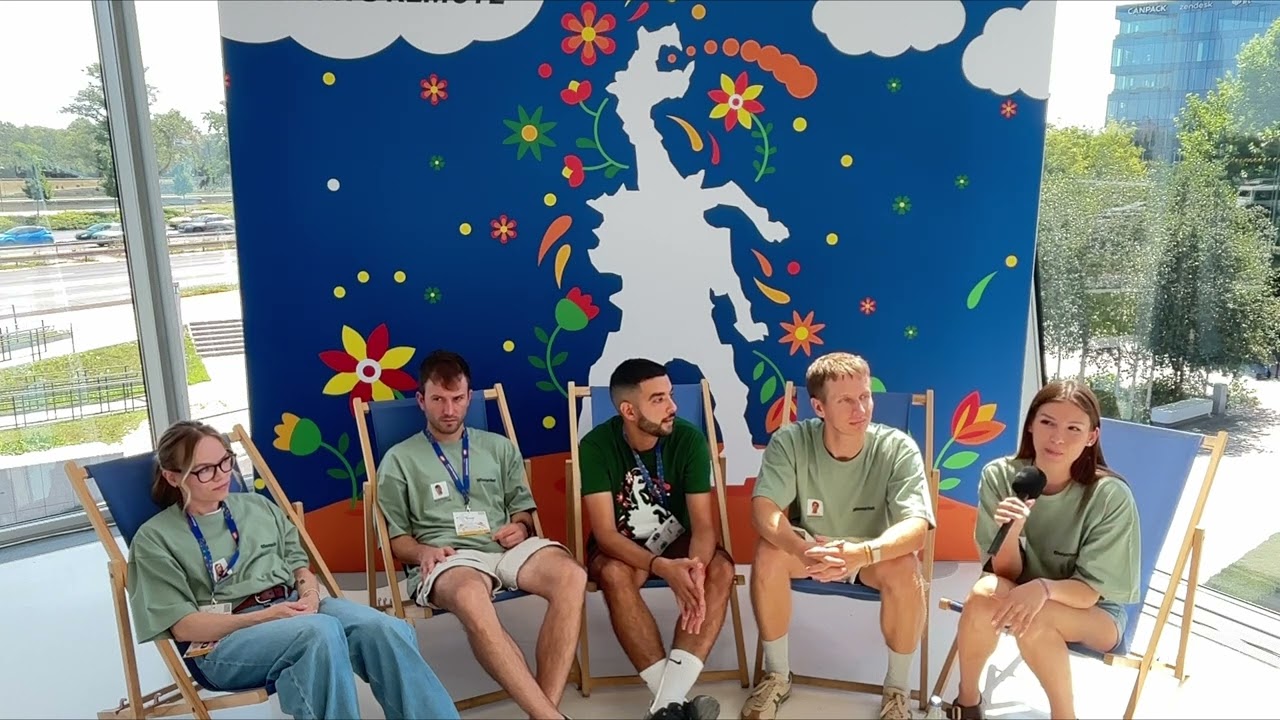
A Conversation with Manychat - EuroPython 2026 Platinum Sponsor
Watch on YouTubeVideo summary
Manychat, a chat marketing automation platform and the Platinum Sponsor of EuroPython 2026, specializes in helping social media influencers and brands automate their interactions across platforms like Instagram and WhatsApp. The company's core mission is to enable users with significant followings to increase audience engagement by automating conversations, stories, and posts through AI agents. These agents are powered by Large Language Models (LLMs) that are wrapped with specific context and knowledge about the user's account, allowing them to navigate complex message flows and provide relevant answers. This automation extends beyond simple chatbots to include sophisticated data processing pipelines and analytics, all built extensively using Python to leverage its vast ecosystem of libraries and tools for both AI and classical machine learning tasks.
The engineering team at Manychat has made a strategic shift from PHP to Python to better support their growing infrastructure, which currently handles 40% of automations flowing through Meta's platforms. This migration was driven by the need for reliability, scalability, and access to modern tools like FastAPI, LangChain, and vector databases such as PGVector. A significant challenge in deploying AI agents is dealing with nondeterminism, where LLM outputs can vary unpredictably, complicating CI/CD pipelines and quality assurance. To solve this, Manychat employs a testing strategy using cassettes to mock LLM responses, ensuring that infrastructure tests remain stable and predictable regardless of the underlying model's variability. This approach allows them to iterate rapidly on new features while maintaining high system reliability and integration quality across multiple AI providers.
Beyond technical implementation, Manychat emphasizes the human element behind their technology and their commitment to the open-source community. The company is actively hiring senior Python engineers for new products that connect big brands with influencers, offering roles in their offices in Amsterdam or Barcelona. They are looking for proactive problem-solvers who can bring creativity to greenfield projects while leveraging the resources of a large, profitable organization. The interviewees highlighted that Python's broad applicability across different engineering disciplines—from QA automation and DevOps to backend development and data science—makes it an ideal choice for their diverse needs. Furthermore, they value the collaborative culture of the Python community, noting that unlike proprietary ecosystems, Python offers free access to tools created by a global network of contributors who share knowledge freely.
In conclusion, Manychat views itself as a company that is human-built and AI-powered, a philosophy reflected in their booth design at EuroPython which gradually revealed the people behind the code. They strive to create a safe space for networking and collaboration, offering refreshments and relaxed environments for attendees to connect. The team expressed deep gratitude for the support of the conference and the broader community, noting that events like EuroPython are essential for fostering innovation and sharing knowledge. As they continue to evolve their platform and expand their team, they invite the audience to join their journey, emphasizing that the future of Python lies in collective effort and open collaboration.
Read the full video transcript
Would [music]
you mind telling us what your company is
and what you're doing at Europyon?
>> I have a microphone. I hope you can hear
me. Uh, hey, my name is Vlad. Um, yeah,
Manyhat is u we call it chat marketing
automation platform, but basically we
help our customers to automate their
social media. It means like you have
Instagram, imagine you have 5k maybe
more followers. You're influencer and
you want to get some value from your
audience. You want to increase
engagement of your audience and I'm sure
you saw some posts in Instagram. Hey
guys, comment like book and I will send
you my like first book. And yeah, this
is where many chats step in and we
automate this kind of conversation. you
want to automate your stories, you want
to automate your posts or you want to
automate your conversation in the direct
messages in any so kind of any social
media. Yeah, thank you so much.
>> Did anyone else want to jump in on this
question? That was great by the way.
>> I think it was great. That actually
covers the first question.
So um where does Python sit in many chat
stack today and what kind of systems is
it powering? Do you use other languages
as well?
>> Yeah, I can answer this one. Um I'm
Sergey. I'm engineering manager at
Manyhat. Uh I am part of the team that's
integrating AI features into Manyhat. So
and actually I'm I was part of the
initial team that built initial Python
service uh powering this AI capabilities
to the manage that product. So well to
give some context what we do we build AI
agents uh that um we can well we use uh
pantic AI agents and we wrap them with
some context some knowledge about the
account and and then we are able to
answer like based on like a certain
message paths and flows we are able to
give LM answers to the users so that's
where we realized that made sense to use
Python so we use fast API service um to
for our endpoints and then we have our
cues and and then our workers that run
those agents. So essentially that's
where that's one of the places where
Python sits. Uh it is great because we
have access to all the tools and
libraries that are um constantly evolved
and built in Python. So it made a lot of
sense to use it. And for instance also
like for knowledge knowledge retrieval
we use um rack and pg vector. So it's
very smoothly to integrate with with
Python and also for observability or for
like one of the challenges we have uh is
that we want to route um uh how to say
uh LLM requests. So we need to integrate
with multiple providers. So we use uh
light LLM as our main library to route
its traffic and and yeah like uh it just
using Python in that part of the stack
just unlocks all these capabilities.
I'm going to ask a follow-up question.
So,
>> can I add something?
>> Of course. Go ahead.
>> Just to say that we we also use machine
learning, classical machine learning.
So, I am my name is Amin. I'm in the
machine learning team. I was the first
hire in machine learning and uh so we
have we have AI meaning LLMs but we also
use classical machine learning from NLP
to yeah text processing to like the
whole stack and everything is is Python
open source. So,
May I also step in here because uh we
use Python not only for ML or AI
engineering, we also use it for data
processing and analytics. And for
example, we have pretty huge uh data
team. Uh they use Python a lot for the
data pipelines. and me and my uh another
teammate, we also kind of so we transfer
all of these data and insights uh using
our uh Python uh service to our users,
actual users.
>> So you said you're working with AI
agents in production. This is obviously
an evolving technology and it has a lot
of challenges. So would you mind
describing some of those challenges that
you might have dealt with and how you're
solving for those?
>> Yeah, so um it is a big challenge for us
because we have uh many paths of or
messages automations that uh we want
that uh an agent or LLM can answer
[snorts] but at the same time we want to
ensure that our system stays reliable
and that all the different integrations
we do um we still maintain certain level
of quality. Um what happens with dealing
with agents and nondeterminism is that
suddenly you start building those
complex pipelines where you want to
validate stuff but things you you
realize that uh it is very there's a lot
of flakiness in your CI/CD pipelines
because of the nondeterminism. So
something we how we approach it is that
um
and on top of this just to add extra
context like uh we uh not so we have
multiple agents that might be using
different configuration different model
different providers. So this adds
complexity on top. So we want to
validate that things um from an
infrastructure p infrastructure
perspective things stay up and running.
So we validate at the right time but
when it comes to uh integrating new
features probably at that time it
doesn't make sense to get like a real
answer from LLM. Instead what we do is
that we use uh piest and we with we use
cassettes and we mock responses of the
agents. What this allows us is that we
know that our pipelines um so at the
time that we introduce new feature it's
just a matter of we record the answer
from the LM it stays in a cassette and
then our pipelines we know that every
time we'll give the same output unless
we change some of the behavior of the
feature and this turned out to be one of
the greatest let's say in infrastructure
decision we've made because it allows us
to move really fast uh interate with
agents but at the same time stay stay
very reliable
That is so interesting. Um I think that
many people who are working with agents
are facing very similar problems and
it's really interesting to see a company
that's successfully overcoming those
issues and using traditional Python
tooling in conjunction with LLMs.
>> So you said you work with Python
extensively. Are there other languages
you work with and does this pose any
challenges for you?
Yeah. Uh we uh as a company 11 years old
and at that time as the most famous
language was PHP and we have built our
platform on this beautiful language and
I I don't think that PHP is bad. It's
bad when you can't cook it normally. Uh
the but reality is that nobody wants to
write in PHP anymore. Not everybody h
and we met the problem that it was one
of our motivation when we are moving to
the python because python ecosystem is
growing you can see this beautiful
conference and you can uh like enjoy
this
how often you can see the big PHP
conference I don't know yeah that's why
we're um try to deeply integrate and
migrate our main uh processing code base
and dependencies on python And we're
doing it accurate because we are holding
you can imagine we are holding 40% of
automations that goes through meta. It's
Facebook, Instagram, WhatsApp. It's huge
amount of money or money messages and
money also. And uh to show our seniority
I want to say that we have downtime of
our system on PHP and the Python only
when meta have downtime. That's that's
what I want to say. Yeah.
>> Thank you.
>> Um, so when you are trying to select
data to ingest into the platform,
are there certain accounts that are
better than others and how do you make a
decision about that?
>> Yeah, we have um it was
super hard for us to understand ideal
customer profile. I would say we spent
two or three years and we always
switched between oh we want to do
e-commerce oh we want to work within
infrepneur I don't know but now we fully
understand that we live in creator world
especially with AI everyone create this
video photo I even this weird photo on
the banners when you have a five or no
six fingers sorry I have five they have
six
>> and uh Yeah, ideal customer profile
looks for us like it's Instagram account
with minimum 5k followers who post
minimum like two stories per week
>> and we see on historical data that these
accounts have minimum five conversation
with their followers and they're growing
their their engagement. That's why in
many chat right now we are building one
more product. It's many chat for brands
and um we see that big brands like
Apple, Uber etc. they want to work with
smaller influencer because they're
expert in their domain. It's five key
like followers as I said and big brands
many chat and the influencer and we
connect them and help them get money and
show their performance transparently for
big brands.
>> It's amazing that such a simple signal
can be so predictive. Um I've certainly
found things like that in my data
science career that really surprise you.
Um and it's quite rewarding when you
manage to find that pattern. Thank you.
>> So why did Many Chat decide to sponsor
Europyonthon this year and what does
Python mean to you individually?
>> Okay, so I guess I can answer for me
individually but also for like so for
many chat in general. So as my
colleagues have said uh just now we used
to have everything in PHP and we've uh
we've we're we're moving to to Python.
So Python is is an important tool for
the company. Um and then from from a
personal like at least for me personally
I so my background is mathematics. I was
in research and then I got into
programming and the main language that I
know is Python and this is my fifth
conference I think in Python. The other
ones were mostly PI data because data
science. Um but yeah for me personally I
love the community. So everything is
free. Um Python is not behind like some
guard rails or like essentially um like
a money wall. uh it's just like the
community uh creates tools um the for
the Python this weekend Saturday and
Sunday. So I'll be I'll be staying the
weekend uh to contribute to sprint. So
those are adding to open source uh
packages. So I'm excited about excited
about that and uh yeah specific for
manyhat I don't know if we have any any
other things you covered dash
>> I covered it. Yes. So we're moving from
we've moved from PHP to to Python. So
Python is great but also yeah Python
Python in general is great because it's
an awesome community.
>> You also probably uh mentioned that of
course besides the sponsoring the
conference we are also organizing a lot
of uh different knowledge meetups
related to Python also collaborating
with PI data. So for us it's important
to create this safe space where people
could just come and share their
knowledge uh and just network with each
other and grow together. So this is
something that we really believe in. Uh
so yeah definitely besides building the
product we're also very passionate about
building the community
>> I think people can find us in also in at
Pi Pi data Amsterdam and Pyon Spain in
Barcelona so come see us in Barcelona
>> amazing
>> so I'd like to highlight something so
for inance myself I started my career
working in Java and suddenly well I
stumbled upon Python I um I really like
that it's very welcoming language like
it's very easy clean to understand and I
think that that's probably like removing
that barrier makes it that a lot of
people can get interested and I like in
the last years I realized like um such a
big community that is behind Python you
can see it in this type of events and
conferences I think that there is like
some shared culture of what it means
Python and you can see it in everyone in
all the interactions you have with
people everything is so collaborative.
Um, people are willing to share and I
think that that translate ultimately in
how we use Python and what is the
language.
someone else. [laughter]
So yeah, I will put uh five cents from
myself about why I actually value Python
a lot and uh for me mostly it's more
about applicability of Python because
for example me I started as a QA
automation engineer I used by test a lot
I use it for some DevOps approaches and
practices then I switched to back end
engineering now I'm backend with kind of
more or less focused on data stuff so if
you notice I jump from one area to
another and everywhere it's Python. So
yeah, applicability is just so broad and
I I love it. So thank you so much for
being a platinum sponsor. It means so
much to us as a conference and sponsors
like you mean that community efforts
like this can happen. People can come
together. We can have the sprints.
people can continue to work on Python
together to share the knowledge. And
yeah, thank you so much. It's it's
really important. And speaking of being
part of the community, you may want to
bring more of the community into your
company. You've told me that you're
actually looking to hire. So, do you
want to tell us a bit more about that?
Yeah, we are hiring
we are hiring a Python senior engineer
for our new brands product that I
mentioned before where we bring value
for a big companies and connect them
with the small influencers
and this is a new product for us under
the big umbrella of big company Manyhat
400 people 11 years uh old and super
profit I would say. Yeah. And uh we are
looking for a senior Python developer.
You can choose our two beautiful offices
in Amsterdam or in Barcelona. I in
Barcelona prefer Barcelona. Sorry. Uh
and yeah, if you have experience, we are
looking only for one main uh skill which
will describe your seniority. We're
looking for people who are bringing
problems up and solve them, not for the
people who are waiting when they get the
problem. This is who we are looking for.
Please apply.
Go Barcelona.
>> Yes.
>> Yeah. For me actually it seems like it's
a totally unique opportunity because on
one side it gives you creative freedom
of the Greenfield project but at the
same time it's under the big umbrella of
many charts. So it's give you all the
resources that the big company can
provide you. So I think this is totally
unique and it's nice opportunity to
consider.
>> Let me plug my team as well. So I'm in
the machine learning and data
engineering team and uh so we have two
parts machine learning and data
engineering and the data engineering
part uh uh we're hiring so we're hiring
for a data senior data engineer uh
platform engineer uh relocation to
Barcelona I believe uh because most of
the team is in Barcelona for this role.
Uh, Barcelona is great. I re relocated
from London to Barcelona a year ago and
so it's great. So I recommend it.
>> But I wouldn't say that you should be
relocated only to Barcelona because
Amsterdam is also great.
[laughter]
>> I've never been to Barcelona, but I've
been to Amsterdam and it is great. So,
and to be honest, having heard the
challenges you're working on and how
you're approaching them, I mean, if I
didn't have a job I liked a lot, I'd be
tempted to apply. So, uh, I think
everyone in the audience should
definitely think about it.
>> Thank you so much.
>> Yeah. And, um, just to close things out,
we talked about a lot of things today.
We've talked about like the really
interesting work your company's working
on. We've talked about like the
products. We've talked about the
problems. And we've talked about what
Python means for you. So, is there one
final thing that you want the Python
community to take away about many chat
as we end this interview?
>> Yeah, definitely something that we want
the audience to remember when they will
think about many chat is that many chat
it's human built and AI powered and this
is actually something that we were
really trying hard to show uh by our
booth concept. So the idea was that
every single day we were changing a bit
and tiny little details details of our
booth. So at first uh we just showed the
curtains full of different Python codes
and then on the second day and the third
day we will start slowly removing
removing and show actually behind people
behind the code people that actually
build the product people that actually
establish the organization and for us
this is something that's very important
and um talking about this human touch
and human factor for the third day we
just understood that a lot of engineers
who came here for the conference they
visited a lot presentations and they
probably must be so tired. So for this
we just wanted to create uh a space
where people could just come, chill,
relax, uh get some smoothies, ice cream,
enjoy the conversations, and just have
fun. So yes, [laughter] thank you.
>> I can vouch the space looks incredibly
fun. I watched it building from across
the way over the last three days.
Anything else? Uh can I Elsa [laughter]
I just remember one thing is that um
sometimes yeah when people uh stop by at
our booth and what they see usually it's
some of the activations that we prepared
like I don't know some quiz uh some
prompt challenges but uh there is
something that's left behind uh behind
the curtains is that how each of us
contributed to this specific project. We
had plenty of calls. We had plenty of
meetings. And for me, honestly, this is
something I never experienced before in
any of the companies. It's the way how
engineers were involved. You can't even
imagine how much efforts and um I don't
know love and passion Amin for example
put into creating the career throw for
participants to make them so beautiful.
So like with a little tiny details that
was amazing. Alisa, one of our also
Python engineers, she prepared very
interesting challenge. that a lot of
people could enjoy and yeah challenge
themselves by playing with the prompts.
So yeah, this is something that's left
behind and this is something that I
personally really appreciate about the
company. So yeah, thank you.
>> The final word or maybe not.
We are here for a long time.
If you want to know the future of the
Python and your future, I mean we'll
help you in our company.
Please join and enjoy this time with us
as we enjoy. I work seven and a half
years in the company which means a lot
and yeah I would say that average
time is four and a half in the company
which is pretty great. [snorts] Thank
you for watching this and I will pass
Mike if someone wants to say something.
I'm
>> just quickly saying go Python and go
open source community.
>> [laughter]
[music]