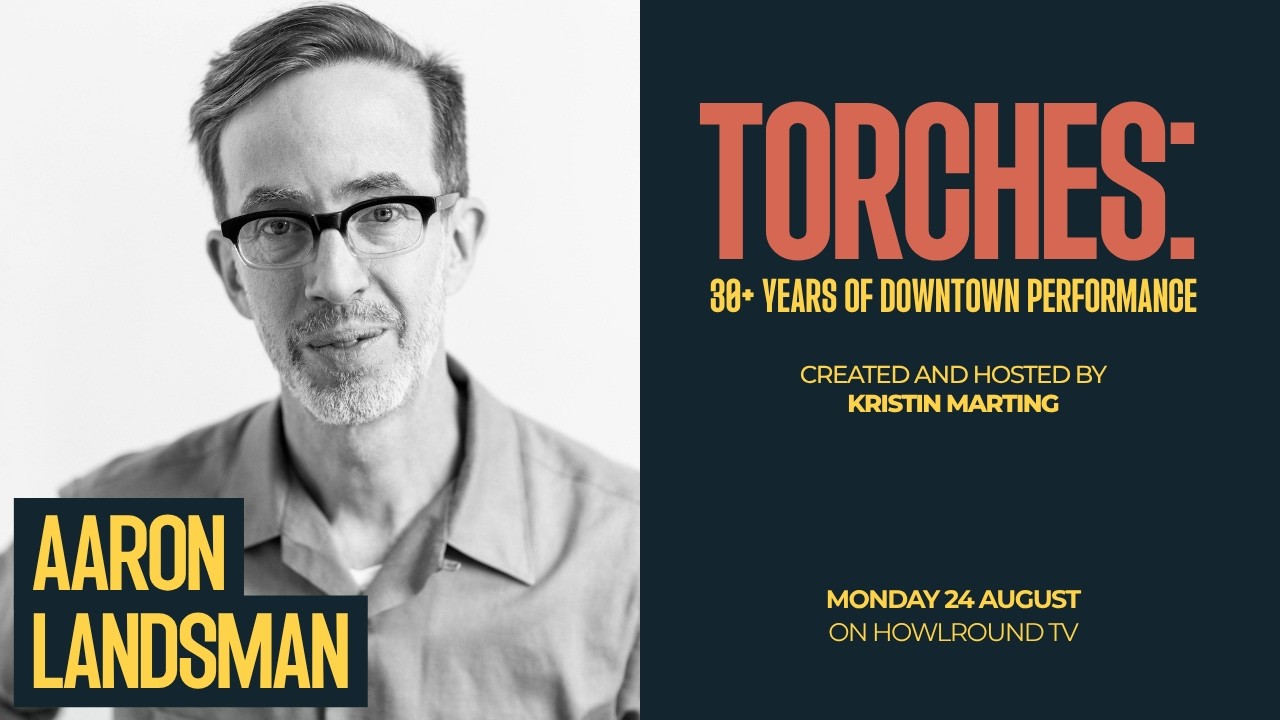
A Conversation with Aaron Landsman -- TORCHES: 30+ Years of Downtown Performance
Watch on YouTubeVideo summary
Aaron Landsman recounts his deep connection to the downtown New York arts scene, a path forged by his early exposure to Minneapolis's vibrant 1980s cultural landscape and transformative encounters with avant-garde groups like Sankai Juku and Butoh. Finding a sense of home at The VUCCA, he developed an instinctive attraction to performance that emphasized rigorous, difficult, yet joyous artistic work, where embracing failure became a vital learning tool rather than a setback. This philosophy is evident in his long-term development of participatory projects such as *City Council Meeting*, which evolved from chaotic workshops into effective tools for community engagement, illustrating how theater can strengthen democracy by teaching citizens to "perform" themselves in civic spaces and move beyond mere words to transact power and information.
Landsman critically examines the current funding landscape, noting that financial pressures often force artists to avoid risk and self-censor, leading to a shift toward insular communities despite some bright spots of diversity. He advocates for long-term processes over quick fixes, contrasting art's unique ability to explore structural issues without immediate electoral consequences against the often partisan nature of activism. His work with Perfect City over twenty years focused on gentrification, urban planning, and community mapping, emphasizing that true inclusion requires understanding invisible boundaries and systemic barriers rather than simply building expensive venues that drive displacement. Instead of investing in costly infrastructure that excludes residents, he argues for supporting artist fellowships and maintaining affordable spaces, acknowledging the complex history of housing activism and the debt owed to those who fought against gentrification across New York's five boroughs and other cities like Philadelphia.
Looking toward sustainability and legacy, Landsman asserts that a stable artistic life requires financial security to avoid worrying about healthcare and to take creative risks, particularly as artists age and support their families. He champions Universal Basic Income or government support models similar to those for public sector workers like teachers and librarians to stabilize livelihoods, while long-term commitments from organizations allow him to focus on developing work strands without the constant pressure of immediate commercial viability. For future theater makers, he hopes to instill a sense of possibility, encouraging artists to expand their horizons rather than being limited by past successes or reputations, citing Tom Waits' evolution in musical style as an example of necessary artistic growth. He also reflects on how rapid technological advancements have made art more accessible and less precious, transforming tools like projectors from rare items into ubiquitous devices that democratize the medium.
The conversation concludes with mutual appreciation between Landsman and host Erin, underscoring a shared belief in the enduring spirit of downtown performance even as it adapts to new realities. While acknowledging that the original "spirit of downtown" may have changed, Landsman affirms its survival in smaller, community-based spaces that continue to foster diverse and risky work. His message ultimately calls for a reimagined ecosystem where artists are supported financially and structurally, allowing them to engage deeply with their communities and tackle systemic issues without fear of displacement or censorship. By prioritizing long-term relationships over quick fixes and financial stability over commercial pressure, the arts can continue to serve as a powerful force for civic engagement and social change, ensuring that the next generation of performers has the freedom to explore the full breadth of human experience.
Read the full video transcript
when we learn the skill of performing
ourselves um whether as actors on a in a
play or as participants in a local
government meeting, we're learning how
to kind of transact something that goes
beyond the actual words said or the room
or that kind of thing.
>> So, it's a little abstract,
>> but I feel like the more theater can be
deployed to help people understand how
democracy works, the more robust
democracy can be.
Ooh. [music]
[music]
>> Welcome friends. I'm Kristen Martin and
this is Torches. Today we have the
provocative Erin Landisman. Erin is an
award-winning multiddisciplinary artist
who's obsessed with cities, shadows,
anonymity, and how we perform power.
He's the founder of Perfect City. I'm
very excited to have this conversation
with him today. Welcome, Aaron.
>> Thank you, Kristen.
>> Yay. So, how did you come to be in
downtown performance?
>> I think I knew that that's what I wanted
to do before I knew that there was a
thing called downtown performance. So,
[laughter]
I took a trip with my friend Carl from
Minneapolis to visit ostensibly visit
colleges, but really it was to just walk
around in a couple of different cities
out east and we were 16 and we were by
ourselves and we looked at Colombia and
we both felt like he was a kind of
higher performing student and neither of
us were very interested and so we walked
all the way downtown and we ended up at
the Vulca on 9th and 2nd and there was a
woman with blue hair reading the Village
Voice and smoking a cigarette and
drinking coffee out of those big thick
mugs. And I was like, "This is exactly
where I need to be." And so, uh, I
auditioned for the experimental theater
wing and basically had four years
working with people like Mary Overly and
Anne Bogart and Wendel Beavers and Kevin
Kulkkey and then basically got spit out
into downtown New York. My apartment was
on 13th and Avenue A. Um, it was a cold
water flat that I had from like 1989
through 92. Um, and I kind of haven't
looked back. Even if I've felt tensions
at time between like how I'm part of the
ecosystem, it's just always been home.
>> Right.
>> Yeah.
>> And is there a particular experience
that is like personal, political, or
creative that most shaped who you are
today?
>> That's a great question. I feel like
there are several. And are you thinking
um prior to arriving or like formative
in any way?
I think just formative like what you
just said was a lot about that, you
know, that that you just had an instinct
that this was the right community for
you. But yeah,
>> I think so there are a couple things
like Minneapolis was a really in the 80s
when I grew up there was a really
thriving cultural scene. So there was
punk music that I was a deep fan of.
There was Prince. Um friends of mine
were extras in Purple Rain. A guy I went
to high school with became his drummer,
you know. And then there was a theater
scene where the Guthrie was run by Livia
Chulle. this Czech director and or
Romanian or Czech, I can't Romanian
director. Thank you.
>> And he was doing really adventurous
work. I was participating in a lot of
theater and the theater that I was part
of, somebody came back a couple years
who was a couple years older than me and
she said, "You should audition for NYU
and you should only go to the
experimental theater wing." And then she
described basically like the rolling
around and making strange sounds. That
was her training. [laughter] And I was
like, "This sounds perfect." And so the
kind of cultural hotbed that I grew up
in was both freeing and limiting. And I
think I always knew that um that I
wanted to be somewhere that was bigger
and more dynamic, but I also had a
grounding in like the possibilities of
experimental art. Um, the last thing
I'll say is I had another friend and we
were going to see a show at Northrup
Auditorium and it was Sankai Juku, the
BHO group
>> and there was a moment Northrup is about
like the size of the Harvey the Bam
Harvey Theater and we had gone to get
Ethiopian food at the first Ethiopian
restaurant open in Minneapolis and kind
of had our minds blown as two like you
know middle-class Midwestern white guys
this was an arrival and like just to
paint a picture there was no sushi in
Innesota 1986, right? There is now.
>> Um, and so there were a lot of things
that we didn't have access to.
>> So we had that meal and then we went and
saw S Kaijuku. And at one moment in that
piece, it was really their signature
piece. The lights come up and there's a
deep blue background. Um, and there's a
man hanging from a rope by his feet
upside down about 20 feet above the
stage.
>> And the entire audience of about 800
people gasped. And I thought like, oh,
this is something I want to be a part
of. Like, this is the kind of culture
that I wanna be a part of somehow.
>> That's an incredible story. I also had a
really amazing uh budo experience with
Popo like in in the 80s,
>> like in an outdoor community garden and
doing some crazy physical stuff.
>> Yeah.
[music]
I remember then seeing the when the
Guggenheim had their Soho outpost, they
did a piece on Bhau and Japanese art
post war.
>> And it was funny because when I had seen
the performances and I had seen um
>> uh Katuono also one time.
>> Wow.
>> And in my naive, I didn't make the
connection to post World War II and post
Hiroshima Nagasaki. And then seeing that
exhibit made me think also a lot about
like how a piece or how a body of work
arises from its time.
>> Um and I made it kind of deepened my
appreciation for that form.
>> Totally. Totally. Could you describe a
moment of pure joy in your art making?
>> Yes. I feel like there are a lot. The
ones that came to mind when I thought
about that question um have a lot to do
with elevator repair service. And I
joined that company in 2003 after having
been friends with them for a while to
work on GATS. And I think there were
moments when the company would just sit
around and make really ridiculous jokes
that were kind of like literary riffs on
pop songs. Um, some of them were kind of
carnal and then all of a sudden we would
have been laughing for like an hour and
realize that we had to finish making a
scene and everyone would panic for a
moment and still sort of semiloughing
try to stage an entire chapter of The
Great Gatsby and that just felt like oh
this is a impossible and maybe that's
something to talk about as kind of you
know our community of work and the idea
of the impossible challenge. I had been
adjacent to that kind of proposition and
worked with like Rich Maxwell and stuff,
but then working with the RS it was like
this definitely won't work to stage an
entire novel. And that felt like the
first time I could see how rigorous
difficult work could be also really
joyous.
>> Yeah. On that that goes right into
something else I was thinking of talking
to you about about risk and failure and
you know that it seemed like that was
doomed for failure. this idea of putting
the entire novel on stage um and a way
was found to overcome that obstacle and
to create a theatrical context that was
>> uh fulfilling for an audience and for
the artists that were making it.
>> Um are there other moments for you
>> that you've taken a big risk
>> and and and and what have you learned
from failure in that context? Uh, I mean
certainly the city council meeting
project that I made with Mallalerie and
Jim started with the idea of like once I
had the idea of transcribing city
government texts and making turning them
into a theater piece, the initial
thought was like we'll have some actors
do it and it will be kind of like an ash
our town sort of like look at people
muddle through and it was kind of about
that version of the piece was sort of
about failure like the failure to really
communicate within the context of
legislation and sharing power. Um, and
then at some point I joked to Mallerie
that if we were really making a piece
about participation, the audience should
perform it. And we both laughed and then
she went away because she's brilliant
and sort of devised a strategy where
audience members could perform these
transcripts without having to play a
character because we sort of stepped in
to the process too saying something we
want to avoid is a lot of the trappings
of participatory theater
>> and artifice. Exactly. where like I have
to play a role, but the actors have been
rehearsed and like that just felt like a
thing we didn't want to get into. So,
she found this structure and [snorts]
the first couple times we did it, it was
definitely still arguably not a good
idea. Like, we did work in progresses
that you may remember. They were chaos.
Like, we had to orient the audience and
the second time we did it up at Art, it
took 45 minutes because we had more
people than we thought and they had tons
of questions. Right.
>> So before we arrived at like the idea of
an orientation video, we had a piece
that would have sprawled for 3 or 4
hours, not in a good way.
>> That project was in development at here
three or four years. And I remember that
first work in progress where we tried
that. It it was like two hours, two plus
hours. And we were like, hm,
>> yeah, [laughter]
>> how do we figure this out?
>> But there was a real excitement. You
could see the potential of the idea in
that very first workshop, you I mean, I
think I was lucky, and this is not just
cuz I'm talking to you, to have the
combination of like Mallerie as a
diehard collaborator who's like, "We're
going to make this work."
>> And here as a space where it was like,
"Well, that didn't work."
>> Like, now we have to keep building this.
And so to not assume that failure means
scrap it.
>> No.
>> Um, and I think I I
>> we learn from failure.
>> Yeah.
>> I hope. We hope. Yeah.
>> Yeah. I mean, and I think I also feel
like failure has become a kind of trendy
thing to talk about,
>> but I I feel really lucky having been a
part of projects that really could have
not worked, you know, that really
probably shouldn't have worked unless
everybody was the right people at the
right place in time to do that work with
the right venues and the right support.
And so I'm I'm kind of curious now how
artists think about failure
for real like the project might not work
>> and then as a field like how do we
support artists who fail you know and
then go on to make something that comes
out of that failure that's really solid
because I think the funding strictures
right now mean that it's more high
pressure to not fail and that younger
artists who are kind of moved to the
four sooner so they can get some of that
support are like well you can be about
failure but you can't fail and you're in
your 20s you know I feel really lucky
that I was like 40 when that started
happening.
>> Yeah I mean I do think that there's a
fear of risktaking and I think it feeds
into what's happening with the
administration and people self-censoring
in the face of the first amendment
>> fears that they have in terms of the
administration right now.
>> Do you feel like that is um venue or
artists or both?
>> I think both is happening. I think that
artists are starting to self-censor
thinking like, well, I'll never get
funding for an idea like that or if I
say things like that.
>> And I'm afraid that organizations are
starting to step back,
>> right,
>> and not program artists that they would
have programmed in the past or projects
that they would have programmed,
>> right? I mean, I'm wondering I I do feel
like there's some huge bright spots and
like am I can I name can I name people
who I think are awesome? like Nile and
Alex Tatarski and there's that
generation like Crackhead Barney and I
think there venues that are
>> Nile Harris Harris is referring to and I
think those artists are really not
pulling punches at all. Then there's the
work that I think I'm a big fan of. Like
if I look at Jess Barbagallo's play that
they just did that he just did and I was
like this is risky because it's
completely free to be what it wants
because it's aiming for a kind of
audience that's in the conversation and
I do feel like that is I'm just like
where does that I hope that work
continues to thrive or that kind of
work. Um, I think in the field, you
know, there's been that conversation of
like how regional is New York City work,
how regional is downtown work, how does
it translate outside of the city or
outside of the coasts? And I hope that
it continues to get made regardless.
Like that's one thing about our lives
here, as challenging economically as I
think New York is now and how
restrictive it is to new people coming,
there is still this sense of like we're
making work for us. Um, and that field
has gotten a little bit more diverse, I
think, even than 10, 15 years ago. So,
all that is to say, I think there are
bright spots, but I agree. I see I see
venues more kind of like getting nervous
about what someone might propose.
>> Yes.
>> Um, and then some venues are just like,
nah, we're going to do this, you know?
>> Yeah. They're not taking the risk. Well,
I just want to follow in on what you
what you just were talking about uh
about the downtown community that the
the work is for the people who are
already part of the community.
>> Um
>> but I think that a lot of the downtown
work has like a ripple effect outward
that that it starts here
>> but then there's an outsized influence
to this one community of artists. So it
may start in a small a smaller I my
implication the implication I was
hearing was like an insular community.
>> Yeah, it's both. I mean, I think I'm a
really big fan of the margin, meaning I
think uh work that is
>> kind of resolutely for the community
it's embedded in, but might have
aspirations in a great way to say like
this is available to you. Like how is
work inviting? How is it, you know, here
if you're willing to come on its terms?
And I think about Nile and Alex as being
examples of that where it's like a lots
of people beyond their the enclave that
they're in the generation they're part
of have really loved that work
>> and it's still not going to compromise
especially aesthetically on what it is
and narratively especially you know.
Yeah. So I think it's the the work I
don't stay interested in work that
aesthetically trades on a kind of in
joke where it's like oh I have to know
about the Worcester group on up in order
to understand the aesthetic of this work
and I think like my favorite artists are
the ones who are like wow I learned so
much from these people and now I'm going
to continue making it mine and expand
it. I was thinking about your city
council meeting and that piece.
>> I think that you invited a different
audience to come to that. Right. You
were your audience was not the typical
downtown theater audience. you want you
wanted those folks to come too, but by
the selection to do the piece at the
Chelsea Vocational High School across
the street from here to [snorts] do it
out at LaGuardia Performing Arts Center
and at Elario,
>> you were able to speak to different
communities and you embedded yourself in
those communities to ensure that you had
folks show up,
>> right?
>> So, I think that's a whole different
approach and that's been a big big part
of the way you've been thinking as an
artist, as a citizen artist, as an
activist artist in your community. Can
you talk some more about that work?
>> Yeah, I mean I think also just uh any
conversation about
being with in and for communities
outside of our own has to for me I
learned a lot from the foundry and
Melanie Joseph. And so I think watching
foundry shows even when they were, you
know, what we might call like art for
art's sake, like Race of the Arc Tattoo,
there was a sense of like you were
walking into a world that was diverse
and inviting and purposeful in terms of
how that organization wanted to reach
people. And so they also because of
their things like food, water, shelter,
the the series of town halls and panels,
the conversation on hope,
>> like I just felt like I I was lucky to
be form formed by some of that work as
an audience member and then as an
artist.
>> Um so that was like getting my feet wet
when I worked with a foundry on my play
open house which was in 24 New York City
apartments
>> including this one. including this one
[laughter] and um in all five burrows
and Melanie and I made a decision that
we were not going to only work with
people we knew. So, we had to find
someone in the Bronx if we were and
someone in Staten Island.
>> And that allowed us to invite different
audiences in. And then we also asked the
host in each place, you might remember,
to bring like a third or half the
audience.
>> And so that was like a a dress rehearsal
for city council meeting.
>> And in New York when we worked, we
worked with this cohort of high school
students. They were paid.
>> We um in each city where we did that
project, we found a local issue that was
vexing people and then got adversaries
to make something with us. So in New
York, we actually had so much more
investment um that we took a long time
to figure out what that issue was and we
came down on standardized testing and
mayoral control of the schools.
>> And so we paid a group of high school
students from five different schools in
three bureaus. Um and they made a fake
standardized test with us and a kind of
chaotic scene that um that led to the
passing out of test booklets for an
audience. And then they answered
questions. We would bring in elected
officials and school officials different
each night to answer questions from the
from the um uh they sorry. So the kids
um asked questions of elected officials
from sitting on the stage and the
elected officials power dynamics shifted
because they were at the testimony
stand.
>> Um they were kind of on the spot.
>> In each school and in each site where we
did the piece, we asked the students
like, "Okay, how would you get your
friends to come to this weirdass show?"
And they would be like, "Well, first of
all, you have to go visit each class.
Um, you have to visit the principal and
find out which classes would be um, you
know, amendable to having you visit. You
have to do this kind of poster with
these kind of colors at this kind of it
can't be landscape, it has to be
portrait, you can't use this kind of
font." So, they gave us this schooling
>> and this is before like widespread
social media. Um, and so that also got
us a high school audience both of um,
educators and students. And the really
sweet spot was when we did it at
Chelsea, they the the students from
Chelsea and a couple other schools
brought um brought you know a third of
the audience and then a third of it was
our kind of downtown theater audience
and then a third was because there were
elected officials and here's audience
and a real mix. So in that piece because
it was participatory, you had audience
members watching each other re react
differently to the same material
>> and that felt like what that piece we
didn't know what's that's what we wanted
that piece to do but that's what it did
on a good day.
>> That's fascinating. Um you've also
talked about theater and democracy as
embodied systems
>> that invite us to both be a participant
and a witness.
>> Yeah.
>> Can you [laughter] share what that means
to you?
>> Sure. Now I now you say that back and
it's like did I write that? But it
didn't. Um I would say
that both theater and let's say a
government meeting is an example of
democracy
>> um are arrangements
and systems
that ask us to be in our bodies
transacting power or information of
other kinds or or kind of like stories.
For me, the intersection recognizing
that a lot of government meetings are
actually performances.
>> That that doesn't mean they're cynical
necessarily, although plenty of people
manipulate people obviously through
power and through the performance of
>> what they what they think we want to
hear or what they think we will be won
over by. In a democracy, when we learn
the skill of performing ourselves, um
whether as actors on a in a play or as
participants in a local government
meeting, we're learning how to kind of
transact something that goes beyond the
actual words said or the room or that
kind of thing.
>> So, it's a little abstract,
>> but I feel like the more theater can be
deployed to help people understand how
democracy works, the more robust
democracy can be. that's my like soapbox
for why to use this stuff.
>> So I find that like I go to classrooms
and schools and communities and I'll
bring like a 15-minute demo of excerpts
from the city council meeting piece. So
we watch an orientation video, they take
up a small number of transcripts and
then we have a conversation at the end
and there's a tiny nod to what we called
our local ending and it's in the
conversation where they're like, "What
just happened?" Oh, when you said that I
felt like I was cut out of the dialogue.
What if you had said something
different? Or when you said that when I
said this and you as the mayor, who I
know is not the mayor, didn't respond, I
felt like I was being ignored. But
that's just the rules. So you get a kid
talking about how it feels to be in
front of power to recognize that that
power is really
>> only has veilance because it's a
performance with a set of rules.
>> Yeah. um then you can begin to think
about systemic change like very slow
small systemic change.
>> Yeah. I was interested to read and I
think this is in your work with perfect
city um some thinking that you were
doing around NICHIP meetings.
>> Oh NICH meetings. Yeah.
>> Yeah. And the way that um
>> the way that they are not truly a
community meeting that's asking for
input from the community that there's an
agenda that is shutting out the
community's participation. and you were
talking about what theater tools can be
applied to that to actually make that be
a space that could be about dialogue.
Can you talk a little bit about that
that application of the theatrical into
the political context?
>> Absolutely. So, I think theater on one
hand you can learn some new tools,
right? Like it's great to learn how to
speak
>> um powerfully and it's great to learn
how to hold your body so that you convey
a sense of conviction. It's also a great
way just by going through the motions of
performing someone else uh from a city
council meeting somewhere else or a
NICHA meeting, you start to um
understand that you carry a lot of
embodied knowledge about policy, right?
So, Perfect City's whole operation um
and that NICHA meeting was a really
great example was like not only is this
meeting not meant for people to feel
included and participate, it's um
everybody who's at the meeting kind of
knows that like they literally I was the
the the description came from an article
I wrote for the architectural league's
um magazine Urban Omnibus. They were
like go visit a Nicha meeting. they're
super contentious and can you write
about it as theater?
>> And I was like, I think so. You know,
and I went and what was so clear was
that everybody knew it was a little bit
of a scam, but they also knew that the
board for NICHA was there on stage and
even if they didn't get a response in
the meeting, they it was the one place
they knew they could get something done.
So like at the NICHA, you know,
administrative offices, it's hard to get
someone on the phone, but those people
who should be on the phone just because
of staff cuts, they're not are there at
the meeting. So you can be like, "My
boiler doesn't work. There's mold in my
grandma's apartment and really raise a
stink and it might actually have a
chance of getting addressed by you
subverting what the meeting is supposed
to be for."
>> Interesting.
>> So it was like a lot of what I want to
do with the arts and democracy is to
say, "You have this knowledge. you
understand a lot more than you were told
you understand.
>> You might understand that the rules
don't necessarily work for everybody or
the structure. Um, and now let's play
with that. Like let's use a creative
tool to play with what we do with that
knowledge. Um, one other thing I can one
other weird little nerdy tidbit is that
um I'm working now with the National
Civic League, which is a 130year-old
120-y old organization that started
around the time of Teddy Roosevelt. and
they evolved the current structure that
we have had now for over a hundred years
of what a local government meeting looks
like. And they were like, it's time for
a change. Like we're trying to change it
now to more things like citizens
assemblies because those meetings were
never really meant to include people in
power. They were meant to be to create
transparency
>> so that we can say we have a public
record that this stuff happened the way
we said it was going to happen. But all
of the deals, especially back in the
day, went on behind closed doors. And
then the meeting itself was a way to say
look we did it. And so everybody working
on local democracy or on democracy
innovation is thinking about like oh
it's time for a change because this was
never about
>> participation and inclusion. It was
about showing people the receipts you
know
>> right? So why do you choose art as your
means of resistance and your form for
activity rather than organizing or
politics or is that a false binary? Are
you doing both? I would say kind of yes
and I mean I kind of wrestle with that
question sometimes you know because
>> there might be faster ways to try and
make change happen I think
so one thing about me as an artist is
that I don't produce at the rate that a
lot of people do. I make work a little
bit less frequently partly because I'm
involved in a number of things but
partly because I really love a long
process
>> and so working on city council meeting
was really like 5 years from the meeting
that set it all off that I saw to the
final performance in 2014 and then now
it's been another 10 years of evolving
it as a kind of tool for teaching and uh
the book that we made and so I did you
>> tell the title of your book
>> the city we make together written with
Mallerie Catlet University of Iowa
Press.
>> Great.
>> Um, still available in stores and
online. Um, [laughter]
and you know, I think that long process
taught me that
creative work
as a tool. Um, and I don't and not just
as as an instrument of change, but just
like as a tool for anything kind of
gives us a chance to
look at things that are structural and
play with them without the consequence
of like
>> am I going to get elected or is the
protest going to work?
>> And then there's another like aesthetic
reason for me. I grew up my parents are
both like, you know, kind of occasional
organizer, educator, activist types. And
um I grew up in the protest movement and
I kind of don't love I don't know how
protests are effective although I think
they are on a mass scale. Like I think
um Black Lives Matter in the wake of
George Floyd's murder was effective even
if it doesn't lead to like legislative
change. There's a different conversation
that is happening that has emerged from
that series of protests. I think Occupy
Wall Street was successful but you can't
kind of quantify the success. I do worry
sometimes that a lot of activism in New
York City is so partisan and so uh
insular and so based on perfectionism
that that just doesn't call to me in the
way that um making art with an eye on
community change does.
>> Mhm.
>> There's a really cool documentary just
came out called Emergent City and it's
about the Sunset Park reszoning and the
battle around that and they followed
people for like nine years. um who were
involved in that, developers, activists,
>> and it points a little bit at some of
the problems with contemporary activism
for me as an end in itself.
>> Um because what you find is like when
the activists didn't get all their
demands addressed and met right away,
they sort of tried to cancel people
like, you know, their current fairly
liberal, very new council member or the
community board. And so I think art is a
way where we can be like we're all here,
you know, like we're sharing this
neighborhood or this planet and so we
need to figure some stuff out and it's
not going to happen overnight. And so
that feels like the opportunity that
Perfect City is trying to kind of create
for other places.
>> Do you want to talk a little more
context about Perfect City for people
listening who don't know about it?
>> Yeah. So Perfect City was a group that I
started in the wake of um city council
meeting being completed. I had a little
money aside. I um met an urban planner
named Alan Chan who grew up on the Lower
East Side and she said city kids are
urban planners from day one and they
rarely go into the field especially kids
of color. Um and she said city kids know
you know you know this cuz you grew up
here right?
>> Yep.
>> Um you ride for public transit before
you're born. You understand the
invisible boundaries of where you're
welcome and not welcome. It's really
sophisticated and the people that go
into the field tend to be white men from
the suburbs and their aesthetics for
what good design is have political
implications for cities and
neighborhoods. So I was like, okay, what
if I gathered a group of young adults um
who maybe had an interest in cities but
no formal training because I don't have
any formal training and paid them and
said in a year year and a half we're
going to make something out of our
conversations. Um, and I started asking
them like, "What are you all experts at
in the city?" And, and in one of those
early meetings, a guy said named uh
Jamal Ayala, um, who I'm forever
grateful to, said, "Well, I'm an expert
at not running into people I don't want
to." And we all laughed. And then
Mallerie Catlet was there, and she said,
"Can you draw a map of that?" And he
drew a map of himself walking across
Tomkins Square Park from his house to
his friend's house, kind of referencing
obliquely people that he didn't want to
see. and also referencing that like as a
large African-American man, he didn't
want to be seen as lurking in the
playground where he didn't know anybody.
So, he had to get through that really
quickly. And the dog run was off limits
because of an X and like the raetball
courts were off limits for another
reason. And so, we all cracked up and
then everybody drew an avoidance map.
And it turns out that if you draw what
you avoid in your day-to-day life, you
understand all kinds of systems and laws
and things like zoning and
>> fascinating. Yeah. And so that working
group around the same time really got
focused on gentrification, which was not
the word that I came in talking about,
but they were living it. You know, they
were from the Lower East Side of New
York coming to a settlement house,
Aprons Art Center, um, and meeting and
going like, "Our neighborhood is
changing like today." And I [snorts]
said, "If we're really going to do
something about gentrification, it's not
going to happen in a year. It's going to
take like 20. Haha." And they were like,
"Cool. 20-year project." And somehow I
just stayed. Speaking of impossible
challenges, like most of the people who
worked on that first year are not part
of the group, but there are a couple.
And you know, some years that means
we're doing one or two things and other
years it means we're three of us are
have funding to be full-time involved,
but we decided it's a 20-year project
and we're in year nine.
>> And now that encompasses city council
meeting is a teaching tool. It
encompasses different kinds of mapping.
Um, there's a curriculum that I made
with Ebony Noel Golden and an educator
that gets young people involved through
different kinds of artistic work into
thinking about local government
structures and stuff like that. So,
Perfect City is a sprawling small uh
endeavor that has me and a group of
people that are younger than me um at
the center.
>> I'm going to shift us a little bit to
like our field. [snorts]
Um, I'm curious how you have felt that
institutions or producers supported or
failed to support your work.
>> Oh, yeah. I mean,
>> I go back and forth with this and I
think
any artist who has any amount of support
or success, what we call success, right?
Mh.
>> And I think like I I think we'll feel
that institutions
are an asset and a difficult tension. So
I would place myself in that
>> and at the risk of you know I on one
hand I want to be a little bit politic
because I think everyone's in the field
for the right reasons.
>> Yeah. I think they're just like
behaviors and practices in the field
that I felt are unsupportive that have
to do with like, you know, being
promised a gig and then not hearing from
anyone for years. Like that kind of
thing just feels like institutions are
have license to do that all the time.
>> And I think there's just like a level of
respect for artists that I think
sometimes gets lost because there are so
many of us trying to make our work and
very few slots in the kind of coveted
>> places that we want to get work. Yeah.
So there's that.
I think that the foundry again is a
place where I felt wildly supported to
make mistakes in the comfort of a
well-resourced process that wasn't going
to put my show up until it was ready,
you know, and that feels like the way,
you know, as a road map for other
institutions. That's rare. I have some
sympathy because I understand why it's
rare. It's like everyone's struggling to
get shows up and make money, you know,
like make a living.
>> But I think that was an example of like
something that really worked like I
think we need six more months. You know,
I remember Melanie saying that we
thought this was going to be a year and
a half, but I think we really need two
years total. Um, and I would say, you
know, obviously the here residency was a
chance to say we have three years. we
can approach other venues with the
safety of being like we're going to make
mistakes in the comfort of our own
residency and then we can come to you
and develop it um from a place of
strength and then same thing with
funders. Mhm.
>> So, like having a three-year timeline
meant that we could apply for funders
that would take a risk on artists that
they didn't know well. Um, like me and
like Mallerie and um although Jim was
more wellknown as a designer,
our collaboration was new, but it was
like, okay, you have this bedrock of
support, I know that if I support you,
it's going to be put to good use. Um, I
think the jump from small venue to
medium-siz venue is still an issue. I
think in the field like going from and I
know that like places like BAM built the
Fiser in order to help dance artists
transition from Dixon Place and PS122
and here to like what would be at the
Harvey or the or the Next Wave or Tour
Europe.
>> And I think that that kind of line of
progression
still doesn't quite make sense. And I
think some of that is just financial.
>> So that's one thing. And then the other
thing I'll say at the risk of like you
know alienating people who run venues is
we don't need another half billion
dollar venue that serves the same
audience and presents the same work as
the three other venues that have been
built for that much money in the last 10
years. Right?
>> We need that money to go to the field.
You could instead of endowing a
building, you could endow how many
artist fellowships really significantly
in the city or in the state
>> for 10, 15, 20 years, you know, and
literally like these buildings cost a
half a billion to $500 million to build
and you could invest that money, you
know, and come up with $150,000
fellowships that would go on in
perpetuity, you know, for working
artists making experimental work. So
that pains me because I just think the
other thing about that is like the staff
aren't getting paid well. You know what
I mean? Like they're not getting paid
like really well,
>> but they're getting paid better than the
artists.
>> Yeah, they're certainly getting paid
better than artists, but I think the
pressures on them are pretty intense,
you know? Mh.
>> And so I think like that is a thing that
um continues to kind of break my heart
about New York is that like because I
did arrive at the tail end of you know
when you could have shows in your loft
um when you could have shows at an old
school building when you could have
shows in someone's living room um and
call that an institution
>> and there were like tons of problems
with that you know and I think largely
the audience that that served was a
little bit more monolithic. I think that
the fact that work has spread to the
outer burrows is not a bad thing. Even
though I wish it was easier to like walk
places. Um,
but I do think that the idea of, you
know, size and kind of money going to
real estate that ultimately helps real
estate, you know, like a lot of these
venues, they don't necessarily help keep
the city viable for artists or anyone
else, you know.
>> Um, they they tend to help gentrify
neighborhoods. Um, so I think that's a
that's the thing that continues to feel
like
>> I think we need to move on from that
phase. You know, we have enough houses
for places.
>> Yeah. Um, on that energy about the
spirit of New York City, the spirit of
downtown,
>> um, with the spread of work across five
burrows, do you think the spirit of
downtown still exists
>> or h and how has it changed? You know,
[sighs]
>> I mean, it's a great question. I don't
know that I have a strong answer
because I think I don't know if I could
define a spirit of downtown except that,
you know, there was a sweet spot for me.
>> The woman with the blue hair reading the
voice.
>> That's definitely that's like definitely
spirit of downtown. [laughter]
But I looked at her and I was like,
she's in my mind, if I go back 40 years,
she's like in her 30s. And so I was
coming in aware that there was a
generation of people who had kind of
paved a way.
>> Um and then I studied with some of those
people
>> and I think some of those people were
brilliant artists who were a little bit
naive that it was always going to be
like that. And so um the spirit of
downtown I feel like our generation
watched it change. And I think there was
a period where like you know Richard
Foreman would give the ontological to
his resident directors.
Sidebar, I think all if uh maybe most if
not all of those directors were white
and most of them were men,
>> but so there's that and that's and you
could get three to four weeks in the
space um and all of your friends would
come help take down the set when it was
strike and put up the lights when they
needed to and show up and act in the
shows because everyone
could work three or four days a week at
a restaurant and kind of eek by. And we
all felt like it was getting more
expensive. So it wasn't like that golden
era, but it was a little bit more viable
to have a community that could see each
other all the time, you know, and from
what I understand a little bit like I
went up and did catch at PS21 and I got
to meet a bunch of artists who were 20
25 years younger than me and they were
like, "Yeah, that's still like that."
Like that there is a version of that
that happens in Bushwick and Ridgewood
and it happens with people performing
for each other in the spare room in an
apartment. So I feel like that spirit's
really alive. I sometimes wish we didn't
all have to struggle and then have the
next generation struggle for
increasingly what seems like smaller
amounts of resources. Like that's the
part that feels like at what point does
it make more sense to go to Philly, you
know, and Minneapolis and Austin, even
though those cities are getting more
expensive, too. I have told a few
students um who I know don't come from
personal wealth that if they want to
start a theater company, Philly is a
much more viable place to do that right
now. And I know artists who've moved
there after 15, 20 years in New York and
they're like, "Yeah, it's better," you
know? So that's a little like, uh oh, is
there a downtown or is it national,
>> right?
>> Is that better or worse? You know?
>> Yeah. But is New York City a key
collaborator for you? I mean for me
>> because I lived my adult life here, you
know, and it was a place I knew I wanted
to make home
>> um since I was 16. So
>> and I think I it's a key collaborator
because I still occupy the position of
someone who came here, you know, and so
perfect city started with born New
Yorkers and there was definitely I never
felt like they were like what are you
doing here? But I do feel a kind of debt
to the city and the people who have
tended it, you know. Yeah. Like I live
in an HDFC co-op, which without going
down too much of a rabbit hole means
that you have to make under New York
City median income to live there. And um
>> these buildings in the East Village and
other neighborhoods came about because
landlords in the 70s were bailing on New
York. And tenants could get together and
work out a deal with the city to
basically get free apartments if they
agreed to rehab and keep these income
restrictions online. And so the
matriarch of my building was Dona Lisia
Torres. She died at 99. She had eight
kids. Their landlord bailed. They fixed
up the building with a group of artists
um including Butch Morris uh the
composer. And they made that
neighborhood viable in so many ways,
right? Like Alicia Torres is one of the
people who would like block bulldozers
during the Giuliani administration from
bulldozing the community gardens that
they had set up. So they made invented
spaces out of something that was rubble.
And invented spaces is a term I want to
give credit to Selena Sue
>> who wrote a great book called Budget
Justice. It's a great book.
>> Yeah. And so they made something that
wasn't there before rather than saying
the city is yours. Please come in, you
know, which is the invited space idea.
Um, and so I'm a little obsessed with
like what does it mean to continue to go
like you're building, you live where you
live because someone put their body on
the line. And I think that is a story of
New York, you know, and a story of New
York culture. Um, that often gets a
little glossed over when we talk about
like downtown.
>> What would a truly sustainable artistic
life look like?
>> I mean, it would look like not having to
worry about health care year by year or
month by month. I mean that is like my
biggest thing of like uh having had
years in which my family's coverage is
precarious and years in which there's a
baseline um that the baseline means that
I can take more creative risks.
>> Absolutely. And as I get older having
made work now for three decades that
becomes more and more important as I
have a kid you know um I'm not
interested in my kids suffering because
I continue to want to be an artist. So
like that um you know there's plenty of
other reasons the kids suffer so like
[laughter]
uh why give him one more um you know so
I think that's a big part of it. I think
things like UBI for everybody making
below a certain amount of money would be
great.
>> Um I think obviously like the
affordability.
>> Why don't you translate that for folks
who might not be familiar with it?
>> UBI is universal basic income.
>> Um which is an experiment that's been
tried in a number of communities. Um and
>> we had it here for a short time in New
York City.
>> That's right. for two years or 18 months
>> during co Yeah.
>> Yeah. And then the um artist creatives
rebuild New York did a kind of 18-month
experiment.
>> Um and it's something that's worked in
other countries. I'm a big fan in
response to your question. I'm a big fan
of placing artists among other people of
limited means. Um, not that every artist
has limited means, but that like what
works for public school teachers,
librarians, bus drivers, um, anyone else
who's making a kind of working to middle
class living would work would stabilize
artists. Also, I think on a more kind of
creative level, longer commitments. So,
it's like we're going to be with you for
3 to 5 years. Um, which is something
I've had from here, from the foundry,
and from ABS. So ABS has kind of let me
carve out a place there that's now gone
on for nine years. Um that sometimes
just means I have an office to work out
of. Sometimes it means I have
presentation support. Um but it it means
that I can follow
like the strands of my work without
feeling like this one better measure up
or I'm I'm out. You know, that feels
like another part of it.
>> What do you hope to leave behind for the
next generation of theater makers? You
think a lot about next generation in
your work?
>> Yeah.
>> Yeah. Because I've been teaching more. I
mean, my relationship to teaching was I
taught business skills workshops for
years through the Creative Capital
Foundation. And I love that because it
meant traveling around and not really
teaching the art part because I kind of
knew coming from an educator's
background, my my parents are both
teachers of different things. I was
like, I'm going to get really wrapped up
in my students. like I like watching
their discoveries and I don't want to
mess that I don't want to mess up my
creative pursuits by getting really
wrapped up in my students discoveries.
It was like a good selfish thing.
>> Um and so now I feel like I started
teaching the creative stuff 10 years ago
and it really makes me feel like
beholden to a continuing series of
generations, you know. So I would say
I'd love to leave a sense of possibility
that for people who are younger to know
that the way everyone says to do theater
or other kinds of art or the way to live
an artist's life is not set in stone
ever. and that some of my favorite
artists are people who um have continued
to expand and explore and not be limited
by what their reputation is or what
their most successful project was um or
what they're most known for. I will say
that sometimes I feel a little
resistance. Sometimes I'm like, "Oh, it'
be easier if I just continued making X,
Y, or Z kind of work." Um but I really
am happier not doing that. Um there's a
story from Tom Weights, the singer
songwriter. Someone asked him like why
when this album Swordfish Trombones came
out it was such a massive shift and they
said what what changed and he said well
I started writing on instruments that I
didn't know how to play only and I was
like that feels like words to live by
you know so I would love to like leave a
space where artists can be like I don't
know how to play the banjo but this is
definitely what I want to do you know
>> I love that that's great is there
anything we haven't talked about that is
important to you [gasps]
>> one other thing about that's very
specific to like our world of
performance making that was just as I
was coming over here I was thinking
about technology and it's like a whole
other hour conversation right because it
gets into things like social media and
maybe AI although I'm just like averse
to talking about AI personally um which
is bad um but I was thinking about how
when Johanna my wife and I um were first
started making work with video in it we
were like well if we rent a projector
it's 300 bucks for a week and if we buy
a projector it's $1,200 and we could
rent it out and so we bought bought this
projector that was like 7 lumens and we
used it in our shows and then we would
like wheel it in like a you know like an
overnight bag like a wheeling um you
know luggage and we would wheel it to
other places that would rent our
projector and I think about how far
technology has come you know I mean I
think like three years later Ken Ninsel
had something he could hold in his hand
that he could move around or if I look
at the work of like radio hole and Jim
Finley's work and Mal's work your work
>> where hybrid the term that here used to
use was like a new discovery and now it
just feels like that's what I love about
you.
>> It's ubiquitous.
>> It's ubiquitous and it's kind of like
well of course you know if you need to
use social media as part of how you
deliver your theater of course. Um it's
not and I I like that because it's sort
of less precious.
>> Yeah. We have 4G on our phones. We have
all this access.
>> Yeah.
>> Yes.
>> Thank you Erin. This has been an amazing
conversation. No, not at all. It's
wonderful to see you.
>> Yeah, you too. Yeah.
>> Keep up the good work. This is awesome.
>> Thank you. And thanks to How Round for
hosting us and we hope you'll come back
to the next edition of Torches.
Oh yeah.
Oh
yeah.
Ooh.
[music]
[applause]
>> [music]