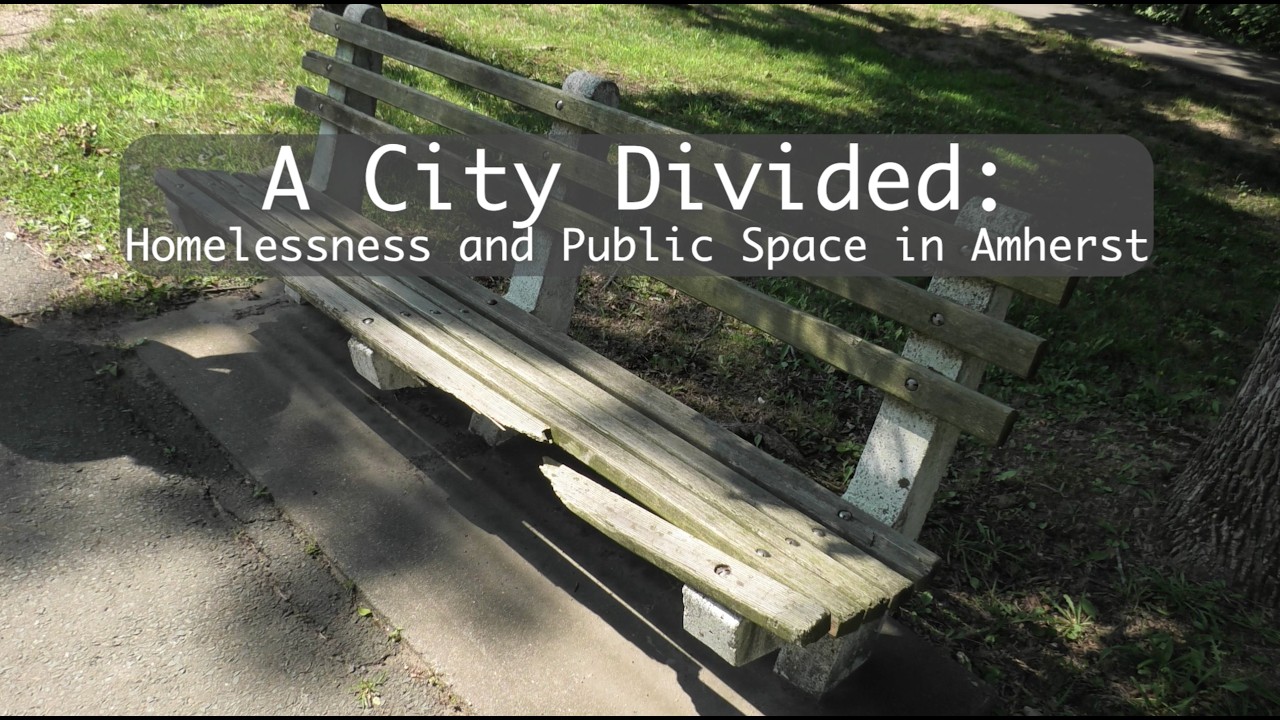
Video summary
The video explores the complex relationship between homelessness and public space in Amherst, highlighting how local signage and infrastructure often create barriers rather than support for vulnerable populations. Viewers are shown numerous "no loitering" signs outside businesses that enforce inconsistent laws to push people out of specific areas, effectively forcing those experiencing homelessness into less comfortable or dangerous situations simply because they occupy publicly owned spaces. This environment is described as a "shelter desert," where the lack of accessible sleeping arrangements compels individuals like the two men seen in the footage to sleep outdoors despite their basic human need for rest and safety.
Beyond legal restrictions, the transcript discusses how hostile architecture, such as metal spikes on benches and slanted seating designed to prevent lying down, negatively impacts everyone while disproportionately affecting homeless individuals who rely on these structures for shelter from the elements. The conversation also addresses the severe health risks posed by climate change, noting that heat is a leading cause of death globally and locally, yet public spaces often lack essential amenities like water fountains or shaded seating areas where people can wait safely during extreme weather. For instance, bus stations are criticized for having no benches at all, leaving those who miss their transportation with nowhere to sit while waiting hours for the next ride.
Despite these challenges, there is a growing recognition of the need for change and investment in community resources. Walker Powell, a town planner, explains that Amherst attracts homeless individuals because it offers easier access to food, financial aid, and shelter compared to rural areas or smaller towns. In response to this reality, local representatives are working on projects at Kendrick Park to add sidewalks and seating infrastructure, aiming to make the space more accessible and usable for all residents. Furthermore, there is optimism regarding the upcoming opening of public restrooms in various locations across Amherst, which are expected to provide a significant benefit not only to neighbors but specifically to those who desperately need access to sanitation facilities.
Ultimately, the video concludes by listing existing and future locations where public bathrooms will be available, including Town Hall, several libraries, parks, and recreation areas, signaling a shift toward addressing these critical needs. The narrative urges viewers to pause when they see restrictive signs in their own communities and consider how such policies impact marginalized people who are trying to survive on the streets. By combining an analysis of current hostile environments with concrete examples of planned improvements like new seating and restrooms, the video advocates for a more humane approach to public space design that prioritizes human dignity over exclusionary measures.
Read the full video transcript
Hey, Matteo. You see that sign back
there?
>> Yeah.
>> What does it say?
>> Wetland area. Do not disturb. Please do
not throw trash in this area.
>> Well, I don't know about you, but I'm
seeing a whole lot of trash back there.
And why is there so much trash ON THE
GROUND?
>> NOT ENOUGH TRASH CANS.
This here is one of the many no
loitering signs outside of local
businesses in Ammerst. Loitering is
usually, and it's it's an inconsistent
law. Um, but usually what it means is
you're not allowed to be out of a
certain place, often a local business,
for a certain amount of time. Um, or in
this instance, it says police enforced,
so I guess the police will be called.
This is a problem for people
experiencing homelessness because it
forces them into less comfortable
situations or places just because they
were in a place that was owned by
someone. All around the public places of
Ammeris, you will see signs that try to
dictate human behavior and tell you
where to go and when to be there.
Next time you see one of these signs,
take a second and think about who this
impacts.
Ammerst is a shelter desert
which leads people to sleep outside as
you see here with these two.
Sleep should be accessible [music] to
everyone even if you don't have a bed.
[music]
Hostile architecture,
for example, baldwire
spikes, metal spikes, and slanted
benches affect all people, not just
homeless people.
>> [music]
>> Let's say a bench is like right out in
the sun on a really hot day. Maybe,
[music] I don't know, make them lighter
so that you can someone could move them
to like a shadier spot.
My name is Mala Banzer and I'm talking
about climate change and how it affects
homelessness and AIS. Um, heat is one of
the most um [music] causes of death not
just in the US but all around the world.
>> That's how it ends.
>> They should have put a water fountain
somewhere around here.
>> Maybe I wouldn't have died.
>> [music]
[music]
>> Like [music] I've seen like two bus
stations and they both don't have
benches. What if someone like wants to
sit down? Like let's say they [music]
miss their bus and they have to wait
another like hour or two hours for the
bus. Can't they all know how to lay down
or sit down?
>> According to a 2024 Hampshire County
report, 871 [music] people experience
homelessness in Hampshire County alone.
This includes 122 children, 80 people
that are 65 years or older, 40 people
that are ages 18 to 24, and 202
veterans.
Uh, my name is Walker Powell and I'm a
planner here in the town. I think that
they see it as a good place to
potentially come and find resources that
can help them like food or people who
might help them with money, um, places
to stay, that kind of thing. It's easier
than being out in the country or in a
smaller town.
So, I was meeting with some
representatives from the state about a
project that we're working on here at
Kendrick Park. We're going to be adding
additional sidewalk um and seating
infrastructure to make the park more
accessible and usable.
>> Uh do you have anything to say about the
public bathrooms that are open soon?
>> Only that it's been a long time coming
and I'm really glad they finally got
them here and that they're going to be
opening soon. I think they're going to
be a huge benefit to the neighborhood
and people who need bathrooms.
Public Grooms in Amoris can be found at
Town Hall, Banks Community Center, Jones
Library, temporary location, Mson
Memorial Library, North Ammeris Library,
Gra Park, Mil River Recreation Area,
Community Field, Ammeris Police Station,
and Kendrick Park. Coming soon.