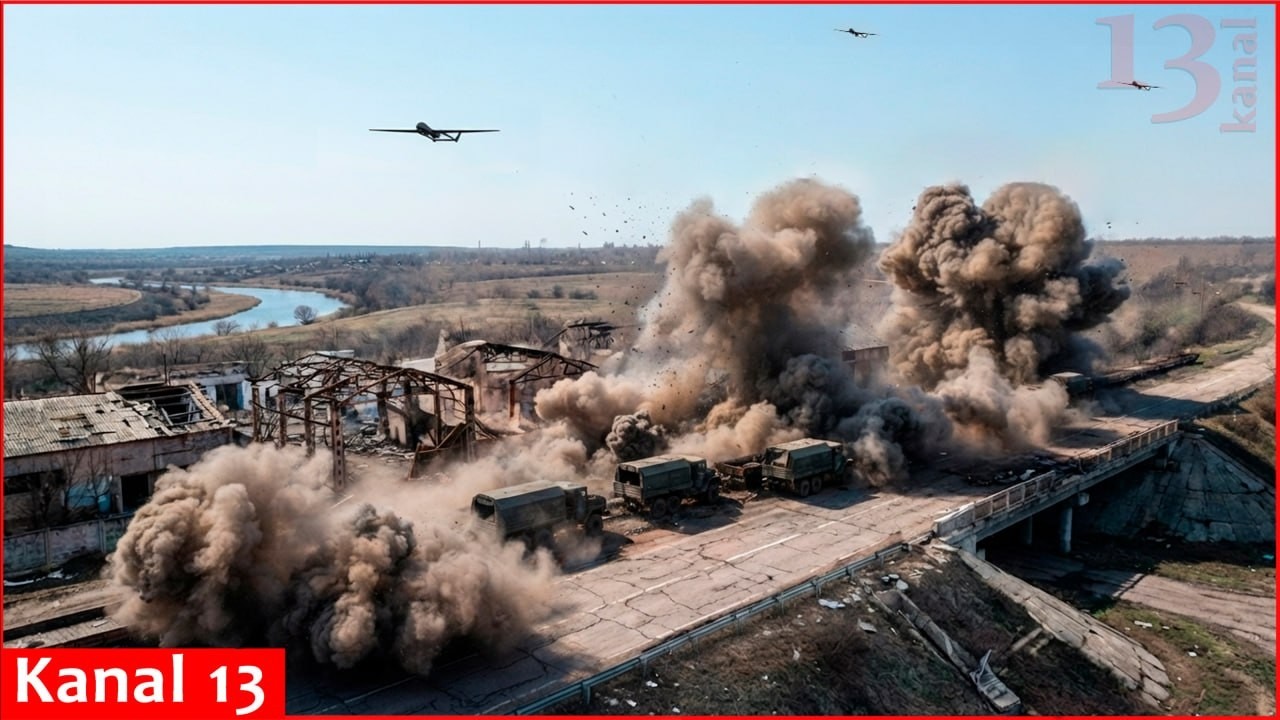
A big nightmare for the Russians at the front; Ukraine hits a target on battlefield in three minutes
Watch on YouTubeVideo summary
Ukrainian forces are leveraging the Delta system, a sophisticated digital platform that creates a unified picture of the battlefield to enhance command and control operations. Developed within Ukraine since 2014, this software integrates data flows from various units to rapidly identify targets and coordinate attacks, effectively serving as a force multiplier. The system's primary advantage lies in its ability to drastically reduce the time required to engage enemy positions; while it previously took at least twenty minutes for artillery to respond to an initial report of enemy locations, the Delta system now enables strikes within just three to five minutes. This significant acceleration in engagement speed is credited with providing a decisive tactical edge on the modern battlefield.
Beyond immediate strike coordination, the system offers critical capabilities for tracking targets over extended periods, allowing commanders to monitor the lifecycle of specific threats such as Russian howitzers. By recording when units are first spotted and when attacks are attempted, the software helps prevent repetitive errors and optimizes resource allocation. While the United States military regards this Ukrainian-developed tool as exceptionally powerful, noting that American systems currently lack its full functionality, there is ongoing development to integrate artificial intelligence features and chatbots into the Delta platform. Despite Russia's efforts to create a variant known as Delta 4, experts warn that Western armies must quickly adapt or risk falling behind in the evolving nature of modern warfare.
The conflict in Ukraine has fundamentally shifted military doctrine by proving that the speed of innovation and adaptation is now a decisive factor in determining victory or defeat. German Army Deputy Chief of the General Staff Heiko Hubner emphasizes that deterrence no longer relies solely on the quantity of weapons but depends heavily on connectivity, adaptability, and the rapid scaling of new technologies. This lesson challenges traditional Western emphasis on producing only the highest quality weapons, suggesting instead that the ability to quickly implement and scale innovations is what truly separates winning from losing forces. Ultimately, the war has confirmed that military power in the twenty-first century is defined by how swiftly an armed force can integrate technical advancements into its operational capabilities.
Read the full video transcript
Ukrainian troops are using the Delta
system, which creates a unified digital
picture of the battlefield for command
and control, and which the US military
calls Ukraine's most powerful weapon.
The New York Times explains how the
system works. The program collects data
and helps identify targets to coordinate
the work of different units. It
integrates information flows and
distributes targets for rapid
destruction. The developers added that
speed determines battlefield advantage.
Specifically, the time it takes to
engage a target has been reduced. One of
the charter commanders explained that
previously at least 20 minutes passed
from the moment a unit reported enemy
positions to the first artillery shot.
Now, it takes 3 to 5 minutes.
>> [music]
>> Commanders cite the ability to track
targets over time as a useful feature.
For example, data is collected on
individual Russian howitzers spotted on
the battlefield. Troops can see when
[music] they were first spotted and when
attacks were attempted. This helps
prevent repeating mistakes.
>> [music]
>> It's worth noting that the powerful
Delta software was developed in Ukraine.
Its origins date back to 2014 when the
first drones were deployed, but it took
a very long time for data to reach
units. Ukraine is currently adding AI
features and developing chatbots that
can be integrated into Delta. US
Secretary of the Army Daniel Driscoll
noted that American systems don't have
the full functionality of the Ukrainian
system. Journalists quoted Kateryna
Bondar, a senior fellow at the Center
for Strategic and International Studies
in Washington, as saying that Russia is
developing a Delta 4 variant, but
Ukraine retains an advantage. Western
armies, she warned, must quickly catch
up or risk being left behind. As a
reminder, according to Heiko Hubner,
deputy chief of the general staff of the
German Army, a key lesson to be learned
from Ukraine's fight against the Russian
invasion is that the speed [music] of
innovation and adaptation in military
affairs can be decisive on the
battlefield. This helps not only create
new developments, but also implement and
scale them up. As NATO reconsiders its
long-standing emphasis on producing the
highest quality weapons, German Army
deputy chief of the general staff Heiko
Hubner noted that the speed of weapons
development could be the deciding factor
between victory and defeat. In my view,
the war in Ukraine has undoubtedly
confirmed one key lesson, that the speed
of military innovation has itself become
a decisive factor in military power. The
question is no longer simply who
develops the best technology. The key
question is who can scale innovations
faster and, more importantly, integrate
them into the armed forces more quickly
from a technical standpoint, said
Hubner. The deputy chief of the general
staff of the German Army added that
today, deterrence is no longer based
solely on numbers, but depends on speed,
connectivity,
>> [music]
>> and, most importantly, adaptability.