A 3 million dollar question: how fast does a muon wobble? - EMF 2026
Watch on YouTubeVideo summary
The speaker introduces the Muon g-2 experiment as a pivotal project within particle physics, aiming to understand the fundamental building blocks of the universe by probing its smallest scales. While the Standard Model provides an efficient framework describing known particles like quarks, electrons, and force carriers such as photons and gluons, it leaves significant questions unanswered regarding gravity, dark matter, and the existence of multiple particle generations. To discover new physics beyond this established model, researchers utilize two primary methods: colliding particles at high energies to create heavy new entities or leveraging quantum uncertainty principles to detect subtle effects of heavy particles at lower mass scales. The Muon g-2 experiment specifically employs the latter approach, focusing on the muon, a particle similar to an electron but significantly heavier, which is sensitive to interactions that could reveal hidden forces or unknown particles influencing the universe's evolution.
The core of this research involves measuring the spin precession frequency of muons when placed in a strong magnetic field, a phenomenon analogous to a gyroscope on a carousel. By observing how the muon's spin rotates relative to its momentum as it decays into an electron, scientists can determine a specific constant known as 'g'. Historically, theoretical predictions based on the Dirac equation suggested this value should be exactly two, but early measurements revealed a slight deviation, leading to the concept of the anomalous magnetic moment. Over decades, both experimental precision and theoretical calculations have advanced dramatically, with modern measurements achieving an accuracy of 127 parts per billion—comparable to counting every person in London correctly or measuring a football field to the width of a human hair. This extreme precision allows physicists to detect minute discrepancies that might indicate new physics not accounted for in current theories.
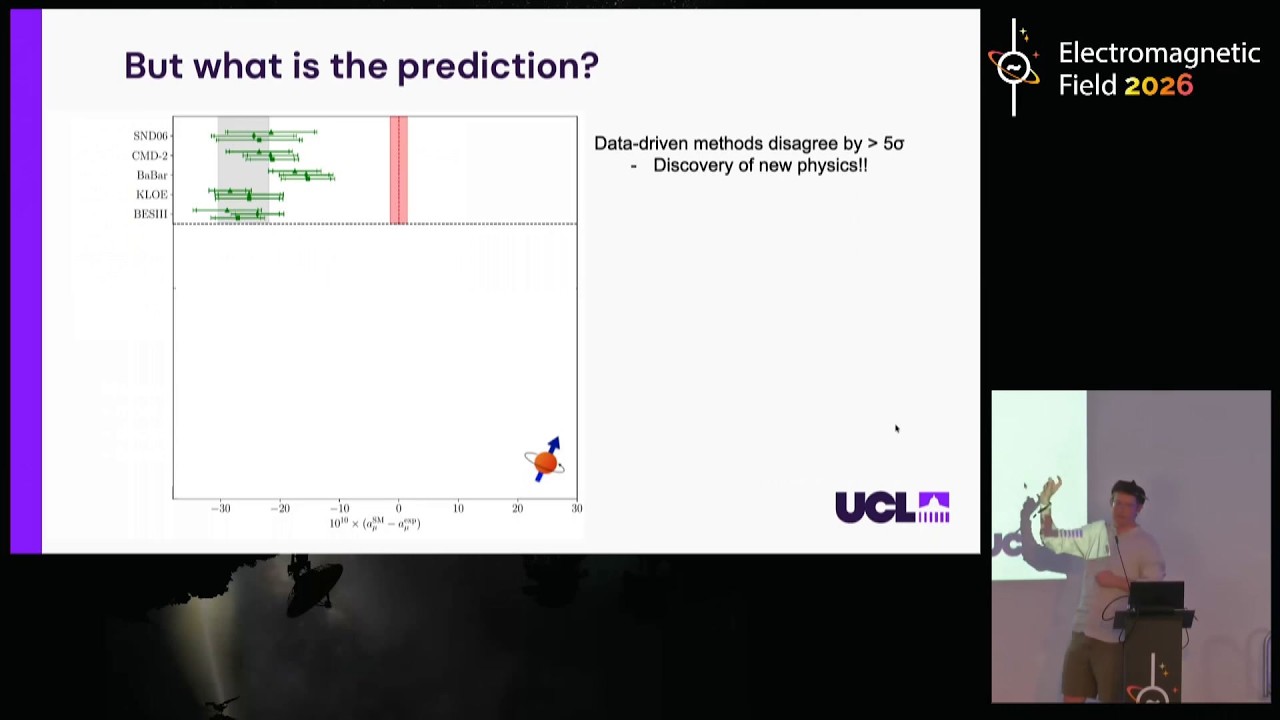
The results presented reveal a fascinating tension between experiment and theory, which initially sparked excitement about discovering new phenomena. When the experimental data was first released, it appeared to disagree with standard theoretical predictions by more than five standard deviations, suggesting the presence of unknown interactions or heavy particles from the early universe. However, subsequent advancements in calculation methods, particularly those using lattice QCD on supercomputers, have produced a different theoretical prediction that aligns closely with the experimental results. This convergence suggests that the initial discrepancy may not stem from new physics but rather from differences in how complex quantum effects are calculated. Consequently, while the experiment has not yet confirmed a fundamental discovery of new particles, it highlights a critical need to resolve why two distinct high-precision theoretical approaches yield different answers, potentially uncovering unexpected elements hidden within the data.
Beyond the scientific findings, the speaker emphasizes the profound importance of funding for fundamental research, noting that the experiment was recognized with a Breakthrough Prize worth three million dollars. Despite this accolade, the field faces an existential crisis due to severe cuts in government funding, particularly in the UK, which threatens to halt such groundbreaking investigations. The speaker argues that fundamental science is not merely an academic exercise but a driver of technological innovation and societal inspiration, often leading to technologies that did not previously exist. As resources dwindle, there is a real danger that these exciting scientific endeavors will be relocated to other countries, underscoring the urgent need to support basic research to ensure humanity continues to explore the deepest mysteries of nature and understand why the universe exists as it does.
Read the full video transcript
[applause]
Uh yeah, great. Oh, that's very loud.
Oh, I guess you can hear me. Okay. Um
thanks for coming out. Um it's difficult
lunchtime slot, I know, but um I'm going
to talk a bit about um so my talk is
about particle physics. I'm an
experimental particle physicist and I'm
going to tell you Oh yeah, there we go.
Um, a bit about one experiment that I
work on. Um, as you know, particle
physics is a fairly esoteric subject in
some ways and this is a fairly esoteric
experiment on in a fairly esoteric
subject, but it's one that got super
interesting um because of what we
measured.
So, these are some of the headlines that
we got really around the world um when
our results came out. So, I'm going to
try and explain a little bit about what
it is we were trying to do and what we
measured.
It was quite fun, I've got to say,
seeing people trying to explain our
measurement um in the newspaper. But
let's see see how I get on. So, let's
start big picture. So, what is particle
physics? um we're essentially trying to
understand
um the the the stuff around us, the the
world around us, the universe that we
live in by looking at it at its smallest
scales. So trying to understand what are
the fundamental building blocks that
everything is made of and those are the
particles that we talk about.
Um this is our kind of understanding of
the universe
where particle physics fits in. You
know, there was a big bang 13.7 billion
years ago. And in the Big Bang or very
soon after the Big Bang, all of the
particles that we that we know of were
created. And then essentially the
universe has evolved
since then.
As a field, it's been a kind of around
for 150 years or so, depending on how
you count. Um, we've we've learned a
lot. our understanding of the universe
on this fundamental scale is is really
impressive. Now we have this theory
called the standard model and this is
like the periodic table of the standard
model. So these are all of the
fundamental particles that we we know
about and as far as we can tell this is
this is it. There isn't anything else.
So it's quite efficient in a lot of
ways.
Um to break it down a bit, you only need
the actually the four on the left to
explain everything that you can see in
the universe.
Um the top two, those are up and down
quarks. Those make up protons and
neutrons which make up the atomic
nucleus. And then you've got the
electron which orbits the nucleus. And
that's that's um all the atoms in the
universe. We've got the one at the
bottom is a nutrino. Um so this is
slightly weird particle. It's involved
in some kinds of radiation but it's
really critical in how um fusion happens
in the sun. So
the ones over here um these are called
bzons. These are force carrying
particles. So these are how the ones on
the left interact with each other. There
are some um three different forces
represented here. We've got the photon
which is electromagnetic.
uh glue on strong force and then this
weak force. So this is how everything in
the universe interacts if you don't
count gravity. That's one of the missing
features.
Um we've got the the Higs Bzon up there
which is a slightly different kind of
force carrying particle. It's not really
a force carrying particle. That's the
most recently discovered particle in
this map. It was discovered in 2012
and it's why
other particles have mass essentially.
Then there's all the other ones in the
middle and we don't really know why
they're there. Um there seems to be you
we've got our four on the left which
make up everything in the universe and
then there's two copies of that set.
They're called generations. So there are
three generations of particle and they
get basically heavier as you go across
and the heavy ones all decay and you're
just left with the lighter ones. We
don't know why. We don't know why any of
this is looks the way it does. And that
that's one of the questions that we have
nowadays is well how does gravity fit
into this picture?
Why is this the particle content of the
universe? And we also know from
cosmological observations there's
something called dark matter out in the
universe and that isn't here at all. So
there's clearly other stuff going on.
And where we're at um as a research
field is that well any experiment we've
tried to do in a lab this picture can
explain it but we know there must be
something else out there. So we're now
like trying to do experiments to
discover the next thing essentially.
Uh I'm going to talk a bit about this
particle which is it it is the best
particle.
It's called the muon. So we'll come back
to that. Uh from where it's sitting you
can see it's like an electron but
heavier. That's
so how do we go about discovering
something new? We've got two main ways
of doing this really. Um one of them is
using Einstein's equation= mc^². So we
think there must be some other force of
nature out there, some other kind of
particle, it's probably quite heavy. If
you collide things with enough energy,
you might be able to make this very
heavy new thing that we've never seen
before.
Um, the other way you can do it is
through the uncertainty principle. It's
a bit like quantum tunneling. It's a bit
tenuous. I know. I just love this
picture so much. I try and work it into
all my talks. Um, the idea is that if
you measure, so quantum mechanics allows
the universe to borrow some energy. So
something that's extremely heavy can
have a very small effect at a very low
mass scale.
And that's the kind of measurement that
I'm going to talk about.
But to come back to the first method,
this is the kind of forefront of high
energy, the energy frontier as it's
called. It's the large Hadron Collider.
Uh it's just outside Geneva in
Switzerland for scale. This white strip
is the runway of Geneva airport. It's
underground, so it doesn't it's not this
giant glowing orange thing. Um, but it's
been running for a few years. It's where
the Hig bosom was discovered. It's going
to run for another 15 or so years. Um,
no other obvious discoveries have
dropped out. That doesn't mean there's
nothing else there. It just means that
whatever if there is something to be
discovered, it's quite buried in the
data somewhere.
So, we're also looking in other
directions and and this is the
experiment I'm going to talk about. Uh
this is um it's called Muon G minus 2.
For a sense of scale, it's much smaller.
You can see there's there's two people
standing in the middle and it's really
targeted. So with the the LHC, the large
hydron collider, you can measure many
many many things all at once. With this,
we were trying to measure one number
really really precisely.
So what were we trying to measure? Um if
you've done undergraduate quantum
mechanics um you will have heard of this
thing called spin procession.
It's a bit like a gyroscope really.
So these particles so electrons, muons,
things like that, they all have this
property where they appear to be
spinning. Uh and they carry electric
charge. So a spinning electric charge
acts a little bit like a magnet. And if
you put that in an external magnetic
field, it will process. the spin will
process just like a gyroscope. You get
this um rotating motion.
Um the
equation which describes that
procession. So you got the omega there
which is the procession frequency.
It's given by this equation in a simple
way. Um, you know, the the speed of this
procession is gi determined by the
amount of charge a particle carries, how
fast it's spinning, how heavy it is, and
how strong is the external magnetic
field you've put it in.
And then there's this other thing in
there, G, and that's just a number. It's
like a constant of proportionality,
and that's the thing we measure.
So, a bit of history. Um
the first prediction for what G should
be was um comes from very early days of
quantum mechanics. Um DRA
you can derive it from DAC's equation
which is given here very this is like
the fundamental equation of the whole of
particle physics. It's it's very very
important equation. It's on DAC's
memorial stone in Westminster Abbey if
you ever go to have a look. But from
this you can work out that G should be
exactly two.
And the problem was that people went and
measured it about 20 years later and
they found that well it's almost two but
it's not it's a little bit higher than
two. And so that um sorry I don't have a
pointer but the plus or minus 6 is the
uncertainty on the last digit there. So
it's it's a very close to two but it's
definitely not two. And this was called
the electron anomaly. And this was a
real puzzle for well about a year uh cuz
in the same year so Julian Schwinger who
was a theoretical physicist at the time
went away and did a more complicated
calculation
and down here are some finement
diagrams. It doesn't really matter if
you don't know what these are but
they're ways of representing how
particles can interact. Um, the one on
the left shows an electron interacting
with an external magnetic field and the
one on the right shows a slightly more
complicated way that that can happen
because you got an extra photon in the
middle.
So the DRA equation basically tells you
the one on the left and Schwinger
calculated the one on one on the right
and he got this answer here. So it's two
plus a little bit extra and that little
bit extra then bought the prediction
very close in agreement with the
measurement. And again, this was a very
important result in the development of
quantum field theory. It's on
Schwinger's gravestone as well.
Um, current state-of-the-art um the
theory well the precision has increased
very very dramatically as you can see.
Um the predictions mostly done by um
Kinoshitan up there who amazing guy well
into his 80s he was still doing these
incredibly complicated calculations and
publishing them. he sadly died a couple
of years ago. U but you can see the
measurement has also increased um in
accuracy and that currently the
measurement is more precise than the
theory and this is according to
Wikipedia the most precisely determined
quantity in physics and what it tells
you is that you know the theory really
works. It really describes nature for
the electron.
Now we come to the best particle the
muon. The muon's a bit heavier. uh and
because it's a bit heavier, you have to
start worrying about other other kinds
of interactions that can happen. It's
the thing about the uncertainty
principle. Um if an interaction is
mediated by a heavy particle and you get
a bit closer in in your energy scale,
you start to feel the influence of that
very heavy particle. So for the muon you
have to calculate more things
and the question is well what if for the
muon there are some unknown interactions
happening. So then if we did our
calculation we would get one number and
if we did our measurement it would
include this previously unknown
interaction and we would get a different
number and that would be the sign that
we've discovered something.
So how do we measure it? Well it comes
back to this equation. Um
we know the charge of the muon the spin
of the muon the mass of the muon. So we
just put some muons in a magnetic field.
We measure how strong the magnetic field
is and then we measure that procession
frequency.
Um, this is our magnet. So, it's the
thing in it's got a white blanket on it
here to keep it the temperature level.
Um,
our muons, they come in at the top. You
can see those red uh magnets there. So,
that's the mon beam line. The muons come
in, they enter this magnet, and when you
put a charged particle in a magnetic
field, it starts moving in a circle. So,
then they just start going round around
our magnet.
And the the the animation on the left
shows you what happens. So at the start
um the the spin vector is aligned with
the direction the mon is going. But then
the spin vector you get this procession.
So the spin vector starts rotating, the
momentum vector starts rotating but at a
slightly different speed.
So now you've got something that's a bit
like a gyroscope on a carousel.
Uh and we have to measure where the red
arrow is pointing basically. Um the
method for doing that is is really
ingenious and it's been developed over
many many decades. Uh but we wait for
the muon to decay and it decays into an
electron. The electron has a bit less
momentum so it falls towards the center
of our magnet and then we have all of
these um boxes around and they count
they measure electrons that hit them and
they measure the time and the energy
that those electrons arrived.
So why is that useful?
So the point is that um the electron
wants to go generally in the direction
the spin vector is pointing the
direction of the red arrow. So when the
red arrow and the blue arrow are aligned
the electron is basically being thrown
forward and it will have slightly more
energy. When it's anti-aligned the
electron is wants to be thrown backwards
and it will have slightly lower energy.
So the plot in the middle shows the
energy spectrum that you measure as a
function of time and you can see it's
going up and down. as the spin and
momentum align and then anti a line and
then a line and anti-line and so on. So
what we do the simplest thing you can do
is just count how many electrons you see
over some threshold.
So electrons above some energy level and
just count the number as a function of
time and you get this
um the technical term is a wiggle plot
for this and the frequency that you see
on this wiggle plot is then the spin
procession frequency.
Then we measure the magnetic field.
We've got the procession frequency and
from that we can extract the G value.
It is a little bit more complicated than
that. This is why it takes several years
to do this and to do it to the accuracy
that we want to do. I'm not going to
explain this at all. [laughter] Um, but
this is really the full equation that we
use. There's many other effects that
need to be taken into account and
understood at the kind of part per
billion level.
The plot on the left shows you our full
wiggle plot and then some of the other
effects that again have to be taken into
account there.
Um,
given the time I'll I'll move on to the
result.
Um
so the the the the results are shown up
there. Um what we have uh on the on the
axis is it's called A. So this is
basically G minus 2 which is the name of
the experiment. It's it's how far away G
is from two essentially.
Um the top the blue line is um a
previous experiment which is that
um result came out about 20 years ago
that was done at Brook Haven to BNL
Brook Haven National Lab. And then the
red points are from our experiment uh
which is in in the US. It's at Fermy Lab
just outside Chicago.
And we've released um three different
data sets. So the first one you can see
the top line has a large uncertainty bar
on it and then we we improved our
understanding of the experiment and
added more data and and our measurement
got more and more precise
um until we arrive at the run 1 to six.
So the bottom red number which is our
kind of definitive measurement and if
you combine it with all of the previous
experiments as well you get the purple
point at the bottom but you can see it's
totally dominated by our single most
precise point.
It's hard to kind of get it from this
plot but this is really an amazing
achievement. It's a measurement that's
accurate to 127 parts per billion. Like
how do you quantify that number?
Uh, one way to think about that is if
you tried to measure how many people are
in London right now and you got it
correct to within one person, that's the
same level of accuracy. Or if you
measured like the length of a football
field and you got it correct to within
the width of a human hair, that's that's
the same level of accuracy. Um, it's the
most precise measurement that's ever
been made a particle accelerator.
And it was really like decades of
progress from three generations of this
like iterate iterative improvements on
this experiment and the method.
Um the the final result um there
combined with all the previous efforts
that went into it was awarded the
breakthrough prize. So that's the 3
million prize that's in the title of my
talk. Um they call themselves the Oscars
of science. I don't know.
I'm not sure anyone else calls them
that. Um, but it was it was a really
nice recognition of, you know, what is
really an amazing scientific
achievement.
The reason it's hard to interpret on
this plot is because I'm not showing you
what the prediction is yet. So, here's
just like we've just gone and measured a
number. Is that interesting? Nobody
knows. What number did we expect to
measure? That's where it gets
interesting. So, now let's compare to
the theory. So, this is a slightly
different graph. So this um now shows um
how far the prediction is away from the
experiment and the experiment measure is
shown as the red band. So the band is
the uncertainty on our measurement
and then the green lines are some theory
predictions
and you can see that they don't agree
and they don't agree if you're into
stats at all. They don't agree by more
than five standard deviations which is
normally the point in my field where you
would say you have discovered something
and what could it have been? So it comes
back to this fact that you know G is
just this number but it has many many
things influencing it. And if you do a
calculation taking into account all the
things that we know
you will get one number but nature will
include everything that is possible. And
so there may be some new physics effects
in our measurement which are not in our
calculation. And so the fact that they
don't agree suggests that that's that we
have discovered
something.
But [sighs]
then there was a different way to do
this calculation. Um so the the top
ones, the green points, um the
calculation is actually very hard and
and it's to do with this thing in
particular. Um you can ask me more in
the Q&A afterwards if you want. Um so
there's a different way to calculate
this number. Um the top ones the green
ones use data inputs to calculate it and
the bottom one is what's called latis
QCD. So this is almost like a first
principle calculation. It's done on
supercomputers.
And the latis predictions are shown in
blue. And now you can see that they
agree actually rather well with our
experimental measurement. So you know
science
um it's the scientific method in action
I suppose
we um have learned something about how
to calculate this property we haven't
discovered anything fundamentally new it
seems unfortunately uh but no there is
still a bit of a question as to like why
these two theory calculations disagree
so I think when we put our first result
out there was a lot of excitement
because we didn't have the latis points
so the latis point had only just come
out. So we at first we thought we'd
really discovered something and now it
seems like um there's a lot of work to
be done on the theory side in
understanding why these two methods
disagree. So there might still be
something unexpected hiding in the data
which is behind the green points but
we'll have to see
how am I doing for time.
Oh I've got I've gone quite fast then
right um because so that that brings me
to the end. So this is really the status
um of this experiment. Um I tried to
think of like what is kind of a tagline
for what we do and it's kind of like um
zooming in to see the big picture in a
way. I mean by
measuring something so very very
precisely you can learn about effects
that are that kind of influence the
whole universe in a way. We're we're
trying to see if there are some there's
some influence on this number to like
the nth decimal place which is caused by
some extremely heavy particles which
existed right at the start of the
universe and might explain why we have
the standard model that we do why the
universe looks the way it does.
Um obligatory nod to my to the funders.
Um if you're interested and want to
learn more I wrote a book a few years
ago. You can find out more about it. I
feel like I would be remiss if I didn't
um stop talking about science for a
minute and started to talking about
politics.
Um
last year um we were all very excited
about our scientific results. This year
we're all spending all of our time
talking about funding. Um there is a
funding crisis in our field. Um
there's been lots of headlines about it.
Um,
I'm obviously have a very strong opinion
on [laughter]
the value of fundamental science. I
think fundamental science is incredibly
important. I think it inspires people to
do scientific subjects. I think it leads
to um
kind of transfer of technology and
knowledge and so on techn because you
know in when you do fundamental science
you end up developing technologies which
didn't exist before because you're
trying to do something completely new
and those spill out those spill out into
industry and so on eventually. Um, and
what's happening right now in the UK is
that the the funding for fundamental
science has been cut very dramatically
over the last uh 3 or 4 years. Um, to
the point where it's becoming a bit of
an existential crisis in the UK and
there's a real danger that many of the
kind of exciting things that we do are
just not going to be possible here
anymore and they will be done in other
countries.
Um,
I'll try and end on a slightly happier
note.
>> [laughter]
>> That's all I had. Um I hope you that
gave you some sense of um
what this this experiment does and maybe
why it was exciting. Um
we have to leave here so they can set up
for the next talk. But I'm happy I'll go
to the Q&A tent. I'm very happy if
anyone wants to ask me anything about
any of this or just have a chat about
particle physics or anything in general.
I'll be over there. So thank you.
[applause]