9-8-8 Technical Advisory Board Meeting 20260812 163311UTC Meeting Recording mp4
Watch on YouTubeVideo summary
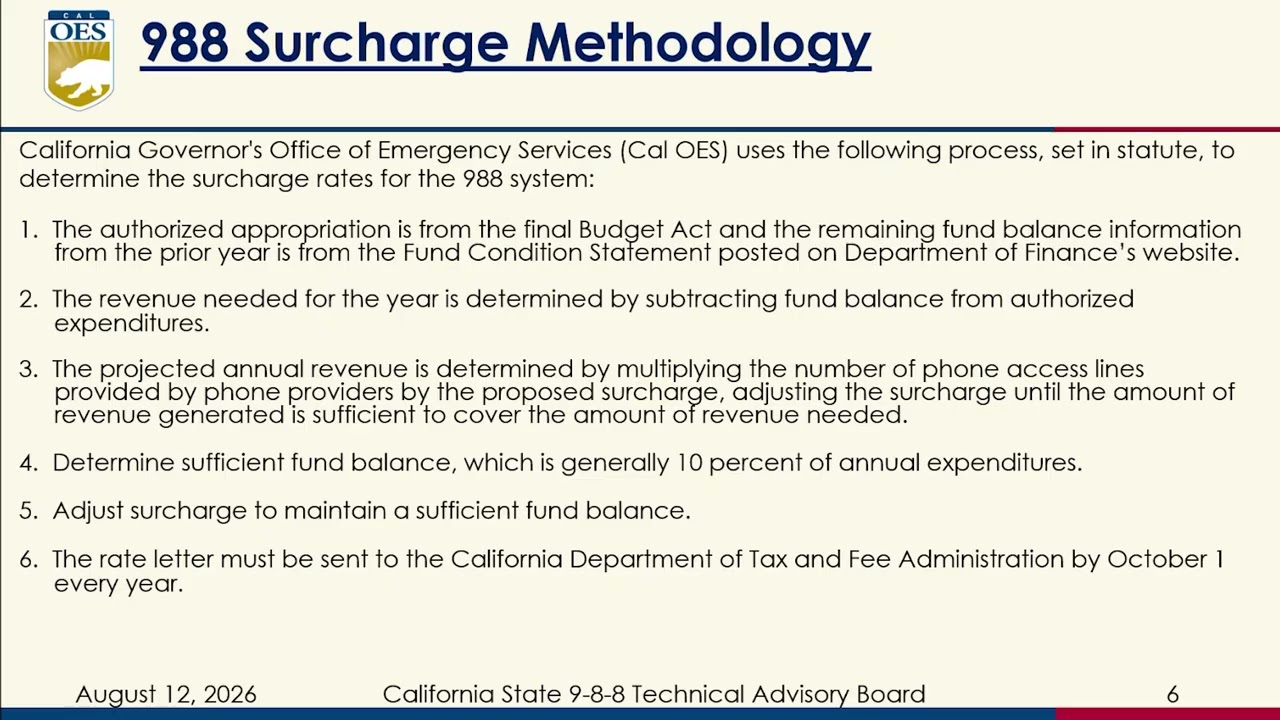
The Technical Advisory Board convened to address legislative updates, financial methodologies, and critical operational delays affecting Next Gen 911 deployment. Paul McGuinness provided a briefing on key legislative deadlines, including an August 13 hearing and an August 31 session end date, while tracking six state bills and four federal bills related to emergency services upgrades and community support. Concurrently, Mary Rucker outlined the process for determining the 988 surcharge rate, emphasizing that carrier data expected early next week is essential for finalizing calculations before the October 1 deadline. The board also approved carrying over the approval of June minutes due to abstentions by Dr. Raflo Yuan and Jamila Fields, who were absent from the previous session.
Significant progress was reported by several working groups, though challenges remain regarding federal interoperability. The 988/911 Interface Working Group requested additional time to finalize their document before a board vote, with staff agreeing to assist in finding an SME for interoperability issues and setting a target date of November 12 for completion. Meanwhile, the Accessibility and Equal Access Working Group finalized their charter and planned attendance at a Tribal Health Coalition conference in San Diego. The 988 Implementation Working Group paused activities pending clarity on a potential Memorandum of Understanding (MOU) delay with SAMHSA, while the Call Handling Solution Analysis group reviewed a memo regarding statutory requirements, noting that state law does not mandate a specific platform but contract details remain unclear.
A major obstacle highlighted during the meeting was the lack of a finalized MOU with SAMHSA, which currently prevents expanding the pilot program beyond the Buckelew site and limits the deployment of additional call centers or chat/text modalities. Although the team has successfully tested chat and text capabilities in a lab environment, production deployment requires SAMHSA approval and external changes for 911 interoperability. The board expressed frustration over these bureaucratic delays that hinder critical communication systems and confirmed that contacts were made with ten centers to gauge their interest in moving forward, despite the current limitations. To ensure future efficiency, the board agreed to explore answers to outstanding questions offline via liaisons and staff, approved dating future drafts, and established a new agenda submission requirement of at least 20 days prior to meetings. The session concluded with an update from Cal HHS regarding an upcoming advisory group meeting on September 9th to review the draft annual progress report for AB 98 implementation before adjourning.
Read the full video transcript
And we've established a quorum, we're
moving on to the next part of our
agenda, which is the approval of the
previous meeting's minutes from the June
meeting.
Um
And so, I'll uh go through essentially
the same exercise here asking for a roll
call vote um
as to whether to approve the meeting
minutes from the June meeting. So, I'll
start uh with the top of the
Oh, oh yes, please. Thank you.
>> Terry, uh motion to approve.
>> All right, I have a motion. Do I have a
second?
>> Second.
>> All right. Thank you. I have a motion
and a second. We will then um
Yeah, we will call for public comment
before we take the vote. So, to that
point, uh is there We'll start in the
room with the public comment section.
Please keep in mind if you're making
your public comment that there are many
people who might like to make comment
and so, limit your remarks to under 3
minutes if you would, please. In the
room is there any member of the public
who would like to make comment on the
motion?
Seeing no hands, uh
we'll say there's no comment in the
room. How about online? Is there any
member of the public online who would
like to make comment?
And we're not seeing any hands online.
So, okay, we'll move then to the roll
call vote
um starting with Dr. Bowie. How do you
vote?
>> Approve.
>> Thank you.
Sherry Sin Welsky.
>> Approve.
>> Approve. Thank you. Diana Gutierrez.
>> Approve.
>> Thank you. Amitria Sydney.
Aaron Riley.
>> Approve.
>> Thank you.
Serena Lewis.
Dr. Raflo Yuan.
>> I will abstain. I unfortunately was not
able to make the June meeting.
>> Very well, thank you.
Lan Nguyen.
Dr. Garzon.
Approve.
Thank you.
Terry Galvin.
Approve.
Thank you. Jamila Fields.
>> Abstain. I wasn't present June meeting.
>> Thank you.
Ivan Bardwaj.
And Tracy Gonzalez.
All right, so
>> One, two, three, four.
>> All right, with the given that we have
the
abstain votes,
the
motion doesn't pass and so we'll carry
that item over for our next meeting.
Um
at that time we'll consider it again.
Thank you, everybody.
Uh moving on to our next agenda item.
Um this is the CalOES Legislative and
Governmental Affairs update wherein
Office of Legislative and Governmental
Affairs will step to the microphone over
there and provide an update on bills
that are being tracked.
>> Uh thank you, Steve. Um good morning. My
name's Paul McGuinness, Legislative
Coordinator at CalOES.
Um I'll provide a couple key dates that
are upcoming in the legislative um
cycle and then um give an update on six
state bills and four uh federal bills
that we are tracking closely.
So tomorrow, um August 13th,
um is the appropriation suspense file
hearing. So, this is the deadline for
all the bills to pass out of the fiscal
committees.
Uh also the deadline for fiscal
committees to meet.
Um after 2 weeks after that will be the
end of session, so August 31st is the
last day for the legislature to pass all
bills.
And then, um the governor has another
month after that date to act on all the
bills that will be put on his desk. So,
that's September 30th.
Um and then, January 1st, um statutes
will take effect um that do not have an
urgency clause.
If a bill has an urgency clause, they
take effect upon a governor's signature.
So, getting into just a quick update on
uh six state bills. So, first bill is AB
1540
by Assembly Member Gonzalez would um
require uh CalHHS to just to annually
determine whether an adequate uh
federally-operated uh specialized LGBTQ+
uh suicide prevention hotline is
available through 988, and if not,
requires CalHHS to request that SAMHSA
establish
a uh press three option to route callers
to a specialized call center.
Uh following federal approval, CalHHS
would
be required to ensure necessary
technology is available.
Uh while um CalHHS would um identify um
and contract with qualified providers
and administer
associated funding.
This uh measure is um on the suspense
file, so it will be heard
uh tomorrow.
Uh next is AB 1832
by um Assemblymember Ranson. This bill
would create a 211 uh fund and require
CalHHS to distribute uh funds for
purposes of statewide uh
211 capacity.
Um also, among other things, including
system alignment with 911
and 988. This bill is uh will also be
heard tomorrow [clears throat] on the
suspense file.
AB 1872 by Assembly Member Ta would uh
increase penalties for repeat uh false
911 emergency reports
and extend liability to property damage
caused by emergency response.
Uh this bill is also on the um suspense
file.
AB uh 2041 by Assembly Member Correa
would require a public safety agency
that was not providing pre-arrival
instructions to 911 callers on or before
Jan 1 of '26 to report their
uh
to their local emergency medical
services agency the status of that uh
their compliance on or before Jan 31
of '27. And this bill is on Senate third
reading.
Um AB 2093 by Assembly Member
Bauer-Kahan
um
would, among other things, extend the
state's 988 advisory bodies through 2029
uh would shift uh some statewide 988
governance to CalHHS, uh require CalOES,
in consultation with DHCS,
to procure, implement, and designate a
statewide interoperability platform
uh to be capable of facilitating
real-time communication and warm
handoffs between 988 centers and 911
uh PSAPs.
The bill would also set additional
statewide standards for 911 and 988
handoffs.
Uh this bill is also on the um Senate
Appropriations uh suspense file
to be heard tomorrow.
And then um last state bill is SB 985 by
Senator Strickland, which would require
CALOES
uh to submit quarterly legislative
reports on NG911 development,
implementation progress, spending, and
responses to
uh state 911 advisory board
recommendations.
That bill's also on the suspense file.
Um uh real quick, just four federal
bills we're continuing to track.
Um HR um 6505's
the um Next Gen 911 Act
by uh
Representative Hudson.
Uh would amend the National
Telecommunications and Information
Administration Organization Act to
provide further deployment and
coordination for Next Gen 911.
Um as of January 26th, this bill is in
the subcommittee.
Um
and is going to a full committee voice
vote.
Uh HR 7031,
Representative uh Fulcher.
Would direct the Secretary of the
Interior to upgrade existing emergency
communication centers in units of
National Park System to Next Gen 911, as
well as for other purposes.
Um this one is also in subcommittee as
of March uh 2026.
And there's two more bills, S 725.
Um this is the Enhancing First
Responders Act.
Senator Klobuchar would require
the FCC to report on certain activations
for the Disaster Emergency uh
Information Reporting System.
Uh
this bill
uh passed the Senate
and is being held at the desk.
And then um last bill is S 2826,
988 LGBTQ+ Youth Access Act.
Um directs the Secretary of HHS to
dedicate sufficient resources for the
support of LGBTQ plus youth seeking help
from 988 suicide prevention hotline and
for other purposes in this bill as of
March
is in the committee on health,
education, labor, and pensions.
Uh so that completes the um legislative
update for this morning. Um I will make
this list available
uh through the liaison to the board and
happy to answer any questions.
>> All right, thank you. Any questions from
the board members here in the room?
All right, seeing none here in the room.
How about our board members online?
And seeing and hearing no
nothing there, we'll thank you for your
report out, sir.
>> Thank you, Stu.
>> Um all right, this time uh we'll move to
the public comment for the legislative
and governmental affairs update. It's uh
same uh structure as before. We'll start
here in the room. Uh if there's any um
please keep your comments to under 3
minutes. Um
Yeah, and this is yeah, related to the
report out that we just heard, which is
the legislative and governmental affairs
update. So, in the room, any takers for
public comment?
Seeing no movement, uh how about online?
Any any public comment on the
legislative and governmental affairs
update?
Seeing no takers there, then we will
move on to the next item on our agenda.
It's item number four,
the 988 surcharge rate setting. Uh and
so
Mary, if you want to go ahead and take
it away.
>> Great. Good morning. Um my name is Mary
Rucker and the assistant director of Cal
OES of administrative services.
Today I'm just going to go over the
methodology for how the rate is
established. It's based on the
authorized appropriation from the final
budget act and we take into account the
fund balance that's left over from the
prior year. To calculate what the
revenues needed is the difference
between what the authorized expenditures
are and the fund balance.
From that we then take the
um
the number of access lines per month and
come up with the rate per month to get
us to what the revenue is that's needed
to be collected. From that then we will
adjust it further to account for a 10%
balance to keep in reserve.
Um and then once that number is
finalized, we will
commit
communicate that out and we will
establish a rate letter that goes to
Department of Tax and Fee Administration
to set the fees effective
January 1.
>> And just a quick question on that.
I recognize that it relies on the number
of access lines that come from the
carriers. How close are we would you say
to getting the full set of data we need
to perform that calculation?
>> We're We're hoping by early next week.
There's still a couple carriers that are
larger
communication operations that have
numbers that could swing it still.
>> All right. Thank you. Any any questions
from the board members on that?
How about our board members online? Any
hands raised out there?
No.
So I'll just comment on this uh we you
know, this is the time of year where we
talk about the rate setting obviously
over the next couple of months is when
uh
when it'll actually be accomplished and
we recognize that
we're going to be uh performing that. I
think the deadline to submit it to tax
and fee administration was October 1st
if I'm correct. Yeah.
>> And so uh we've made a commitment in the
past to share it with uh with the
members here
uh 30 days in advance of that. So, um
you can look forward to that coming
along. As soon as we get the data, then
we'll perform the calculation and we'll
begin the sharing process so that we can
meet that deadline.
Um okay. So, with no questions then um
we'll turn uh to the opportunity for
public comment on the surcharge and rate
setting
uh starting in the room. Any takers in
the room to make public comment on the
rate setting methodology?
Seeing none in the room, we'll turn our
attention online. Any takers for public
comment on the rate setting methodology?
And we're seeing none there either. So,
we'll thank you Mary for your report
out.
And we will move on to the next item on
our agenda, which is the working group
reports. Um
And so, we'll start
um
the first one we have up there on the on
the slides the 988 and 911 interface
working group report. And
so, this one includes Shaheen Saeed and
Dr. Hernando Garzon. If uh you'd like to
please go ahead and make your report,
we'd be
we'd be gratified.
>> Yes, good morning. We're we're happy to
report out. So, we had our first work
group meeting and we have shared the
purpose of the workgroup as well with
Samantha which is we'd like to focus on
a high-level document
in terms of the protocols that way each
911 and 988 Center can curate the
document
in a way that fits best for them. In
addition to that we have recognized that
it's important to have a recommendations
and a consideration section as well
especially since we have
various SMEs on our workgroup and so
that's something that we're planning on
incorporating as well. And we do
understand that there's it seems like
there's an urgency to get this document
completed. It looks like there one of
the agenda items is to vote on it. We
would like to request that we have some
time to work on the document before the
board is able to vote on it if that's
okay.
>> Yes, thank you for that and it seems
sensible not to
you know make a premature move to vote
on something. So
I think that's a
reasonable recommendation. I don't have
any objection to not
moving for a vote on that item today
given its current state. So
thank you for that report out. I'd ask
if if there's any questions from the
board members on that report out.
Seeing none in the room are there any
hands from the board members online
raised?
No. All right. Well, thank you for that
yeah, go ahead.
>> We yeah, we had one question. So
we understand that the initial purpose
of the workgroup was to really focus on
interoperability between 911 and 988 and
we wanted to ask the board if it's
possible to help identify an individual
who is an SME when it comes to
interoperability because that's the one
piece that's missing.
>> Thank you for that question. Any members
of the board have an idea around
who a subject matter expert might be?
In that regard, it occurs to me that
it's
something of a technical question.
>> Yes.
>> And
as such, it probably then falls to the
technical team
here at OES that would be useful for
that conversation. And
so
I'm looking I see
my chief engineer here in the room and
and he's nodding his head saying yes,
they'd be happy to assist with that. So,
what we'll do is we can uh
identify one of the staff resources here
that can
talk talk with the work group about
that.
And so, we'll put you in contact through
our board liaison afterwards.
>> Sounds great. Thank you so much.
>> Right. Yeah, thank you for that report
out.
Um
All right, if no objections, then I'll
move on to the next working group.
>> Sorry, sorry to interrupt. I this this
is Eric on online. I I did have a
question for the the working group, if
that's okay.
>> Oh, yes, by all means.
>> Um so, thank you to to both of our
working group chairs and the working
group members for taking on this
document, which
as you referenced has
uh been a work in progress for months
and now years. Um
did uh I think the request on
uh
time for now that's been assigned to the
working group and so, you need to
actually work on it. I think that does
make sense.
Um do you have a timeline in mind of
when it would be brought back for us to
review and approve?
>> What would the the board prefer?
Is there a timeline that they have in
mind?
>> I think the general preference is that
sooner is better because we have
um
had had this this document in being
brought forward for a number a number of
months
and it keeps getting delayed. But, I
will also allow other folks. That's just
my impression of of how the the the
board meetings have gone. I'll let other
folks say their opinions as well.
>> Could you share when the next board
meeting is?
>> Yeah, so I I believe it it generally
occurs in November, if memory serves. I
think it's November 12th this year.
Um
and I'm
hoping Yeah, so it sounds like that's
confirmed, November 12th.
>> [snorts]
>> What we could do is plan to have the
document ready by November.
>> That seems reasonable to me. Um any any
objections from any of the board members
with that as a a
>> No, I I think that that's
Oh, sorry. Go ahead.
>> Sorry. I I don't have an objection. I
just want to make sure for process,
would it need to be submitted 30 days in
advance so that it could be considered
for approval at the November 12th?
>> Um I don't think 30 days in advance is
required. It uh would need to be posted
10 days in advance in order for us to
deliberate on it and and ultimately cast
a vote. So,
um and that, of course, can be
coordinated through our board liaison,
Samantha Barton at caloes.ca.gov.
Um
So, uh yeah, if you want to work on the
product and get in touch with uh with
Samantha as to when the date that it
needs to be posted by.
I think it's 10 calendar No, 10 business
days.
>> On the agenda.
Yeah, so target somewhere right around
the 1st of November is when we would
need to have that ready so that we could
post it online and
so forth.
>> Okay, thank you.
>> Yeah.
>> I have a follow-up question from last
meeting.
Um
>> Okay.
>> And it had to do with um
that the technical advisory board is
responsible for the document and not Cal
OES and I had asked a question about
what are the
legal ramifications of the
responsibility of each individual board
member
in terms of taking responsibility for
this document.
>> We can talk about that off offline. I'll
get um some materials over for you.
>> All right.
Thank you for that.
Um
Yes, then.
Um
Okay, where were Yeah, then we'll move
on to uh
within the working group reports agenda
item uh part B is the accessibility and
equal access working group.
And I believe that is um
doctors Bui and Raufli Wan reporting.
>> We have not had a chance to meet um and
I'm going to hand it over to Dr. Yuan.
He has some uh updates.
>> Yeah, so these these will be pretty
brief. Uh
the work group members corresponded over
email to review and and finalize uh
working group charter.
Um and so the most important part is
pretty short, so I'll just read this out
loud. The purpose
of the accessibility and equitable
access working group is to advise the
technical advisory board on the
technical, operational, and policy
considerations necessary to ensure that
California's 988 system provides
equitable, accessible, high-quality
crisis response services to all
Californians, regardless of disability,
language, geography, age, race, or
ethnicity, sexual orientation, gender
identity, immigration status, insurance
status, or veteran status.
Um so, hopefully that's mostly
self-explanatory. One of the the reasons
why we haven't had a lot of activity
these past few months is that we have
not received um
action items or or directives from the
board. So, if there are specific items
that you feel would be strengthened by
our working group reviewing or providing
feedback, whatever way we can support,
please do consider that.
Um and then uh somewhat associated with
that uh later this month is the
Tribal Health um Coalition's third
Tribal 988 uh conference that is in San
Diego. Um and so, we hope to be able to
be able to attend that. And if there are
important pieces of information there
relevant to the board to relay that
back.
>> Wonderful.
That Any questions from the board
members on that report out?
Not seeing any here in the room. Are
there any hands raised from our board
members online?
All right, hearing no comments from the
board on that. Thank you for that report
out. We'll move to part C of this agenda
item,
which is the 988 Implementation Working
Group Report.
And that is
Terry Galvin and Lan Nguyen. I trust
that I've updated the name correctly.
>> [laughter]
>> It
It is correctly labeled. Thank you. Um
we were able to meet one time, and our
next meeting is Friday since we moved
this meeting it ends up after. Um but
our at our last meeting we discussed as
a work group that our work should pause
in favor of the call handling solution
analysis working group because we are
the implementation group. Um and so we
don't want to work at cross purposes and
we do need that information to then
participate in implementation.
Um so
the only questions that we had
outstanding
we're we are curious about the impact on
implementation when we're there um if we
don't end up with a signed MOU.
Um
I know that up until this point we've
just assumed that
the signing will be forthcoming but we
are curious if it doesn't get signed or
they or it is is a long way in the
future,
what is the impact on us implementing
at all.
Um so I don't know if that can be
answered now or later. And then the
other comment we had out of our group
was Ryan was able to on your team was
able to join our meeting and it was
really helpful and Tara attends our
meeting and it's really helpful. So um
as these working groups are
really trying to advance um the work
we were just curious whether we invite
members when we need a technical expert
or whether we can have standing um
participants or or how that particular
part will work because we do find having
the expertise very helpful.
>> Yeah, I think uh you know, as as the
need arises, it would be appropriate to
request the representation
of one of the staff, you know, like as
we mentioned even just a moment ago,
when when there's a need for like a
technical SME,
that would be an appropriate use of the
staff here. And so we're happy to help
um
elucidate some of the more technical
elements and and certainly, you know,
when it comes to
an implementation project um then we
have staff who are tasked through the
course of their jobs to implement
the project. And so it would be
appropriate in that regard as well.
>> Do you have any thoughts about the MOU
signing?
>> Um yes, I have several thoughts on that,
but the ones that I
prepared to share um
I was going to cover in a later agenda
item, if that's all right. Yeah. So just
a a couple agenda items from now I'll
talk a little bit about the status of
that MOU and then I'll of course um
you know
answer the question stated here about
what the impact, should it not be signed
or delayed in signing, would be.
All right.
>> Thank you. And that's the end of my
report.
>> All right.
Um thank you. Any questions from the
board members um
about the report out from this
implementation working group?
All right.
Uh any any board members online have a
hand raised?
No.
All right.
Uh in that case, we'll move to part D of
this agenda item, which is the call
handling solution analysis work group.
And that is uh with Amitria Sydney and
Sheri Senwelski reporting.
>> Thank you, Steve. Uh I actually put a
couple of slides together just to try to
help walk us through this. Um Thank you
for putting those up, Sam. Um so, just
as a reminder of where we were last time
we met um in this meeting in June, um
the work group had presented five goals
or recommendations of what we thought
needed to be done uh in regards to the
Cal call handling system, which was to
define interoperability, determine a
requirement for whether or not centers
needed to be on the platform, if if it
was determined yes, um then based on the
definition of interoperability, as well
as the rest of the centers' needs, we
would redetermine the technical
requirements of a platform and and then
make recommendations as to who might be
best or a process to determine who might
be best uh to meet those requirements as
a vendor. Um and lastly, we also asked
for improved transparency and
communication regarding processes with
CalOES uh because it felt like it was
often taking a long time to to get some
of these things accomplished. Um as my
as I recall, CalOES OES agreed to try to
get us the answers to the bolded items
on the top. So, a definition of
interoperability, as well as the
requirement for the platform uh within
about 3 weeks, so that we wouldn't get
stalled and um be able to actually make
some progress on this before today's
meeting.
Um
I did receive a memo on July 23rd, um a
quite lengthy memo, it was about 12
pages, that did um uh
look to answer bullets number one and
two, and it had a lot more information
in it as well uh that I did have some
questions about. Um I wasn't sure at
that time uh how to get those questions
answered, and I had posed them several
times and didn't get um any responses to
them for quite some time. Um but, on
July 31st, I did get permission to share
the memo with the working group um so
that we could try to react and respond
to it. Unfortunately, that permission
did not come until after our working
group had already met. So, we really I
did share it with them, but we didn't
really get a chance to discuss it or
formally um respond to it or for me to
put those uh
reflections into any format that's
um
really
a consensus at this time. Um and then
yesterday I did receive direction that
we could ask some of our questions and
discuss the memo in this meeting today.
Um so, the memo, as I mentioned, was
quite lengthy and there's
>> Excuse me, I just wanted to um summarize
what you're speaking about. So, in your
last in our last meeting, you as the
chair of this group asked um several
questions, which we worked with uh PSC
in trying to get these communications to
you.
>> Mhm.
>> Um
once that was done, there was a memo
that was sent to you.
>> That's right.
>> Um and the working group.
>> It was actually just sent to me and
Demetrius, but yes.
>> Okay. Um so, that was sent to the
working group or at least the leads of
the working group. Um and then
just for everybody's reference here, um
that was discussing interoperability and
statutory requirements for the 988 board
just so that we know what you're
speaking about.
>> Thank you for that clarification, Sarah.
Um so, yesterday I received uh
permission that we're able to ask some
of our questions here um and to discuss
the memo in in the meeting today. Um so,
I've tried to summarize uh the memo as
well as our questions, but I just want
to give the caveat since I just got this
direction yesterday.
Uh my summary might not be complete. Um
also, I didn't write the memo, so I'll
I'll my best to summarize it, but it's
long. Um and I and I don't have
consensus from the work group because
again, I only got this direction
yesterday. So, I'm just trying to share
the best that I can because I don't want
to have to wait another 3 months to our
next meeting to make some progress.
Okay. So,
um we can go to the next slide.
So, the first key takeaway that I had
from the memo, and please Steve or Sarah
or others correct me if I've
misinterpreted anything.
Um but the first takeaway I had was that
state law doesn't empower CalOES to
impose a mandatory platform or the usage
of a mandatory platform on the centers
uh nor dictate which platform centers
must use.
Um and so, I believe that
so, that's good to know. That's helpful.
Thank you for getting that information.
I think the issue of the requirement is
being in our contract still remains. And
so, we need to determine who might be
able to answer that question for us. You
know, there's no statutory law agreed to
know. Um but what about this requirement
that's still in um
our contracts?
Do you want to pause and discuss each
one-on-one or do you want me to go
through this whole thing?
>> Uh we could No.
>> Actually, I think what would be
uh
better cuz you're doing a report out
from your working group is presenting
these ideas to the board.
So, if you're taking these back for
consensus from your working group, that
would probably need to be done before
the
>> Well, I do have some questions for you
all though before we move forward for
from from so that I can move forward
with the working group.
I believe your email yesterday said if
we had questions, we could ask them.
>> Your You're
You're providing a report out from your
working group.
>> Okay.
>> To the board.
>> Okay.
>> So, you're summarizing what's going on
from the working group. That's what the
agenda item said.
>> That's what I'm trying to do, yes.
>> Okay, so um we can absolutely take
questions from the working group. And
if you have questions regarding the the
memo from the working group, we can
absolutely talk about that offline.
>> Can you Can you Can you tell me the best
way to do that, Sarah? Cuz I actually
tried about four times to talk about it
offline, and no one answers.
>> Okay, well, you can always email the
board liaison.
>> Done that.
>> Which is Samantha.
>> Done that.
>> You can also reach out to Steve Ybarra.
>> I've done that.
>> Okay, well, and we've been working with
you trying to provide you with
information.
>> Mm,
sort of.
>> Did we provide you with a memo?
>> You provided me with a memo, and I asked
for how do we get our questions about
the memo answered, and no one answered
until yesterday, when you said we could
do it today.
>> What I said was you can report out on
the summary from your working group.
That's what's agendaized.
>> Okay.
>> This memo has not been Not that there's
anything wrong with that, but it hasn't
been included in the agenda. It's not an
item.
>> Okay.
>> So, I mean, you're more than
I'm more than happy to have you, you
know, raise these questions regarding
this
um this matter with your working group.
We can always, you know, at your working
group, we can always figure out some
dialogue we can have with that. But, I
don't want to get into the specifics of
the memo, only because it hasn't been
>> I just want to note something that you
said to me yesterday, Sarah, in this
email. I'm just trying to improve our
communication.
>> And yeah, I'm I'm
>> It says "Memorandum was not distributed
to the Cal HH the I'm sorry, to the CHS
work group."
>> please do not read a confidential email
into public notice, public record. Thank
you. Um
the
and I'm just trying to keep us in line
with the Bagley-Keene Open Meeting Act.
We are not discussing the memo itself.
The report outs are very similar to like
the legislative reports or
um like uh the set of fund report.
They're to the board to provide a
summary of the the issues that were
there. I'm more than happy to improve
our communication. I can give you my
business card. You can call me anytime.
Um we can figure out how to get these
these questions answered from the
working group. My concern is that we're
talking about something that has not
been agendaized.
And we're getting into a a deliberation,
a consideration, or um a discussion
relating to any sort of future action.
That's my concern.
>> I understand.
Although I did ask if this could be put
on the agenda.
>> I
apologize. I I I didn't see that email.
>> Okay. Thank you.
Well, I'm not really sure what what else
there is for me to say now if I can't
ask any questions.
>> I I get again you you can ask questions
regarding this memo, just not in this
forum. That's a like a working group
issue. But if you have something that
you want to share with the board, um if
you would like any anything from you
know, your report out from your working
group,
that's perfect that's that's the
agendaized item.
>> So, is it permissible then for
the report out to include the questions
that they've come up with?
>> Absolutely. Absolutely.
>> Which is what I was trying to do.
>> Well, but you're getting into the the
substance of the memo as opposed to we
have questions for the
>> Okay. So, there's a queue there which
was to indicate that we have a question
that this this issue of the requirement
being in our contract still remains. And
our question is to how do we determine
who can provide that answer to us.
Thank you.
We can go to the next one.
So, an another item that we are another
point that was made in the memo um
was that hold on a second, I'm going to
pull my slides so I can see better here.
Um,
>> [gasps]
>> so CalOES shared a definition of
interoperability,
um, which from Nina is the ability of
disparate systems to communicate with
one another.
Um, and CalOES, I believe, was noting
that interoperability for 911 988 has
been established,
um, as shown by the Buckaloo pilot. Um,
so our questions on that one is we were
trying to understand whether or not
interoperability is simply the same
transfer of a 911 call to a 10-digit
number as it was prior to the platform
being implemented, um, or if there is
something different or special about
using the platform to transfer these
calls.
Um, if it's the same process as before,
um, some of the centers have reported
that there's some challenges with that
at times, and so we were wondering, will
CalOES, uh, still be available to help
with technical issues? I know in the
past Kurt has been very helpful for
DDHSD specifically, and so we just
wanted to know if CalOES is still
available for one-off concerns.
Um, and then we were also wondering if
interoperability related to 988 chat,
text, and follow-up calls was completed,
um, cuz from right now we only
understand that there's the ability to
transfer,
um, calls, but we're concerned or
curious about chats and texts.
Um, the next thing that we noted that
was in the memo, um, is it went on to
review what is allowed or not allowed to
be, um, a use of the funds from the 988
surcharges.
Um, specifically, you all have seen this
before, so I don't think I need to go
into all of this, but it just reiterated
that the 988 surcharge, um,
makes clear, uh, where those funds
should be used, including administrative
costs being paid first, um, including
that the centers, um, are prioritized
first, and secondly, uh, that funds can
be used for mobile crisis teams. Um, and
I believe that it was also suggesting
that the provision of a CRM, a customer
relationship management platform, either
as part of what's already been developed
or separate, um, would potentially be
something that AB 988 surcharge funds
could be used for, um, because it looks
like other states have done similar
things.
Um, so I think that finally, in
conclusion, if I'm allowed to say this,
if not, stop me. Um, the last slide,
um, is that, um, basic interoperability
of 911 to 988 transfers exist, um, but
perhaps other elements of
interoperability do not exist. So I
think that maybe, as we talked about
last time, there's a lot of different
definitions of what interoperability is.
Um,
that there is no interoperability right
now at a state-wide level for 988 and
mobile crisis, um, so while those things
are happening, they're happening between
simple as simple referrals, as direct
transfers, or some 988 centers have
their own technology to dispatch. Um,
CalOES CalOES has asked the work group,
um, if we seek deployment of the current
NGA platform, um, and I believe that we
still need some further information,
which are the questions that I posed,
um, which is, are we required to use it?
And specifically, if it's doing anything
special for 988 911 transfers.
Um, and that perhaps further support, so
this goes into goals four and five that
we had in my initial recommendations
that further support of interoperability
could be explored if that's so desired
and properly defined.
So, the work group is happy
to comment on whether or not we want to
move forward with the platform, but I
don't believe we're ready to do that
right now because we need to still try
to get the answers to those two
questions.
>> Thank you for that.
And then in terms of evaluating whether
to move forward or not with the
platform,
is that
that's on a location-by-location
basis or is it a broad answer for all
call centers?
>> That's a great question. We haven't dug
into that yet. Um
My gut might tell me that it might need
to be location-by-location since
Buckaloo's already on it and other
centers aren't. So, I don't I don't know
if there will be or could be consensus,
but we can certainly try to clarify that
when we bring a recommendation.
>> Yeah, that would be helpful. I It has
been hypothesized
by me
>> [gasps]
>> that
each of the each of the centers has
their own
you know, personality for lack of a
better word where they perform their
tasks and and arrange them in ways that
is somewhat unique to each of them and
therefore they might each have a
different set of requirements that would
serve their purposes best
that wouldn't necessarily align with all
of the others. And so, it kind of makes
sense to me that you know, given that
they're independent of one another to a
large extent, there would be unique sets
of requirements or preferences for each
of them. So,
>> Yeah, I mean I think for sure Steve if
we're getting into those more expanded
definitions of interoperability,
uh, I think that there there would be
differences, um, between center to from
center to center and
maybe there's a process of developing
consensus there. I know it's been done
in other states. Um, but maybe maybe
people don't want to achieve that
consensus. I'm not really sure. That's
not for me to say.
>> Sure.
Yeah. No, that's uh that's helpful and I
I look forward to more
uh
more digging in, refining, and analyzing
what the what the features and findings
would be. So, um
yeah, and I take a note here that, you
know, there are questions that you have
posted and uh
we'll
figure out how to get you an answer
sooner rather than later.
>> I appreciate that, Steve. I mean, I I do
recognize that I think you guys tried to
answer the are we required, um, and so
we might need to be going somewhere else
to to understand the requirement of our
contracts
and, you know, we can try to do that.
>> Yeah.
>> Um, but the second question of whether
there's something different that's
happening with the transfer that's going
through the NGA 911 platform as opposed
to our doing our regular 10-digit
transfer, that would be really helpful
if we could get clarity on that.
Oh, and the chat and text piece, sorry.
>> Right.
Got a note here on that part as well.
So, thank you for that. Um
yeah, and yeah, I I agree, um, you know,
it it there's been reference to a
contract
stipulating that you must use, uh, you
know, and I would suggest that perhaps
the people who are party to that
contract might be the ones who could
weigh in on that.
>> Yeah, we can try to explore that. Thank
you.
>> All right.
Thank you. Um, any questions from the
board on this report out?
>> Um, I I don't know if this is the right
place to ask this question, but one of
the things that
has come up is is how we are to work in
between the meetings
when we have three board members who are
988 consortium members. And so we want
to be very clear that we're never
violating any
groups when we're together trying to
advance these um
trying to advance our progress in
between meetings because that's
something we're really committed to um
so that we don't go 3 months by 3 months
and never accomplish things. So um any
clarity or documents that says you guys
can discuss this this way would be
helpful.
>> Balakian has a whole section on that, so
I'll I'll disseminate that to the board.
>> Thank you.
>> Okay. Uh any other comments from the
board members
on that report out or any of the report
outs for that matter?
Not seeing any hands raised. Um
then we will uh
open it up then to public comment on the
working group reports.
Um
we'll start here in the room. Any public
comment in the room on working group
reports?
Seeing no hands or movement. How about
online? Any members of the public online
who would like to make a public comment
about the working group reports?
And we're not seeing any hands raised uh
online either.
So we will then
move along uh to agenda item number six,
uh which is the 911 988 transfer
recommendations document.
Um
I perceive that this
uh
this particular document was covered in
the uh interface working group report
out, and I feel like
that information also uh
referred That report out referred to a
lot of the material here in what would
be this uh this particular agenda item.
And so
I'll have the opportunity here for the
board members if there's any questions
they had or comments they wanted to make
on that point
um
that they didn't make earlier.
Um now, you know, you could have an
opportunity again if you'd like.
I'm not seeing any takers in the room,
any any board members online who would
like to discuss anything further on the
911 988
um
transfer recommendations document.
All right.
Um it is uh on the agenda here. Now, we
move to the public comment portion
concerning the 911 988 transfer
recommendations document. Any public in
the room who would like to make comment
on that document?
Seeing none. How about online? Any hands
raised online about the transfer
recommendations document?
All right. Seeing none online either.
Um
>> Sorry, this is Eric. Sorry, I
>> Yes.
>> should have jumped in at the Can you ask
about board members online? Um something
that has come up in the past and still
is a little bit confusing for me is none
of the drafts that I can find have the
dates on the actual documents, and
there's a multiple versions now of
drafts kind of floating around over the
past number of months.
Is it possible to have the dates of the
draft or a draft number
um added to the documents themselves?
>> Yes, I think that's uh a reasonable
request. I
suspect it will be included in the next
version that is uh provided um from the
work group
uh as we approach the next meeting.
Inclusion of a draft version number
as a watermark or a page number
um
element so that we can keep track of
which draft we're considering at any one
time.
So, excellent idea. Thank you.
>> Thank you.
>> All right.
Uh we'll move on then to the next agenda
item. Number seven, this is the CalOES
988 updates portion.
Um
So,
I think
one of the things I wanted to share
here, and it's been alluded to in a
couple of different ways. Um
You know, back in the May time frame,
uh the team here at OES reached out to
the call centers asking of you know,
engaging interest really about whether
to
uh adopt the the state call handling
solution
and uh client relationship management
solution. Um
And so, there was you know, some uh a a
variety of answers that came back from
that. Uh some you know, were not
interested, some had some questions, and
some said yes, they were. And so,
since then, the team is working closely.
Um There was one one I I think it was
the Contra Costa center um
that indicated they would be interested
in adopting that solution and being the
next one to transition onto it. And so,
uh
my team and that uh team from that
center are working together and and
performing business analysis and
in planning the implementation process
moving forward. My expectation is that
it could be transition onto using that
net that platform sometime in the you
know, towards the end of this calendar
year is what my
current expectation is. So, unless the
project teams tell me otherwise, that's
what I'm thinking will happen with that.
Now, obviously
you know, that would be
contingent upon
the
the SAMHSA MOU that we've talked about a
number of times here.
Um
that MOU right now is is sitting with
SAMHSA. We're waiting their review and
response back from
the last version that we submitted to
them.
And as recently as this week, we heard
back from them that they
are not done considering it yet and are
in fact considering other ones similar
to that as well. So,
we don't have a final MOU, which means
that we don't have a green light to
expand beyond the pilot at Buckelew.
And so,
given that that is
a requirement
before we could go live with another
call center on that platform, then I'm
expecting
that we'll have to have
a
more intensive dialogue with our
partners at SAMHSA to figure out the
path forward. Because it is my
understanding right now with that
without that agreement from SAMHSA, we
can't expand beyond the one pilot site.
Now, um
it has been
raised to my attention that the
other states perhaps don't have to enter
into this MOU. And so, wondering, is
that a unique requirement for some
reason, or is there some element of it
that we're not understanding? So, I
think there's some clarification that we
need to seek from SAMSA on that point.
And if if it isn't a requirement for
other states, it shouldn't be a
requirement for California. And so, we
would then
you know, discuss you know, how is it
that we move forward. I believe
we should be able to get some some
movement on that over this next uh
I I would say month or so, is what I'm
endeavoring to do, is get to a final
resolution and answer in the next month.
Um
and that resolution could be that
there's an MOU signed and in place, or
it could be that we've determined that
it isn't required after all.
Or
it could be that it will be provided at
some time after that period of time. So,
to your point, I think Terry earlier, um
is having having it take a lengthy
amount of time is
effectively no different than just not
signing it at all. It stops us. And so,
if if that's what's happening, then we
would need to pull some other lever
levers to try to keep the project moving
forward. Um because a bureaucratic
document stopping us from delivering,
you know, what is critical communication
systems shouldn't be
shouldn't be the way things are done.
So, um I'm working with our legal team
on that point to try and see, you know,
how to read things more clearly so we
understand it better.
Um
and then, you know, of course, we've
mentioned there has been some you know,
change in in our counterparts at the
SAMHSA level that we're we're navigating
through. So, um
but I feel like we're getting good
engagement from them now. I don't feel
like we're being ignored. So, um
I have confidence that we'll be able to
work through with our counterparts at
SAMHSA.
Um
one of the things, and I think it it
relates to, you know,
the idea of um
Well, before I move on, actually.
Did your your question
was did that address your question, or
was there another element of your
question that I still haven't touched
on?
>> That that
addresses my question. I I just wonder
um
it seems if we're going to be in this
exact same space, let's say, in 1 year,
I'm just wondering if we're
structured right to do whatever we
should be doing. So, I I I'm just trying
to understand if we're talking about 3
months or by year end, and all of a
sudden the path is going to become
clear, and these decisions are going to
funnel into
>> Right.
>> activity, or if we're going to have four
more meeting, you know,
that's what I'm just trying to get a
sense of.
>> Yeah. No, it's a valid valid point, and
um I think, like I said, you know, the
the process should exist to serve the
mission,
not the other way around.
And so, um if if this process is
hindering the mission, then we need to
figure out how to,
you know, adapt the process to suit the
mission, not uh the mission to suit the
process. So,
I'm there with you.
>> I I have a question, if it's okay. Uh
two, actually. One, I really one's a
comment, maybe. I appreciate the the
willingness to potentially look if the
process is supporting the mission, cuz I
there's obviously been frustrations at
times about the process and not
understanding it and not being able to
work within it. So, I think that's
really important and you know, in the
last part of the slides that I presented
is that perhaps there may be an interest
and a willingness in looking at other
types of interoperability within the
platform and you all stated that it
perhaps that would be fundable. And I
think a process in that would be
crucial.
So that we can be actually successful
because there's there's a lot of
stakeholders to consider. It's it's us,
it's the centers. If we're thinking
about mobile crisis, it's the mobile
crisis dispatch teams who
the counties who are overseeing that. So
I just wanted to state my agreement with
that process.
I did have a question Steve about what
you were saying earlier in terms of the
surveying that you all did of the
centers and their interest in moving
forward in the current platform.
Um
We have a lot of people on my team, but
I don't recall that we were asked that
on that question. And the only reason
I'm wondering is is because back to what
you were saying before, if we're trying
to actually understand what centers may
or may not want to implement, it would
be helpful to know what if anything has
already been done so that we don't do it
again.
>> Yeah. Um so yeah, when you say we were
contacted, you're referencing DD Hirsch.
>> sorry. Thank you.
>> Yeah. No, that's fine. Um
And so my direction to the team was to
contact all of the call centers with the
exception of Buck Luke cuz they were
already on. So the other 10 and I
believe that happened. I don't know
specifically who it was. I can get that
answer for you.
>> Yeah. Well, in any case, I mean maybe we
were and somebody else spoke to it and I
just don't know about it which okay. But
I guess my question is is would it be
valuable for us to to do that again cuz
I think that's what you were asking
earlier.
>> Well, so I mean the question that I had
the team, you know, essentially conduct
the survey on was do you want to move
forward At that moment. And so, not
necessarily under what circumstances
would you or what is your preference
otherwise. And so,
>> yeah, I think it it it's a piece of the
of the pie, but not the whole thing. So,
if if they if they are overlapping, it's
a sliver. But, um I think yeah, we can
share um
you know, I'll ask the team to to dig
that up and find out, you know, who who
we contacted and um because I think for
your work group that you're talking
about, it would be useful to have that
information um
for, you know, not just for the one
center, but all of them, really. It's
like, "Here's who we talked to and
here's what they told us."
>> If we're able to see that, that'd be
great. Yeah. And and we can also just
reassess where we're at a new point in
time now and with different
stipulations, so maybe it's better to
find out again anyway.
>> Yeah.
No, I agree. Yeah.
Um and then, you know, so thank you for
that. The the other part was concerning
chats and texts as a modality of
communication.
Um
I know that
voice right now is, you know, the one
that comes in and is um handled and
transferred about and that's included
within the scope of the um
the pilot project.
Getting approval to have Vibrant send
the chats and texts to the pilot project
is something that we're continuing to
work with SAMHSA on getting a green
light for.
And um we have tested the capability in
our um
test environment, so not in the live
production environment, but in the test
of the lab area. And so,
the the technical capability exists.
It's just can't be deployed to a
production environment until we get a
green light from our partners at SAMHSA.
And so, that is part of the MOU
conversation. So, once that happens,
then it's my understanding that we would
be able to then open the door to all of
the modalities, not just the voice
modality.
>> Can I Can I clarify something on that
one?
So, when you guys were testing it, um
does that mean that the ability
to transfer a chat or text also exists?
>> So, I think depending on the
destination.
>> Okay.
>> So, for example, if it was from center
to center,
then
I believe text is capable center to
center.
Um I don't I don't want to speak out of
turn. I don't have specific answer on
the chat part.
Um but I know that one of the one of the
items that is, you know,
uh fly in the ointment in all of this
interoperability discussion is there is
no analogous chat feature on the 911
side.
>> And so, that obviously
takes
uh some more things happening before
that would be possible that definitely
are not in the control of CalOES, but um
when the conversations arise, we know
that it on that side, there would have
to be some changes.
>> Got it. Thank you.
>> Good question and yeah, we'll keep
digging in to understand with more
clarity
uh about the capability.
Um so, yeah, I think that was That was
sort of what's going on here at the at
CalOES with regard to that. I know, um
you know, during the the last, you know,
quarter, uh I mean even before that, but
certainly in the last quarter, there
have have been continued uh requests
for, you know, feature enhancement or
development within the product, and the
vendor has been working to include
features and capabilities within the
product, um and be responsive to
um what's coming from the Buckaloo
Center specifically. Um this would be
helpful, or that would be helpful, being
able to arrange, you know, windows on
the screen, and so forth in custom
arrangements, um cuz I think all of the
all the people answering the calls have
a preferred arrangement of of things on
the screen um that makes sense to them.
So, um
you know, having being able to have
those things arranged accordingly and
saved, like with a personality profile
or something that when you log in in the
morning, it snaps back to what you
wanted to see, those types of things.
So,
um yeah, we continue to continue to work
with the vendor on features as well. So,
um I think there's some, you know, some
good things happening on that front, um
and, you know,
I think looking towards the future of
being able to deploy at an additional
center, resolving the SAMHSA issue would
be uh
you know, really one of the big key
things that removes a lot of obstacles
for us. So,
um
and that, I think, is the extent of the
extent of the update from my side. If
there's any other questions from the
members of the board,
um happy to hear those now.
No hands online from the board members.
Um okay, great. Um
so, in that case, um
move on to the public comment portion
of the updates from CalOES
uh
988 program. Uh we'll start here in the
room. Any members of the public in the
room want to make comment on the Cal OES
988 updates?
Seeing no takers. How about online?
Any members of the public online who
would like to make public comment on the
Cal OES 988 updates?
And seeing no hands raised online,
either.
Thank you, then. Uh
we'll move to our next agenda item
number eight. This is the California
Health and Human Services updates.
>> We just have a very short update, which
is the Cal HHS 988 Crisis Policy
Advisory Group will meet next on
Wednesday, September 9th from 10:00 a.m.
to 3:00 p.m.
Uh at a different location this time.
It's a DHCS Stillwater building at 840
Stillwater Road in West Sacramento. I'll
send all this information to Cal OES so
they could put in the minutes. Um it's a
hybrid meeting meeting so the Zoom link
will be available in the public agenda,
which we will post on our public website
10 days prior to the event.
Um what will happen in that meeting is
among state updates and um other
exciting updates, we expect to review
the draft annual progress report that
Cal HHS is mandated to um publish uh
yearly on AB 98 implementation.
Um and then that will begin the public
comment period the rest of September.
So, we're inviting uh
people to come and review. Uh materials
will be posted on our website 10 days
prior to September 9th.
Um and that's it.
>> Thank you for that. Um any questions
from the board members on the update
from Health and Human Services?
Seeing none here in the room, any board
members online have a question or
comment on that?
Seeing none there either.
Um, okay.
Um,
in that case, we'll open it up to public
comment starting here in the room. Any
public comments uh for the California
Health and Human Services update?
Right, seeing no takers in the room.
How about uh the public online? Any
public comment for the California Health
and Human Services update?
No. All right. Thank you then.
Um, our next agenda item is agenda item
number nine
and that is
any ideas for future agenda items. So,
does the board uh
>> [snorts]
>> board have any ideas about future agenda
items they would like to see at this
time? Noting, of course, that you don't
necessarily have to answer now. You
could always submit those to the board
liaison ahead of the deadline
for when the next agenda is finalized,
which is always at least 10 days before
the next meeting because we have to post
it that
uh time.
Um, so.
Oh.
Oh, yeah. We Yeah, I'm sorry. You're
right. Yes, uh so, it Yeah, it has to be
posted 10 days before the next meeting,
so we need to have time for approvals
ahead of that. So, I would say make sure
that it's probably
say 20 days before the next meeting is
uh when we would like to have those
submitted if you don't have them now.
But, if you do have them now, we're glad
to hear them. So, yes.
>> I don't have one now, but I would
request that you send out to the board
in writing the process for getting an
item on the agenda
because I did try to do that for this
meeting and it was very unclear.
>> Okay.
>> Thank you.
>> Yeah, process.
I got that.
All right, um
not hearing or seeing any of the board
members who have a future agenda item,
we'll move on to the next agenda item,
which is number 10,
and that is public comment for matters
not on the agenda.
Um
So, we'll start here in the room. Any
public comment for matters that are not
on the agenda?
All right, seeing no
no hands or takers in the room, any
online for public comments for items not
on the agenda.
No?
All right, no hands online either.
Um okay, in that case, we'll move to our
next agenda item, agenda item number 11,
which is the adjournment. So,
I will pronounce at this time that uh
this meeting of the 988 Technical
Advisory Board is adjourned. Thank you,
everybody.