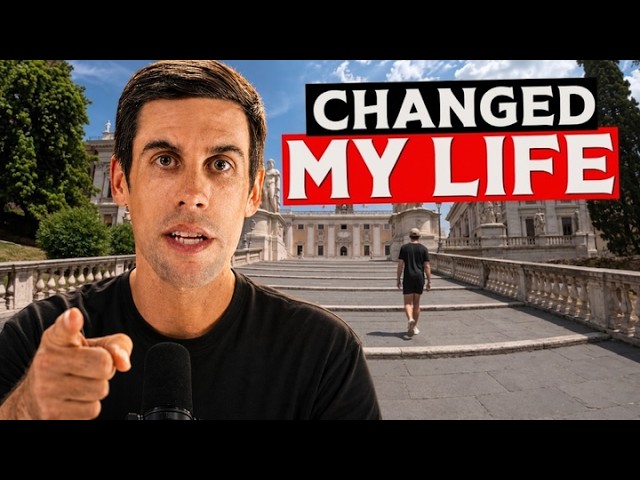
Video summary
The video explores seven Stoic strategies for mastering time management, rooted in the teachings of ancient philosophers like Seneca, Marcus Aurelius, and Epictetus. The central theme is that humans often waste their most precious resource by following aimless habits rather than intentional choices. Seneca emphasizes that death is not a distant future event but something happening every minute, urging us to recognize that time passing belongs to death itself. This perspective shifts the focus from procrastination to living fully in the present moment, ensuring that each day is spent wisely and with purpose.
One key strategy involves starting the day early with physical exercise, such as running through empty streets, which fosters a sense of self-mastery and empowerment. The speaker references Marcus Aurelius's advice to rise before bed when tempted to stay warm under covers, reminding us that our duty and nature demand action despite discomfort. Another approach is training the mind to focus in noisy environments, inspired by Seneca's experience at the chaotic Baths of Caracalla. By deliberately concentrating amidst distractions like crowds and construction sounds, one strengthens mental resilience. Similarly, engaging in physical challenges like swimming or running helps clear the mind for deep thinking, proving that external chaos does not have to hinder internal clarity.
The video also highlights the importance of focusing only on what is within our control. Epictetus's lesson from the Circus Maximus illustrates that true success comes from aiming to do one's best rather than obsessing over outcomes like winning races or achieving bestseller lists. Ambition for fame, power, or legacy can enslave individuals, as seen in the tragic lives of historical figures like Marius and Julius Caesar, who were driven by desires beyond their control. Stoicism offers liberation by shifting goals toward personal growth, learning, and serving others, allowing people to break free from the trap of endless ambition and live simpler, more meaningful lives.
Finally, the concept of *memento mori*—remembering one's mortality—is presented as a vital practice for balancing life's priorities. Carrying a ring inscribed with this reminder encourages individuals to act as if they could die at any moment, fostering gratitude and urgency in daily actions. The transient nature of possessions is also discussed, noting that everything we own is held temporarily and will eventually be passed on or lost. This mindset reduces stress and attachment, helping people enjoy their lives without fear of loss. Ultimately, the Stoic approach to time management invites us to design our lives with intention, making every moment count while accepting life's impermanence with grace.
Read the full video transcript
Seneca talked about how if you stopped
the average Roman walking about their
day and you asked them what they were
doing, why they were doing it, they
wouldn't have a good answer. They just
sort of followed what what he called
wretched habit. They just did what
everyone else was doing, they just did
what they always did, and they were
paying for this aimlessness with their
life, with their most precious resource.
The most powerful lesson from Seneca
about not wasting time comes with his
reframing of death. He says, "It's not
that we die in the future, like you have
however many years you think you have
left." He says, "No, death is now." He
says, "The time that passes is belongs
to death. We are dying every minute, we
are dying every day." The reason you
have to stop procrastinating, the reason
you have to stop wasting time is that
your life is tick tick ticking away.
Here are seven strategies for how to
manage your time better.
If you want to feel amazing, if you want
to feel like a king, if you want to feel
like you own a city, get up early. Get
up early and go for a run. Streets are
empty, there's no one out, it's just
you. You're pushing yourself, you're
challenging yourself. You might not rule
over the city, but you are ruling over
yourself. And that is, in a way, the
hardest thing to do. And how do I know
this? Well, Marcus Aurelius talks about
it in Meditations. He says, "When you
have trouble getting out of bed in the
morning, say to yourself, is this what I
was put here to do, to huddle under the
covers and stay warm?" He says, "No, get
up and get after it. Go do what your
duty demands, go do what your nature
demands." Look, it it can be hard while
you're doing it, no question. It's not
fun to get up early, but you're always
glad afterwards that you did it. I went
for a nice run this morning in Rome
along the river through the empty city
streets. I feel empowered, I feel
powerful over myself, which is the whole
point.
This is not the Baths of Diocletian,
this is the Baths of Caracalla. We don't
know if Seneca went to this one,
probably not, but he did go to that one.
And we know that he found it unbearably
noisy. And that's where his challenge
came in. He he sought it out because it
was noisy, because it was hard. He said,
"It's so loud here, it makes me hate my
powers of hearing." Which I love. He
said he could hear men getting their
armpits hair plucked, getting pummeled
by masseuses, he could hear boxing, he
could hear wrestling, he could hear
people jumping in the water. But he
said, "I find even here that I could
think." He sought out the noisiest,
busiest place in Rome to train his
ability to focus, to train his ability
to concentrate. Which is a wonderful
idea. I heard Malcolm Gladwell like
works in coffee shops on purpose. Makes
him focus. We have to understand it's
not just the physical part of this that
we're training. It's the mental part of
it, perhaps more than anything. In this
noisy, busy, crazy world that we're in,
like doing hard physical things might be
simpler than sitting down and focusing
for 30 minutes. Concentrating like a
Roman, as Marcus Aurelius said. These
baths were enormous complexes. The the
Diocletian Baths could hold 3,000 people
at one time. There was hot rooms and
cold rooms and steam rooms. There was
exercise equipment. There was vendors
selling their wares. There's also all
the noise on the street below. You know,
it wasn't New York City construction
loud, but it was pretty close. Right?
We'd like to think the ancient world was
quiet, but it was anything but. And so
Seneca, he puts himself in this
difficult challenge and and he's writing
and and by the way, there that's not the
only noise he hears. His life is falling
apart, Nero is insane, everything's
going sideways for him, and yet he's
working on his ability to concentrate.
That's his challenge. You could do a
marathon, you could lift heavy weights,
but can you focus? Can you lock in? Can
you concentrate like a Roman, as Marcus
Aurelius said? That's the rare thing
these days. That's what we don't see
enough of. The irony is I find when I do
these physical challenges, I do some of
my best thinking. It's why I take my
walks, it's why I go running, it's why I
swim. That's where I concentrate. Funny,
I was at a gym one time and I got
recognized and uh as I was getting out
of the pool and like I said, "Oh, I just
read Ego is the Enemy, I really liked
it." And I said, "I wrote that book in
this pool." And he's like, "What are you
talking about?" And I did it. That's
where I would go. It's not as quiet and
serene as my office, but it's a it was
the perfect place for me to lock in and
focus.
>> [music]
>> The other line from the Stoics that
pertains to Circus Maximus comes to us
from Epictetus who obviously wasn't
sitting in an owner's box as he watched
the races probably had no interest in
what was happening here whatsoever but
he said, "Look, if you want to win, you
should only run in races where winning
is up to you." Right? This comes back to
the Stoic idea of what's in your control
and what's outside your control. If
needing to be first, needing to beat
other people, if needing to get the
perfect score from the judges or in my
case hit the best seller list if if if
you're focused on any of the parts of it
that are not up to you, that are up to
the critics or the scorecard or the
other competitors, well then you're
vulnerable. You are needing, hoping,
desiring things that are external to
you. But, if your goal is to do your
best, if your goal is to push your
limits, if your goal is to learn
something about yourself, if your goal
is to check a box, then winning is up to
you. Then you're going to succeed no
matter what. And that's a good metaphor
for life. I think about this as an
author. My My goal is to write the best
book that I possibly can, to grow from
the process, to be made better for it.
And then depending on where it hits on
the list or how many copies it sells,
that's all extra. Same goes for when I
run. Am I pushing myself? Am I
challenging myself? Am I having fun? Am
I learning? All that. Then how my time
stack up to someone else, how I place if
it is in a race, all of that is extra.
That's an important reminder from
Seneca.
On the road in front of the forum,
there's a bunch of statues of some of
the most famous and eminent Romans.
Julius Caesar, Augustus, Trajan, all the
famous emperors. And And it would have
looked something like this in in the
ancient world, too. There would have
been not just emperors, but senators and
generals and patrons of the arts. But
Marcus Aurelius wanted to make a point
about these so-called famous people, the
ones that we look up to. We're told for
instance that Julius Caesar once saw a
statue of Alexander the Great and broke
down weeping in front of him because
Alexander the Great in that statue was
younger [music] than he was in that
moment and he had already conquered the
world and this made Julius Caesar
immensely jealous. But but Marcus
Aurelius actually addresses that in
Meditations. He says in book eight he
says Alexander and Caesar and Pompey,
three of the most famous Romans, he says
compared with Diogenes, with Heraclitus,
and Socrates. He said the philosophers
knew the what, the why, and the how. He
said their minds were their own. He said
the others, the great generals, the
people with the statues, he said they
knew nothing but [music] anxiety and
enslavement. Enslavement sounds like a
pretty strong word considering there
literally were slaves here. But but
Seneca makes a similar point. He's
talking about Marius, one of Rome's
great generals and dictators. He said,
you know, Marius commanded armies but
ambition commanded Marius. He says we're
all a slave to something and in fact
that idea of ambition, of of the need to
be powerful, to have the most, to be
remembered, to be commemorated, right?
To be in the room where it happens, to
be in the mix, to be necessary, to be
relevant. These are timeless desires and
urges. They're also traps. Seneca talks
about, you know, old lawyers who can't
retire, who's still begging for one more
case, one more one more crack at being
the talk of the town. And so all these
things were happening then and they're
still happening now. But Marcus Aurelius
is saying that philosophy gives us the
clarity, gives us the perspective, gives
us the truth to break out of this trap,
to see what actually matters, to see
what's actually important, to live a
simpler life, a more contemplative life,
a more public service-oriented life, not
about aggrandizement and achievement and
accomplishment, but you know, actually
making a difference for people, you
know, actually maybe getting to know
your kids, being around, being home. You
only get one life and so to spend it
enslaved, to spend it in harness, worst
of all a harness you put on yourself and
that you could take off at any time. The
Stoics saw this as particularly tragic
and sad and most of all, it was
avoidable.
I've talked a bunch about getting up
early, the power of getting up, getting
after it in the morning, but make no
mistake, I think sleep is super, super
important. Not just what time you go to
bed, but how you sleep. And a big part
of my sleep routine is my Eight Sleep. I
love it, my wife loves it. You [music]
can have different sides, cool at
different temperatures. It's even how I
wake up in the morning. Instead of an
annoying alarm clock or that, you know,
horrible sound on your phone, it lightly
buzzes you awake and then when you're
up, you want to turn it off, you just
tap the mattress. There's all sorts of
awesome features in my Eight Sleep. It
was worth every penny. I love it. You
can use the code dailystoic at
eightsleep.com/dailystoic
[music]
right now for up to $500
off. And if you have an HSA or an FSA,
some Eight Sleep stuff qualifies for
that as well. Through TrueMed and
qualified customers save about 30% on
average. [music] Check your eligibility
at trumed.com/eightsleep
before you buy. TrueMed is for qualified
customers. HSA [music] and FSA tax
savings may vary.
When I'm watching the game, I'm present.
I'm enjoying it. Maybe I'm learning
things. I'm just watching excellence uh
play out. That's great. But when I'm
reading the news the week before about
who's hurt or what the plans are or what
people are speculating is going to
happen, that's when I remind myself I'm
kind of just totally wasting my time
because nothing I learn in the days
preceding up to the game is going to
change what happens during the game cuz
I'm not the GM or the coach or on the
field, right? I think about this with
the election. I know what I want to
happen. I know who I'm obligated to vote
for. Watching the news play out in real
time, every late-breaking development,
every gap, every disaster, every
frustrating thing, all that's doing is
making me crazy and not changing the
outcome in any way. In fact, what it's
doing is taking me away from my actual
family, my actual job, and things that I
might do in the real world to bring
about that outcome. So, I think enjoying
things, watching things, whatever, as as
long as it doesn't become this kind of
pseudo reality that it's so easy to live
in. To me, that's my relationship and
the the way that I I think about those
things, right? I will say Marcus
Aurelius did not enjoy the gladiatorial
games and he was often seen writing his
philosophical meditations at the
Colosseum to the chagrin of most Romans
who were, you know, rather bloodthirsty.
I think there's a difference between
that and, you know, what we watch on the
pitch or the field or the court.
So, this is the Caswellis family tomb.
They came to Bastrop in the 1850s and
they built a little building on Main
Street, which housed a shop that he
owned and he built a house down the
street. His son, Will, who This is him.
That's the father. This is Will. Carried
on the business when his father died in
1901. Well, I own that building now. The
The building has changed hands dozens of
times in the decades since it left the
Caswellis family, which, by the way, is
what happens to all our possessions. The
things you love, the things you care
about, eventually someone is going to
possess them. That is to say, if they
don't throw them away. There's a story
about Epictetus. He had this lamp that
was stolen. And you'd think he'd be
upset. Instead, he goes, "Look, you can
only lose what you have." And he goes
back and he replaces it the next day
with something cheaper. But, the funny
part is that after he died, one of his
students bought it for a lot of money.
He wanted to possess something that
Epictetus had possessed. Of course,
totally missing the point of the lesson.
Now, again, the lesson isn't you should
never have anything and you shouldn't
care about anything. You should give
away all your possessions like a monk.
No, it's just a reminder that that as
the Stoics say, we only own this stuff
in trust. We have it temporarily. Not
just the job, not just the house, not
just the place we currently stand or
operate, but everything in our life is
only ours for as long as we are lucky to
have it. I heard someone say and I think
about this with where I live on this
ranch out not far from here. He says,
"The bank is just letting me make
payments on it." Like you don't even own
it. You have it temporarily. And if you
can think about it that way, you're not
only going to be more insured against
the ups and downs in life, you're going
to know the proper perspective on
things. It helps me relax with my
children. I don't have to take
everything so seriously. I don't have to
stress about everything. I don't own it.
We remind ourselves that we don't really
own this stuff, that it's only ours
temporarily. So, the day when we have to
give it up, whether it's while we're
living or at the end of our life, we're
okay with that. We're okay giving it
back. I actually had a friend of mine
who died not that long ago. And he he
wrote about this saying, "I'm ready to
give the gift back." That's what he was
saying about his life itself. Ready to
return the gift. And that's a very Stoic
idea. All of it. It's only temporary. We
only get it for a little bit.
>> [music]
>> As we wrap up here, I wanted to give you
I think what the most important
practice, a practice I always try to
leave people with from the Stoics, which
is this idea of memento mori, right?
Remember that you are mortal. The Roman
emperor had someone whisper this in
their ear at their highest moments.
Remember that you are mortal, that you
are not a god, that you are a human
being. I carry a
ring with me. I'm wearing it right now.
It says memento mori and on the inside
has a quote from from Marcus. He says,
"Let that determine what you do and say
and think. You could leave life right
now. Let that determine what you do and
say and think." Of course, we all know
we're going to die on some level, right?
Obviously, everyone who's ever born will
die. That's the one prophecy that's
never failed. And yet, the Stoics would
say we get it wrong to think of death as
this thing in the future, right? It's
not some distant thing that will happen
to you when you're old. I mean, it can
happen to you at any moment. But, Seneca
would say we have to see death as
something that's ever present, right? In
the midst of life, we are in death. Not
just cuz people can die, things like
plagues or pandemics can happen,
tragedies can happen. But, he would say
that the time that passes belongs to
death. That once
time passes, it's dead to us forever. As
we kill time, time kills us. He says,
"We're dying every minute. We're dying
every day." So, the reason we have to
say no, right? The reason we have to
design our lives, the reason we have to
be conscious of where we're going and
what we're doing is we don't know how
long we have. Don't know how long we
have. The Stoics say we have to balance
the books of life each day to make sure
we're spending this time wisely, we're
making a positive difference with it,
we're using the gift for what it is.
It's a gift. And I was in Waverly
Cemetery today. Look, if that's where
you go when you die, I guess there's
worse things that could happen to you.
But, all those people, right? All those
people, they saw death as something that
would happen eventually, inevitably, and
then it came to them one day all too
soon, as it does to all of us. It comes
as a surprise, even though we know it's
always going to be there. Maybe we
thought we we were too healthy, too
important, or we thought we're working
on something that's going to outlive us.
It doesn't do Marcus Aurelius any good
that we're talking about him, you know.
He says, "People who long for posthumous
fame forget that they won't be around to
enjoy it." And he says, "The people in
the future are also stupid and annoying
and uh
you know
The point is Marcus Aurelius survives
and endures not cuz that's what he
chased but because of what he did with
the time that he had and who he was with
that time. And that has to be enough.
Dying every minute, we're dying every
day. You could leave life right now. Let
that determine what you do and say and
think.