Video summary
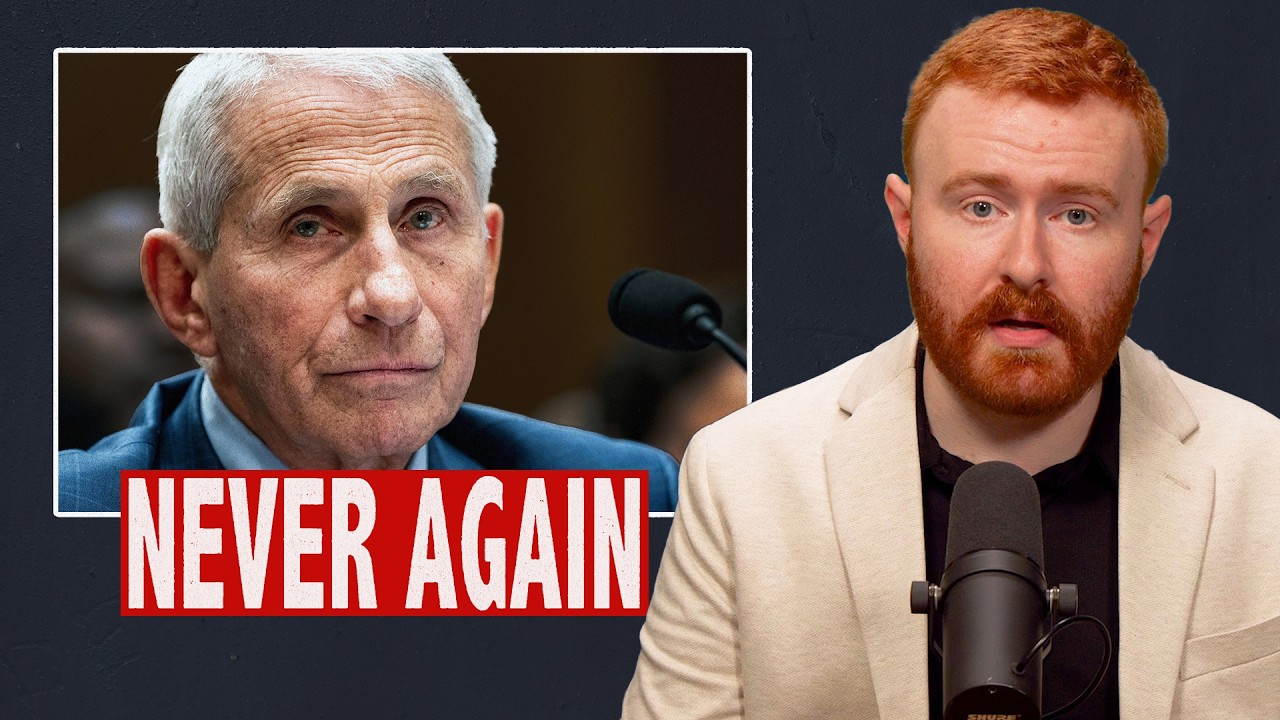
The recent release of Anthony Fauci's personal diary has provided a critical window into the true nature of American government operations, particularly regarding how unelected bureaucrats wield significant power over elected officials and citizens alike. While public attention often focuses on politicians who campaign for votes, this transcript argues that real authority resides within the permanent federal bureaucracy, which operates with legal immunity regardless of election outcomes. Fauci's career exemplifies a system where administrative functions are controlled by millions of government officials rather than representatives chosen by the people, effectively shifting power from a democracy to an oligarchy managed by faceless experts who can override public opinion and state governors during crises without facing immediate accountability.
Furthermore, the transcript contends that the primary function of federal agencies is not genuinely solving problems or protecting citizens but rather enriching the political class and well-connected corporations through exaggerated risk assessments and massive taxpayer transfers. Fauci's repeated warnings about inflated pandemic dangers served to funnel billions into pharmaceutical companies for vaccine development while expanding bureaucratic power, a pattern observed in previous health scares like swine flu and Zika where actual risks were far lower than projected. This dynamic reveals that the state utilizes science as a new form of legitimacy or "god" to justify its expansion, wrapping complex administrative maneuvers in scientific jargon to obscure the fact that these actions often serve special interests rather than public welfare.
Ultimately, Fauci is portrayed not merely as an individual who made mistakes but as a key figurehead for a systemic racket designed to consolidate power and generate revenue through fear-mongering and lockdowns that caused staggering economic and human costs. The transcript emphasizes that blaming only individuals like Fauci allows the underlying system of crony corporatism to continue unchecked, suggesting that true reform requires rolling back regulations that empower bureaucrats to infringe on rights for profit. While holding specific officials accountable is necessary, the core lesson drawn from this analysis is that Americans must recognize and dismantle the structural mechanisms allowing federal agencies to operate as a self-serving entity rather than a public servant institution.
Read the full video transcript
6 years after the COVID pandemic and
nearly two years after he was pardoned
for any and all crimes he may have
committed since 2014 relating to his
role at HHS, Anthony Fouchy was back in
the news last week. The former head of
the National Institute of Allergy and
Infectious Diseases was called to
testify before the Senate Committee on
Homeland Security and Governmental
Affairs where he made news for pleading
the Fifth Amendment 111 times. But the
real headlines came from the over 1,000
pages of Fouch's diary entries released
by Senator Rand Paul before the
proceedings. Fouch's personal diary was
really a long digital document where he
would write up a summary of his workday
every night to help inform his
postretirement memoir and any
sympathetic future biographers. The
release provided some new details on the
nature of the government's response to
the pandemic and to an even greater
extent exposed the mentality of the
bureaucrat who quickly emerged as the
public face of it all. These insights
are instructive because perhaps more
than any other government official in
recent years, the career of Anthony
Fouchy can teach us a lot about where
power actually resides in America and
how our system really works. So, with
Fouch's name back in the news and some
new details from his diary in hand, here
are five important lessons that Fouchy
has done much to exemplify.
First, bureaucrats hold the power. In
American politics, elected politicians
get almost all the attention, which
isn't surprising. They're some of the
loudest, most obnoxious personalities in
government, and they have to spend much
of their career campaigning directly to
the general population for votes. But
even more importantly, the democratic
process lies at the core of how the
American government legitimizes its
perceived power over all of us. The
creation myth of the current American
regime begins, of course, with the
colonies revoling and seceding from
Britain. But the specific simplistic
version the establishment always pushes
and that most of us were taught in
government or government accredited
schools emphasizes the colonial
opposition to taxation without
representation. That emphasis implies
that the issue has been totally resolved
for good. Because now we're taxed and
governed by officials who represent us,
the people. Never mind that this
government taxes us and tramples on our
rights at levels no king could ever have
gotten away with back then. We live in a
democracy now, so it's fine. The ruling
class needs to keep this perception up
to preserve its legitimacy. But the mask
often slips, especially during crisis.
The narrative that the American
government is above all run by our
representatives did not stand up well
when a public health bureaucracy with an
unelected career bureaucrat as its
public face effectively ran the
government's pandemic response. The
narrative may have held at the beginning
when virtually all politicians were
aligned behind them. But as more and
more elected representatives began
pushing back, Fouchi and the bureaucracy
he helped oversee went to war with those
governors and representatives in public
and behind the scenes with the full
enthusiastic support of the political
establishment. This wasn't an
unprecedented departure from the status
quo, but a peak behind the curtain at
the true power structure in DC. Since
the late 1800s, the unelected federal
bureaucracy has exploded in size and
more importantly secured legal immunity
from the changing attitudes of voters.
Today, the bulk of federal power lies
not with our representatives, but with
millions of government officials who
control the actual administrative
functions of the federal government and
who remain in their roles regardless of
who voters send to Capitol Hill or the
White House. Anthony Fouchy was the
epitome of this kind of faceless
permanent official. He just happened to
be thrust into the limelight at the end
of his career. One could argue that some
issues are too important and some crises
too dire to be left up to the whims of
public opinion. And that's perfectly
reasonable. But if a system only gives
the elected representatives the final
unquestioned say when an issue is
unimportant enough or a situation is
trivial enough, then that is not a
representative government. That said, it
is also not accurate to frame Fouchy or
the rest of the federal bureaucracy as
experts genuinely trying to keep us safe
or financially secure. Which brings us
to the next lesson. The federal
bureaucrat's job isn't to solve our
problems, but to enrich and empower the
rest of the political class. For nearly
his entire career, Fouch's job has on
paper been the same. assessed the danger
of emerging infectious diseases, advise
policymakers on the appropriate
response, and oversee the administrative
components of much of that response. But
what quickly becomes clear if you look
at his whole career is how abysmal he
was at that. Early on, he was criticized
heavily by the public for bungling the
response to the AIDS epidemic. But even
when it came to lower profile cases,
Fouchi would repeatedly make wildly
inaccurate projections about the danger
posed by new illnesses. Those warnings
would prompt huge transfers of taxpayer
dollars to the bureaucracy he helped
oversee and the well-connected
pharmaceutical companies who would
dutifully rush to develop a new vaccine
or treatment. The most egregious
examples before CO were a strain of
swine flu in the 1970s, a bird flu
strain in 2005, another swine flu in
2009, and the 2016 Zika virus. over and
over again, the actual danger proved to
be far more limited than he had been
warning about, even before the
government's response could be
mobilized. Yet, the tax dollars would
still go on to be transferred. The
public health bureaucracy's power would
expand, and big pharma would enjoy a
sizable revenue boost. If Fouch's rule
were truly to pass on the risk of
infectious diseases in a manner accurate
enough to facilitate the prudent
allocation of public funds, he would
have almost certainly been pushed out
decades ago. The fact that he not only
remained in his position for so long,
but was treated with an almost
preposterous level of admiration and
gratitude from the rest of the political
class suggests that the true purpose he
was serving was different. The most
plausible explanation is that his true
role was to move as much money to the
federal bureaucracy and well-connected
companies as he could. And indeed, if
you take an honest look at the origins
of the entire administrative state, it
becomes clear that this has always been
the purpose of these federal agencies.
Everything from the FDA to the Federal
Reserve was created not by some
unenthusiastic government officials who
reluctantly gave themselves more power
over the economy to answer the people's
demands for more regulations, but to
help the well-connected established
firms secure their market dominance and
hinder future competitors. Whether they
were the genuine mistakes of a bad
scientist or the deliberate
exaggerations of a cleareyed power
player, Fouch's exaggerated projections
helped move a lot of money to the
federal bureaucracy and the
pharmaceutical industry. And he was
clearly well compensated for that. At
the end of his career, Fouchy was the
highest paid government employee. And
upon retiring, the self-described public
servant had a net worth of over $11
million.
However, as we can see from his newly
released diary entries, money is not the
only motivation for bureaucrats. Fame
and power are ends in themselves. It is
immediately clear from Fouch's own
recollection of his day-to-day life that
he is obsessed with his own public
image. He spent a lot of time writing
out in detail all the compliments and
praise he received, especially from
famous or important people. When we talk
about corruption or bribery or more
accurately the quidd proquo between
government and special interests that
define our crony corporatist system, it
is easy to focus exclusively on the
wealth being transferred between groups.
But the fact is for a lot of people
things like perceived authority, respect
and agilation from the legacy media and
general public, access or even
friendship with the biggest names in the
country or even just raw political power
itself can be even more enticing than a
paycheck. Fouchi was absolutely driven
by this kind of thing. His diary reveals
a man reing in the praise he was getting
from the public, gleeful about A-list
celebrities reaching out or mentioning
him and above all ecstatic about being
seen as the national authority on all
things science during the biggest global
pandemic in [clears throat] over a
century. And that last point is
important to dig into a bit more because
the fact is the modern state uses
science for legitimacy. As I mentioned
before, the way we're taught to view the
American Revolution as a glorious, and
totally justified revolt, while viewing
any case for another revolution as
preposterous, deeply immoral, and worthy
of the death penalty, is to focus on the
representation side of a colonist demand
because that helps delegitimize the
state the colonist seceded from while
legitimizing the state we currently live
under. However, as Murray Rothbart laid
out in anatomy of the state, the
narratives and ideas that give states
legitimacy in the minds of a sufficient
portion of the population are so crucial
for state's existence that they really
can't afford to rely on only one,
especially as the state changes and
grows into new forms over time. As the
US government has shifted from a union
of states governed primarily by a small
group of elected politicians to a single
superstate controlled by a massive class
of unelected bureaucrats, a new excuse
for this expansion of state power was
required. And as Rothbart put it, in our
more secular age, the state found that
with the invocation of a new god,
science. In his words, quote, state rule
is now proclaimed as being
ultracientific, as constituting planning
by experts. The increasing use of
scientific jargon has permitted the
state's intellectuals to weave
obscurantist epilogia for state rule
that would have only met with derision
by the populace of a simpler age. A
robber who justifies his theft by saying
he really helped his victims by his
spending giving a boost to retail trade
would find few converts. But when this
theory is clothed in Keynesian equations
and impressive references to the
multiplier effect, it unfortunately
carries more conviction. End quote.
Anthony Fouchy could well be the
culmination of this phase of state
epilogia hiding behind the label of
science. He perfectly embodied the
simplistic corrupted version of science.
Not a process for relentlessly
attempting to disprove hypotheses, but a
fixed body of knowledge discovered and
approved by state approved scholars that
could never be questioned without severe
social and professional costs. To say
you believe in science became a common
way for establishment figures and
progressives to virtue signal during the
co years and Fouchi came to represent
the human face of this dogma. He even
famously conflated criticisms of himself
with criticisms of science in one of the
more cartoonish moments of the pandemic.
However, it may have gone too far. As
the lockdowns stretched far beyond the
initial 14 days, public health officials
reversed their guidance to sanction mass
protests simply because they agreed with
them politically. And it was becoming
clear that the government was interested
in only allowing people to get their
rights back if they consumed a patented
product from a well-connected
pharmaceutical firm. Public opposition
to the government's pandemic response
was growing. And unsurprisingly, the man
who was made the public face of that
pandemic response bore the brunt of that
anger, especially as he declared himself
to be the embodiment of truth and
science itself. But that is where Fouchi
began to take on what could honestly be
his most important role. Because
bureaucrats can also serve the racket as
individual scapegoats when people get
upset with the current system. The
release of Fouch's diary has further
confirmed the true nature of his time
leading the pandemic response that has
emerged in the years since. Far from the
noble, science-minded public servant who
was solely concerned with the well-being
of the public that many initially took
him for, Fouchi lied repeatedly to the
public in ways that caused widespread
harm. He understood early that the death
rate of the virus was well below the
scary initial estimates that were
circulating in the early spring of 2020.
Yet, he decided not to clarify that and
instead helped fuel the growing concern
that would eventually result in the
lockdowns, production halts, and school
closures that swept across the nation in
March. Fouchi then used his position to
relentlessly push for the shutdowns to
be extended far longer than the short
period he had initially argued for. He
put institutional pressure on governors
and infectious disease specialists who
did not go along with his program. And
he marshaled the federal government's
entire public health bureaucracy to push
for the production and dissemination of
patented medications and treatments
while blocking, banning, or demonizing
cheap generic treatments that had been
showing positive initial results. Even
setting aside the very real possibility
that Fouchi had actually helped
facilitate the illegal funding of the
risky gain of function research at the
lab in Wuhan that could have caused the
entire pandemic to happen in the first
place. Even setting that aside, the
economic cost alone of shutting
everything down and only slowly
reopening was staggering, especially
when you factor in all of the later
inflation caused by the Fed printing
over 6 trillion new dollars to push the
inevitable economic pain down the road a
bit. But the full human cost of all the
missed days at school, social
gettogethers, workouts, family visits,
doctor's appointments, cancer
screenings, funerals, everything. The
full cost of all of that is impossible
to calculate in its entirety or even to
fully comprehend. But it is
extraordinary. The fact that Fouchy, the
government official who spearheaded it
all, was not reluctantly taking drastic
steps only after he was certain there
was no alternative. but as records now
show was actively looking for any
excuse, any effective spin to justify
this unprecedented and destructive power
grab because it sent money to the
pharmaceutical industry, enhanced the
status of his department and colleagues,
and satisfied his personal desire to
feel important is nothing short of a
crime. A crime worthy of consequences.
But it is also important to remember
that this was not Fouchy corrupting what
had been a sound public health
bureaucracy. It was him effectively
running a racket that he was momentarily
given the reigns of. The focus on
Fouchy, the man, while certainly
justified to a significant extent, can
also feed the impression that had he
been swapped out with some other
official early on, the federal
bureaucracy would have been working
purely on behalf of the American people
and none of this damage would have
occurred. That is wrong. But more
importantly, it is useful for keeping
the racket going. If all of the blame is
aimed solely at Fouchy and not the
system he was operating within, then
regardless of whether he escapes any
accountability or spends the rest of his
life behind bars, he will have fulfilled
his role. Fouchi is now in fact retired.
But the racket he oversaw continues on,
moving money and expanding federal power
at whatever level the political class
can get away with at the moment. Holding
him and the other individuals who
oversaw the pandemic response
accountable for what they did is
necessary if we're ever going to truly
move on and prevent something like this
from happening again. But that alone is
not sufficient. We must also roll back
the legislation and regulations that
empower all corners of the federal
bureaucracy to rip us off and trample on
our rights. That is and ought to be the
main lesson this country learns from
Anthony Fouchy.
>> [music]