3D Modelmaking "for girls" - The overlooked engineering skill of pattern cutting - EMF 2026
Watch on YouTubeVideo summary
Amy Jeskins, a seasoned costume maker with two decades of experience in theater, introduces pattern cutting as a sophisticated and often overlooked engineering skill that deserves recognition beyond its historical association with women's work. Although her industry is deeply connected to fashion, it remains largely analog, relying on bespoke construction rather than the digital mass-production methods common in modern fashion. Jeskins highlights the complexity involved in creating even simple garments, noting that a standard suit consists of 38 separate pieces made from various fabrics and requires over 200 steps to assemble. She emphasizes that successful pattern cutting demands a deep understanding of human anatomy, fabric behavior, and three-dimensional geometry, skills that are essential for transforming flat materials into functional clothing that moves with the body.
The presentation explores two primary methods of pattern creation: flat patterning and draping. Flat patterning involves drawing precise 2D shapes on paper based on mathematical averages and specific body measurements to create blocks that can be adapted for different styles, while draping requires manipulating fabric directly on a mannequin to achieve the desired fit. Jeskins notes that while digital tools like CAD software and 3D modeling programs are becoming more prevalent in fashion, they still require a foundational knowledge of traditional pattern cutting techniques to be effective. Without understanding how fabrics behave and how bodies move, users cannot effectively utilize these advanced technologies, which often merely replace pen and paper with a mouse rather than eliminating the need for specialist knowledge.
Jeskins also addresses the cultural perception that garment making is exclusively "women's work," arguing that this bias has historically excluded these skills from STEM fields and engineering curricula. She traces the evolution of the industry from the secretive guilds of the 16th century, where tailoring was a male-dominated profession requiring mathematical expertise, to the Industrial Revolution, which shifted much of the labor to women and children in lower-paying roles. Despite this shift, she points out that high-level pattern cutting has always required rigorous technical training and geometric understanding, skills that are now being revitalized through modern innovations like 3D scanning and digital archiving. By combining traditional craftsmanship with new technologies, the industry is moving toward a more inclusive future where art and engineering are recognized as inseparable disciplines.
Ultimately, Jeskins concludes that pattern cutting represents a unique blend of practical engineering and artistic expression that challenges binary thinking about gender roles and technical capabilities. She encourages viewers to see sewing and garment construction not as minor domestic tasks but as complex problem-solving activities that involve spatial reasoning, patience, and an understanding of physical constraints. As the industry continues to evolve with digital tools and sustainable practices, the core principles of pattern cutting remain vital for creating high-quality, bespoke garments. By acknowledging the mathematical beauty inherent in clothing design and breaking down artificial barriers between art and science, makers can embrace a holistic approach that honors both tradition and innovation.
Read the full video transcript
[applause]
Hello. Um, uh, my name's Amy Jeskins.
I'm, um, a costume maker and I also run
the costume and wigs, hair and makeup
departments at, uh, an off-western
theater called the Domar Warehouse in
London. Um, apologies, I am an an analog
person and we'll go into that in the
talk. So, I've got my bits of paper. So,
um I I hope I'm not um glued to them too
much. I'll try and look up and blah blah
blah. And we've got some lovely slides,
so you can look at those instead of me.
Um
so, I've been working in theater for um
about 20 years, making costumes, as I
say, working in wardrobes, things like
that. During that time, I've made suits,
corsets, uh ball gowns, um magical quick
change outfits, um hats, a 6-ft tall
worm, um and if you can believe it, this
is two different kinds of uh gorilla
toys come to life. So, this is the same
character uh depicted in two different
designers um imaginations.
Um, my most famous costume, I'm very
pleased to tell you, it was actually for
uh Mary in the TV show Ghosts, which you
might have seen. Um, I cannot tell you
how exciting it was the first time I saw
someone cosplay as one of my costumes
because I hadn't done much TV and film
and I was I was really pleased. I still
haven't. Um, but that was pretty
exciting. Um, with all that in mind, I
want to highlight to you that my
industry, although it is um, deeply
connected to the fashion industry, it's
is still quite analog. Um, we we make
things bespoke. Um, some people might
even call us backwards. Um, compared to
sort of fashion and large scale garment
construction. Um, we rarely use
computers or or digital patterning
because it's often literally one of a
kind. Um, so I want to give a special
shout out. She's not here, but my friend
Lucy Shilton, she gave me loads of
advice um about specialist knowledge
about p pat pattern cutting software um
because she's doing a PhD on it. Um uh
[snorts] all of this is to say that I've
got a bit of a bias towards a more
theatrical or historical viewpoint um
rather than sort of fashion. Um, I also
make quite a lot of few generalized
sweeping statements um that I can't back
up with evidence. What can I say? I'm
not scientific. Um, [snorts]
I will also say this talk discusses
about gender and how it's represented in
industries. I am fully aware that gender
is a spectrum and it also doesn't
determine the things you're good at and
the jobs you like doing. There are boys
that like sewing. There are girls that
like engineering and technology. And
there are non-binary people who like
both or neither. Um, for the purposes of
my talk, I do generalize. It is often in
a historical context. So, sorry about
that.
Okay.
I enjoy all aspects of my job, but I
particularly enjoy pattern cutting and
pattern manipulation as we would call
it. [snorts] Um, I'm going to try as
best as I can to give you the basics and
how we put these skills into practice.
But first, to break up the talking,
here's a little video clip.
To the naked eye, a suit appears to
consist of two parts, a jacket and
trousers.
But those two seemingly solid parts are
composed of four different fabrics.
cotton, silk, mohair and wool.
Now those four fabrics are cut into 38
separate pieces.
The process of size and forming to join
in those pieces requires no fewer than
228
steps.
[music]
Heat.
[music]
Heat.
[music]
So the first step is measurement.
[music]
But measurement [music]
doesn't mean
just reaching for your tape. So many
inches here, so many inches there. No,
no, no. [music]
[music]
>> [music]
[music]
>> You cannot make something [music] good
until you understand who you're making
it for.
So, that is a really useful little tiny
clip from a film to give you kind of a a
sense of what might be happening when
someone is laying out and cutting a
piece of tailoring.
The simple version of pattern cutting is
that you are drawing up a series of 2D
shapes that will connect together to
form around a 3D body. Um they also take
into consideration um changes in the
shapes that include stylistic or comfort
choices. Um there are two ways to draft
a pattern. Flat patterning or draping.
These are two uh examples of pattern
blocks. So there is a bodice and then a
sleeve which is interconnected why which
is why it's laid over the top. [snorts]
In flat patterning you draw out the flat
version of the garment onto the paper.
here front and back are represented but
it's assumed that the average person is
relatively symmetrical. So actually you
draw half of the front and half of the
back. So you'll see on the um the part
with the lower dip in the top right
that's the front line and then there's
the back line on the other side and you
when cut it out you fold it and then
open it out.
This is a basic block. And then you
could use this as a template to cut your
fabric. You always add a little bit
extra for your seam allowance. You can
sew it together. Um, and [snorts] uh,
the basic block is very basic as you can
see.
Once uh, it goes around the body, you'll
be able to add on and adapt uh, to
create the styles and details that you
want. As you heard from the clip,
there's a two-piece suit will have 38
separate pieces. Um, some simple
garments have fewer. Um, complex ones
have many, many, many more. [snorts] Um,
you can also further shape the fabric
with what we call darts, which are tucks
in the fabric that you sew to make it
fit around a 3D body.
Some pattern cutters who are really
experienced can draw these things from
memory um, and will instinctually know
the proportions uh, and shapes to draw
by using a comprehensive set of bodily
measurements. And here is
the set of measurements that I would use
to draft a block and start making
something from scratch. [snorts]
Most people follow a set of instructions
that have been developed using uh the
mathematical averages um of the shapes
and proportions of the human body.
There's no um
particular uh one version of these. So
these are just two of those sets of
instructions to make those two blocks I
just showed you. So the bodice and the
sleeve. And as you can see, they're
relatively complex. People get to know
um and learn. They can skip steps or or
uh you know, not look at their paper. Um
but this is the basic moment steps you
would go to to make your block. Um
[snorts]
everybody's got their favorite. Um these
are just a few of the most popular
pattern cutting books.
It uh some people even write their own.
Um
once the pattern's complete,
you then obviously adapt it. Um and then
you make a version in plain fabric. We
would call that a twile.
And then you can make any changes, have
another fitting, and then there's your
final garment.
>> [snorts]
>> Um,
the other way to create a pattern is
what's called draping. And I've got a
little example to play whilst I talk.
[snorts] So, in this way, you take your
measurements, but uh it does require you
to have a a dummy, a dress maker's dummy
that basically is the same measurements
as the person you're making for. Um,
[snorts]
you can pad them out to size, but again,
that's an extra step. You mark it up on
the mannequin. um those key reference
points that you'll see there. So bust
and waist and and down the center. And
then you drape the fabric over the
mannequin, cut it and pin it in the way
you wish. And then you use these pieces
of fabric to make a pattern.
Both of them have their advantages and
their disadvantages, but um as you can
imagine, when you're making a really
bespoke garment, some people struggle to
find a mannequin or or make it fit um
the person they're making for. I always
favor flat flat patterning. Draping is
more often used if you're creating
couture garments in the fashion industry
where everything is is made to sample
sizes um and then the models fit the
clothes rather than the other way round.
>> [snorts]
>> um
as described these two methods are
standard in the costume industry because
it's bespoke but just um uh like most
other industries uh the event of CAD has
allowed fashion in particular to come
become more digital.
>> [snorts]
>> Um, a company called Electra uh started
making uh basic digital 2D pattern
drawing and uh grading which is the
process of making patterns bigger or
smaller um software in the ' 70s. But
now there's several other programs that
have been developed specifically for
garment pattern making. Um there are
programs such as clo 3D which um you
have the ability to draw the patterns
up. You can put them on the 3D model.
Um, you can even make the 3D model move
and you can see how it would work on an
actual body and you can even import
different fabric assets. So, uh,
different fabrics will make the clothing
move differently.
But yet Lucy's really big takeaway was
that without previous knowledge of
pattern cutting and um uh in general how
human bodies and clothing work, it's
it's almost impossible to actually
utilize this technology. Um you need to
draw the pattern up yourself. It's just
that instead of pen and paper, you use
uh the mouse. um you still need to have
knowledge of fabrics, how to adapt the
shapes, um where to put straight lines
and where to put curves.
Recently, some programs have actually
started adding draping functions,
although uh to to to quote Lucy
directly, they didn't really come out
resembling patterns. Um, of course
technology is going to improve, but for
now there still needs to be a huge
amount of specialist knowledge of
fabrics and pattern cutting to use any
of these tools to your advantage.
So, why the heck have I brought 3D
modeling into this? Um, I've got another
clip for you now with uh one of my
favorites, probably lots of people's
favorites, Adam Savage.
A sewing machine is a
the sewing machine can be a concerning
device.
It can really it can really ruin your
day. And yet getting good at operating a
sewing machine is really one of your
finer
translatable maker skills. I'm serious.
Um,
sewing
I don't think it's tooh. Let me stop
moving this around and let me make my
point.
Sewing is like a gateway drug to
thinking through complex problems.
It seems really simple culturally. We
make it women's work. Uh and that's how
we couch it as like somehow that it's
let me tell you real sewing at any kind
of level of proficiency is a bloody
magic trick. Um sewing like mold making
involves mental frames that require one
to think inside out and backwards.
It requires one to work on an order of
operations that is often taking into
account the reverse and making sure that
that order allows. Yeah, it is
it's a really really important skill.
And if you learn how to sew, you're
mostly on your way to carpentry and
welding and sheet metal work. I'm not
kidding. These are planer forms meeting
under rules and conditions. And if you
can make us if you can make a sleeve
work, I swear to God, you could build a
house. Um,
I recognize that as a bold statement.
Let me back that up with just a little
bit of uh institutional knowledge. the
um the patience it requires to
understand the patience and the
institutional knowledge. It requires to
understand fabric, how it moves, where
the weave is going to sit on a piece of
a panel of a piece of clothing and how
these front top and back panels are
going to meet this sleeve and allow it
to not look goofy no matter how you're
moving your body.
the sensitivity to do those basting
stitches to get that sleeve close then a
second set of basting stitches to get
even closer than a third set of basting
stitches to get like I I don't know how
to sew at a super high level but I do
understand some of the requirements of
sewing at a high level and it's about
it's about patience and it's about
thinking inside out and backwards
so don't put it in your mind as
something minor man cuz it will it will
hurt you [laughter] if you go in
thinking you know what you're doing. Um,
>> there we go. And, uh, I captioning that
was really tricky because of course I
let the the software do it and then I
had to edit literally everything he said
cuz he's basically lost for words um, at
the uh, at the thought of sewing.
So, I looked um, over all sorts of
definitions of 3D modeling. The one that
I thought actually summed it up best was
jolly old Wikipedia obviously. Um, so 3D
modeling is a process of developing a
mathematical coordinate-based
representation of the surface of an
object in three dimensions by
manipulating edges, vertices, and
polygons in a simulated 3D space.
Three-dimensional models represent a
physical item using a collection of
points in 3D space connected by various
geometric entities such as triangles,
lines, curves, etc. Um, knowing now what
we've briefly touched on about pattern
cutting, I hope you can see the
similarities. Um, but sewing goes much
further than that. As Adam Savage says,
sewing is just planer forms meeting
under rules and conditions. To draft a
pattern that works, you need to know
your materials. You need to know how to
work with them. You have to have a deep
knowledge of how a human body moves and
the infinite variety of shapes and sizes
that they can come in.
I've made um structural garments like
corsets and bodesses that sculpt,
change, lift, bare weight of the human
body. Um [snorts]
these uh you can use uh fabrics, you can
use uh sort of sewing techniques to mold
pieces of fabric into a curved surface
that skim the torso that weren't flat
before. You can literally um stitch and
pull in such a way that the fabric
becomes curved instead of flat. Um,
there is an incredible competition in
New Zealand called the world of wearable
art and I've got a little mini clip for
you of that and see if you think any of
these garments actually uh speak of
engineering to you. 87 I decided [music]
to take art off the wall, put it on the
moving human body in the form of art
being worn or wearable art. Wearable
[music] art to me is art that you can
move in and you can perform in something
impressive visually. So it has to look
incredible on a stage.
[music]
Wearable [music]
art is like a portal into other worlds.
You get to [music] come in and create
things from your unique creativity that
no one else has thought about before.
Full creative [music] freedom. Well
creates a global platform for creativity
and innovation. Platform that's dynamic,
inclusive, [music]
and multidisciplinary
allowing endless and boundless artistic
expression.
Let's go.
>> So when you look up kinds of engineering
uh and uh STEM subjects, sometimes it's
for universities, institutions, it's a
list of the courses they offer, it's
very unlikely you'll see anything like
patent drafting and garment construction
listed there. [snorts] I would argue
that it is primarily due to the cultural
perception that it is women's work. As
Adam Savage pointed out, [snorts]
according to engineering.com,
women make up just 17% of the
engineering workforce um compared to 56%
in other occupations. Um almost to prove
my point, there actually doesn't seem to
be a lot of solid statistics about um
fashion and garment industries, but in
most places I looked, it suggested it
was somewhere between 60 and 80%
dominated by women. and costume uh some
small studies say it's sits around 80%.
But interestingly enough, this wasn't
always the case.
Up until about uh the 1500s, garments
were mainly constructed with uh a
slightly less methodical method um
called the rock eye method. pattern
[snorts] pieces were sort of drawn out
by eye um and
they just had certain standardized
points on the body to to draw from. This
was at a time when standardized
measurements were very new. Um inches
had only been around for a hundred years
or so. And so actually the measurements
were kept on a a tape with notches along
for each customer. They were they were
personalized to each customer. And that
was the measurements that they used to
to draw up the patterns.
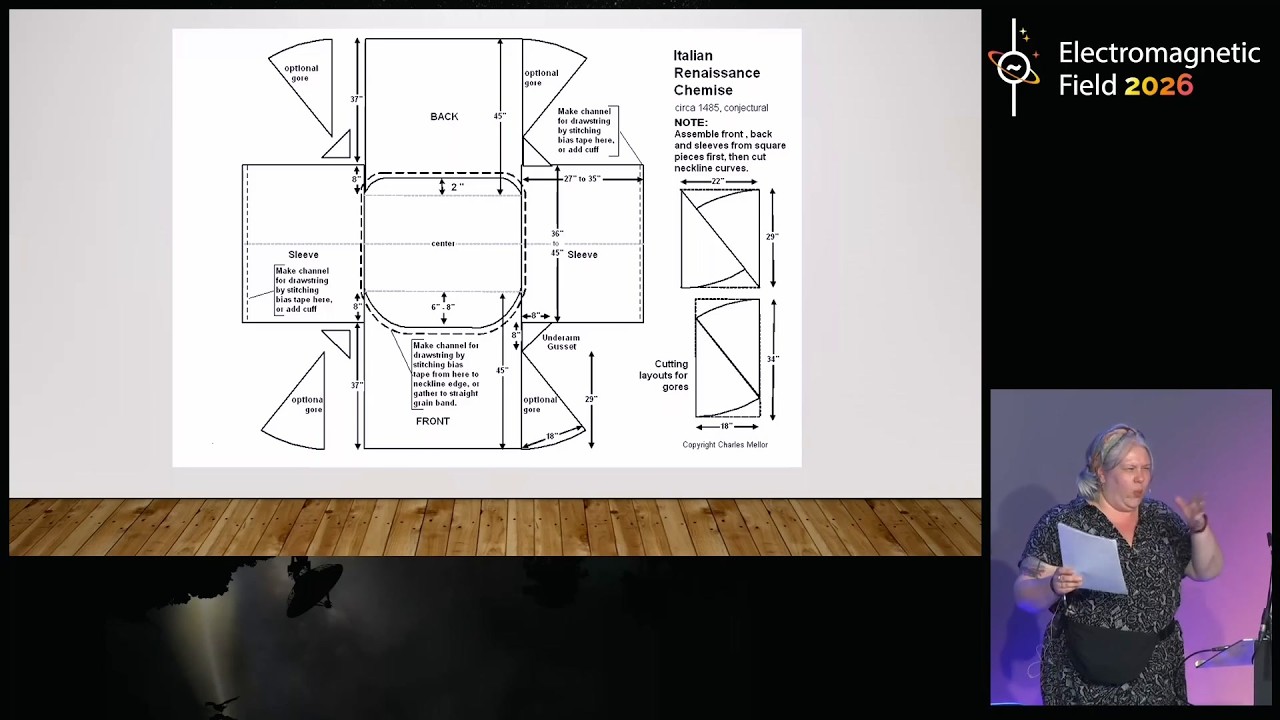
[snorts] Um garment shapes were were
loose um at this time. So I've got an
example of a a a shemath. It's uh sort
of circa uh 1485.
[snorts] Um
they uh they're squares usually squares
and rectangles that often came straight
off the loom. uh or they were divided
into triangles um rather than what we
would consider form fitting garments
today.
>> [snorts]
>> Um you can see in the pattern for the
shmese it's squares and triangles um
under the arms which are the sort of
four points you can see there they have
uh inserted a triangle to give ease of
movement whereas today as you might
remember from the uh sleeve before we
would draw a curve to fit around the top
of the arm and and give you movement
there.
It's it's widely recognized that the
first ever pattern cutting book, the the
forefather of the the books I showed you
earlier, um was written in uh 1580 and
it was a Spanish master tailor and
mathematician called Juande Al Sega.
Sorry about the pronunciation. Um its
title directly translates as book of
trigonometry, practice, and tracing.
>> [snorts]
>> In the book's description, the Al Sega
states that to use it, you need, and I
quote, intimate familiarity with the
prevailing standards of tailoring
practice, a deep knowledge of fabrics,
and a sophisticated grasp of
three-dimensional geometry.
It [snorts] was part of a huge trend at
the time for writing books about applied
geometry, mathematical knowledge, but it
was a really secretive practice. um it
was passed down sort of father to son to
preserve that specialist knowledge and
also a monopoly on the rich people's
money and patronage.
It [snorts] was around this time they
formed guilds um they acted as
gatekeepers for the profession.
Apprentices were at the bottom
journeymen to um working after their
apprenticeship working for the master
tailor and then at the top were the
master tailor.
um you had to uh to become a master
teller, you had to submit your
masterpiece
>> [snorts]
>> um to the guild and they would assess it
and then you would be allowed to be a
lead tailor in the guild and a
self-employed master tailor. [snorts] Um
it was therefore a strict hierarchy in
the industry. Um [snorts]
apprentices weren't allowed to join
until they went up the career ladder.
tailor and dress makers were mainly
catering to anyone with quite a lot of
money. It was the church, the military,
nobility, and royalty.
It won't surprise anyone um during this
time that right during this time and
right up to the industrial revolution
that most but not all people working in
tailoring and garment construction were
men. There were notable exceptions.
daughters, wives, and particularly
widows were allowed to take over the
guild members business, but they weren't
allowed to have a say in guild matters.
Most women were involved in garment
making at home. [snorts] Um
they uh pe lots of people suggest the
reason that fiber arts were originally
assoc associated with women's work is
that it's work that you can pick up and
put down easily whilst you are caring
for children.
>> [snorts]
>> Um they would often spin yarn and
sometimes even weave fabric and make
clothes for their families. Although
quite often there'd be a local weaver
that you could take your homespun yarn
to and then uh they would make the
fabric for you. Cottish industries sort
of grew up. Suppliers came in with
fabrics from abroad and then they would
make garments and then sell them back
and trade them on.
Slowly as the ind industrial revolution
progressed, spinning, weaving and fabric
production became easier with the ad
advent of new machinery. And here you
have the industrial revolution version
of the things before. You got a spinning
journey and a power loom.
Um,
more people were able to afford clothing
made to the latest fashions and tailor
realized they could make money by
teaching their pattern cutting uh to
others. More demand meant more need for
people sewing and operating machinery.
And then the cheapest paid workers, of
course, women and children. They created
a new gender divide here. Uh more women
were officially working in the garment
industry, but were getting paid the
least and doing the most dangerous jobs.
The less said about the children, the
better. Um even with all the new
innovations, garments weren't cheap.
They were constantly mended, repaired,
and recycled over and over again, which
meant that the women mending and
altering these clothes at home would
know how to adapt and repair, but not
necessarily to patent cut.
As we slowly move towards the middle and
end of the 19th century, the advent of
the sewing machine and the industrial
paper maker um brought the invention of
commercial patterning.
Initially, the tailoring industry was
pretty skeptical and uh uh they thought
that you couldn't make good quality
garments on a sewing machine. Um and
they didn't actually pick it up as
quickly as home sewers. Um even though
initially there was a big concern that
uh maybe women wouldn't be able to
handle such complex machines um and
maybe they would damage their health uh
or um maybe even the luxury of not doing
loads of hand sewing at home would make
them lazy. Um, but now women could make
their own garments at home and at
relative lightning speed.
Ladies periodicals and homemaker books
began to publish patterns you could use.
It also meant that repairing or making
garments took considerably less time and
they could focus on other things like
getting involved in the suffragette
movement. Um, if you can't read that
here, this is a cartoon from Punch
magazine in 1866.
And the draper in the center is saying,
"A most wonderful invention indeed,
Mom." And it really executes the work so
efficiently and quickly that my word, I
think there's nothing left for the
ladies to do now but improve their
intellect.
The transformation of um public
perception of pattern cutting and sewing
was nearly complete. Now, if any old
woman at home can do what used to be the
preserve of um scholarly gentlemen and
mathematical minds, then maybe it wasn't
so difficult after all. With the rise of
the fashion industry and ready to wear
garments through the 20th century,
slowly but surely, the general public
has somewhat lost touch um with knowing
what skills are needed for garment
making and fixing. And clothing is cheap
enough to buy and throw away. As we all
know, that's damaging to the
environment. But it does help instill in
the general perception that making
garments is easy. They're not worth very
much and they're quick to produce and
anyone can do it.
My grandma was um deeply affected um by
World War II, living as she did at the
time in the East End of London. [snorts]
And sadly, she had to stop going to
school and get out to work at age 14.
She worked as a seamstress for a large
part of her life between the 40s and the
70s. [snorts] Um, she still sees herself
as not very clever and not very
technical and that she worked as a
seamstress because she wasn't good
enough for anything else.
My family were able to improve their
financial situation because of my
granddad's job. This is the real life
representation of the diminishment of
the so-called women's work, which may
not happen so much in the UK today, but
it certainly happens all over the world
in factories and sweat shops overseas.
When I was deciding what I wanted to do
with my life, I was drawn to costume
through performance and sewing through
textiles. And I was delighted to hear
there was a way to do pattern cutting,
sewing, and engineering without having
to go into the fashion industry.
Um,
apologies. I know I might go over time
slightly. I've got two more two more
pages to go. Um, so what about my
specialty? Um, costume. Um, is the best
that we've got uh some pattern drafting
um programs that you actually need a
pattern cutting masters to use? Well,
the way I personally work is still very
analog, but the worlds are coming
together. Of course, the software to
create 3D patterns will only improve and
become easier to use. Some of the big
film studios are utilizing 3D scanning,
so they have exact mannequins of
particular stars. Um, this means that
they can perfect the fit of the costumes
before they even try them on. Uh, this
is all work by a company called FBFX in
London. They're at the cutting edge of
costume making. They're developing what
they call the quintessential FBFX
approach, which combines traditional
methods with inventive new techniques.
They've been working for 30 years, and
they integrate vacing,
3D printing, 3D scanning, digital
design, um, and, uh, bespoke costume
electronics. And I really recommend you
check out the website. It's really cool.
uh digital um practice also has uh a
role to play in costume conservation. A
company called Darchchive um are using
3D scanning and their own analog
knowledge of garment construction to
replicate 3D digital versions of
historical garments and fashion pieces.
Um this is from their website. By
combining 3D technologies and
traditional techniques, we create
accurate 3D replicas of historical and
vintage clothing and accessories. and we
offer them freely to visitors. These are
not mere representations of an item's
appearance. They carry technical
information making them insightful
educational to tools. Having [snorts]
these pieces uh online and uh uh
available means that they're handled
less and they can be used as a resource
all over the world rather than just
being housed in one museum. They've even
created digital PDF patterns that you
can download.
Um
I think the other big problem that plays
into the perception of garment making um
is that as opposed to a lot of other
engineering garment making blends both
practical and artistic concerns.
[snorts] I know lots of engineering and
product design and all sorts of other
things uh has an element of aesthetics
but for hundreds of years clothing's
been more than just a way to cover up
your body and keep you warm.
Historically and today, garments reflect
culture, class, status, and clothes can
be used to enhance and change the shape
of the body to suit the societal
standards of the time. Um,
this has all shaped what we consider
fashion. The funny thing is the more you
look, the more these things actually
blend together. Mathematics is present
in some of the most beautiful structures
in nature. The Fibonacci sequence, the
golden ratio. I've heard mathematicians
talk about how beautiful numbers are.
And I defy anyone not to see the
incredible beauty in a church that's
been engineered so well it's stood for a
thousand years. [snorts] Right at the
beginning I claimed that I'm more
artistic, less scientific. But actually
I'm going to push back on myself about
that. I am both. I think I know that we
all as makers know we need to be less
binary about it. Um it's not two
options. men's work, women's work. It's
not uh engineering art. Making things is
inherently both and inherently neither.
There's a a move towards acknowledging
this fact even in the acronym. More
people are using the term steam instead
of STEM to fully represent how all these
subjects overlap. Science, technology,
engineering, art, mathematics. Thank you
very much.
[applause]