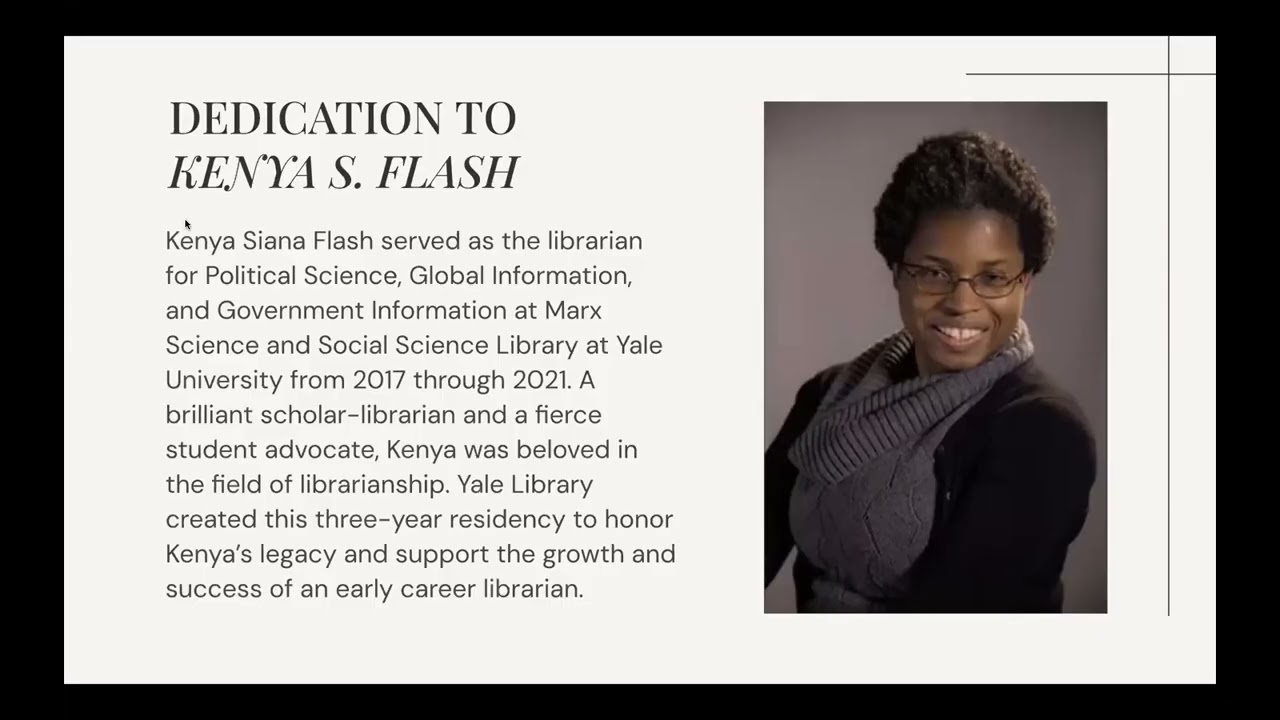
2026 Kenya Flash Virtual Lecture Series
Watch on YouTubeVideo summary
The 2026 Kenya Flash Virtual Lecture Series honors the legacy of librarian Kenya Shauna Flash by showcasing an innovative residency program established at Yale University's Mark Science and Social Science Library following her passing in December 2021. Designed to reflect her core values rather than merely filling staffing gaps, this inaugural residency created a dual embedded experience that integrated residents into both the academic institution and the broader New Haven community. The initiative was built upon an advisory committee of mentors including former residents and experts like Michelle Peralta, fostering an iterative learning cycle where professional socialization occurred through campus committees, conferences, and publications. This approach ensured that emerging librarians were treated as partners with agency rather than just labor, emphasizing ongoing learning, advocacy, and excellence within a supportive community structure.
Central to the program's success was its focus on investing in people over positions, which allowed residents like Nick Wsala to develop their professional identities through meaningful contributions such as archival work, committee service, and leading specific initiatives. The residency successfully bridged the gap between public libraries and academic institutions by viewing differences not as barriers but as opportunities for growth, with community engagement serving as a central purpose rather than an add-on. Specific projects like the MLK citywide reads program demonstrated how campus and public library spaces could collaborate to engage youth through literature discussions and book giveaways, while apprenticeships at branches like Stetson centered on Black history and culturally responsive collections. These efforts deepened reciprocal ties between universities and communities, fostering trust-based collaborations that supported locally relevant programs even amidst resource constraints or shifting political priorities.
Despite facing challenges such as balancing workloads with developmental stretch and managing the emotional labor inherent in equity-focused roles, the program proved adaptable across institutions by prioritizing shared responsibility for development over simple output metrics. The impacts were multifaceted, accelerating resident growth while strengthening supervisory practices at Yale Library's Staff Development Engagement department and enhancing outreach capabilities within New Haven Free Public Library. Speakers emphasized that exact replication is not feasible everywhere, but core principles like intentional design around genuine investment in emerging professionals can be adapted to honor Kenya Flash's legacy elsewhere. The session concluded with a call for audiences to reflect on designing similar pathways into librarianship grounded in equity and dignity, encouraging continued collaboration across silos in public, academic, government document, and archival fields to expand recruitment efforts and make the profession more accessible and diverse.
Read the full video transcript
Uh we'll just wait we'll just wait for a
few minutes for uh additional people to
enter the room and then we'll get
started.
And perhaps just a minute or so more. I
still see some people entering. I never
know
when to get started, when to wait.
Perhaps just another minute or two.
Well, I see we have uh 64 um members in
the room and that sounds like a good
number to me because that is the age I
plan to retire. But anyway, uh yeah, I'm
Jim Church. I'm a member of the
committee and I'd just like to welcome
everybody to the Kenya s flash virtual
lecture series in Librarianship which is
a free online annual speaker series
dedicated in honor of our beloved
colleague the late Kenya flash. The
series is sponsored by the ACRL politics
policy and international relations
section or pippers and the ALA
government documents roundtable go.
Today's lecture will address the design
and evolution of the Kenya s librarian
residency at Yale University
highlighting the relationships
mentorship structures and opportunities
that have shaped the resident's growth
as a librarian colleague and community
member. Our presenters will reflect on
the residency's impact not only on the
resident but also on colleagues,
mentors, collaborating organizations,
and the communities engaged through the
work. They will examine the
opportunities and challenges of
intentionally designing a residency
grounded in exper experiential learning,
leadership development, and community
partnership. But before they begin, we'd
like to say a few words about Kenya, her
legacy, and what she meant to us as a
colleague and as a person. Kenya earned
her bachelor's degree in government and
law from Lafayette College, an MA in
political science from East Strawsburg
University, and an MS in library and
information sciences from Drexel
University. She was a librarian at Kings
College and the University of Tennessee
Knoxville before joining the Mark
Science and Social Science Library at
Yale University in 2017 where she served
as the librarian for political science,
global information, and government
information until her untimely passing
in December of 2021.
Kenyon provided instruction, research
support and collection development for
the department of political science and
global affairs and for the programs in
ethnicity, race and migration and
ethics, politics and economics. Her
passion and expertise was demonstrated
in the research guide she created and
the glowing testimonies of the students
and faculty she helped. Kenya was a
passionate advocate and educator about
government information. She was a
lecturer at the University of Illinois
School of Information Studies where she
co-taught a class in government
information with Scott Mat currently
serving as the US superintendent of
documents. Advocacy for an interest in
government information from the state
and local to the international was
instrumental in her professional
calling.
Kenya was also a productive author and
speaker. Among her many published works
was the book ethnic studies and academic
and research libraries edited with
Raymond Pun and Melissa Gardianis Dao
published by ACL and assumed identity
realities of AfroCaribbean librarians in
the black librarian in America
reflections resistance and reawakening.
Kenya presented at the International
Federation of Library Associations or
ILA in 2017 and was instrumental in
reaching out in introducing NPR's Hanzi
Lo Wong who speak who spoke at the
counting on trust trusting the count
census 2020 sponsored by God and the
social responsibilities roundt at the
ALA annual conference in 2019.
But above all, Kenya was a beloved
colleague, friend, and community member.
She was an active member of both Pippers
and God, was elected to the Pipper
executive board, and served
exceptionally on the Pipper's
professional development and membership
committees, where she was instrumental
in the creation of the webinar series,
Fundamentals of International Law. She
was also sponsored by God in ALA's
emerging leaders program. Served as the
coordinator for the international
documents task force was a go to
representative to the ALA equity
diversity and inclusion assembly and
leaison to the social responsibilities
round table. In all of her professional
activities, Kenya was an expert whose
council was widely sought and an
inspirational leader who tirelessly
inspired and forged relationships among
her colleagues. There are no words to
adequately summarize the creative
energy, positivity, grace, kindness,
humor, and brilliance she brought to
every group she joined and every person
she touched. We count ourselves so
fortunate to be among the many people
who have known her. And with that, it
gives me great pleasure to introduce our
speakers.
Rhysa Nelson serves as the director for
staff development engagement at Yale
University Library. In this inaugural
role, she provides strategic leadership
to enhance the staff experience and
foster a healthy workplace climate
across the library system through
initiatives that promote learning,
connection, and collaboration.
A collaborative and consultative leader,
Nelson works across the library and
university to cultivate a workforce that
is engaged, empowered, and resilient.
Prior to joining Yale Library, she
served as assistant dean of Yale College
and director of the Afroamerican
Cultural Center at Yale. Earlier in her
career, she held positions at Cornell
University, Mercy College, Loyola
University Chicago, and the University
of Notradam, St. J St. John's
University, and Columbia University,
where she also earned a master of arts
in higher and post-secary education from
Teachers College. Throughout her career,
Nelson has partnered with students,
staff, faculty, alumni, and community
members to create more equitable and
accessible learning in communities.
Next, I'd like to introduce Nick Wsala,
who is a librarian with more than a
decade of experience in access services
and currently serves as Yale Libraryies
inaugural Kenya as Flash resident. He
previously worked at the Robert F.
Woodruff library at Emory University
where he held roles including library
coordinator for access services, student
supervisor and research specialist. His
commitment to librarianship began during
his undergraduate years at the
University of Cincinnati where he worked
at Langom Library as a technical and
equipment specialist.
Nick earned his master of library and
information studies from the University
of Alabama. During graduate school, he
was active in the Society of American
Archavists and helped develop archives
and communities, a podcast series
featuring archivists from across the
country sharing their pathways into the
profession. Passionate about
librarianship, student success, and
community engagement, Nick brings
creativity, curiosity, and a
collaborative spirit to building
connections within and beyond the
library. And finally, I'd like to
introduce Diane X. Brown, a native of
New Haven, Connecticut, who serves as
the manager of the Stson branch of the
New Haven Freedy Public Library. A 2003
recipient of the Bill and Meinda Gates
Fellowship Award, she earned a master of
arts in information technology and
library science from Southern
Connecticut State University in 2004.
From 2005 to 2011, Brown served as an
adjunct professor in Southern
Connecticut State University's
Department of Information Technology,
teaching undergraduate and graduate
courses both online and on campus. She
assumed leadership of the Stson Branch
Library in 2006 and played an integral
role in the development of the branch's
new facility, participating in every
stage of the project from design through
its opening in 2022.
through her leadership, she has remained
deeply committed to serving and
strengthening the New Haven community.
And so that's all I have to say. Uh for
that, I'd just like to hand it over to
our speakers and thank you again for
everybody joining us.
>> All right. And you all can hear me.
Okay.
Awesome. So, thank you so much. Good
afternoon, everyone. Thank you again for
joining us uh today. Before we fully
begin, we want to express our
appreciation to the ACRL politics,
policy, and international relations
section and the ALA government documents
roundt for inviting us to participate in
this year's lecture series and for your
continued commitment to honoring Kenya's
life, work, and enduring contributions
to our profession. We're also grateful
to you all, our audience today, for
choosing to spend part of your day with
us. And um today we're going to explore
intentional approaches to leadership
development to mentorship and community
partnership through the story of the of
the Kenya Siana Flash residency at Yale
Library. Along the way, we'll reflect on
the residency's origins and design, the
experiences that shaped its evolution,
its impact on our resident mentors,
colleagues, partner organizations, and
our community, and what we believe this
experience may offer to broader uh
conversations about cultivating the next
generation of librarians. So, Nick here,
Diane, and I are excited to share this
journey with you on Kenya's birthday,
and we look forward to hearing from you
all at the end of the session.
All right. So before we uh begin, we
wanted to dedicate this presentation to
Kenya whose life and legacy inspired the
residency we'll be discussing. Kenya
served as librarian for political
science, global information and
government information at Yale Libraries
Mark Science and Social Science Library
from 2017 to 2021. She was a brilliant
scholar, librarian, a generous mentor, a
passionate advocate for students and
colleagues, and someone who is deeply
deeply committed to expanding
opportunity within this profession. In
2022, after her very untimely passing,
Yale Library uh established the
three-year Kenya s Flash residency to
honor her legacy by investing in the
growth and development of an early
career librarian.
Uh those who knew Kenya speak not only
of her remarkable enterprise but also
the care, integrity and encouragement
she brought to her work and to the
people around her. Among the various
committees she served, Kenya's
leadership on Yale Library staff
advisory committee on diversity and
inclusion helped pave the way for the
creation of the library's inaugural
director for a diversity, equity,
inclusion and accessibility position
whose work whose work this residency
supports. Another reminder that her
influence continues to shape this
library in meaningful ways. As you'll
hear throughout today's presentation, we
sought to create an experience that
reflected that values uh that the
reflected values that Kenya embodied
ongoing learning, mentorship, advocacy,
meaningful community engagement, and
excellence in librarianship.
And although today's presentation
focuses on the residency, we hope that
you'll come away seeing that in many
ways the residency itself became our
effort to honor Kenya's legacy. Not only
by remembering her, but by carrying
forward the values that she lived by
every day uh through the ways that we
intentionally designed this experience.
Um so before we dive in, I'm going to
briefly share how we'll spend our time
together. Uh we'll start by sharing the
philosophy behind its design and the
intentional choices that shape this
residency. Uh we'll then bring the
residency to life by sharing our
experiences and perspective uh from
Nick's experience and u professional
growth and our inaugural uh resident the
community um apprenticeship the
partnerships that have shaped the
residency along the way. And then we're
also going to reflect on the residency's
broader impact not only on Nick but on
mentors, colleagues, our organizations
and the communities we engaged
throughout the process. Um we'll
conclude by sharing lessons that we
learned uh that we hope will be helpful
to you all if you are designing um or
overseeing any residencies or early
career development efforts. Um but uh
we'll then open the um floor for
reflection discussion any questions that
you all have. So in terms of designing
the residency, um as I began designing
the residency, I found myself asking a
different set of questions than I might
have for uh a more traditional position.
Um but before I could answer those
questions, I first spent time reflecting
on Kenya herself. Um although I didn't
know Kenya deeply, I was connected with
her several years before I joined Yale
Library through my work uh as assistant
dean of Yale College and the director of
the African-American Cultural Center uh
where I created the history keepers
program. So I partnered with Yale
Library and the Smithsonian's National
Museum of African-American History and
Culture to familiarize through this
program um and prepare um under
reppresented students for careers in
archival and uh academic research
careers. Um we did mentorship,
experiential learning, paid research
opportunities. Uh and Kenya served as
one of our mentors and through that
experience I came to not only know her
work but also the values that shaped the
way she approached librarianship and
student success. Uh several years later
after joining Yale Library I had the
opportunity to design the inaugural
Kenya Slash residency. And as I
reflected on those earlier experiences
and learned more about Kenya from her
family, her friends and colleagues, I
came back to the values that defined
both her work and the way she moved
through the world. A commitment to
ongoing learning, mentorship, and
advocacy, meaningful community
engagement and excellence in
librarianship.
I wanted the residency experience itself
to reflect not just Kenya's name, but
the values that she embodied. uh my hope
was that every major design decision
would intentionally translate those
values into the resident's experience.
So those values became the lens through
which I approach my design decisions.
And instead of only asking uh what
responsibility should this position
have, I found myself asking a whole set
of different questions. What
experiences, relationships, and
opportunities best support an early
career librarian's continuous learning
and growth? How do we intentionally
surround the resident uh with guidance?
the encouragement and the support needed
to thrive. How do we help the resident
establish roots within uh both the
university and the broader community
that foster meaningful relationships,
genuine integration, and a lasting sense
of belonging? And how do we help
cultivate the knowledge, skills, and
professional networks that prepare the
resident to contribute to the profession
through leadership, scholarship,
service, and a lifelong commitment to
learning? So those questions shifted my
focus from designing a position to
designing a real developmental
experience. And once that philos uh
philosophy was clear, every major design
uh just served its purpose. So I'm going
to go into community of mentorship here.
One of my uh earliest design decisions
was to create an advisory committee. Um
to me meaningful professional
development has um never been the
responsibility of just one manager or
supervisor. Uh throughout my career,
I've believed that people learn best
when they're surrounded by colleagues
who bring different perspectives, um
expertise, experiences, connections,
relationships. Um so that philosophy
naturally shaped the residency. Um there
was another reason that I felt this was
especially important. Um beyond her work
at Yale Library, Kenya also served as
liaison to the ACRL diversity alliance
and cared deeply about expanding
pathways into librarianship for emerging
professionals. Um, at the same time, she
was thoughtful and at times very
understandably and necessarily critical
of residency programs that treated
residencies as inexpensive and uh
largely unsupported labor rather than
opportunities for comprehensive
professional development and real
investment. She believed residency
experiences should honor the residents
uh expertise and their dignity while
genuinely preparing them for a
successful career in librarianship. So
this was also core to my own
philosophies on staff development. And
as I reflected on my own experiences
with Kenya and learned more from uh her
loved ones and um different colleagues,
I kept coming back to that principle. Um
if we were going to create a residency
in Kenya's name, it had to reflect those
commitments. So the resident wouldn't
simply support the work of the library.
The library would make an equally
intentional investment in the resident's
learning growth and their future. So as
I continued uh researching residency
models, I was encouraged to find the
ACRL diversity residency toolkit,
recommended a similar approach through
residency planning and steering
committees. Um so that affirmed my
thinking and provided practical guidance
and uh helped strengthen the model and
later on I'll I'll add in the link for
um this and other resources that we'll
mention here. Um, one aspect of that was
especially meaningful, uh, one of the
toolkits co-authors, Michelle Peralta,
is also a Yale library colleague, and I
invited Michelle to serve on the
advisory committee because of her
experience as a resident, her expertise
in residency design, and her thoughtful
um, perspective on supporting early
career librarians. So together, this
group became much more than an advisory
committee. It was a community of
mentors, of colleagues, of advocates who
shared a genuine investment in the
resident's growth and uh their success
as well as a sounding board and support
to me as a resident's um supervisor. Um
and this is a picture here of uh the
advisory comm some of our advisory
committee members and Barbara Rekenbach,
university librarian uh with Kenya's
family for the first advisory committee
meeting.
I am now going to go uh into the
residents um advisory committee. So I I
want to start off by recognizing uh the
colleagues the amazing colleagues who
serve on the advisory committee each of
whom played an important role in shaping
this experience. So uh Mary Caldera
Adiva Nabis Michelle Peralta and Mike
Rush and you can see their titles here
and in the first uh the first year of
the u residency also Jeremy Geritano um
I assembled this this group very
intentionally um together they brought
the experience as former um library
residents or residency supervisors. They
were colleagues of Kenya. Uh they were
leaders with deep knowledge of
librarianship and professional
development. uh their collective
perspectives helped ensure the residency
remained grounded in both the values
that we hope to honor and the realities
of preparing an early career librarian
for the profession. Each committee uh
member brought their own unique
expertise and experiences but uh
definitely a shared common commitment to
um to Nick's success. Um and
collectively they provided mentorship,
uh created opportunities for reflection,
um offered career guidance, facilitated,
uh connections to different professional
networks, um and folks, uh especially up
here. Um identified meaningful
experiential learning opportunities and
remained a consistent source of
encouragement and support throughout the
residency. And looking back, uh one of
the things that I'm most proud of is um
Nick never had to rely on one single
mentor or perspective. um instead he
instantly became a part of a community
that was genuinely invested in his
growth from the beginning.
So now I'm going to go into the
framework. Um so once those questions
became clear and after um consulting
with Barbara Rakenbach again our
university librarian uh our advisory
committee our colleagues who knew Kenya
and Kenya's family um I began
translating those ideas into the overall
framework of the residency which of
course informed the position description
the recruitment process national search
uh the resident's experience from
beginning to end. So um rather than
designing a collection of disconnected
opportunities, I wanted to create a
coherent um developmental framework in
which each component reinforced the
others. Um at a high level, the
residency came to rest on five
interconnected design um elements. So I
intentionally designed a bounded
portfolio that balanced meaningful
contributions with opportunities for
stretch and growth and reflection. As I
mentioned, I created a community of
mentorship um through the advisory
committee and a broader mentoring um
ecosystem so that Nick's uh development
would be supported by many colleagues
rather than just me, the single
supervisor.
I built an an iter iterative learning
cycle in which experience, reflection,
and professional development
continuously informed one another. We
were able to adapt and be flexible with
all of the pivots that we've had to take
over the past few years. Um, I
intentionally uh emphasize professional
social socialization by creating
opportunities to participate in
committees on campus and off uh uh
professional associations, conferences,
um presentations, scholarship,
networking. So, experiences that would
help an emerging librarian begin to see
themselves as a truly an active um
contributor to the profession. And then
um I've uh designed what would be um one
of the residencies I think defining
features. So, a dual embedded experience
that intentionally integrated the
resident into both the Yale community
and the broader New Haven community
where I'm also from here. Um, if there's
one idea that I hope you'll take away
from this portion of the of the
presentation, it's that the residency
was not designed necessarily around the
work that Yale Library needed the
resident to do. It was designed around
the experiences, the relationships, and
the opportunities that would prepare an
emerging librarian for the next stage of
their career while meaningfully
contributing to both our organization,
our institution, and the broader
community. So, for me, the the the
measure of this opportunity was never
just what Nick accomplished during the
three years at Yale. Um, it was whether
the experiences we designed would
prepare him for a successful career
while simultaneously strengthening our
organization and the communities with
whom we partnered.
I'm going to talk just a little bit
about learning and leading through
experience. So, um, it was really
important to me that um, learning and
leadership developed through authentic
practice rather than just the
observation. So, Nick became, uh, an
active contributor across many aspects
of, um, staff development and
engagement. you might hear me call it um
SDE for short. Um he helps support staff
learning, engagement, um communications,
assessment, community partnerships. Um
and so you'll uh hear a little bit more
about those uh from Nick directly in a
little bit. And the goal was not simply
to complete a project. Uh it was to
invite Nick into the thinking behind the
work. Um to understand how decisions are
made and to help make those decisions.
um to understand how relationships are
built, how competing priorities are are
balanced, and how leadership is
exercised in practice. Um my role as as
the supervisor and designer of this this
um experience wasn't simply to to
delegate work out. Uh it was to
intentionally create opportunities that
stretched Nick's thinking um while
ensuring that he was supported and
challenged and encouraged every step of
the way. So beyond our department, I
also wanted Nick to experience
librarianship from multiple perspectives
both uh across the institution and the
profession. And so that included again
serving on different library and
university uh committees um contributing
to crossf functional initiatives um
attending and going uh and presenting at
conferences um and the uh New Haven Free
Public Library apprenticeship which
again he's going to tell you about um
all of all of these things. Um all to
say every opportunity served a
developmental purpose. So uh together
these experiences helped build not only
the the knowledge and the skills but
also the confidence the professional
identity and a growing network of um
colleagues and collaborators so that
Nick could thrive in this role and um
beyond it once he moves on from here.
Um, so now that I shared uh the
philosophy behind the residency and the
design um uh decisions that shaped it,
I'm going to pass it over to Nick who
will share a little bit more about the
opportunities, relationships as he
experienced them himself.
>> Thank you, Risa. Um, I'll start off
again to kind of uh reiterate my library
experience up until this point. As
mentioned earlier, uh I began at the
University of Cincinnati back in 2011
where originally um as I've spoken to a
lot of librarians. It's not the first
field that I thought about going into
college. I was actually trying to be a
sports journalist uh because I love
sports and I love writing. Uh but that
quickly changed after my work study uh
program um position that I had at the
library at Lenom Library where I was uh
took on a mentorship of my boss, the
director who's still there, Ben Klein,
uh the director of user services at the
University of Cincinnati Lenom Library.
He saw a big interest in me as far as
like you're he was like you are really
talented at uh understanding what we do
here, understanding the resources that
we have available, but also basically
spreading that out to the students. I
see how you talk to your friends. I see
how you talk to other patrons and you're
really good at communicating that in a
way that applies to them and exactly
what they need. Um so I kind of took
that on and um switched careers uh based
off of that uh encouragement and uh as I
was still working at the University of
Cincinnati. I took on more leadership
positions after I graduated. I ended up
becoming a technical equipment
specialist. Uh but then I wanted to kind
of pursue more of myself on a personal
level. So I uh I left Cincinnati and I
moved to Atlanta, Georgia. But I still
had the pursuit of being in li in
libraries and doing librarianship. So I
ended up working at Emory University
libraries in Atlanta, Georgia. And
during that time, it was around 2018. So
I was still a staff member, but I saw
based off of that uh label, I was
limited to the positions that I could
apply for in the library and I was not
as aware of what the MLIS degree would
open up to me as far as options. So
during the pandemic where um if you were
you know blessed to have the opportunity
to kind of reflect on not only your life
but your career that's something that I
did uh which made me say okay this is
the best time to kind of lock in and get
this degree. So that's what I did. I
applied uh to the University of Alabama.
I saw this EPCO scholarship program was
more for about upcoming uh preservation
digital archiving uh which is something
that I was familiar with doing because
in the city of Atlanta I was working
with a local media company that was in
uh podcasting. So I was always working
with audio and visuals and doing some
editing also uh producing and hosting.
So it was something that I felt like I
had the skill set for and I just married
the two together and uh I completed that
degree program with the help of that
scholarship uh in the spring of 2023
which at that time I had a colleague at
Emory send me a link for this residency
saying I heard you got your degree I
think this would be a great opportunity
for you uh in your next phase and it
kind of took off from there.
Mhm.
>> Um and as you've heard, Rhysa's designed
the residency around learning,
mentorship, and meaningful contribution.
From my perspective as the resident,
that initially was evident from the very
beginning. Uh basically from our
conversations before I before she even
knew who I was and vice versa, she was
very adamant about saying, "Well, I'm
here to help you however it is whether
you want to stay at Yale or go." And uh
based off of that, rather than observing
from the sidelines, I quickly became an
active uh contri uh contributor uh to
the work of the staff development and
engagement. Working alongside Rhysa, I
support a rise range of initiatives,
including staff learning and engagement
programs, our learning and development
opportunities, help manage staff
development, engagement li uh resources
library, and help coordinate
communications and assessment efforts,
as well as community engagement
initiatives. What stood out to me wasn't
simply the variety of work. It was the
opportunity to understand that uh to
understand the thinking behind it. It
wasn't just learning what we were doing.
I was learning how organizational
decisions are made, how relationships
are built, how priorities are balanced,
and how staff development engagement can
strengthen the organization over time.
At the same time, the residency
initially extended beyond my day-to-day
responsibilities. I had the opportunity
to continue developing as a librarian
through archival processing projects,
committee and task uh task force
service, conferences, presentations,
publications, participation in national
professional associations, and helping
coordinate leadership development
experiences, including the association
of research libraries leadership and
career development program. One aspect
of the residency that I especially
appreciated was that it wasn't a fixed
experience. While the overall framework
remained consistent, there was
flexibility for me to identify new
learning opportunities, pursue emerging
interests, and help shape aspects of the
residency as I grew professionally. That
meant I wasn't simply participating in
thoughtful design experience. I was an
active partner in my own professional
development. Together, these experiences
helped me build new knowledge and
skills, expand my professional network,
strengthen my confidence, and develop my
identity as a librarian. They they
reinforce that librarianship extends
well beyond any single role and or
department. It is strengthened through
collaboration, service, scholarship and
community. Two experiences in particular
became very transformative because they
initially extended the residency beyond
Yale. The first was serving as a
resident fellow in the Davorn College
here at Yale University, meaning I lived
on campus in one of the residential uh
uh colleges, their community housing. uh
something that Rhysa was uh uh kind
enough to arrange prior to my arrival.
Uh through this opportunity, I was uh
became very deeply connected to Yale's
campus community and student life. And
the second was my apprenticeship here at
the New Haven Free Public Library,
specifically the Stson Branch Library,
which introduced me to community center
leadership or librarianship in entirely
new ways. Um, and I'll pass this on to
my mentor, Diane Brown, uh, to share
more about her work, our partnership,
and the important role that it played in
my development as a librarian.
>> Thank you, Nate. Good. That was good.
Right on target. Um, good afternoon,
everyone. Um, I'll start by sharing a
little bit about my journey. Um, Nick
said, you know, wasn't his first career,
so it's probably like my fourth career.
Um, so I've had quite a few careers
prior to becoming a librarian, but my
career as a librarian began u with a
conversation with the former Mr. James
C. Wellborn. Um, he was the first and
only black library director of the New
Free Public Library to date. Um, who
would become my mentor. That's another
whole story in itself.
Um, I was granted a Bill and Melinda
Gates Fellowship scholarship 2003 and I
completed my MLS in 2004 at Southern
Connecticut State University. I was
hired at the New York Free Public
Library in 20 in 2004. I served in
several departments including reference
cataloging and I was the first young
adult librarian in the system. Um and
I've been in my current role um as
branch manager here at Stetton um for
going on 20 years. In 2005 I was hired
as an adjunct faculty at SCSU Selenega
State University where I remained for
six consecutive years. Um, I want to add
in that time I had the opportunity to
mentor several dozen librarians. And as
many of you may know, um, the percentage
of African-American librarians or
librarians of color is, uh, is is sparse
is is very sparse. And in those years
and and coming up to to date, Nick is
probably
the third person of color. in my uh 23-y
year career as a librarian that I was
able to actually mentor someone of
color. So, um it was it was not saying
that I won't mentor anyone, but to
mentor a black male is was was very
special to me. Um
when working with Rhysa and Nick um to
design the apprenticeship, we agreed
that we wanted to include the following
purposes. It would be a community
embedded apprenticeship to complement
campus-based fellowship work. We wanted
Nick to experience librarianship within
a branch that intentionally centers
black history and the African diaspora
through its collections and community
partnerships. We wanted to we wanted to
support development of early career
competencies, operations, collection
stewardship, community engagement and
program design. We wanted this to
provide apply We wanted this to provide
applied learning in public librarianship
grounded in local context and
relationships and to offer career
exploration and mentoring.
In terms of the of the design, Nick and
I work to build in the following public
librarianship operations to focus on
fluency and branch workflows, manager
and staff roles and service delivery.
collection development to ensure that
they are culturally responsive and to
focus on strategic selection and
collection stewardship, community
connections. It was critical for us to
focus on relationship building and
outreach with community stakeholders. Um
I'll add in there, STSON um has is is a
nationally recognized library. We are
one of five branches in the New York
free public library system and our
success is because of our uh building
and sustaining community partners. That
that's that has been our success.
um community informed program
development, collaborative design,
coordination of community informed
programs um including the Martin Luther
King citywide read um Junth celebrations
and the Elm City Freddy Fixer parade
which is one of the oldest
African-American parades in the country.
Um and Nick participated in in all that
and he's going to be missed. In fact,
they missed him at the parade this year.
He was traveling but they missed him.
So, I'm going to turn it back over to
Nick.
>> Thanks, Diane. Um, we've shared so far
uh how the residency was designed and
what the experience looked like in
practice. Uh, we would like to reflect
on its impact now across several levels.
From my perspective as the resident, the
impact has been both uh developmental
and professional. The residency paired
meaningful contribution with
opportunities for stretch, reflection,
and support.
That combination accelerated my growth
while allowing me to develop a broader
professional identity across
librarianship, staff development and
engagement, community based work, and
organizational leadership. The
experience also increased my confidence
and visibility through committee
service, professional associations,
presentations, publications,
conferences, and relationships across
Yale and the broader field. I develop a
much stronger professional network and
clear understanding of how I hope to
contribute to librarianship moving
forward.
>> And from my perspective as the
supervisor and designer of the
residency, Nick's contributions
increased our capacity to advance
important work uh within staff
development and engagement. Um but the
impact obviously extended well beyond
having just additional support. Uh the
residency strengthened my own practice
as a developmental supervisor and coach.
Um it required me to be even more
intentional about connecting assignments
to learning goals. Uh creating
opportunities for increasing
responsibility um providing meaningful
feedback and uh making space for
reflection. It also uh reinforced the
importance of documenting both uh
progress and learning so that um our
development could be recognized,
assessed and uh carried forward. Um at
the library level, Yale library level,
um the residency contributed to staff
learning and engagement initiatives,
which this is again a new uh department.
Um new resources, community partnerships
and outreach uh communications,
assessment and committee work. So the
whole shebang. Uh it also demonstrated
what can be possible when an early
career development um uh and and the
librarian um are treated not just at an
ancillary um activity or level but
really as a collective and um even an
organizational investment. So for me uh
one of the the most important outcomes
is that the residency offered a concrete
model for cultivating talent while also
strengthening the work of um the
department and of our organization and
uh those outcomes were mutually
reinforcing but um again the the
residents learning and development
remain central to all of this and Diane
>> um from the perspective of the New York
free public library and the local
community. The apprenticeship deepened
an important institutional relationship
and created opportunities for sustained
engagement over time. The work supported
programs and outreach strategies that
responded to community interests,
histories, and priorities. It also
strengthened connections between
university resources and community-
based work in ways that were reciprocal
rather than onedirectional.
The work wasn't simply conducted in the
community. It was developed with with
the community through relationships that
require trust, consistency, and an
understanding of local contexts.
>> From the broader professional community,
we believe there is value in sharing
what can travel beyond our particular
setting. This residency cannot and
should not be replicated exactly
everywhere. Institutions differ in their
resources, structures, communities, and
capacity, but many of its design
principles are adaptable. Beginning with
the resident's development, creating a
community of mentorship, connecting
meaningful work to reflection,
supporting professional socialization,
and allowing the resident to shape the
experience. By sharing the framework,
our reflections, and what we've learned
through the presentations and
publications, we hope to contribute to
broader conversations about how
libraries can create responsible
developmental pathways into profession
from prospective employers. I also hope
to work I hope I hope the work makes
visible not only what I've accomplished,
but how I learned, collaborated,
exercise leadership, and developed as a
librarian through the residency.
As we've reflected on the residency,
we've also spent time thinking honestly
about some of the challenges that is
accompanied by. For me, one of the
biggest was learning how to grow without
trying to do everything at once. Because
the residency offered so many
opportunities, there was consistent need
to balance professional stretch with
realistic workload expectations and to
remain clear about my role as both a
learner and a contributor. Another
challenge was simply learning to
navigate the complexities of a large
research university as an early career
librarian. Like many institutions, Yale
experienced organizational, financial,
and broader political changes during my
residency. Learning how to work through
uh thoughtfully through that complexity
became part of my development experience
itself. And because much of my work
centered on staff development,
organizational culture, and community
engagement, there were times when the
work also carried emotional weight.
Having a strong network of mentors and
colleagues made an enormous difference
in helping me process those experiences
while continuing to grow.
>> And again, from my perspective as the
supervisor and um designer of this, one
of the greatest challenges for me was
protecting the residents uh uh the
residency's developmental purpose. Um
meaningful coaching and sponsorship
require time um investment, real
intentionality and organizational
support. Um development doesn't happen
alongside the work. It happens like
through the work which means that
supervisors must create the space for
reflection, for feedback, and for
progressively increasing responsibility
if there is the capacity for it. Um,
another ongoing uh consideration was
maintaining the residency's original
purpose while remaining responsive to
the changing organizational priorities.
Um, every new opportunity had to be
considered through the question, does
this contribute to Nick's development
rather than simply asking whether it
would be helpful to the organization or
not. Um, at an institutional level, um,
sustainability is perhaps the greatest
challenge. Uh, one of the questions
we've continued asking ourselves is how
we preserve the intentionality of this
model. be beyond a single residency or a
single um supervisor. This is a
residency that is that was supposed to
rotate um every 3 years. And so these
are the things that we are thinking
right now. And obviously um every
institution and and every library um has
different cultures, priorities, uh
partnerships, resources as Nick
mentioned. Um so the goal isn't to
replicate this exactly but to carry
forward the principles and again um
Kenya's values that made it successful
while allowing for future iterations to
reflect uh their own contexts. Um I'll
also say that measuring impact remains
complex. um professional growth,
mentorship, um confidence, uh
organizational learning are amongst the
most um meaningful outcomes of the
residency, but they're also the most
some of sometimes the most difficult to
um quantify. So that reminds us that um
responsibility for developing early
career librarians must be shared across
the institution or organization rather
than just again resting on a single
resident or a single supervisor or
program.
Um, from the from the perspective of the
New Haven Free Public Library and the
community we serve, um, from my years of
experience, um, I can confirm that one
of the biggest lessons is that
meaningful partnerships are built
through relationships and relationships
take time. Trust cannot be rushed and it
certainly cannot be transactional. It
develops through consistency, mutual
respect, shared purpose, and a
willingness to learn from one another.
Those qualities became the foundation of
this apprenticeship and our partnership
with your library. Partnerships between
institutions
also require
public libraries and academic lies
lines organizational cultures
those different
Did we lose you?
Can you hear us? Can you see us?
>> We can hear you now.
>> Awesome.
>> Okay. So, I I'll go back just a little
I'll go back just a little bit. Um,
I was talking reflecting on the
challenges and the opportunities. Um, I
don't know what part I cut out at, but
I'll go uh I'll I'll start here. From
the perspective of the New Free Public
Library and the community we serve. From
my years of experience, I can confirm
the biggest lesson is that meaningful
partnerships are built in relationships
and relationships take time. Trust
cannot be rushed and it certainly cannot
be transactional. It develops through
consistency, mutual respect, shared
purpose, and a willingness to learn from
one another. Those qualities became the
foundation of this apprenticeship and
our partnership with Yale Library.
Partnerships between institutions also
require flexibility.
Public libraries, academic libraries
often operate with different missions,
timelines, organizational cultures, and
resource constraints. Rather than
viewing those differences as barriers,
we approach them as our opportunities to
learn from one another and to build
something stronger together. Finally,
community responsive work requires
sustained investment. Programs and
partnerships are most meaningful when
they grow out of genuine relationships
with the communities we serve. Not
simply because they're good ideas, but
because they're good grounded in local
because they are grounded in local
voices, histories, priorities, and
strengths. For me, that's one of the
most rewarding aspects of this
residency. It demonstrates that
community engagement isn't an is is not
an additional component of
librarianship. It's one of the ways
librarianship fulfills its purpose.
And from the perspective of the broader
profession, I think one of the biggest
lessons is that there isn't a single
model for designing a successful
residency. Every institution has
different resources, organizational
structures, staffing models, governance,
and community relationships. The goal
isn't to replicate this residency
exactly, but to thoughtfully adapt the
principles behind it to fit it uh to fit
your own context. I also think it's
important that residencies not be viewed
as quick solutions to institutional
challenges. They represent long-term
investments in people, in organizational
learning, and in the future of our
profession. The resident's development
has to remain at the center of the
experience. Finally, I think our
profession continues to face an
important challenge, creating stronger
pathways for residency experiences into
meaningful long-term careers. My hope is
that the conversations like this and
residencies designed with intentionality
and care can help us move forward and
closer to that goal.
>> And as we reflected on the residency
over the past three years, almost three
years now, um we've also spent some time
asking ourselves what lessons might be
useful beyond Yale Library. Uh the first
is to let the values guide the design.
So rather than beginning with a position
description or a list of
responsibilities, uh we began with
Kenya's values uh and asked how they
could be reflected in the resident's
experience. Those values became the
foundation for every decision that
followed. Um secondly, intentionally
designed experiences uh not just
positions. Professional growth doesn't
happen by accident. And it develops
through very thoughtful opportunities
for learning, for um creating meaningful
uh contributions and increasing um
responsibility bit by bit and authentic
relationships. Um building communities
of men uh mentorship. Again, no single
supervisor can provide every experience,
perspective or connection, nor should
they um that an an emerging librarian
needs. And so development is just
strengthened when mentorship becomes a
shared commitment across colleagues,
departments, um institutions and even
communities. Um create opportunities for
meaningful contribution. So truly
meaningful contributions. Um work that
is challenging that allows them to grow
that helps them uh understand how
librarianship is practiced in real
organizational and community contexts.
Um I think a really important lesson
though is this that we have to invest in
people. Um again, not just the positions
or the needs for that role um or
organizational capacity. And when we
intentionally cultivate professional
identity um and support ongoing
learning, encourage um engagement and
well-being and and create pathways for
leadership. Um we strengthen not only
individual librarians, but we strengthen
our institutions, our communities. We're
stronger as supervisors. Um, we also
strengthen the future of this
profession.
>> And from the resident's perspective, one
of the most meaningful aspects of this
experience was being trusted to help
shape my own learning.
The framework gave me direction, but
also gave me room to explore emerging
interests, pursue new opportunities, and
grow in ways that reflected my own
professional goals. That flexibility
transformed the residency from something
I simply participated in into something
that I helped shape.
For me, I'd add one more I'd add one
more um lesson from the community
perspective. Community shouldn't be
viewed as an extension of learning. It
should be recognized as one of the
richest environments. Some of the most
meaningful growth happens when emerging
professionals build relationships beyond
their own institutions, listen to
communities, and learn alongside the
people they hope to serve. Those
experiences don't simply strengthen
individual librarians. They strengthen
the profession's connection to the
communities that libraries exist to
support.
>> And as we close, I I just want to share
a couple of uh quick reflections. Um
when we began designing this residency,
our hope was never to simply create a a
job, a position. Um, our hope was to
create an experience and one that
honored Kenya's legacy by investing
intentionally in the growth of an
emerging uh career librarian um while
strengthening relationships across our
library, university, and our community.
Um, over the past almost three years now
um that vision has been shaped not only
by thoughtful design um but also by the
generosity, the wisdom and the
commitment of many many many people who
believed in its purpose. Um, and I think
that's one of the greatest lessons that
we've learned. When we again
intentionally invest in the people, we
don't simply strengthen individual
careers, we strengthen our
organizations, we enrich our communities
and um again sustain the future of this
profession um in in different and new
ways. Um before we open the
conversation, I would like to invite
Nick to share um some final reflections
on the uh Kenya Shauna slash residency
and some really really great news.
>> Um I believe you all saw earlier the the
first photo I think we all took together
with it was me, Rha, uh and Kenya's
family. And during that dinner, uh, of
course at that time Reese has already
informed me about who Kenya was, but
during that dinner I got to experience
the legacy she left behind. And I
actually spoke to one of the family
members and I said, "I hope I can live
up to, you know, uh, your uh, how great
Kenya was as a person." And they were
like, "Don't worry about that. Kenya's
legacy is Kenya's legacy. Make something
of your own that will go in partnership
with that." So at first I was very much
concerned about like am I doing the
things that she would do or am I you
know making choices and and doing things
that would shed more light onto her her
life and what she embodied. But as I
grew into this and I as I met a lot of
different people who she's touched and
she touched a lot of people. I went to a
bunch of different conferences my first
couple years in this residency and
everyone knew her. everyone knew and the
one thing that was very much in unison
of when they talked about is how much
she made them feel comfortable and how
much she made them feel like a family
friend or or someone that they've known
all their lives specifically at the uh
Black Caucus American Library
Association annual conference the last
one I met uh one of her close friends
Toana Haj and we end up being able to
you know communicate and and and speak
to each other and she's shed more light
on who she was but she also really just
again showcased how much librarianship
is not just it's a profession, but
sometimes it's a life calling, which is
what I felt like she was into. Um, and
that's something I will always be
grateful for because that's kind of what
I've used in my own personal uh
professional kind of philosophy and
mantra. Um, and one of the things I'm
especially uh grateful for is is that
this residency has prepared me for the
next stage of my career, which I'm
excited to share. I'll be joining Texas
A&M uh as a teaching, learning, and
curriculum librarian. um this
opportunity, this position is more about
helping uh integrate library resources
into the courses that are taught uh at
an institution like uh a research one
institution like Texas A&M. So, I'm
excited to do that kind of work. And uh
while this opportunity represents an
exciting professional milestone, I also
see it as a reflection of what this
residency was dedicated and designed to
do. provided experiences, relationships,
mentorship, and opportunities that
prepared emerging librarians like myself
for meaningful careers and continued
service to our profession, which so I'm
deeply uh grateful to everyone everyone
in this room. And there's a hundred of
people I could shout out to as well. And
some of them are actually, you know,
watching this live who invested in my
growth and and and my career path. So, I
want to continue to do the same for
others as well. Before we open it up for
um any questions, discussions, um
thoughts, uh thank you again, gracious
host. Thank you so much for inviting us
to um share this work and also for again
your continued um stewardship of Kenya's
remarkable legacy. Um to our colleagues
in leadership at Yale Library and to our
partners at the New Haven Free Public
Library, thank you all um for believing
in this residency in me and Nick um and
investing uh your time, your expertise,
uh your encouragement, and your your
deep deep care um throughout it all.
This really has been a very uh shared
effort and experience. Um to Kenya's
family, thank you for entrusting us with
the privilege of carrying forward
Kenya's legacy and your generosity, your
insights, your encouragement have really
helped shape this residency in profound
and lasting ways. And finally to Kenya,
uh Kenya shown a flash. Uh her career
was far too short. We all know this. Um
but I hope she knows that her example
continues to inspire so many people. um
her commitment to mentorship, advocacy,
community, learning and and excellence
and integrity um challenged us to
imagine something worthy of her legacy
and continues to challenge us all, I
think, to be better colleagues, um
better leaders, and better stewards of
this profession. Um so, thank you again
uh for joining us, um for honoring
Kenya's legacy with us here today. Um
thank you for the work that you all do
to cultivate learning, leadership, and
community in your own libraries. And at
this point, I think we have like 15
minutes or so. Um, we can open it up for
questions, comments, thoughts.
>> Yeah. Well, hold on one second.
Let's go back to the share.
We'll
go on to last.
>> Um I I don't have any qu uh questions in
the chat yet, but my one of my questions
was can you tell me a little bit more
about the MLK citywide reads program
that you guys um participated in? What
did that entail? I assume it was with
New Haven Public Library, but it did it
have also a campus component? Yeah. So,
I used to um coordinate I served as the
chair for the university's MLK um
commemoration. And so, this uh we grew.
It's the largest um event outside of
commencement. And when I came over to
the library, I said, you know, we can do
something kind of tap into that. Um and
uh we wanted to focus it on youth um
literacy, empowerment, um engagement,
and so um I mean, I'll I'll let you talk
a little bit about it, but that was that
was the the roots of it.
>> We wanted to extend it out. Um it was
something that re it was one of those uh
very much uh early career experience for
me as far as overseeing a project an
initiative. Uh Rhysa wears a thousand
hats. So she gave me one of them to
wear. So I was blessed that she trusted
me with that. But I also I was I didn't
do it alone. A lot of the stuff that
I've done in this residency was all
mostly collaborative. Even if it was my
idea, I was able to work with others.
Um, so I was able to take an idea that
was already formed, but the help that
Diane gave me and still does is probably
one of the most impactful, if not the
most impactful thing that I've got out
of this experience. What I was able to
do was uh we pretty much looked at
different uh letters levels of
literature, mostly focused on uh youth
literature uh to kind of talk about the
legacy of Martin Luther King Jr. or the
ideas that he shared with during his
life. And we wanted to kind of bring
that to a young audience to kind of, you
know, introduce them to not only li the
library, but just also just ideas that
they should be thinking about as they
get older. And Diane is great as far as
creating space for those kind of
programming. Um, she's always someone
who's big in the community. So, she's
like, "This is a community event. This
is great, but you got to do the work.
You got you got to set it up. You got to
organize it. I'll give you the space."
And that was so I was so blessed to have
that kind of support because one it's
hard to find a space for certain events
like this because you know again during
this political times you don't really
know what uh institutions organizations
to trust but because Rhysa whoever Rhysa
vouched for I trusted. So when once I
met Diane I was like oh I got I get why
you trust this person. So we were able
to kind of uh again do an onampus and
off-campus. That's something that we my
uh position was all about as far as
connecting the university Yale to New
Haven because there's been some
disconnect over the last few years. So,
or even more than that to be honest. Um
so, this was something that I was able
to host online. Um we did a book author
talk. The most recent uh literature we
did was a book called That Flag, which
is um about a conversation between a
young black girl and a young white girl
about the history of the Confederate
flag in America. And since this is
America 250, we felt that it was a
really good way to kind of talk about an
honest look and viewpoint of American
history. Um, so we were able to have an
author book talk with author. So that
was a more like an adult, you know,
conversation. Um, but then also we were
able to talk with the kids about it,
which is where Diane would came in and
gave us the space to kind of do that.
Uh, uh, I guess what is it called? Uh,
learn to share. What was the the
>> We gave the books away.
>> Yeah. Learn to share program. And we
gave books away. And there was a lot of
the kids. I still have videos and
pictures of it. A lot of kids really
loved it. They actually asked a lot of
great insightful questions as well too
to follow up from the conversation that
brought about from the book. So that was
one example of what we do when it comes
to the MLK city read. We usually do like
a different book every year, but this is
the most recent one that we did and that
was really uh impactful.
>> And I want to add that the children love
Nick. He would come to many of the
programs that he partnered with us or
that he designed. And one little girl
one time, Nick came in, she walked and
she said, "Oh, no, you again."
But she stayed with Nick the whole time.
So I say that to say, you know, children
are real. Children don't fake. Children
either like you or they don't like you.
But the children came to know Nick as
one member of the community. And so I I
feel blessed with that, especially with
him being a black male, a black male
librarian from Yale. Um, and it was
important for me to let the children
know who he was. Um, that he was a part
of our village. And so, uh, that was
that was very heartwarming.
>> That was so good. So, I'm going to read
out one of the next questions. Um, and
this is from Trip. One of the things I'm
fanboying about is the way that you made
aspects that are often treated as
luxuries into the loadbearing pillars of
this program. room to explore employee
employee centeredness and
thoughtfulness. Nick talked some about
this, but I was hoping you could expand
on how you think the experience you've
fostered could get approximated at an
institution with stronger
pressures about the aspects of these
like luxuries rather than being the
central part of what they can do. Um but
it so it seems like staff and funds
pressures may make it more difficult for
or um institutions or organizations who
are moving away from
uh the sort of extractive approach to
this kind of position.
So like
exploitive or extractive versus
supportive. So, um, gosh, that's a long
question, but
go ahead.
>> Yeah, I'll I'll just say it it
that never crossed my mind because
that's not how that's not my approach.
That's not within my heart. That's uh I
I designed this um again to honor Kenya
and and to to do that to to kind of ex
just extract or have it be like a
transactional experience where the
library or I supervisor, you know, I'm
I'm getting more out of it. That's kind
of uh it's wild to me. It it just
wouldn't make any any sense, especially
um I mean, I've never been that way as a
as a supervisor in my, you know, now
decades in higher education.
But it also was not Kenya's way, right?
Um in in her work um as a resident
liazing um you know with the diversity
alliance like it's I wanted to make sure
that this experience was something that
would speak to her as well um and that
would be aligned with her vision for
what this could or should be as well.
And I I think um it's important to note
that these resources, these connections,
these uh initiatives, all of that
happened because I made it so because I
used my connections and not necessarily
resources, but my my connections. Oh,
Nick is interested in community
librarian. That came from from our first
conversation. You know, I really would
like to explore community librarianship.
I said, "I know the person." That
requires um both the the commitment and
the the knowhow and just the the
connections of the supervisor to say,
"Okay, this is your interest. I'm going
to find somebody who can give you this,
who can fulfill this either need, um you
know, skill, learning that that kind of
thing that I could not. Um I'm not a
librarian, right? It was very important
uh to me to make sure that we were um
partnering very very closely with and
consistently with librarians both on
campus um also library workers but also
off-campus too um and so I think it
really it it comes down to your
commitment um and the connections that
you are are willing to explore um build
and again going back to the issue of of
trust that takes time. So my hope would
be that uh any any person working at a
library trying to create a residency
experience like this, they will have
already done the work to build those
relationships before they bring someone
in. Um are they ready for it? Is the
organization ready for it? Those are
some of the questions that I think uh
people would need to ask first and do
the work first before they they bring
folks in and making make sure that there
is really a a commitment there. um even
if it's you know so there's the
supervisory uh commitment as I mentioned
the community of mentoring that was
really important that the advisory um
you know committee and and whole network
that um I work to build around Nick um
that was super super important so that
now as you know he heads off to Texas is
leaving us um which no I'm very I'm very
very excited about and that was the
whole point of it right um you know that
you still have people and you have
people to to that you can count on that
you have people you can depend on um
when you do go down there. I assume I
hope you're going to have people there
too. If you don't, you know who to call
and we'll still, you know, we'll still
be there for you.
>> And and what I don't like about what
Rhysa said in that in that statement was
that she says she's not a librarian, but
she has the spirit of a librarian and
she has the mindset of me and Diane are
trying to get her to go to get her MLS
degree right after this, but
>> she just needs the paper. Yeah, she just
need a piece of paper. That's all she's
missing because
>> else paper.
>> So, I say that because um networking and
collaboration is I feel like a
fundamental disregard in our profession
sometimes because a lot of us feel
siloed in our work or siloed in our
units and departments. But Rhysa is
someone who's very much, you know,
outside with the people and she knows
how to not only work a room but also
know how the room should operate
efficiently if we're trying to have a a
center a center goal. And I that's one
of the things I've took from her
leadership is that you should be able to
not just as a profession, but just
especially as a librarian like you
should be able to know what's going on
in the public libraries. You should be
able to know what's going on around the
other surrounding universities. That
way, if you do have an idea that your
university or your department or your
job isn't allowing you to do, you can
funnel that to other opportunities and
make it work. You know, there's there's
a lot of people who want to do similar
work and they're always asking how do I
do this who like where do I go? And I
feel like if we talk more amongst each
other and create time to actually do
collaborations, we can kind of get that
job done. So, when it comes to like
financial restraints or political
restraints, there's other ways to
navigate that. just because I think we
talked about this a lot cuz we had to
change a lot from the DEI, you know, uh,
kind of, uh, initiative that was
attacked. We had to change a lot of our
wording, but the work never really
changed. We just found different ways to
navigate. So, I think if you're really
open to doing volunteer work or doing
uh, unique collaborations, you'll be
able to find ways to help support your
staff or even yourself. I wanted to add
really quickly that um Rhysa kept
referring to commitment and sacrifice.
Um I know when I first became a
librarian, no one wanted to mentor me
public library, I could not get one
librarian to mentor me. They basically
told me it was not their job to mentor
me, to teach me. I think in part um I
think a little bit of it was
selfishness, but then I think in part of
it had to do with race. But with all
that aside, I was grateful that the
former library director, the first black
library director, he became my mentor
because he understood what that felt
like because he's he had been through
it. So, imagine being a firsttime black
library director and now you have to
mentor one of your only black librarians
because the rest of your staff refuses
to mentor that individual. Um, and he
one of the things he said to me got very
sick and he said, "You promise me that
you will teach what you know to anyone
that comes along." I was the last person
that he mentored before he got sick.
Very sick. So when Risa called me and
asked me that I want to do this, of
course I want to do this, but I can't
teach heart, I can't teach care. One of
the things when I was teaching um in
library school, I don't understand why
people go to library school that don't
like people. They don't want to talk to
people. I don't want to be out in the
public. Well, you're a public servant.
Whether you're in academic libraries, no
matter what library, you're still
providing a service to individuals that
come from the outside in. But in my
career, I meet so many librarians who
don't like people.
I'm sure there's people on here you if
if you don't like people, how are you
going to be an effective librarian? So,
I've done a little bit of research and
studying over the last few years. The
most successful librarians, no matter
where you come from or where you're at,
there are people that are people
persons. There are people that get out
in their community. They know their
community outside of their college
campus, outside of their public area.
Even if you work in a in a town, you
drive over to the next town you work.
The most successful librarians are those
that get out and they tour around their
community. So any librarians on here,
anybody else, you got to get up and get
out and get out into the community.
That's that's the success. You can't
teach that. You got to want to do that.
>> Great. All right, we've got a few more
questions. Um, this come this is from
Naen. As a Canadian, my institution is
specifically looking for ways to
encourage people to become future
librarians and to mentor early career
indigenous librarians. I'm particularly
interested in mentoring
for the emotional work. Did you have
plans to publish about the
apprenticeship journey or structure?
on the Friday. I'll see you there.
>> Diane, I don't know if you can hear her.
She said she's going she's going to
Canada on Friday.
>> See you on Friday. I I'll meet you
there.
I mean, we we've actually talked about
it uh quite often u about uh discussing
this
more nationally or regionally. Talking
to whoever needs this information um so
that we can help them create something
like this that works for them and for
their their their residents in their
communities. Um I would love to to
publish.
I have a very full plate yet.
>> Or I'll take a phone call or an email if
I can offer up some ideas. Um, you know,
to do that. Um, we have a nice Native
American um, museum. The Peekquats have
a nice library.
>> That's beautiful. And library too.
>> And library. It's very It's beautiful.
Um,
>> so yeah. So I'd be I would be willing to
offer some suggestions. Um but
publishing we should think about that at
some point because uh
>> retention is something that's a part of
my mindset moving forward too as well.
Well, not just retention but
recruitment. I think we've talked about
this amongst ourselves as well is that
>> starting with Risa.
>> Risa is great at that. But um
>> trying to be cooler.
>> Um what I see the field is lacking is
being something that is an accessible
field for people who are really
passionate about librarianship or just
about access to resources. Again,
library the scope of libraries is so
huge that I feel like a lot of people
don't understand how far and reaching it
can be when we're talking about museums,
archiving. Archiving could even be in
film and television. um
>> law.
>> It could be law library, the medical
libraries. There's all kinds of ways you
can get into different fields through
libraries. So, I feel like that is
something like to lack of a better term,
try to make it more sexy so people can
can find like you can do what you want
to do even here. And I and I feel like
that is lacking in the profession. So,
that's something that I've been actively
trying to uh help assist with. It's like
the recruitment as far as like seeing
people like us, seeing people like it's
diverse. Like it's it's inclusive. It's
it's acceptable. You can even be
creative. Like there's things that
people want to do that doesn't have to
just go into a box with certain fields
that you're in. I feel like libraries
gives you the most broad scope you can
be in in a field to kind of play around
and collaborate and do all kinds of
things that not only please you
personally but also of course
professionally.
>> Thanks. Um, next up we have one from
Tana.
Will there be more residents? And then
to Nick, what advice do you have for
MLIS students or current residents
fellows?
>> You want to go first?
>> Okay. Um, the advice that I have for an
MLI student or current residents is
something I've always said even uh
before I took this position when I was
working as a student supervisor at
Emery. take advantage of everything that
you have to your at your disposal. Uh
especially if you're at a university. Uh
once they remove that student tag or
that resident tag from your name, they
kind of treat you like everybody else.
So to me, I I I emphasize that and and
that's what I spoke about in in the
presentation is that I I kind of
sometimes bit off more than I can chew
because there's so many things that are
available to me. So take advantage of
all that you can, but also make sure
that you're making meaningful
connections outside of your job, outside
of repression. Again, meeting someone
like Diane who's not connected to Yel
means that I can have different
conversations with her that I couldn't
have on campus with somebody who's
working there. Um, and you can kind of,
you know, understand what I mean by
that. So I feel like when you enrich
your experiences also outside in your
surrounding area, go outside, get get
involved, meet different people, uh uh
collaborate with different people.
Again, I keep on speaking on
collaboration because that enriched my
experience. If I just relied on Yale, if
I if Rea was just doing her job and
sticking to the, you know, the bullet
points of the residency and not going
above and beyond like she did for me, I
would have a very different experience
that was not as enriching as the one I
have now. The fact that she encouraged
me to go outside and the fact that I
took advantage of that is why I feel
like I've had the opportunity to get
other employment or other people asked
me, we would like to see what you're
doing here. So, I I think uh my main
thing is just make sure that you are a
part of the community as much as
possible that is surrounding the
university or wherever uh you work at um
professionally.
And I I know we're out of time just
really quickly because I did want to
answer the other question, but also Tana
has put a lot of different resources uh
call for proposals, conference
information. So definitely check that
out in the in the chat and I have a
meeting with Barbara Rakenbach, our
university librarian, I think it's next
week to talk about the possibility of uh
what this to talk about the residency
for next year or the next iteration. But
again, it's going to uh it was supposed
to rotate every 3 years. So, it it
wouldn't be um most likely would not be
reporting to me, although I would love
that. So, stay tuned. We'll we'll see
what what things are going to look like.
Oh, on behalf of the family of Kenya,
Shauna Flash, special thanks to the
organizers of this annual event, Rhysa
Nick, and the rest of the Yale team.
Many thanks. I appreciate that.
>> Nice.
>> Appreciate that.
>> Um I I'll thank you so much. I don't um
I'm looking for some more questions. Oh
yeah. Um one of my other takeaways that
I I've always reflected on as a member
of the federal depository library
program, which is a government documents
um network that includes public and
academic libraries, is that they don't
have to be silos. They don't have to be
um one or the other. I I actually really
appreciate the fact that you've done
this work in the community with the
public library audience as well as the
campus audience and then you're going to
be going to Texas in an academic
position, but that doesn't necessarily
mean that you're still going to be
siloed in there, right? Like you can
you'll you'll still have this this um
experience
um
impacting what you're going to do next,
right? because it it is they're they're
not they're different but they they talk
to each other, right? That that they're
related. Um so if
if we don't have any other questions
popping into the the chat, I have
um
I have a small slide. Oh, I have to
request to be to show this. Okay, let's
see if that works.
So, um I did want to say from the ACRL
politics, policy and um international
relations section
and ALA goore government documents round
table just please join us next year. We
we've love that the that we've gotten to
hear about this residency this year.
We've now been able to part on this
lecture for um several years and um we
invite anybody to join the um the
planning committee so that our next July
will have an equally um incredible
lecture to put on. And then um I also
have my final slide which is these
lovely yellow carnations. And I I do
want to thank everybody for for joining
us and um remembering
um this this is um my final slide
because yellow carnations were Kenya's
favorite and um yes please um we we
um really appreciate everybody who has
come together for this presentation and
um
Yeah, this has just been wonderful. And
Robbie mentioned in the chat that this
um
recording will be available um so that
we will uh if if you've missed something
or want to go back, we can you'll be
able to um access the uh potentially
also through these ALA websites that um
the organizations manage. So um yeah,
let me stop the share now.
Is there do we have anything else for
today?
>> Thank you again.
>> Thank you so much for joining us today.
Thank you.
>> Thank you all.
>> See you.
>> Bye now.