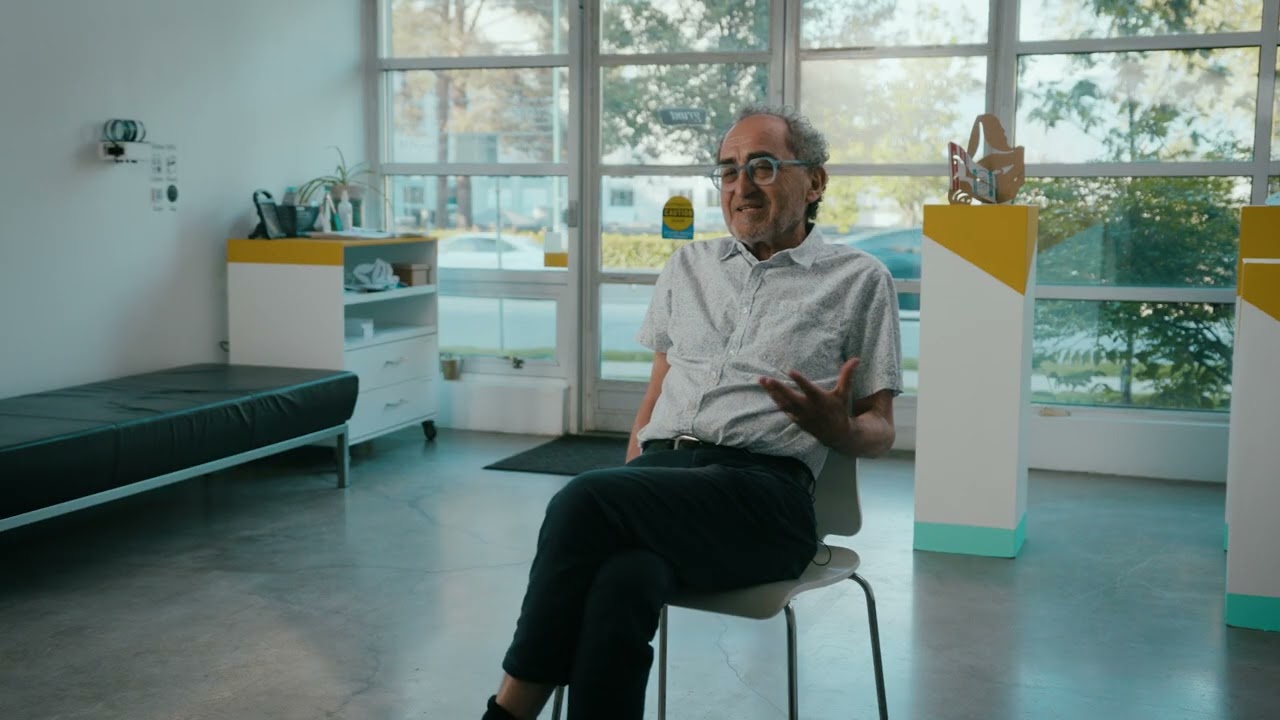
Video summary
Glenn Alteen reflects on his academic journey from literature and theater to visual art, a path that led him to become deeply involved in the arts community starting around 1984. His early work was driven by a sense of responsibility to ensure that artists had opportunities to be hired and paid, particularly when dealing with marginalized groups such as First Nations, queer, and BIPOC artists. This commitment evolved into using performance as a dynamic tool to engage with these communities, fostering festivals where artists could utilize materials and stories emerging directly from their own cultural contexts.
A significant portion of his career involved challenging systemic barriers, exemplified by his role in curating a project that aimed to "shoot the Indian Act." Although obtaining permission for three shots into this legislation took considerable time, the resulting exhibition served as a powerful statement against oppressive laws. When the group faced eviction from their original space, which was then occupied by squatters, they innovatively relocated their operations to a barge equipped with a small house residency. This move allowed them to continue their mission of remediation and fundraising to build a permanent cabin, demonstrating their resilience and dedication to sustaining their artistic vision despite external pressures.
Alteen emphasizes the importance of stepping outside one's comfort zone by engaging in projects where the outcome is uncertain, noting that such challenges keep creators on their toes and drive innovation. He highlights that GRUNT has consistently pushed into areas that others avoid, fostering an environment where survival is not the only metric for success. By shifting the financial model to support more than just basic existence, the organization aimed to prove that artists could achieve much more than mere survival, thereby changing the landscape of how art and funding are approached within these communities.
The legacy of this work extends through the mentorship of curators who were supported early on and have since gone on to accomplish amazing things in the wider world. Alteen views this development as a testament to the long-term impact of their efforts, creating a ripple effect that continues to empower new generations of artists and leaders. Ultimately, his story illustrates a profound commitment to social justice and artistic freedom, proving that with persistence and community support, it is possible to transform restrictive models into ones that celebrate diversity and creativity.
Read the full video transcript
My first thing in university was
literature, but specialized mostly in
theater.
And then I got more interested in visual
art at that point.
>> So I moved in there probably in the
beginning of 1984 and then by September
we had the first official grunt show.
>> As a matter of fact, we had a kind of a
mandate that became over time was that
if we don't show this, will somebody
else show it? Eventually we did a deal
with a developer to buy this space. Just
trying to make sure that we could keep
going and that we could provide
opportunity for them. Hire artists and
pay artists. So that part of it was
always real important. Whether it was
working with First Nations artists or
queer artists or bipoc artists,
different kinds of communities we were
working within. Performance became a
kind of way to work within those
communities. We would do these festivals
at different grunt. Performance was a
dynamic way for different artists. They
could use stuff that came from those
communities. And one of them was to
shoot the Indian Act. Well, I was the
curator of the project, so I went with
it. But to get three shots into 20
Indian Acts
took a long time. And then we brought
shot up copies of the Indian Act back
here and made a an exhibition out of it.
They had gotten evicted from the space
and the space was a squatter's cabin.
They came up with the idea of the, you
know, putting it on a barge with a small
house as a residency. So that was kind
of provided the vision and then it was
just figuring out how to do that.
Because we had bought this place and we
owned the place, we ran the thing to
remediate it, to raise the money to
build the cabin.
>> I really like to get into projects where
I really don't know what I'm doing.
There's something about being in these
things where you were really out of your
league, where you really keeps you on
your toes. And that always makes me is
interesting for me.
I think grunt has been a lot of that
thing of trying to push into areas that
we, you know, nobody else tries.
>> We decided early on that when we were
going to work in the bipoc communities
that we would do a lot more to support
curators. We mentored a lot of curators
over the years. As those people have
moved out in the world and done amazing
things, I think that's really a legacy
of what we did.
There's no way to look at money in a
different way than, you know, just mere
survival. If we done anything, it was to
change that model. It's to say, "No, you
can do more than survive."