Video summary
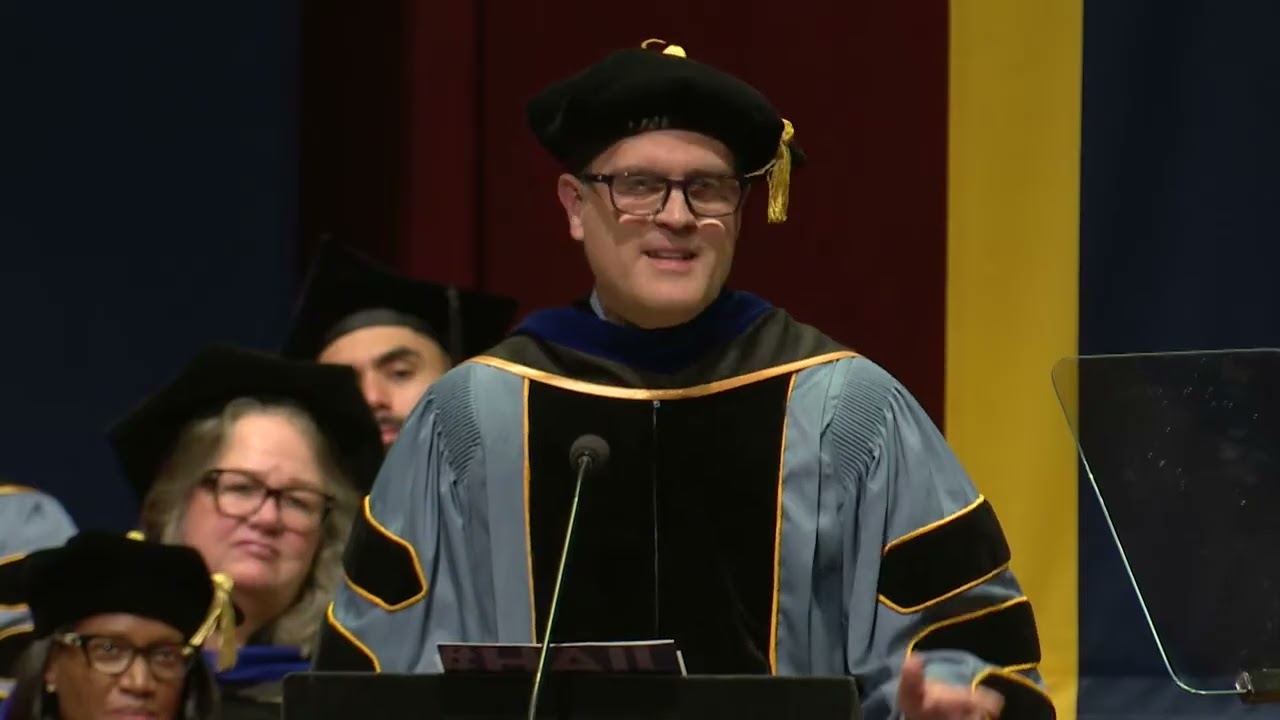
Professor Jonathan Hanson, speaking on behalf of the Ford School faculty at the 2026 commencement, begins by acknowledging the unique role graduates play in shaping the program and expressing his own nervousness about delivering a speech that balances seriousness with levity. Drawing upon his background as a political scientist and statistics teacher, he humorously notes that he sought advice from students to determine the tone of his remarks, ultimately deciding to be himself while encouraging the class to relax and enjoy this significant milestone. He reflects on the enduring nature of the Ford School community, noting that while the specific individuals come and go, the institution remains a constant home for generations, a sentiment symbolized by naming rooms after distinguished alumni like Betty Ford and Rebecca Blank, though he jokingly admits his own ambition to have a room named after him was perhaps not the best idea.
As the graduates face the uncertainty of life after graduation, with immediate tasks like moving apartments and securing jobs looming alongside global challenges such as war, inequality, and threats to democracy, Professor Hanson urges them to view this transition not as an endpoint but as a new beginning filled with opportunities for exploration. He shares his own unconventional path, revealing that he did not take his first statistics class until age twenty-eight, illustrating that life rarely follows a linear map and that one's first job is certainly not their last. This perspective is intended to alleviate the pressure many feel about having everything figured out immediately, encouraging students to embrace uncertainty as a space for growth, skill acquisition, and the discovery of what truly matters to them in their work and lives.
Despite the overwhelming nature of current global issues, which often make it seem like there are no easy solutions, Hanson emphasizes that these problems will require the lifelong labor of dedicated individuals rather than being resolved by a single election or event. He invokes Shakespeare's "winter of our discontent" to illustrate that while the present moment may feel bleak and full of despair, winter is merely a season that precedes spring, signaling that renewal and change are inevitable. The roots of democracy and common humanity remain intact, providing a foundation for rebuilding institutions and developing new policy approaches that can address both today's problems and those of tomorrow, requiring the collective effort of the next generation to construct a better future rather than simply returning to a past that was never perfect.
In his concluding remarks, the faculty expresses deep hope and optimism for the graduates, confident that their skills, intelligence, and idealism will enable them to make the world a better place as they embark on their respective journeys. While the school will miss them, it is eager to see them apply their expertise in various sectors, from local governments to community nonprofits, where they can drive change at both small and large scales. Professor Hanson ends with a call to action for the class to continue representing the values of evidence-based policymaking and the public good wherever they go, reminding them proudly that no matter where their paths lead, they should always remember to "go blue."
Read the full video transcript
Thank you, Senator Peters. Thank you so,
so much.
At this time,
I am really thrilled and honored to
introduce Professor John Hanson.
>> [applause]
>> One thing that I really appreciate about
the Ford School commencement is that the
graduating classes help shape today's
program.
Each year, students elect a faculty
speaker and student speakers
representing our undergraduate and
graduate classes. So, the next three
speakers that you hear our faculty and
our two students have been selected by
the graduates.
This year, the classes of 2026 elected
Professor Jonathan Hanson, who many of
us know as John, to offer remarks on
behalf of the faculty.
John is a political scientist and
lecturer at the Ford School, and he
directs our Master's of Public Policy
and Master's of Public Affairs programs.
He teaches our graduate-level statistics
and econometrics courses, and for the
past 4 years has led undergraduates to
Brussels for our BA Global Engagement
Seminar.
He brings a deep commitment to teaching
and advising and a practitioner's
understanding of how policy actually
gets made, shaped by his years of
experience working in Congress and on
election campaigns.
John, thank you for your leadership and
for all that you do for our students and
for this community.
I'm delighted to welcome you now to the
podium to speak on behalf of the
faculty.
>> [applause]
>> Dear graduates, I'm very honored to
represent the faculty today. Sorry, I
have a bit of cold. I do wonder a bit
because this feels a little strange to
be at the receiving end of a big
end-of-semester assignment. I mean,
usually I'm the one giving those, and
well, it's been a little stressful, and
I've kind of struggled about what to
say.
I mean, should it be serious because,
after all, the world has got a lot of
heavy things happening right now.
Or maybe it should be more
light-hearted. Maybe you just want to
hear a bunch of dad jokes.
So, I didn't know what to do, but, you
know, being a stats teacher, naturally,
I thought I should take a sample.
So, I asked like, you know, six or seven
of you for your thoughts and your
feedback.
Don't get too excited. That's only like
five or six degrees of freedom.
So, you know, I got a lot of great
advice from the students. They're like,
"Just relax. Be yourself." Blah, blah,
blah. You don't want to work yourself
into some sort of state of delirium.
Okay, there you go. I'm waiting. There's
inside jokes here. You have to You have
to follow along. Other students just
told me, you know, just it's fine. Just
turn on the music really loud, you know,
dance around, you know, shake it to the
max.
I don't You know, whatever. Students
will be students. They'll say these
things.
But, where I thought I should start is,
you know, with our community because the
community here at the Ford School is
such a wonderful place.
And it's that interesting thing to think
about in the context of graduation,
which, after all, is a departure of many
of you. Um but, if you think about it,
the Ford School has never been static.
It's an ever-evolving constellation of
students, staff, and faculty. But,
despite this change over the years,
there's just There's these enduring
features and qualities that make this
place home to so many generations of
people.
So, once a Fordy, always a Fordy. You're
always one of us.
I got to thinking, you know, about all
the amazing people that have come and
gone over time.
You know, some of them we remember by
naming rooms after them. So, we have the
Betty, which is, you know, our classroom
named after former First Lady Betty
Ford. And then, you know, more recently,
we've named the Great Hall the Becky
after Rebecca Blank, one of the founding
deans of the Ford School.
And, you know, that got me thinking, and
my mind began to wander, and I said,
"You know, what does it take to get a
room named after you?"
So, yeah, and I started to have these
delusions of grandeur, and I'm like,
"Wouldn't it be great to have a room
named after me?"
Yeah, yeah, I'd be like, "Hey, where's
that class meet today?" "Oh, the class?
It meets in the John."
>> [laughter]
>> Okay, okay. Maybe not the best idea.
Um but, you know, I've been stressed
out, and maybe you've been stressed out,
too, lately. It's really been a
whirlwind, you know, finish up the
semester, policy memos, problem sets,
final exams. And you probably still have
a big to-do list of things burning you
have to do like right now. You got to
move out, find a new apartment, find a
job. And, you know, with everything
that's going on, I just urge you to take
one moment right now to stop and think
and reflect upon your time here at
Michigan. Think about our community and
appreciate this day. You've worked so
hard to get here, so make sure that you
enjoy this moment with your friends and
your families.
And as one of your teachers, I've just
got one more lesson I want to give you.
You are entering a period of your lives
that has a lot more uncertainty.
Um everything up till now has been sort
of on a plan, you know, you go to
school, finish your classes, get good
grades, get your degree, get a job, and
that's supposed to be the end of all
this big process.
It's not the end. As you leave this
building today, you are walking out into
a world of all kinds of opportunities,
and commencement, after all, is the
beginning.
So, you may have a plan for what's next,
or at least you think you have a plan.
Or you may not have a plan at all, and
that's okay. It's just fine. This is
still a time of exploration, and you
need to give yourself the space to do
that.
I think about myself when I was your
age. I mean, most of you know me as your
statistics teacher. I guess that's my
job. I'm statistics teacher. But, if you
told me that when I graduated from
college, I just would have laughed at
you. There's no way I would have thought
that out, planned that out. That's not
possible. I didn't even take my first
statistics class until I was 28. That
was my first year of grad school. And,
you know, but that one course was the
first of many, and it opened up new ways
of thinking for me and launched me down
pathways that I just never would have
anticipated.
So, I ask you, urge you to hold open the
possibility, even the likelihood, that
what you may be doing for the next
several years are just steps on a
pathway, that journey, and that journey
has no map, and you don't know where
you're going, and that's fine. Your
first job is not your last job, and it
shouldn't be. So, this is a time for you
to grow, to gain new skills, to figure
out what you value in your work and what
you want to do next.
So, I hope that takes the pressure off,
but I do understand the stress.
It's natural to worry about what's next.
The world is a pretty awful place right
now. We face so many challenges. There's
no point in trying to minimize them.
War, threats to democracy, virulent
racism, economic inequality, loss of
opportunity.
It's overwhelming. We all know there's
no easy solution to these problems, and
they will not be solved suddenly after
just one more election. They will be the
labor of our lives.
So, yes, the times are tough,
but you are tougher.
You have made it to this day. All the
work that you put in to get to this
point, to wear these robes, to walk
across this stage, you've had to build
up all kinds of skills.
And as graduates, you will represent the
values that we embody as a school.
Evidence-based policy making to advance
the public good.
Evidence matters.
Expertise matters.
Expertise does not appear to be valued
as much as it should be right now at the
highest levels of government. We see the
consequences of that every day. But,
it's not going to last forever. It just
won't.
In the meantime, you can make an impact
at various levels. So, where the federal
government steps back, state and local
governments, community organizations,
nonprofits will step up and take action.
Build your skills, make small-scale
change, and look for opportunities to
make the large-scale change that we need
to see.
Shakespeare's play Richard III famously
starts out, "Now is the winter of our
discontent."
The winter of our discontent,
which is cold, trees are bare,
everything that grows is either
hibernating or dead.
The winter of our discontent, on its
face, seems like the depths of despair.
And maybe that feels a bit like the
times we're living in today.
But, that's not what Shakespeare meant.
If you read the passage, the winter of
our discontent is what marks the end of
a period, for what comes next is spring,
and summer is on the way.
You know what I'm trying to say. Things
are bad.
The country,
the world needs renewal.
But, spring is coming, and things will
change, and the roots are still there.
The roots of democracy, the roots that
link us together in common humanity.
And as we move forward, we will so
desperately need you people with your
skills, your talents, and your passion
for doing good.
Rebuilding is hard work, and we'll need
to do that work.
But, it can't be just going back to what
things were before, because that wasn't
some kind of perfection. It's time to
build new institutions and new policy
approaches that can solve not only the
problems of today, but the ones of
tomorrow.
So, we as the faculty look out at you
today with feelings of hope
and optimism.
With your skills, your intelligence, and
your idealism, you will make the world a
better place.
We will miss you.
But, we are ready to send you off and
watch you get to work.
So, we will take pride in your
accomplishments as you go through your
journeys in life.
Today's just the beginning after all.
Just remember,
wherever you are,
wherever you go,
go blue.