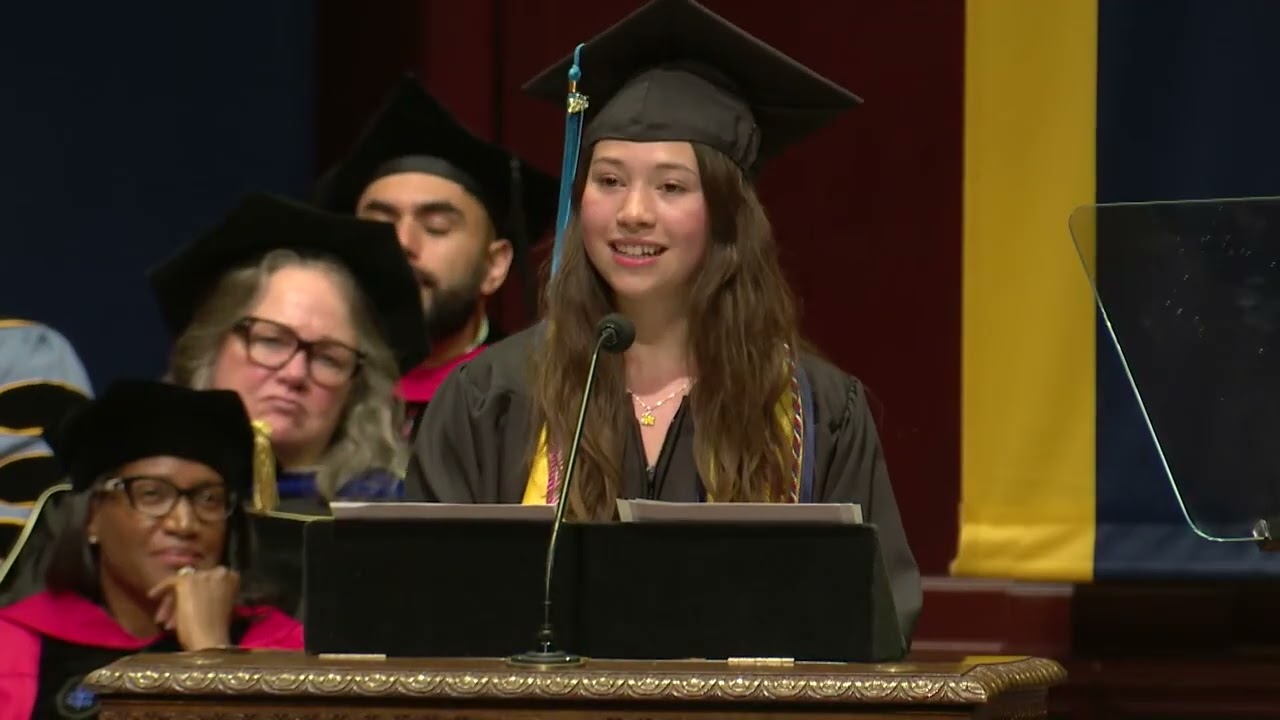
2026 Ford School Commencement: Breah Marie Flores Willy speech
Watch on YouTubeVideo summary
Bria Marie Flores Willy, a native of Metro Detroit elected by her peers as the 2026 commencement speaker for the Ford School of Public Policy, delivered an inspiring address centered on bridging divides in an increasingly polarized world. During her time at the university, she served as a research assistant for the inaugural Bridge Builders program and held leadership roles advocating for progressive policy and community through music. Her speech acknowledged the profound support from faculty like Dean Watkins-Hayes, staff who challenged critical thinking, and families who provided unwavering confidence, while also honoring fellow classmates for making their college experience unforgettable despite systemic challenges they faced together.
The core of her message addressed the persistent inequalities in education, healthcare, and clean water that are often determined by race or socioeconomic status, noting how well-intentioned policies can sometimes fail due to entrenched discrimination. She reflected on the difficulty students face when witnessing political violence and rights reversals without knowing where to start, emphasizing that simply presenting facts rarely changes minds or fosters true listening. Instead of reacting with defensiveness or attempting to win arguments, she urged graduates to let go of the need for victory in conversations and to prioritize understanding over being right, a lesson deeply ingrained through her experience leading dialogues across differences within the Ford School community.
To move forward constructively, Bria challenged everyone present to adopt specific habits such as asking thoughtful questions about why others hold certain values, sharing personal stories to build empathy, responding with calmness rather than reacting impulsively, and actively seeking common ground among opposing viewpoints. She highlighted a meaningful moment when Mike Ford, son of the former President Gerald R. Ford, validated their work by stating that engaging in constructive dialogue with those they disagree with is exactly the legacy his father hoped to leave behind. This call to action was framed not just as an academic exercise but as a moral imperative for future leaders who must never lead from hate but instead guide society with love and care toward building a democracy everyone can be proud of.
Concluding her remarks, she invoked the timeless words of Marvin Gaye that only love can conquer hate, offering this wisdom in response to current times marked by uncertainty and division. As soon-to-be alumni ready to carry forward President Ford's legacy, Bria expressed confidence that Class of 2026 would not only change the world with their ideas but also reach across differences through understanding and compassion rather than just questions alone. She thanked her fellow graduates for enriching the school experience with empathy, dedication, friendship, and hope, promising to look forward to seeing how much love they will share in building a better future together as they go forth from Ann Arbor.
Read the full video transcript
[applause]
>> Thank you so much, Sean. That was
fantastic.
Our next speaker was elected by the
undergraduate class of 2026.
Bria Marie Flores Willy is a Metro
Detroit native who has earned a BA in
public policy and a minor in
quantitative methods in the social
sciences with a focus on urban
inequality and development.
At the Ford School, Bria served as a
research assistant for our inaugural
Bridge Builders program, strengthening
her skills in facilitating dialogue
across differences. Work she cares
deeply about as we all navigate a more
polarized environment.
Bria played a key role in shaping and
facilitating constructive dialogue,
helping design and lead discussions
within the Ford School and across campus
that foster curiosity, respect, and
deeper understanding.
Through this work, she helped strengthen
a culture of thoughtful engagement at
the Ford School, leaving a lasting
impression on the students she worked
with. Outside the classroom, she has
advocated for positive change as
co-president of the Michigan Institute
for Progressive Policy. And
she is I hear you. And she has built
community through song as vice president
of the University of Michigan's Women's
Glee Club.
>> [cheering]
>> There they are.
After graduation, she plans to use her
public policy and quantitative analysis
skills to advance economic and housing
justice in Michigan. I am so pleased to
welcome Bria Marie Flores Willy to the
podium.
>> [cheering]
[cheering]
[applause]
>> Thank you so much, Dean Watkins-Hayes.
It has been a privilege to learn in the
light of your leadership and to feel
your unwavering support, especially in
the Sunday night messages.
The biggest thanks to Ford School
faculty and staff who challenge us to
think critically and give us the skills
to serve the public good.
To our parents, family, friends, and
loved ones, thank you for answering our
phone calls, giving us confidence, and
enabling us to be where we are today.
We would not be here celebrating this
accomplishment if it weren't for your
support and guidance.
Last, but certainly not least, to my
friends and fellow 40s, thank you for
making our college experience
unforgettable and dedicating yourself to
the public good.
We came to the University of Michigan
because we wanted to address the
injustices facing our communities.
Despite coming of age in the 21st
century, we still witness unequal access
to education, health care, and clean
water too often determined by race or
socioeconomic status.
We grew up with some leaders who tried
to change these outcomes while others
further entrenched disparities.
We watched so many videos of police
brutality and gun violence, we feared
becoming desensitized.
Coming to college, I didn't know where
to start
until I found the Ford School of Public
Policy.
And I don't know about many of you, but
once I was accepted and proudly
announced my major to anyone who asked,
I was often met with the response of
wait, what is that again?
So, what is public policy? Some define
public policy as whatever governments
choose to do or not to do.
Others say it is the sum of government
activities and its influence on the life
of citizens.
Ford School Professor and former Dean,
Susan Collins, defines public policy as
our collective quest to address the most
pressing and stubborn problems and to
seize opportunities for society.
In context, public policy is the
seatbelt law that has saved over 300,000
people since its passing in 1985.
Public policy is establishing programs
to give people more access to
transportation and housing.
And public policy is, too often, a
failure to solve the problems it aims to
address.
With racial, sexual, and class
discrimination entrenched in our
systems, even well-intentioned policy
can fall short and further perpetuate
inequality.
My fellow classmates, I know this is not
news to you.
We have taken classes in politics and
institutions, economics, and program
evaluation.
Electives in social justice,
philanthropy, climate policy, poverty,
and urban inequality.
We have written our memos, completed our
final exams, and mostly passed our
classes.
And even outside of the classroom, you
are making your voices heard at
protests, club meetings, or spending
evenings organizing events to advocate
for immigrant rights or those in
solitary confinement.
We are working hard, but sometimes it
feels like the systems of inequality are
working harder.
When policy and leadership fail, what do
we do?
And when polarization impairs
relationships with family, friends, and
our ability to work together, where do
we turn?
When we witness political violence, the
reversal of rights, discrimination,
government shutdowns, and immeasurable
loss abroad,
and we can't even talk about it,
how do we move forward?
The Ford School addressed this challenge
through a program called the Bridge
Builders.
Kicked off by Jennifer Niga Meyer and
guided by Claire Lo Wandie and Dr.
Stephanie Sanders,
Bridge Builders is a student-led program
that advances conversations across
difference at the Ford School.
The opportunity to serve in the
inaugural cohort of the Bridge Builders
has been a defining experience of my
time at the Ford School and has left me
with lessons I will always try to honor.
Those lessons are
let go of winning,
ask questions,
share stories,
respond rather than react, and find
what's shared.
I believe that all of these principles
are important, but I like to focus on
one of them,
asking questions.
While we Fordies love our data, spitting
facts at someone will never change their
mind and certainly won't encourage them
to truly listen to your point of view.
Asking thoughtful questions to
understand the why of someone's story
tells us their values and leads to
deeper understanding.
The next time you face a difficult
conversation, try asking questions like,
"Can you say more about that?
Have you always felt this way?"
to keep the conversation going.
You may be wondering,
"How is asking questions going to reduce
polarization, let alone solve world
peace?"
As we've learned, there is never one
silver bullet method that is going to
fix every problem we set out to address.
Just as asking questions is only one
important piece of the puzzle.
As bridge builders, we were fortunate
enough to meet with the Ford School
Committee made up of esteemed alumni and
leaders to share the work we've been
doing.
After our presentation, Mike Ford, son
of Gerald R. Ford, came to shake our
hands and told us that engaging in
constructive dialogue with whom we
disagree is exactly the legacy President
Ford hoped to leave us.
I challenge you, my fellow 40s and
everyone here today, to carry President
Ford's legacy forward and to try.
Try to let go of winning.
Try to ask more questions. Try to share
stories and listen.
Try to respond rather than react. And
try to find what's shared.
As leaders, we must try.
Never to lead from a place of hate.
Instead, we should lead from a place of
love and care, including those we
disagree with, so that we can work
together to build a democracy and a
world we are all proud to live in.
Fellow 40s, as soon to be alumni of the
Ford School, I can't think of anyone
more prepared to carry this legacy
forward than us.
I know we will not only change the world
with our ideas and courage, but in these
divisive times, we will reach across
differences, not only with questions,
but with understanding and love.
And speaking of love, I'll leave you
with the words of musician and activist
Marvin Gaye, written in another time of
uncertainty, war, and division.
Only love can conquer hate.
Class of 2026, thank you from the bottom
of my heart for enriching my Ford School
experience with your empathy,
dedication, friendship, and most of all,
your hope.
I cannot wait to see the love we have to
share and the legacy we will leave.
Thank you so much. Congratulations, and
go blue.
>> [cheering]
[applause]
>> Go blue!
>> [applause]