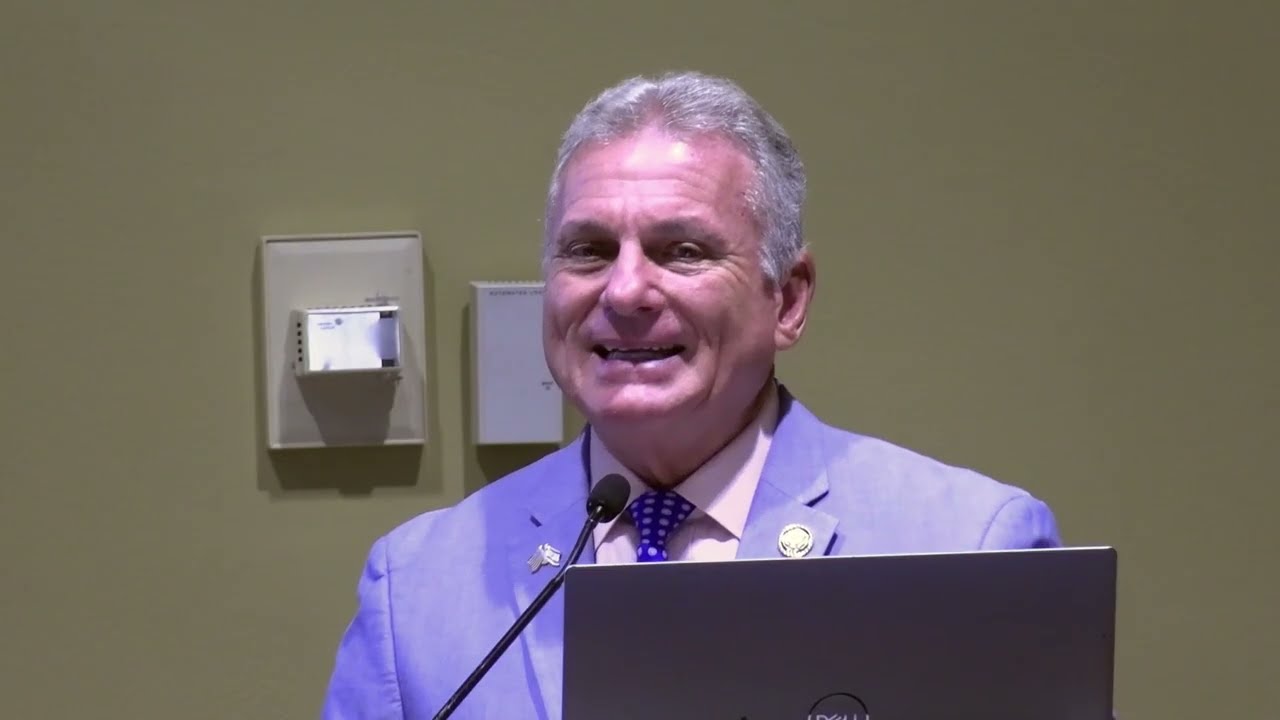
2026 Congressional Renewable Energy and Energy Efficiency EXPO: Rep. Buddy Carter (R-Ga.)
Watch on YouTubeVideo summary
Rep. Buddy Carter opens his address by emphasizing the critical importance of energy resources to Georgia and the nation, highlighting the unique strengths of his district which includes over 100 miles of coastline, two major seaports, significant military installations, and robust forestry and agriculture sectors. He challenges the common political narrative that equates Republicans solely with fossil fuels and Democrats with clean energy, asserting instead that both parties share a genuine commitment to environmental stewardship. To illustrate this point, Carter notes his personal history fishing on the Georgia coast and his current role as vice chair of the conservative climate caucus, underscoring that protecting the environment is a bipartisan priority for ensuring future generations can enjoy similar natural opportunities.
Carter details Georgia's diverse energy portfolio, which serves as a model for reliable and affordable power generation across the United States. He points out that while the state utilizes natural gas, it also relies heavily on nuclear energy, with plants Vogtle and Hatch providing nearly one-third of the state's electricity; notably, Vogtle houses the first two new reactors built in the last 30 years. Additionally, Georgia ranks seventh nationally in solar power usage, demonstrating a commitment to clean energy without relying on wind turbines. This mix of technologies supports the state's status as the top place for business for twelve consecutive years and addresses the surging demand for electricity driven by data centers, which are essential for maintaining American leadership in the artificial intelligence sector against global competitors like China.
A central theme of his presentation is the urgent need for permitting reform to accelerate energy production without compromising environmental standards. Carter introduces legislation such as the Clear Act, which refines the Clean Air Act, and the Speed Act, designed to streamline the approval process for all forms of energy in a technology-neutral manner. He argues that lengthy permitting timelines do not equate to thoroughness or safety, whereas faster processes can still ensure efficiency and environmental protection. Furthermore, he advocates for streamlining critical minerals permitting to secure necessary resources like lithium and nickel for batteries, enabling companies to operate under temporary permits rather than waiting years for final approval, thereby speeding up the development of essential energy infrastructure.
During the Q&A session, Carter addresses concerns regarding data centers and local community impacts, acknowledging valid worries about resource usage and infrastructure strain while warning against allowing foreign adversaries to dominate the AI landscape. He stresses the necessity of working smart with local governments to mitigate these issues without halting progress on national security fronts. The discussion also touches on the broader issue of legislative authority shifting to the executive branch through frequent executive orders, which Carter argues undermines the stability intended by the founders. He concludes by reiterating that the Energy and Commerce Committee stands as one of the most bipartisan bodies in Congress, where members from all sides unite to solve shared challenges like energy access and healthcare, proving that collaboration across the aisle is both possible and essential for the country's future.
Read the full video transcript
[applause]
Thank you very much for having me here
today and thank you for being here. You
would not be here if you didn't care and
we need people who care in this in this
country and I appreciate you being here
and certainly energy resources are
something that is extremely important to
us on the Energy and Commerce Committee.
It's extremely important to us in
Congress. I'm Buddy Carter. As you
heard, I have the honor and privilege of
representing the first congressional
district of Georgia. That includes the
entire coast of Georgia. Over 100 miles
of pristine coastline.
Two major seap ports. The port of
Savannah, the number three container
port in the country, the fastest growing
container port in the country. Also, the
port of Brunswick, the number one roll
on rolloff port in the country in terms
of vehicles and trucks and cars that go
through that port. So, they've really
found their niche there. We also have a
strong military presence with Hunter
Army Airfield, Kings Bay Naval Base,
Fort Stewart, two Coast Guard stations,
the Federal Law Enforcement Training
Center. A lot to be thankful for. As you
heard, forestry is a big part of our
district as well, a big part of my
portfolio. And also agriculture. All of
those are very important. So, it's a
great district. I tell people all the
time, 435 districts in the United
States, and I get the honor and
privilege of representing the very best
one. And I truly rem I I truly believe
that uh it's my home. It's where I've
lived all my life and where I intend to
live the rest of my life. It's also one
of the reasons why I get so frustrated
sometimes when people particularly
outsiders who don't know and understand
how Congress works when they try to
label us all Republicans care about in
the way of energy is oil and gas and
that all Democrats care about is is
clean energy. Nothing could be further
from the truth. That is not the case at
all. We all believe in in making sure
that we take care of our environment. As
I mentioned, I I grew up in the in the
on the coast of Georgia. Some of my
fondest memories growing up or going
fishing with my dad. I want my children,
my grandchildren to have those same kind
of opportunities to make memories. I
care about our environment and I I truly
believe that Republicans care about our
envir environment. I serve as vice chair
of the conservative climate caucus. That
is something that's very important. A
couple of years ago when the Democrats
were in the majority in in the House, we
had a select committee on climate
change. I actually advocated to be on
that committee and served on that
committee. It's very important and
certainly very important for us. Now,
let me tell you about the state of
Georgia. For 12 years in a row, the
state of Georgia has been the number one
state in which to do business. And
there's a number of reasons for that.
Yes, the fertile environment, if you
will, that we have in Georgia, welcoming
businesses, but also because we are able
to provide energy, affordable, reliable
energy to our to our businesses, and
that's extremely important. And in
Georgia, I would submit to you that we
have a good mixture of the types of
energy that we have. Yes, we use natural
gas, but we also use nuclear energy,
which is clean energy. Nuclear energy
accounts for almost a third of all the
energy that is produced in the state of
Georgia and used in the state of
Georgia. We are proud to be home to the
largest clean energy plant in America
and that is plant vogal. The first two
nuclear reactors that were built in the
last 30 years were built at plant Vogle.
Plant Vogle along with plant hatch which
is in my district provide as I say
almost a third of the energy needs
through nuclear power in the state of
Georgia. We're also in the number seven
state in the use of solar power. That's
very important. We don't have any wind
tunnels any any windmills in Georgia but
we do use a lot of solar. We do use
nuclear. We do use a lot of clean
energy. It is very important for us. One
of the things that we are tackling here
in Congress and particularly on the
Energy and Commerce Committee is the
permitting reform. Look, we understand
we've got to have permitting reform. It
has always been frustrating to me to
think that, oh, just because it takes
five years to get a permit, that means
you've done it correctly. You can't do
it correctly in two and a half or three
years. No, you can do it in two and a
half and three years. you can do it and
you can still be efficient and you can
still make sure that you are protecting
our environment. All of that is
extremely important. We passed the Clear
Act. The Clear Act is my legislation
that that refineses the Clean Air Act
and it's actually passed out of
committee. We passed the Speed Act. We
passed it out of the House. It's in the
Senate right now. It calls for for
permitting reform and it is techneutral.
When I say techneutral, I mean that the
permitting applies to all forms of
energy, whether it be clean energy or
whether it be fossil fuels or whatever
it may be. It is techneutral and that is
very important. It's also important to
note that it is it was passed in a
bipartisan fashion. Energy is we all
understand we're going to need every
electron that we can use in the near
future. There's no question about that.
That's why I truly am an advocate for an
all of the- above type energy strategy.
We've got to make sure that we provide
energy, particularly with the advent of
data centers. All of you know that data
centers are a big user of energy. We've
got to make sure that we can provide
that energy to the data centers to make
sure that we win the AI war and that
China does not win that war that we win
it. That is going to be extremely
important. I also want to tell you about
uh another area that I've worked in and
that is something that we just got out
of the environmental subcommittee
hearing today in the energy and commerce
committee and that is streamlining
critical minerals permitting and that is
some something that is extremely
important. We actually had a hearing on
that act this morning and we'll be
bringing it up before the subcommittee
to vote on that act in the very near
future. When we think about energy, we
need to think about it more than just
transmission and production of energy.
You also have to think about critical
minerals. Critical minerals are very
important in energy. Making sure we have
enough nickel, enough lithium, enough of
all of the critical minerals that go
into batteries or that go into the
energy process. All of that is very
important. That's why the streamlining
critical minerals act, that's why it
reforms the permitting process to to
allow companies to have temporary
permits so that they don't have to wait
for the three or five years in order to
get the permit that they can go ahead
and get started under certain
conditions. This will speed up the
permitting process as well. So my
message to you today is that we're
working diligently here in Congress and
particularly on the Energy and Commerce
Committee to make sure that we are
reforming the permitting process without
hurting our environment. We are working
together in a bipartisan fashion to make
sure that we meet the energy needs and
the transmission needs of our country.
We work together to make sure that that
happens in a bipartisan fashion. So I
appreciate again the opportunity to be
here today. I appreciate you being here.
As I said at the beginning, you wouldn't
be here if you didn't care. Clean energy
is a big part of what we do, a big part
of what I'm involved and up here on the
energy and commerce committee as well as
as I mentioned earlier as a co-chair of
the climate of the conservative climate
caucus. All of these are important.
They're important for me, for my
district, the coast of Georgia, and
they're important for our country. So
again, I thank you for having me here
today. God bless.
>> [applause]
>> Thank you, Mr.
Questions. Um, yeah, sure. Um, uh, Mr.
Carter has time. If anyone in the
audience has a question, um, please feel
free to raise your hand. Um,
>> oh, so, uh, sure. Uh, where did Yasm
mean go? Uh, Yasm mean has a microphone.
She's just going to bring it over here.
>> Okay,
>> great. Thank you.
>> Thank you.
>> How much time do you think?
>> Um,
>> 510.
>> Five.
>> Five. Great. Thank you.
>> Thank you,
>> Mr. Carter. [clears throat] Thank you
for being here. I have a question for
you. I'm from Georgia.
>> Oh, what part?
>> I get it. I'm in the Roswell area. So
>> Oh, great. Yeah,
>> I'm on the other end. But we've seen the
growth of data centers.
>> Yes,
>> we have too. And I know you've seen it
on the coast even.
>> So with that growth,
I'm just asking I know you had
bipartisan support this year for some
changes to the way we regulate them,
>> right? right?
>> Like bring your own energy or
things like
uh tax breaks for equipment,
>> right?
>> I can't believe they passed tax breaks
for equipment again. That got overridden
by the governor. What is the thinking
from you guys, especially with your
perspective on just allowing whatever?
>> You know, it's amazing to me that this
has become essentially a hot button
issue, and it has. There are a lot of
communities that don't want data centers
because they think that it's going to
use up all of their resources, all of
their energy, make their energy bills go
up. As you know, we have a public
service commission in the state of
Georgia. And that commission has passed
a law that says that the the price of
the energy cannot go up as a result of
data centers. But let me warn you about
this, okay? And I'm not advocating for
data centers. We've got to work. Look, I
was a former mayor in another life. I
served in the state legislature. I've
I've been through I've been through the
chairs, if you will. I get it. I
understand the heavy hand of of
government, particularly the federal
government. I was in business for 32
years, so I understand it all too well.
I don't like that. So, I do think we
need to be working with the local
communities. However, I mentioned
earlier, and this is what I want you to
keep in mind, okay? I mentioned earlier,
we're in a war, an AI war with China.
China does not want us to win that
battle. They want to be the leader in
AI. We can ill afford to let that
happen. I would submit to you that a lot
of what is going on right now, not all
of it, it is legitimate. There's no
question about it. There's no question
about a community being concerned about
the water resources, about their
infrastructure being able to handle some
of these data centers. But a lot of what
you're seeing also, I will submit to
you, is the is a and and I hate to use
this word, but it is China and a
conspiracy to make sure that they are
the ones who succeed and not us. So, I
just warn you to look at this with an
open mind. Yes, there are concerns. No
question about it. I couldn't agree with
you more. We've got to work with the
local governments, but at the same time,
let's not let China win this AI war. We
can ill afford to let that happen.
>> Thanks. Um, Mr.
>> That sounds like a politician talking
out of both sides of his mouth. It is.
>> Fair enough. You're allowed. Um, so I
posed this question uh to the panel. Um,
that uh I was really interested in what
they had to say. You know, permitting
reform is kind of the topic of this
panel. It's what everyone wants to talk
about. I'm sure you talk about it
constantly uh with people coming in to
visit you. Um, but what's actually at
stake uh from your perspective? Um, our
panelists, I think, all kind of sort of
oriented themselves around the idea that
sooner is better, there's a cost of
delay, but I'm curious to hear what you
think about that idea that, you know,
the longer we put this off, there'll be
more unknown unknown, you know, no more
unknown unknowns happening and sort of
what's at stake for you, uh, you know,
right now for getting this done. You
know, I don't care what committee you go
to up here at the Capitol. Everyone's
talking about China and about our
competition with China and about making
sure that we don't let China overtake
us. This is an example of it. And you
know, China doesn't have the permitting
that we have. Now, I am not suggesting
that we go to their model because their
model is there in the model. They just
when they want to do something, the
government says do it and they start
doing it. We can't afford to do that.
But we can do better than what we do.
And as I said earlier, it's not
necessarily, oh, if it takes five years,
that means it's a good permitting
process. If it takes three, must be a
problem. No, we just got to be smart
about this. You know,
I I I had a business for 32 years. I had
my ownies and and you talk about
swimming with sharks. When you're an
independent retail pharmacist competing
against the CVS's and the Walmarts and
the Walgreens in the world, I always
stress to my employees, yeah, we got to
work hard, but we got to work smart,
too. So, I'm just asking us to work
smart with the permitting process. Some
of the issues that we're dealing with
are duplicate and and and we don't need
to be that
that detailed on them. So, again, that
that's just the point I'm trying to make
here.
>> Great. Well, thank you. Um there do you
have time for one more? Is there one
more one? We've got Mr. Tonko, your twin
actually. Different shirt and tie, but
uh any other questions from the audience
before Oh, I see one in the back. Yes.
Me and we'll go back with the
microphone. Thank you, sir.
>> Coming, Congressman, and you're probably
the right person to ask um based on your
track record here working across the
aisle. I spent about 10 years working on
the Virginia offshore wind project. I've
represented the chemical industry. I've
done clean coal projects. And I know to
many people in the room that's a
contradiction in terms, but we did what
we could. Um, and one of the challenging
things there is that the arbitrary
nature of being able to just blow these
projects up. And at some point,
hopefully some of you that have some
record of working across the aisle with
each other need to come together and
say, "Look, we can't do this. We can't
have one administration come in from one
party and blow up their work or this one
come in from that one. That is just
absolutely brutally self-destructive.
What kind of insight can you give us on
where we might be in those discussions?
>> Well, let me applaud you for what I
think is a very astute point. You get
it. You see what's happening here, you
know, and and it it really is. And I I'
I'd be interested maybe maybe
Congressman Tonko will will comment on
this when he talks, but you know, we've
we've gotten to the point now in the
legislative branch where we've conceded
a lot of our authority to the executive
branch. And the country is being run on
executive orders. And executive orders
change every four years or every time
you have a change in administration. Not
every four years, but when you have a
change in administration. That's one of
the things that we've got to to correct.
We've got to get the authority back into
Congress where our forefathers meant for
it to be back into into Congress and not
necessarily so much, you know, those
those scales of justice. They they get a
little out of whack sometimes and I'm
afraid it has happened. But but working
bipartisan is in particularly on the
committee that Paul and I serve on on
the energy and com commerce committee. I
would submit to you that the energy and
commerce committee is one of the if not
the most bipartisan committees in
Congress mainly because of the issues
that we deal with energy you know
everybody needs energy health care
everybody needs health care I often say
as a health care professional wean
a Democrat or an independent you want
affordable accessible quality health
care we work together on those kind of
things but that's the kind of thing
we've got to do we got to work across
the aisle we've got to work together. It
one thing I want to mention and I
mentioned this that that some of these
permitting reforms that we have passed
have been techneutral. They apply to all
types of energy, not just to clean
energy, not just to fossil fuel energy,
but all energy. Those are the type of
reforms that we need that are
techneutral.
>> Thanks, Cameron. I appreciate that.
>> Okay, thank you all again. Thank you
very much. Thanks so much for coming to
life.