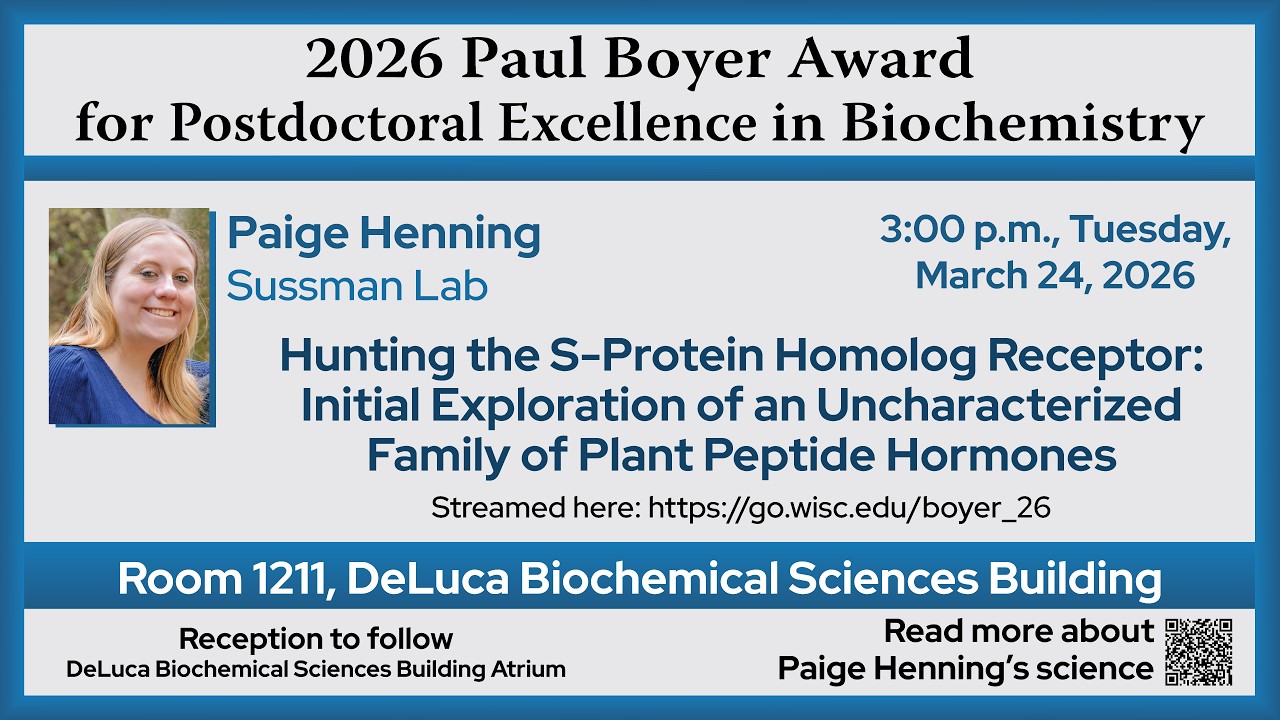
Video summary
Dr. Paige Henning was honored with the 2026 Boyer Award for her exceptional post-doctoral research into the genetic mechanisms governing plant reproduction, specifically focusing on distyly in *Turnera subulata* and *Arabidopsis thaliana*. This reproductive system relies on flowers possessing either short or long styles to prevent self-pollination, a trait controlled by specific genes such as *BAD*, *YUC6*, and the elusive *PH1*. Henning's work successfully characterized the function of *PH1*, revealing that it promotes filament elongation by activating endoreduplication, a process where cells grow without dividing. Her research also drew important comparisons to the well-studied poppy system, highlighting differences in how self-incompatibility is regulated through peptide hormones and programmed cell death in pollen tubes.
To understand the molecular details of these processes, Henning employed advanced multi-omic techniques including RNA-seq and phosphoproteomics to analyze developmental differences between short and long morphs. These analyses uncovered that the protein ATM1 is phosphorylated exclusively in the short-morph style, while functional assays demonstrated that specific members of the SPH peptide family, such as SP4, can inhibit root and shoot growth. Through co-immunoprecipitation experiments, her team identified candidate interactors within the AP1/AP2/AP4 transcription factor family and utilized mass spectrometry to investigate potential co-receptors for SPH signaling. Although a GPI-anchored protein was hypothesized based on poppy models, Henning's collaboration with Michael Marty revealed that specific binding partners in *Arabidopsis* remain under active investigation amidst the massive diversity of the SPH peptide family found in plants.
The presentation further expanded into *in vivo* experiments using intact tobacco stamens and short hypocotyl mutants, which provided evidence for covalent labeling within disordered regions of proteins, a finding supported by AlphaFold structural predictions. These studies suggested that PH4 interacts with other P family members like P42 during reproduction and identified AS5 as a potential GPI anchor protein required for SPH signaling. While initial mass spectrometry data contained some noise, Henning outlined future plans to employ size-exclusion chromatography, kinetic measurements, and cryo-EM to definitively confirm the structure of these signaling complexes. She also addressed the critical role of SPH peptides in halting vegetative growth to initiate reproductive phases, noting unique sequence variations in poppy-specific receptors that distinguish them from those found in other species.
In conclusion, Henning's research underscores the ongoing effort to empirically validate bioinformatic models regarding how complex peptide families regulate plant reproduction and development. By bridging gaps between *in vitro* assays and living tissue experiments, her work has clarified the intricate signaling pathways involving SPH peptides and their receptors. The study not only elucidates the genetic basis of floral dimorphism but also highlights the necessity of combining diverse analytical techniques to resolve structural complexities in plant biology. Ultimately, this comprehensive approach advances our understanding of how plants evolve sophisticated mechanisms to ensure successful pollination while preventing self-fertilization across different species.
Read the full video transcript
Welcome everybody to the uh Boyer Award
for post-doal excellence. Um it's my
pleasure to uh award it this year to uh
Paige Henning. But I'm going to just say
a couple quick things about Paul Buer
first. Paul Buer was a graduate student
here. Got his PhD in 1943.
And as far as I know, he was the only
one of our graduate students in
biochemistry to go on and win a Nobel
Prize. Hopefully some of you will uh
change that to more.
But uh he then donated some of of that
uh money from the prize to the
department. One of the things that it
was used for was to create this um this
award in uh Paul Boyer's name. And so
it's a real pleasure to be able to give
the certificate for the award uh today
to Paige and suitable for framing. So
there you go. Now, uh, Paige has done
some great work, but I'm going to let uh
Mike Susman, her mentor, uh, introduce
that work.
>> This is really I have my uh, backup
hearing aids in, so
never mind. Anyway, so
next slide. Oh, I do.
>> Yeah, you do it.
>> I am really happy to talk about Paige,
introduce her. This is her anttogyny.
Fancy word. She taught me her
development.
Started at Washington State University
for her bachelor's and then did her
thesis at Washington State.
>> Wow.
>> Speak into the mic.
>> Oh, I should speak into it. That's good.
Now you can hear me. Okay. So she did
her bachelor's at Washington State and
then she did her PhD and her thesis was
really cool. She um was part of a group
that sequenced the genome of um of uh
Tinera Subulada and uh that um out of
that came a new peptide hormone that we
know nothing about and that she'll talk
about.
Can you hear me now? Usually my voice is
louder than me,
>> but not anymore. I'm getting old. So,
>> oh, for the recording. Oh, okay.
All right. Um then she got a three-year
NSF graduate fellowship
um to come to my lab and uh study um the
SPH peptide hormone receptor protein
in both uh subulada and arabidopsis.
It's a large peptide hormone family. She
I don't want to take her thunder so I'm
not going to say anything about it. Um,
talking more about Paige, um, she is
both meticulous and creative and these
are important traits of great scientists
are can be very difficult to juggle and
um, uh, she's done an amazing job of
that and I'm sure we'll continue.
Another uh, particular is that she's
very brave. Some of you who know me well
would argue just coming to my lab
demonstrates braveness. But in fact, she
did more than that. She actually
switched fields. She hadn't done much
protein work and uh she switched from
developmental biology to protein
chemistry in my lab and has a great
sense of humor. Has even come up some
new bad jokes that I don't know if
she'll be sharing them with you.
So to summarize
um she came to my lab four years ago
with that fellowship
um her goals were to learn protein
chemistry
number one two number two was to find
the ph receptor and number three was to
teach me about flowers and genetics.
uh she's made real nice progress on one
and two which while not perfect or
complete her experiment suggests that
the SP peptide receptor is not one of
the usual players in other words it's
not a protein kynac protein coupled
receptor um and indeed like Marcus some
of you may know who's uh the oxen
receptor and also a poppyph receptor it
may be a new unexpected paradigm for
plant peptide hormone action.
Goal number three, in other words,
teaching me has turned out to be more
difficult, I think, than she expected.
And here she is starting. She we went to
lunch together and she she said, "Mike,
this here is a flower."
Wow.
And then she told me she wants to come
to my lab to answer the deepest possible
molecular level questions that Darwin
himself pondered. In other words, what
controls the length of male and female
sexual organs and flowers? And also, how
am I going to get a job? So, I said, I
can do that. I'll help you with both of
those.
And I am so pleased that she joined my
lab and I hope she feels the same. And
this is another experiment she recently
completed. uh a beautiful baby named
Junipa. And um so that's it. I just uh
with Oh no, there's one more slide. Now
without further ado, I'd like to
introduce this year's Boya Post-doctoral
Award, Dr. Paige Henning.
>> Oh, the seminar is just getting started.
Don't leave yet.
Okay. Hypothetically, this microphone is
picking me up because I turned it on.
Okay. Hi. As you all heard, my name is
Paige Henning. I'm a posttock in the
Susman lab. And today I'm going to talk
to you about my favorite topic, sex,
specifically plant reproduction. That
first part of the sentence was to
capture your attention. I saw some head
lifts. Yeah. The second half was to set
your expectations low. And that
explanation was to let you know that I
am that guy who gets in front of people
and I try to make jokes when giving a
serious presentation. Okay, great. Happy
for that. So, I'm sure when you thought
about sex and reproduction, you thought
about flowers, right? And there's a
reason for that. So, of the approximate
38200,000
plant species, approximately 87% of them
are flowering plants.
which uh brings up this question. How
have angioperms managed to uh dominate
the plant world, the plant kingdom,
right? Um angioperm, they're the only
plant lineage to actually exist on every
continent. So you might think
Antarctica, surely there's no plants
there. You'd be wrong. There are grasses
there. So like I said, how have
angioperms managed to dominate? The
answer is the evolution of the flower
and the fruit, which is why we're here
today to talk about flowers. because
flowers are pretty and I don't care
about fruit.
Okay,
as long as Mike laughs, that's all that
matters.
Uh, everyone else, you can pity laugh as
well. That'd be real great. Um,
so if we're going to talk about
reproduction in terms of plants, we're
also going to have to know words
probably. And everyone in here probably
isn't a plant biologist, and everyone in
here probably doesn't know floral
anatomy. So let's speedun this. Okay. So
here in red we have the anther. This is
where our pollen is produced attached to
the anther. We have our filament.
Together they make up the stamon. We
then have our stigma. This is where our
anther or our or pollen falls. It falls
onto the stigma and then a pollen tube
grows through the style eventually
reaching an ovary and fertilizing an
egg. Uh here's a picture of a
rabbidopsis flower. Um, I've highlighted
the anther here. Well, I forgot I have a
pointer. Uh, I've highlighted the anther
here in red. We can see that it actually
has multiple anthers. And there's our
little filament in blue. We have
multiple filaments.
And here we have our stigma. And then we
have our style. So, just to recap why
you should care about any of this, our
male gamtates are produced in the anther
with our pollen. Our pollen contains our
male gametes. And then within the style
somewhere we have our ovary which is
where our eggs exist or our female
gametes.
So I'm specifically interested in
destyly right there are so many plant
reproductions reproductive systems you
got to pick one and I picked dy um it's
a form of heterostyl and it's really
cool because a species will have
individuals that either have es more
flowers or elmore flowers. So the S just
stands for short style morph. So you can
see our style is short in this
individual and our anther is placed high
in the flower because we have this long
filament. And then we have our Lmorph
individual and that just stands for you
guessed it, long style. Um
so yeah, we have our long style and then
we have our short filament phenotype.
This is comparable to animals. At least
that's what I tell people to make it
easier for them. So you can either be an
Smorph individual or an Lmorph
individual. You can't be both. Just like
a human can be a male or a female, they
can't be both biologically.
Um
so Dyl is super cool because it's a case
of convergent evolution. It's found in
at least 28 families and 187 genre with
like a ton of different like points of
evolution. Like it's been evolved a tons
of different times and even within a
genre. For example, uh the linen, it's
evolved multiple times in linen
and is of economic importance
hypothetically because jasmine,
starfruit, and buckwheat are all die
stylus and we do eat starf fruit and we
do eat buckwheat and jasmine can be used
in perfumes. So you should care at the
very least because you enjoy eating.
Hypothetically, maybe you don't.
There are five general key
characteristics of a datus plant. So, as
we talked about these anther height
dimorphisms where in one morph we have
anthers higher in the flower than the
other. Um, and then our pistol length
dimorphisms. So, we have our stigma
lower in one morph than the other. We
have differences in our pollen grain.
So, hypothetically, even if you're not a
plant biologist, you can see that there
are clear differences between the pollen
grain in figure A. Then in F, we have
differences in our stigmatic papial. So
hypothetically, even if you're not a
plant biologist, that is very obvious in
our figures B and E. And it's
hypothesized that these dimorphisms
evolved to discourage self-pollen from
sticking to self-stigma.
And then occasionally we have self-
incompatibility. So that's an
individual's inability to reproduce with
itself. So a lot of plants, they can
just mate with themselves and they don't
need anyone else.
um self- incompatibility
just means that you can't do that. Um
sometimes we also see intramorph
incompatibility and that's when an
Smorph individual is incapable of
reproducing with an Smorph or vice
versa.
So there are a lot of Dylist species
that are studied at the genetic level
and I spent my PhD studying Dylan and
Pascllaci specifically in turn. So these
are pictures of turner seulata. Uh, one
thing Mike was right about is that you
can't teach him how to pronounce things.
I've been telling him as Turner this
whole time.
That wasn't I don't care that he doesn't
know how to pronounce it. That was a
joke. I'm sorry, Mike. That was a joke.
But at the
Okay, I'm moving on.
So, here's a picture of Turner
Seabulada. Again, it's beautiful. It's a
subtropical shrub. Dicy is an ancestral
trait, meaning the last common ancestor
had Dasty. So any species within the
genus that is dyus uh is going to
hypothetically have the same genes
controlling that. Um it has self and
intramorphine compatibility which makes
genetics easier. It has an annotated
genome which makes it um an exceptional
model to study in because we like to
have genomes and I I annotated it not to
like um and it has 3S genes. So it's a
relatively the genetic basis of dicile
is relatively simple in turner compared
to other dicilus species.
So we talked about s genes like for one
second on that last slide. Let's dive
deeper into the genetics of dying.
So yeah I'm sure you guys all came here
for a plant talk in biochemistry award.
You're welcome. Um so the genetic basis
of dicilate in all dilus plants is
called the slocus or the
self-compatibility locus. Uh today it's
always a hemzygous super gene. So super
gene is just multiple lossi that are
inherited in a mandelian fashion as if
they are only one gene. Um today all of
the dilot species that have been studied
um the super gene is esmorph specific.
So this means there's one cop if it is a
diploid individual there's one copy of
the s locus and then the other
chromosome would not have anything
there's no alilic region.
Um in terms of turnaround specifically
we have our female mating type and
morphology gene. We have a male mating
type gene. So mating type just refers to
who you're capable of mating with.
Right? So if you're an Smorph
individual, your mating type means that
you're capable of only breeding with
Lmorph and vice versa.
Then we have our male morphology gene.
So that's involved in establishing those
filament dorphisms.
So our female gene we found was this uh
ail transferase that's involved in brass
steroid inactivation. We called it bad
after the name of the super family it's
from. It's what causes that short style
phenotype and establishes female self-
incompatibility.
We have yuck 6. It's a member of the
yucka family which is involved in oxin
bio synthesis through the tryptophane
dependent pathway. It's the most
bioactive pathway for oxin biosynthesis.
It establishes that male mating type.
And then we have ph1 or which is a
member of the sproin homalologue family.
It's a family of cysteine rich peptide
hormones. Um and it's what contributes
to that long filament phenotype.
Now I'm going to highlight this because
as you may know there are citations for
these other two uh genes and that's
because I characterized those during my
PhD or I helped characterize them. Uh
the PH one however eluded me because
there's only so much time and only so
many resources um and so this guy kind
of got left out. So I made it my
posttock mission to characterizing this
is my mission.
Okay. So let's talk about the S- protein
homalologue family um just in general
just background knowledge. So like I
said it's a family of cysteine rich
peptide hormones and there are two
members with known functions. So as you
might have guessed there's ph1 I'm going
to specifically refer to the copy from
turnar cellulada. So tsp1
um it's from dilus turna um it's
involved in filament dorphisms and how
we know that is through this little
mutant right here. So here we have our
wild type subulada esmorph wild type
Elmorph and then our little mutant. Um
this mutant is an Smorph individual and
you will notice it has short filaments
causing its anthers to be at the same
level as the stigma. Um when we looked
at expression of the 3S gene, so bad
yuck and PH in this individual, we found
that PH was not expressed. And based off
of that, we decided that's
hypothetically our filament dorphism
gene. This was back in like the paper
was published in 2019. So you'd imagine
a lot of work has gone come out since
then. Um yeah
the other member of the S P family with
a known function comes from Poppy. So
Papai
um so it's this PRSS. It's the founding
member of the SPH family. Um it just
stands for papari stigma s protein. It's
involved in self- incompatibility and
it's an alilic system which makes it
really confusing and difficult to talk
about. Basically,
an individual will have their little
slocus, the poppy individual, and that s
locus will contain a copy of PRSS and
its receptor PRPS. Um,
and you're basically wanting to mate
with someone who has a different copy of
both of those genes from you, right? Um
so hypothetically if you mate with
yourself let's say this is us our ph P
RSS is secreted from our stigma and then
because it's our own receptor we're
going to be able our pollen tube is
going to perceive our self as PH right
and it's going to cause a response
within the pollen tube it causes death
it causes death of the pollen tube
if we breed with someone else who has a
different alals for these two proteins.
Um, when we secrete our PRSS, our SPH
from our stigma, it's not going to be
perceived by the pollen tube specific
receptor because it does not fit.
Hypothetically, that's what this diagram
is showing. Um, and that's going to
allow for the pollen tube to continue
elongating through the stigma into the
style and eventually the ovary and then
it will fertilize the egg. Uh, so that's
like our crash course on self-
incompatibility and poppy. It really
does not matter beyond that PRSS is the
founding member. And another thing
that's extremely important to know is
that our receptor PRPS is papaveracy
specific. So PRPS does not exist outside
of papaveracy and it really only exists
in
uh papaver and then a very closely
related genus that I cannot remember off
of the top of my head and I didn't write
down so I failed you if you were
interested in that. But that was the
wrong reason to come to this talk if
that was your point. Okay.
So now we know about our two phes. Let's
compare notes. Um so we have our Turner
cellulata SP1. We know that's involved
in filament elongation. And while I
didn't have a slide about this, I did
search the Turner cellulata genome and
there are 77 family members of inulata.
Hypothetically there could be more
because our genome is only at the
scaffold level. We're not fancy. We're
not at the chromosome level.
In poppy, our poppy PRSS, our founding
member, it's involved in self
incompatibility. It does this through
program cell death and it does have a
receptor that is poppy specific.
The one overlap that we see between our
two proteins, our two uh peptide
hormones is that they're involved in
reproduction because self
incompatibility and filaments. Yes.
So this is a diagram that summarizes
everything Franklin Tong's group has
found about diet styling or about self
incompatibility in Poppy. And it's
really just a lot and I'm not going to
like go through all of it except for I
kind of am. But if you want like a
really detailed version, you can see
this review which is where I stole this
from. So basically what the poppy people
know is that when we have perception of
the SPH prss by its pollen tube specific
receptor PRPS, we see an increase in
cytoolic calcium and a decrease in pH um
of the cytool and then we see increase
in Ross and decrease of ATP all within
the pollen tube. So this is in the
pollen tube.
We have this inhibition of endoccytosis.
We have in um inhibition of this space
which is a pyrohospitase.
This protein here MPK9 it triggers
program cell death and is involved in
actin alterations.
Um this protein here PGAP it is involved
in um deacilation of anitols.
They think hypothetically this might be
the result of aha inactivation.
There's actually like a paper this year
about mitochondria and like related to
this but uh that's not in the diagram so
we're not going to talk about that but
if you're eager to know about that
exists um and they hypothesize that um
deacilation of is probably critical for
SI response in poppy
and they think hypothetically based off
of their data but they had nothing to
prove this or like support this
hypothesis that there might be a GPI
anchored protein that's acting as a
co-ceptor with PRPS.
And I only bring all this up because
it's going to be cool in like 45 minutes
if you can stay awake. Not 45, that
would be excessive, but whatever. So,
we've increased what we know about PRSS.
Obviously, it's inhibits endoccytosis.
It increases ROSS and calcium levels.
Decreases ATP, that's a typo, and
cytoolic pH. Uh there might be a GPI
anchor protein co-ceptor. Um yeah, so we
know a lot about poppy. Don't know that
much about PH. And now you might be
asking what about our favorite plant
ever, Rabbidopsis.
Well, not much is known about
arabidopsis that orphabidopsis
stalliana. We know that there are 98
family members and we have the NMR
structure for PH15. Um, one thing that
we do know based off of this analysis in
general is that the best way to
determine if a peptide is an isn't
actually sequenced because they are very
divergent in their sequence, but rather
the number of cyine residues they have
and the number of beta sheets. Uh, so
secondary structure is more important
for determining if it's an or not.
What I have found through just
downloading RNA seek data and then being
a nerd with my computer, you can laugh
at that,
okay? Is that apparently the phes
they're only expressed in reproductive
tissue. So this is just RNA seek data um
that I've turned into a a heat map for
you and I've artificially set the cap of
expression level and we can see that all
of our SPHs are only expressed in
reproductive tissue. um we don't see any
expression in vegetative tissue. And if
we look specifically at um just like
I've summarized it here for you, we can
see again that we have very high
expression of these in the sphes and the
pollen. If I artificially cap it again,
we see that we do actually have
expression in the um infllorescent
apical merist stem and then also seed
development.
We look at the spec like the specific
family members in only reproductive
tissue, we can see that we actually do
have expression in a bunch of different
reproductive tissue. Um yeah so overall
this kind of suggests that in
arabidopsis
uh we're also seeing that the phes are
important for reproduction. We don't
know how. This is just based off of RNA
seek data. Uh for the arabidopsis phes
like I said we have that structure for
PH15 and there are 98 members
based off of the number of members in
arabidopsis the number of members in
turnaround and then I did a very large
fogyny of the family back in like during
my PhD sometime so I don't know whenever
that was. Um this is true across a bunch
of different genres. So the SP family is
massive. That's all. That's all.
So now let's actually talk about cool
experiments I've done and not just
things I've downloaded or papers I've
read or Yeah. Um so the question is for
me at least because I'm interested in
destiny
filament elongation.
And so the concept that I came here with
was to do a multi-omic analysis of
filament development. Um and when I came
here I was very naive in the world of
biochemistry and I did not realize how
hard biochemistry was.
Mike
so
>> yeah and I still don't like a rapidopsis
but I'll use it. Okay. Yeah. Um so the
concept here is that I'd take the
filaments from the smore um do some RNA
seek and then we'd make a co-expression
network using the RNA seek. Uh one thing
to consider is that really this lab is
the only lab that's doing anything right
now with turner um a molecular level and
so there really aren't that many
resources available for turner outside
of what I've done. Yeah, what I've done.
I'm going to take I'm going to take the
claim for that.
So um yeah we needed to generate some
RNA seek because RNA seek just did not
exist for the filaments only the stamon
um and then we decided it's time to
enter the world of proteomics with dile
um and turner. So we did some protein
isolation. The idea here is that once we
had these isolated uh protein, we'd do a
phosphoenrichment
so that we could look at phosphorolated
peptides and differences in
phosphorilation between the S and the
Lmor.
And then we could take our
non-phosphorilated peptides and just
look at differences in protein
abundance. And this is under the
hypothesis, if we remember, SPH1 is
hemisygous and Smor specific. So only
the Smorph has a genomic copy of SPH1.
the Elmorph does not. Um, which is
beautiful because we don't have to make
knockouts or anything. We can just
hypothesize that there are going to be
differences due to SPH1 because it just
only exists in one genotype, right?
Yeah. Yeah. Okay. So then once we have
all these differences and this
co-expression network, we could combine
them to create a final network. We can
look within that final network to find
clusters that contain SP1 and then we
could make a model for filament
elongation. And so here I'm just showing
you this uh so that we have a picture to
look at while I give you numbers. So I
found a cluster that had SP1. Uh it
consisted of 165 different genes. um of
the genes that were expressed so the
eight different RNAs that we found um
67% of them had peptides
and then 59% of them had phosphorolated
peptides which are denoted from by the
uh circles versus like squares and
yellow versus blue.
When we look at go terms because
everyone loves go terms. Uh we found
that reproductive structure development
was one of our top terms. Binding was a
top term and membrane bound organels was
a top term which is exciting because
again we're looking at filaments in the
flower. So I was hyped. I'm sure Mike
was hyped too even though he hates go
terms.
>> Okay.
>> So next what I did is
Sorry.
So,
I'm so sorry.
Okay. So, next what I did is I took
those uh proteins that were had
phosphorilation events that were
specific to one morph or occurred more
in one morph than the other.
And um I compared it to a database of
arabidopsis phosphorilation events. So
it shows every single site on a protein
that has been previously documented as
capable of being phosphorolated. Uh I
don't remember the name of that
database, but you can read about it
here. Um or I guess email me. Um
um so I did that and I came up with this
list of proteins that have previously
identified phosphorilation sites. Um,
specifically these five are the ones
that have the previously identified
phosphorilation sites. We see that this
one is interesting because it's only
phosphorolated in the Elmorph. So the
morph that lacks SPH. Um, the rest of
them are phosphorolated only in the
Smorf or there are some phosphocosytes
that only that occur at higher rates
than um in the Elmorph.
So if we look at the actual roles of
these proteins based off of their
arabidopsis homalogue. So I assigned all
turner proteins, rabidopsis homalologues
so that we could have some idea of what
a function might be. Um we see that
these three proteins are involved in RNA
processing which is pretty cool.
Uh we see that this AT5 PTA 12 um is a
type 2 anitol polyphosphate five
phosphatase
um which is cool because that means it's
involved in phosphonesides.
Whoops. Oh, and then I forgot that I
didn't put description here because this
is just an ethylene uh protein. So it's
just a protein that's involved in
ethylene response. Um but that was
pretty exciting because if you remember
the Poppy people were talking about um
phosphonesides having a role potentially
in self-inccompatibility response based
off of the role of uh that one protein.
So that suggests that pis likely are
common between uh ts1 and prss
signaling.
What I also found interesting in this
analysis was the presence of this ATM1.
Um so this is a kynise that promotes
fertility, meiosis, mitosis. Um and it
also prevents double stranded breaks
from occurring during crossing over
during the enduplication cycle.
The CDK G2 also interesting because it
promotes endoruplication and growth um
cell growth expansion. So the
endoruplication cycle is just uh when a
cell is going through mitosis, it may
prematurely stop after the genome has
duplicated um and it enters into the
enduplication cycle which just allows
the cell to m become much larger than it
normally would doubles in size. Uh
plants use this cycle as a way to
rapidly grow tissue
like filaments hypothetically.
Um so this then brought up the
hypothesis is tsspsph1
regulating the indoor reduplication
cycle. So as you might remember I
assigned arabidopsis homalologues to all
of my turnaround proteins and that
allows me to take advantage of tools
like string which um mine pubmed for
experiments
um and like actual support for
interactions between proteins.
interactions is used loosely because
like they might not actually be
interacting. It might be that this is a
homalogue of this protein and this is a
homalogue of this protein and they do
something together. Um but anyways it
allows me to draw more conclusions from
my data set than I might be able to if I
only had the subulada names. Um, and so
by throwing all of my proteins into a
string, I was able to come up with this
little network and then a model for
hypothetically
how um, filaments are elongating in the
L versus the Smorph. Um, and so the
hypothesis here, we'll go through it on
the Lmor. Yellow means that the protein
was found in both morphs but not
differentially expressed, so same level
of abundance. white means that it was
only found in the RNA seek data. We
didn't have peptides in our uh massback
data set. Um and then this purple means
that the protein was only found in the
Smorph individual. Our dark green means
that the phosphocite only existed in the
Smorf. And then our light green means
that existed at a higher level in the
Smorph relative to the L. Okay, now that
I've taught you about colors,
let's go through this diagram. So
because ATM is not phosphorolated in the
Elmorph, we could probably assume that
it's inactive and if it's inactive, it's
SOG one is likely inactive because SOG
one is activated by ATM1.
If this is the case, then that means the
CDKB1
is active um which forms a complex with
this
psych A34 um psych A34. It might be
active as is phosphorolated in both data
sets. This complex together actually
phosphorolates CDKG2 at a site that
causes its degradation. So it gets
marked for degradation. Hypothetically
since CD CDKG2 is not present in the
Elmor but it is in the Smor uh we might
hypothesize that this is because it's
been degraded in the Elmorph due to the
presence of this complex. Um if this is
the case then we would s like endo
reduplication wouldn't be happening and
we would not be elongating our filaments
uh resulting in our short filament
phenotype.
Alternatively
we do see phosphorilation of ATM1
specifically in the esmor. Um ATM1 it
activates the SOG one. SOG one is a
negative regulator of CDKB11.
Um that would prevent CDKB1 from forming
that complex with psych um and it would
prevent degradation of CDKG2 by that
complex.
CDKG2 actually interacts with this psych
LA um
and is phosphorolated asset that was not
related to degradation. um in the Smorph
only we see higher phosphorilation of
the psych LA in the Smorf relative to
the Lmorph. Uh that might suggest that
this complex is actually active.
Together this act complex um activates
endo reduplication
um resulting in filament elongation
and then resulting in our long filament
phenotype. Hypothetically, this is all
bioinformatics and so we can't actually
say if this is real or not and needs
empirical support, but it at least gives
us a starting point.
See if this hypothesis had any merit. I
uh measured a bunch of things.
I'm going to zoom in. I'm using fancy
PowerPoint. Um
and it really made the uh quality of the
picture go down, but I'm sure you can
understand what's going on. Um here we
have the length of uh cells in the esmor
filaments, mature esmor filaments. So
this is after the flower has opened and
we have the cells of the morphs
filaments right here. And we can see
that the esmorph filaments are
significantly longer than that of the
elmor. Imagine there's a star there.
There isn't because I um am neglectful.
So this might support that hypothesis
that endo reduplication promotes rapid
growth of the filaments of the esmore.
Um that might not be so surprising
because if you see we do have very rapid
growth of the filaments towards that
late stage. So we can see that up to a
certain point our filaments are
basically the same size between the S
and the Lmor. Uh and then right before
opening we have this rapid growth of the
filaments. um basically over like a
night. So I don't know if a night is
actually that rapid, but compared to
pistol elongation, it certainly seems
much more rapid.
Okay, so back to our little circle
diagram, summary diagram. Uh we can now
throw indoor reduplication up there. So
hypothetically, SP1 may be promoting
filament elongation through
endoruplication.
So does that mean that both of these uh
proteins are involved in stopping
mitosis from occurring? Um as you might
think like programmed cell death that
can be a result of premature stopping of
mitosis and telling the cell that the
cell needs to die and reduplication
premature stopping of mitosis telling us
that the cell needs to get big.
Okay, so that was cool. Paige, you did a
little proteomics. But what about our
receptor? What about the meat of this
talk and why we all came here today?
because I'm sure this is the riveting
part. Okay, so like I said, there are 77
members of PH internal cellulada
and there's ph1. What's cool is that ph1
evolved from a scaffold that contains at
the very least five different phes. It
looks like there might be two more, but
they've been truncated either
artificially due to the fact that this
is a scaffold genome or actually just
they're just actually truncated.
So what we did is we actually uh made
recominant protein for a bunch of
different PH family members from Turner.
So we have SP1 from Turner Seabulada. Um
SP1 from Turner Joeli. Joeli is another
D stylist member of Turner. Um we have
tsp2, four, three, and five. So those
are all um part of that area of the
genome that SP1 duplicated from. Um we
have SP 25 and 29 that we synthesize and
this is because they're differentially
expressed in the anther, which is cool.
Um
SP7 is actually expressed in the
filament as well. Um which is why we
decided to synthesize that. And then we
have SP 20 and 21 which are the closest
homalologes to a rabidopsis 15. So we
had a bunch of different recombinant
SPHs.
And this was when Mike was like you got
to start working with a rabidopsis. And
I was like but why? Okay. And then I
did. I just did because sometimes you
just do what your boss says. You don't
question.
Okay. So that's what I did. I have my
recominant phes. Uh so I did some root
assays and so that's what I did.
Basically what I did is I took uh
rabidopsis seedlings. I threw them in
liquid media either control uh
containing a control which was just
buffer or the ph within its buffer and
we found that a bunch of phes actually
reduce uh root elongation in arabidopsis
seedlings. Uh we also did this with
arabidopsis phes. So, Arabidopsis SP22,
23, and 90.
And we saw a similar thing where some
SPHs are actually reducing root
elongation. Um, some do not, and some
kind of have an intermediate phenotype.
At this point, I decided to hone in on
SP4. SP4 had a very severe severe
phenotype. Um, and it's closely related
to SP1, which was my protein of
interest. Unfortunately, at this point,
we did not make enough PH1 for me to
really do anything with it. So, I had to
just say RP to SP1 and
do my job.
Okay. And so before we get like wild and
like do a bunch of different things with
the PH, I needed to make sure that it
was actually a result of the PH itself
and not the recominant protein because
this PH was attached to an FC tag. Um,
so here we just see that there is a dose
dependent effect with SPH4.
Here we see that the tag does not
actually reduce root elongation. It's
just PH4 that's getting the job done.
And here we're just showing that
structure is important for PH function.
So I digested PH4 and then I threw it in
the um with some roots and we saw
nothing happened.
Um, next I was like looking at actual
vegetative tissue would be cool. So I
set up these massive plots and we're
just going to zoom in on something that
I submitted and it is low resolution. So
I'm sorry. Um, okay. So I set up these
plots and I treated each plant with PH.
So I literally took my pipette and I
just pipetted PH onto each plant because
I'm a plant biologist. Yay. I don't
know. But that seemed like the best way
to go about this without using a ton of
PH. Um, and we see 5 days after I
treated these plants with PH, we don't
really see that much of a difference.
But once these plants got out to 33
days, we actually saw that the wild type
plants or the control plants, sorry, the
control plants continued to grow and
they look really healthy. And our SP
treated plants really, it's just like
this one guy survived. the other ones,
they're just dead. They're gone. Um,
don't know if it's because they got like
they drowned and like fell under dirt or
I'm a bad plant biologist. I don't know.
Um, but that was cool because it
suggests that SPH4 kind of represses
vegetative growth, not only of the root,
but also of the chute. Um, yeah, no one
brought up the patent and I thought at
this point I'd be like this is the basis
of the patent, but I guess like Mike
failed me as a boss today.
Okay. Um, cool. So now that we have this
like data that showed that FPH can
actually do something4 specifically. Um
I did some coip with arabidopsis
seedlings and that like I actually did
it three times because I'm neurotic. So
I had
N of one here and then both of these had
N of three. So yeah, I then took these
three data sets and I filtered all of
the like proteins that pulled down with
SP4 from arabidopsis. I removed anything
that I considered a housekeeping gene.
So like ribosome related things gone out
of there. Um and then I came up with a
filtered list of candidada interactors.
Once I had this filtered list of
candidate interactors, I went to the
Arabidopsis Biological Resource Center.
That's a typo. Um because I'm lazy and
I'm not going to make a bunch of
knockouts myself when someone's done the
work for me. Um, and so I ordered a
bunch of seeds from Ohio State's
Arabidopsis Biological Resource Center
and I treated them with SPH4. Um, yeah,
and I censored things because it's the
basis of this patent that I submitted to
Warp and I knew that this was going to
be online and I didn't want Warpf to
come murder me. That's a joke. Warf,
please laugh, guys. We're being held
hostage. Okay, anyways. Um,
God, I'm sorry. Okay. Uh, so what was
cool is you'll notice that we have these
censored proteins that I've called AP1,
AP2, AP4. Um, they all belong to the
same family, the P family. Um, two of
them were insensitive to SP treatment.
So that likely suggests that they are
somehow involved in PH signaling. either
they are directly interacting which
would be the strongest hypothesis
considering these were identified
through coip right or they're
interacting somewhere downstream.
This family is cool because it's
involved in mitosis. It's involved in
transport and it binds uh phosphones
anestides sorry
what was also cool is that we see this
protein AS5 is also insensitive to PH
treatment. Um, SP5 is cool or S5 is cool
because it's a GPI anchor protein. Um,
which you might remember the Poppy
people think there's a GPI anchor
protein involved in SPH signaling
just to make sure that this was not just
like some fluke from the line that I
had. I ordered additional knockout lines
and we continue to see insensitive
phenotypes. Um, so like let's go back
and summarize. So we've shown that PIPs
are important hypothetically through our
Frankenstein arabidopsis turner system
um for SPH signaling. We've shown that
mitosis hypothetically is important
since the P family is involved in
mitosis and we've shown that there is
actually likely a GPIA GPI ink protein
that is important for SP uh signaling.
So it's likely actually the co-ceptor
hypothetically.
Um we also showed that um SPHs are able
to suppress vegetative growth.
So if we look at that P family, yeah,
okay. Uh this is just an out group. It's
not actually a member of this specific
subf family, but is part of the super
family. Um so it's just there for that
reason. We see that P1 is actually
highly expressed throughout the plant um
compared to the other members. So
potentially it's not that surprising
that P1 was screaming at us in our data
set. Um what's cool is P4 that protein
that was interacting with SPH um well
that came down in the co but didn't show
it in sensitive phenotype is actually
highly expressed in reproductive tissue.
So perhaps we're not seeing a vegetative
phenotype solely because uh P4 plays a
bigger role in the flower, specifically
the pollen tube, than um the vegetative
tissue. Who knows? Um I do know that
based off of other research, uh P4 is
redundant with other members of the P
family. And so hypothetically it just
might be that we have to have uh more
knockouts like uh the actual P4 P5 P3
knockout that is used in other studies.
Okay. So we did our knockout root say
that was cool and we found this
candidate interactor P.
So then we made re combinant P using CHO
cells. All of this has been in CHO cells
so far. So then we decided we need to
show that there's actual binding between
these two proteins um hypothetically
using uh well yeah this is the
arabidopsis.
Okay so the first thing I did is I made
a really ugly heat map for you. Um so I
took the recombinant SP4 and recombinant
SP1 2 and three. Um, I threw them in a
tube with either recominant P1 or
recominant P2 and I did a co-IP assay um
to see if uh P1 would pull down more
like p would actually pull down with
these different phes and if P2 would
pull down with these different phes. SP4
was set as the um standard. So it equals
one. Everything is ratioed to it. Um,
based off of this, you can see that SP1
surprisingly interacts much stronger,
hypothetically, with P1 than the other
SPHs, even SP4. Um, SP2 didn't really do
anything at all. SP3, it does pull down
with P1, but to a much lower extent than
four. Um, yeah, what was cool is that
with P2, um, we actually don't see any
of the PH is pulling down with it. um
which may suggest that P1 is more
degenerate than P2 and it's um who it's
willing to perceive. I guess
we in a collaboration with uh Arizona
State
but he moved to somewhere in Texas.
Michael Marty Texas now Michael Marty.
>> Yeah. In collaboration with Michael
Marty but in Texas uh we did some
non-denaturing
um mass spec. So again, we had our AP1.
Uh we went with P1 because we were able
to make a large amount of P1 in show
cells. The other P's um we did not we
weren't able to make like a ton of it.
Um yeah, so this this is why we were
fixating just on resources alone. Okay,
done talking about why we're fixating.
Okay, so
one thing to note with the P family is
at the very beginning of the P family,
they have a disordered region. Um, and
so it makes all of our graphs pretty
messy like this. Um, so yeah, you'll
just have to accept this, I guess. Um, I
accepted it, but I'm not a Yeah. Okay.
So, we see that when we combine P1 with
PH, we actually end up getting a uh peak
that we don't see in our PH sample and
we don't really see it in our uh P1
sample alone. So, that kind of suggests
that they are interacting. Um but that's
really the weakest of our data I would
say because of this like how messy it
is.
Um and then Ben from our lab um Minkoff
that's his last name. Um
he did some coalent labeling for me. Um
so basically what he did is again he
took the two proteins he put them in a
tube and he did some coalent labeling
mass spec. Um so this is when you are
able to identify regions of the protein
that are um accessible to the soluble uh
solution there. Um and we found that
when we add PH2 P1 we have changes in
our coalent labeling which is pretty
cool because they're occurring in that
disordered region. This is a structure
that generated using alpha fold. Um and
we can see that it's in that disordered
region.
So that was cool. We have a bunch of in
vitro essays. Um, but what would be
cooler is if we did the same thing but
now in turn sebulada. Um, and so Ben, he
also helped me with this. Uh, we had
some Turner stamon lysate. So we did
whole stamon because
it takes a lot of work to get lysate
from filaments alone because they're so
tiny and you need so much and I can only
have so many bushes growing in a growth
chamber. So we went with whole stammon
because you have a lot more tissue to
work with and it's a lot easier to get
the amount of protein needed for coalent
labeling. Um so yeah we did some coalent
labeling um and we did some
phosphoproteomics
at the same time and I'm going to just
show you this fogyny real fast of the
turner p family and the arabidopsis p
family so that you can understand what's
cool and significant about this. So as
you might remember P4 is highly
expressed in reproductive tissue in
arabidopsis and turner we actually have
three P4 homalologues um which suggests
that maybe that like re uh it expanded
in turner right and potentially maybe
that's because it's important for dying
maybe not who knows um yeah I only bring
this up because TP242
we found uh significant differences in
coalent labeling as well specifically in
that disordered region. So we can see
again here's an alpha fold predicted
structure of uh P42 and turner and we
see labeling in that disordered region.
So that was pretty cool but then it was
like what if we actually do something in
vivo and not just in vitro. Um so then
we took turner sebulada intact stamon
and we had them in solution and we did
some covealent labeling again
and what was cool is we found labeling
in that same region again. We actually
found much more labeling. This is still
like all statistically significant. I'm
only showing you the statistically
significant changes. Um so yeah that was
exciting because it actually suggests
that yes in its native system PH4 is
actually interacting with a member of
the P family and this P P homologue P42
might be uh important to reproduction
just like how the arabidopsis uh for is
only expressed really in reproductive
tissue. Yeah. So that was cool. Um, my
final bit of data, it comes from an RNA
seek data set from my PhD that nobody
did anything with because I was too
naive with computers back then. Um, and
so I did nothing with it. So, as you
might remember, we have this short
homicile mutant which has short
filaments. Um, and we had RNA seek data
for the short homicile that was not
published. I also had RNA seek data for
the statement of the Lmorf and the
statement of the Smorf. This was all
stamon data. Um but what was cool is I
did a co-expression analysis and what we
found is that PSP1 the dileph
and um P2 P2.2
two, they're both um the expression of
both of these proteins positively
correlate with wild type esmor,
which potentially means or at least
supports the potential interaction of PH
with these um this protein family, this
P protein family. I want to say the name
so bad, it's just hard. Okay. Um
yeah, and like filament elongation. So
like an actual roll and dice sty
hypothetically that we'd actually have
to have like transgenics to like prove
this. Um so just to highlight the cool
things that I saw or like this data
suggests suggest that we found that uh
GPI anchor protein that the poppy people
suggest might exist and we did ex uh
support their hypothesis that pips are
important for um hypothetically PH uh
signaling somehow.
So yeah, through this data we supported
a potential role of phosphones and PH
signaling. We identified a potential
co-ceptor that AS5 um which is a GPI AP
anchor protein that is probably required
for SPH signaling.
And then we identified a strong
candidate receptor but we require
additional stronger support. And yeah,
I've been out of the lab for like three
months because I had a beautiful baby
like Mike showed you. Uh yeah. Okay. And
I like to end with this quote. Most
people don't know that Charles Darwin
was a botnist in his later years and his
favorite thing that he studied was Dyl
Primrose. Um and you don't have to take
my word because he has this quote in his
autobiography. And that's cool because
Charles Darwin, he made a lot of
comments about how he hated himself. I
hate myself. Charles Darwin, he loved
Dylat,
very cool. Um, and with that, I'll stop
torturing you with my bad jokes and I'll
take any questions. Y
>> um
>> the flowers now
questions.
Oh, one thing do want to add
the um PH.
>> Yeah,
>> the SPH uh and the P protein expression
in uh CHO cells was done for us by uh
Fritz Shamberg and um
>> Oh, yep.
uh David uh Rancor uh PhD student from
Rich's lab and master's lab uh as part
of their company Litic Solutions. I'm
very thankful for that. Um
okay, so now uh any questions?
>> Oh, good.
>> Wow. Uh that was close. I'll start here.
What do you think is the
>> What do you think is the the key piece
of evidence you need to lock in your
receptor?
>> Think I have to believe it myself.
I that's I think that's my strongest
point as a scientist is that I refuse to
believe anything because I refuse to
think I'm competent enough to get
something right. Um, so I think there's
a cool data set that Ben generated that
I haven't gotten to go through. And
Ben's been doing some more experiments
while I've been out of the lab. And
potentially those experiments will show
me that I can be confident in this as an
actual thing. I think that really if to
prove it to myself, I would need
transgenic lines of either where I'm
probably like Turner. I' I've wanted
turner but it takes two years to
generate transgenic turnaround. Uh from
experience someone wants to like
optimize that for me that'd be cool but
um yeah so I think transgenics.
>> Okay. Am I allowed to add to it?
>> Yeah. What would prove it to you Mike?
>> Mike has the confidence. I I don't.
>> So I No, I think you said it perfectly
well. the uh um mass spec, the non-
denaturing mass spec. Uh that was very
noisy purple line as you probably saw.
Uh we need to repeat that. Uh we've also
got some nice SEC data uh which is um
also known to naturing interactions.
We're also doing some KM KDs. So I think
once we get a better idea of the complex
uh we have pretty good idea but like I
said that that needs to be short up.
We'd like to do cryogam on it.
Fortunately, it's just under the uh it's
about 140 KD. So, um I don't know. Tim
tell Tim tells me it's too small. What
do you say?
>> Huh?
>> Thank you. Well, then we're going to be
over to your lab tomorrow.
>> Rick,
>> your alpha predicted a lot of
unstructured region in a couple of
domains. Okay. So, one of them was the
E32
binding domain.
>> Yeah.
>> And so, you got the other one. Have you
mapped to see where this peptide is
binding? And also, I did say how long?
>> Oh, it's approximately
140 amino acids, but then you have to
subtract like I think it's 17 for the
tag itself.
>> 17.
>> Uh, that's the tag itself. the the
peptide itself is
>> SP is 17. The receptor is uh 60 or 70.
What you see here is 554 amino acid
long.
>> Yes.
>> Um
um so Rick, you're asking um this is the
phosphonosetide binding region that's
known. This is the unstructured region
that was predicted to have a liant, but
they didn't know what it was. We believe
now we know what that liant is ph.
>> Is that in your alpha fold at all?
>> In the alpha fold. Yeah,
>> either like these.
>> This is the unstructured.
>> This is the phosphonetide stuff.
>> This
you can see it's up here too.
>> That's all this
any Oh, do you need this? So, oh yeah,
actually I'm sorry I should have done
this
>> really cool talk. Um, so you're studying
a a peptide hormone that's primarily
involved in um flower morphology in
turn. Um why do you think it's uh
causing those uh growth defects and
arabidopsis in the root and vegetative
tissue?
Well, somehow you have to stop
vegetative tissue from growing so you
can start reproducing, right? And so,
hypothetically, there's always the
possibility that it's involved in
stopping vegetative growth so that we
can begin actual reproductive growth,
right? We only know the function of two
of the family members and the poppy one
clearly is an exceptional case of
neofunctionalization given that its
receptor is papa specific. Um,
functionalization.
>> Yeah.
matrix.
>> Oh god. Turns out
>> so yeah why only has a sequence this
sequence is not in any other
>> yeah unfortunately
>> really amazing and it's probably calcium
it's a very small
trans
uh did I answer the question
sufficiently
Okay,
>> cool.
>> Oh,
any other questions? Well, again, let's
thank Paige.