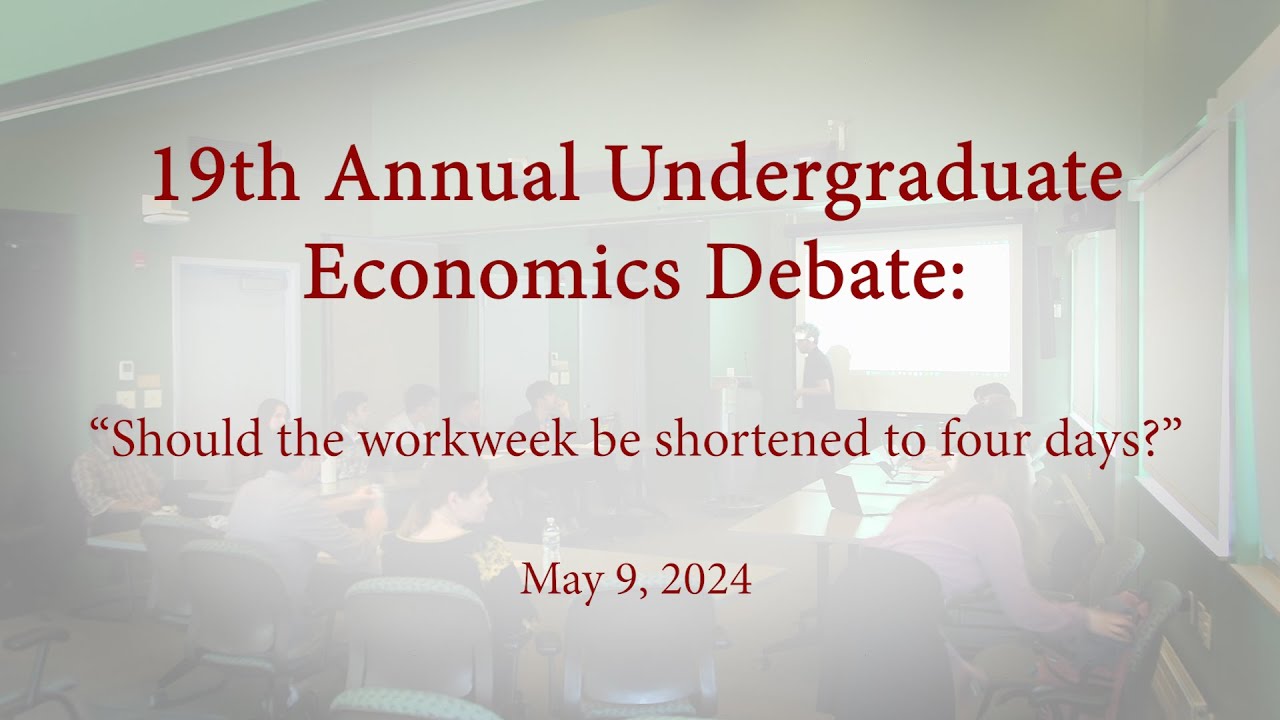
2024 Undergrad Econ Debate: Should the workweek be shortened to four days?
Watch on YouTubeVideo summary
In this undergraduate economics debate moderated by Grace Davis, the central question was whether the standard five-day workweek should be reduced to four days to address rising stress and declining mental health among workers. The affirmative team argued that historical precedents, such as the shift from six to five days which increased productivity without raising pay, along with John Maynard Keynes' predictions, support this transition. They presented empirical evidence from trials in Sweden, New Zealand, Iceland, and the UK, highlighting improvements in employee well-being, reduced turnover, maintained revenue, and environmental benefits like decreased carbon footprints. Furthermore, they emphasized that a shorter week would significantly improve work-life balance for families, breaking the cycle of stress and low productivity observed in many modern workplaces.
The negative team countered that implementing a four-day week is impractical for industries with irregular schedules, such as manufacturing, healthcare, and emergency services, where it could lead to staffing shortages and output disruptions. They argued that the policy would exacerbate inequality by benefiting salaried white-collar workers while reducing income for hourly wage earners who cannot afford to work fewer hours, potentially increasing childcare costs if schools remain on a five-day schedule. Additionally, the negative side raised concerns about potential increases in industrial accidents due to fatigue, the erosion of spontaneous workplace interactions essential for innovation, and the risk that high achievers might ignore shorter weeks while low achievers exploit them, leading to burnout for the former and dual employment issues that dilute employee focus.
During the rebuttals and final discussions, both sides acknowledged logistical hurdles but disagreed on whether the benefits outweighed the challenges. The affirmative maintained that successful trials included diverse industries and that companies can tailor schedules to their needs, dismissing concerns about accidents as based on flawed studies. They advocated for maintaining current labor mandates while prioritizing laws that foster good workplace culture, noting that human resistance to change and industry-specific constraints like continuous operations in hospitals are the primary barriers rather than inherent flaws in the concept. The negative team insisted that stress stems from poor leadership and communication rather than the number of hours worked and argued that work serves as a vital social connection for many, warning that reducing hours might leave some individuals isolated at home without addressing the root causes of loneliness.
Ultimately, the debate concluded with judges awarding victory to the affirmative side, finding their case for a shorter work week more compelling despite strong arguments from both teams. The affirmative reinforced their position by citing successful trials in Iceland and Reykjavik where no negative effects on unemployment were found, alongside significant environmental gains from reduced carbon emissions. While the negative team highlighted that a four-day week is not a universal solution and failed to prove a direct causal link between fewer hours and less stress, the judges recognized the affirmative's ability to demonstrate that reduced hours can effectively break the cycle of burnout. The consensus leaned toward the idea that while transitional challenges exist, the potential for improved mental health, economic stability, and environmental sustainability makes the shift to a four-day workweek a necessary evolution for the future of work.
Read the full video transcript
okay so um welcome everybody uh to uh
the uh undergraduate debate and
economic uh events day I hope everybody
uh has been enjoying the events that
we've had today and this is a nice way
uh to wrap up uh the semester um and so
I guess this uh in this debate we'll be
debating whether to reduce the work week
right and we have our pro team over here
and our con team um over here um I don't
know if Grace is going and our uh
moderator is Grace Davis from the
undergraduate economics class I don't
know Grace if you're going to ask people
to introduce themselves or whether I
should uh Do
It um you can yeah you guys okay so why
don't we have everybody uh from the pro
and con team introduce themselves go up
there oh yeah I guess so why don't you
introduce yourself when you come up here
the first time because I guess we need
the microphone to have for everybody to
hear so when you come up um the first
time then then uh uh introduce yourself
and um I'll be uh judging the debate
along with Arena B from the economics
department and also Chris Boon from the
economics department so I'm really
looking forward uh to hearing what you
all have to say and I think now Grace
will come up and will tell us the rules
of the
oops of the
debate hello I'm Grace Davis I'm going
to be moderating the debate today um so
the formatting of the debate is starting
with 15minute opening statements from
either side starting with the
affirmative um we'll then have a f
minute break for each team to collect
their thoughts and move on to a
16-minute back and forth broken up into
four pieces um with four minutes for the
affirmative four minutes negative and
then back and forth for that amount of
time um I think we should give them a
brief break and then have let's say
two-minute break and then a 10-minute
Q&A from the judges where the judges at
this point will have seen a lot so
they'll you know be able to drill down
into things things that they want to
hear more from get maybe a a side to
clarify a particular Point that'll be 10
minutes and then we'll move on to two
minute closing statements one from
either side um so that's the formatting
of the debate um I
guess to okay would you guys um for
introducing yourselves would you guys
rather do that how tight are you in
terms of time for the opening statements
like are you exactly to 15 minutes or is
a little do you have a little bit okay
then yeah I guess we can just keep the
introductions in the opening statement
if it's not too like ruinous for people
all right um so we can start with the
open uh sorry we can start with the
affirmative side um whenever they feel
ready then we um Can Begin that time
it's 15 minutes and uh I'll start the
timer I will give you guys a five minute
warning and I'll give you guys a one
minute warning and then I'll cut you off
if you're still
talking hello we are the affirmative for
why we should transition to a 4-day work
week workers all throughout the United
States are fed up with being with the
status quo right now they are tired and
overworked levels of stress are shown to
be high while happiness is low and uh
well-being and happiness is low and
productiv productivity is being stopped
by burnout and people all around agree
that we have difficulty B balancing life
and work now more than ever that was
what was happening in the early 1900s
and see that all of you thought was
rrring to the current day yes we are
dealing with the same problems that we
did 100 years ago now how did they fix
it back then the solution they came up
with to these problems in the 1900s was
transitioning from a Six-Day work week
to a 5day work week people's work life
balance became far were far more
balanced which actually uh resulted in
productivity increasing and the pay to
stay the same uh but times are changing
and these problems of the past have
resurfaced our history has set a
precedent for us we must take the
solution of the past one step further
and trans transition to a 4-day work
week given how we transitioned once
before we can see this debate is not a
question of whether our economy can uh
sustain a transition but whether or not
uh a 4 days is better than 5 days in
answering the problems we Face to answer
this question we will cover topics
including economic theories we all love
as economists real life examples
productivity and more thank you
Taylor my name is Wes and I'm going to
talk about Theory
here English economist John manard KES
argued that in Progressive countries the
standard of living is going to increase
kind of rapidly over time and this was a
prediction that he gave back in the year
1930 and his time period was 100 years
that was the example he gave because he
was looking and talking about his
grandchildren in the future and he
believed that people would still want to
do some work at this time but they would
be content with 15 hours a week and the
standard of living was going to have
increased tremendously and he thinks
that he his idea was that people would
have be have already accomplished so
much and the standard of living for
future Generations has already been
raised sign so significantly that why
are we still working as hard as we did
to get to this point
um reducing the number of hours people
spend working a job also allows for more
adequate time for people to complete
life's tasks with reduced stress levels
today mental health is on the decline
among young people largely and is
becoming one of the more pressing issues
facing not only our country but most of
the world stress is a huge Factor
playing into depression and anxiety and
many people today point to their jobs as
their main stressors in their day-to-day
lives then the point to life is liberty
and the pursuit of happiness and we are
seeing work becoming the main culprit
and chipping away people's happiness
since the year 2000 we've noticed that
happiness and well-being have been on
the decline this according to the world
happiness report and we want happiness
to increase along with our increased
standard of living but what's going on
right now in society is we're seeing the
complete opposite of
this obviously there are other factors
at play such as social media and state
of politics
right now but stress in the workplace is
really not looking great these days um
according to the American Institute of
stress 62% of workers experience high
stress levels and some feel that they
aren't in control and feel
fatigued this is diametrically opposed
to the 5% saying that they have low
stress levels while in the workplace
these numbers speak for themselves
people are too stressed at their jobs
and this excess stress is deteriorating
Mental Health on a large
scale scaling back the number of hours
people spend at work will have large
positive impacts on stress reduction and
Society overall and mental health is
something that has been closely paid
attention to now and has become an
important factor for decision-making of
any kind one small step that we can take
right now is to address these growing
problems to adopt a shorter Work
Week hello my name is Lee southernland
um the 5-day 40-hour work week is
outdated and has proven to have NE
negative impacts on the employees and
the environment the 5-day work week has
a negative impact on the environment
since many jobs are still in person and
the transportation to uh to work 5 days
a week puts a strain on the environment
seen from research done by UMass amher
um political economy Research Institute
a 10% reduction of hours causes a 12.1
decrease in ecological footprint a 14.6
decrease in carbon footprint and a 4.2
decrease in carbon emissions the 5-day
week work week also isn't fair for those
who are low income and have to work more
than one job to make ends meet um they
are either not able to work multiple
jobs or if they do they have no time for
anything else we're also seeing that
more schools are starting to Pilot the
4-day school week and if this is
becoming more common then the 4-day work
week will be make more sense since
parents won't have to pay an extra day
of child support if they aren't there um
perhaps the biggest problem with the
five out day work week is burnout
burnout is defined as a state of mental
physical and emotional exhaustion caused
by excessive and prolonged stress I'm
sure many people have experienced that
especially with finals week coming up um
stress from work uh perpetrated this and
having to do the same thing five 5 days
40 hours a week causes high level stress
and loss of motivation as well as not
having enough time in the week to do
Hobbies have personal time and family
time since and this can make burnout
worse since you feel that your job isn't
worth um what you're giving up um mental
health awareness is also becoming more
prevalent in the workplace and high
levels of stress can cause more mental
health issues such as depression and
anxiety all these factors cause high
level of stress and burnout accumulating
into lower productivity levels which is
bad for companies and the economy
hello my name is Mike and I'd like to uh
make the empirical case for the 4-day
work week so first I want to emphasize
that um the 4-day work week which it
means like reducing the work week in
general from say like to um usually 32
hours it's not just some crazy idea but
it has been um tested many times where
um companies and governments and um
different parts of the world have um
agreed to like um have their employees
work less hours per week and for the
same pay and we have like results from
them and it's almost been universally
positive for almost all the firms which
um have participated in them first a
notable experiment occurred in Sweden
where 80 nurses and an elderly care home
adopted a 6-hour workday and the trial
was a success and it led to improved
physical and mental health for the
majority of nurses involved we also see
evidence from New Zealand where the
financial services for impet Perpetual
Guardian instituted a 4-day work week
for its employees across the company and
found improvements in a variety of
organizational factors including um
including uh improved work life balance
for employees and uh less stress the
trial was so successful that the CEO of
Perpetual Garden Andrew Barnes is
actually one of the um leading Advocates
worldwide for reducing the work week
which goes to show that it's not just
like um employ workers who are
advocating for this but it's also um
CEOs of companies right and another
trial occurred in Iceland which I know I
think uh Lee is going to talk about next
but it was successful too and one
another one in the um the US which
involved 41 companies and
9888 participants found increases in
employee satisfaction and Company
support for the
measures uh here you can see that um
that the tri as the trial went on uh
factors such as burnout uh physical
health uh mental health life
satisfaction improved and the trial over
overall received a 9.1 out of 10 rating
among among employees and 8.7 out of 10
rating among companies finally the
largest trial to date in the United
Kingdom involved 61 companies and 2900
workers across a variety of a variety of
Industries which experienced an overall
4-Hour drop per week and found that um
39% of employees reported less stress
71% reported reduced levels of burnout
while the company's experienced
35 a 35% increase in Revenue while the
tri trial went on and a 57% drop
employee turnover crucially the study
rejects the idea that reducing the work
week only works in certain professions
such as like say white collar jobs right
but in highlights the flexibility of how
of reducing the work week it it notes
that each quote each company design a
policy tailored to its particular
particular industry organizational
challenges departmental structures and
work culture a range of 4-day work weeks
were therefore developed furthermore
based off the success of these trials
Corporate America is very receptive to
the idea a kmg survey found that 30% of
large corporations are experimenting
with reducing the work week so to
conclude my part the evidence for the
reducing the work week exists and it's
pretty
strong um one of our group members
couldn't make it due to the stomach bugs
so I'll be presenting her research um
contrary to Conventional opinion longer
hours don't NE necessarily equate to
increased productivity in fact Studies
have shown that prolonged work hours
often lead to burnout decreased morale
and diminished efficiency by condensing
the work week into 4 days we give
employees the gift of time a pre
precious resource that can be invested
in rest Rejuvenation and personal
development with extra days off
employees return to work feeling uh
energized ready to tackle challenges
more clear and refreshed
they have the opportunity to purchase
Hobbies pursue Hobbies engage in
physical activity or simply relax and
recharge this does not only enhance
their overall wellbeing but also Fosters
a more positive and productive work
environment moreover a 4-day work week
promotes work life balance a concept
that has become increasingly elusive in
today's fast-paced world by giving
employees an additional day to spend
with their families pursue personal
interest or attend errands we Empower
them to lead more fulfilling lives
outside of the office this in turn leads
to Greater jobs satisfaction improve
mental health and reduce turnover rates
according to CNN in Iceland beginning in
2015 2 200 public sector workers started
working 35 to 36 hour weeks with no
change in Pay careful research found
positive effects all all around workers
had less stress more energy better work
life balance as well as steady or
improved productivity but perhaps most
importantly a 4-day work week isn't just
about working less it's about working
smarter with fewer days in the office
employees are incentivized to prioritize
tasks streamline processes and eliminate
inefficiencies this encourages
Innovation creativity and strategic
thinking all of which are essential
ingredients for long-term success in
today's competitive
landscape all right so that was yeah
give them a round of
applause all right so that was the
affirmative side um I'll just read out
the names of the partici participants
right now is wait is this on is this
working it doesn't seem like it's not
working well it stopped working well oh
well that's not great I guess I'll just
try to project my voice um yeah so that
was the affirmative side um with Wesley
whand Michael Weagle Lee southernland
Taylor Quigley and Emily Ono who could
not make it today but contributed to her
research so that was the affirmative
side and for the negative side we have
cole Hartford Charlotte l
Alex hang Gabriel Mach Garen sakan and
aditha anad Anand Anand and they are the
negative side uh they're about to do
their opening statement um I'll give you
guys a second to arrange you know get
your slides up uh figure things out and
let me know and I'll start the 15minute
timer okay the 4day work week sounds
amazing it is a flashy headline and a
concept most people are immediately on
board with however despite the marketing
around the idea a 4day work week is not
a cure all solution is riddled with
issues since it does not work for all
Industries exacerbates
inequalities does not help with
employees stress and does not increase
productivity we are not better off
implementing a widespread 4-day work
week one of the biggest issues with
implementing a widespread 4-day work
week is that it fails to acknowledge the
diverse array of Industries in which
people work few Industries can Implement
a 4-day work week without significant
staffing issues and disruptions to
Output productivity and social
institutions these the hurdles these
industries would face make implementing
a 4-day work week impractical for
example all cap an engineering and
Industrial Supplies company struggled to
operate efficient efficiently while
experimenting with the 4-day work week
because of the business their business
model is based on irregular intervals
firms like all cap wait for customers to
place orders and then manufacture the
and directly the directly ordered
materials through their trial with the
4-day work week all caps window of
business shrunk shrunk drastically
employees struggled with with four
extremely busy work days and did not
experience the intended positive effects
of having a short week when another fir
firm citizens advice experimented with
the 4-day work week they found issues
with Staffing The Firm relies on contact
centers to interact with its customers
Mondays and Fridays are usually their
busiest days during the trial the
company had to invest in almost three
extra employees worth of money to keep
the up with a 4-day work week in most
cases firms such as restaurants and
Emergency Services fewer work hours
would mean more workers must be hired to
compensate a move that would be
impossible depending on the abundance of
workers and the cost of hiring
additional workers Industries open seven
days a seven days a week require Around
the Clock Staffing and are often
subjected to the solution and are often
subjected to the solution that they
could simply cut their workers hours and
make up the difference through hiring to
adapt a 4-day work week but as we said
before this is not
practical consequently a Drive Research
survey found that 62% of businesses
stated that implementing a 4-day work
week would require a reduction in
employees salaries and reduction in
salaries would harm the economy as
people would have less money to spend
additionally we need to think about
schools there's this is is another
profession where the 4-day work week has
been experimented with currently there
are over 900 districts in the US that
utilize a 4-day work week the intended
outcome was Employee retention and while
they have been able to retain teachers
the program places undue stress and
burden on the families of the district
most people are not working the 4-day
work breek and having the extra day off
now presents a new Need for child care
will the district offer child care for
30 EX for the extra day for $30 a day
per kid this adds up to an additional
$1,080 of of money per child each year
this is simply not feasible for many
families both these examples do not even
mention the elephant in the room the
white collar and blue collar split the
4-day work week only appears to work
well in white collar industries those in
salary jobs are able to experience the
luxury of an extra day off even if that
puts more strain on their jobs but for
those unable to secure such a position
they might just be looking at reduced
hours or not even getting to participate
in a 4-day work week at all on this
front the issue of hourly jobs rears its
head many jobs operate on a out out on
an hourly wage and with each worker
being paid on the amount of hours they
work people working these jobs will lose
out on valuable opportunities to earn
money the New York Time Magazine pointed
out that when one can hardly pay their
bill the absence of full-time work is
often experienced as a deprivation
rather than a reprive it continues on to
point out that while a reduction hours
for a salary employee might be seen as a
labor Victory it leaves the hourly
laborer with both less pay in a more
unpredictable schedule this isn't even
mentioning how there are other ways that
companies can maximize employee
efficiency giving the option to work
remotely more paid mental health days
and a limit on what employees are
expected to do beyond their working
hours are all options that companies can
consider instead of a 4-day work week so
whether it's maximizing the efficiency
of businesses or making sure employees
are at their best a 4-day work week is
just a mandate that many Industries
won't be able to adapt
to although at a glance it may seem like
a 4-day work week is beneficial to
society the reality is far different a
4-day work week would actually cause
workers to have more stress and fatigue
and it also carries negative Health
consequences as stated in Forbes
Magazine in 2023 it doesn't address the
core issue of how we work just how many
days we do it eliminating Fridays does
not solve the issue of constant
interruptions um and Days full of
meetings emails messages pings and texts
as our work habits and the distractions
that come with them that contribute to
burnout while reducing work hours May
delay burnout onset uh ignoring the
fundamental problems with our work
culture and daily habits will inevitably
ensure we remain on the same stressful
path truly uh if we Implement a 4-day
work week we're walking a very fine line
between extra day of relaxation and
increases distress and fatigue that
would overall lead to a decrease in
productivity or even lead to some
dangerous
consequences uh Professor dembe a
professor of Health at Ohio State uh
asserts that a 4-day work week leads to
a 37% higher risk of industrial
accident and all this assumes that we
can even Implement a 4-day work week in
the first place the sad reality is that
the overall number of job posts
advertising a 4-day work week remains
low clocking in only around uh 0.3% of
total posts according to Harvard
Business Review experts seem to think
that a 4-day work week is not going to
be implemented anytime soon three upen
experts said it's a nice idea that could
take root in small parts of the industry
but they don't hold out hope for
widespread change sure if you Tre pick
the best studies a 4-day work week
sounds great but when you realize the
reality of health concerns in the small
scale that a 4-day work week is being
tested on it doesn't sound as
good Jus hi uh I'm ad and my point is
about my first point is about loneliness
uh a specific stressor that can be
exacerbated by 4-day work week is
loneliness and social isolation it's a
well-known fact that America is dealing
with loneliness at epidemic levels with
the 19th US Surgeon General V Mory
saying that it's the greatest Public
Health crisis we Face Studies by health
insurance provider siga in 2020 found
out that more than three out of five
Americans deal with considerable levels
of loneliness showing a 133% increase
from 2018 further the highest levels of
loneliness were found in J C the same
generation that be greatly affected by a
change of 4-day work week the study
linked uh the the study linked
loneliness to having negative impacts on
mental and physical health with the plos
medical journal stating that loneliness
was comparable to smoking 15 cigarettes
a day further new workplace Norms
because of covid with virtual and hybrid
work environments reduces the time
individuals spend in work in general
which on a count average for onethird of
an individual's lifetime if one were to
add a 4-day work week on top of this the
impact it would have on individual
social and relationships lost because of
it could not is incalculable with
loneliness already being such a big
issue in America and the rest of the
world World actions like a 4day work
week have to be considered with the
impact it might have on the people it's
trying so hard to
help the second idea is putting the idea
of a 4day work week itself into the
current economic system that we're in
the truth is we live in a capitalist
Society across the world employees are
seen as individuals to produce enough
Revenue in order to generate a profit
for the company such organization they
work for as such ideas like a 4-day work
week would only pass if they don't
hinder The Profit that can be generated
by the employees in such an idea
corporations would lose an entire day of
Labor from the
workers and as such would find ways to
recuperate them in the four days that
the workers now actually work on this
could mean more managers to make workers
more productive this could mean
assigning more work on the days they do
work and in the case of virtual work
days pushing the boundaries of work to
make employees work at times when they
would not normally be asked to a study
by La based Staffing firm Robert Half
found that people in virtual work
environments were more likely to feel
pressured to work on weekends work more
than 8 hours a day
and were unable to fully disconnect from
work an issue we saw a lot during CO as
work has now entered the home a divide
that used to exist a clear divide that
used to exist back in the day has now
been blurred for many
people ideas like a 4-day work week
could very possibly lead to the same
negative outcomes for those it is
implemented on in time leading to work
culture the same or even worse than what
we have right now the fact of the matter
is we are here to debate if a 4-day work
week is a good idea and because of this
I don't think this is the i in the and
because of this it must be considered
the lens of the present day reality in
which I don't think a 4 day work week is
the way
forward our next Point concerns a
reality that has been already Dawning on
the labor market for the past decade
particularly since covid with more
companies switching to Virtual and
Hybrid models of work workers are less
and less required to engage in
face-to-face interactions with their
colleagues and Leadership the negative
consequences of this will only be
magnified by reducing the number of days
they show up what are these consequences
firstly is less spontaneous interactions
A reduced presence in the office limits
opportunities for casual unplanned
conversations such interactions are
often the seeds of innovation
spontaneous discussions that lead to
collaboration across departments or the
exchange of expertise such organic
collaborations could become rare
moreover such unplanned engagements play
a vital role in building and nurturing
professional relationships trust and
chemistry are developed through these
dayto day exchanges which in turn
contribute to a more cohesive and
productive Workforce in the absence of
these spontaneous interactions employees
may find it more challenging to
establish the depth of Rapport necessary
for Effective teamwork and
Innovation second rushed work is bad
work moreover the compression of the
work week may lead to rushed tasks Under
Pressure to complete the same amount of
work and less time the output of quality
may suffer leading to suboptimal work
results this can affect client
satisfaction and Company reputation in
the long term lastly I'd like to talk
about the 3-day weekends are kind of too
big of a break for us we might have
three four or five 3-day weekends
throughout the current calendar year and
once we get back to the office on Monday
mornings it might be kind of tough to
get back to the uh way of things so
having a 3-day weekend every single week
is actually not really that good good of
an
idea all right good
afternoon next A reduced in-office
schedule also weakens the connection
between leadership and employees leading
to a Cascade of negative effects with
fewer days in the office or in in any
other workplace even remote there are
less opportunities for real-time
feedback mentorship and career
development this results in
misalignments not only within teams but
also between different levels of
leadership in a 4-day work week there
are fewer days for leadership to gather
input from employees discuss options and
make
decisions this leads to slower
decision-making processes which can be
frustrating for employees who may need
quick responses or guidance to move
forward with their own work reduced
interactions can also lead to a
perception among employees that
leadership is out of touch with their
needs and challenges eroding trust and
morale within the organization
monitoring employee performance and
providing timely feedback can be more
challeng challenging with a shorter Work
Week impacting employee development and
overall productiv
perhaps a manifestation of employees
having lost commitment to their employer
or leadership is a phenomenon of dual
employment with the rise of remote jobs
people are increasingly taking on more
than one full-time job often two
full-time
jobs now as people find themselves with
an extra day off some may be tempted to
ctly take on such additional jobs this
trend dilutes focus and commitment on
the company Mission impacting
productivity loyalty to the primary
employer even worse when the companies
are in
competition a Reddit Community Reddit is
a popular online Forum called our
overemployed has over 300,000 members
ranking in the top 1% of Reddit
communities it shares methods and ideas
on dealing with being a full-time
employee in two different companies and
often an essential component to this is
making sure the employers do not catch
on many users sharing advice and stories
about nearly getting caught moreover an
essential component to the disconnection
between employee and Leadership is poor
communication as we've shown
communication communication will clearly
be affected in a 4-day work week a study
published by Forbes adviser shows that
imperson conversation is a strongly
preferred method of communication for
in-person office employees as you can
see here the blue bar strikes is quite
striking there is simply no substitute
for face-to-face convers ations whether
with respect to human connection or
workplace productivity a day lesson that
week to chat talk about personal and
professional matters will undoubtedly
lead to less of these types of
interactions of conversations new day
people come in fresh and open to talk in
addition this same study has shown that
digital communication which is likely to
increase with less days for teams and
employees to interact in person is a
significant cause of burnout
now in conclusion you see this right
here in conclusion the concept of a
4-day work week may seem attractive but
its implementation would have
significant drawbacks and is not
suitable for every industry it would
exacerbate issues like classism disrupt
Industries reliant on traditional
schedules and hinder sectors requiring
high responsiveness and
Innovation concerns about hourly wages
increase stress and decreas productivity
also point to the 4-day work week being
a bad idea it's a bad idea for for
worker satisfaction for individual
Company Success and the economy as a
whole okay thank you to the negative
side we'll now give both teams five
minutes to collect their thoughts and
take some notes um and then after that
we're going to go into our rebuttal
section which will be four four minute
segments of the teams responding to each
other's arguments
so whenever the affirmative side is
ready they can come up to the podium and
begin their
rebuttals okay so I think the opposition
does make a good point about that work
culture does have a serious problem in
this country but I think uh the evidence
shows and we've made the case that um
that the for that reducing the work week
is a step in the right direction so
first of all I'd like to address the
point that this is going to result in a
um in less pay for workers well what
we're explicitly ating is that um
workers get paid the same for Less hours
and this seems to have no impact no
negative impact on productivity
according to the studies we have cited
and also I I recall um Charlotte was
talking about some companies where
um uh the 4day work week or um producing
the work week didn't work well it not
every policy is perfect like every
single policy has a neg has a negative
effect on someone it's just about but
the goal of um implementing a policy is
to support more people than people are
getting than number of people getting
harmed and the 4day work League surely
does that and it has um wide
popularity from the trials we have cited
and about it only um not working in Blue
Collar professions well the US trial uh
involved companies in a variety of
Industries such as Healthcare mark
marketing entertainment engineering
construction and it was pretty
successful all around and it's a very
flexible proposal too because um
companies can um design a work schedule
that fits their business needs right and
I'd also like to um touch on a couple
points I the opposition made a point
that um a study from Ohio State found
that um there is a that a increased risk
of industrial accidents by the 4-day
work week they were talking about a
4-day work week with um with um they
were not talking about reducing the work
week and the way they were advocating
they were talking about a work schedule
where people would work equal hours for
um they would work the same hours but in
less days and also um the the graph you
showed about only 20% of employees left
their job because of
um because of um their um
be because uh because of um the long
hours well where else are they going to
go no most companies don't have a 35h
hour work week or 32h Hour Work Week
where they can go
to we would like to uh make a few points
about their graphical information and
how in a way they lie to you uh in a
very one of their slides they had three
graphs up and on the left was they're
trying to make a point about how lonely
this has been spiking but they showed a
graph of grade school students how does
that relate to the 4-day work we get all
another one that I'd like to point out
is you might remember they had a graph
of many categories in a circle showing
you what they wanted to show you but
that uh people working too much is
increasing stress but right above that
actually showed that more people are
getting stressed out from Child Care the
4-day work week would allow more time
for families to watch over their kids so
this problem wouldn't
exist thank you now we will have time
for the negative yeah Round of Applause
sure now we will open it up to the
negative side for their first four
minute uh portion of the back and
forth okay so first of all in response
to their argument about um the benefits
in terms of stress levels so
you cited a study that showed a clear
correlation between less work less
amount of work and uh reduced stress
levels right now fundamentally the
question is whether what the causal
mechanism is there whether a reduction
in the amount of hours actually caused
that reduction in stress or whether
there's something about reducing the
hours work per week that also leads in
some way to a reduction in
stress from the evidence we showed you
about communication being a primary like
primary cause of bad communication being
primary cause of
burnout we
uh claim that it's not the amount of
work that matters it's poor leadership
that matters it's bad communication
between employes and their leaders that
matters that fundamentally determines
stress levels no one day
less I just wanted to touch on the idea
that like mental health issues are EX
masturbated by the 5-day Work Week um
for a lot of people uh work is like
their main source of human connection um
and social interaction so by cutting one
day off the work week uh that would most
likely actually negatively impact uh
mental
health so you guys mentioned how the
5-day work week is not fair for
low-income families but I think the
4-day work week actually be less fair
for the low-income families because
they're most low-income families are
working minimum wage jobs right so their
salaries are not going to increase with
a 4-day work week and um cut putting a
cap on the hours they can work is just
going to make them a lot more stressed
um just decrease the quality of their
life and also they're going to try and
squeeze in 5 days of worth of work in 4
days so let they might be working
nighttime shifts so actually um you guys
were saying how they can spend more time
with family that's actually going to
work like it's going to backfire I think
so I wanted to respond to your point
about the grasp by loneliness that I
brought up or I put on the slides the
one on the left about grade school
children was supposed to show that how
loneliness was already an issue existing
in grade school children and changed
like a 4-day work we could increase the
issue even more uh the graph on the
middle was to Showcase how the current
picture of liness in America where 15 to
18y olds have a one one out of four of
15 to 18y olds have levels of loneliness
that are considerable or they feel very
lonely and the last graph on the right
was to showcase the impacts of
loneliness because of
co uh the last point that the conside
would like to make would be about that
would be about the blue collar worker
point that they keep sighting and about
how we actually have studies that are
quite flexible I would like to see the
actual Industries in it instead of a
general oh these are some hypothetical
BL col Industries and they somehow work
we have yeah 13 seconds left on the
clock um for that segment so if that's
all you guys have to say I give them a
round of applause we've been doing
rounds of Applause for
everything all right we'll give um four
more minutes to the affirmative and then
four minutes to the negative after them
um then we'll open it up to Q&A so let's
hear the negative I mean the
affirmative so it was mentioned by the
opposing side that a 4-day work week
would not work for both white and blue
collar industries and I'm here to say
I'm here to ask why would you believe
that if this country transition from a
Six-Day work week to a 5-day Work Week
across the board and we're just fine now
and we now see problems with that model
and we want to make changes it's going
to be difficult there is going to be a
transitional period and not every policy
is going to have 100% success some
policies will fail there are going to be
fundamental problems with Staffing with
pay with hiring with firing with any
everything adopting this new model it's
not going to work
overnight but addressing these
fundamental problems the workers have
spoken no one comes home at the end of
the day and says I wish I spent more
time in the office I really want to keep
being
stressed they come home and say I hate
my job or I'm very stressed I'm I'm
losing my mind they they are spending
too much time in the office it's very
obvious no one wants to spend more time
so spending less time would have
positive impacts on their stress
levels and it was mentioned that experts
believe that this is a bad
idea experts can think that this is a
bad idea in the 1940s experts our
medical experts thought smoking was fine
smoking cigarettes was normal and
doctors offices
until over time there were studies done
and then we figured out it's you even
the experts figured that out they were
wrong because it was just something they
think and having a 3-day weekend I do
want to address having a 3-day weekend
is not going to cause issues in the long
run for people coming in to work on
Monday after a long weekend because that
long weekend will eventually become the
norm a two-day weekend was a long
weekend back then when we used to only
have one day off so having a 3-day
weekend and as opposed to two-day
weekend yes will be crazy in the
beginning but it will become normal very
quickly as the industry
adapts and I also did want to mention
one more thing so you were talking about
stress and how workers are leaving from
stress so if workers are saying they are
very stressed at work and they work too
much how is working too much not the
cause of their stress if this is what
they're
saying um I also wanted to counteract
your point cuz you offered um remote
remote work and mental health days as a
solution um but then you counter that by
later saying that remote work causes
people to take their work home with them
and how remote work actually isn't as
helpful so okay so first I'd like to
briefly touch on the point about um that
our studies not showing a causal
mechanism well one of the Sweden study I
mentioned before actually did and found
that the 4-day work week it allows for
other like interventions that um are
shown to have a positive effect on
mental health it enables these to happen
now a response to um to Alex about an
example I have an example right here of
a Manufacturing Company implementing
their own unique um unique working
schedule which it's basically called the
um protected model where um our staff
like take their take um a day off but
like in some circumstances like staff
can be called in in like usually like
emergencies C cumstances but it's um
staff still um work uh reduced hours and
quote the manager of a small scale
manufacturer used a staggering model
recognized that the business could be
vulnerable in in an emergency on days
with lower staff
coverage all right thank
you now we'll have the final segment of
our back and forth with one more 4minute
segment from the negative side so just
to complete that elaboration on on
causal mechanism perhaps judges are
interested in their questions um and in
that too but what we suggest is that
it's not the amount of hours that that
leads to these decreased levels of
stress it's could be just less exposure
to leadership to bad leadership that is
for example or any other factors that
you have with more amount of hours work
it's not the amount of hours
themselves another Point brought up was
that with less days workers would be
incentivized to work more efficiently uh
just allocate their time better um we
claim that's to speculation I mean um it
seems very counterintuitive to claim
that you as a worker you're being you're
being given more work okay your response
to that is let me become more efficient
rather than you being why am I giving
more work now
so those are two
responses so one thing the positive side
addressed is uh my bar graph um which
says uh because of child care issues um
it that's a top reason for uh us workers
leaving a job but um a 4-day work week
would likely lead to more child care
issues because um I mean if schools
still operated on a 5day schedule
whereas workers operate on a 4-day
schedule would just create like a
logistical nightmare where you can't
pick your kids up from school in time
and
daycare um and also um working too many
hours is comparable to working too few
hours for the reasons that people left a
job I would like to thank the
affirmative side for giving the
manufacturing example I am pleased with
that I would however like to stress
something that I think I would like to
be elaborated more which is does the
affirmative side believe that we should
establish a for a 40 Work Week general
or business-wise because you've been
talking about cuz yes the manufacturing
company works well with their own policy
but that's their own policy that's not
every single industry and then another
point which is about how no one everyone
about complaining to work I would like
to bring up the fact that people there
are people who work multiple jobs we've
already talked about this with the arch
class overworked and how they are
sharing tips and strategies who avoid
being caught by their employers for
working multiple jobs okay cool all
right thank you negative side
amazing after the judges deliberate
we'll open it up to a 10-minute
Q&A okay so we have some questions um
we'll each come up up here and ask a
couple questions maybe we'll try to keep
it to 3 minutes each so that for each
question so I just had a couple of
questions uh so for the pro side um you
argued that you know this change would
be good for both workers and employers
and so if that's the case I suppose my
question is why aren't people doing this
already or to some extent you said that
some people are doing this already but
if it's really good for both it's a
win-win for both workers
and firms then you know to the extent
that's the case why aren't they um doing
it already a related question I have for
sort of both sides is what sort of you
talked a lot about which would be better
but what sort of laws and
policies um would you uh Advocate to
support um your position and since I
asked the uh uh Pro a question I also
want to ask the con question which is do
your arguments actually imply that we
should increase uh the length of the
work week or if not then what are the
reasons why it would be bad to to to
increase the length and do those reasons
not argue for for decreasing the length
so those are my questions here's the
first question really quick uh why is
this not being implemented yet if we
believe there are going to be benefit
large benefits to this and our response
is it's because this is a shift sh in
the status quo this is not something
like I was saying earlier this is not
something that just happens overnight
and we have brought up case studies
where companies and countries are
actually adopting this new model and
they are sharing their research with us
it's going to take time for everybody to
be on board with this because it is a
huge change and people are resistant to
change that's just inate human quality
and the shift from the status quo is
this is shifting from working 5 days
which is the traditional work week to
four that going to take some time
because there are there are a lot of
professions where like hospitals you
can't just close a hospital you can't
close a police station there are going
to be professions where this isn't going
to happen but it's going to take time so
it's not happening with everybody but
it's slowly happening in small
increments and it's just getting the
ball rolling it's kind of like a The
Snowball Effect because we're seeing
positive results in all these most of
these
studies to address what like policies we
would advocate for the um Fair labor
standards act that was amended in 1940
that set the 40-hour work week and today
weekend as like the official mandate in
the United States that's what the
negative side would have um we would
Advocate to keep that and maintain that
as it is just adding to that we'd say
that in some manner laws and policies
can Encompass or manifest uh bring about
good leadership good communication good
a good word culture those things that
actually matter for prevention of
burnout or a good workplace environment
and and so in that case really that
should like laws and policies should we
should prioritize um what would actually
bring about a good work culture and as
we've shown reducing the work week by
one day will not do that quite the
obiously oh yeah and uh should we
increase the length from from of of the
work week back to six well a six- day
work week reducing that to five is
fundamentally different than reducing a
five day work week to 4 days 2 days is
double of one day so just the marginal
gains you get is is quite it's a very
quite a very different situation the
change you're talking
about um in the interest of time I think
we should move to the next question hi
uh both sides uh brought really uh good
arguments uh and summarizing all of that
so
for affirmative side you said that uh it
would 4 days uh 4 day week would
increase productivity uh happiness uh
less stress uh so what do you think
about
um like uh making three days uh 3-day
week instead so would they uh increase
even more productivity increase
happiness uh um decrease stress uh and
um to your to the negative side um I
have the the opposite question question
so would all your arguments like would
it U decrease loneliness uh increase
salaries and uh Etc um if people would
work six days instead so would it would
be even better would they be happier and
uh another uh very important thing uh
you both like both sides uh you both uh
spoke about happiness but your
perspective on that were completely
different uh like opposite I would say
not not just different uh So Pro side
said that uh the less people work the
happier they are uh the negative side
said the more people work the happier
they are so can you say that people are
happiest ever when they work for days a
week and when when they work 5 days a
week or they would be even happier if
they work 3 days a week and even happier
if they work six days a week and um like
additional um question uh to the
negative side about
loneliness uh why uh people who spend
more time at work necessarily uh less
lonely that than people who spend more
time at home with family with friends uh
especially uh work could be in person
but could be remote uh so could you
please explain more about this argument
thanks so responding to the first
question about loneliness or happiness
increased with six days now for a lot of
people six days would decrease their
would indeed decrease their loneliness
or happiness uh increase their happiness
but for a lot of people especially
people with families they have friends
at work that's a significant Community
to them but they equally have their
family at home so increasing that to six
would equally not not be a good idea for
them so blanket solution
for the whole economy switching it to
six days is not a good idea
either some people do happen to be
happier with 6 days some people happen
to be happier with 4 days uh we don't
deny that there's cases where 4 days is
a better solution but applying that to
the whole economy as is just not a good
idea as we
show so for your point about loneliness
and how that impacts uh how that's
impacted by 5ay work week the last
question you had it's more about how in
the workplace because it accounts for
about 1/3 of your overall lifetime um
being in work it's kind of a way to
build relationships so if you're redu
reduce that to 4 weeks and have 3 days
at home it kind of doesn't allow you to
develop the relationships you normally
would have if you were working five days
a week and with the current 5day model
you still have 8 hours after you work
you still come back home to your family
and friends you have the weekend with
your family and friends so kind of
balance in five their work week is
something that I think we advocate for
and we feel like moving towards 4-day
work week would not really improve the
learning situation I think would very
easily can make it
worse just to address some of your
points um uh we're not implying that
like working more means people are
happier we're just um we're implying
that like it's the main method of social
connection for a lot of people so by
cutting that off I mean sure some people
have families but not everyone some
people have to go home to uh just an
empty house which is pretty depressing
and also um like for the whole like 6
days um argument uh we're not like we're
saying that should stick to the
traditional 5-day schedule so 6 days 4
days it doesn't matter it's we want to
stick to
tradition um
yeah um on how we define happiness for
the affirmative side I believe we look
at it through the lens of leisure being
a main source of Happiness where uh a
survey in the United States found that
Leisure does play a significant role in
affecting individual happiness
um and then your question about why
don't we just make it a three-day work
week um we think that it would be too
intensive from going from a 5 to a three
but we don't know yet in the future
depending on productivity and Technology
cuz we've gone from 6 to 5 5 to four so
maybe in the future we could go from 4
to 3 just not right now from going 5 to
three all right thank you we'll now open
it up to I think the final question yeah
we have time yeah we have time I mean
yeah it's if you guys are okay for more
time then I'm okay for more
time uh so all right let me just
um so for the con side um so my
questions are building a little on some
of the questions that have been asked
before but um you mentioned uh your
comfortable the the current standard for
overtime in the United States it applies
after 40 hours a week and you want to
keep it there um so one of the ways to
implement a shorter work week would be
to change the the hours threshold for
overtime pay and so you could say not
that these companies that really need
workers 5 days a week they could still
have workers 5 days a week they'd just
be required to pay them overtime and so
it would essentially raise the wages for
the workers so I guess my question for
you is uh you know there are arguments
against the minimum wage there are
arguments against uh unions and
collective bargaining institutions that
raise wages for workers
uh you're against uh shortening the work
week are you also against other policies
to raise wages for workers like minimum
wages and stronger unions and if not
what's the distinction between uh you
know lowering the overtime threshold in
terms of hours and and some of these
other policies and then for the for the
pro side if you could talk a little more
about you mentioned a lot of cases where
companies voluntarily chose to implement
a 4-day work week um if if you could
talk a little more about whether we can
sort of uh expect similar results if
there was some policy mandate that then
applied to all firms in particular
consite has mentioned a few times that
well there might be some companies that
if they cut hours uh they won't be able
to maintain the same level of overall
earnings and so would we expect the
results that you're talking about about
happiness Etc to still apply if workers
are seeing a reduction in their overall
earnings
thanks okay so responding to the first
question what makes a 4-day work week so
different from minimum agage or any
other kind of policy
is how workers will or the effect it
would have on certain industries with
minimum
wage it's Tech generally speaking it's a
solution you can apply to most
Industries with before they work with
some Industries would suffer or benefit
but suffer a lot more than certain other
Industries and so that's a key
difference between the 40 work week and
other
policies uh you asked if uh we were
against uh unions and minimum wage and
not necessarily um if workers want uh if
workers want these things um they'll ask
for them them but uh there's no like
widespread um like uh worker demand for
a 4day work week
yet so on the question about whether
we'll see different um effects of um if
this was government enforced rather than
like voluntarily by uh companies well I
think it's a it's a good point and that
there might be Merit to it if like it's
tested I think um so far if if um so far
what we've seen in for example this was
a government policy right like the
government
mandated the national city government
and the capital of Iceland rashik and
the um the n and the national government
instituted A reduced work week for
public sector employees and it it had a
um overall it had no negative no there's
no evidence that it um had a negative
effect on um unemployment and I think um
instituting I don't see like why like
instituting it as a policy will make
much will have like a negative effect
while it's not having a negative effect
on firms that are already doing it
because it's already an organizational
it's big organizational challenge for
like a firm to um implement it right
even if they're doing it voluntarily and
I think that um at all firms would be
able to do it all right thank you to
both sides that closes off our 10minute
Q&A section
I think we went over 10 minutes by a
little bit but you know time flies when
you're having fun and talking about
economics doesn't it
guys all right we'll open it up to our
closing statement um and we'll have two
minutes for the affirmative two minutes
for the negative then after that um the
judges will go and deliberate um and
then we're going to have somebody
announcing the economic ceremony Awards
um so that will be able to fill your
time so we'll start on the affirmative
uh when they step up here I'll start two
minutes I just want to like to say thank
you for staying us through our opening
statements are back and forth and even
giving us some great questions to answer
uh our workers are facing so many
problems at the moment being burned out
or unhappy or just not being able to
plan their life and work at the same
time uh now let me remind you of what
we've said so far today history shows
that the solution to these problems is a
transition to Less hours worked week
workers are too stressed that stress
turns into worse productivity which just
turns into stress making this endless
cycle having those extra hours off from
the 4-day work week uh gives people time
to recover and recuperate to make it so
the cycle never happens there are many
examples that we've stated from trials
or actual imp uh
implementations of the 4-day work week
of showing the positives where even the
some companies decided to keep the
system after the
trial we would like to make one point
that what one minute okay we would like
to make one point that they didn't even
talk about our stance on the environment
and how we have a research paper from
here the political economic research
institute how uh reducing hours worked
results in lowered carbon emissions we
hope that you can now see that the 4day
work week is the answer to these
problems we face in our economy
instead of suffering in our 100-year-old
structure we have now we should be
implementing the new 4-day structure
that's what humans are all about
Innovation thank
you now we'll give the negative a chance
for their closing
statement okay so just to know a couple
of points the opposition has failed to
respond to or insufficiently resp
respond
to number
one the 4day work week is not a blanket
solution not every industry is going to
respond well most Industries are going
to respond very poorly to
reduction
then next point
is stress and fatigue we've shown
that or opposition has not established a
clear causal mechanism between one week
one day less and less
stress
next they fail to respond to our
assertions
about Connections or disconnections
between employee and Leadership
communication being essential for
workplace
satisfaction and
loneliness
minute in addition opposition also
failed to respond to the phenomenon of
dual employment that being on the rise
people getting more than one job
employeers not knowing about this and it
being a significant issue our
eony uh when it comes to the 4-day work
week the high achiever will ignore it
and the low achiever will take advantage
of it remember that disastrous project
in college the one where the high
Achievers did 99% of the work while the
Slackers enjoy an eza similarly with a
4-day work week uh High achieving
employees will keep being efficient and
continue getting more work piled on
until they burn out uh whereas the low
Achievers will rejoice in their new
found work life balance for a few weeks
until the next new workplace Trend
surfaces and they feel entitled to even
less hours at the same
pain all right that's time yeah give
everybody a round of applause
amazing yeah I thought that that there
were really great arguments on both
sides um so we'll give the judges some
time to deliberate um while the economic
ceremony awards are
announced thank
you okay so it was a really uh tough
choice you all did not uh make it easy
on us uh we learned a lot from this
debate we really saw that there were
strong arguments in favor of uh the the
the 4-day uh work week and also strong
arguments against uh ultimately we felt
that the pro sign eak it out and and and
came out ahead so uh we'd like to
congratulate you on your Victory but uh
the con side uh really gave you a run
for uh your money so it was a great
great debate and I would also like to
thank uh Grace for being such a great uh
moderator so let's give everybody a big
round of applause