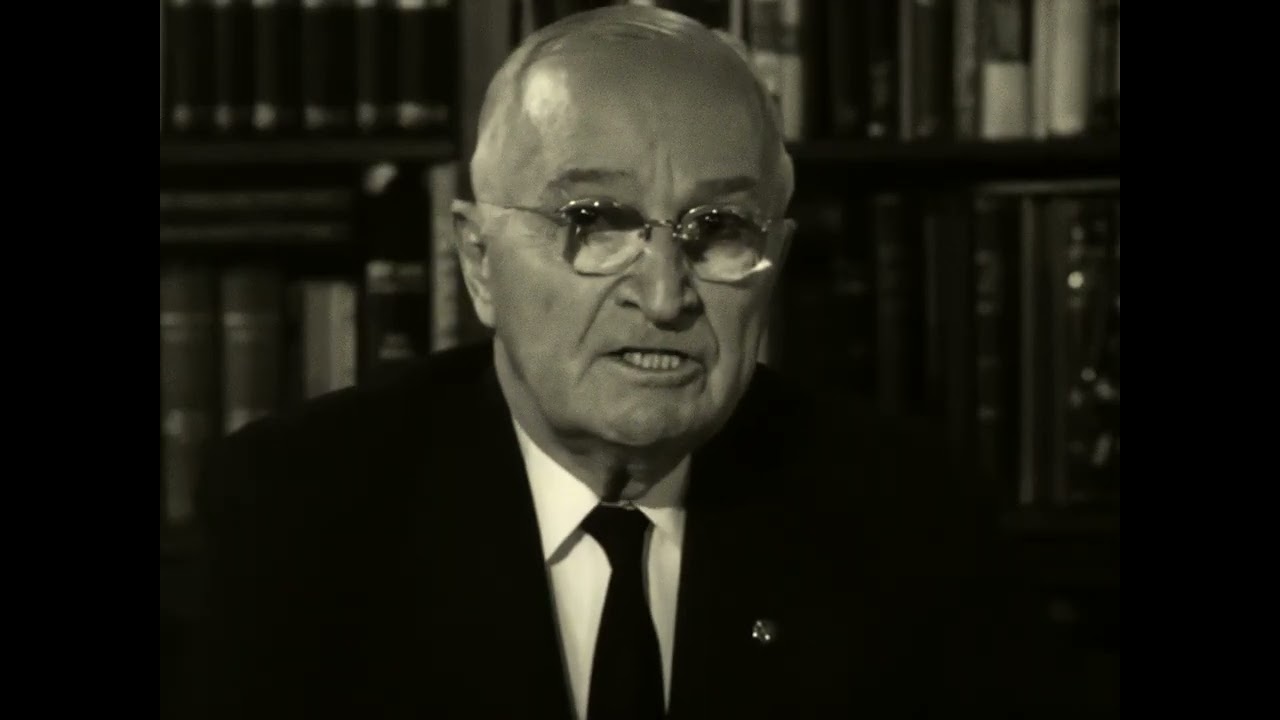
1960s Interview 🎞️ Harry S. Truman on Using the Atomic Bomb to End WWII • 4K 60FPS
Watch on YouTubeVideo summary
In this historical interview from the 1960s, former President Harry S. Truman reflects on his initial reaction to the discovery of the atomic bomb, expressing that he viewed it primarily as a blessing rather than a curse. His perspective was driven by the urgent necessity to win World War II quickly and with minimal loss of American lives. He believed that if the weapon could be used effectively, it would serve humanity's best interests by ending the conflict decisively, and he never entertained the notion that it might become a destructive force against mankind itself.
Truman also addresses the geopolitical context surrounding the bomb's development, specifically noting that the United Nations was already in the process of being formed when these events unfolded. He recalls his immediate actions as president, including attending the UN meeting in San Francisco to set the organization to work, while acknowledging the unique position the United States held with the atomic bomb in its exclusive possession. Despite this powerful advantage, he did not believe that the mere demonstration of the bomb's capability would instill such overwhelming fear in humanity that it would act as a sufficient deterrent against future wars.
The interview concludes with Truman discussing the practical reality of using the weapon after successful tests in New Mexico and Texas. Upon receiving detailed reports from Potsdam confirming the success of the first explosion, he shared the information with his cabinet members to underscore a critical strategic point: the United States was now in a position to win the war without suffering significant casualties on its own side. This realization reinforced his conviction that the bomb was a powerful tool designed to achieve victory efficiently, aligning with his primary interest in securing peace through decisive military success rather than relying on psychological deterrence alone.
Read the full video transcript
Sir, at the time that you first found
out about the atomic bomb, did you
regard it as a curse or a blessing to
mankind?
>> Well, I thought it was a blessing. I
thought it could be used and made a
blessing. I never worried about it being
a curse. I wanted a weapon that could
win the war, and it did. That's what I
was interested in.
>> The United Nations was already in the
process of being formed at that time.
And with the atomic bomb in our
exclusive possession, what were our
chances of preventing another war?
>> The United Nations was called to meet on
the 16th, I think, of July
in San Francisco. And the first decision
I had to make after I became president
of the United States, the newspaper men
came in and asked me if the United
Nations meeting would take place. The
United Nations The Nations meeting did
take place, and I went to San Francisco
and set them to work.
>> Did it seem to you that the
demonstration of the bomb to put an end
to the horror of war might give humanity
a good chance of really being frightened
to death,
and that such overwhelming fear would
become the compelling deterrent to war?
>> No. I never had any such feeling at all.
I always thought of that as a weapon of
war, and as a weapon that was powerful
enough to win that war. After we made
the the demonstration of it in Texas in
New Mexico, and the first one was
exploded in New Mexico, the word came to
me in Potsdam just exactly what had had
happened.
Two pages on legal type paper, and it
was a long weepy proposition. And I
showed it to the members of the cabinet
that were there, and I said, "Now, we're
in a shape to win the war without very
very with very few casualties on our
side, and we hope not