Video summary
Christina Lumia, a midwife and PhD candidate at the University of Milano-Bicocca in Italy, presented findings from her scoping review on the role of midwives in perinatal palliative care (PPC). She highlighted that while PPC is an increasingly important field focusing on quality of life rather than just cure for families facing complex pregnancies or uncertain outcomes, a significant gap exists in the literature. Although midwives are central to providing continuous support throughout pregnancy and birth, they are often overlooked in academic studies where their roles get merged with nursing or described generically as general healthcare professionals. This lack of explicit recognition obscures the specific contributions midwives make to this emotionally demanding area of care.
The research identified two main domains affecting practitioners: professional experiences and organizational frameworks. Midwives frequently report emotional burdens, moral distress, and a feeling of being unprepared due to insufficient training for such sensitive situations. However, the study found that mentorship from experienced colleagues, increased clinical exposure to transform uncertainty into competence, and supportive organizational systems with clear protocols significantly improve professional confidence and resilience. Furthermore, while established models in high-income countries emphasize family-centered care and shared decision-making, midwives remain rarely explicitly positioned within these pathways despite their values aligning perfectly with the core principles of PPC.
To address this invisibility, Lumia proposed a conceptual framework that places the woman and her family at the center, viewing perinatal palliative care as a longitudinal process rather than an isolated event. In this model, midwives act as essential connectors who maintain relational continuity across different clinical settings and phases of life, from antenatal to postpartum periods. The presentation concluded with strong implications for education and practice: curricula should formally integrate PPC competencies, research must focus specifically on midwifery contributions in diverse contexts including low- and middle-income countries, and the profession needs to actively claim its identity distinct from nursing to ensure that compassionate presence is recognized as a vital power rather than an implicit background role.
Read the full video transcript
Let me introduce you to Christina Lumia
which is a midwife and a PhD candidate.
Courage
to complete it. Christina uh a PhD
candidate in nursing in midway free at
the University of Milano Boka
Italy and she has a solid clinical
experience gain across different Italian
hospital settings. Her research and
knowledge translation activities address
uh sexual and reproductive health,
cancer prevention and perinatal mental
health. Her professional interests focus
of on strengthening the integration
between clinical practice, research and
education in order to improve women's
health outcomes.
So I'm welcome and I'm pleased to uh to
listen to what you want to share with
us. So I will um stop the sharing and
you upload your own uh
your own presentation.
>> Okay, perfect.
>> Okay, I think you can see the
presentation now.
>> No problem.
>> So hi everyone. Uh thank you Seline for
the presentation. I'm from Italy and
today I would like to uh share with you
the finding of a sping review on medifer
practice in perinatal palative care and
to present to you a conceptual framework
that we developed based on our research.
So um let me start with a simple
question to all of you. Um why does this
topic matter? Um we know that parental
palative care is an area that is growing
globally.
uh more and more families are facing
pregnancies complicated by lifetiming
fetal conditions or uncertainty
um uncertain neatal uh prinosis. Um the
situation required um require extremely
complex and emotionally intense decision
making processes. Uh in this context
midwives are always present. We
accompany women and families across
pregnancy, birth and postnatal period of
course and yet despite the central
present in care uh our role within the
prenatal palative care remains unclear.
Uh this leads to what I consider the key
message of our study. uh midwives are
everywhere in care but nowhere in
literature.
Uh we already know that uh prenatal
palative care is an holistic family
centered uh care focus on the quality of
life instead than only cure
and importantly it is based on a
multid-disiplinary approach. So um the
philosophical and organizational
foundation of perinatal palative care
are already well established
but uh when we look more closely to the
literature a clear gap emerged. Uh most
studies are focused on parents
experiences and this is very important
because we can manage our assistance our
care about the expectation of parents
and our stud our other studies are
focused on physicians perspective and
experiences
but midwives are often grouped with
nurses only or described very
generically.
within the the sentence health care
professionals. This creates an issue.
There is a lack of clarity about what
midwives actually do in perinatal
palative care.
For this reason, we designed the study
with three main objectives. Uh the first
was to map the evidence available on
midwives in in perinatal positive care
to identify the real gaps in literature
and to explore how midwifery practice is
integrated in the care pathways.
So we conducted a scoping review
following the Joanna Bricks Institute uh
methodology and the prismoscoping review
guidelines. We searched in the measure
databases included,
enalp, psych info and base and the
search was conducted between May and
September 2025
and we decided to included only the
primary studies.
This is the uh Prisma flow chart of the
study selection. We initially identify
79 records. We screen uh 57 for title
and abstract and then we read the 23
full text and we included 11 studies at
the at the end of the the scoping
review.
These are the uh mainly characteristics
of the studies that we included. The
first was that we found only uh studies
from high income countries published
after 2010
because we supposed to have a more
interest after this period and in
particular in the recent period and they
mainly focus on professional experiences
of the healthcare in general and they
were focused on clinical and
organizational framework. works and in
particular guidelines.
These are the results about our
analysis. We conducted a thematic
analysis according to uh Brown and Clark
and two domains uh emerged. The first
was the professional experiences and
preparedness
and the second was organizational and
clinical framework.
The main one is quite important. Um the
literature outlights that health care
providers uh involved in parental
quality care sometimes experienced a
significant emotional burden, a moral
distress and a lack of specific
training. This is a very important point
in my opinion because um we provide uh
PPC the prenatal operative care and in a
context that is not only clinical but
also very emotionally demanding if if we
think about the parents or if we think
about the providers too. So
professionals often face a healthy
challenging situation and may feel
unprepared to manage them.
At the same times
literature shows that some factor can
significantly improve the professional
experience of those involved in PPC. The
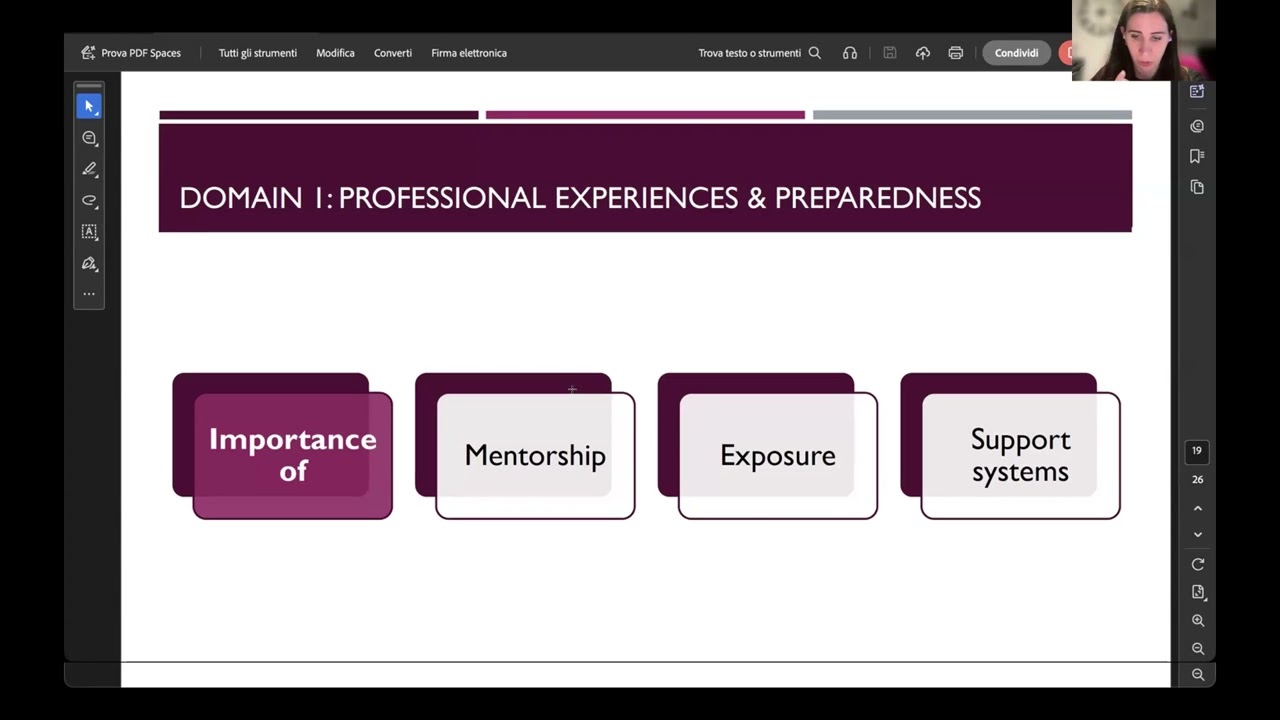
first we consider the mentorship. The
mentorship play a crucial role. Having
the opportunity to work alongside more
experienced colleagues allows
professional to develop not only
clinical skills but also ways of
navigating emotionally complex
situation. So the mentorship provides a
safe a safe place to reflect to have
question and to process difficult
experiences which is essential in
midweery field in general but in this
field of palative care I think is quite
important.
Um the second uh was the clinical
exposure. Um professional who have more
experience with PPC situation tend to
report higher level of confidence and
comfort like in other activities that we
invol we are involved as midwives. uh
exposure help transform uncertainty into
familiarity and hollow the clinicians,
midwives and all the providers to
gradually build both competence and
emotional readiness.
The third is the supportive
organizational system which is very
fundamental. Um this includes the
presence of a clear care pathways,
institutional protocol,
interdisciplinary
uh collaboration and the spaces for the
briefing and supporting the emotion.
When professional feel the support of
their organization, they are better able
to provide consistent and compassionate
care together. These elements are
crucial because they do not only improve
technical competencies but also uh
strengthened the confidence, the
emotional comfort and the resilience of
the system and other professionals. And
this is particularly important in PPC
where professionals are constantly
balancing clinical responsibility with
deep emotional involvement.
The second domain is the organizational
and clinical frameworks. Um they are
actually welldeveloped in literature. Um
but uh there are a clear model of care
exist but I want you to remember that we
are talking only about the high income
countries. So we need to focus in the
future to the low middle inome countries
for example but uh the clear model uh
exist
uh they are strongly in focus and
emphasizing the quality of life the
family centered care and the shared
decision making between families and
between professionals
however despite this well- definfined
frameworks midwives are
rarely explicitly described often merged
with other professional and not uh
clearly positioned within the care
pathways.
So this leads to a paradox in our
opinion because midwives are not
explicitly recognized in PPC but
midwifery values are perfectly aligned
with the principle of quality care. For
example, if you think about the
continuity of care, the relational care,
the effective communication and the
family centered care. These are the
values and the principles of our
professional. So these are core elements
of midwifery of midwives and at the same
times fundamental principles of PPC.
To try to address this gap, we developed
a conceptual framework grounded in the
evidence identified through our scoping
review, but also informed by uh
midwifree theory and practice. At the
center of this framework, you can see
that we intentionally place the woman
and the family. This reflects a uh a
fundamental principle that perinatal
pivot care is not organized about the
condition about the diagnosis the
illness but around the lived experience
of the entire family. Around the central
core we structure the continuum of care
across
um the phases the mainly phases of the
midwifery practice. So the antennatal,
the intrapartum and the postpartum
period with the deb care. But this is
very important because we don't consider
only a single moment but a longitudinal
process that unfold over time often
across different setting and
professionals.
Within this continue, the midwives is
positioned as a connector across all the
faces of care. And this is really the
key idea of this framework. Midwives are
one of the few professional who can
accomp
maybe maybe the only we can see together
that accompany women and family
continuously over the the entire life
over the time moving across clinical
setting while maintaining our
relationship
our relational power with the family and
with the woman too. If you think about
the the the the box number two promotion
of sexual and reproductive health.
This is important when we consider a
woman who experienced before uh a
palative care for the newborn. Uh but in
the future maybe she could uh think
about another pregnancy and we have to
support this woman. So um we wants to
maintain communication between the
professional between midwives support
the woman who wants to share their their
decisions and try to maintain the con
the the coherence into all the pathway
all the care experience. So this
framework does not introduce a new role
for midwives in my opinion but rather
makes visible a a role a practice a
competence that is already being
intacted in practice often implicitly
and without a formal recognition. So
ultimately it lights how midwifery is
not peripheral
but central to delivery of truly
integrated family centered palative
care.
These are the main uh implication. Uh if
we think about the practice
uh we hope for a a clear recognition of
midwives that provide prenatal palative
care because we we we we do this every
day but without formal recognition. Um
we can consider implication for
education. So maybe we can integrate
also this field in the undergraduate or
maybe post-graduate uh curricula.
And for research of course we need to uh
to focus on to focus on studies that are
specifically
um focus on med midwifery on midwives
and the contribut contribution sorry and
competencies and the practice of
midwives involved in PPC and as said
before also for the context of the
research because we are talking about
only the high income countries.
So these are the the take-h home message
that I want to share with you. Um and
maybe we can discuss together about it
about them sorry. So uh PPC is spending
all over the world there are clear
recognition of the palative care in
general as a a primary care priority. So
we have to be involved in PPC very
clearly because we are central but we
don't have to be under recognized in the
future. So we need to make their the
role visible structured supported
and because I truly believe that
midwives all over the world are already
doing this work every day.
uh the challenge now is not to invent a
new role but to recognize to name to
support what is already happening in
practice. So uh if you are interesting
in the um entire in the full article
sorry uh you can read it in woman and
birth in the last issue and if you have
question we can talk together now or
maybe this is my personal email if you
wants to uh to exchange some
opinions or discussion and thank you so
much for your attention.
Uh Christina, thank you so much. which
it's an important uh message to take
home and to be conscious about the the
the importance of the the the presence
of the midwife, the consciousness
in the moment and the paliotative care
with the ch children and babies.
Um
was
was there is there any uh question or
commentary? I wrote things but uh yeah
it's time to ask question. Uh
let me see if I if you can unmute
yourself. Can you
uh let me see?
Oh boy.
>> Oh there are Oh okay. This a real
problem.
>> Hello.
>> Ah
>> hello.
>> Hi. Hello. Thank you for the
presentation.
>> Uh I wanted to ask if um perinatal
palative care is actually well
established in Italy because it's not
you know it's not like a widely
recognized and widely um accept like
established concept all over the world.
I mean I know there are pockets of good
practice but um there often aren't like
specific teams or named professionals
who lead on that care. So I think that's
part of why midwives are not recognized
for it either because it's generally a
concept that's not so well known.
>> Oh yeah, I agree with you. Sometimes the
teams are very uh different in
professionals and in some part of the
world midwives are included. In Italy we
have differences in the regions. For
example, if we think about the north, we
have one hospital with a specific
protocol in which midwives are involved.
For example, when the woman decide to uh
to donate the the milk for example
or
um because sometimes the palative care
uh occur after uh a starting of the
breastfeeding
for example. Our another situation is in
the center of the Italy
uh in which midwives are starting to be
involved but is quite difficult because
is not highly recognized as a skill of
the midweery in particular but also for
only sorry for uh nurses or pediatric
nurses because in Italy we have
differences in professional we midwives,
nurses and pediatric nurses. So it's not
easy to to have a particular recognition
of the world of the role
completely and universally in all the
the the all the nation.
I don't know if I answer.
Thank you.
And I I like Christina that you uh
insist that to to u distinct nursing
from midway free because they are two
unique and distinct professions and you
claim something clearer and uh to to uh
assume as a professional identity of of
unique about midwife. lives and not not
mixed up with nurses.
>> Yeah, I know that this is not a
situation of all the countries in the
world because for example maybe the
colleagues from the US are better
informed than me but sometimes midwives
and nurses are the same professionals.
In Italy, we have a clear recognition of
the roles of the competencies and
identity of the nurses and of the
midwives are different but strongly
independent.
Um, and we recognize the midwives as a a
key role for support the woman in the
entire life, the woman and the family.
This not means that nurses are outside
the clinical pathway. Of course, but
maybe midwives is quite prepared from
the curricula, the from the university
curricula to be involved mainly in woman
life and in woman health.
>> That's good to know.
Uh,
is there another commentary?
Yeah. I I wonder for uh I have a
question for you. I wonder how
can uh teacher or information for
student midwives.
What would be a good thing to help a
midwife
to feel like confident to be in that
part of you know welcoming life when the
baby is crying but welcoming like life
when you know that the baby will go. Uh
was there any special
courses or
Yeah. what what is your experience?
>> Um there's no specific course but the
idea of the of this research came from
one of my students. This is the I
supports the her bachelor thesis uh
because she went to um a conference in
Italy in which the neonatal palative
care where was introduced to the
audience and she comes in the university
said okay I just wants to improve my
knowledge because I think that um is
something very important for the future
Maybe the the courses or the the
bachelor degree is not clearly focused
in this field but however the students
are curious. So uh maybe it will be an
idea to improve the
uh this field also in the future. So we
care about to publish as a to publish
this re this research to uh to greeting
for Sara. They had they had the the
mainly idea but also for give an an idea
of all over the world to the importance
of this of the research in this field or
the midwives all over the world.
H
well yeah thank you. Uh
yeah um
was there any uh sharing discussion with
people
uh not specialized but experience in
palative care for adults but what it is
about working in paliotative moments. Uh
so for adults and for babies or whatever
it may be the attitude or virtues or
ethics of that can be shared and be
making clear as well as you know it can
be for adults but it can be for uh for
midwives.
>> Yeah. And um I think that sometimes when
the population and the society thinks
about a midwives only think about the
the beautiful moments, the most
important moments of happiness and but
sometimes we are clearly involved also
in very sadly
periods, sad moments. So for adults
maybe is quite accepted maybe uh but for
babies is something very hard to to
understand to accept but is is in this
point that our communication the
importance of relationship that midwives
has with the the family with the woman
with the entire community that we can
try to support this particular sadly
moments. So um it's very good to say
that we are not here just when is sunny
outside but also when the moment is
quite hard and that's why I very caring
of this I'm caring of this research
because I want to share with other
colleagues that we have to improve the
communication the decision making with
women with families also when it's not
sunny outside.
So, it's very important for us as a
professional in the community.
Thank you. We certainly midwives need to
um cultivate humility
of the impossibility to control
everything and to be responsible for
life and you know all things but and
help parents
to to to live with that uh uh
powerlessness.
>> Yeah. Uh and you know it's it's painful
and it's sad and it's fear. We fear this
and we don't want this. Nobody want
that. So wow. And yeah maybe values of
our society
uh help doesn't help us to be prepared
for that. But so that's why prepared
midwives would be so important.
>> Important. Yeah, of course.
>> I think there is um a question from
Wilson.
Uh do you think this concept can work in
low middle income countries? Oh yeah,
absolutely.
Uh
if I can answer Seline, I can say that
um the studies are uh probably um from
high income countries because in my
experiences I think that in the
uh high income countries the conception
of debt is hard to accept
than in the uh low middle income.
countries.
Um that's why this is something
culturally mediated I think because when
a baby die in a high income countries is
something that you say no why because I
have the possibility to to to do my best
but I think that in the low middle
income countries this is quite important
too because we have rates of death of
women and and baby too that are very
very very high. But it doesn't mean that
we don't have to be compassionate or
prepared to understand also the suffer
of a woman that culturally accepts the
death better than another woman. So I
think this concept may be uh culturally
mediated of course also for the low
middle inome countries and is it will be
an idea to um to have some research in
this context and understand if women has
the same experiences the same feelings
of the others. So thank you Wilson for
the question and I don't know if I if I
answered
Well said. Thank you.
[clears throat]
>> And Katherine, do you have a a question?
No. Okay.
>> I just liked it.
>> I appreciate it very much. It's I think
it's such a gift that we can be there
for families in this way.
>> I agree. Thank you so And if we're
ready, we can really transform someone's
experience and someone's and then how
they enter into their entire future
relationship with their family, future
children,
and and and their ability to um to still
live a meaningful and powerful
life full of autonomy and potential
power, joy, and find joy. like still put
it somewhere but still maintain joy.
>> Yeah, I agree.
>> I like that you talk about joy and we
can talk about love, you know, all all
in in life of of families.
Thank you.
Is there any
one more question or commentary?
That was so it was powerful and it uh
yeah
yeah yeah it puts
>> yeah I I I agree that sometimes we are
invisible in some situation this morning
I was talking about with a colleague for
the uh the cancer assistance to women
and she said uh I I think that women
appreciate more the compassionate care
of a midwives also during the
chemotherapy for example
uh because it's something very close to
our identity to be in relationship
is our is our power we I don't want to
be mean with other professionals but I
understand that we have a very good
power in many fields. So I think the
palative care is one but maybe we can
talk about the oncology.
So
I I want to empower all the colleagues
to not being visible. Absolutely we are
visible. We are here.
We need to be more visible as as midwife
and not just as what I say good good
girls you know conform to protocols and
algorithm and guidelines and all that
but it's it's more than that it's not
just doing it's being so
>> it's not only practice
>> it's not only doing things but very be
>> uh compassionate
be present
>> sometimes with silence but be present be
here be there for women and for
families. I know that uh from the woman
that I met in my career
>> also to take an end was a a power.
>> So without any words or without
discussing but just to take a day at the
end. So uh we have to be conscious of
our power.
>> Yeah. Thank you for talking about the
you know the presence in Quebec where I
practice as midwife. We're talking about
holding space you know.
>> Yeah. protecting. There's something
precious, important and deep that has to
be, you know, uh,
guardian in our consciousness about
what's happening
for people.
>> Absolutely.