Video summary
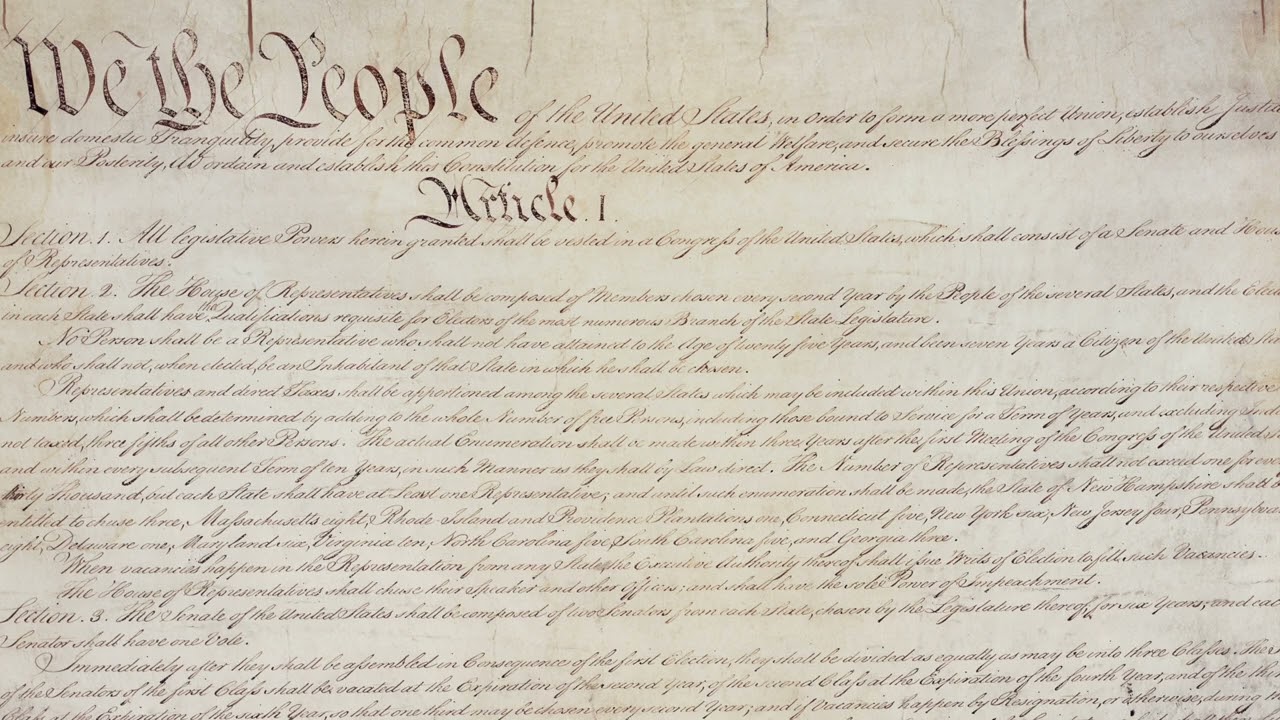
The United States Constitution begins with a preamble that outlines its core purposes: forming a more perfect union, establishing justice, ensuring domestic tranquility, providing for the common defense, promoting general welfare, and securing liberty for future generations. The document then establishes Article One to create a bicameral legislature consisting of the House of Representatives and the Senate. Members of the House are elected directly by the people every two years with specific age and residency requirements, while Senators serve six-year terms chosen initially by state legislatures. This section also details how representation is apportioned based on population counts that include three-fifths of enslaved persons, a provision reflecting the historical compromises of 1787, alongside rules for filling vacancies and granting Congress powers such as impeachment authority to the House and trial power to the Senate.
Article Two vests the executive power in a President who serves a four-year term and is elected through a system involving electors appointed by each state. The text specifies that no person can hold this office unless they are a natural-born citizen, at least 35 years old, and have resided within the United States for fourteen years. It further outlines the process where if no candidate receives an electoral majority, the House of Representatives chooses the President while the Senate selects the Vice President from the remaining candidates. The President acts as commander-in-chief, has the power to grant pardons except in cases of impeachment, and is responsible for ensuring laws are faithfully executed, all while receiving a fixed compensation that cannot be altered during their term.
The final sections establish the judicial branch with life-tenured judges on the Supreme Court who can hear cases arising under the Constitution or involving ambassadors and disputes between states, alongside Article Four which guarantees republican government to every state and ensures full faith and credit among them. The document concludes by affirming that this Constitution along with federal laws and treaties constitutes the supreme law of the land, overriding any conflicting state provisions, while explicitly prohibiting religious tests for public office. It ends with a historical note on ratification requiring approval from nine states, followed by signatures including George Washington and prominent figures like Benjamin Franklin, marking the formal establishment of this foundational legal framework in 1787.
Read the full video transcript
This is a LibriVox recording. All
LibriVox recordings are in the public
domain. For more information or to
volunteer, visit librivox.org.
The Constitution of the United States of
America. 1787.
We the people of the United States in
order to form a more perfect union,
establish justice, ensure domestic
tranquility, provide for the common
defense, promote the general welfare,
and secure the blessings of liberty to
ourselves and our posterity. Do ordain
and establish this Constitution for the
United States of America. Article one,
section one.
All legislative powers herein granted
shall be vested in a Congress of the
United States which shall consist of a
Senate and House of Representatives.
Section two. The House of
Representatives shall be composed of
members chosen every second year by the
people of the several states and the
electors in each state shall have the
qualifications requisite for electors of
the most numerous branch of the state
legislature.
No person shall be a representative who
shall not have attained to the age of 25
years and been seven years a citizen of
the United States and who shall not when
elected be an inhabitant of that state
in which he shall be chosen.
Representatives and direct taxes shall
be aortioned among the several states
which may be included within this union
according to their respective numbers
which shall be determined by adding to
the whole number of free persons
including those bound to service for a
term of years and excluding Indians not
taxed three-fifths of all other persons.
The actual enumeration shall be made
within three years of the first reading
of the Congress of the United States and
within every subsequent term of 10 years
in such manner as they shall by law
direct. The number of representatives
shall not exceed one for every 30,000
but each state shall have at least one
representative and until such
enumeration can be made, the state of
New Hampshire shall be entitled to
choose three. Massachusetts 8, Rhode
Island and Providence plantations 1,
Connecticut 5, New York 6, New Jersey 4,
Pennsylvania 8, Delaware 1, Maryland 6,
Virginia 10, North Carolina 5, South
Carolina 5, and Georgia 3. When
vacancies happen in the representation
for any state, the executive authority
thereof shall issue rits of election to
fill such vacancies. The House of
Representatives shall choose their
speaker and other officers and shall
have sole power of impeachment.
Section three. The Senate of the United
States shall be composed of two senators
from each state chosen by the
legislature thereof for six years, and
each senator shall have one vote.
Immediately after they shall be
assembled in consequence of the first
election, they shall be divided as
equally as may be into three classes.
The seats of the senators of the first
class shall be vacated at the expiration
of the second year, of the second class
at the expiration of the fourth year,
and of the third class at the expiration
of the sixth year. so that one-third may
be chosen every second year. And if
vacancies happen by resignation or
otherwise during the recess of the
legislature of any state, the executive
thereof may make temporary appointments
until the next meeting of the
legislature, which shall then fill such
vacancies. No person shall be a senator
who shall not have attained to the age
of 30 years, and had been 9
[clears throat] years a citizen of the
United States, and who shall not, when
elected, be an inhabitant of that state
for which he shall be chosen. The vice
president of the United States shall be
president of the senate but shall have
no vote unless they be equally divided.
The senate shall choose their other
officers and also a president prom in
the absence of the vice president or
when he shall exercise the office of the
president of the United States.
The Senate shall have sole power to try
all impeachments. When sitting for that
purpose they shall be on oath or
affirmation. When the President of the
United States is tried, the Chief
Justice shall preside, and no person
shall be convicted without the
concurrence of twothirds of the members
present. Judgment in cases of
impeachment shall not extend further
than to removal from office and
disqualification to hold and enjoy any
office of honor, trust, or profit under
the United States. But the party
convicted shall nevertheless be liable
and subject to indictment, trial,
judgment, and punishment according to
law. Section four. The times, places,
and manner of holding elections for
senators and representatives shall be
prescribed in each state by the
legislature thereof, but the Congress
may at any time by law make or alter
such regulations, except as to the
places of choosing senators. The
Congress shall assemble at least once in
every year, and such meeting shall be on
the first Monday in December, unless
they shall by law appoint a different
day. Section five. Each house shall be
the judge of elections, returns, and
qualifications of its own members, and a
majority of each shall constitute a
quorum to do business, but a smaller
number may adjourn from day to day, and
may be authorized to compel the
attendance of absent members in such
manner and under such penalties as each
house may provide. Each house may
determine the rules of its proceedings,
punish its members for disorderly
behavior, and with the concurrence of
2/3, expel a member. Each house shall
keep a journal of its proceedings, and
from time to time publish the same,
accepting such parts as may in their
judgment require secrecy, and the yays
and nays of the members of either house
on any question shall, at the desire of
1/5if of those present, be entered on
the journal. Neither house during the
session of Congress shall without
consent of the other adjourn for more
than 3 days, nor to any other place than
that in which the two houses shall be
sitting. Section six, the senators and
representatives shall receive a
compensation for their services to be
ascertained by law and paid out of the
treasury of the United States. They
shall in all cases except treason,
felony, and breach of the peace, be
privileged from arrest during their
attendance at the session of their
respective houses, and in going to and
returning from the same, and for any
speech or debate in either house, they
shall not be questioned in any other
place. No senator or representative
shall during the time for which he was
elected be appointed to any civil office
under the authority of the United
States, which shall have been created,
or the imolments whereof shall have been
increased during such time, and no
person holding any office under the
United States shall be a member of
either house during his continuence in
office. Section seven. All bills for
raising revenue shall originate in the
House of Representatives, but the Senate
may propose or concur with amendments as
on other bills. Every bill which shall
have passed the House of Representatives
and the Senate shall, before it becomes
a law, be presented to the President of
the United States. If he approve, he
shall sign it. But if not, he shall
return it with his objections to that
house in which it shall have originated,
who shall enter the objections at large
on their journal, and proceed to
reconsider it. If, after such
reconsideration, twothirds of that house
shall agree to pass the bill, it shall
be sent together with the objections to
the other house, by which it shall
likewise be reconsidered, and if
approved by twothirds of that house, it
shall become a law. But in all such
cases, the votes of both houses shall be
determined by yays and nays, and the
names of persons voting for and against
the bill shall be entered on the journal
of each house, respectively. If any bill
shall not be returned by the president
within 10 days, Sundays accepted, after
it shall have been presented to him, the
same shall be a law in like manner, as
if he had signed it, unless the Congress
by their adjournment prevent its return,
in which case it shall not be a law.
Every order, resolution, or vote to
which the concurrence of the Senate and
House of Representatives may be
necessary, except on a question of
adjournment, shall be presented to the
President of the United States, and
before the same shall take effect, shall
be approved by him, or being disapproved
by him, shall be repassed by twothirds
of the Senate and the House of
Representatives, according to the rules
and limitations prescribed in the case
of a bill.
Section eight. The Congress shall have
the power to lay and collect taxes,
duties, impost, and excises to pay the
debts and provide for the common defense
and general welfare of the United
States. But all duties imposed in
excises shall be uniform throughout the
United States. To borrow money on the
credit of the United States, to regulate
commerce with foreign nations and among
the several states and with the Indian
tribes, to establish a uniform rule of
naturalization and uniform laws on the
subject of bankruptcies throughout the
United States, to coin money, regulate
the value thereof and a foreign coin,
and fix the standard of weights and
measures. to provide for the punishment
of counterfeiting the securities and
current coin of the United States. To
establish post offices and post roads,
to promote the progress of science and
useful arts, by securing for limited
times to authors and inventors the
exclusive right to their respective
writings and discoveries,
to constitute tribunals inferior to the
Supreme Court, to define and punish
piracies and felonies committed on the
high seas and offenses against the law
of nations. to declare war, grant
letters of mark and reprisal, make rules
concerning captures on land and water.
To raise and support armies, but no
appropriation of money to that use shall
be for longer term than 2 years. To
provide and maintain a navy. To make
rules for the government and regulation
of the land and naval forces, to provide
for calling forth the militia to execute
the laws of the union, suppress
insurrections, and repel invasions. to
provide for organizing, arming, and
disciplining the militia, and for
governing such part of them as may be
employed in the service of the United
States, reserving to the states,
respectively, the appointment of the
officers, and the authority of training
the militia, according to the discipline
prescribed by Congress, to exercise
exclusive legislation in all cases
whatsoever over such district not
exceeding 10 mi square, as may by
session of particular states, in the
acceptance of Congress, become the seat
of government of the United States, and
to exercise like authority over all
places purchased by the consent of the
legislature of the state in which the
same shall be for the erection of forts,
magazines, arsenals, stockyards, and
other needful buildings, and to make all
laws which shall be necessary and proper
for carrying into execution the
foregoing powers and all other powers
vested by this Constitution in the
government of the United States or in
any department or officer thereof.
Section N. The migration or importation
of such persons as any of the states now
existing shall think proper to admit
shall not be prohibited by the Congress
prior to the year 1,88.
What a tax or duty may be imposed on
such importation not exceeding $10 for
each person. The privilege of the writ
of habius corpus shall not be suspended
unless when in cases of rebellion or
invasion the public safety may require
it. No bill of attainer or exposfacto
law shall be passed. No capitation or
other direct tax shall be laid unless in
proportion to the census or enumeration
herein before directed to be taken. No
tax or duty shall be laid on articles
exported from any state. No preference
shall be given by any regulation of
commerce or revenue to the ports of one
state over those of another. Nor shall
vessels bound to or from one state be
obliged to enter, clear, or pay duties
in another. No money shall be drawn from
the treasury but in consequence of
appropriations made by law and a regular
statement and account of the receipts
and expenditures of all public money
shall be published from time to time. No
title of nobility shall be granted by
the United States and no person holding
any office of profit or trust under them
shall without consent of Congress except
of any present imalment office or title
of any kind whatever from any king,
prince or foreign state.
Section 10. No state shall enter into
any treaty, alliance, or confederation,
grant letters of mark and reprisal, coin
money, emit bills of credit, make
anything but gold and silver coin a
tendering payment of debts, pass any
bill of attainer, exposfacto law, or law
impairing the obligation of contracts,
or grant any title of nobility.
No state shall without the consent of
Congress lay any imposts or duties on
imports or exports except what may be
absolutely necessary for executing its
inspection laws. And the net produce of
all duties and imposts laid by any state
on imports or exports shall be for the
use of the Treasury of the United
States. And all such laws shall be
subject to the revision and control of
the Congress. No state shall, without
the consent of Congress, lay any duty of
tonnage, keep troops or ships of war in
time of peace, enter into any agreement
or compact with another state, or with a
foreign power, or engage in war unless
actually invaded or in such imminent
danger as will not admit of delay.
End of article one. Read by Christ
McQuillin, Tokyo, Japan, 11th of
November, 2005.
This is a LibriVox recording. All
LibriVox recordings are in the public
domain. For more information or to
volunteer, visit librivox.org.
The Constitution of the United States of
America. Article 2. Section one.
The executive power shall be vested in a
president of the United States of
America. He shall hold his office during
the term of four years and together with
the vice president chosen for the same
term be elected as follows. Each state
shall appoint in such manner as the
legislature thereof may direct a number
of electors equal to the whole number of
senators and representatives to which
the state may be entitled in the
Congress. But no senator or
representative or person holding an
office of trust or profit under the
United States shall be appointed an
elector. The electors shall meet in
their respective states and vote by
ballot for two persons of whom one at
least shall not lie an inhabitant of the
same state with themselves. And they
shall make a list of all the persons
voted for, and of the [clears throat]
number of votes for each, which list
they shall sign and certify, and
transmit sealed to the seat of
government of the United States,
directed to the President of the Senate.
The President of the Senate shall, in
the presence of the Senate and House of
Representatives, open all certificates,
and the votes shall then be counted. The
person having the greatest number, the
person having the greatest number of
votes shall be the president. If such
number be a majority of the whole number
of electors appointed, and if there be
more than one who have such majority and
have an equal number of votes, then the
House of Representatives shall
immediately choose by ballot one of them
for president. And if no person have a
majority, then from the five highest on
the list, the said house shall in like
manner choose the president. But in
choosing the president, the vote shall
be taken by states. The representation
from each state having one vote. A
quorum for this purpose shall consist of
a member or members from twothirds of
the states and a majority of all the
states shall be necessary to a choice.
In every case, after the choice of the
president, the person having the
greatest number of votes of the elector
shall be the vice president. But if
there should remain two or more who have
equal votes, the Senate shall choose
from them by ballot the vice president.
The Congress may determine the time of
choosing the electors and the day on
which they shall give their votes, which
day shall be the same throughout the
United States.
No person except a naturalb born citizen
or a citizen of the United States at the
time of the adoption of this
constitution shall be eligible to the
office of president. Neither shall any
person be eligible to that office who
shall not have attained the age of 35
years and been 14 years a resident
within the United States. In case of the
removal of the president from office or
of his death, resignation or inability
to discharge the powers and duties of
the said office, the same shall devolve
on the vice president, and the Congress
may by law provide for the case of
removal, death, resignation, or
inability, both of the president and
vice president, declaring what officer
shall then act as president, and such
officer shall accordingly until the
disability be removed, or a president
shall be elected.
The president shall at stated times
receive for his services as a
compensation which shall neither be
increased nor diminished during the
period for which he shall have been
elected. And he shall not receive within
that period any other imolment from the
United States or any of them. Before he
enter on the execution of office, he
shall take the following oath or
affirmation. I do solemnly swear or
affirm that I will faithfully execute
the office of President of the United
States and will to the best of my
ability preserve, protect and defend the
Constitution of the United States.
Section two, the president shall be
commanderin-chief of the Army and Navy
of the United States and of the militia
of the several states when called into
the actual service of the United States.
He may require the opinion in writing of
the principal officer in each of the
executive departments upon any subject
relating to the duties of their
respective offices. And he shall have
power to grant reprieves and pardons for
offenses against the United States
except in cases of impeachment.
He shall have power by and with the
advice and consent of the Senate to make
treaties provided twothirds of the
senators present concur. and he shall
nominate and by and with the advice and
consent of the Senate shall appoint
ambassadors, other public ministers and
consoles, judges of the Supreme Court,
and all other officers of the United
States, whose appointments are not
herein otherwise provided for, and which
shall be established by law. But
Congress may by law vest the appointment
of such inferior officers, as they think
proper, in the president alone, in the
courts of law, or in the heads of
departments.
The president shall have power to fill
up all vacancies that may happen during
the recess of the Senate by granting
commissions which shall expire at the
end of their next session. Section
three. He shall from time to time give
to Congress information of the state of
the union and recommend to their
consideration such measures as he shall
judge necessary and expedient. He may on
extraordinary occasions convene both
houses or either of them. And in case of
disagreement between them with respect
to the time of adjournment, he may
adjourn them to such time as he shall
think proper. He shall receive
ambassadors and other public ministers.
He shall take care that the laws be
faithfully executed and shall commission
all the officers of the United States.
Section four. The president, vice
president, and all civil officers of the
United States shall be removed from
office on impeachment for and conviction
of treason, bribery, or other high
crimes and misdemeanors.
End of article 2. Read by Christa
McQuillin, Tokyo, Japan, 11th of
November, 2005.
This is a LibriVox recording. All
LibriVox recordings are in the public
domain. For more information or to
volunteer, visit librivox.org.
The Constitution of the United States of
America, Article 3, Section One. The
judicial power of the United States
shall be vested in one Supreme Court,
and in such inferior courts as the
Congress may from time to time ordain
and establish. The judges, both of the
Supreme and Inferior Courts, shall hold
their offices during good behavior, and
shall at stated times receive for their
services of compensation, which shall
not be diminished during their
continuence in office.
Section two, the judicial power shall
extend to all cases in law and equity
arising under this constitution the laws
of the United States and treaties made
or which shall be made under their
authority.
to all cases affecting ambassadors,
other public ministers and consoles. To
all cases of admirality and maritime
jurisdiction, to all controversies in
which the United States shall be a
party. to all controversies between two
or more states, between a state and
citizens of another state, between
citizens of different states, between
citizens of the same state claiming
lands under grants of different states,
and between a state or the citizens
thereof and foreign states, citizens, or
subjects.
In all cases affecting ambassadors,
other public ministers and consoles, and
those in which a state shall be a party,
the Supreme Court shall have original
jurisdiction.
In all other cases before mentioned, the
Supreme Court shall have appallet
jurisdiction both as to law and fact
with such exceptions and under such
regulations as Congress shall make.
The trial of all crimes except in cases
of impeachment shall be by jury, and
such trials shall be held in the state
where the said crimes have been
committed. But when not committed within
any state, the trial shall be at such
place or places as the Congress may by
law have directed.
Section three. Treason against the
United States shall consist only in
levying war against them or in adhering
to their enemies, giving them aid and
comfort. No person shall be convicted of
treason unless on the testimony of two
witnesses to the same overt act or on
confession in open court. The Congress
shall have the power to declare the
punishment of treason, but no attainer
of treason shall work corruption of
blood or forfeite except during the life
of the person attained. End of article
3. Read by Christine McQuillin, Tokyo,
Japan, 11th of November, 2005.
This is a LibriVox recording. All
LibriVox recordings are in the public
domain. For more information or to
volunteer, visit librivox.org.
The Constitution of the United States of
America. Article 4, Section One. Full
faith and credit shall be given in each
state to the public acts, records, and
judicial proceedings of every other
state, and the Congress may by general
laws prescribe the manner in which such
acts, records, and proceedings shall be
proved, and the effect thereof.
Section two, the citizens of each state
shall be entitled to all privileges and
immunities of the citizens in the
several states. A person charged in any
state with treason, felony, or other
crime, who shall flee from justice and
be found in another state, shall on
demand of the executive authority of the
state from which he fled, be delivered
up to be removed to the state having
jurisdiction of the crime.
No person held to service or labor in
one state under the laws thereof
escaping into another shall, in
consequence of any law or regulation
therein, be discharged from such service
or labor, but shall be delivered upon
the claim of the party to whom such
service or labor may be due.
Section three. New states may be
admitted by the Congress to this union,
but no new state shall be formed or
erected within the jurisdiction of any
other state, nor any state be formed by
the junction of two or more states or
parts of states without the consent of
the legislators of the states concerned,
as well as of the Congress. The Congress
shall have power to dispose of and make
all needful rules and regulations
respecting the territory or other
property belonging to the United States,
and nothing in its Constitution shall be
so construed as to prejudice any claims
of the United States or of any
particular state.
Section four. The United States shall
guarantee to every state in this union a
republican form of government and shall
protect each of them against invasion
and on application of the legislature or
of the executive when the legislature
cannot be convened against domestic
violence.
End of article 4.
Read by Christ McQuillin. Tokyo, Japan,
11th of November 2005.
This is a LibriVox recording. All
LibriVox recordings are in the public
domain. For more information or to
volunteer, visit librivox.org.
The Constitution of the United States of
America, Article 5. The Congress,
whenever 2/3 of both houses shall deem
it necessary, shall propose amendments
to this Constitution, or on the
application of the legislators of two/3s
of the several states, shall call a
convention for proposing amendments,
which in either case shall be valid to
all intents and purposes. as a part of
this constitution when ratified by the
legislators of 3/4s of the several
states or by conventions in 3/4s thereof
as the one or the other mode of
ratification may be proposed by the
Congress provided that no amendment
which may be made prior to the year 1,88
shall in any manner affect the first and
fourth clauses in the ninth section of
the first article and that no state
without its consent shall be deprived of
its equal suffrage in the Senate.
End of article 5.
Read by Christa McQuillin, Tokyo, Japan,
11th of November, 2005.
This is a LibriVox recording. All
LibriVox recordings are in the public
domain. For more information or to
volunteer, visit librivox.org.
The Constitution of the United States of
America, Article 6.
All debts contracted and engagements
entered into before the adoption of this
Constitution shall be as valid against
the United States under this
Constitution as under the Confederation.
This Constitution and the laws of the
United States which shall be made in
pursuance thereof, and all treaties
made, or which shall be made under the
authority of the United States, shall be
the supreme law of the land, and the
judges in every state shall be bound
thereby anything in the Constitution or
laws of any state to the contrary not
withstanding. The senators and
representatives before mentioned, and
the members of the several state
legislatures, and all executive and
judicial officers, both of the United
States and of the several states, shall
be bound by oath or affirmation to
support this constitution, but no
religious test shall ever be required as
a qualification to any office or public
trust under the United States. End of
article 6.
Read by Christa McQuillin, Tokyo, Japan.
11th of November, 2005.
This is a LibriVox recording. All
LibriVox recordings are in the public
domain. For more information or to
volunteer, visit librivox.org.
The Constitution of the United States of
America. Article 7.
The ratifications of the conventions of
nine states shall be sufficient for the
establishment of the Constitution
between the states. ratifying the same
done in convention by the unanimous
consent of the states present the 17th
day of September in the year of our Lord
1787
and of the independence of the United
States of America the 12th in witness
thereof we have here unto subscribed our
names George Washington president and
deputy from Virginia New Hampshire John
Langden Nicholas Gilman Massachusetts
Nathaniel Goram Rufus King Connecticut,
William Samuel Johnson, Roger Sherman,
New York, Alexander Hamilton, New
Jersey, William Livingston, David
Brerley, William Patterson, Jonah
Dayton. Pennsylvania, Benjamin Franklin,
Thomas Mifflin, Robert Morris, George
Climber, Thomas Bitsimmons, Jared
Ingles, James Wilson, Governor Morris.
Delaware. George Reed Gunning Bedford
Jr. John Dickinson Richard Basset Jacob
Broom Maryland James Mckenry Dan of St.
Thomas Jennifer Daniel Carroll Virginia
John Blair James Madison Jr. North
Carolina, William Blount, Richard Dob
Spate, Hugh Williamson, South Carolina,
Jay Rutled, Charles Coatsworth, Pikney,
Charles Pikney, Pierce Butler, Georgia,
William F, Abraham Baldwin. Attested
William Jackson, Secretary.
Read by Christ McQuillin, Tokyo, Japan,
11th of November, 2005.