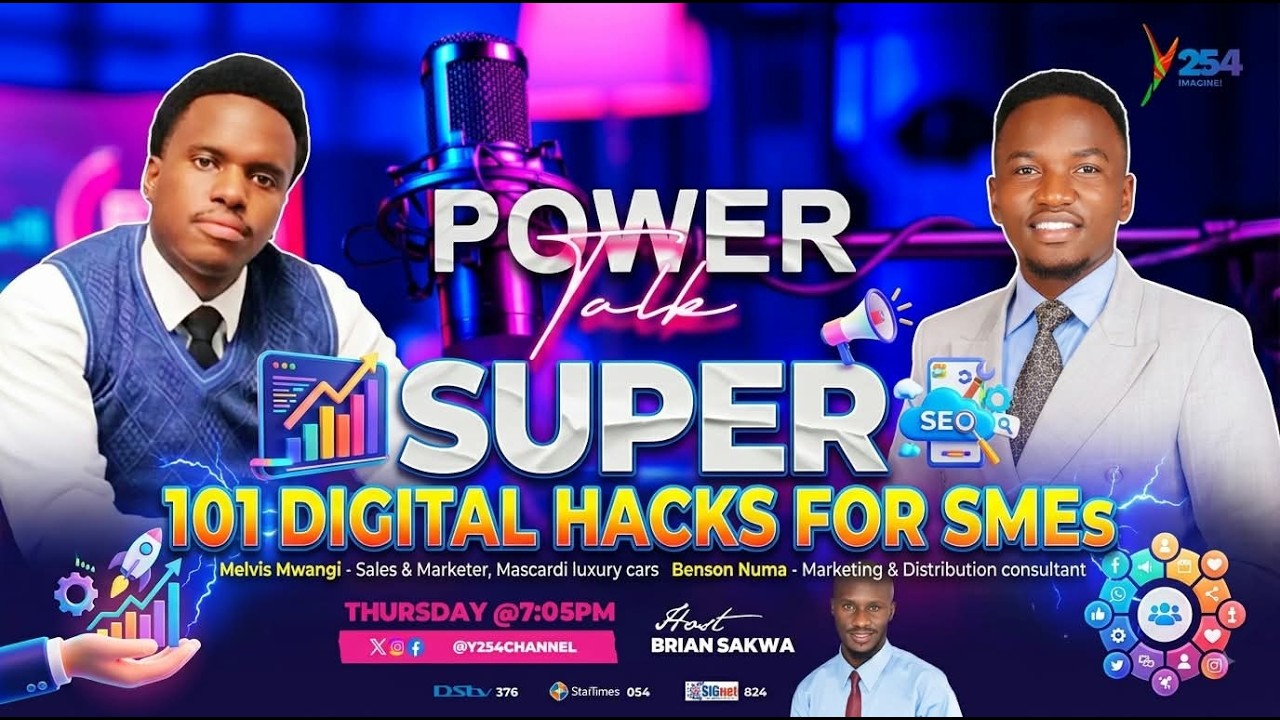
Video summary
The episode features hosts Brian S alongside guests Melvin Mangi and Benson Numa, who discuss critical digital strategies for Small and Medium Enterprises in Kenya aiming to survive their early stages. A primary lesson emphasized is the necessity of validating product ideas with strangers rather than friends or family, as emotional bias often skews feedback; true market value can only be tested through brutal honesty from unbiased individuals. Furthermore, transparency regarding a product's origins and condition is presented as a vital trust-building tool, particularly in industries prone to fraud like alcohol sales or electronics trading, where solving client problems immediately—even at personal cost—can significantly enhance reputation and revenue streams.
Beyond validation and integrity, the discussion highlights common pitfalls such as founders quitting their jobs too early before securing sufficient cash flow or momentum, especially when dealing with service-based businesses that require longer trust-building periods compared to physical goods. The speakers argue that success relies heavily on self-belief and confidence in building a personal brand so strong that customers buy from the individual rather than just the company, illustrated by an example of a car dealership owner who could sell vehicles personally after leaving his original firm. Entrepreneurs are also advised to pivot strategies quickly if results stagnate for two weeks instead of repeating ineffective tactics, while understanding conversion rates and avoiding desperation in marketing efforts to maintain authenticity without blindly imitating others.
To sustain operations during economic fluctuations like inflation, businesses must ensure they capture enough profit from their value proposition rather than relying solely on inventory volume, as reputation is often the owner's most valuable asset. Practical examples of supply chain management include sourcing carpentry services for resale without assuming production risk and securing broiler chicken supplies directly from local farmers to serve fast-food clients effectively. The conversation also touches upon essential business indicators such as understanding one's ecosystem by identifying reliable wholesalers, knowing specific customer acquisition channels, and analyzing reasons for lost sales to improve closing skills rather than guessing at the root causes of failure.
Finally, the speakers urge young entrepreneurs in Kenya to start immediately despite the potential for early failures, focusing on continuous self-improvement that includes gaining knowledge, maintaining physical fitness, and ensuring professional presentation. They advocate for government policy changes such as mandatory entrepreneurship education covering negotiation and financial literacy, along with a five-year tax grace period to allow startups time to learn bookkeeping without fear of non-compliance due to lack of expertise. The segment concludes by promoting an upcoming book launch titled "Concept to Cash," which focuses on money management skills at Hotel 360 on September 4th, reinforcing the theme that consistent marketing budgets and targeting the right audience are more vital than chasing vanity metrics like follower counts or high view volumes.
Read the full video transcript
All
>> [music]
[music]
>> right, a very good evening to you. Thank
you so much for joining us right here on
hasht power talk. My good name is Brian
S and I'm so excited to be right here.
In just a bit, we'll be posting our
question of the day. We want to engage
you. So feel free to share your thoughts
and your feedback on the hashtag which
is part of TV show at V24 channel and at
brand sak 101. Now in tonight's
conversation we are delving into how to
thrive into the ever evolving digital
landscape especially as an owner a
startup a business owner on real talk
about money investments and adding value
not only just to you profits that you
make but also to your clients directly.
What are some of the hacks 101 that you
need especially right now in Kenya? And
my guests who are joining me live in
studio today are going to help us to
unpack this conversation in such an
amazing way. So ensure that you plug in
move close to your TV. Right. I'll be
speaking to Melvin Mangi. He's a sales
and marketer at Mascadi Luxury Cars
alongside Benson Numa. He's a business
growth strategist, founder Grandes
Consulting Group and also author of a
book. He told me he's going to launch it
very soon called Concept to Cash.
Today's a boy child edition. Uh great to
have you guys karabunisana and good
evening.
>> Right. So maybe let me start off with
you uh since you're still an
entrepreneur.
>> Um if you look at the industry right now
especially the current business
ecosystem we have in our country maybe
how are you let's say making stride in
in terms of uh having a relationship
with your clients ensuring that you have
let's say a conducive business work
environment. First of all, is the
business working environment really
conducive or you're adjusting and you're
putting in measures that are helping you
to thrive? Just a short story of how
you're thriving.
>> Um, so you know, we learn and we grow
every day. Uh, and our relationships
with our clients is also what make us uh
improve as we go. So currently at
Mascadi Luxury Vehicles, for example,
the main thing that we're pushing is uh
transparency with our clients and in my
own endeavors, I just replicate what I
do here that works and vice versa.
>> Right.
>> Yeah. So meaning that are there any
tools that you're using so far so good
in this digital landscape?
>> Yeah. Uh which which specific one would
you be interested?
>> Uh in terms of like you reaching out to
clients, marketing, positioning yourself
uh as as a client.
>> Uh currently we use uh social media more
than anything else.
>> Uh mainly focusing on Instagram, Tik Tok
and Facebook.
>> And there's also uh funnels and AI tools
that help us with this.
>> Yeah. So I can say for example with
Instagram uh we do Instagram res and uh
yeah we just follow trends and things
that are happening around we study the
market and do that.
>> Uh let me jump on to you uh Ben
>> son. [laughter]
Right. When it comes to businesses
thriving I think we live in such a world
where I think social media matters and
the digital landscape. So when you look
at the pressure to be seen and to be
heard as a business, is it hurting or
it's amplifying in terms of reach out to
clients and customers and maybe what are
some of the biggest mistakes uh startups
are making cuz I was reading an article
that was saying most businesses actually
don't make it to the first uh year of
founding and others even die out in six
months into founding.
>> Yeah,
>> thank you so much Bri uh Brian. Now I'm
going to unpack that in two ways. First
I'm going to start with uh uh with a
story and I'm going to tell you a story
of our startup. When we started that is
five years ago we we had a really really
really rough kind of a runway for the
first for the first two years
>> we were not making any sales. Actually I
remember telling a friend of mine that
the first two years we did not make any
sales. Yeah.
>> So I want to start from there. What
you've just said that most businesses
don't make it to the first year.
>> And usually the reason that usually
never happens is because most founders
especially in this part of our of our
world.
>> Yeah.
>> It's not like when Facebook was starting
uh these guys could go for seven years
without revenue or cash flow.
>> Yeah.
>> In this side of the world when someone
goes into business they usually going
into business to ensure that they have
something to eat. They get money to pay
their rent. They can travel. They can
dress. So they going into
entrepreneurship for survival. Yeah.
>> And that is what makes it really hard to
drive the first one year because once
you go into something for survival and
then there is what is required for you
to build something you see there is a
time for you to build momentum to build
trust and for clients to start buying
from you. So for you to get that buy in
especially if you're offering a service
to your clients becomes really uh really
tough and then it's also a really long
journey. You see building trust for
services sometimes is quite longer not
like products. You come to me, you tell
me, hey, you know what, Benson, I like
your watch. I want to buy your watch.
Okay, you want my watch? Here's my
watch. You see, someone gets it and goes
with it. They just need to confirm that
it's working. So, as far as as far as
something is uh utilizable to them, they
it's easier to buy it when it's a
product. But you see, when it's a
service, there is that time that takes
to build that trust. So, that is the
first thing that I'm going to tell you,
and that is the biggest mistake that I
think most founders or entrepreneurs are
making when it [clears throat] comes to
going into business.
Uh I remember there was a time we were
having a master class. We usually have
round tables for founders and I was
telling them the biggest mistake that we
made at the early stage myself and
another co-founder I had her name was
Daisy. When we started the biggest
mistake we did that the first thing we
quit our jobs. I was a chef.
>> She was Oh chef by profession.
>> Yes. Yes. Yes. Before I joined Jquad to
pursue my bachelor's in real estate. I
was a chef
>> and then uh herself she was a data
analyst and she quit what she was doing
and we started to build Grandies. Back
then it was called Grandes Business Hub.
>> Okay.
>> And the first like six 8 months there we
really strained to a point we were
almost giving up on the business.
>> Why? Because we were surviving on this
thing.
>> Yeah.
>> So the first two months was okay because
you have some little savings.
>> H people still kind of like you. You see
there is also this concept by when you
start a business your friends are not
going to buy from you. Trust me.
>> Yeah. I've heard so many [laughter]
young entrepreneurs say start your
business and you'll see that your
friends are not your friends. Yeah.
>> Exactly.
>> Should they support you? Are they are
they supposed to be part of your
business?
>> Of course in the beginning but they
don't. Right.
>> I have never understood. Maybe you could
explain to us.
>> What I think is this I actually actually
discourage people from getting clients
from their friends and family.
>> Why not? They say your friends is your
is it your friends are part of your
network or your network is your network.
>> It depends. It depends on on which level
you are at because when you're starting
>> Yeah.
>> the most invaluable way and um for lack
of a better word, it's a kind of a
useless way to validate your value in a
market is to get a friend to buy from
you.
>> Because if I'm close to you, I'm going
to buy based on my emotions towards you.
So you never get to validate whether
your service or your product has any
value to the market.
>> And that is why also why most businesses
fail because you're starting something
or maybe you're starting something and
then your father comes to you and tells
you give me 10 of those pieces.
and very
>> you try to push your product to the
market and then you realize oh I did not
answer certain question on value I
answer certain question on trust I did
not answer certain question on quality
assurance
>> so you get to a market and then you
realize
>> you get to a place where by then you
realize that actually you use the wrong
way to validate
>> and I I usually I usually even tell tell
some of my friends um avoid selling your
products on WhatsApp at the very start
because those guys are not going to give
you real valuation.
>> But that's the nearest you could start
off if you don't have like an Instagram
or a Facebook.
>> How how much does it cost to get an
Instagram or a Facebook?
>> Yeah, maybe literacy on how to operate
too.
>> Right. It's it's just going on your
phone creating one.
>> Yeah.
>> Um if you have an account, create a
page. If you have already an account,
start posting. Start pushing it. pay a
thousand or 2,000.
>> That's actually the approach that I took
personally. So I was a co-founder last
year of a retail store that deals with
high-end Apple products
>> which is iPhones, Apple watches and so
on and so forth. And we started off on
Instagram and we're still driving
>> also using WhatsApp right?
>> Yeah. So actually funny enough we only
used WhatsApp for the communication
which was very rarely but we were still
making sales on Instagram
>> right. So a lot of clients are more vis
are more pre like they like using social
media interactive platforms like
Instagram, Tik Tok, etc.
>> Honestly speaking, it all depends on
your target and who you're trying to
>> to get to. Yeah. To buy from
>> because I'm looking at Apple products
and then WhatsApp. Yeah. Now I see. Now
I see. But still on you maybe during
your first early uh formative years of
trying to uh brand yourself as a because
you are a sales marketer. What were some
of the skills that you had to hack
before you started thriving because you
transitioned from that to what you're
currently doing right now?
>> Yeah. Yeah. So actually uh with my
story, my journey started off in liquor
distribution. So you know that one is a
bit straightforward. Someone comes and
they know what they want to have
>> and then from there now we went to the
Apple retail and now to automotive
industry. All of them are very unique in
your approach, but they all share one
thing in common
>> that uh the tactic you have to use in
all of them was just transparency with
your product. I'm sure you're familiar
now with what's going on in the country
with a lot of fake alcohol.
>> I'm sure you also know the situation
with the snatching of phones. These
phones, it's not like they leave the
Kenyan market. They're resold within our
own markets.
>> And same thing with vehicles as well. uh
if you don't have a complete record of
where they're being imported from,
>> yeah,
>> you don't, you know, you don't have that
uh transparency with the client. So, the
tactics I used were just being
transparent with clients
>> and uh what they see is automatically
what they get at the end of the the
purchasing.
>> Yeah.
>> Right. So, you've been into three
industries at the same time.
>> No, no, no, no. This was uh gradually.
So, this is over a span of four years.
>> Yeah. Cuz being a sales marketer, you
you're you're literally a customer
executive. Yeah. So, how did you
establish yourself in terms of being a
professional and doing outreach so that
you're striking a personality that's
welcoming? Um, I've spoken to hundreds,
if not thousands of young entrepreneurs.
What they say a lot is striking a
relationship with your client. It could
be one client and they stick with you
from when you are a startup to a big
franchise. So, what were some of the
skills that you had to shape into
becoming one? Um some of the skills I
I'd say I really used was um
in order to first of all to captivate
you I needed to fix your problems. So
what you had is uh when I started off
with the iPhones for example there was a
huge problem with uh upcoming uh digital
what's it called upcoming uh musicians
and so on and so forth. They didn't have
the right utilities to shoot music
videos or record the you know their
music and so on and so forth. So what I
did first
and
in return what I'd get is them marketing
my products. So what this did is that it
created a sort of notoriity for black
and then it brought in more clients to
us. So it was just tapping into their
culture and what's already happening and
>> and that's how I started off.
>> Right. Uh let me come on to you Ben. How
do you create let's say a brand in this
digital space without going the route of
um I think we have a lot of influencers
and celebrities who like cloud chasing
but I tend to I tend to see cloud
chasing as a very powerful tool too as
well especially if you want to bring
attention to your enterprise or your
business so how do you create a positive
visibility in this noisy field digital
landscape that's super ever evolving you
can now add AI in its new form sometimes
it's not even easy to differentiate
between a real ad and an AI ad. I don't
know if it's an advantage or it's a
disadvantage. How do you create a warm
visibility with this, you know, noise in
the digital space?
>> The CL chasing him.
>> Yeah.
>> All right. It's I think it's not simple,
but it's also simple. Number one, just
be authentic. Be authentic with your
voice, with what you can do and with
what you cannot do. Know your strengths
and your weaknesses. I remember the
early stages when I was starting I think
most of the visibility that myself I got
back then that is started around 2019
there most of the visibility that I got
was from Facebook
>> I was never good with Instagram actually
this is the the [snorts] year that I'm
starting to know oh I can use Instagram
to post to get clients I used to use
Facebook so
>> what were you posting at that time
>> um just articles you see back then I I
think we had not really embraced AI Mhm.
>> We we are still trying to embrace AI as
a country at the same time. But I used
to write maybe stories telling people
this is what I think I could do if I was
starting a business. These are some of
the tactics that you could use. You see
this is the time that we are starting
the startup with Daisy. So I used to
post a lot on Facebook and I used to get
a lot of DMs on Facebook.
>> And mind you, I had connected my
accounts both on Facebook and Instagram
but my Instagram was not performing. So
the first thing just be really
authentic. Be really authentic with what
you can do and what you cannot do. Yeah.
>> Instagram is really gramorous. Most of
the people who are trying to upcome
especially into entrepreneurship these
people don't have a lot of exposure and
some of the platform that they quickly
uh interact with is either Tik Tok or
Facebook. Back then there was no Tik
Tok. So they were interacting with a
with a lot of content on [snorts]
Facebook.
>> Yeah.
>> And so that is number one. Be authentic
to yourself, your voice. what you can do
and then
>> master somewhere to start so that it
gives you that visibility that
perception because I I I tend to believe
that followers are good as you've said
>> and cloud chasing is good because it
brings money I'm a sales executive I get
consulted on this uh I think like two or
three months uh back then I will not
mention names but we also pulled a
really good one for a for one of one of
a really known figure and it was really
good for the business you understand so
also cloud can work But I I I tend to
tell people who are starting out as
entrepreneurs, if you're starting your
business, if you're really authentic,
you stick to the platform that you want
to focus on.
>> Yeah.
>> Uh sometimes I think followers are
vanity metrics for you.
>> Yeah.
>> Because followers, you realize followers
don't pay bills. Followers don't pay
your your employees
>> and actually true clients are going to
pay you.
>> So how do you translate your followers
into clients though? Because you could
be having a 100K, but you know people
not purchasing your business. How do you
curate uh if it's an art?
>> Uh because I understand tools like
storytelling are also part of ways to
like capture an audience. You've seen
some of these kids with even celebrities
and influencers. They do something
crazy, spontaneous and then in the end
it's an ad of a product. Yeah. So maybe
how do you transform your followers on
Instagram, Facebook and the rest of the
platform into direct clients cuz that
would be fantastic for sure for a
business. So that is easy and I and this
brand this this is actually the thing we
in a society whereby you see we grew up
receiving a lot of free things. We came
some some some of the guys who are
really older than us
really free some of us got free
education from you see when when you
grow up in a culture by everything is
given to you for free it becomes really
hard for you to scale anything because
it's not possible for you to capture a
good value in a market for free. Let's
first get that one right. You cannot get
it for free.
>> So sometimes you can get followers and
have 100 followers. I have clients who
who whose business pages have tens of
thousands of followers and they're not
making any sales. So they come to you,
they tell you, you know, we have these
followers, we're not making any sales.
It goes down to budget for your
marketing because if you don't budget
for your marketing, there's nothing else
that you're doing. And most of us do not
have the culture of budgeting for
marketing.
>> Even if it's 5,000, at least have that
budget and let it be consistent.
>> Yeah.
>> Because I feel like 5,000 can be a game
changer. Can I tell you something? This
is going to be this is going to be a
real shocker for you. when we started
our marketing social media marketing do
you know we did an advert of 3,000 and
that 3,000 I think brought around uh
some revenue of about I think 70 80,000
you can imagine the magnitude of the
result the the multiplier that we
experienced just by thinking that let's
just have a small budget because when it
comes to and this is something people
don't know our that metads can give you
access to amazing clients because
they've been told if you want to get
clients go on Tik Tok go on Tik Tok
live. It's It's working of course and
it's been working but we we can all
attest. You're a marketer. You've been
on these platforms. We can all attest
that Tik Tok is not going anywhere with
marketing. Eventually it's going to slow
down. Yeah.
>> It's not going anywhere.
>> But that's where half of Kenyans are,
especially youngans when it comes to
>> that the story they sold us to get into
it.
>> Is it true or not? Cuz have you ever
checked out Kenyan Tik Tok at night at
midnight?
>> Tik Tok is more entertainment.
>> Yes.
>> Or it's more entertainment just sales
and marketing. touching even up on the
question that you asked as well.
>> Uh what a tactic we also use currently
in my position is we entertain our
clients
>> and then you'll also now have a catch at
the end of the each video. The reason
why you have to tap into entertainment
is because currently we're living in a
time where attention spans are very
minimal.
>> So if you're not captivating your
audience within the first five six
seconds it's gone. And uh you know as
he's saying like Tik Tok in the next 4
years I don't think it's going to be
used for any
>> this thing is not have you checked some
of the influencers that you follow have
you seen their videos how they
performing you go to a video with
someone who for someone who has like
400,000 followers then you realize it's
at 3,000 you're wondering how is it
>> recently I was telling my friend I don't
have a lot of followers but I was
telling my friend I don't know what is
happening how do you how do you tell me
that you have over a thousand followers
and then you get 90 views
>> how is that even possible your and
should be viewing.
>> Yeah.
>> The thing is also there's a big
misconception in marketing about uh
numbers. People think that oh you had
300,000 views we're doing well. It's not
about the number the amount of people
that are watching. It's about the right
people watching. Out of 200 people
watching maybe only one person can
afford a GLE for example.
>> Yeah. Is there a way you can uh drive
them from that 3,000?
>> Yes, there is. So there are things that
they will tend to be more interested in.
So, for example, um we do skits with my
colleagues, right?
>> The skits are going to get everyone
entertained.
>> But once you do a video, starting off
with the vehicle, the first three three
words are about this car, which is the
GLE, the person who's interested in that
cuz people always they know what they
want and they're there because of what
they want.
>> You'll tend to find it has less views,
but the person who's there for it will
stick around.
>> For me personally, I'm not the biggest
fan of uh Subarus, for example. If you
start a video saying this Subaru is I'm
going to scroll away immediately.
>> But if you start a skit with, you know,
a pretty girl or something and then it's
about a Subaru
captivating and you
>> too. So it's it's it's not about uh it's
it's not about how many people are
watching, it's about the right people
watching,
>> right? And we're asking our viewer right
now, what do you think makes a business
fail after 6 months in operation? And
we've just highlighted in in the first
15 minutes of our conversation, most
actually don't make it even to the first
year of founding. Some even die into six
months into operations. What do you
think makes businesses fail after 6
months in operation? The hashtag is
pound TV show. Send in your comments,
send your feedback. We will sample it
towards the tail end of our conversation
right here on the hashtag which is once
again power TV show at Y244 channel.
They'll say the handles to the tail end.
But let me ask you, Benson, as as a
young Gen Z who's watching this
conversation and they're interested to
venture out there and compete and maybe
they have a vision of growing into a big
tech, uh what would you advise them?
What would be the first uh startup
strategies especially if maybe they're
thinking to venture into like a
distribution business? Uh he was into uh
he's he's into cars in the automo
industry. uh should they are their
tactics and how should they position
themselves to a point that if I'm
starting six months then I want to
receive assurance of my niche and my
market so that I can make it out to the
rest of of the remaining you know 6
months because I don't know if the
conducive uh conditions for operations
in our country are viable or you have to
make the conditions viable for yourself
meaning that you have to arm yourself as
a startup so maybe what are the channels
and the steps they should take for
startup So if you're starting out a
business, the first first thing first as
I told you, validate value. And this is
the biggest mistake that most of us do.
You you heard that Mel said that they
realized that there was a gap with music
videos. These influencers making videos
and stuff. You realized a gap that was
bringing value to the market. So the
first thing just validate validate what
is the value that you that you're giving
to the market and whether it's needed
because sometimes you can pro you can
produce a lot of value that is not
needed. All right. For example, right
now, if I came and I told you, you know
what? Um, I can maybe start giving you
water that smells like perfume. I don't
know does what. It is not going to harm
your health. It can it can sound like a
good concept at first because you're
thinking you're adding flavor to their
water. But is there really a need for
that water? Is there really a need for
people to buy that water from you? So,
sometimes you can produce some value
that doesn't have monetary gain for your
business. So, that is the first thing.
Validate the value that you give into
the market. to ensure that people are
willing to pay for it. And how do you
validate this? Go out there to the
market.
>> I think right now because we're in a
world of social media, don't go to your
friends. As I told you, these people are
going to buy from you because of
feelings. You go to your girlfriend, you
tell your girlfriend, you want to start
selling, I don't know, vehicles that
that that use kerosene. She's going to
be happy for you. You know, this girl
loves you. You go to your mother, tell
her, uh, this and this is what I want to
do for farmers. She's going to be happy
because you're her son and and she's
like, you're doing something with your
life. So, first things first, validate
the value. And the best way to validate
it, go there, get people who don't know
you, get people who don't have any
emotions with you. People are going to
be really brutal with you. People are
going to tell you, "We don't need, we
don't think we need this."
>> And then you're going to understand
that. All right? You can go do meta ads.
You can go uh to networking events. Go
and pitch your idea. Go there and talk
to people. Even you see the biggest
thing that most businesses have lost in
the modern market, especially in our
landscape, is that we've lost the touch.
You see, there is the cold response that
you need from your client, and that is
what we are losing eventually. You need
to talk to your clients. Call your
clients. Talk to them. Hey, how are you?
Is our product working for you? Hey, how
are you? We have this product that we
want to launch. Do you think it's going
to help you? This and this is what is
going to do. Right? You validate value.
>> Then number three, come up with a way to
capture the value that you're creating
for your for your clients.
>> I'll give you a good example. There is
there is this meme
sold I don't know 50 shillings on the
shop. You go to I don't know a
restaurant 300. You go to an airport.
This you see this that is just a a
mental tattoo that we are trying to give
you to tell you that it depends how you
capture value. It's not even about the
product. It's how you capture that
value.
>> Like as you're creating this value, how
much are you capturing for yourself
because again remember you're in
business and for you to be sustainable
you need to make profits and not just
profits but big profits. You know why?
Because not every month is good for
business. Ask any entrepreneur they will
tell you this month we did really good
and there there are things like
inflation there are things like uh
government releasing money to the
economy that really affect how cash flow
comes into your business you understand
that so
>> first of all understand that there is
value validate it with people then
capture that value and and you know
Brian most of us are creating value for
clients and we are not capturing that
value for oursel so you're helping
>> just to explain a little more what is
value for you and then what is value for
the client cuz I'm seeing profit
Somebody say I made profit
>> or maybe my business grew and I scaled.
Yeah. So what is value for for the
client and then value for you as the
business owner?
>> You want to go in? Sure. Go ahead.
>> I think I'd say if you if you have a
startup value for yourself as the owner
of that company, the most important
thing to you is your reputation.
>> Okay.
>> For your client, it's, you know, as I
said, when they come to you, they
already have what they want in mind.
Make sure it's the best condition. And
why do I say this? Mhm.
>> With a bad reputation, there's almost no
market that you can penetrate. It's
better for him to own a dealership that
has two vehicles than me owning one with
30 vehicles and have a bad reputation.
Everyone will go towards him. And how do
you do this? Just as he said, you listen
to your clients, right? If they come to
you with a problem, solve that problem.
It's better for you to solve this
problem before going on to the next
client because the word on the streets
is very important. But that would be my
two cents on it.
>> Big time. Actually to add on what he's
saying you see when you're building
value for you
>> if you if you want to build a business
>> of course you have 5 years 10 years 20
years projections of where your business
is going. Yeah.
>> So we start with what he's saying the
brand itself
>> what are you getting you know you'll be
shocked at how much you know people are
bringing a lot of value to the market
but you'll be shocked at how much you
don't even know the person who did
something to bring a solution
>> like who who sat down and imagined let's
let's have cameras to do this let's have
a microphone that is way better that is
way tinier you don't need to hold it you
don't need to do this you see that is
for your brand and you can tell it from
the people who invented uh the likes of
Thomas Edison So on the the likes of
Albertson. But let me now come to that
that is the part for you to build a
brand a name for you as a business. But
now realize this if you build a brand
for you and you not now translate it to
the most important thing for your
business.
>> The most important trust you me revenue
is way more important for your business
as far as you're providing the right
thing to your clients.
>> Okay?
>> Understand that. So we we have
everything kept at constant that you're
not lying to your clients. You're
applying everything that is right. If
you tell them you're going to get a
product by tomorrow, deliver by
tomorrow. You're going to get this by
this. This is what he's going to do.
Just deliver that. So, let's keep that
aside. The most important thing is your
revenue
>> because as I've told you, it's revenue
that you're going to use to do product
development. It's revenue that you're
going to use to do expansion. If you're
having trouble answering calls to your
clients who call you and they're feeling
inconvenience is the same revenue that
you're going to hire a customer
relationship personnel. Yeah. It's from
the same revenue that you're going to
hire a social media manager so that now
clients can interact with your brand
more on social media. Understand?
>> So that is the third thing. So capture
enough value for you as you're creating
value for your clients but ensure that
the value that you're creating for your
client is way bigger than what you're
getting. Let me give you a question and
then I end it there. Okay?
>> Right now if I come to you Brian and I
and I tell you give me give me 1,000 and
I'm going to give you 10,000. All right?
Then I tell you give me 10,000 and I'm
going to give you 100,000. Then I tell
you, give me 100,000 and I give you 1
million. And I tell you, for all these
three options, you only need to take
one.
>> You only need to take one.
>> Yeah.
>> Which one would you take?
>> Uh please, which one will you take?
[laughter] You supposed a very good
question. Uh let me pivot to you, uh
Melvis. Maybe what were some of the
hurdles at first that you faced in your
early starting days or in your formative
days because you've said you've been in
the industry for four four years. Yeah.
What were the challenges because uh
you've we've been our sales marketer uh
a distribution store. You mentioned
Leica and then now into cars
specifically the profile of automo. What
were the hurdles in the inception?
>> So I think for a startup cuz that's what
we're talking about right now. We did
have the revenue with my co-founder but
we found that uh there were times that
even the revenue would be harder to come
your way if you don't have the
reputation as I was bringing it up. Uh
so I'd say that uh some of the I faced
three challenges when I was starting up.
Number one, the credibility. That was a
huge issue. Number two, I had the wrong
wholesaler at the time. Uh so I'd say
those three things are things that you
should really invest in. Get a proper
wholesaler who even though he's he's
selling you things, he's selling you the
right things. Don't cheap out. Sometimes
you'll go to two wholesalers, one is way
cheaper and it's the same product. Mhm.
>> So you think, but eventually down the
line you find that you're even spending
more money than you should have.
>> The second thing as well is uh I'm very
persistent on this cuz it's cost me
money.
>> Always uh make sure that if a client is
coming to you with an issue, fix it. And
why do I keep on emphasizing on this? My
biggest challenge is I had a client who
came and bought a phone from me.
>> Everything was smooth. Down the line it
became a whole problem.
>> Yeah.
>> Because all I needed to do was just swap
the phones. Once I did,
>> it opened up more doors because the
person my client was actually not happy.
He's the one who went and praised me and
said you he replaced this and he did
this and he did that. That opened more
doors for revenue. So me personally, I'd
say just invest in your reputation and
>> right.
>> All right. Absolutely. We want to take a
break but we are asking you what makes a
business to fail after 6 months of
operation especially in the early
formative days from startups tomemes to
even micro medium enterprises and a lot
more please let us know your thoughts
and your feedback on the hashtag which
is part of show not part of TV show
first I said TV show but it's part of
show on Facebook Instagram and XR254
channel personally minds a brand what
makes a business to fail after 6 months
of operation or founding. Let's take a
break. When we come back, we'll be
delving deeper into the conversation
with my guests right here who are live
with me in studio. See you on the other
side in a bit.
>> All right, welcome back. Thank you for
staying with us. You're still watching
Power Talk. I'm Brian Squand. I'm still
live with my guest in studio. Before we
went on a break, we asked you what makes
a business to fail after 6 months of
operation. Let us know why 244 channel
at Brown1. The hashtag is power talk
show. Now back to my guest. Uh we can
try to paint a panoramic picture. Maybe
Elvis, you can go first. What makes
businesses to fail in their early
founding or early operation or formative
years?
>> Yeah. Uh I'd say uh the main two things
in my opinion that make a business fail
is uh number one not reinvesting your
money into your own stock uh which is
getting carried away and uh the second
one as well is uh as I said with the
lack of a good reputation. So what you
do is u if you want to avoid this
there's making money is one thing but
reinvesting it and selling it and
learning how the markets are working is
another. You'll find situations where my
competitor is trying to price match me,
but we don't have the same wholesaler.
So, of course, I'm going to fail. I'm
trying to match your price of how you
bought how much you bought your watch or
how much you bought your phone, but I
don't know you're making a 15,000 profit
margin. And me price matching you is
only making me 2,000 shillings.
>> So, of course, I'm destined to fail.
Another one is I lack a clear plan. And
a lack of a plan leads to no consistency
whatsoever. If I'm just doing this and
this and this today, there needs to be a
clear flow. Your social media also needs
to have a flow to it. Maybe you post two
skits and then you post two photos of of
your items and so on and so forth. So if
I don't have a plan where I said, "Okay,
in my first two months whether or not I
make a sale,
>> yeah,
>> this is what I'm going to do with my
company."
>> Another thing is you can't keep on doing
the same strategies expecting different
results [music] at the end of it. If
this isn't working for 2 weeks,
>> then I should pivot and change my
direction,
>> right?
>> And uh by pivoting and changing my
direction, it could also be even social
media sites. Maybe for example, there
was a time where the phone business was
booming on Tik Tok. There were so many
ladies live every day selling phones.
Maybe it's not booming there because I
have so many competitors. Why don't I
pivot to Facebook?
>> You know, always be ready to change your
plan. Start from zero. Don't try to
price match others because you don't
know where they're getting it from. And
if you really have to price match them,
then you should consider changing your
sources.
>> Absolutely.
>> So that would be my
>> my advice to you.
>> Yeah. And if you've not understood for
thatly say wherea comment section but uh
originally as I come to you Benson we
are conditioned to go to school finish
your academics graduate get your
documents go get employment but now we
are seeing more conversations and
debates around entrepreneurship
uh start a business don't solely depend
on a 9 to5 also people are scaling even
in their career profile somebody could
be employed on a 9 to5 but still they're
running a business they're on the
journey to entrepreneurship
uh for founders maybe why does branding
really matter and then also you can
combine it with if you told somebody to
start a business they'd say I need money
first you know capital is what really
matters yeah so is is it possible to do
away with all those factors and start
small without this big capital cuz
somebody would say I need like half a
million for me to start a distribution
business y yeah and I'm sure you can do
that with 10k if you position yourself
really Yeah. So you can start off with
why the obsession with branding and then
our journey to capital.
>> Okay. So with branding I I feel like
what Melves is saying about reputation
sometimes we get really obsessed with
how people are going to perceive us as
and it's not only in business even in
life you get really obsessed with how
people are going to perceive you that
you forget exactly what truly matters to
you because sometimes even you remember
previously
I had mentioned that when when you want
to realize whether there is value for
your product you need to listen to your
clients but also Let me put a balance to
that that sometimes when you listen so
much from what the outside market is
giving you. You see that water that is
coming in again and again to your sheep
again and again and again. Sometimes it
makes you crash for this reason. Not
every time as you're starting out that
the client is going to understand the
vision, your founder, your co-founder is
going to understand the vision nor your
employees are going to understand the
vision. So the best thing number one is
to lay a balance. So as you're building
on this one whereby you want people to
you want to listen to people you want to
give them that first uh first priority
when it comes to developing your
business also you need to get to a place
whereby you you understand what is true
to yourself
>> and I'm a strong believer that anytime
you brand yourself in a certain way and
you position yourself out there number
one the world will adjust number two
you're going to pull the clients that
are yours something that Melvin again
said I'm going to go back to that
>> he said that if you're not a subaru kind
of a fanatic
right I'm not and I'm not also a fanatic
of so many other brands so if I go on
something and then they start mentioning
that brand I'm like this not
>> it's not for me for sure understand so
I'm going to scroll pass by all right
>> so that is the thing so push your brand
out there let the people who truly love
what you're doing get to you come to buy
from you and let the people who are you
are not because you cannot be for
everyone when you're building a business
be ready to not be for everyone all
right of course I'm going to I'm going
to push in something that we do in
sales, it's the law of odds. There is a
law of odds when it comes to sales. And
that is where you understand that for
every 20 people that I'm going to DM,
only one person is going to reply to me.
All right? For for all 100 people that
I'm going to talk to to buy my product,
only five people will buy my product.
So, you understand that law of odds. So
the moment you understand those odds,
you understand that by the time I'm
going to the market, so if I talk to
you, Brian, and I talk to my elves,
>> it's okay if you two don't buy because I
know I have another 98 to talk to so
that I can get my five buys,
>> right?
>> You understand? So you kill that
desperation because that desper that
desperation is what kills your brand.
>> And that applied to social media in
terms of visibility too.
>> Yes. Exactly. Because sometimes you you
find yourself you're trying to pivot too
much that you lose your authenticity.
>> You lose the identity that you are
trying to build on
>> just because you saw you see we have
already moved past what we used to do
back then. You want to start a business
because Benson started a business and
it's working.
>> Yeah.
>> You're selling Mumba because someone
else is selling Mutumba.
>> But we're being encouraged to be young
entrepreneurs right now. They're telling
us 9 to5 be self-employed
>> and because your colleagues are
self-employed too. Me too. Let me go
that route. Is it a bad thing? Uh, I
mean, it's always a bad thing if you're
not authentic to yourself and you're
imitating what's happening around. But
the reason why I personally would
convince people to try it out is because
we live in a time now where you don't
even need to have stock yourself. Maybe
if I was to give you an example of two
boys, right, who are both 18, they just
finished high school.
>> One is able who has the capital to start
a business and one has no money. They're
both in a position that they could
>> in their starting cuz we're speaking of
startups make a similar amount of money.
And I know you wonder how, right? Yeah.
>> Whatever your markup is, keep it
>> and sell me the phone. You see that? You
don't have any you don't have any stock.
You haven't spent any money.
>> It's almost as if you could argue and
say you're making 100% uh profit
>> unless you're paying for transport. Very
very profit. Actually to add on what Mel
is saying uh there was a time 2022 I
believe when we were starting we started
a furniture business back then we didn't
have a workshop we didn't have a
carpenter what we used to do we sort we
did sort for some really good carpenters
who could deliver good quality we post
photos then people would order this
products we go to the carpenter and then
we tell the carpenter how much are you
going to charge us for this one they
would say maybe 30,000 and then we go to
our client you know what this is going
to cost you 40,000 then the 10,000 is
ours we don't have any risk. Again, we
did the same same thing with uh with
chicken that is 2022 still whereby we
went to some fast food.
>> We talked to them you know what we can
be delivering chicken to you these
broiler chickens. So they were like it's
okay how many pieces can you deliver
because at this time you need to commit
to yourself to what is the capacity that
we can deliver and then we went to Kiamu
interior Kiamu we looked for these
farmers with another lady from there we
asked around can we find people who have
this number of chicken they can supply
this amount every week and then that is
how we did it and we would go get them
get the suppliers and then we sell them
we make our own markup
>> so it is very much possible it's very
much possible as long as you have a lot
of self-belief and you know the
confidence but to touch up on it again
is yeah so you could sell things on
markups including vehicles you could
also just go take photos of cars
>> right
>> once you find buyers you you're making a
good amount of money so the reason why I
would uh advise young people to go and
try [music] these things out is because
when you don't have that backup of
employment and you don't have something
to fall back on or a safety net it also
pushes you harder we're not going to be
any younger
>> right absolutely And uh we have all that
energy right now.
>> Let me ask you absolutely sorry to cut
you on your point before I forget. Maybe
at at one point in your entrepreneurial
journey did you feel that you're now
scaling? I don't know if you've scaled
already or maybe you felt like you're at
the height of operations. Now clients
are streaming in thick and fast. What
was that hack that you injected into
your business and [music] it blossomed?
>> It blossomed. uh when I changed my
wholesaler when I started off I had
someone who he was almost selling it his
products at a retail price but I didn't
know any better so I was buying them and
selling them even more expensive
>> but when I changed my wholesalers uh I
was able to price my products at such a
cheap price that even clients would be
like what's the catch you know and
that's when I felt like I've really
hacked this because I also learned that
>> as much as you're retailer as well with
the right wholesaler you could also
position yourself as a wholesaler to
retail shops
And these are things that you learn as
you go. But uh
>> again to really cuz I know like a lot of
young people are watching. So I'd
definitely say
>> go and try go and start and you learn as
you go.
>> Most of these things we didn't figure
them out. A lot of money has been lost
on the way. But uh one thing that has
stayed constant during that journey is
you always grow.
>> Yeah. And you tell us as well what bad
days in your industry look like. Finish
up on your point. Sorry.
>> Okay. Bad days. Uh, it depends. If I was
to speak specifically on vehicles, I'd
say bad days is any day you lose a sale
to a different dealership. [music]
>> All right.
>> Meaning that instead of a client coming
>> and buying it from us, they went
somewhere else.
>> But that's competition. I'd say
>> it's competition, but fair enough. But
here's the thing. It's one thing to lose
a lead on social [music] media. That
happens every day. But you walked into
our dealership. we had the same vehicle
as the other guy you went and sold it to
and we're selling it at the same price
and you bought it there. That could only
mean one or two things.
>> It either means we didn't give you the
best service,
>> right?
>> Or we just bad at closing deals because
how can you go and buy the exact same
thing
>> Yeah.
>> from someone else for the exact same
price. So that's a bad day.
>> It means that we have to Another thing
also in business is you really have to
uh look deep within yourself. Mhm.
>> You have challenging days where you ask
yourself questions. Am I really as good
as I think?
>> And one thing that you learn, the best
businessmen have is every time they ask
themselves, am I really as good as I
think I am?
>> There's always room for improvement.
There's always I'm actually not. So you
keep learning and keep learning.
>> Yeah. So is it possible people buy you
and not the business?
>> Most times actually. Yeah. I mean
>> people go for I don't know which what
brand is the loudest right now in terms
of fashion. Like you can look at the
Gucci, the the Louis Vuitton, the Louis
Vuitton and the rest. Somebody goes for
the brand and not the product itself.
>> Yeah, let me not even lie to you. Uh
>> the best salesman and you can agree with
me are the salesmen that sells. They
sell themselves first.
>> That's number one. Number two, I can
tell you is why don't we even use the
company I work for for example.
>> We don't make any cars.
>> Yeah, true.
>> We resell vehicles.
>> We don't make Benzes. We don't make BMWs
or any other vehicle. But people are
buying the brand. In fact, I normally
tell this uh to myself every time when I
go to work, I tell myself that my goal
since I'm working here is in the next
one or two years, I don't want kids to
go and buy a car and say I bought a Benz
from Mascadi for example. I want them to
go there and say I want a Mascadi no
matter what it may be. And uh once
you're starting to make the middleman,
which is you and your brand, even
bigger,
>> then you're winning,
>> right? Uh let me we are almost closing
up uh the conversation maybe uh Benson
how can you tell that you're making
progress uh as a business how do you
feel that you're making this progress
even though it might not be visible to
you and you're not feeling it but people
outside could could possibly there could
be tell signs this person is now finding
routing and ground in their business
ecosystem and also maybe if you are to
inject in skills that you or strategies
that you can use to uh speed up process
as a theme owner, startup, business
owner, etc.
>> Okay. So, how how you can tell that
you're making really good progress for
your business? Nan is what he was
saying. First of all, get to know that
you've understood the ecosystem. Most of
us don't understand our ecosystem. You
have so many people that can get you the
same product. Very many wholesalers can
get you the same same product, a really
amazing amazing prices, but you're going
for the one that you're getting just
because you don't know any better. you
don't know whether that thing exists. So
the first thing starts do you understand
your ecosystem? Even if you're not
making any sales. If you can understand
your ecosystem from where am I going to
get what I need from? Number two, your
customers. You get to understand this is
where I get my customers from. You see
the moment that you realize I can get my
clients from Tik Tok is where I get my
clients. Even though at that time you're
not making any sales, you're able to
think now if from Tik Tok is where my
clients are, what do I need to do on Tik
Tok? Because you see business is a lot
of guessing as you were saying you get
to question yourself a lot you get to
think a lot second guessess yourself
really actually a lot of times so the
first time when there are no visible
signs that you're making progress is
when you get to understand where are
your customers coming from so that now
you can think what do I need to do
better when it comes to my clients
number three you get to understand why
am I losing business or why am I not
making sales
>> that is also a really amazing thing
because it gives you a glimpse of what
are some of the mistakes that you're
what do you need to improve on and what
do you need to amplify out there to your
clients so that they feel this these
people really listen to us these people
really understand us
>> because you see Brian um the major
indicator of progress in your life is
usually not the things that actually
happen when you realize that you're
making progress but actually
understanding this is what I need to do
to make the progress that I need to make
>> so sometimes it can be even even in your
own personal life sometimes progress can
be understanding the right kind of
friends to be around
>> it can be understanding the right food
to take can be understanding the right
time to sleep. You see those are some of
the things that tell you that you're
making progress because now you're not
guessing because most of the times
you're going to find yourself guessing.
So the moment that you find yourself
you're in this season whereby you're not
guessing anymore. You understand that if
I need to get more clients I'm going to
get them from here. If I need to do this
I'm going to get them from there.
>> Yeah.
>> Maybe to add on something when it comes
to marketing because you've said that we
are closing. You've asked a question
about is it possible for people to buy
from you rather than your product or
your brand. So true and that is why in
the recent times people are really
encouraging
CEOs uh doing the marketing see the face
of the CEO being on the marketing. Why
you remember there's this time I think
like a month ago last month it is when
this guy from Kasoko left Kasoko and
then everyone is shocked this guy you
want to mean this guy never own Kasoko
you want to mean Kasoko was not
belonging to this guy why was that
happening because people are buying from
the brand of this guy and as a result
they thought that this guy was the brand
actually so they were they thought we
are buying from this guy and you see
when you've built a good brand it's
going to show see this guy leaves Kasoko
goes to another place and Then like one
week in he sells like two Lexus right
two lexas at I think 17.5 or something
>> two Lexus
>> and people are trusting you
>> and you are on a new venture because
you've built on your brand so I feel
like building you as I was telling build
who you are push yourself out there let
the people who are for you know you let
them buy from you let them accept you
because that is going to give you
caution even tomorrow if something
happens to you and you need to do
something else we've seen people who are
TV personalities really great TV
personalities the go of being TV
personality and they decide to start
their own podcast and it really booms.
Why? Because people were tuning into the
brand not to the show that was happening
around.
>> Oh, so it was the person the personality
and not
>> exactly
>> and not the station.
>> Yeah. So that's why that's why these
people move out and then you realize the
following is following them. So all
these followers who are with them on TV,
they're now following them to their
private shows. You understand? It's
because of the brand. And I keep on
telling people even if you're employed
as you're working for another brand
never stop working on yourself.
>> Okay. Shortly before I come to you
Melvis as we close it up. What are you
big on in terms of cuz you're a business
growth strategist.
>> What in your forums and your
convergences? What do you always want
your clients or the young entrepreneurs
or the people you meet with what is
always the message that you insist? Also
picture the current uh ecosystem,
business ecosystem we have in our
country. I don't know if it's favorable.
I'm not anme owner but I think I should
head out to that direction soon. Uh what
is pinching for young starters
especially in our country? 30 seconds
please keep it short so that I get to
Mel.
>> Okay simple getting the the leads that
are going to translate to prospects who
are going to be your customers. So
marketing is the biggest problem and
that is what we're trying to solve for
our clients to understand where do I get
my leads from? How do I get get to my
leads because that is the biggest
problem when it comes to startups. All
right. And then number two, which is
also a really big one, is you truly
truly understanding how do I close my
sales when I get these leads. As you
were saying, if I lose a client is
because I'm not good at closing deals.
So become really good at marketing,
become really good at sales. And that is
what we've been doing with our brands.
Even them that are dealing with
products, we are dealing with
distribution, showing them how do you
get your product pushed to so much
audience out there, getting them to more
people out there so that they can sell
to those people. Right. So basically
that marketing once you market you get
the attention know how to convert that
attention to sales.
>> Yeah. Melvis what would you advise a Gen
Z who wants to get into the automo
industry or the car retail industry as
well or even important cuz it's a whole
chain you could in fact in fact you've
just said you can buy a car uh sell it
but you also bought it at another
showroom. I don't know if if that's a
thing in your industry too.
>> Yeah it is. It's actually big.
>> So what would be your advice to them in
terms of them pivoting from scratch to
establishing themselves here? I'd say
start working on yourself, whatever that
means for you. Whether it's getting more
knowledgeable with the game, whether
it's getting in good physical shape and
also your dressing, because you need to
be in a position where people can take
you seriously. If you want to be in
certain rooms, unfortunately or
fortunately, there's a way that you need
to carry yourself. Once that's ready,
then you can tap into any market. Go out
there,
>> whatever your niche may be, whether it's
vehicles, even motorbikes, and just
start doing it. Starting is the only
way, right?
>> That's it. Yeah, most of the times just
start. Most of the times you'll actually
find that you learn as you go along cuz
your method may not be mine and mine may
not be yours, but mine works
>> and yours doesn't. But
>> yeah,
>> just start.
>> All right, let me see some of the
reactions on to our question of the day.
What do you think makes a business fail
after 6 months in operation? The hashtag
is power talk show. Send in your
comments and questions. We'd like to
hear uh somebody Presley.
Okay,
Jason.
Uh, I'm trying to find a response that's
uh in regards to uh the question. What
do you think makes a business fail after
6 months? Let me check on my on my
personal too as well. Yeah, that's the
question. But also asking you what are
other success stories? You know the way
people say I started with Chapati uh
business uh uh distribution now I own uh
the milling industry. Tell us what other
business successful stories that you've
come across. We'll definitely like to
hear from you. All right. Uh sorry not a
lot but yeah please continue interacting
with us and let us know your thoughts
and your feedback as we close this
conversation. I can start off with you
Melvis and then you guys will see your
social media platform. If you are to
picture a future where entrepreneurship
is like the main main main main main
tool of trade or income for each and
every young person if you are to
recommend maybe as a policy if you are
to look at you know the authority and
I'm talking about the government what
would you suggest to them that they
should do to ensure that they make uh
the operation environment conducive
>> I'd say they should start off by first
educating us you know they should teach
us how to file our taxes they you teach
us uh how the importation process go
happens and what you need to do to make
sure that even things like insurance
getting your products insured. So long
story short I think that uh our
government should just uh try and
educate us more.
>> Yeah.
>> Right. Uh Benson what would you tell?
>> First make it mandatory in our
curriculum that you have to learn about
entrepreneurship. mandatory understand
how to do how to do business with people
and then understand how to negotiate
should be you see the same way we do a
common a common unit like HIV
>> negotiation should be a common skill
that a common unit that you go there and
then you learn how to negotiate but the
most important thing is uh we lower we
lower the I think I would say that give
startups grace period maybe for like
five years allow them not to pay any tax
>> that is what I would because it becomes
way easier. The big the biggest reason
why most startups are afraid of
complying is because they're afraid of
taxation because they don't they don't
even know how to navigate around it.
>> So tax reprieve for you've said for the
first year of funding
>> five years or five years. Yeah. Actually
somebody said a previous guest said that
when we were talking about taxes too
last week. Yeah. Interesting.
>> Yes.
>> Why is that important though?
>> Because within five years you're able to
learn about the important skills that
you need to develop when it comes to
financial management. Because most
entrepreneurs don't understand. You not
be shocked. I will not even be shocked
if you go to a supermarket and you buy
whatever you and you don't carry your
receipt. You find them dumped there. I
will not be shocked that you pay for
your petrol at a petrol station and you
ask you don't ask for a receipt. You see
those are the basic things. So within 5
years you able to know how to manage
finances how to record simply what we
call bookkeeping
>> right
>> then you start filing.
>> And she had a book called I think she
had a system called my accurate books.
So social media very fast which one
where you know your clients your fans
can plug you with you. Yeah,
>> mine is melvis.
Everywhere,
>> right? Mine is Benson Numa everywhere.
>> By the way, you said you had a book
coming up. I I mentioned it's called
>> Concept to Cash. Yeah. Right. Uh where
is the launch?
>> Um it will be at Hotel 360.
>> Okay.
>> This is the 4th of September,
>> right?
>> Yes.
>> It's about matters money. Yeah. Pesa.
Okay. So, S thank you so much Melvis and
Benson for being here. I believe this
was just a quart of that conversation.
There's a lot to cover, but yeah, plug
in with us right here on # Y254
channel talk. I almost said y morning
cuz I [laughter] cuz I host the other
side too as well. So, so ensure that you
plug [music] in with us. But continue
letting us know your thoughts and your
feedback in regards to our question of
the day and we'll definitely sample it
off the air. Personally, mine is at
Brian Sako 101. [music] We'll definitely
see you next time right here on Panto.
Thank you for watching.