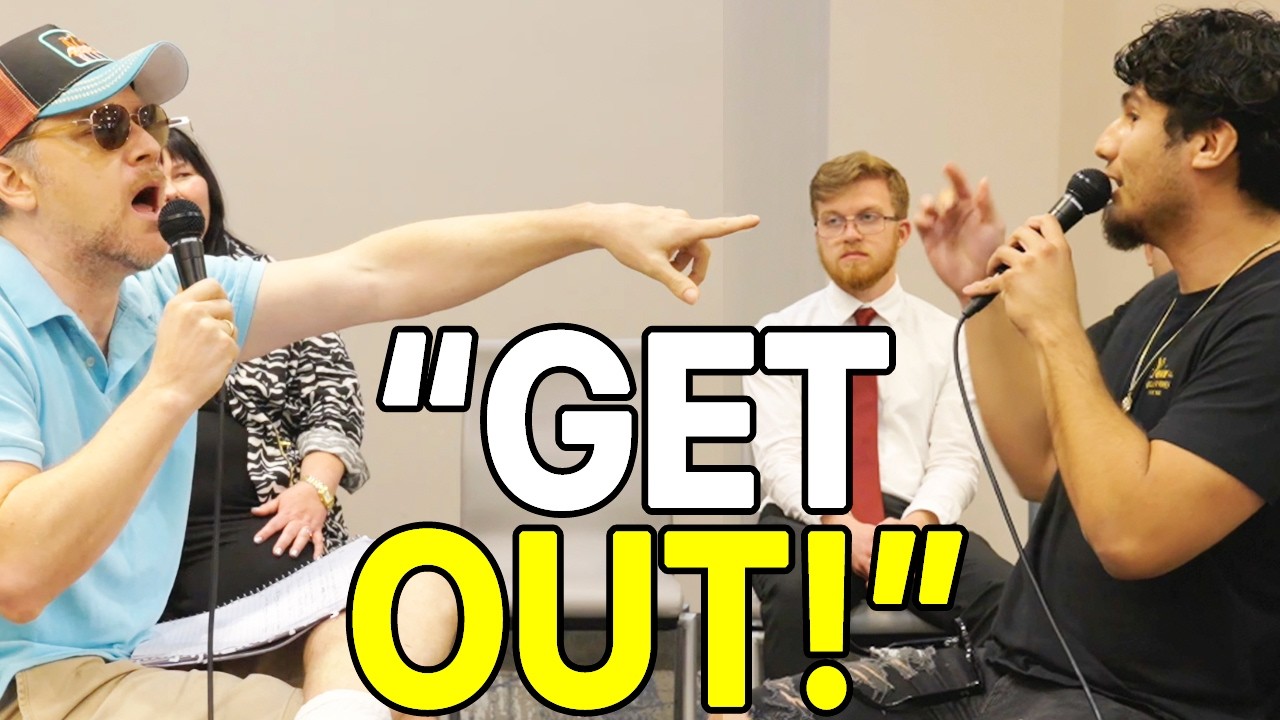
Video summary
The video presents a heated debate centered on whether the Eastern Orthodox Church remains most faithful to the early church compared to Protestant and Catholic traditions, specifically examining ecclesial governance, scriptural canon formation, and baptismal validity. The discussion highlights significant disagreements regarding authority structures; while Catholics argue for collegiality based on Acts 15 but also cite historical canons supporting Roman appellate power over deposed bishops, Orthodox interlocutors counter that such documents allowed only for retrials rather than autocratic judgment. This tension extends to the concept of communion, where Catholics assert that heresy excludes individuals from visible unity—labeling Protestants as Donatists in their view—while Orthodoxy rejects the notion of an "invisible church" often associated with Protestant theology. Furthermore, the debate scrutinizes the formation of the biblical canon, challenging why modern Protestants adhere to St. Jerome's 66-book list that excludes Deuterocanonical books when early Christians relied on oral tradition and the Septuagint for centuries before a fixed written standard was universally established in the fourth century.
A major portion of the conversation addresses liturgical continuity and the nature of worship, particularly concerning the Eucharist and apostolic succession. The Orthodox position asserts that true faithfulness requires adherence to specific liturgical patterns established orally by the apostles long before they were codified into written documents, arguing that modern Protestant services lack this historical depth because they reject early sacrificial understandings of the altar found in passages like Hebrews 13 and ignore regulations regarding communion elements. In contrast to what is described as a "do-it-yourself" approach or reliance on later formal lists not explicitly cited by early Church Fathers, Orthodoxy maintains that usage defined orthodoxy during the first three centuries rather than a closed canon existing from the start. The dialogue also touches upon ecclesiology and authority, debating whether communion with specific patriarchs is necessary for belonging to the One Holy Catholic Apostolic Church; while acknowledging historical periods of independence, the Orthodox stance emphasizes submission to legitimate hierarchical authority as essential for full unity, contrasting this sharply with Anglican "branch theory" or other Protestant views on apostolic succession.
The debate concludes by exploring deep theological divergences regarding justification and *theosis*, asserting that only Eastern Orthodoxy fully preserves these early church marks alongside the doctrines of one, holy, catholic, and apostolic nature. Speakers reference patristic authorities like St. Athanasius and Irenaeus to argue against Reformed views on salvation by faith alone, citing scriptures such as James 2 and Romans 4 to demonstrate that Abraham was justified through both works and faith, thereby rejecting the idea of glorification occurring solely after death or requiring perfectionism in this life. The discussion distinguishes between the Orthodox concept of *theosis*, where humans become partakers of divine nature without losing their humanity, and alternative interpretations like Mormon "Adam-God" doctrine (*apotheosis*), ultimately framing the conflict as a choice between maintaining apostolic continuity through oral tradition and hierarchical communion versus adopting later doctrinal shifts that break from early liturgical reality.
Read the full video transcript
Are you stupid? Are you dumb? Because I
said you cited it
>> to the degree of invisible communion.
I'm going to prove it to you right now.
>> Are you reading on your metagasses?
>> I'm going to prove
>> Why are you reading on your metal
glasses? This person's too stupid.
>> I'm not dumb. I'm not stupid. You are
stupid.
>> No. No. Call me titties. Call your
titties. It's all good. It's all good.
>> Ice is coming, dude. Ice is coming.
>> The unintended consequence that you're
>> you're shaking right now. So, I trust
video of you. Why should I limit myself
to the church? Dude, where's your
Yamaka?
>> Were according to Pope St. Louis the
Great.
>> Yo, I could see why he retired and came
back.
>> Dude, all I got is a bunch of low
levels.
>> He's got his meta glasses up on a piece
of glass.
>> He's got his meta glasses.
>> On a piece of glass in the middle of
>> Get out of here, dude. I'm not even
talking to you.
My name is Jay Dyer and today we'll be
debating uh the idea is the Orthodox
Church the most faithful to the early
church. The early church has as its
normal practice cinnodality or
collegiality and only the Orthodox
Church maintains this principle of
church [music] governance.
>> All right. So Jay, what do you mean that
only the Orthodox church has this
caliggo cenotal matter when we have the
same thing as Catholics?
>> You don't have that. You have elements
of what we have. But if you look at the
structure of Acts 15, the way that the
Jerusalem council happens, you'll notice
that Peter does not rule that council.
>> He's there with the other bishops. They
have a debate. And then as you progress
into the second and third century, you
see cenidality. That means the normal
governance of the church is local sinods
collegiality. So you have Gangra, you
have Ankaira, you have Nika and in canon
six of Nika, it says that Rome has a
similar jurisdictional structure to
Alexandria and Antioch.
>> Right. Yeah. Yeah. But here's the thing.
Ozius of Cordova at that same senate who
resided over Nika also resided over
Sardica which said that the bishop of
Rome has the authority to judge any
deposed bishop anywhere else in the
world and it does can canon for says
that canon for says that both
>> you understand that Rome itself now
admits that the Sardic cannons are only
about a retrial
>> you're talking about Ki right
>> yeah you know Kady the same document you
like to appeal to a lot says that since
the 3rd century Christians in the west
believed in the Vatican won't papacy.
>> No. No, it doesn't.
>> It does. It doesn't.
>> What's the la What's the last statement
of K80?
>> I I don't remember off the top of my
head.
>> Well, then you would know that that's
the most important controversial
statement. It says that the bishop of
Rome did not exercise jurisdiction in
the east.
>> No, you know who wrote that? It was the
Metropolitan that was with the cardinal
at the time. I don't remember his name.
>> I mean, it's approved.
>> It's not We We don't this document.
>> Well, so if it's not papery approved and
it doesn't matter, then why did you just
cite it as a proof for the papacy?
>> I didn't site it as a proof for the
papacy.
>> You just did. You brought up
>> No. Two seconds ago. You said
>> No, you said that.
>> You said it. You just said that.
>> No. No. You said that. Doc, you brought
up that document, but that same document
refutes you. All right. Let's go back to
>> Okay. So, if it refutes me, then it's
not a good proof, right?
>> It against your position.
>> No. I mean, it's not a good proof for
you. If it refutes me, but then you also
reject it for its very last paragraph.
>> No. No. It's a It's treated as
scholarship. It's not It's not binding
to believers.
>> I didn't say it was binding. I said it's
paperly approved. I mean the the joint
commission is it under it is it under
the paper the joint commission of the
orthodox and the Catholics that is joint
approved no pope signed k
>> that's not true the pope later Leo has
said that is a paply approved document
he said recently
>> I don't I'm not sure so you don't know
that let's go back to sardica okay so if
your position right is that the bishop
of Rome didn't have the authority to
judge um jurisdictions outside of
himself when it comes to a deposed
bishop why is it that in contra
>> you don't even know what says I didn't
even I didn't even see that.
>> Canon 4 canon 4 says
>> it says a retrial in that bishop.
>> Canon 5. That's canon 5.
>> Canon 4 says that when a bishop is
deposed they go to Rome and Rome makes
the judgment and no one is to be put in
that sea until Rome makes that judgment.
>> The judgment is for a retrial. He's not
an autocrat.
>> Why does say in the very last statement
that it's not a universal
>> jurisdiction? Let me ask you something.
No, let me ask you because
>> K8 is irrelevant right now.
>> You just cited it as an argument. You
brought it up.
>> You cited it as an argument against me
after I brought it up.
>> No, you you cited it. The same thing.
All I said was the same document you're
appealing to doesn't represent your
position.
>> It doesn't have to. I'm not a Roman
Catholic. It's an internal critique of
your position because
>> it's a dialogue between the Orthodox.
The Orthodox wrote it
>> and it admits that the that Rome had no
universal jurisdiction. It's the last
paragraph. Does it say that in the last
paragraph?
>> I'm I haven't I haven't read it in a
while. But Jay, are you saying that?
>> Is it saying it in the last paragraph?
>> I haven't read it. I just told you.
>> Okay. It's the most controversial
statement. It does say that.
>> Wait, Jay, real quick. You're
>> Don't keep saying my name, dude. Come
on.
>> Okay. You're telling me we can't talk
about what Julius said without talking
about the clown masses of today.
>> What? That's totally irrelevant to this
to this completely.
>> This is not the prompt. Clown masses
have nothing to do with your prompt.
>> I know, but it I'm I'm saying that that
comes way later. But when it came to
Julius who was at the council of
Sardica, do you think he believed your
ecclesiology that's only for a retrial?
Yes, he did. Okay, let me ask you this.
How come in Simon's church history and
Socrates's church history, they both say
and so does Athanasius that he
reinstated Paul of Constantinople,
Marcellus of Anyra, Athanasius of
Alexandria, all to their
>> Do you understand that Ke who did the
>> Why do you keep interrupting me? Why do
do you not know that Kied says that
other patriarchets did the same thing?
>> No. No.
>> You're saying it doesn't say that.
>> Sardica doesn't appeal to that.
>> Kied I'm talking about Sardica.
>> I'm talking about your church's
interpretation of the dumb thing that
you're
>> of Sardica.
>> Yes. Kied says that also the patriarchs
in other jurisdictions had the same
place as Rome. They got appealed to
>> the Orthodox wrote that.
>> Did Alexandria get appealed to?
>> Yes. Alexander received appeals, but it
wasn't it wasn't superseding the
regional jurisdiction.
>> You know that.
>> Nor is Rome because it allows for a
retrial. No, it doesn't.
>> Let me ask you. Do you think Do you
think you just keep changing from one
thing to another?
>> I'm trying to stick to I'm trying to
stick to the same topic.
>> You cited Ki to refute me for using Ki.
>> I didn't cite it. Watch this. The way
>> Are you stupid? Are you dumb? Because I
said you cited it because I cited it to
refute me. Right.
>> Yes. That that doesn't represent your
position.
>> Are you stupid? Are you going to let me
know?
>> It doesn't rep It doesn't represent my
position nor your
>> Does Leo site Ki?
>> Does Leo? I'm not sure about Leo.
>> You don't know because he does. He cited
it recently. We did a whole stream
without on it.
>> Hang on.
>> Leo said that the dialogue at K80 does
represent the Roman church's attitude.
>> You think Orthodox is a sister? Is it a
sister church?
>> Yes.
>> How could it be a sister church in
schism according to Vatican 1?
>> According to Vat What do you mean?
Because Vatican 2 stop
>> Vatican 2.
>> Vatican one. What does Vatican 2 have to
do with it?
>> Cuz it's the same church. Referring to
the same church.
>> Vatican 1 says Eastern Orthodox are out
of the church cuz they're damn
schismatics. The
>> So how are we a sister church?
>> Because we lifted the excommunication
off of you.
>> No, you didn't.
>> Yes, we did.
>> How can you lift the excommunication if
we still believe heresies? Hang on. In
Vatican 2.
>> So I can believe heresies and be a Roman
Catholic.
>> No. Wait, you're not a Roman Catholic?
>> Are you stupid?
>> What?
>> Are you stupid?
>> No, I'm not stupid. You said that I can
be a sister church believing heresies.
>> Mhm. To to a degree. You're still
invisible communion.
>> No, actually,
>> you know, we have reestablished
invisible communion, right?
>> That doesn't exist. There's no such
thing as reestablishing invisible
communion.
>> Why does why does Barthomia say
>> how can I be a schismatic? Are
schismatics outside of the church?
>> Yes. How
>> then? How can I be in the church if I'm
outside the church?
>> Visible church. You're outside the
church.
>> No, you're a Protestant.
>> What?
>> There's an invisible church. How's that?
That's a Protestant doctrine.
>> No, it's not. Why
>> the invisible church is the key
doctrineism?
>> Why did St. Robert Bellamy teach it?
>> Why did St. Why does Bartholomew That's
just an appeal to authority? He's not
even a He's not
>> my authority. Yes.
>> Yeah. When you're critiquing that you
have you have you have a saint that
believes in a Protestant doctor. Why did
Bartholomew Why does Bartholomew agree
with it?
>> Bartholome he can be a heretic.
>> You're a patriarch can be a heretic.
>> Yeah, duh. We're not papist.
>> I I get that. You think that I'm a
heretic, but I'm also in the church.
That makes sense.
>> I'm invisibly in the church.
>> There's no such thing as invisible
church, dude.
>> There you Okay, let me ask you this.
When it comes to what does your Roman
Catholic doctrine say at Katad domino?
>> Are we just going to keep spamming
questions?
>> What does katad domino say?
>> It says you have to be subject to the
Roman pontis
>> and schismatics are what? Outside the
church.
>> Yes.
>> So, how am I inside the church and
outside the church?
>> Because you believe in the same thing
via baptism.
>> One heresy puts you outside the church.
>> Correct. Yes.
>> So, you just refuted yourself. No,
you're in to the degree of invisible
communion. To the degree of invisible
communion.
>> You haven't proven the Protestant
doctrine of invisible church yet.
>> Bartholomew agrees with it. You agree
with Bartholomew. Agreeing with a wrong
position proves your church is
invisible. I'm going to prove it to you
right now.
>> Are you reading on your metagasses? I'm
going to prove
>> Why are you reading on your metag
glasses?
>> I'm going to prove it to you. Right.
When it comes to baptism,
>> do you not do you not accept our
baptisms?
>> It doesn't matter.
>> It does. I'm going to prove it to you.
I'm going to prove it to you. I do
>> in your own doctrine if you believe.
>> Are you going to keep avoiding
questions?
>> You're outside the church.
>> Okay. Do you accept our baptisms?
>> Mystici Corporus.
>> Mystique.
>> You know what that is? Yes.
>> Who wrote that?
>> Uh P the 11th
>> 12th.
>> 12th. 12th.
>> Okay. The Mstichi Corporus and uh the uh
Satis cognitum of Leo the 13th
>> teach that if you deny one dogma of the
Roman Catholic Church, you are outside
the church.
>> I agree with that. The Orthodox Church
denies
>> several of your dogmas.
>> But you realize that
>> so we are outside of your church
>> invisible form. Yes. But you realize you
accept the same principle. You accept
the same principle.
>> What's the Let me No, we don't. Yes, you
do.
>> It doesn't matter if I I have a
different system. Would it matter if I
accepted that if a different system? No,
it wouldn't. Yes, it would. Do you
accept
>> So, I have to have different system.
>> Jay, stop. Do you accept our baptisms?
>> No,
>> you don't. No.
>> So, you're a Donatist?
>> No, that's not the Donatist. Yes, it is.
>> You don't even know the Donatis. Okay.
Why is it Bartholomew?
>> What's the difference between the
donuts?
>> Watch this. Why does Bartholomew John
the 10th and
>> they're not I don't care if they make a
mistake. You don't even know the
difference between position and our
position.
>> Yeah. Because Donatists are essentially
that you have to be a sinless
perfectionist in order to administer
sacraments,
>> right? And how does that differ from the
Athanasius position for example in the
festival letters where he says that
outside of the Orthodox church the
Catholic church
>> the Catholic church
>> how do they not have the Eucharist
>> he's referring to Aryans obviously they
don't have the Eucharist Jay
>> they would have the Eucharist as an
Aryan if they had apostolic succession
in your position
>> what
>> a valid conseidly ordained in your
position through exoperado they still
have the Eucharist
>> no a valid ordination can't be under
heresies Yes, it can. You don't. That's
exoperado.
>> No. No.
>> Yes, it is. You don't even know your
position. Exoparado says if the was What
are the three things What are the three
things necessary for a valid sacrament
in your view?
>> Uh, we're not going to go keep
>> You just made a claim. So, you need to
know your three your three bases. What
are the three things?
>> No, I'm not doing this question
>> because you made a claim that you came
back up.
>> I'm trying to get back to the question.
>> No, you made a claim and now you're
stuck.
>> No, I'm not stuck, J.
>> What? You just made a stupid mistake.
What does Xoper mean? I I don't know
that Latin term. That's irrelevant
doctrine.
>> Hang on. Why are we jumping from topic
to topic? Why are we jumping? No, you
brought
>> you brought up sacraments and baptism.
You
>> Yes. You accept our baptism. We don't.
So, you're a donist. No, we don't.
That's not even the three of you know
what it is.
>> Okay. Why is it? Let me ask you this.
Right. When Paul V 6 met with the
patriarch of Constantinople, that
patriarch
>> You saying that we have a paper
position?
>> No. No. I'm saying that your leaders
accept our baptism so long as
>> I don't care because they're not popes.
You don't understand that.
>> Does the can grace of baptism be
administered?
>> You don't know your own position. Why am
I going to listen about the grace of
baptism? You can't tell me what the
basic is.
>> Cuz you're a donatist.
>> Tell me the difference between our
position and donatism from our
perspective.
>> From your perspective, um it's any valid
sacrament has to be by an ordained
clergy of the Orthodox Church. Donatist
are sinless perfectionists that
>> So that's not Donatism.
>> Huh?
>> By that explanation, it's not Donis.
>> You're leaning towards you're leaning
towards
>> Oh, so now you've moved now you move the
goal post. You move the goalpost. You
just move the goal. You
>> move the goalpost. I brought up Pope
Julius. You brought up not relevant to
what we're talking about.
>> Okay. Can we go back to the topic of
does the
>> where do you get papacy out of this? By
the way, Sardica is not the first three
centuries.
>> It's in the third century. It's after
it's in the 300s. My argument.
>> Did you say third century?
>> I said first, second, and third century.
>> Okay, then that's my bad. But still, do
you seriously
>> because you're I didn't hear you say
third century.
>> I said first, second, and third century.
>> All right, then.
>> That's my fault. I'm sorry. You could
look it up on your medical glasses.
>> I wasn't recording, but can we get
>> Perfect. That was amazing.
[applause]
>> Awesome.
The early church is not Protestant. And
one way we know that is because they do
not have a set cannon of scripture. And
so they are using consistently
tradition. And it's only centuries later
that there is a canon of scripture.
>> What's up? So
>> what's up?
>> Could you go ahead and say
>> so J fake and J
>> something like that.
>> Yeah. you can go ahead and uh still man
your claim a bit more.
>> Yeah. So my position is that if you look
at the early church particularly the
first three centuries but we don't have
to stop there. We can go to fourth and
fifth and sixth as well. You will find
that they do not have a consistent clear
canon of scripture. In fact many of the
church fathers will list between east
and west varying text cannons of
scripture. Right. In the 4th century in
the west you have the council of Rome in
the 380s and that cannon of scripture
includes the dudero cannon. In the
eastern apostolic cannons in the 4th
century you have a canonical list that
includes the dudero cannon. Okay. So I'm
not saying that that settled the canon.
I'm saying that by the 4th century east
and west what is the normative practice
is to site and use the dudero cannon. So
even if there's not a set universally
accepted cannon there's still no
evidence for the protestant cannon
except for St. Jerome and there's no
reason why as a Protestant I have to
accept or should accept Jerome's cannon.
So we need the Eastern Orthodox Church
to determine the cannons is a big chunk
of your claim
>> is
>> it's inextricably bound up with the
providential move of history that the
east and the west both were involved in
the process of the formation of the
canon.
>> But just a yes or no is the Eastern
Orthodox uh church needed in order to
establish a cannon?
>> It did establish the cannon.
>> Yes. I mean
>> you're assuming that there's these
different church. Is there a different
church in the first eight centuries?
>> I mean, I think that whenever we discuss
the term early church, whenever you mean
Protestant, do you just mean like
generally one that a sort of belief that
doesn't confide with
>> Well, particularly here, it's about the
canon. So, that's why I mentioned St.
Jerome and the Protestant cannon.
I mean, whenever whenever we talk about
the eastern the Eastern Orthodox Church
establishing a a cannon, if you're going
to connect that to Eastern Orthodoxy
being like the fullest of the faith, I
think that what we're going to end up
running into here is a bit of a like
what what type of standard did um did
the church fathers or sorry, did the
Eastern Orthodox Church go to in order
to establish what was scripture and what
was not? Did they go by like historicity
or did they just know what was canon?
Well, if you look at the canonical
debates in the various councils, they
looked at what the church fathers prior
to them accepted, what the apostolic
seas handed down and passed down as
tradition. For example, that Matthew
wrote the gospel of Matthew. Uh you look
at the uh other councils that were prior
to those councils. For example, Trello
will look back to the previous
ecumenical councils when it says we
accept what Carthage said uh about the
Old Testament cannon. That's why it
includes the duro canon. I really hinge
this argument on the acceptance of the
Dudo cannon by the 4th century east and
west. So why would I think that I don't
accept the duro canon as a Protestant?
>> So just to just to elaborate a bit for
everything you just everything a good
chunk of the things you just listed have
to do with history. Would you say that
history is the basis as which
>> I listed one element of history not
everything?
>> I mean you said that to do with the
>> you don't think the canon was a
historical decision? I think that the
And do you think like like in the sense
of like do I believe like the cannon was
established at some point? Yeah, I'm
confused on what you're talking about.
>> Okay. When
>> um like a a direct time I probably
a same time off the top of my head.
>> So but I'm saying but I'm argue argue
that 4th century you have absolute
cannons in the east and you have council
of Rome in the west and those are
normative for east and west by fourth
century. I'm not saying that they are
authoritative even necessarily
infallible or whatever. I'm just saying
east and west
universally for the most part except for
Jerome excepted the duro canon
>> and you're connecting that to the idea
that that you
>> the argument is the orthodox church is
the most most faithful to the early
church. So why does your church whatever
that is protestant not have the
duteronical books because it's not
faithful to it.
I I mean, like I like I said earlier, I
feel like the the idea that we're just
going to keep running into it. It's it's
the fact that I feel like what you're I
I feel like what you're doing here just
really isn't faithful. If I'm being
honest,
>> what I feel like it's it's just not
really faithful here. What I'm being
honest with
>> Okay. Did I make an argument?
>> How is it not faithful?
>> I mean, I I I feel like what we're
talking about here, if you're connecting
the fact that um we're like we we don't
have certain scripture. I believe that's
we don't have certain scripture and
therefore what we have is is less of the
faith. I just don't see.
>> Okay. So then tell me why the Protestant
church is more faithful to the early
church then.
>> I mean you I mean you've given an you've
given a an argument. I'd like to for for
you to expand on that even more.
So again, I'm arguing that if I look at
the first, second, third, fourth century
in the in the 300s,
the east and west are using the dudero
cannon and I cited the specific
examples. And then by the sixth and 7th
century, the e the eastern church and
the western church agree on the dudero
cannon almost universally. Now for the
Roman Catholics, they have a different
measure because they're going to look at
the council of Rome because Pope Damos
has said it. So therefore that makes it
normative for them. From the Orthodox
perspective, we're more interested in
totality and collegiality. So for us,
East and West, speaking at an ecumenical
council is when the seventh council
accepts Trello, which Rome doesn't
accept. But regardless, East and West
agree by the seventh ecumenical council
and it includes the Dudo cannon. So I'm
saying if we take those first four
centuries or the four first seven
centuries, we don't see the Protestant
cannon except for St. Jerome. But if
we're going to go with Jerome in terms
of most faithful to the early church,
then why as a Protestant should I accept
what Jerome said?
>> I
Yeah, I'll end it right here.
I'll uh I'll I'll go. I'll let someone
else take over this.
>> All right.
Okay. First of all, you didn't give us a
prompt. You gave us a thesis that was
400 words long. Secondly, as it relates
to the main point of the whole
discussion is the Eastern Orthodox
closest to the early church. Well, how
early? Your point in this is you're
talking about they don't have uh the the
scripture, the cannon, the same cannon.
Well, the the first century church
didn't have a canon.
>> So, wouldn't that be
>> closer to the Protestant that doesn't
have your canon specifically? Not at
all. Because the Protestant position
specifically delineates the 66 books of
their canon. So, that actually works in
my favor. If the first three centuries
of the church don't have a canon, that
proves that they're not faithful to that
early church. So where's the Protestant?
>> How does that make any sense? The early
church didn't have a canon.
>> Yeah,
>> there was no canon.
>> So they weren't working on soul
scripture.
But again, you you're saying your claim
is that like the Protestants don't match
the early church, you know, the first
century because they don't have your
canon and the first century church
didn't have your canon and they didn't
have No, they didn't have your cannon
here was about the
>> the apostles didn't have your canon. If
your canon was established in the third,
the first century,
>> I didn't argue it was established in the
third century.
My point is is like how early church cuz
the earliest church of the earliest
church the first the first century at
least is like people meeting in homes in
secret.
So they're not operating right. So
they're not operating planning churches.
>> So they're not operating on solos
scriptura.
>> What are you talking about? What does
that mean? What does that matter?
>> Because that's the Protestant doctrine
of
>> they're not working on any scriptor
Torah. Nobody's working on a scriptor at
the time.
>> So now So now you're not a Protestant.
was no scriptor Torah in the first
century. There was letters between
churches. There was testimony between
people. There was, you know, the people,
the eyewitnesses going around telling
people there was Paul planting churches,
but there was no script Torah at that
point. There was no script Torah or
canon or gatherment until a certain
point. So church now matches the
Protestant church. Okay. the closest
sense the the point is the letters of
Paul to the churches the testimony of
the apostles and the eyewitnesses the
words written down Luke's history he
gathered the history of Jesus and his
life and what
>> so the Protestants didn't teach solar
scripture I mean so so the Protestant
doctrine so
>> what does that have to do with what
we're talking about
>> because you don't even know the
Protestant doctrine
>> I do know the Protestant doesn't apply
right here
>> so they're not teaching sol scripture
>> the main promp So they're not no the
main prompt is admitting the prompt is
the Eastern Orthodox Church more bas
and I said three centuries yes exactly
yours instead of prompt that's four ages
long is talking about the the canon
>> did anybody have the century the first
century church didn't have a canon
>> so they're not operating on solos
scriptura so they're not Protestant
>> that doesn't matter that's
argument here.
>> No, it is not.
>> It's my argument. You just said canon.
You
>> the Protestant canon,
>> right? Exactly.
>> So, they don't have it.
>> The 66 books is the
>> So, they're working on tradition.
>> No,
>> you just said they were
>> tradition in the very early church.
There was no tradition. It was the
Jewish tradition. Does Paul tradition
>> in second Thessalonians Paul talks about
tradition?
>> The tradition keep the traditions people
>> that I delivered to you. Paul says,
>> okay, so they are creating the
traditions that we now participate in.
>> Paul says we all participate in
>> Paul says keep the traditions that I
delivered unto you whether written or
oral.
>> Okay. So again, so what are you saying
those traditions were 10, 20, 30 years
after
>> the resurrection? What tradition?
>> Everything that Paul delivered to
Timothy, he says everything that you
heard me say in the presence of many
witnesses because he taught for three
years in
>> Ephesus. And how do we keep those
traditions
>> oral and written as Paul said?
>> Well, okay. So then if he had oral and
and written traditions that they were
writing down solo scriptura, right?
>> Again, you didn't mention a thing about
solos scriptor. I don't have to. It's
your doctrine. You should know that.
>> No. In your prompt,
>> I don't have to explicitly mention all
of your doesn't say anything about solos
scripture.
>> It's your doctrine. It's not the prompt.
It's not my prompt. I I don't have to
answer anything. That's not the specific
prompt. Why am I in the argument?
>> No. What's your prompt? Read it again. I
know it's like four sentences.
>> The early church was not Protestant
because they didn't have the canon of
scripture that Protestants have.
>> Okay. The canon of scripture. There was
no canon of scripture. So they don't
believe in church. That has that doesn't
follow. It has nothing to do.
>> You already admitted they didn't you
already admitted that they didn't
follow. It's a critique of your
position.
>> Nothing to do with it.
>> It's the argument. What is my position?
>> You believe in solos. What did I just
say? Are you a Protestant?
>> No. What did I just say? Are you a
Protestant here? What did I say?
>> Do you believe in solos scripture?
>> That has nothing to do with my argument.
I don't sit there and say it has nothing
to do with it when it's my argument in
your face right now.
>> My argument and your prompt says canon.
So, we're talking specifically about
>> canon is the 66 books.
>> So,
>> so why are you not defending it?
>> There was no canon in the first. So,
again, you can't relate. They weren't
Protestants.
>> Well, then the Eastern Orthodox has
their canon. The first century, no
canon. Arguing for that. So, again, you
don't even understand the argument.
>> No, I do understand the argument. I
understand it perfectly. Repeat it. Your
argument is what you just said. You said
the Protestants is not as close to the
the original church because they didn't
have a clear canon, right?
>> The first century church.
>> So, they're operating on tradition. So,
they're operating on tradition. So,
solos scriptural was not true in those
centuries. That's the point. But you
didn't say a thing about solos scriptor
in your
>> That is the argument. When I say you're
canon, you said canon. When I say you're
canon in solos,
>> you don't know your own position. Two
different words. No, they're not. Yeah,
they're two different words. It's
included in the position. Two different
things. It's included in the position.
This is so low.
>> It's not included. If it was included,
you would have written it down. You had
plenty of words to write it down. This
is not even I can't. This person's too
stupid.
>> No, I'm not dumb. I'm not stupid. You
are stupid. No. No.
>> You're haggling over words because you
can't make over words. That's who's the
first person we're here to do over
words. No, it's not. A debate is not
haggling over words.
>> You said canon. That's what I'm
referring to. The canon is the
>> your canon is the Protestant cannon.
>> Yes. So what the point is they're
talking about the century had no canon.
Then they don't have your canon. Can you
even make an argument? Then they don't
have your canon.
>> Doesn't they don't have your canon.
>> Then they don't have a exactly. So it's
tradition.
>> So again the m Did Paul talk about
tradition?
>> The main prompt. Is that Did Paul talk
about tradition?
>> What tradition?
>> I already defined it for you.
>> Yeah. What? What is it?
>> You tell me what Paul means by that.
>> No, you tell me.
>> I did already. I already did.
>> Tradition is I did. I said it's what
they were.
>> You did it.
>> You're just a gaslighter.
>> No, I'm not gaslighting.
>> Go back to the food bar.
>> The food bar is still open head on. Read
the prompt that you set out. It was 400
words.
>> If there's no cannon,
>> I did not not one single word. Do you
know what a canon? scripture. We're not
the [clears throat] canon. A canon is a
group of included documents into a group
of them. So yes, your canon has more
books than the Protestant.
>> If there's no canon, what were they
operating on?
>> Canon includes all of the books.
>> If there's no canon, what were they
operating on?
>> But again, on the first century,
>> if there's no canon,
>> there was no canon,
>> what were they operating on? They were
operating on copies of the letters,
copies of the testimonies and also the
oral testimony, right?
>> Testimonies. So it's not solos
scripture. So it's not the Protestant
position.
>> No testimonies. So it's not operating on
testimony.
Testimonies tradition according to Paul.
It's tradition. What happened? What
literally happened. People going around
telling them what happened. No clue what
you're talking about. You don't have a
clue.
>> But a canon. You're using the word canon
wrong because the word canon means a
group.
>> It means a rule.
>> No. If you mean solos rule, if you mean
the the concept of scripture, then you
don't mean the word canon. So you should
put that you should have put haggling
over and the concept of it in your
prompt instead of the word canon because
the word can overather.
No, I know exactly what. Will I find the
correct prompt at the food bar? Will the
word solos scriptorra be there instead
of not under the donuts underut there
and that's what you want to talk about
because you want you don't want to
address what I'm saying
>> you don't have an argument
>> the point is is like early are you
talking if you admit I said three
centuries three centuries you can yeah
exactly so the first
>> that's how early
>> yeah didn't have a canon no
>> thank you so they weren't Protestant
thank you
>> no one had a canon
>> then they weren't protestant how are you
how how does then they weren't
protestant support the main prompt which
is the weren't protestant closest to
>> they were using our text meet the prompt
it doesn't the overall
>> because the dudero canon was the duton
what's the dudo cannon
>> it doesn't do what's the duton
>> for your argument who cares it doesn't
apply
>> thank you so doesn't have any clue you
don't even know what's being debated
>> I know I don't know all of the words and
all of the terms
>> this is the thing being debated you
don't even know that
>> know that what's being debated You don't
know what the dudero canon is. You have
no business debating is the main.
>> Tell me what the duton is. Is the
Eastern Orthodox Church is the first
early church because they're using it
early because the three centuries
because the first century the earliest
of churches. They didn't have a canon.
They didn't have traditions. They were
creating the traditions that you're
talking about. So who created
traditions?
>> They were creating an example. Give an
example. the apostles Paul and all the
churches that he started he started so
they'realing so they're oral planting
churches so they're oral no they would
they're not all oral cuz they discussed
anytime there was discussion about how
the church you don't even listen to the
arguments should operate the duton they
all got together and they decided
wrote it down the duton wrote it down
the not just oral yapp yap yap yap has
nothing to do
>> what's the dut cannon
>> has nothing to do with
>> what is the dudo I tell me, Jay, I don't
know.
>> No, you're here to debate that. What is
it?
>> I don't. No, I'm not. Because again,
>> you don't even know what's being
debated. You don't even know what's
being about the doral or whatever canon.
It just the cigarettes you're going to
go smoke there. Go get your Virginia
Slims and your Doron. Go get your says
canon. Go smoke your doral.
>> Again, when I look in a pack of
cigarettes, am I going to find solos
scriptural? Am I going to find dural
canon instead of what your prompt was
was just canon. So again, the first
century church, the earliest of church
had no canon whatsoever. Thank you. So
they weren't Protestant. It's not so
they weren't in any way prove you're so
they weren't Protestant. The the main
topic which is is the Eastern Orthodox
Church the closest. So they weren't
Protestant.
>> So again, what does that have to do with
anything?
>> How does it how does it follow?
>> The food bar is going to close.
Not the Eastern Orthodox. Not
>> okay.
Thank you.
>> All right. So
Paul writes in Romans 9
about the uh about the tradition of the
Israelites and about um how they
preserve the text. There are Israelites
and to them belong the adoption, the
glory, the covenants, the giving of the
law, the worship and the promises
and to them belong the patriarchs. So
Paul is giving um clear
clear instruction to us that the the
Jews were the ones who had copied the
scripture. They copied the text. Mhm.
>> So when we trace back what the Jews had
copied, we get to uh the 66 books of the
Bible.
>> Which Jews?
>> So
>> which Jews?
>> Well, uh we have the Maseretic text from
the Jews that had
>> you think they had a Maseretic text at
that time?
>> Well, yeah, the Maseretic text was
compiled.
>> No, there's a protomaseretic text in the
first, second, third century, and that's
a theory. So there is no maseretic text
that Paul cited.
>> So you understand there's there's
Palestinian Jews and diaspora Jews. Did
they use the same cannon?
>> Well, I would believe so.
>> No, they didn't. It's not even all the
Protestant scholars will admit that
diaspora Jews, especially those that
spoke Greek, they used the Septuagent.
>> Well, no, they didn't use
>> that's not questioned in in Protestant
scholarship.
>> Diaspora Jews who spoke Greek used the
Septuagent.
>> Okay. Okay. So, where are the dudero
canonical books in the Dead Sea Scrolls?
>> Yes.
>> Where? Which ones?
>> I don't know expl every specific one.
>> They're not in
>> I have a whole essay. Yes, they are.
You're lying. I I have a whole essay.
You don't even know that. I have a whole
essay I wrote about that. And I cite
nothing about Protestant scholars that
duo chonicle texts include
>> uh excuse me, the Septuagent includes
the Duro Canon and the Dead Sea Scroll
includes some elements of the Duro
Canon.
>> Okay. But
>> but the the Dead Sea Scrolls also have
the Essenes too. So that wouldn't prove
anything to do with canonicity. It's
just a historical addestation.
>> It it's just a a remnant. Sure. Like
that includes some of those books. But
when we have the the Masterites
compiling the text that they've had,
they they copied it very diligent.
>> Yeah. But you're begging the question,
how do I know that I'm supposed to go
with Palestinian Jews and not diaspora
Jews when the apostles for the most part
site which Old Testament?
>> Well, they site from the Septuagen. I'll
admit that.
>> Yep. But at the same time, the
Septuagent isn't even consistent with
with which I mean you can say that, but
why why are the apostle So now you're
saying the apostles cited a bad text?
>> No, I'm not saying that they cited a bad
text. The manuscripts we have
include different apocryphal books. That
doesn't mean that the those exact
manuscripts were the ones that
>> Why weren't they all citing your
Maseretic Proto Maseretic then? I'm not
saying that they cited the Maseretic
text because it's in Greek. So of course
they're going to cite from the Septu.
>> So then Romans 9 doesn't prove the
Maseretic text.
>> Okay. But
>> for the for the church.
>> Okay. But also in Romans 3, Paul says
that you know they were
>> How does Romans 9 or 3 tell you which
which textual tradition is the church's
norm?
>> Well, it's because the Jews had copied
it.
>> But I just showed you that there's
diaspora Jews with the Septuagent. The
apostles are citing the Septuagent. Why
am I supposed to go with the Palestinian
protomaseretic tradition?
>> Well, it's because they they didn't copy
the books because they didn't have them.
>> The the ma the Jews
>> then what? Wait, the Jews didn't copy
what books?
>> The apocryphal books and
>> the dudero canon has the the apocryph
the duter chrononical books are not
included in the maseretic text because
they didn't have it.
But how does Romans 9 and Romans 3 tell
me which of those traditions is right
for the church? It doesn't because it
doesn't tell you in that passage whether
we go with the protomaseretic or with
the Septuagent which has the duturo
cannon. And if the apostles continually
cite the Septuagent and they site the
Duro cannon, why would that not argue in
my favor?
>> Okay. So can you tell me?
>> So you're not gonna So So your answer is
a two quick way.
>> Not necessarily. Just just let me know
what what was it again.
>> That was a question. Okay. So, Romans 3,
Romans 9, Paul's referring to the Jewish
heritage. We agree there, right? That
they have the scriptures. They're
passing it down.
>> Yes.
>> But I'm making a more nuanced layer of
argument. I'm saying
>> if you look, there's a tradition that's
in what's called the Palestinian
tradition, which is a protomaseretic
limited cannon. That's the Protestant
cannon. But outside of that, diaspora
Jews that spoke Greek used and cited the
Septuagent. And because the the Roman
Empire eventually had at that time point
A Greek as the normal language, the
apostles tended to site
>> the Septuagent for the Old Testament and
that includes the Deuteronical text. So
if the Romans texts that you're citing
are intended to prove the Palestinian
Jewish cannon, they would have cited
that and not the Septuagent.
>> Well,
I would also say that uh Jerome had not
included those.
>> As a Protestant, why am I supposed to
follow Jerome?
>> I mean,
>> you think he's a heretic?
Uh, not all of his stuff.
>> I didn't say all of it.
>> I'm not.
>> Does he teach justification by faith
alone?
>> I would believe so. Yeah.
>> No, he doesn't. He consistently says
that works are necessary for salvation.
He was a monk. So, I don't think that
you believe that monks and priests,
right,
>> believe in justification by faith alone
typically, right?
>> Well, just because that's what I think.
I mean, I haven't necessarily read.
>> Well, I've read Jerome explicitly,
right? So he has a famous treatise on
the perpetual virginity. Mary has a
treatise on relics. Do you believe in
relics?
>> Well, I personally don't.
>> Is it part of the Protestant tradition
to believe in relics?
>> No.
>> Okay. So Jerome departs from the
Protestant tradition, right? On
fundamentals.
>> Okay. Well, according to that, sure.
>> Okay. And did he uh did you do do you
know that he also included the dudero
cannon in his version because he
submitted to the pope?
Well, I was saying that he wasn't.
>> Huh?
>> I was saying that he he didn't include
the dudaro cannon in
>> No, he did. He personally did not
believe it, but his translation of the
vulgate includes it because he submitted
to Rome.
>> What's up, dude? Hurry up. Ice is
coming.
>> Shorts are over there.
>> Yep. You can see my testicles if you
look hard.
>> Yeah,
>> Ice is coming, dude. Ice is coming.
Hurry up.
>> Yeah. Yeah. So, this is Paul's Christian
Apologetics. I'm a Protestant and I'm
happy to be debating you, Jay, on this
topic. So, yeah. So it seems that you do
agree though that um when Paul in uh
Romans talks about um the scriptures
being faithfully given to the Jews that
he is referring to um uh number one he's
referring to a set of Jews and what set
of Jews are those
>> I think that Paul is speaking
collectively of the whole of the Jewish
tradition. I don't think he's
specifically saying in those earlier
those passages I don't think he's saying
which textual tradition. So, I was
arguing that it's ambiguous with that
guy.
>> Okay.
>> That doesn't tell me whether I go with
Palestinian or diaspora cannon.
>> So, are you are you arguing that uh Paul
believed in an open cannon or um
>> Well, since the New Testament wasn't
written yet, technically there's not a
full Bible cannon because it's still
ongoing, but
>> Right. with the New Testament. Yeah, for
sure.
>> But no, I don't think that the Jews had
a set cannon at that time. No.
>> Yeah. Well, the
>> Jews don't believe that either.
>> Yeah. Well, the fact of the matter is uh
Josephus would disagree with you. He
writes um in against Zapion that the
cannon was long closed and up until the
uh uh time of Moses up until the point
of Arctic Xerxes that
>> well yeah it's evidence for my position
that
>> no it's not I mean Josephus ended up
being a heretic so for from the Jewish
perspective so what
>> well no he's definitely a Jew um that
>> but I don't he didn't even but I mean
from the Jewish perspective
>> how is he how is he a heretic
>> because he has terms of he has a weird
logos view no I'm saying he's a heretic
from the Jewish perspective so why
should we listen to a person that the
Jews consider a heretic on the on their
>> How do you know that they were that he
was considered a heretic by the Jews?
>> He is still and to this day because he
believed in the two powers.
>> Well, by that logic like Pho of
Alexandria and a whole swath of second
temple Jews would be considered
heretics.
>> They they were though, right? So, in
other words, oh no, excuse me. Let me
take that back. I want to correct
myself. You're right.
>> Phod in the two powers, but uh Josephus
ended up being some other kind of
messiah believer. So he did end up being
a heretic but for a different reason. So
he believed in
>> a heretic from the from the Jewish
perspective. So basically anyone any Jew
who believed in any messiah whatsoever
um was a false Jew in your opinion?
>> No from the Jewish perspective those
people end up being heterodox Jews. So
why would we listen to whom the Jews
consider a heterodox person if we're
looking to the Jews for the canon?
>> Say that again.
If say Pho or Josephus end up being
heretics from the Jewish perspective,
why would we listen to the people that
they consider to be heretics to get the
Jewish cannon? Wouldn't we listen to the
normative Jewish?
>> Well, by that logic, like anyone who
believed in a messiah, any Jew who
believed in any Messiah whatsoever,
whether that be even like
>> No, no. From the Jewish perspective, Jew
Jews would not say any person that
believed in a Messiah was necessarily a
heretic. But if you believe in a false
because they all believe in a coming
Messiah. Yeah.
>> Right. So, but if you leave a false
messiah and and follow that tradition,
then therefore their cannon is
incorrect.
>> Why ought we listen to a heretics's
cannon from the Jewish perspective?
>> Well, their cannon was pretty much the
same like Joseph that
>> No, it's not. You're just assuming you
had Pharisees. Well, the thing is you're
appealing to an authority too by
claiming that the um the council of uh
Trello or the seventh ecumenical council
was the uh
>> yeah from the Christian paradigm. But
we're talking about the Jewish paradigm
and you're saying that well Joseph
>> then then it's a reductio, right? So
because if I can't make appeals to
testimony, not authority, then that
>> why am I supposed to go with Josephus's
argument?
>> Oh, yeah. Because he's a first century
Jew who was in contact with the
Sanhedrin. He
>> and other first century Jews who
believed in the pal the diaspora cannon.
>> They were not part of the Sanhedrin.
They weren't Pharisees. They weren't um
part of the same tradition that we
inherit from. So Protestantism follows
So Protestantism follows the Christ
rejecting Jewish tradition.
>> Christ is the king of the Jews. Do you
reject that?
>> No. But Jesus set up the apostles and
the apostles cite which which text?
>> They cite the Old Testament.
>> Which Old Testament?
>> They cite the closed 22 book canon. But
>> what text? You you
>> what text?
>> The 39 book.
>> Which textual tradition?
The old
>> tell me then
>> the septuagent
>> there are many septuagents.
>> Okay. Do they include the do they
include the duronical text?
>> Do they include fourth mcabes?
>> Do they include the duronical textcl?
>> Well, no it's a reductio because
>> No, it's not. You don't even asking me a
question when I ask you a question. Is
duoquay not a reductio?
>> No. No. Because it's appealing to the
difference between I'm not saying the
difference. Calm down.
>> You don't even understand the argument.
No. Come on, dude. Calm your titties.
Calm your titties. It's all good. It's
all good.
>> ISIS is coming, dude. ISIS is coming. Um
yeah. So yeah, a reductio the difference
between a reductio and an um u a tuoquay
is a twoqu is appealing to your
hypocrisy.
>> Which tradition are they citing?
>> Uh like I was saying um a reductio is
appealing to the unintended consequence
that you're
>> you're shaking right now. So I had fun
playing video games.
>> Yeah, I'm making fun of you, too. Yeah,
>> you're just repeating what I say,
though.
>> Yeah. So anyway, yeah, let's get back to
the topic, right? Because you're um kind
of shifting.
>> Let me be let me let me let me restate
what I'm saying so you don't
misunderstand me. I'm asking you
>> if Paul and the apostles are
consistently citing the Septuagent.
>> They're citing a Greek translation
there. There's no such thing as the
Septuagent, which you conceded on.
>> I don't It doesn't matter if there's
variance because I'm not hinging the
cannon on that. I'm saying that Romans 3
and Romans 3. Why don't you shut up and
listen to me what I'm saying? If Romans
3 and Romans nine don't specify whether
it's a protomaseretic, exactly what I
said to this guy, or the Septuagent, why
am I supposed to know from those
passages which is which? Which one do I
go with?
>> Well, let me tell you what's not the
answer. The Eastern Orthodox.
>> Which one do I go with?
>> We go with what is most evidentially uh
>> says who?
>> Well, here's the thing, Jay. I'm not a
vantel presuppositionalist like you. So,
I'm going to do to testimony. I'm going
to make appeals to scholarship.
>> Yeah. Cool. So let's understand why
that's let's do that. Let's do that
because how would I know which one is
the right historical evidence or claim?
>> Yeah. So by and large uh everyone
recognizes that the 22 book
>> that's an appeal to that's an appeal to
the masses fallacy.
>> So councils that's a two quotequote
>> on your position reductio.
>> On your position you can't just ask me.
>> Repeat to me. Repeat to me on your
position. Why do I go with that?
>> What's the difference between
>> Don't ask me about the fallacies dude.
Yeah, because you're shifting because
you can't prove your evidentialism. Why
am I supposed to go with this pro?
>> You're calling it you're calling it a
>> you made a fallacy to say everyone
agrees with this way. What's the
difference?
>> Who believed in your
in the first question in the first three
centuries who had your in the first
three centuries in the first that's not
the prompt. In the first three centuries
in the first three I'm not going I'm not
going to answer this guy's question if
he's going to go off into other topics.
The first three centuries the first
three centuries.
>> Who had your cannon?
>> Who had yours?
>> That's a tuquo.
>> It's It's a
>> No, it's not. Who had your cannon?
>> I like I said, Joseph.
>> Who had your cannon?
>> Josephus.
>> In the church in the first three
centuries.
>> Josephus was a church.
>> Who had your cannon in the first three
centuries of the church?
>> By extension.
>> Name a church father that had your
cannon.
>> Name a church. First century church
father that had your cannon.
>> The first three centuries. Who had your
cannon?
>> The first three centuries. who had my
cannon
>> like
>> yes for the 10th time
>> like the majority of
>> no name a church father name one
>> sure let's go with uh Clement of Rome
>> where does where does Clement give you
he cites the dudo cannon
>> does he
>> well and where does he tell you where
does Clement tell you the canon
>> well he doesn't uh
>> so he doesn't so so there isn't one
>> so wait
>> so he doesn't give you the protestant
canon so you just admitted that Clement
doesn't give you the Protestant cannon
Well, you're the one asking for you're
you're framing you're framing. No,
here's the thing. Here's the thing, Jay.
>> So, you couldn't name one.
>> Can you just Can you Can you name one?
Can you name one? It's a redo.
>> There's not a cannon. That's my point.
They're not soul scriptura. They don't
use the Protestant cannon.
>> No, but here's the thing, Jay. I'm not a
vantal presuppositionalist. Like, my
version of relevant to this. Who cares?
My version of soul scriptura is not
presuppositionalist. I look at the
evidence. What does that have to do? I
follow where uh
>> You don't look at the evidence cuz you
didn't know. You're literally a
presuppositionalist.
literally presuppos.
>> Is that part of the prompt?
>> No. No, it's not. But you you asked the
question.
>> So, who had the canon in the first three
centuries as Protestant? Wasn't Clement.
And he doesn't tell you a canon. So, you
don't have one, do you?
>> Silence.
>> What? Where? Where's your
>> Let's keep all this silence in. Don't
edit the silence out. It's beautiful.
It's beautiful silence.
>> Yeah, I think I
>> sound of silence.
>> Silence. Sound of silence. side of
music. Yeah. Um,
no, I mean, like, here's the thing, Jay.
Like, you're you're you're you're making
like a bunch of like hypocritical
critiques on my position.
>> Ad hom.
>> Um,
>> okay then. Well, I not not not
hypocritical, but it's a reductio in the
sense that you're appealing to the
irrationality of my appeals.
>> You're an evidentialist. I asked for one
evidence. You didn't give one.
>> Yeah, I did. I cited Josephus and the
fact that he was in church main
>> in the church. Why should I Why should I
follow with that? And why should I
follow that?
>> I thought you were a Christian, so I am.
It sounds like you're a Jew. Like you
want to follow Josephus and the Jews.
>> Jesus is king of the Jew. Jesus is king
of the Jew, sir.
>> Yeah, but the Jews religion is fulfilled
when Jesus came. So you're a Judaizing
heretic.
>> No, I'm not.
>> Then why am I going to listen to
Antichrist heretics?
>> So we should listen to Antichrist
heretics and not the apostles and their
successors.
>> Sir, all we we can go back back and
forth. Sir, sir, sir.
>> We can go back and forth and talk about
uh
>> Yeah, but you haven't given any
evidences.
>> We can go back, we can go back and forth
and talk about like ad hominemum
attacks, and I can call you anti-Semitic
first.
>> Oh, here we go. Yeah.
>> I mean, you you're the one calling me
Judy heretic, so I think it's a fair uh
exchange. So, uh nothing personal, but
it's whatever. Um
>> where was anything anti-semitic in that?
>> Where is Judaizing? Where where's the
Judic?
>> Because you're saying that we go with
Antichrist rabbitic tradition to decide
the canon and not the early church and
the apostles.
>> That's the early church. You're you're
expanding the early church to include
things like 7th century um
>> specifically here said the first three.
>> So where's the ecumenical council that
talks about the dudero can?
>> I didn't make that argument.
>> Well then but then you can't you can't
use that argument against me then.
>> I don't have the same paradigm. Dummy,
dummy. I believe in oral tradition.
>> I believe in tradition, too. Okay. Yeah,
let's make that again. Put your position
on me.
>> What position?
>> Because no one in the first three
centuries has the Protestant cannon.
>> Joseph Joseph Church.
>> Why? Why should I limit myself to the
church?
>> Dude, where's your yamaka? Get go get a
yam.
>> Did your Did your Did your come from a
drrele? I'll bring you a drreleium.
Uh uh
>> now he's he's being anti-semitic. Look,
he's doing
>> you just copy all my jokes. And so now
>> you you literally do it.
>> When you copy my when you copy my Oh,
here we go. So now he wants to start
with a with a atheist. So good. Jews and
atheist. That's literally all that.
That's your church. Jews is is atheist.
Good job.
>> Where does the Old Testament come from?
Did it just drop from the sky from the
Orthodox church?
No, we follow the Septuagent
>> which was written by
>> It was written by Jews.
>> There you go.
>> All right. [laughter]
>> Yeah.
>> Yeah. Nobody denies that. I mean, that
was so stupid.
>> The early church has a lurggical
specific ordered form of worship that
comes out of the Old Testament synagogue
and temple service. The apostles gave
that tradition. In the Protestant world
today and in the Roman Catholic Vatican
2 world, there's not a consistent
uh reverent form of lurggical worship.
And thus, the Orthodox Church is the
only one faithful to the early church
again with your paragraphs instead of
prompts. Okay. So again, same question
on this matter as well. Like first off,
how early and where where's your
evidence for that?
>> Yeah. So
>> with the early church,
>> the first three centuries
>> look like the Eastern Orthodox
>> first three centuries
>> worship. Well, how about the first
century? How about the first
>> Yeah, sure. The New Testament. Sure.
>> Yeah.
>> So Revelation 5 through9.
>> We do we know what their worship looked
like?
>> Yeah. Sure.
>> Yeah. Cuz where cuz where how do we
know? Because the early church in the
book of Acts has evidences of liturgy.
>> They wrote it down.
>> Uh well, Acts is not describing the
entire service itself.
>> Okay. So then how do you know
>> that? Well, the argument is that it's
tradition
>> because the New Testament doesn't have a
worship service. It shows images of how
they worship but not the actual service.
So it's a tradition.
>> A tradition
>> of what?
>> Of the liturgy. How to do it. The
apostles set up lurggical worship
services in their in their missionary
efforts.
>> Okay. So, you're saying that you know
exactly how the first century church
conducted their worship service
>> not because they wrote it down
>> because they
>> well it eventually got down but event
there we don't have a first century
service but we have a later for example
in 150 St. Justin Martyr describes the
lurggical worship of the church.
>> Okay. So it's either described written
down
>> it's eventually written down by the by
the third century
>> by the third century
>> or I should say we have copies
>> the other couple centuries you don't
know. So the only thing we know about
the first century
>> that's not true it's say we don't know
is not true. No that's not
>> okay. Well how do we know? Demonstrate
how we know.
>> Well we have attestation and testimony
to the type of service but the earliest
actual lurggical record is like in the
200s but that doesn't mean they didn't
have it. just means we don't have a
written version of it.
>> But we do have some written versions in
Acts and in the letters. Oh, we don't.
We don't. So, we don't know
>> the people
when the apostles gathered and talked
about how they should do when Paul wrote
letters instructing the churches on how
to what they ought to be doing when they
gathered. So, like we have that written
down, but you're saying like we don't
have a list itself. But so again, how
early are we talking? So maybe third
century century. Correct.
>> Yeah. But the earlier church. So if I
just say, well, I'm just talking about
earlier. So it doesn't match with
earlier. It's not the closest because
you can't claim that you know how it is.
>> I think you understand the argument. So
>> Okay. Well, then go ahead and read it
again. But
>> if there's not a lurggical service,
>> you know, do you know what I mean by
that?
>> Yes.
>> Okay. So there's not a lurggical service
in the New Testament.
>> Kayla, I know what you mean.
>> In the New Testament, [laughter]
in the New Testament, we don't have a
service. We have descriptions of how
they worshiped, not the service itself.
>> Okay. So if they're not worshiping
clearly in your view, then it would have
to be tradition. Correct?
>> Say that again.
>> If there's not a service in the New
Testament, a written worship service,
then how are they doing it? Has to be by
tradition, right? Do they give
instructions?
>> No, but the service itself is not there.
>> The service is not there. But but what
we're told to do,
>> so again, how would you know? How would
you know what they're doing or how
they're worshiping
>> tradition?
>> Well, then I have the same thing that I
can go by, you know, how it was. The
Protestant church doesn't have I have a
description.
>> You do not have a lurggical service like
the early church.
>> The Protestant churches today kind of
match more with the descriptions of the
first century. You don't have people
meeting together, going around planting
churches, evangelizing. Where's your
altar? You know, we have altars.
>> No. For a eucharistic service. No, you
don't.
>> Yes, we do.
>> No. Paul says you eat the sacrifice at
the altar in Hebrews 13. You don't do
that.
>> Protestantism rejects the idea of a
eucharistic sacrifice.
>> What are you talking about?
>> Protestantism. Yes, it is. The
Protestant church is founded on the
Eucharist not being a sacrifice.
what
>> the Protestant position the Eucharist as
a sacrifice.
>> Well, the Jesus's position on what we
ought to do and the first is as
described in the scriptures that we have
is is you know every time you eat the
bread and drink the wine do this in
remembrance of me. So we do that
>> but that's not a Jesus said it should be
doing
>> Protestant Reformation. place in you
know
>> the church fathers believe in a real
presence and it's a sacrifice talking
about what Jesus said like you're not
the first there I mean he kind of left
it there
>> so it's not the worship service every
time we do this do it in remembrance
those were his
>> so you reject Paul so you reject you
reject Hebrews 13
>> again Jesus
>> you know I'm going to Jesus's words
about it
>> against Paul
>> well yeah [laughter]
>> so Jesus fights Paul okay
>> you know I'm going to
>> so you don't believe in inspiration
>> I'm going to say well again if Jesus
said it out his own mouth and then you
just rejected Paul expanded on it Paul
gave you know might have given some sort
of like you know um additional
this is how we remember it so Jesus
wasn't he didn't inspire Paul
>> I'm not saying that I'm just saying each
other Jesus said so you're attaching a
whole lot of stuff to what Paul said
that I'm not I'm just saying Jesus I'm
going to go with what came out of his
mouth for the like So again, if you have
some extra stuff you want to put on the
extra stuff is to be
>> extra stuff is Hebrews 13 claiming we
don't have altars and then we don't you
don't have a Eucharistic alter. That's
your opinion.
>> No, it's not.
Yeah, it is. Because again,
>> can you name a Protestant reformer who
believe the Eucharist is a sacrifice?
>> What I'm saying is that we have altars
for the Eucharist.
>> Not for the Eucharist. You do not.
Protestantism is founded on rejecting
the Eucharist as a sacrifice. You don't
believe that in the Protestant
tradition. That's not true.
>> No, I'm pretty much going again with
what Jesus said about it.
>> What does that have to do with the
Protestant position rejecting that's
it's a fact
>> because again, you're you're attaching a
lot of requirements to the Eucharist
that Jesus didn't. So again our position
generally speaking is that whatever
Jesus said about it is going to be what
we
>> the Protestant position also holds to to
Hebrews 13 which you rejected this you
know man was not made for the Sabbath
but if you reject if you reject Hebrews
not you know we were not made if you
reject Hebrews if you reject Hebrews why
do you accept Acts do you reject Acts
too
>> no of course not
>> but you reject Hebrews
>> no I'm not I'm not
>> you just said a minute ago that it
doesn't matter what Paul said I'll go
with Jesus
>> I didn't say it did Yes, you did. What
Paul said? Yes, you did. You said he
attached those other things.
>> Okay. I take what Jesus says above what
Paul says.
>> That's heresy in the Protestant
tradition even. No.
>> So, you're not even a Protestant.
>> That's not heresy. Jesus Christ. I'm
going to I'm going to I'm going to stick
with what he says. If he says that Paul
inspired Paul contradicting what Jesus
said contradiction,
no.
>> Then in Hebrews 13, Paul says we have an
altar that we eat from. You know, you
Okay. Again, I don't know what your
>> Your tradition rejects the Eucharist as
an altar sacrifice. Your tradition
rejects that. Yes, it does. It's a
That's Protestantism 101.
>> No. No. That's just y'all's definition
of what an altar is. I used to be a
Protestant definition of what a
Eucharist is. And you're
>> You don't even know that Luther's one of
Luther's key elements was to reject the
Eucharist as a sacrifice.
>> You know, I go,
>> can you name a Protestant?
>> Name a Protestant that teaches the
sacrifice. And in what way is it is you
just want to altar
>> that you know no again I'm trying to
figure out the context I mean you
already contradicted Paul and Jesus
>> you what I didn't contradict Jesus
>> you contradicted Paul to Jesus
>> I didn't contradict Jesus and I'm saying
I'm not contra I don't know if Paul
contradicts Jesus or not. I'm not saying
>> well a minute ago you said that he did.
Now you're saying you don't know.
>> No I didn't say he contradicted Jesus. I
said I don't care what Paul said. So he
if he added on would it not be inspired?
>> Jesus
Paul
church fathers.
>> Yeah tradition. So again Jesus is up
here. So whatever he says is more
important than you know or more the
point or more the the the actual point
of something than what Paul says. Paul
might expand upon it. That's fine. But
again I'm not sure how this relates to
anything about the prompt.
>> Where in the New Testament?
>> I've already forgotten. Where's the
lurgical service? Where is the lurggical
service in the New Testament?
>> The lurggical service. I'm not saying
that there is one.
>> Thank you. So, it's tradition.
>> Again, I'm not saying that that's not
the point. Again, back to my point. Uh
back to the main thing.
>> My point is it's a tradition.
>> The main thing closest to the early
church. The early church didn't have it
either.
>> Yes, they did.
>> So, the
>> Yes, they did. Thank you very much,
All right. So, with worship, um
I can admit that a lot of Protestant
groups don't necessarily agree with the
traditions. Like for example, Lutheran
have their own liturgy and um
Presbyterians have their own liturgy,
Baptists don't necessarily have a
liturgy for service.
>> But when Paul is laying out how Timothy
should be conducting worship in
churches.
>> He leaves it up to how the elders are
going to lead the church.
>> Where does he leave the worship service
up to any elder?
>> So he whenever he appoints bishops and
uh to lead churches
>> that doesn't tell you that it's a that
it's a open service. Well, he Okay, so
in 1 Timothy 2, he explains that he
exhorts all people to be praying for the
leaders. And then later on, he explains
that all men should be lifting up hands.
And he also explains that women
shouldn't be preaching um at all.
>> Yeah, those are those are lists of dos
and don'ts, but is that a service?
Well, uh, that's not the whole service
because we also have we have recorded
sermons.
>> The question was, is it a whole service?
Is it a lurggical service?
>> Not necessarily. No.
>> So, should you, for example, have a
reciting of a creed in the church in the
church service?
>> No, you don't necessarily need that.
>> Well, now you're saying that, but I'm
saying, how do you know that you
shouldn't have that? Because Paul
exhorts Timothy in 1 Timothy chapter 4
to have public reading of scripture,
that doesn't necessarily mean that they
have to read out a creed like
>> and how does that how is that conducted?
Could I have a worship service where I
just read Deuteronomy?
>> Sure. Yeah, that would be a great
service actually.
>> No, but I just read Deuteronomy, so I
don't have to read anything from the
Gospels in the in in a in your church
service. Well, if you're only reading
from Deuteronomy, you're not you're not
uh being faithful to what Paul says to
Timothy in 2 Timothy 3:16.
>> It requires an interpretation and
there's not specifics.
>> There's not specifics for which
scriptures to go through.
>> Anything goes. Can I use Welch's grape
juice in the Eucharist?
>> No. Uh I mean,
>> oh, hold on. How do you know?
>> Well, okay.
I mean,
>> if it's corn syrup with 10% juice or
corn syrup with% when you were saying
it. Okay.
>> There's not a regulation for what
Welches is.
>> No, no, I understand what you're saying
now.
>> When you when you first said it, sorry.
There's not a regulation for what you
necessarily need to use for when you're
passing out the elements.
>> Oh, can I use Doritos?
>> I mean, Welches and Doritos.
>> I wouldn't personally recommend loco. I
I wouldn't personally recommend it, but
>> I mean, but it doesn't matter. So, we
can have Dorito, Welch's, for loco. So,
could I mix the fourlooco and the
Welch's grape juice and the Doritos?
What if it's kosher Doritos?
>> Yeah, you don't.
>> So, there's no So, you don't have any
idea.
>> So, when
>> can I do it in the basement of Can I do
the liturgy by myself in the basement
with Welches and Doritos?
>> Okay. So you're when you're talking
about the u you I I assume that you are
talking about the you know first
Corinthians when Paul is talking in
chapter 11 about uh you know eating the
bread and drinking wine for uh ukares
right
>> communion. Mhm.
>> I I don't necessarily
I wouldn't necessarily recommend that
>> but I mean it's not clear. So sure it's
not clear really.
>> So it could be Doritos.
>> I mean he's talking about unleavened
bread.
>> So it has to be unleven bread.
>> Sure. Yeah.
>> But it could be Welches.
>> Could it Could it be Purple Source Rex
>> Kool-Aid?
>> So
>> could it be Kool-Aid? I'm being serious.
I mean I'm being silly about being
serious.
>> Yeah. I
haven't really thought of that.
>> Mhm. Well, that's the point is that the
chaos of the Protestant church, which as
we're seeing here from all of your
answers, shows us that you don't have
any clear laid down prescriptions about
worship because there's not a lurgical.
>> I can understand that it would it would
be kind of stupid to have
>> But why?
>> Well, because it's not
>> I mean, mega churches do all kind of
stuff like this.
>> Yeah, I know. I I can I can understand
that. And I don't think that's honoring
what uh Christ had done. I believe
>> you understand that if you're not going
by the tradition of what was laid down,
that's why there's all the chaos.
>> Okay. But then how do you define what
the tradition is?
>> We have the lurggical traditions in
those apostolic seas.
>> And it's a lurgical worship that we
still have.
>> Where are those first written down?
>> They're not first written down until
about the 200s. But but I'm saying that
>> if it's a lurggical tradition and just
because we don't have a year 200
lurggical text, it doesn't mean that
they weren't worshiping that way. So if
the requirement is that I only believe
what's written down, you're not you're
not going to be able to have the
Protestant cannon because it's not
written down in the first three
centuries.
So when when you're talking about having
things written down, Paul had ex had had
instructed uh the Corinthians in 1
Corinthians 4 to not go past anything.
>> Paul says to not abuse what he laid down
as he says in Corinthians as a
tradition. Paul uses tradition in
Corinthians and he says follow the
tradition that I delivered to you.
>> No, that's
>> no he says it
and he says the same thing he says the
same thing in Corinthians that he gave a
tradition. It's It's in both passages,
>> but he wrote it down.
>> He didn't write the liturgy down. He
wrote down, "Don't."
>> Okay. So, if he didn't write a liturgy,
then we don't need it.
>> No, that's the point I'm I'm trying to
tell you is that if it's an oral
tradition that he establishes in those
churches and they do a lurggical worship
service, it is eventually written down,
but it doesn't prove that they didn't
have lurggical worship because it's not
written down in 200. Let me give you an
example. There's no Protestant list of a
canon of scripture. There's no list of
what the books are. Yet, they're still
using those books in those centuries.
Right? So, if you in other words, you
nobody has the criteria that everything
has to be written in a certain way or
else we don't believe it because the
churches don't have a written list of
the canon. And yet, you still think that
they were worshiping, right, in those
centuries?
>> On what basis?
>> Okay, I would assure. Yeah, they they
worshiped. I'm not going to deny that.
How
>> they prayed. They lifted up hands.
>> How did they worship? Do you think we
can read them?
>> Uh well, we don't have the documents for
that, but that doesn't mean that they
didn't worship.
>> Can we read the church fathers about how
they worshiped is what I'm saying.
>> We can we can read them,
>> right? And how did they say
>> Jerome Justin, how did they say they
worshiped?
>> Okay, so they say that they worshiped
liturgically.
>> Exactly. Okay, that's an example of
worshiping that. But
>> correct,
>> since we don't have apostolic
uh an apostolic authority telling us
exactly how to worship,
>> but we do. That's my argument. And the
argument is that it's not in the Bible.
We know they worship lurgically. The
church fathers believed it came from the
apostles. So therefore, it was a
tradition passed down in the different
seas. When Paul went to Rome, do you
think he just told them like you said,
"Do whatever you want." How could he
tell them not to abuse the service to
the Corinthians, okay, if they were
doing whatever they wanted? So clearly
there's a pattern of worship that he
gave.
>> Okay. Well, Jesus says to the women at
the well that those who worship God will
worship in spirited truth.
>> What does it have to do with whether
it's lurgical? It has nothing to do with
this.
>> Okay. Yeah. It doesn't have to
>> How did David worship?
>> He worshiped by writing the Psalms.
He had
>> well he yeah but I'm saying in the
temple liturgy that his psalms are used
in
>> there was a pattern of lurggical worship
right in the old testament
>> yes
>> okay when Jesus went to the synagogue
there was a pattern order of worship
right yes there was okay
>> protestant scholars liturgists whether
it's Hugh Wrew any of these people even
Anglican and Lutheran
>> scholars will say that the first second
and third century church again Hugh Wru
has a great book on this called the
Byzantine liturgy.
>> Okay.
>> They worshiped after an apostolic
pattern that was uh crafted out of the
temple and the synagogue services. Okay.
>> Okay.
>> So the Protestant church does not have
that apostolic pattern of worship. Do
you believe that worship is so
significant like Naabu in the book of
Leviticus that if you worship falsely it
could result in death?
>> Yes, I agree with that. And Paul
>> And Paul writes that in 1 Corinthians
11.
>> We agree. We agree.
>> Yes.
>> So why is there not a worship service
the liturgy itself in the New Testament?
>> Because God wanted us to
>> DIY do it yourself.
>> Yeah. Basically
>> why would God
>> do it yourself? But you
>> if he kills Native Au over offering
strange incense fire,
>> why would he leave it up DIY?
And you just admitted that they
worshiped lurgically in the first,
third, second, third century.
>> Okay.
>> So, it's not DIY.
>> Yeah, they Well,
>> is how could it be lurgical and DIY?
>> That's an example, but that's not a
command. We since that's not an
apostolic authority. Like,
>> you're begging the question. I'm saying
it is. It's a tradition.
>> It's a tradition, but it it's not an
inspired tradition.
>> Well, how could the worship of God not
be inspired?
because we're we don't have the apostles
with us anymore.
>> Yeah. But the apostles in Paul's letter
to Timothy set up the successors. Paul
tells Timothy that I laid hands
>> and the giving of the Holy Spirit is lay
is given. So don't you lay hands Timothy
on anybody hastily.
>> So do you believe that the Holy Spirit
is transferred in that way?
>> No. It's in we have the indwell Holy
Spirit when we
>> No. In in Timothy's letter to Paul's
letter to Timothy, he says, "I laid
hands on you, Timothy. You give the gift
of the Holy Spirit by the laying on of
hands.
>> He does not say those words.
>> Yes, he does. He says, Yes, he does. He
says the Holy Spirit is given through
the laying on of hands. Don't lay hands
on hastily.
>> Okay. Can you cite that for me, please?
>> Uh, it's it's it's either it's first or
second Timothy. I don't remember.
>> Okay. I I know what you're talking
about, right?
>> He specifically says, let me tell you
why he says that because
>> it's it's the gift of prophecy that he
has.
>> No, it's not. It's talking about the
successors in Ephesus. Timothy is
appointed by Paul in Ephesus and he says
when you do this don't do it hastily
because the gift of the Holy Spirit is
given.
>> Well, he doesn't say because the gift of
the Holy Spirit is
>> Yes, he does. He literally says that.
>> He does not say that.
>> You're lying. And yes, he does.
>> Okay. So, and I I know I know what
you're referencing. Do not lay hands
hastily.
>> Because why?
>> He doesn't he doesn't say because why?
Okay. So, I know in 1 Timothy chapter 4,
he says in verse 14, "Do not neglect the
gift that you have, which was given to
you by prophecy when the council of
elders laid their hands on you." And
then he says, "Practice these things.
immerse yourself in them. Um,
I think it was in chapter five where he
says
>> [sighs]
>> It's the passage where he talks about
not doing it hastily.
>> Yes, that's I I know that.
I don't I'm on my way.
>> Okay. So, it's it's first Timothy 5:22.
So, Paul says, "Do not be a hasty in the
laying on of hands, nor part nor take
part in the sins of others. Keep
yourself pure. No longer drink water,
but use a little wine for the sake of
your stomach and your frequent
ailments." So I don't see anywhere here
where it's referring to the Holy Spirit
being given in that way.
>> Yeah. The he says earlier in Timothy, do
not lay hands any on anyone hastily. He
says the Holy Spirit was given to you.
And yes, it says the gift of prophecy,
but that's the same laying on of hands
that Paul's talking about.
>> Oh yeah. So in in 1 Timothy 4:14,
>> who did Paul put into authority in in
Ephesus?
>> Okay. He put Timothy,
>> right? And the gift of the Holy Spirit
was transferred to him. And then he
says, "Do not lay hands
>> of prophecy." It's a
>> Yeah, but that's that's part of the
apostolic power.
>> Okay. But every believer has No, they
don't. The Holy Spirit. Yes.
>> Not every believer has the power of
prophecy.
>> Okay. Sure. But there are other gifts
that are given by the Holy Spirit. Same
Holy Spirit.
>> What does that have to do with this?
>> Each person can have a different gift.
>> Not everybody had the authority in
Ephesus.
>> Okay. So that's why
>> that's my point. And Protestant
Reformation theology rejected the idea
that there was a giving of the Holy
Spirit through the laying on of hands.
That's why you believe in a doctrinal
succession, not a spirit apostolic
succession.
>> Exactly.
>> In Numbers 11.
>> Yeah.
>> The uh the tradition says that they laid
hands and the Holy Spirit was given.
>> Okay. But the Holy Spirit works
differently since we have the
indwelling.
The nying creed nino cosapolitan creed
talks about the one holy catholic
apostolic church. Only the orthodox
church still maintains these four marks
to this day. Protestants and Roman
Catholics do not have one holy catholic
and apostolic.
>> All right, [clears throat] Jay, let's
see if you do the dodgeball this time.
So, when it comes to one holy catholic
apostolic church, does that um involve
communion necessities?
>> Communion necessities.
>> Yeah. So between the patriarchs, between
the bishop of Rome, between authority,
>> does communion and and necessitate
patriarchets?
>> No. No. When you say one holy, Catholic
and apostolic church
>> within that claim?
>> Mhm.
>> Is it qualified that there must be um
necessity of communion between certain
bishops or between the bishop of Rome or
an authority within that claim?
>> Uh at Constantinople one, the whole
council happened out of communion with
Rome. So no, Rome is not necessary.
>> Okay, Rome is not necessary. Okay, can
we I want to talk about calcedon. So at
the council of calcedon after Ephesus 2,
the robber council, the patriarch had
said that they held a sinned without
Rome and they can't do that.
>> And then the deposition of dascorus was
immediately imposed um that Pope St. Leo
the Great did before the council.
>> And then along at towards the end, we
can go over it if you'd like. They said
it is absolutely necessary to submit to
Leo's authority when it comes to his
tome and to submit to the decisions. And
this is session 10. Anatolia said Leo
overturned Ephesus 2 and instated
Maximus to replace Dominus in Antioch.
>> So
>> yeah, none of that proves Vatican 1
view.
>> Did I say anything about Vatican 1?
>> Well, your argument is that the Roman
Catholic interpretation is what they
had, right? No, I'm saying that that
>> you're arguing for the Roman view of the
four marks,
>> right? And I'm saying that the authority
of the Roman pontiff is included with
the four.
>> That's equivocation because it's because
you're assuming that the authority is
the Vatican 1 interpretation. I
>> the orthodox view can agree that the
patriarchs are needed and yes,
absolutely people appeal to Rome because
that's part of Sardica. Sure.
>> Is the is the bishop is the bishop.
>> It doesn't prove that the bishop of Rome
is the mark of the for of the church.
>> Is he necessary?
It's necessary to have as many
patriarchs as possible.
>> Okay. But is the bishop of Rome
specifically necessary?
>> They're all necessary.
>> They're all Is the bishop of Rome
specifically necessary? Cuz
>> if you want to if you want to secure
your position, you want all of the
patriarchets and bishops as as many as
you can get.
>> Okay. So, when it came to over
>> was it necessary cons?
>> Hang on. When it came to Ephesus 2,
right, did anyone but Pope St. Leo the
Great overturn that council before
session 10?
>> Probably not.
>> Okay. So he overimposed his authority
over the other patriarchets because
everyone else affirmed it the other
four.
>> So in that instance was having communion
to him
>> to submitting to his decision necessary
to be in the one true church.
>> No. Although it would be
>> So could I have been in communion with
Alexandria
>> when they accepted Ephesus 2?
>> Well these periods of communion and out
of communion are ambiguous at times.
>> Right. And didn't you argue that in your
first statement?
>> I don't remember what we argue.
>> You argue for an invisible church.
>> Invis to a degree.
>> So, but does it apply here?
>> But does that apply here when it comes
to being in communion to the Roman
pontiff?
>> One holy Catholic. So, the four marks is
that invisible this time.
>> Not this time though.
>> Can we?
>> Are you serious?
>> Not at this time.
>> So, the Roman Catholic Church. No, no,
no, no, no.
>> You just said it wasn't true at this
time.
>> Hang on. Hang on.
>> So, your argument in the first stop in
the first dodging. No. I'm calling you
out on a contradiction. You literally
contradict. You just said you got caught
and now you're lying. That's why I don't
want to shake your hand because you're
lying.
>> You know how it's not a contradiction?
You just said I'm going to show you how.
I'm going to show you how invisible.
Watch this. Watch this. No. I'm going to
prove to you that I'm going to prove to
church now. Enough of this rhetoric
king. We know you're the smartest guy in
the room. Listen. In letter church now
and not then you are.
>> No. No. No. No. You want me to show you
how there is? You want me to show you
how there is? You know what? Pope saying
the other. No, no, no. Pope St. Leo the
Great and Watch this. No, no. Pope St.
Leo the Great. No, watch this. Watch
this. I'm not I'm not asking you. I'm
not asking you. I'm telling you. Pope
St. Leo the Great and Letter 95. He said
I'm not. He said he modified the
deposition of Diosaurus. He modified it
for the sake. Then
>> he said go back to address
>> invisible church. None of this matters.
>> I'm going to prove to you how it
matters.
>> You just taught that Roman Catholic
dogma changes. No, I never said that.
>> You said that there's invisible church
now.
>> I'm going to prove to you.
>> Did you say that?
>> Hang on. Did you say it?
>> Are you talking about the
>> Is there invisible church now in your
view?
>> Right now?
>> Yeah.
>> Yes.
>> And you said not then.
>> The proof you're a liar. No, I'm going
to prove to you. No. No. I'm going to
prove to you it's not then.
>> Okay. Do you want me to respond? Was it
true then? Do you want me to respond?
>> Was it true then?
>> Yes. You would you like me to prove? Was
it true then?
>> Yes, it was true.
>> You said no. You asked me. You asked me
if that applied to the depositions of
overturning Ephesis.
>> Okay. Do you want me to respond?
>> Was invisible church true then and now
not.
>> Do you want me to show you how? Do you
want me to show you how? In letter 95.
>> What did you say a minute ago? It
wasn't.
>> Okay. I misunderstood. Yes. No, you got
caught.
>> No, I didn't say it's completely out the
window. In letter 95, Paul say I'm not
I'm not asking. I'm telling I'm not
lying. Watch this.
>> You got caught and you got caught the
first time. So, you lied. Why would I
shake your hand and would you just lie
to my face?
>> I'm not lying to your face. Jay, listen.
Pope St. Leo the Gray in letter 95
modified his deposition of dascor.
>> What does it have to do with invisible
church? I'm going to show you. I'm going
to show you. He was deposed. You're
running out the clock. But he was still
in authoritative bishop if he repented.
>> What does that have to do with the
invisible church?
>> Communion.
>> So was one in communion
with Rome?
>> Why are you dodging?
>> You know this gets you. You know this
gets you.
>> No, it doesn't. You just with your
stupid change of doctrine. Pope St. Leo
the Great said Dascorus had the
opportunity.
>> I see you using your fake ass glasses,
dude.
>> So listen, Pope St. Leo the Great
looking up [ __ ]
>> I'm looking through a piece of glass.
Through a piece of glasses
on a piece of glasses on a piece of
glass in the middle. Get out of here,
dude. I'm not even talking to you.
>> Listen, Pope St. Leo Lra in letter 95
said he modified the deposition.
>> You're a liar, dude. Get out of here to
give him the opportunity to recant.
You're a phony, dude.
>> No. Okay. You're a phony. Jay, you
tweeted that Metropolitan Hilarion gave
you a blessing.
>> Sentinel. Now you're going after he got
trying to make it personal. He didn't
know who this guy was. Metropolitan. I
have the letter. I have the letter.
>> He said that he said he didn't give you
Stop lying, dude. He said he didn't give
a blessing to talk about theology, but
he does know who I am. I have the email
where he talks about me.
>> He said he said what you're doing is
wrong.
>> No, he didn't. No, he didn't. Let me
>> What does that have to do with the
prompt? That is not You just called me a
liar. Get out of here, dude. Let me read
this to you.
>> This has nothing to do with the prompt.
He's going after my character because
>> you just called me a liar to my face
when I'm trying to Okay, get out of
here. No. Pope Cindia the Great proves
you wrong.
>> This has nothing to do with the prompt.
>> This is what he says. Jay is a
freelancer. Thus, it would be not
appropriate for me to give an official
blessing for such a program.
>> Official blessing has to do with
representing Roore, you dummy.
>> No, no. with representing the orthodox
>> where he says I'm doing great work
>> on the ones theology you liar he gave
you no the same letter talks about
political blessing
>> political blessing bro
you're not engaging
>> I already called ICE you better hurry up
dude ICE is on the way you better get
out of here
>> I called Metropolitan Hilarion he's
outside he's going to depose you
>> he's dead you you liaric
piece of [laughter] crap why are you
laughing about a person that
I'm not laughing about a person that
died. God bless him. I didn't I wasn't
aware of that.
>> So now you're bringing it back cuz
you're a piece of trash.
>> Yeah. Yeah. No problem. No problem.
>> Okay. So everyone watch. He didn't want
to engage my argument. He didn't want to
engage my argument.
>> Lying piece of crap.
>> Listen this Jay. This behavior
>> invisible church. But not then.
>> Pope St. Leo said the same thing. He
said the same thing.
>> So thank you. So your popes also teach
your stupid heresies. So popes
contradict.
>> Okay. You believe the same thing cuz
they you did your patriarchs not sign
off on calcedon?
>> Did they sign off on Post Leo's tome and
his letters? Did they sign off on
>> Okay, look.
>> Did it happen on respond?
>> Did they sign off on Pope Leo? Did they
sign off?
>> You got to look to your tool, bro. But
that's all you [laughter] got, dude. You
got to back up some homies. Homies, back
me up, bro.
>> Jay, did Jay,
>> you're what?
>> He's Asian. He's Asian.
>> So Jay, did they sign off his letters?
>> No more homies, bro.
>> Did they sign off his letters? Did they
sign his letters?
>> Pope, excuse me, Patriarch Anatolia said
the full force of confirming the acts
were according to Pope St. Lay.
>> Yo, I could see why he retired and came
back to
>> Dude, all I got is a bunch of low
levels.
>> Like, is this like the behavior of like
the king of Orthodoxy?
>> Put my Let me put my meta glasses back
on so I could.
>> What is it? What is it? Like for the
first years, everyone came to Orthodoxy
because of this guy. I went to
Orthodoxy. because of him as well.
>> So this guy's a liar. All he does is
lie.
>> Yeah, I lied.
>> Nobody thought you were or hey
>> I was a catacub for a year.
>> Oh dude, that's that's that's your
problem, bro. You couldn't stick with
it, dude.
>> I could have stuck with it.
>> They didn't have enough tortas there.
[laughter]
>> Dude, you went for me personally. So I'm
going to go
>> me. You called me a liar.
>> You lied to my face.
>> No, I didn't. No, I didn't. I'm trying
to prove to you how he didn't lie. No.
Post the great in letter 95 affirms my
position.
>> King of Orthodoxy.
>> Sorry. I heard you're feeling so bad
last time that you
>> You're the one shaking, dude. Did you
Did you tinkle a little? Did you tinkle
a little bit?
>> I'm not shaking, dude.
>> You were shaking. Your lips are to your
lips are shaking, bro.
>> Okay, whatever. Um, so yeah. So your
argument is basically in the Nyian
creed.
>> Mhm. Nice cosmopolitan creed.
>> Yeah. Um,
>> two different creeds.
>> Okay. Can you repeat your argument?
>> Yeah. So the four marks of the char
church are one holy Catholic apostolic,
right? So that's in the ninoapolitan
creed. And I'm saying that the Orthodox
Church is the only church that still
maintains those four marks and thus we
are the only church faithful to that
time period.
>> Okay. And you're a part of Roor.
>> Mhm.
>> Okay. So you're not Eastern Oriental
Orthodox.
>> Mhm.
>> And you're not a Syrian church of the
East.
>> Mhm.
>> Okay. So those you're not in communion
with all of these other Eastern Orthodox
churches.
>> They're not Eastern Orthodox. They're
oriental.
>> Yeah, that's right. They're oriental.
>> You're the one.
>> They're oriental according to their own
description.
>> Yeah. So yeah. So
>> yeah. how
>> I I don't understand why I came for my
position for my type of Protestantism.
>> Well, do you think that you have to
understand the four marks according to
the way that the people that wrote the
creed understood it or no?
>> I don't think I'm necessarily bind bound
to a specific uh metropolitan creed, but
I do think that my
>> Metropolitan Creed. What's that?
>> That's what you said. Um but I do think
that my church is is
>> I never said Metropolitan. When did I
say Metropolitan Creed? Okay, then
repeat it for me. What? What?
>> The nino constant, the second amenical
council, its creed says one, holy,
catholic, and apostolic.
>> Okay. Yeah. Then I I agree that I'm part
of the one holy and apostolic catholic
church.
>> No, you're not.
>> Okay. Then
>> how could you be?
>> How could I not be?
>> You reject the people that wrote that
creed and what they understood the creed
to mean. So you're clearly not mean by
it. the one visible church meeting at
Constantinople one with bishops with
episcopacy with apostolic succession
that teach Catholicity that produces
saints that's unified throughout the uh
>> so so just to clarify I thought you were
talking about the original NY creed so
um
>> so you didn't even know what this is
what's the original creed
>> we believe in one god or uh and so on
and so forth um but
>> okay so let me help Yeah. So, Nika 1,
>> yeah,
>> produces the original Nian creed, right?
But it doesn't have the phrase about and
the Holy Spirit and the one holy
Catholic apostolic church. That's added
at the second ecumenical ecumenical
council in 381, the nino constant creed
381. Okay, that's when they have this
addition to the nyine creed. So, what we
have today that's recited in most
churches and even Protestant churches is
called the nino constant creed.
>> Okay? and it has the phrase one holy
Catholic apostolic.
>> Okay. Yeah, that's fair. Um I
misunderstood originally.
>> That's fine.
>> Um but yeah, so I guess then now that I
understand what the prompt is actually
about, um
>> yeah, I don't see myself to be bound by
a quote unquote visibility of some
church. I mean, you said yourself that
you're not in communion with uh the
Assyrian Church of the East.
>> What does that have to do with one holy
Catholic? How does how does that help
your case? Well, how does how does how
does this help your case? You made the
claim
>> because the literally the people that
wrote this creed argued for one holy
Catholic apostolic. We have and recite
that same creed. We interpret it the way
that the people that wrote it said. So,
it's the Capidosians.
>> Okay.
>> They teach baptism, regeneration. They
teach the uncredited energies. They
teach all that.
>> Okay. Well, where where does it say that
um where does it say in the first three
centuries that the church is visible?
in this creed
>> that's that's the fourth century.
>> Well, but I'm saying that they're
adopting the idea of one holy, Catholic,
apostolic from everything that came
before. So, do do you think that the
church fathers in the first, second,
third century taught that it was an
invisible church? Is that what you're
saying?
>> Yeah.
>> Where So, first of all, when Paul says
to the church at Ephesus that they are
one body, there's one Lord, one faith,
one baptism, you think that's invisible?
>> Yeah, it necessarily has to be. How
would the So the church at Ephesus was
invisible?
>> Well, are you trying to exclude the
church at Jerusalem, the church at
Antioch?
>> No, Paul is calling the entire Christian
world and Ephesus one exp uh one
microcosm of that. He's saying that
they're all one holy Catholic apostolic
church.
>> Yeah. And that would be my position.
>> So they're not invisible. It's visible.
>> Well, it's not visible in the sense that
you're saying that I have to be in
communion with the Eastern Orthodox
Church. But the people who wrote the
creed and who are teaching this theology
teach Orthodox theology. So you're not
in commune with them. You don't have
their beliefs.
>> I don't really buy that. But anyway,
>> oh, so who teaches Protestantism in the
first three centuries?
>> The original apostles were more in line
with the uh
>> we're talking about the people that that
said one holy Catholic apostolic. And
you said, well, who said that the
visible church was visible in that one
sense before them? And I'm saying, okay,
Justin Martyr, Erynaeus, let's take
Erynaeus 180, right? Bishop of Leon.
>> In uh books three and four of Against
Heresies, he says that the way that we
know the true church is through
apostolic succession and tradition.
>> Sure.
>> You don't believe in apostolic
succession?
>> I might.
>> Well, then you wouldn't Well, no. There
are some Protestants that believe in
apostolic succession.
>> No, they don't. The only group The only
No. Well, they claim to have it, but
they don't believe it in the way that
I'm talking about it. So, so how do you
know how do you know that your your
bishop right is
>> because Anglicans teach branch theory
and the Orthodox church does not teach
that. So it's not the same ecclesiology.
>> So how does how does this how does this
idea of the one holy apostolic Catholic
church like somehow discriminate against
the Eastern Orthodoxy hypothesis?
>> Does it
>> discriminate against it? That's what I'm
>> discriminate for it. discriminate for it
like
>> doesn't make any sense. Discrimination
would be against it.
>> No, no, no. In epistemology, there's
such a thing called discriminating
evidence. It basically means that it
uniquely selects the evidence. It's not
underdeterminative. It's not um evidence
for multiple hypotheses. So, yeah. I'm
sorry you didn't take a philosophy
class, but yeah, that's fine. Um
>> Yeah. Where did you go? Where did you
study philosophy?
>> I'm not going to tell you the name of my
>> Because you didn't because you didn't go
to No.
>> Well, my friends I didn't take an
epistemology class.
Maybe not at like the not maybe not at
like a high.
>> Can your friends back up? Yeah, your
friends can back up that you that you
study philosophy.
>> Yeah. Okay, good.
>> They can.
>> Um,
>> and how is this going to help you?
>> It's not.
>> I never said it, dude.
>> Then why are you bringing it up?
[laughter] So, you just want to yab
about your past and your history?
>> No, I'm talking about
>> Did you study literature, too?
>> Did you take
>> I'm talking about talking about
epistemology.
Well, what about Filipino history? Did
you take courses in that, too? Did you
take some homecck?
>> What makes you think I'm Filipino?
>> Cuz I'm a racist, right?
>> Yeah. Okay, cool. [laughter]
>> Um,
yeah. All right. Um, so yeah.
>> How is this helping your case? Where is
>> Well, you're the one who made the claim.
How does it discriminate for the Eastern
Orthodox Church?
>> How does what
>> your your creed? How does it
discriminate for the Eastern Orthodox
Church? Because every church father and
I gave an example of Irenaeus. He argues
for apostolic succession and oral
tradition that sets our church off
against all the heretics and the sects
of the second century. And I'm saying
that you have all the same views of many
of those gnostic sects as a Protestant.
And we have the same views as araeus. So
that's
>> how you know that
>> I never told you I never even told you
my type of Protestantism. So,
>> so you can't you can't say whether or
not I believe in apostolic succession or
not
>> because no Protestants believe in the
orthodox doctrine of apostolic
succession.
>> You literally just conceded that
Anglicans do believe in a type of
apostolic succession.
>> Not in the orthodox doctrine and I said
that's my point.
>> I said they believe in branch theory.
Well, your point that there's some other
group that claims it has nothing to do
with whether that's what the doctrine
was at the 4th century.
>> So that's what I'm arguing for.
>> So yeah. So
>> yeah. So yeah, you want to talk about
home again? What what's the evidence
>> talking about your full college class?
>> What's the evidence? What's the evidence
that the
>> Okay, St. Cyprian on the unity of the
church. You want another prening father?
St. Crian writes an entire treatise on
the unity of the church and he calls it
a visible apostolic.
>> But you're not in union with the Eastern
Orthodox.
So
>> the oriental schism has nothing to do
with this argument. It that would just
simply prove that even the schismatics
from that time are not the Protestant
view. So that even refutes you.
What?
>> If the schismatics of that time aren't
Protestant and still have our same view
of absolute succession, then they're not
Protestant. That's even against you.
>> Oh my god. Did you Are you this
stupidest protestant?
>> You can't follow the argument.
>> If the group that you're put If the
group that you're using
>> has the same view of apostolic
succession as we do, then that's against
Protestantism.
>> How? Because no one at this time has the
Protestant understanding of apostolic
succession that you're arguing for.
>> What are you talking about?
>> You can't even follow the argument.
>> You can't follow the arguments.
>> Believe in apostolic succession.
>> So what?
>> If it's you literally just said, you
literally just said,
>> can you follow the argument?
If you're going to use the Orientals, if
you're going to use the Orientals as an
example, and they don't believe if they
have the same view of absolute
succession as we do, that's an argument
against you for this time period having
a Protestant idea of absolution. You You
can't grasp that.
>> You're saying that What are you saying
again?
>> I'm not going to repeat it again.
>> Okay,
>> I'm sorry.
>> Yeah, that's fine. Let's go back to your
college classes in home because that was
really cool.
>> You you you you said you you you said
you went to college. So
>> I don't
>> and and so your argument is that I
didn't go to college. Good one.
>> No, that you did too. You did go to
college.
>> Your joke and your argument was that you
didn't even go to college.
>> Yeah. No, no, no. It's fine. It's fine.
This prompt is that only the Orthodox
Church continues the petristic teaching
and New Testament teaching of theosis or
deification through the uncreated
energies of God. Uh and so since
Protestantism and Catholicism in my view
no longer consistently teach that we are
the most faithful to the early church.
>> Sprint, dude. Sprint for two feet.
>> All right. So,
>> are you sure you're not a Mormon?
because you're dressed very Mormon. So,
did you come on a bicycle?
>> No. Uh, I just came from Utah. So,
>> so you're a Mormon? I'm confused.
>> No, sir.
>> Everybody in Utah.
>> They've got some They've got
[clears throat] some style, you know.
I'll admit that.
>> Some of drip. Okay.
>> Yeah. So,
>> so Elder Caleb, go ahead.
>> You know, um, can you define theosis for
me?
>> Yes. participation in the unccreated
energies of God to become like God.
>> Okay, that sounds Mormon. Are you sure
you're not a Mormon?
>> Mormons teach the Adam Godd doctrine
that Adam was a man who became a God
like God the Father who is a man with a
body.
>> So, they don't teach that Adam has
become a man yet.
>> No, Adam will become a God like God the
Father was a man who became a God.
>> It's exaltation.
>> It's apotheiois, not theosis. Okay. So,
>> it's the Adam Godd doctrine is what it's
called.
>> Okay. So, the Bible teaches this um you
know theosis.
>> It's not
>> I mean I don't think we have the time to
talk about essence energy distinction
but
>> in second Timoth or in second Peter 1
>> uh Peter describes it as partaking in
the divine nature. And um even in Romans
8,
>> Paul says that um I mean the creation
has been waiting and growing for the
revealing of the sons of God and that we
will partake in the glory of God
whenever the resurrection happens. So
the Protestant church teaches that.
>> And
>> no, the Protestant church does not teach
that you now partake of the glory of
God.
>> Well, yeah, we don't partake in the
glory of God now because we're waiting
for the resurrection. Well, but Paul
says in 2 Corinthians 3 that those that
see Christ face to face, he says, "Now
we move from glory to glory." And he
uses the example of Moses. He says,
"Moses went up on the mountain."
>> Yeah.
>> Moses saw Christ and then he came down
with his face shining.
>> Okay. When Steven was preaching in the
book of Acts, his face began to shine.
That is the light and glory of God.
>> Okay, I can see that.
>> Okay. So it's not just an esqueological
situation.
>> Well, I'm not necessarily saying it's
escatological.
>> You just said that the resurrection.
>> Okay.
>> You said So you did.
>> Okay. Sure. Yeah. Um so with with the
doctrine of theosis,
the the reformed uh tradition has
labeled it as glorification.
And sure, that's not a current state,
>> but the passage in 2 Corinthians proves
that the reformed tradition is wrong
because glorification happened to Moses
in this life. And that's a pattern for
us in the New Testament. Glory to glory.
>> So again, that that is before we have um
you know, I mean that example with Moses
is not the same time period as what we
have now.
>> But the example of Moses is to say it's
the norm for us now. But God doesn't
manifest himself physically anymore.
>> Well, he manifested himself physically
in the incarnation.
>> Yes.
>> And he appears in a theo theophanic way
all throughout the Old Testament.
>> We don't have we don't have theophanes
anymore.
>> Well, that's not I'm not talking about
God as a theophony. I'm talking about
our participation in Christ.
>> Yes.
>> Through moving from glory to glory
through the New Testament grace. So that
happens now and that refutes the ordo
salutus of the reformed.
>> Well, the reformed tradition would
define it as sanctification where we are
becoming more.
>> I know I'm I'm ref I don't I know that
I'm talking about glorification. Glorifi
if glorification happens in this life
then the reformed order is false.
>> Are you perfect?
>> I didn't say anything about that.
>> Okay. But
>> I don't think that glorification
requires uh perfectionism in this life.
But so that doesn't make sense.
>> How could David say, "I am righteous and
I've not committed sins."
>> Well, because he's perfect.
>> Because he's justified. He's he's
perfect before God.
>> Well, wait a minute, though.
Justification.
>> No. Well, I don't So, you think you
think David taught justification by
faith alone?
>> Yes.
>> Where?
>> 100%.
>> Okay. Then in Romans 4, why does Paul
site Genesis 15 and not Genesis 12?
>> Well, he does site Oh, yeah. Okay. I get
what you're saying. Yeah, because he
wasn't justified until he believed
>> then. But he believed in in Genesis 12,
three chapters before and he does three
chapters of good works,
>> Paul says. And in Hebrews,
>> yes,
>> in Hebrews,
>> yeah,
>> it's uh it even praises Abraham for
tithing to MelkiseDC.
>> Yes.
>> Before Genesis 15.
>> Okay.
>> So, how could he not be justified? He's
a he's a rep probate and he's still
lauded for his good works and faith.
>> Yeah. I mean even even James in chap or
Yeah. James in chapter 2 talks about how
he was
>> just uh you we see that he was justified
by his works in chapter 22.
>> But if Romans 4 is teaching
justification by faith alone, then he
should have cited Genesis 12.
>> When was the transition from wrath to
grace in Abraham's life?
>> Well, it it was when he believed God. So
>> So that's Genesis 12. So Romans 4 is not
teaching your view.
>> Well, thus neither is David.
>> I I'm I don't think that
Yeah, I need to look back at the like
exact text for that. So
>> So again, from 12 to 15, you got three
chapters of Abraham doing good works
that are praised as faithful works in
Hebrews when he talks about the whole of
faith and all that.
>> Yeah. So that means that he had to have
had a transition from wrath to grace in
12 if you're reformed or whatever.
>> Yeah.
>> So that means that Romans 4 cannot be
teaching justification by faith alone
because Paul would have had to have
cited Genesis 12.
>> I I see.
So
yeah, and I do see that it was cited
from Genesis chapter 15. So the works
that Abraham did did not justify him.
>> I didn't say that. Yeah. I'm just saying
that even on your your view, Romans 4
can't be teaching your view. But how
does this prove uh anything to do with
theosis? I mean, St. Athanasius says
that God became man so that man might
become God. And he teaches the energies
doctrine. So, how are you going to say
that the Protestant view of
justification or salvation or whatever
you think glorification is? Yeah.
>> Is faithful to the first, second, third
century.
>> Okay. So, God had given man grace so
that he could so that he may become God.
>> But is man becoming God on the earth
right now? Is there any man that you
know that is
>> all of the all of the saints in the
Orthodox church are deified?
>> They are perfect completely.
>> Well, they're they passed on. So,
they're dead and then they are removed.
They're released from their
>> s they're presence of God right now.
>> But yes, there are holy people who can
be in a state of theosis. Yes.
>> Okay. And I would I would in a way agree
with that since people are in the
presence of God right now as they are
>> as as they are dead. I mean the res the
bodily resurrection has not happened
yet. But Jesus promises to the um to the
man that was crucified with him that
today you will be with me in
>> par. But how does that show that there's
no theosis in the first, second, and
third century? Where's the Protestant
doctrine of salvation in those
centuries? Well, it the the Protestant
doctrine of salvation is with uh
Erynaeus when he says that when he when
he says that justification is by faith
alone.
>> No, he doesn't say that. That's crazy.
Okay.
>> Erenus says that you have to participate
in baptism regeneration. You have to
live a life befitting of a Christian. Do
good works. He teaches recapitulation.
He teaches theosis. He teaches absolute
succession. He doesn't teach any
>> doctor. I would like you to decide where
you're getting that from. So uh against
heresies books three and four cover
specifically orthodox ecclesiology and
sacmentology and it's not protestant.