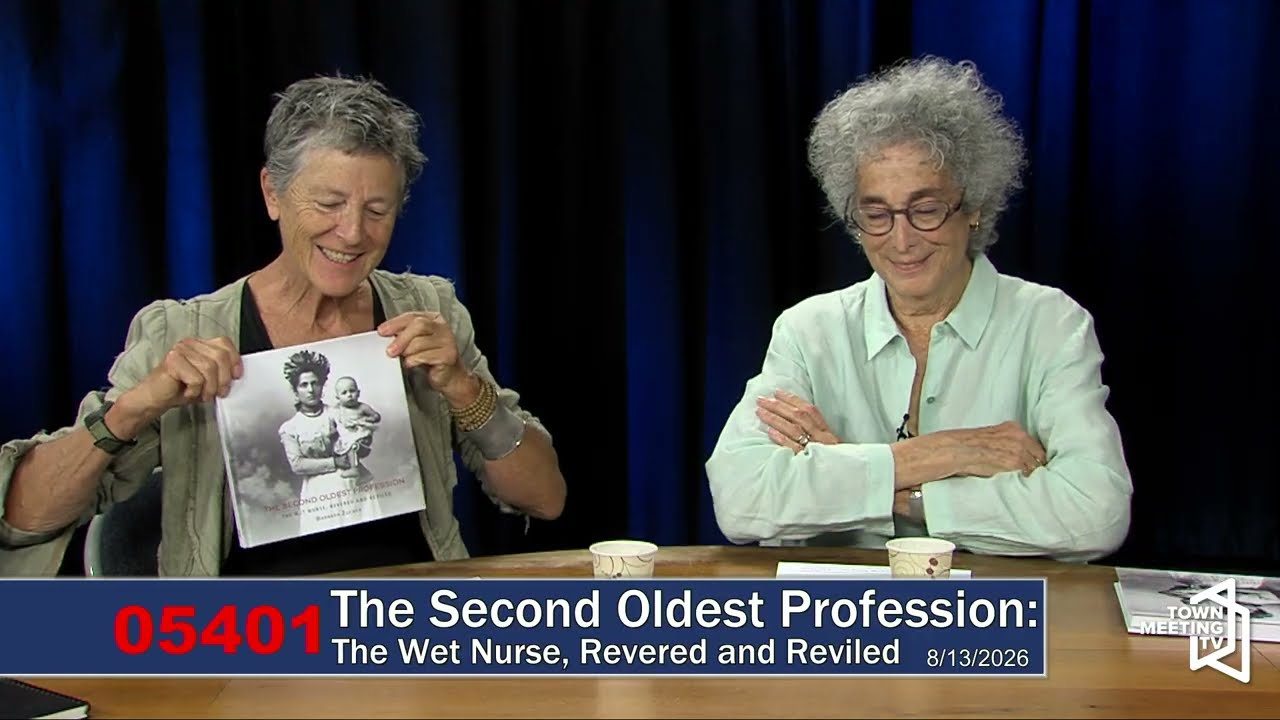
05401 - The Second Oldest Profession: The Wet Nurse, Revered and Reviled
Watch on YouTubeVideo summary
The video features an interview with Barbara Zuker, a sculptor and author who discusses her book titled "The Second Oldest Profession: The Wet Nurse, Revered and Reviled." Zuker explains that she originally did not intend to write the book but found herself compelled by extensive research into wet nursing after creating relevant sculptures. She defines wet nurses as women throughout history who suckled other people's children for pay, a practice dating back at least two thousand years. While often dismissed or misunderstood today, these women were essential figures who kept millions of babies alive until the late 20th century, operating within a complex system that involved brokers and specialized training in certain regions like France during specific historical periods.
The discussion highlights the unique status and rituals surrounding wet nurses, particularly in places like Paris where they wore regional costumes as a sign of high social standing and received gifts such as silver bells for their hair. Zuker notes the stark class divide inherent in this profession: wealthy families would send infants to rural areas or hire foreign women from regions known for superior milk production, often leaving these babies with strangers while the parents remained unaware until it was time to return them. This separation frequently resulted in deep emotional trauma when children were taken back to their biological mothers who had not bonded with them, and sadly, many infants died due to a lack of medical care or proper nutrition during this vulnerable period.
Zuker also explores how society's perception of breastfeeding has shifted dramatically over time, contrasting the historical ubiquity of wet nursing with modern prudish attitudes that often criminalize public feeding. She points out several reasons for the erasure of wet nurses from history, including women entering the workforce after World War II and the development of baby formula which made human milk seem unnecessary to many parents. Furthermore, she addresses the cultural taboo against selling one's own body products like breastmilk compared to blood or hair donations, suggesting that this prejudice stems from a discomfort with female sexuality mixed with maternal duty. The interview concludes by emphasizing Zuker's mission to restore these women to their rightful place in history and acknowledges that while wet nursing may have declined in the West due to economic changes and formula availability, it persists today in developing countries through informal networks of milk sharing among friends or paid arrangements.
Read the full video transcript
Hello. Good morning. Um, my name is
Diane Gayer and um, I'm going to be
interviewing Barbara Zooker and um, but
first I want to say this is part of 0541
program. We're starting to do live
interviews. Manny Leone started 0541
about 30 years ago, which as many of you
know is a journal full of interviews,
writings, poetry, photography, art, um,
by Vermonters, about Vermonters, but
greater than that and urban design and
just everything that we think of in
terms of coloring how we live within a
cultural context. Um and so in
recognizing that the journal is still
being produced
maybe quarterly maybe annually um we've
started to do some live interviews with
various folks in the same vein as what
the publication looks like and um so to
that um Barbara Zuker is here and she's
a American sculptor an author a feminist
art pioneer who co-founded did AIR
gallery in 1972 in New York. Um she
moved to Vermont when she became chair
of the art department at University of
Vermont. Um and is a professor of art at
UVM. Um the dates were something like
1979 to 2001.
So, a long career in the arts including
articles and now a book, a beautiful
book called
the second oldest profession, the wet
nurse reved and reviled. Sorry about
that. Um, and so I'll let um you say a
few words about the book and then I'll
ask you some questions.
>> There are so many words I could say
about the book.
just that in a sense the book found me.
I never intended to make a book. I had
done I'll tell you about how I got
started later but
>> I made a lot of work that was relevant
sculptures drawings
uh other kinds of works on paper and uh
it did not seem sufficient to whatever I
was after and ultimately I realized that
I had done so much research and I had
traveled and I had done more more sort
of delving in this subject than anything
else I'd ever done and I realized it had
to be a
And so then then my focus shifted and um
that's how that's how I got started.
>> So just even stepping right into the
title, who were the wet nurses? What how
>> Yes. You know, it's funny. If you ask
some people what a wet nurse is, they
really have no idea. They don't know
what they were or what they still may
be. And the wet nurses were were
everywhere. They were throughout
history, at least it's been chartered
for 2,000 years. They were women who
suckled other women's children. So
>> for pay.
>> Well, yes. Yes. And and I mean,
incidentally, there still is tandem wet
nursing where a good friend who also has
milk has a baby, they might share it.
They might give another child suck. But
yes, so second oldest profession to
guess what the prostitute. And so this
it the profession has never been
respected.
>> Well, I shouldn't say that has
alternately been respected and hated and
is considered I don't know bad, vile,
um, inappropriate, wrong. So I would say
that about prostitution as well as the
wet nurse, they're necessary. And in
fact, wet nurses, women who gave stuff
to other women's children, kept millions
and millions and millions of babies
alive throughout history until the 20th
century, until
the late 20th century because even in
the 40s there were wet nurses
>> in United States. So backing up just a
little bit, I think in reading the book,
even in Egypt, we have drawings, freezes
that showed absolutely the suckling of
babies or Yeah. Um
[cough and clears throat]
and so it goes throughout deep time,
deep history. Um but there was also
training, wasn't there? Training the the
the nurses,
>> yes,
>> had a whole Now I'm jumping centuries
probably.
>> Go ahead. Um but at some point in um
was it the Middle Ages or or more recent
18 19th century that there were training
schools for the nursing?
>> No.
>> Because all you really had to do was
whip out a breast with a nipple on it.
>> Oh, but there was no training. Okay.
>> There were brokers. There were wet nurse
brokers like it was a business, you
know, and uh some men and some women had
>> homes, houses, and wet nurses either
live there until they found employment
or they were there for the day. So, they
were they were brokered. So, there
there's some images in the book of women
hanging out who had given birth
>> recently or had wet nursed someone
else's baby recently. And incidentally,
once you had given birth, once you had
milk, you could have it throughout your
productive years. You could you could be
a milk fountain for a very long time. So
anyway, there were brokers uh and there
were places where uh mostly husbands
>> could go to find the right witness. And
and I think you talk about in the the
tests that they ran. Yes. The testing
and the
>> squirting and the Yes.
[laughter]
>> So so I thought speak briefly about the
squirting.
>> I mean because that leads to one of your
sculptures.
>> Yeah. Yeah. So when when the husbands
big surprise when the husbands would
come to choose the proper wet nurse for
their child, one of the things that
women did, I don't know if they did this
everywhere, but they certainly did do it
in France, they would squirt their milk.
>> They would squirt it as far as they
could. And usually the woman who
squirted farther, farthest got the job.
And you know, I mean, kind of like also
in the book there's a, you know, the
pissing putty, the little sculptures of
little boys peeing. And so this kind of
gave gave equality to women because they
could make the same arc with something
productive.
>> So there's a a Yes. There a sculpture
that you made.
>> Yes, it is. It's called milk fountain.
And if you can't tell, it's a boob.
There's a breast
>> with milk splashing out.
>> Milk splashing out. Yes.
>> Yeah.
>> Yes.
>> It's extraordinary. It's It's about two
feet.
>> Three
>> three
>> three three-ish a little over that.
>> But
>> yes.
>> Um
but so for me it it fits with and I
guess I thought it was that they came
out of schools like nannies were trained
in schools. Um but you have a an image
of a woman in a costume with epilelettes
and all sorts of um
>> You mean that one?
>> Yes.
>> Yes. So that's an interesting subject.
Um if a wet nurse was hired from a
specific area, France, Italy, wherever,
they often had regional costumes and
they were dem it was demanded that they
wear them because it was considered a
kind of sign of status. It was status.
Um they also got certain rewards. So in
that image that you saw,
>> there were these big silver balls that
went into their hair. was a gift that
they got after a certain amount of
service
>> and
>> if they didn't have a regional costume
or even if they did in France in Paris
they were sent to the bul mare which is
fancy fancy department store that has
existed for hundreds of years and their
affluent employers would buy them an
entire set of clothing
>> for winter for summer for spring and
they were these elegant women who were
giving milk to their infant and they
were paraded around you know and it's
kind of an analogy that I made was they
were like the best chev if they came
from France in a certain area called the
morva and if you got a wet nurse from
the moran you had scored like you had
the best cheese in the world you know
that's the analogy I would make
>> anyway
>> it was also an era where people were in
in Paris um France maybe more in general
>> you were supposed to wear the clothes of
your status You were identified in the
street by what you wore and you were
supposed you could get stopped by the
police if you weren't wearing your
appropriate dress. Yeah.
So, so that to me fit in that hierarchy
piece of it. And I think there's a lot
of hierarchy in all of this
>> of like who can afford a wet nurse.
>> Absolutely. Well, well, that's
>> And didn't they have children at home?
>> Yes. So one of the questions that people
have asked me often is what happened to
these women's babies
>> because first they had to give birth in
order to earn the money to be a witness
and there were many things that
happened. Uh, one thing would be the
baby is left left with the parent and
maybe you know the grandmother or
something and maybe there's a f maybe
there's a relative maybe there is maybe
the baby will be given milk and maybe
not and if not they were given maybe pap
which was not really nutritious and a
lot of infants died some did not you
know but the child was abandoned and or
>> the infant of an affluent family could
be sent away to the wet nurse to the wet
nurs's family in the country somewhere.
Get this, they'd never seen this place.
They didn't know what it looked like.
They would send their infant off to be
suckled for over a year. Some of them
died, some of them didn't. But the
infant would love the person who was
giving them milk. And the wet nurse
often loved the baby. And so then after
a year there was this wrenching sorrow
because the child was whipped away
>> from from the person to whom he she was
attached
>> to go back to his mother
>> her mother
>> and to no longer be nursed
>> and some of them died. Some of them more
of them died if they were in the country
because the mother and father could
never see what was going on and they
were getting paid. Fewer died but
infants did die. you know, there were no
medication, no nothing. So,
it's it's kind of
>> and it was a rural urban divide, too, as
well as a class divide in all this mix.
>> Yes.
>> Yeah.
>> Yes.
>> I know. when I saw
I accidentally found this
subject
>> because I was reading I was reading a
book of essays um by a woman I respected
a woman the late Linda Nland who was a
critic and there was a picture which you
probably know of a Berth Maurico who was
an impressionist who's now very hot who
wasn't considered so hot then anyway
painting of a a little kid on the lap of
a woman and It turns out that the little
kid was her little kid and the woman was
in fact a wet nurse and she was painting
the wet nurse. She had hired to feed her
baby.
>> Yeah.
>> And that was just that was it like what
you know what's that? And um
>> so that triggered a whole lot.
>> It triggered the whole thing.
>> Yeah. So, people have asked me, well,
how did you get interested in this and
how did you write a book and blabby
blabby and what I've also said is that
if you're an artist and you get an idea
>> and you have to have the courage to
follow out that idea,
>> it sort of leads you to what medium
you're going to use. And so, to me, this
was in effect another medium, another
way to get at what I was looking for,
what I wanted to say.
>> Well, it's a whole creative story. It's
a whole creative evolving and how long
did it take you?
>> You ready?
>> Yes.
>> This is embarrassing.
>> No, we know this stuff.
>> It took me to a long time five years to
do this. But you have to realize I had
no idea I was making a book, right? I
was making
process along the way.
>> Making drawings. I was making things
that went in the wild. I was making
research. I was going to France. I was
going to Italy. And I thought, what is
this, right?
>> What are you really doing?
And the box in Italy. Oh,
>> you mean the archives? Yeah.
>> Oh, so before the internet, remember
that did exist that time. Before the
internet, before you could look up
anything,
>> you almost had to go somewhere to see
it. And I I uh I found archives at the I
think it's archive Alinari. It's no I
think Fatellia Alionari in Rome and you
would sit there and you'd make a
request. You had to prove you were
either an artist or you were a scholar
or whatever. They put a big box in front
of you and you could just go through the
box and you could look at all the
photographs and all the information. And
incidentally, that was also true at the
New York Public Library.
>> Yeah.
>> I would go to the New York Public
Library maybe three times, sit down,
they bring you a box
and you could finger everything. You
look at all the photographs, you look at
all this stuff and a lot of the images
put them out on the table. Yeah.
>> A lot of the images from the New York
Public Library images I either took a
picture of or I was able to get. Aliari
I had to buy them initially for my
inspirational work. But then once it
became serious then the publisher had to
purchase them.
>> Do we have a photo of one of the from
that box from that archive?
>> Yes. the woman whom you just whom we
just saw at that fantastic that
extraordinary outfit
>> and the bells and the silver bells.
>> Oh, also um
>> Oh, so this photo, what's this photo?
>> So, this is a famous a very famous
photographer. I don't know if I'm
pronouncing his name correctly, Nadar.
And I am still not sure from the title
whether this was his baby or not. It was
unclear. But it's but it is a famous
Nadar photo. A rare one apparently.
>> It's quite posed. So in in a studio.
>> Yes, it is. It is a studio photo.
>> So I mean there you have it. And
absolutely I would say shameless.
>> You know the thing about it is that wet
nursing was so common that you know
people just did it. Whereas now, if one
is
>> feeding one's infant,
>> you're asked
>> to you're not in you're not welcome to
just whip it out. You have to go to one
of those little aluminum things and you
know do it privately
private. Yeah. But there was I don't
know maybe 10 years ago somebody on an
airline was arrested
>> taken off the airplane because she
nursing
>> nursed her child. We have a very prudish
attitude,
>> i.e. puritanical. Yes. Yes. Attitude.
Right.
>> But it's not just babies who've been
nursed.
>> No, it isn't.
>> Right. I mean,
>> because you have a whole section on
that.
>> Yes. Yes. Well, um, adults were nursed
uh if they were ill
>> uh or perverted. And um there's
something called interspecies feeding in
which uh a woman might feed a baby bear
for example. There's an American woman
in the early 20th century. I forget
where she lived. There's a photo in the
book.
>> I thought it was in Maine, but yeah.
>> Maine in the country, right? And there's
a photograph of her. Her infant is on
one breast. The little baby bear is on
another breast. and she wrote a small
note about how proud she was of being
able to nurse both. And I think she gave
the bear a name. I'm not sure,
>> but there is an image that you'll see in
a while.
>> There it is of a woman, I think it's in
Peru, where she's nursing a baby lamb.
And um also sometimes a woman had too
much milk
>> and so she might nurse
>> extra
>> something.
>> Yeah. another animal. This was not, you
know, and this was not unusual.
>> Uh, one incident that's in the book is
the fact that a goat, a goat was the
animal that's the closest to the
substance that an a mother, a human has.
And so if a mother died
>> sometimes or didn't want a nurse, the
goat would be a standin. And there is
there is a small bit in the book about
uh
>> the orphanage.
>> No. Okay.
>> A particular goat
was feeding a particular child and the
goat fed this child and one day another
goat came and the child refused the goat
and the child most probably died.
>> Wow. And the goats also if they were
nursing in an orphanage, which they did
if there weren't enough women who who
women wet nurses,
>> the get the the goat knew its baby.
Yeah.
>> And the goat would tried in and position
itself and the baby would be held up and
the baby would be drinking milk from his
or her personal goat.
>> Yeah. I mean, that's amazing. the the
relationship to animals that that we
know is strong, but but it's so visceral
in this case. I mean, it's
>> well, it's a sculpture, you know, like
Romulus and Remis. No big deal. Oh,
look. Right.
>> Very famous bronze sculpture that I
think most people know and uh it's
actually by two different artists. So,
there's a there's a a sculpture of of a
>> founding story of of Rome. Really?
>> Yes. Yeah.
>> And these little babies or are sucking
milk from the teeth of this wolf.
>> And I think we've taken that sculpture
for granted. We've never really looked
at it, right? We've never looked at the
implications of that sculpture.
>> Well, because I so I loved reading about
it and understanding that sculpture much
more. As a child, when I went to Rome
and I brought an astray back to my
mother of Romulus and Remis and the
wolf, my mother was horrified. She re
she was like, "Oh my god, this is
horrifying." And she quickly put it in a
drawer, got rid of it. So So you know
there is it's very interesting. So you
know, however many decades later to
really understand the whole mythology
around that is pretty important.
>> Yes.
>> Yes, it is.
>> Wow.
>> Um I want to just throw in something
Diane before you ask me something again.
I wanted to tell you who St. Katherine
is initially
many months ago um I was supposed to do
an event on February 5th which didn't
happen and the reason is because St.
Katherine was is and was the patroness
of breastfeeding.
>> Um she was a teenager. She
loved God. She found God. She was a a a
devout Christian and some big monkey
monk in her town wanted her to be his
lover girlfriend.
>> Okay.
>> And so uh he tried and she was married
to Christ and refused and ultimately he
had her breast removed
>> and she is the patron saint of
breastfeeding and breast cancer in fact
>> and became canonized and became a saint.
She's canonized and there's a place
somewhere in Italy, I think in Sicily,
there's a wall and the the wall has been
sculpted and it's a boob wall that's
dedicated to her. I I recently saw a
picture of that.
>> Wow.
>> So,
>> but there's some contemporary artists
who are working with this as well.
>> I'm sure.
>> Okay. I'm sure
>> I think of well I can't come up with
>> I have a question for I mean for you I
assume we still have time
>> and maybe a question for anybody who's
watching like
>> why do you think that almost no one
knows what a wet nurse is? Why has she
been erased from history? Why don't
people understand how incredibly
important she was as a being to keep
millions of people alive and yet people
are turned off by it? Have not
acknowledged her presence.
Why is that? What is that about? I still
don't get it.
>> So when let's see, you did a
presentation at the firehouse
under BCA. I did
>> and and raised a version of that
question and so we at home have been
talking about it
>> and and a couple pieces I don't think
it's the answer but a couple thoughts
have come into it. One is post World War
II or during World War II, women went
into the workforce
and they started getting paid for
working in the economic structure of the
industrial changing economy. Um so to go
back to sort of dis domestic work if we
can call it this that for the moment I
don't think that there was an the the
world world was modernizing and people
were getting paid jobs in a very
different way and I think that broke
some of it um women weren't available as
as nursemaids in the same way as they
had been previous to World War II and I
think that's true both in the US and in
Europe um because the
number of of well the poverty in in in
Europe was more extreme after World War
II. Um so there was a lot more available
domestic help for a while but not for
very long. So I think that cut the
habit.
>> Well I'm not really that wasn't really
my question but but actually
>> what did happen was because of the war
women were not able to travel. Mhm.
>> What nurses were not able to travel and
and be paid and so it ended.
>> Uh also
um formula had been developed. Nestle
had developed formula and now you didn't
need to have anyone. You didn't need a
wet nurse and you didn't need to feed
your child yourself,
>> right?
>> You had formula and that was like the
magic answer for a long time until that
too had been reversed and now we know
how good breast milk is and how bad, you
know, etc., etc. and and people babies
are more and more allergic. I just
learned, you know, from a recent story
of a particular baby that I'm a familiar
with and came off mother's milk came off
formula 1 2 3 and finally was okay on
formula 4 at the expense of all the
others. So I don't know how this
sensitivity stuff is is sort of
unfolding.
>> So that has that's recent. Yeah,
>> there are incidentally
>> in the last year. Yeah.
>> Oh,
>> yeah.
>> There are milk banks.
>> There are in the United States and in
Europe where women some women donate
their milk and some women I think pay um
are paid and and one of the things
>> so you can go to the cooler like
>> hey yeah you want some milk a little bag
of milk
>> right
>> baggy milk baggie
>> right milk bank. So I think part of it
seems to be that you can get paid for
all kinds of work,
>> but to be paid for something that comes
from your body except you can give
blood,
>> right?
>> For free.
>> Yes. For free.
>> Yeah.
>> Unless Yes. [snorts]
Um anyway, trying to sell your milk from
your breast is considered
>> inappropriate,
>> trashy,
>> wrong.
>> Oh well, without getting into all the
rest of the things of our body that we
can sell, it's interesting that this is
not
>> it's the one thing
>> you can sell your hair.
>> You can also donate it. I'm just saying,
you know, think about it. Yeah.
>> So really I mean I guess I'm kind of
back to my question which is why is this
profession
which is which it was ubiquitous in the
entire world
>> this is a major profession right
there are doctors
dentists you know photographers
I don't know other kind of steel workers
ers
minors. We know about those professions.
I mean, we know about them historically.
Why don't we know about the wet ners?
This is still something that that I I
don't understand. And I can only think
that it's a prejudice
>> about women who are supposed to be,
which I've written, sexy. You can wear a
fancy dress and show your boobs, not the
nips. You can show your boobs, but if
you're really also at the same time, if
you simultaneously
are giving suck to a baby, well, that's
just not cool. It's inappropriate.
Somehow,
>> we used to hide pregnancy and then
>> we did
>> and then and then Hollywood sort of
said, "Oh, it's okay." Or some
>> and now you can show that you're
pregnant and have close fitting clothes.
not only close fitting
>> but now there's something
I don't know
>> astonishing
>> it's
>> so
>> it's a world that's maybe always beyond
understanding but when you look at the
breadth of of how long women have been
feeding babies and it's such a natural
thing
>> forever
>> forever or else we wouldn't be here
>> correct
>> um
>> we wouldn't
I know.
>> Yeah. There's a disconnect and it's okay
in another culture. It's not okay in our
culture.
>> Oh, I wanted to say that it is still
thought that in developing countries wet
nursing persists.
>> Um, you can't I can't say for sure
because my my book stopped short there,
but I don't think I don't think it's
ever really ended. And I didn't say
there was something that I wanted to
bring up which was something called
affluent infant death
>> because some women didn't want you know
wealthy women and their husbands wanted
their women's the breast to stay the
same.
>> They didn't and they wanted to party
down. They couldn't party. So, so um
stuff stuff that happened was the the
kid would only be having some kind of
substitute or or and and they died.
>> Yeah,
>> they died.
>> Well, there's no bonding
familiar.
>> There's an image that came up just now
that I wanted to talk about briefly uh
which is a very important.
>> Oh, there's this one here.
>> Yes. Which are very important. Um,
slaves nursed white babies.
Uh, slaves were nursed white babies even
at the expense of their own. I mean,
they had to have their baby. And so, it
was yet another way
>> in which they were hugely exploited.
>> Um, and and you can tell from that
photograph that baby is perfectly happy,
that little white baby, as relaxed as
any baby could be. This is from um 1873,
I think. And it's just a few not much
not much later than the the war.
>> And uh she's not a slave.
>> Civil War.
>> Yes. Civil War. And she's not a slave,
but she's still doing it.
>> Oh, yeah.
And you know the difference between
nannies and nursemaids and maids and I
mean there's a whole hierarchy there but
the the nursing part of that you know
does taper off but the domestic may stay
within the household or not depending on
what their role is.
>> Yes, there is something called in Italy
there's something called a dry nurse or
a wet nurse
>> a bala auta
>> and I can't remember what the other one
is. So if if a if a wet nurse was
beloved
>> and lived with a family, she could go on
as a kind of governness until the child
child was grown. And
>> my husband has a cousin, Italian cousin.
And what he told me was that his father
used to go every year to visit his wet
nurse.
>> Oh yes.
>> When he was an adult. when he was an
adult, he would go and see her because I
mean, think about it. You see,
>> it's a bonding that's
>> you see what happens when a when a baby
is being nursed. It's like happy time,
right? And it's perfect. It's a perfect
time. And how could if if it's
successful, if the wet nurse is kind,
>> if the wet nurse is loving, how could
you not, right, develop an attachment
>> to to that women? And um incidentally my
husband who is quite old now he was wet
nurse but he doesn't know by whom.
>> And all of his friends had wet nurses.
Every one of them. We're talking the
1930s.
>> Yeah. Yeah.
>> And
>> well a friend of mine my age, so I'm in
my 70s. She didn't have a wet nurse, but
she had a nanny.
And the nannies outlived her parents.
>> And she still bonded.
>> Huh. She still goes to visit her.
>> Huh.
>> Yeah.
>> So, you know, I mean,
>> I I feel like what you know, my my
mission I've never had one before
really, you know, [laughter] I mean, I
guess being an artist is a slightly
selfish profession. I work in my studio.
I want the work to be seen, but it's
mine. And this is kind of the first time
in my life that I have felt so strongly
about something that really these women
should be written back into history. And
it has been my modest effort to make
that happen.
>> So is it translated into Italian or
French?
>> Lancor.
>> Oh, all right. Maybe soon. That would be
nice. I mean, I think it needs
>> an expanded life. I hope so.
>> Yeah. So, where can you get the book?
>> Oh, yes. Well,
if you go if I don't know where you all
are or if you are all, but you can order
it directly [clears throat]
from Abyville Press. Um, you could go to
Phoenix Books in Burlington and beg them
to to offer it again. You could go to
BCA, which is Burlington City Arts. They
[clears throat] had some. I think
they're still selling them. And do I
dare say this out loud? You could order
it on Amazon.
>> No, you can't. You can go to Crow
Bookstore. Top of Church.
>> I forgot. Wait. No. No. I have to go to
Crowbooks because I'm sure they'll be
interested.
>> Yes.
>> Okay.
>> Yes. Good. Thank you.
>> Bye.
>> Thank you all. Thank you all for
watching.
>> Yes. I hope you did.
>> One more 0541 live.